ACC303 Assignment: Corporate Accounting Memo on NAB Consolidation

Verified

Added on  2022/12/14

|5
|1730
|163
Report
AI Summary
This report is a corporate accounting memo prepared for the Board of Directors of National Australian Bank (NAB), analyzing the bank's financial performance and potential consolidation strategies. The memo begins with an overview of NAB's market position, global presence, and key financial figures, including revenue, net earnings, and employee count. It then delves into the concept of consolidated financial statements, emphasizing their importance under the Companies Act 2013. The report examines NAB's corporate governance practices, sustainability initiatives, and employee engagement programs. The core of the memo focuses on the technical factors to consider during consolidation, including share acquisition, debt clearance, and profitability analysis, particularly in the context of potential mergers and acquisitions, such as insurance companies. It highlights the advantages of consolidation for both the holding and subsidiary companies. The analysis includes a review of NAB's subsidiaries and their contributions. The report provides key performance indicators, such as cash return on equity, common equity tier, and statutory net profit, along with a discussion of the bank's performance in the 2018 financial year, identifying areas of strength and weakness. The report concludes with an assessment of NAB's overall performance and its potential for future growth through strategic initiatives. The memo references relevant academic and industry sources to support the analysis.
Document Page
Running head: CORPORATE ACCOUNTING
Corporate Accounting
Name of the student
Name of the University
Author Note
tabler-icon-diamond-filled.svg

Paraphrase This Document

Need a fresh take? Get an instant paraphrase of this document with our AI Paraphraser
Document Page
1CORPORATE ACCOUNTING
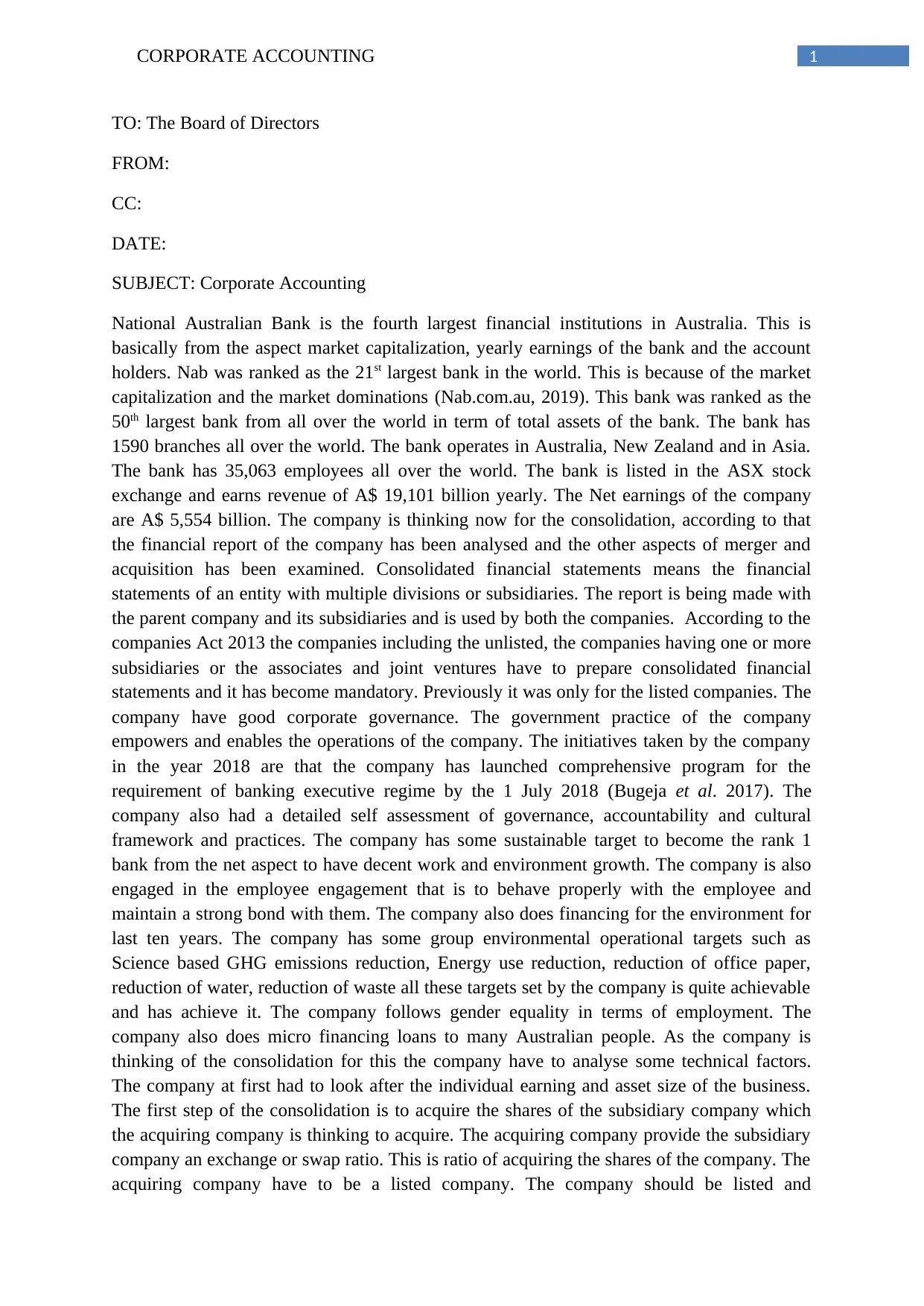
TO: The Board of Directors
FROM:
CC:
DATE:
SUBJECT: Corporate Accounting
National Australian Bank is the fourth largest financial institutions in Australia. This is
basically from the aspect market capitalization, yearly earnings of the bank and the account
holders. Nab was ranked as the 21st largest bank in the world. This is because of the market
capitalization and the market dominations (Nab.com.au, 2019). This bank was ranked as the
50th largest bank from all over the world in term of total assets of the bank. The bank has
1590 branches all over the world. The bank operates in Australia, New Zealand and in Asia.
The bank has 35,063 employees all over the world. The bank is listed in the ASX stock
exchange and earns revenue of A$ 19,101 billion yearly. The Net earnings of the company
are A$ 5,554 billion. The company is thinking now for the consolidation, according to that
the financial report of the company has been analysed and the other aspects of merger and
acquisition has been examined. Consolidated financial statements means the financial
statements of an entity with multiple divisions or subsidiaries. The report is being made with
the parent company and its subsidiaries and is used by both the companies. According to the
companies Act 2013 the companies including the unlisted, the companies having one or more
subsidiaries or the associates and joint ventures have to prepare consolidated financial
statements and it has become mandatory. Previously it was only for the listed companies. The
company have good corporate governance. The government practice of the company
empowers and enables the operations of the company. The initiatives taken by the company
in the year 2018 are that the company has launched comprehensive program for the
requirement of banking executive regime by the 1 July 2018 (Bugeja et al. 2017). The
company also had a detailed self assessment of governance, accountability and cultural
framework and practices. The company has some sustainable target to become the rank 1
bank from the net aspect to have decent work and environment growth. The company is also
engaged in the employee engagement that is to behave properly with the employee and
maintain a strong bond with them. The company also does financing for the environment for
last ten years. The company has some group environmental operational targets such as
Science based GHG emissions reduction, Energy use reduction, reduction of office paper,
reduction of water, reduction of waste all these targets set by the company is quite achievable
and has achieve it. The company follows gender equality in terms of employment. The
company also does micro financing loans to many Australian people. As the company is
thinking of the consolidation for this the company have to analyse some technical factors.
The company at first had to look after the individual earning and asset size of the business.
The first step of the consolidation is to acquire the shares of the subsidiary company which
the acquiring company is thinking to acquire. The acquiring company provide the subsidiary
company an exchange or swap ratio. This is ratio of acquiring the shares of the company. The
acquiring company have to be a listed company. The company should be listed and
Document Page
2CORPORATE ACCOUNTING
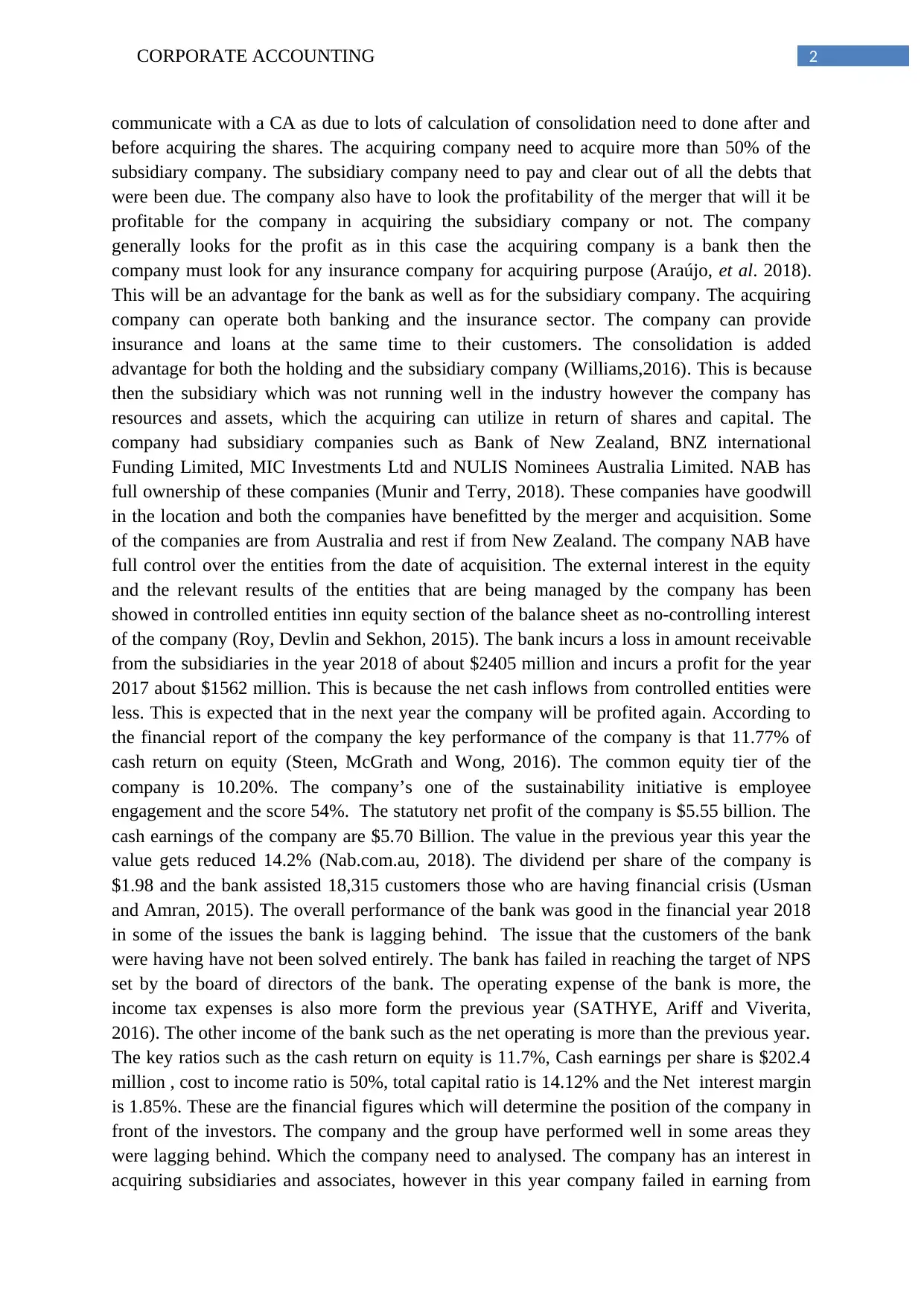
communicate with a CA as due to lots of calculation of consolidation need to done after and
before acquiring the shares. The acquiring company need to acquire more than 50% of the
subsidiary company. The subsidiary company need to pay and clear out of all the debts that
were been due. The company also have to look the profitability of the merger that will it be
profitable for the company in acquiring the subsidiary company or not. The company
generally looks for the profit as in this case the acquiring company is a bank then the
company must look for any insurance company for acquiring purpose (Araújo, et al. 2018).
This will be an advantage for the bank as well as for the subsidiary company. The acquiring
company can operate both banking and the insurance sector. The company can provide
insurance and loans at the same time to their customers. The consolidation is added
advantage for both the holding and the subsidiary company (Williams,2016). This is because
then the subsidiary which was not running well in the industry however the company has
resources and assets, which the acquiring can utilize in return of shares and capital. The
company had subsidiary companies such as Bank of New Zealand, BNZ international
Funding Limited, MIC Investments Ltd and NULIS Nominees Australia Limited. NAB has
full ownership of these companies (Munir and Terry, 2018). These companies have goodwill
in the location and both the companies have benefitted by the merger and acquisition. Some
of the companies are from Australia and rest if from New Zealand. The company NAB have
full control over the entities from the date of acquisition. The external interest in the equity
and the relevant results of the entities that are being managed by the company has been
showed in controlled entities inn equity section of the balance sheet as no-controlling interest
of the company (Roy, Devlin and Sekhon, 2015). The bank incurs a loss in amount receivable
from the subsidiaries in the year 2018 of about $2405 million and incurs a profit for the year
2017 about $1562 million. This is because the net cash inflows from controlled entities were
less. This is expected that in the next year the company will be profited again. According to
the financial report of the company the key performance of the company is that 11.77% of
cash return on equity (Steen, McGrath and Wong, 2016). The common equity tier of the
company is 10.20%. The company’s one of the sustainability initiative is employee
engagement and the score 54%. The statutory net profit of the company is $5.55 billion. The
cash earnings of the company are $5.70 Billion. The value in the previous year this year the
value gets reduced 14.2% (Nab.com.au, 2018). The dividend per share of the company is
$1.98 and the bank assisted 18,315 customers those who are having financial crisis (Usman
and Amran, 2015). The overall performance of the bank was good in the financial year 2018
in some of the issues the bank is lagging behind. The issue that the customers of the bank
were having have not been solved entirely. The bank has failed in reaching the target of NPS
set by the board of directors of the bank. The operating expense of the bank is more, the
income tax expenses is also more form the previous year (SATHYE, Ariff and Viverita,
2016). The other income of the bank such as the net operating is more than the previous year.
The key ratios such as the cash return on equity is 11.7%, Cash earnings per share is $202.4
million , cost to income ratio is 50%, total capital ratio is 14.12% and the Net interest margin
is 1.85%. These are the financial figures which will determine the position of the company in
front of the investors. The company and the group have performed well in some areas they
were lagging behind. Which the company need to analysed. The company has an interest in
acquiring subsidiaries and associates, however in this year company failed in earning from
Document Page
3CORPORATE ACCOUNTING
their also. NAB is a very popular bank and has the power to take them in a better position in
the nearest future.
tabler-icon-diamond-filled.svg

Paraphrase This Document

Need a fresh take? Get an instant paraphrase of this document with our AI Paraphraser
Document Page
4CORPORATE ACCOUNTING
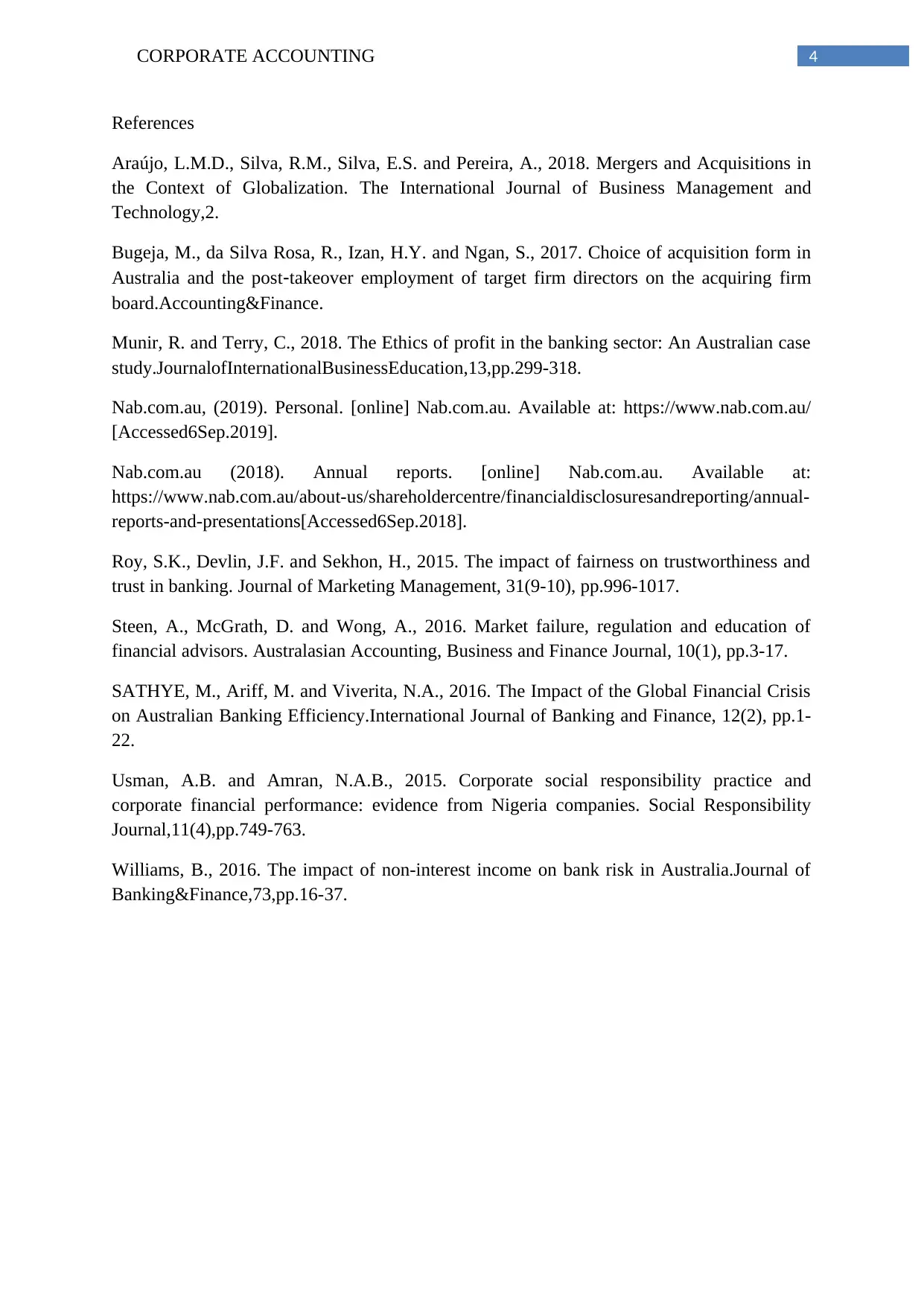
References
Araújo, L.M.D., Silva, R.M., Silva, E.S. and Pereira, A., 2018. Mergers and Acquisitions in
the Context of Globalization. The International Journal of Business Management and
Technology,2.
Bugeja, M., da Silva Rosa, R., Izan, H.Y. and Ngan, S., 2017. Choice of acquisition form in
Australia and the posttakeover employment of target firm directors on the acquiring firm
board.Accounting&Finance.
Munir, R. and Terry, C., 2018. The Ethics of profit in the banking sector: An Australian case
study.JournalofInternationalBusinessEducation,13,pp.299-318.
Nab.com.au, (2019). Personal. [online] Nab.com.au. Available at: https://www.nab.com.au/
[Accessed6Sep.2019].
Nab.com.au (2018). Annual reports. [online] Nab.com.au. Available at:
https://www.nab.com.au/about-us/shareholdercentre/financialdisclosuresandreporting/annual-
reports-and-presentations[Accessed6Sep.2018].
Roy, S.K., Devlin, J.F. and Sekhon, H., 2015. The impact of fairness on trustworthiness and
trust in banking. Journal of Marketing Management, 31(9-10), pp.996-1017.
Steen, A., McGrath, D. and Wong, A., 2016. Market failure, regulation and education of
financial advisors. Australasian Accounting, Business and Finance Journal, 10(1), pp.3-17.
SATHYE, M., Ariff, M. and Viverita, N.A., 2016. The Impact of the Global Financial Crisis
on Australian Banking Efficiency.International Journal of Banking and Finance, 12(2), pp.1-
22.
Usman, A.B. and Amran, N.A.B., 2015. Corporate social responsibility practice and
corporate financial performance: evidence from Nigeria companies. Social Responsibility
Journal,11(4),pp.749-763.
Williams, B., 2016. The impact of non-interest income on bank risk in Australia.Journal of
Banking&Finance,73,pp.16-37.
chevron_up_icon
1 out of 5
circle_padding
hide_on_mobile
zoom_out_icon
[object Object]