NAB's Financial Accounting: An Analysis of Relevance & Comparability
VerifiedAdded on 2023/06/11
|13
|2992
|115
Report
AI Summary
This report evaluates National Australia Bank's (NAB) financial reporting practices, focusing on the qualitative characteristics of relevance and comparability within the conceptual framework. It assesses NAB's adherence to these principles, highlighting strengths in financial information representation and weaknesses in environmental reporting. The report also addresses business combinations and consolidations, providing examples and explanations of pre-acquisition entries, dividend considerations, and goodwill recording. Recommendations are offered to enhance NAB's environmental disclosures and ensure compliance with accounting standards, ultimately aiming to improve the transparency and decision-usefulness of its financial reporting. Desklib offers a platform to access this and many similar solved assignments.
Running head: CORPORATE AND FINANCIAL ACCOUNTING
Corporate and Financial Accounting
Name of the Student:
Name of the University:
Author’s Note:
Course ID:
Corporate and Financial Accounting
Name of the Student:
Name of the University:
Author’s Note:
Course ID:

Paraphrase This Document
Need a fresh take? Get an instant paraphrase of this document with our AI Paraphraser
1CORPORATE AND FINANCIAL ACCOUNTING
Executive Summary:
The current report would focus on evaluation of the two qualitative characteristics of the
conceptual framework, which include relevance and comparability in the context of ASX listed
organisation. Therefore, National Australia Bank (NAB) has been chosen as the organisation for
this report, which is one of the leading banks operating in the financial services industry of
Australia. It has been assessed that National Australia Bank has ensured the two qualitative
characteristics while representing its financial information so that the users could make relevant
decisions. However, deficiency could be observed in its environmental reporting practices for
which adequate recommendations have been provided to improve disclosures. Finally, the report
has provided adequate answers regarding the business combinations and consolidations.
Executive Summary:
The current report would focus on evaluation of the two qualitative characteristics of the
conceptual framework, which include relevance and comparability in the context of ASX listed
organisation. Therefore, National Australia Bank (NAB) has been chosen as the organisation for
this report, which is one of the leading banks operating in the financial services industry of
Australia. It has been assessed that National Australia Bank has ensured the two qualitative
characteristics while representing its financial information so that the users could make relevant
decisions. However, deficiency could be observed in its environmental reporting practices for
which adequate recommendations have been provided to improve disclosures. Finally, the report
has provided adequate answers regarding the business combinations and consolidations.
2CORPORATE AND FINANCIAL ACCOUNTING
Table of Contents
Introduction:....................................................................................................................................3
Part A:..............................................................................................................................................3
Requirement 1a:...........................................................................................................................3
Requirement 1b:...........................................................................................................................4
Requirement 2:.............................................................................................................................5
Requirement 3:.............................................................................................................................6
Part B:..............................................................................................................................................6
Requirement i:.............................................................................................................................6
Requirement ii:............................................................................................................................8
Requirement iii:...........................................................................................................................9
Requirement iv:...........................................................................................................................9
Requirement v:...........................................................................................................................10
Conclusion:....................................................................................................................................10
References:....................................................................................................................................11
Table of Contents
Introduction:....................................................................................................................................3
Part A:..............................................................................................................................................3
Requirement 1a:...........................................................................................................................3
Requirement 1b:...........................................................................................................................4
Requirement 2:.............................................................................................................................5
Requirement 3:.............................................................................................................................6
Part B:..............................................................................................................................................6
Requirement i:.............................................................................................................................6
Requirement ii:............................................................................................................................8
Requirement iii:...........................................................................................................................9
Requirement iv:...........................................................................................................................9
Requirement v:...........................................................................................................................10
Conclusion:....................................................................................................................................10
References:....................................................................................................................................11
⊘ This is a preview!⊘
Do you want full access?
Subscribe today to unlock all pages.

Trusted by 1+ million students worldwide
3CORPORATE AND FINANCIAL ACCOUNTING
Introduction:
The current report would focus on evaluation of the two qualitative characteristics of the
conceptual framework, which include relevance and comparability in the context of ASX listed
organisation. Therefore, National Australia Bank (NAB) has been chosen as the organisation for
this report, which is one of the leading banks operating in the financial services industry of
Australia (Nab.com.au 2018). Moreover, the significance of environmental reporting could not
be ignored, since it is a major factor for the investors to undertake investment decisions.
Moreover, this report contains certain elements that the business organisations need to take into
consideration various accounting regulations in relation to business acquisition as well as
consolidation.
Part A:
Requirement 1a:
The business organisations need to disclose certain financial information, which would
contain all qualitative features for benefitting the investors. The financial statements contain six
qualitative characteristics, out of which two would be discussed in the context of NAB. They are
relevance and comparability.
Relevance:
If the financial information provided is relevant, it has the ability of making difference
for the users to make decisions. For relevancy of the financial statements, the financial
information needs to contain predictive as well as confirmatory value. This would help the users
to seek feedback from the past evaluation when confirmatory value is present (Beatty and Liao
2014). With the help of predictive value, it is possible for the users to gain accurate financial
information about the organisations. Based on the annual report of NAB in 2017, the financial
Introduction:
The current report would focus on evaluation of the two qualitative characteristics of the
conceptual framework, which include relevance and comparability in the context of ASX listed
organisation. Therefore, National Australia Bank (NAB) has been chosen as the organisation for
this report, which is one of the leading banks operating in the financial services industry of
Australia (Nab.com.au 2018). Moreover, the significance of environmental reporting could not
be ignored, since it is a major factor for the investors to undertake investment decisions.
Moreover, this report contains certain elements that the business organisations need to take into
consideration various accounting regulations in relation to business acquisition as well as
consolidation.
Part A:
Requirement 1a:
The business organisations need to disclose certain financial information, which would
contain all qualitative features for benefitting the investors. The financial statements contain six
qualitative characteristics, out of which two would be discussed in the context of NAB. They are
relevance and comparability.
Relevance:
If the financial information provided is relevant, it has the ability of making difference
for the users to make decisions. For relevancy of the financial statements, the financial
information needs to contain predictive as well as confirmatory value. This would help the users
to seek feedback from the past evaluation when confirmatory value is present (Beatty and Liao
2014). With the help of predictive value, it is possible for the users to gain accurate financial
information about the organisations. Based on the annual report of NAB in 2017, the financial
Paraphrase This Document
Need a fresh take? Get an instant paraphrase of this document with our AI Paraphraser
4CORPORATE AND FINANCIAL ACCOUNTING
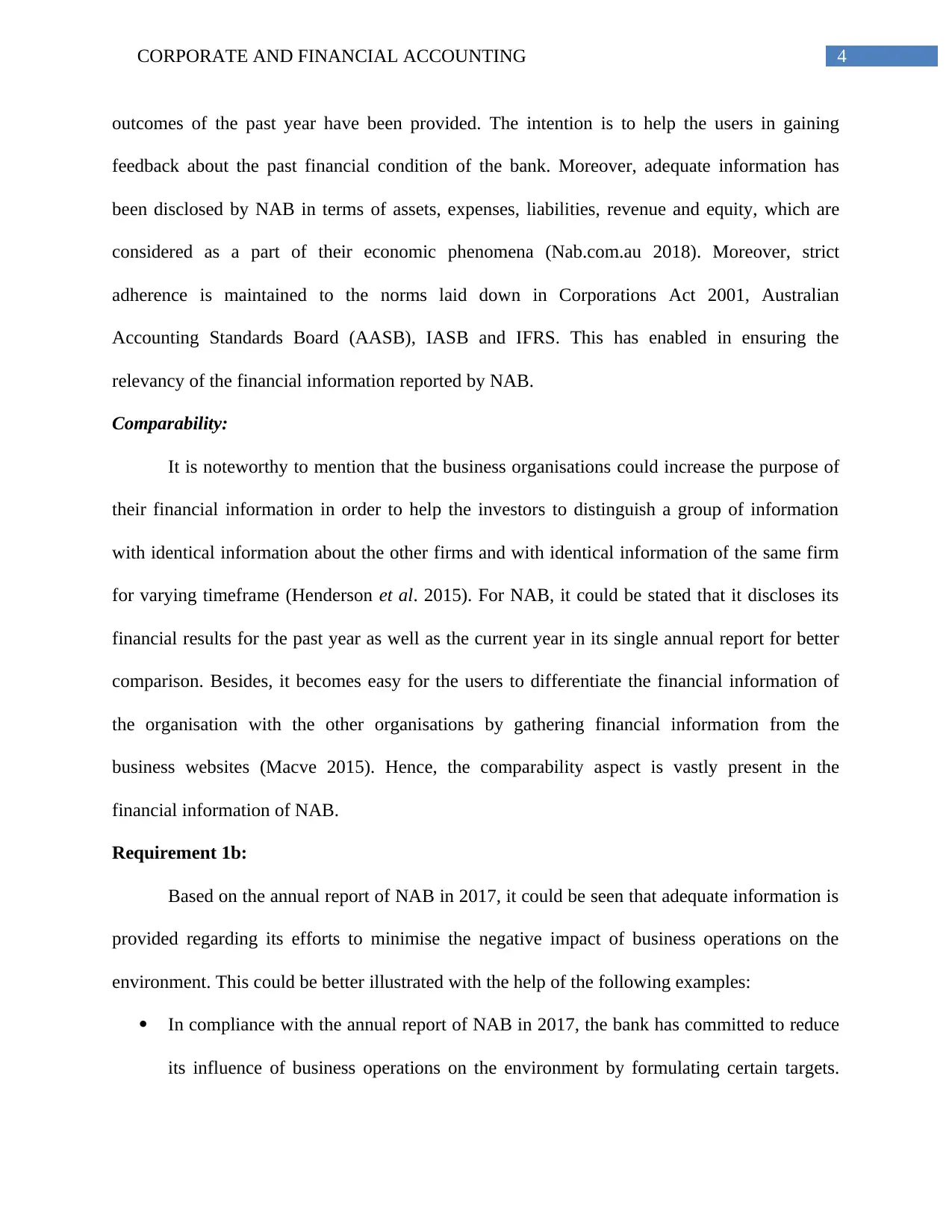
outcomes of the past year have been provided. The intention is to help the users in gaining
feedback about the past financial condition of the bank. Moreover, adequate information has
been disclosed by NAB in terms of assets, expenses, liabilities, revenue and equity, which are
considered as a part of their economic phenomena (Nab.com.au 2018). Moreover, strict
adherence is maintained to the norms laid down in Corporations Act 2001, Australian
Accounting Standards Board (AASB), IASB and IFRS. This has enabled in ensuring the
relevancy of the financial information reported by NAB.
Comparability:
It is noteworthy to mention that the business organisations could increase the purpose of
their financial information in order to help the investors to distinguish a group of information
with identical information about the other firms and with identical information of the same firm
for varying timeframe (Henderson et al. 2015). For NAB, it could be stated that it discloses its
financial results for the past year as well as the current year in its single annual report for better
comparison. Besides, it becomes easy for the users to differentiate the financial information of
the organisation with the other organisations by gathering financial information from the
business websites (Macve 2015). Hence, the comparability aspect is vastly present in the
financial information of NAB.
Requirement 1b:
Based on the annual report of NAB in 2017, it could be seen that adequate information is
provided regarding its efforts to minimise the negative impact of business operations on the
environment. This could be better illustrated with the help of the following examples:
In compliance with the annual report of NAB in 2017, the bank has committed to reduce
its influence of business operations on the environment by formulating certain targets.
outcomes of the past year have been provided. The intention is to help the users in gaining
feedback about the past financial condition of the bank. Moreover, adequate information has
been disclosed by NAB in terms of assets, expenses, liabilities, revenue and equity, which are
considered as a part of their economic phenomena (Nab.com.au 2018). Moreover, strict
adherence is maintained to the norms laid down in Corporations Act 2001, Australian
Accounting Standards Board (AASB), IASB and IFRS. This has enabled in ensuring the
relevancy of the financial information reported by NAB.
Comparability:
It is noteworthy to mention that the business organisations could increase the purpose of
their financial information in order to help the investors to distinguish a group of information
with identical information about the other firms and with identical information of the same firm
for varying timeframe (Henderson et al. 2015). For NAB, it could be stated that it discloses its
financial results for the past year as well as the current year in its single annual report for better
comparison. Besides, it becomes easy for the users to differentiate the financial information of
the organisation with the other organisations by gathering financial information from the
business websites (Macve 2015). Hence, the comparability aspect is vastly present in the
financial information of NAB.
Requirement 1b:
Based on the annual report of NAB in 2017, it could be seen that adequate information is
provided regarding its efforts to minimise the negative impact of business operations on the
environment. This could be better illustrated with the help of the following examples:
In compliance with the annual report of NAB in 2017, the bank has committed to reduce
its influence of business operations on the environment by formulating certain targets.
5CORPORATE AND FINANCIAL ACCOUNTING
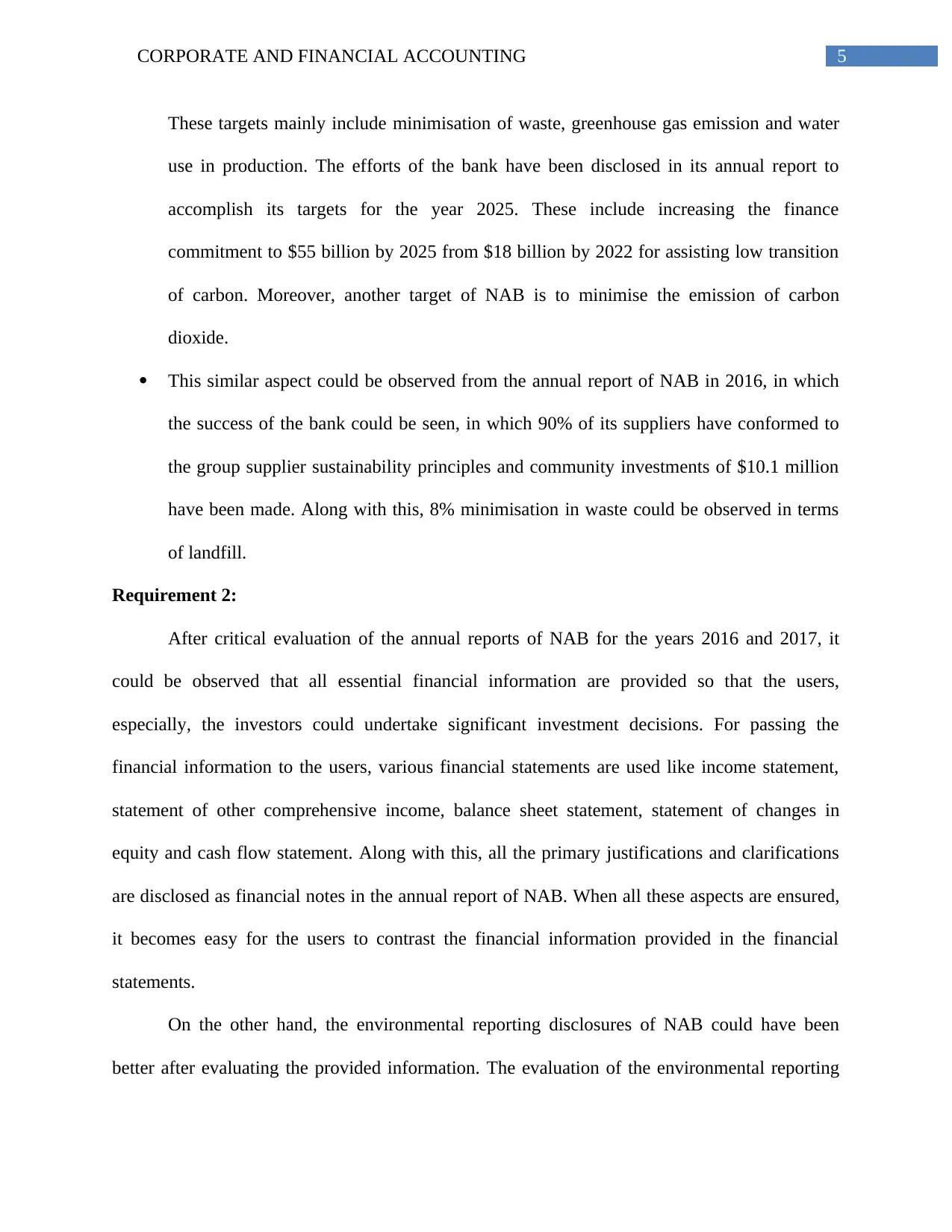
These targets mainly include minimisation of waste, greenhouse gas emission and water
use in production. The efforts of the bank have been disclosed in its annual report to
accomplish its targets for the year 2025. These include increasing the finance
commitment to $55 billion by 2025 from $18 billion by 2022 for assisting low transition
of carbon. Moreover, another target of NAB is to minimise the emission of carbon
dioxide.
This similar aspect could be observed from the annual report of NAB in 2016, in which
the success of the bank could be seen, in which 90% of its suppliers have conformed to
the group supplier sustainability principles and community investments of $10.1 million
have been made. Along with this, 8% minimisation in waste could be observed in terms
of landfill.
Requirement 2:
After critical evaluation of the annual reports of NAB for the years 2016 and 2017, it
could be observed that all essential financial information are provided so that the users,
especially, the investors could undertake significant investment decisions. For passing the
financial information to the users, various financial statements are used like income statement,
statement of other comprehensive income, balance sheet statement, statement of changes in
equity and cash flow statement. Along with this, all the primary justifications and clarifications
are disclosed as financial notes in the annual report of NAB. When all these aspects are ensured,
it becomes easy for the users to contrast the financial information provided in the financial
statements.
On the other hand, the environmental reporting disclosures of NAB could have been
better after evaluating the provided information. The evaluation of the environmental reporting
These targets mainly include minimisation of waste, greenhouse gas emission and water
use in production. The efforts of the bank have been disclosed in its annual report to
accomplish its targets for the year 2025. These include increasing the finance
commitment to $55 billion by 2025 from $18 billion by 2022 for assisting low transition
of carbon. Moreover, another target of NAB is to minimise the emission of carbon
dioxide.
This similar aspect could be observed from the annual report of NAB in 2016, in which
the success of the bank could be seen, in which 90% of its suppliers have conformed to
the group supplier sustainability principles and community investments of $10.1 million
have been made. Along with this, 8% minimisation in waste could be observed in terms
of landfill.
Requirement 2:
After critical evaluation of the annual reports of NAB for the years 2016 and 2017, it
could be observed that all essential financial information are provided so that the users,
especially, the investors could undertake significant investment decisions. For passing the
financial information to the users, various financial statements are used like income statement,
statement of other comprehensive income, balance sheet statement, statement of changes in
equity and cash flow statement. Along with this, all the primary justifications and clarifications
are disclosed as financial notes in the annual report of NAB. When all these aspects are ensured,
it becomes easy for the users to contrast the financial information provided in the financial
statements.
On the other hand, the environmental reporting disclosures of NAB could have been
better after evaluating the provided information. The evaluation of the environmental reporting
⊘ This is a preview!⊘
Do you want full access?
Subscribe today to unlock all pages.
Trusted by 1+ million students worldwide
6CORPORATE AND FINANCIAL ACCOUNTING
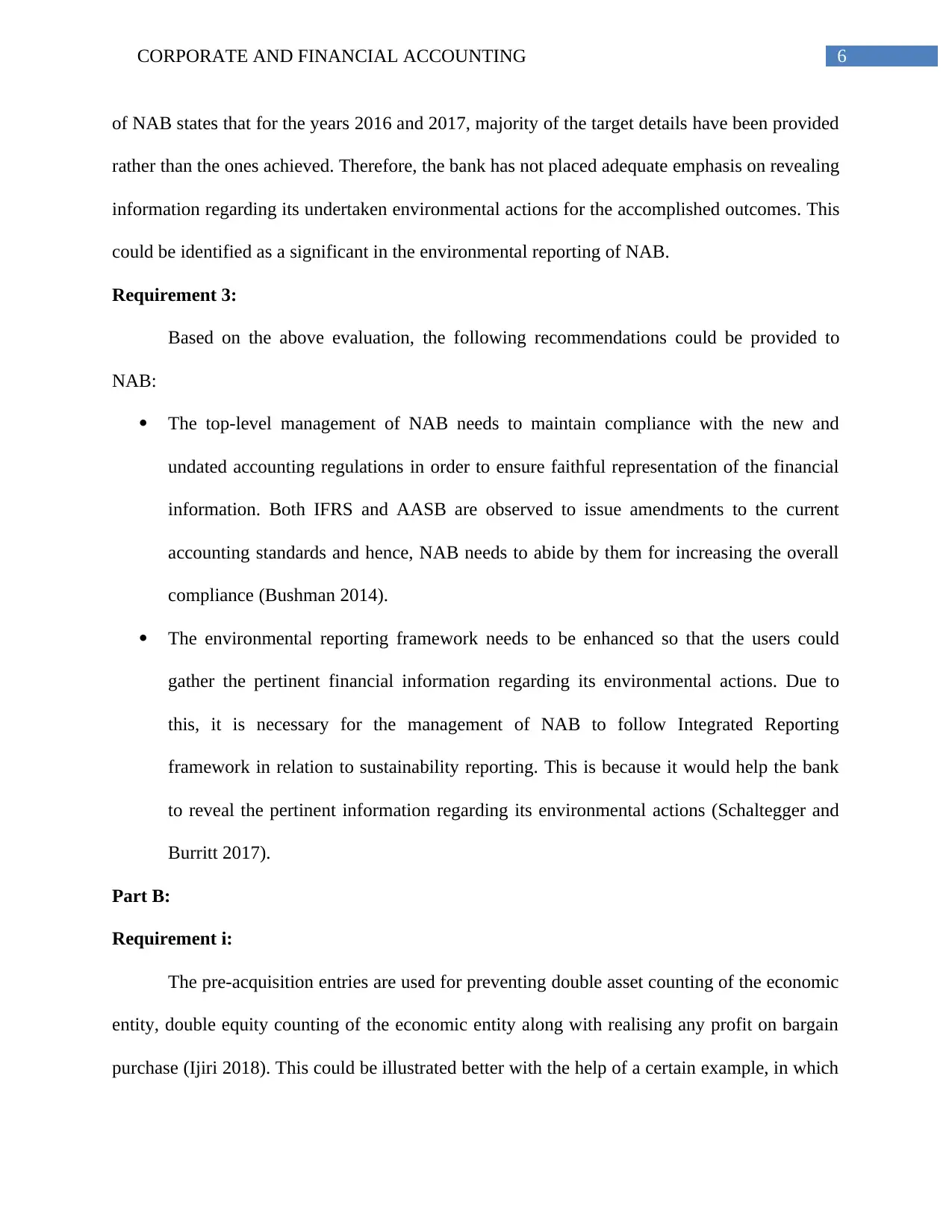
of NAB states that for the years 2016 and 2017, majority of the target details have been provided
rather than the ones achieved. Therefore, the bank has not placed adequate emphasis on revealing
information regarding its undertaken environmental actions for the accomplished outcomes. This
could be identified as a significant in the environmental reporting of NAB.
Requirement 3:
Based on the above evaluation, the following recommendations could be provided to
NAB:
The top-level management of NAB needs to maintain compliance with the new and
undated accounting regulations in order to ensure faithful representation of the financial
information. Both IFRS and AASB are observed to issue amendments to the current
accounting standards and hence, NAB needs to abide by them for increasing the overall
compliance (Bushman 2014).
The environmental reporting framework needs to be enhanced so that the users could
gather the pertinent financial information regarding its environmental actions. Due to
this, it is necessary for the management of NAB to follow Integrated Reporting
framework in relation to sustainability reporting. This is because it would help the bank
to reveal the pertinent information regarding its environmental actions (Schaltegger and
Burritt 2017).
Part B:
Requirement i:
The pre-acquisition entries are used for preventing double asset counting of the economic
entity, double equity counting of the economic entity along with realising any profit on bargain
purchase (Ijiri 2018). This could be illustrated better with the help of a certain example, in which
of NAB states that for the years 2016 and 2017, majority of the target details have been provided
rather than the ones achieved. Therefore, the bank has not placed adequate emphasis on revealing
information regarding its undertaken environmental actions for the accomplished outcomes. This
could be identified as a significant in the environmental reporting of NAB.
Requirement 3:
Based on the above evaluation, the following recommendations could be provided to
NAB:
The top-level management of NAB needs to maintain compliance with the new and
undated accounting regulations in order to ensure faithful representation of the financial
information. Both IFRS and AASB are observed to issue amendments to the current
accounting standards and hence, NAB needs to abide by them for increasing the overall
compliance (Bushman 2014).
The environmental reporting framework needs to be enhanced so that the users could
gather the pertinent financial information regarding its environmental actions. Due to
this, it is necessary for the management of NAB to follow Integrated Reporting
framework in relation to sustainability reporting. This is because it would help the bank
to reveal the pertinent information regarding its environmental actions (Schaltegger and
Burritt 2017).
Part B:
Requirement i:
The pre-acquisition entries are used for preventing double asset counting of the economic
entity, double equity counting of the economic entity along with realising any profit on bargain
purchase (Ijiri 2018). This could be illustrated better with the help of a certain example, in which
Paraphrase This Document
Need a fresh take? Get an instant paraphrase of this document with our AI Paraphraser
7CORPORATE AND FINANCIAL ACCOUNTING
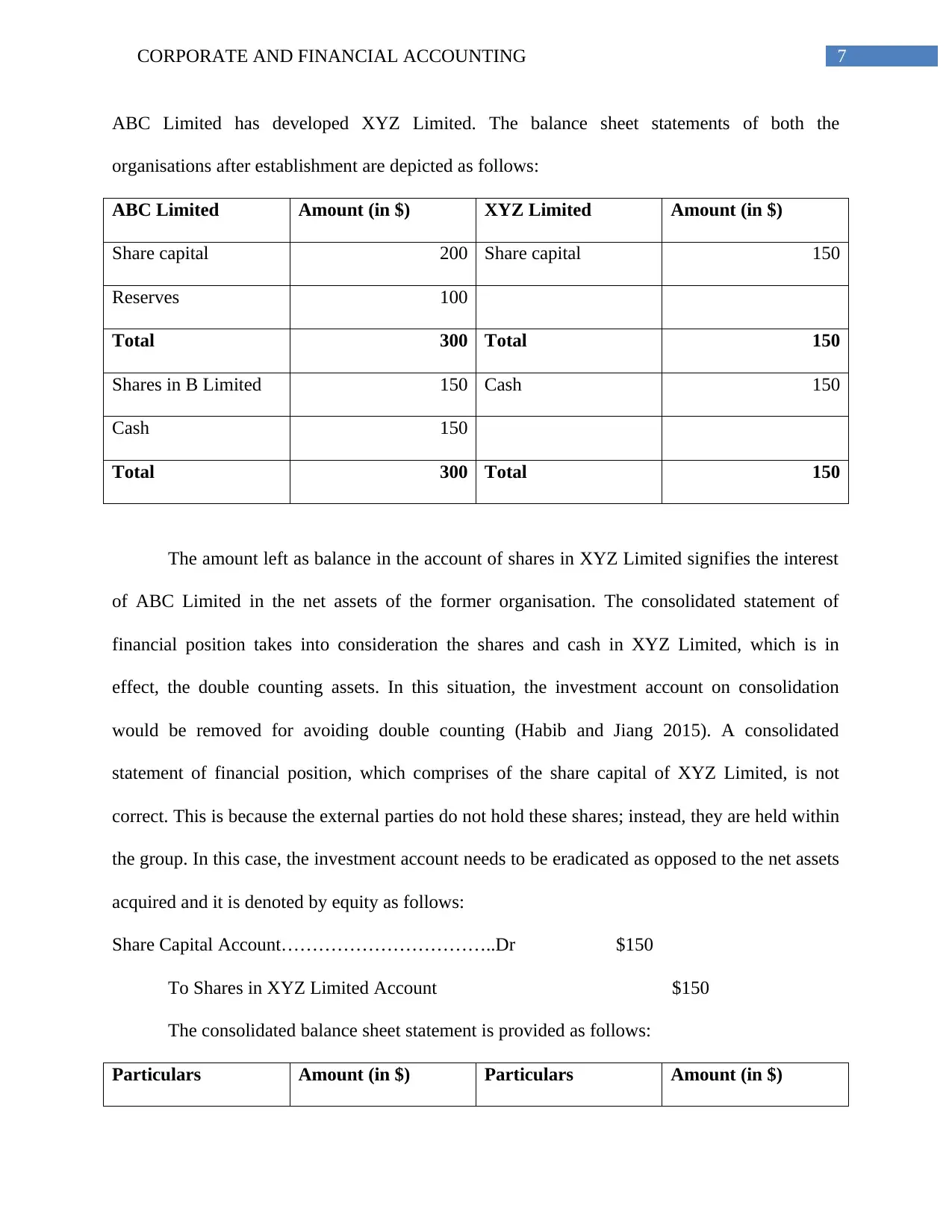
ABC Limited has developed XYZ Limited. The balance sheet statements of both the
organisations after establishment are depicted as follows:
ABC Limited Amount (in $) XYZ Limited Amount (in $)
Share capital 200 Share capital 150
Reserves 100
Total 300 Total 150
Shares in B Limited 150 Cash 150
Cash 150
Total 300 Total 150
The amount left as balance in the account of shares in XYZ Limited signifies the interest
of ABC Limited in the net assets of the former organisation. The consolidated statement of
financial position takes into consideration the shares and cash in XYZ Limited, which is in
effect, the double counting assets. In this situation, the investment account on consolidation
would be removed for avoiding double counting (Habib and Jiang 2015). A consolidated
statement of financial position, which comprises of the share capital of XYZ Limited, is not
correct. This is because the external parties do not hold these shares; instead, they are held within
the group. In this case, the investment account needs to be eradicated as opposed to the net assets
acquired and it is denoted by equity as follows:
Share Capital Account……………………………..Dr $150
To Shares in XYZ Limited Account $150
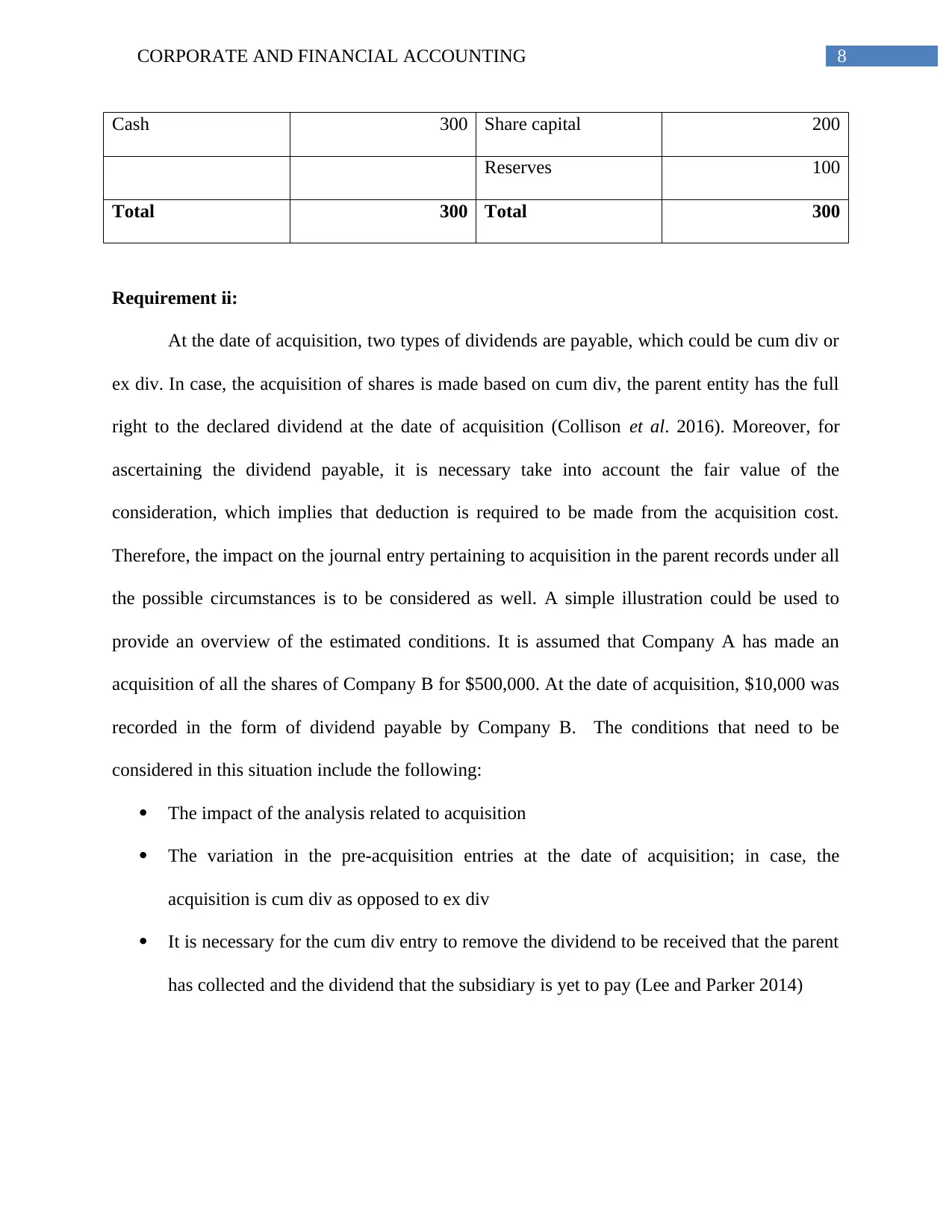
The consolidated balance sheet statement is provided as follows:
Particulars Amount (in $) Particulars Amount (in $)
ABC Limited has developed XYZ Limited. The balance sheet statements of both the
organisations after establishment are depicted as follows:
ABC Limited Amount (in $) XYZ Limited Amount (in $)
Share capital 200 Share capital 150
Reserves 100
Total 300 Total 150
Shares in B Limited 150 Cash 150
Cash 150
Total 300 Total 150
The amount left as balance in the account of shares in XYZ Limited signifies the interest
of ABC Limited in the net assets of the former organisation. The consolidated statement of
financial position takes into consideration the shares and cash in XYZ Limited, which is in
effect, the double counting assets. In this situation, the investment account on consolidation
would be removed for avoiding double counting (Habib and Jiang 2015). A consolidated
statement of financial position, which comprises of the share capital of XYZ Limited, is not
correct. This is because the external parties do not hold these shares; instead, they are held within
the group. In this case, the investment account needs to be eradicated as opposed to the net assets
acquired and it is denoted by equity as follows:
Share Capital Account……………………………..Dr $150
To Shares in XYZ Limited Account $150
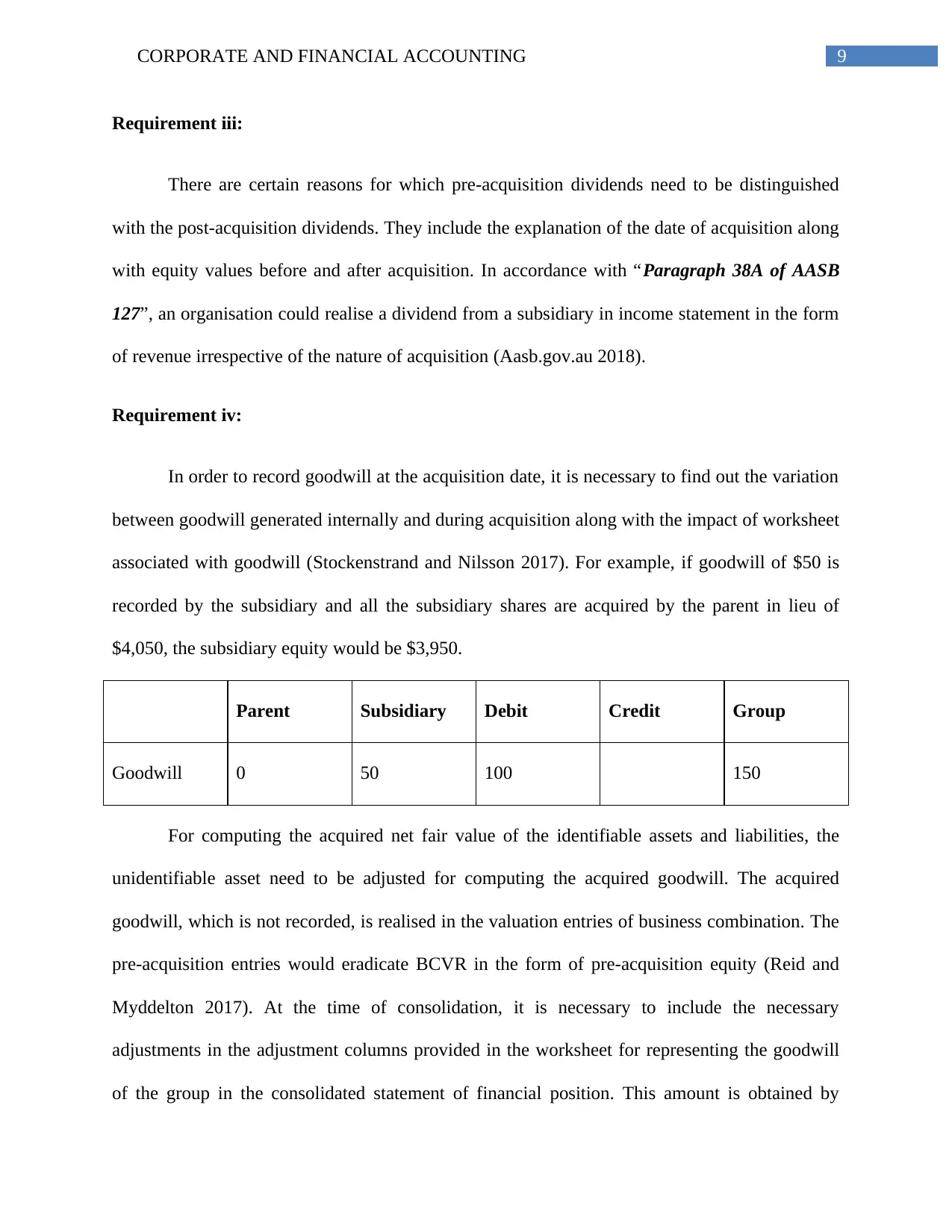
The consolidated balance sheet statement is provided as follows:
Particulars Amount (in $) Particulars Amount (in $)
8CORPORATE AND FINANCIAL ACCOUNTING
Cash 300 Share capital 200
Reserves 100
Total 300 Total 300
Requirement ii:
At the date of acquisition, two types of dividends are payable, which could be cum div or
ex div. In case, the acquisition of shares is made based on cum div, the parent entity has the full
right to the declared dividend at the date of acquisition (Collison et al. 2016). Moreover, for
ascertaining the dividend payable, it is necessary take into account the fair value of the
consideration, which implies that deduction is required to be made from the acquisition cost.
Therefore, the impact on the journal entry pertaining to acquisition in the parent records under all
the possible circumstances is to be considered as well. A simple illustration could be used to
provide an overview of the estimated conditions. It is assumed that Company A has made an
acquisition of all the shares of Company B for $500,000. At the date of acquisition, $10,000 was
recorded in the form of dividend payable by Company B. The conditions that need to be
considered in this situation include the following:
The impact of the analysis related to acquisition
The variation in the pre-acquisition entries at the date of acquisition; in case, the
acquisition is cum div as opposed to ex div
It is necessary for the cum div entry to remove the dividend to be received that the parent
has collected and the dividend that the subsidiary is yet to pay (Lee and Parker 2014)
Cash 300 Share capital 200
Reserves 100
Total 300 Total 300
Requirement ii:
At the date of acquisition, two types of dividends are payable, which could be cum div or
ex div. In case, the acquisition of shares is made based on cum div, the parent entity has the full
right to the declared dividend at the date of acquisition (Collison et al. 2016). Moreover, for
ascertaining the dividend payable, it is necessary take into account the fair value of the
consideration, which implies that deduction is required to be made from the acquisition cost.
Therefore, the impact on the journal entry pertaining to acquisition in the parent records under all
the possible circumstances is to be considered as well. A simple illustration could be used to
provide an overview of the estimated conditions. It is assumed that Company A has made an
acquisition of all the shares of Company B for $500,000. At the date of acquisition, $10,000 was
recorded in the form of dividend payable by Company B. The conditions that need to be
considered in this situation include the following:
The impact of the analysis related to acquisition
The variation in the pre-acquisition entries at the date of acquisition; in case, the
acquisition is cum div as opposed to ex div
It is necessary for the cum div entry to remove the dividend to be received that the parent
has collected and the dividend that the subsidiary is yet to pay (Lee and Parker 2014)
⊘ This is a preview!⊘
Do you want full access?
Subscribe today to unlock all pages.
Trusted by 1+ million students worldwide
9CORPORATE AND FINANCIAL ACCOUNTING
Requirement iii:
There are certain reasons for which pre-acquisition dividends need to be distinguished
with the post-acquisition dividends. They include the explanation of the date of acquisition along
with equity values before and after acquisition. In accordance with “Paragraph 38A of AASB
127”, an organisation could realise a dividend from a subsidiary in income statement in the form
of revenue irrespective of the nature of acquisition (Aasb.gov.au 2018).
Requirement iv:
In order to record goodwill at the acquisition date, it is necessary to find out the variation
between goodwill generated internally and during acquisition along with the impact of worksheet
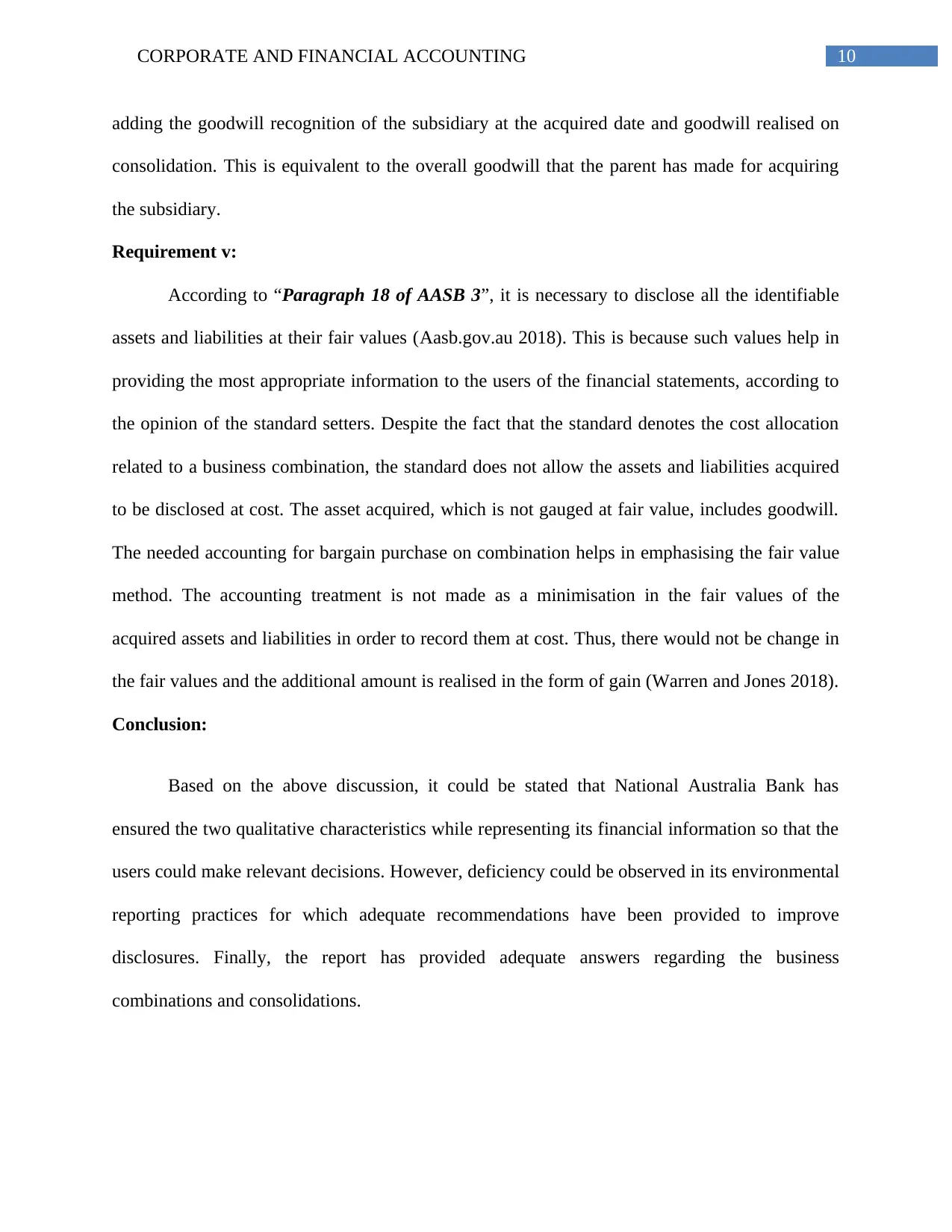
associated with goodwill (Stockenstrand and Nilsson 2017). For example, if goodwill of $50 is
recorded by the subsidiary and all the subsidiary shares are acquired by the parent in lieu of
$4,050, the subsidiary equity would be $3,950.
Parent Subsidiary Debit Credit Group
Goodwill 0 50 100 150
For computing the acquired net fair value of the identifiable assets and liabilities, the
unidentifiable asset need to be adjusted for computing the acquired goodwill. The acquired
goodwill, which is not recorded, is realised in the valuation entries of business combination. The
pre-acquisition entries would eradicate BCVR in the form of pre-acquisition equity (Reid and
Myddelton 2017). At the time of consolidation, it is necessary to include the necessary
adjustments in the adjustment columns provided in the worksheet for representing the goodwill
of the group in the consolidated statement of financial position. This amount is obtained by
Requirement iii:
There are certain reasons for which pre-acquisition dividends need to be distinguished
with the post-acquisition dividends. They include the explanation of the date of acquisition along
with equity values before and after acquisition. In accordance with “Paragraph 38A of AASB
127”, an organisation could realise a dividend from a subsidiary in income statement in the form
of revenue irrespective of the nature of acquisition (Aasb.gov.au 2018).
Requirement iv:
In order to record goodwill at the acquisition date, it is necessary to find out the variation
between goodwill generated internally and during acquisition along with the impact of worksheet
associated with goodwill (Stockenstrand and Nilsson 2017). For example, if goodwill of $50 is
recorded by the subsidiary and all the subsidiary shares are acquired by the parent in lieu of
$4,050, the subsidiary equity would be $3,950.
Parent Subsidiary Debit Credit Group
Goodwill 0 50 100 150
For computing the acquired net fair value of the identifiable assets and liabilities, the
unidentifiable asset need to be adjusted for computing the acquired goodwill. The acquired
goodwill, which is not recorded, is realised in the valuation entries of business combination. The
pre-acquisition entries would eradicate BCVR in the form of pre-acquisition equity (Reid and
Myddelton 2017). At the time of consolidation, it is necessary to include the necessary
adjustments in the adjustment columns provided in the worksheet for representing the goodwill
of the group in the consolidated statement of financial position. This amount is obtained by
Paraphrase This Document
Need a fresh take? Get an instant paraphrase of this document with our AI Paraphraser
10CORPORATE AND FINANCIAL ACCOUNTING
adding the goodwill recognition of the subsidiary at the acquired date and goodwill realised on
consolidation. This is equivalent to the overall goodwill that the parent has made for acquiring
the subsidiary.
Requirement v:
According to “Paragraph 18 of AASB 3”, it is necessary to disclose all the identifiable
assets and liabilities at their fair values (Aasb.gov.au 2018). This is because such values help in
providing the most appropriate information to the users of the financial statements, according to
the opinion of the standard setters. Despite the fact that the standard denotes the cost allocation
related to a business combination, the standard does not allow the assets and liabilities acquired
to be disclosed at cost. The asset acquired, which is not gauged at fair value, includes goodwill.
The needed accounting for bargain purchase on combination helps in emphasising the fair value
method. The accounting treatment is not made as a minimisation in the fair values of the
acquired assets and liabilities in order to record them at cost. Thus, there would not be change in
the fair values and the additional amount is realised in the form of gain (Warren and Jones 2018).
Conclusion:
Based on the above discussion, it could be stated that National Australia Bank has
ensured the two qualitative characteristics while representing its financial information so that the
users could make relevant decisions. However, deficiency could be observed in its environmental
reporting practices for which adequate recommendations have been provided to improve
disclosures. Finally, the report has provided adequate answers regarding the business
combinations and consolidations.
adding the goodwill recognition of the subsidiary at the acquired date and goodwill realised on
consolidation. This is equivalent to the overall goodwill that the parent has made for acquiring
the subsidiary.
Requirement v:
According to “Paragraph 18 of AASB 3”, it is necessary to disclose all the identifiable
assets and liabilities at their fair values (Aasb.gov.au 2018). This is because such values help in
providing the most appropriate information to the users of the financial statements, according to
the opinion of the standard setters. Despite the fact that the standard denotes the cost allocation
related to a business combination, the standard does not allow the assets and liabilities acquired
to be disclosed at cost. The asset acquired, which is not gauged at fair value, includes goodwill.
The needed accounting for bargain purchase on combination helps in emphasising the fair value
method. The accounting treatment is not made as a minimisation in the fair values of the
acquired assets and liabilities in order to record them at cost. Thus, there would not be change in
the fair values and the additional amount is realised in the form of gain (Warren and Jones 2018).
Conclusion:
Based on the above discussion, it could be stated that National Australia Bank has
ensured the two qualitative characteristics while representing its financial information so that the
users could make relevant decisions. However, deficiency could be observed in its environmental
reporting practices for which adequate recommendations have been provided to improve
disclosures. Finally, the report has provided adequate answers regarding the business
combinations and consolidations.
11CORPORATE AND FINANCIAL ACCOUNTING
References:
Aasb.gov.au., 2018. [online] Available at:
http://www.aasb.gov.au/admin/file/content105/c9/AASB127_08-11.pdf [Accessed 30 May
2018].
Aasb.gov.au., 2018. [online] Available at:
http://www.aasb.gov.au/admin/file/content102/c3/AASB3_03-08_ERDRjun10_07-09.pdf
[Accessed 30 May 2018].
Beatty, A. and Liao, S., 2014. Financial accounting in the banking industry: A review of the
empirical literature. Journal of Accounting and Economics, 58(2-3), pp.339-383.
Bushman, R.M., 2014. Thoughts on financial accounting and the banking industry. Journal of
Accounting and Economics, 58(2-3), pp.384-395.
Collison, D., Jansson, A., Larsson-Olaison, U., Power, D.M., Cooper, C., Gray, R., Ferguson, J.,
Sikka, P., Yuval Millo, Y., Jonnergård, K. and Djelic, M.L., 2016. The Modern Corporation
Statement on Accounting.
Habib, A. and Jiang, H., 2015. Journal of International Accounting, Auditing and
Taxation. Journal of International Accounting, Auditing and Taxation, 24, pp.29-45.
Henderson, S., Peirson, G., Herbohn, K. and Howieson, B., 2015. Issues in financial accounting.
Pearson Higher Education AU.
Ijiri, Y., 2018. An Introduction to Corporate Accounting Standards: A Review. Accounting,
Economics, and Law: A Convivium, 8(1).
Lee, T.A. and Parker, R.H. eds., 2014. Evolution of Corporate Financial Reporting (RLE
Accounting). Routledge.
References:
Aasb.gov.au., 2018. [online] Available at:
http://www.aasb.gov.au/admin/file/content105/c9/AASB127_08-11.pdf [Accessed 30 May
2018].
Aasb.gov.au., 2018. [online] Available at:
http://www.aasb.gov.au/admin/file/content102/c3/AASB3_03-08_ERDRjun10_07-09.pdf
[Accessed 30 May 2018].
Beatty, A. and Liao, S., 2014. Financial accounting in the banking industry: A review of the
empirical literature. Journal of Accounting and Economics, 58(2-3), pp.339-383.
Bushman, R.M., 2014. Thoughts on financial accounting and the banking industry. Journal of
Accounting and Economics, 58(2-3), pp.384-395.
Collison, D., Jansson, A., Larsson-Olaison, U., Power, D.M., Cooper, C., Gray, R., Ferguson, J.,
Sikka, P., Yuval Millo, Y., Jonnergård, K. and Djelic, M.L., 2016. The Modern Corporation
Statement on Accounting.
Habib, A. and Jiang, H., 2015. Journal of International Accounting, Auditing and
Taxation. Journal of International Accounting, Auditing and Taxation, 24, pp.29-45.
Henderson, S., Peirson, G., Herbohn, K. and Howieson, B., 2015. Issues in financial accounting.
Pearson Higher Education AU.
Ijiri, Y., 2018. An Introduction to Corporate Accounting Standards: A Review. Accounting,
Economics, and Law: A Convivium, 8(1).
Lee, T.A. and Parker, R.H. eds., 2014. Evolution of Corporate Financial Reporting (RLE
Accounting). Routledge.
⊘ This is a preview!⊘
Do you want full access?
Subscribe today to unlock all pages.
Trusted by 1+ million students worldwide

1 out of 13


Related Documents


Your All-in-One AI-Powered Toolkit for Academic Success.
+13062052269
info@desklib.com
Available 24*7 on WhatsApp / Email
![[object Object]](/_next/static/media/star-bottom.7253800d.svg)
Unlock your academic potential
Copyright © 2020–2026 A2Z Services. All Rights Reserved. Developed and managed by ZUCOL.