Sociological Analysis: The Cold War's Role in NASA's Formation
VerifiedAdded on 2023/04/25
|6
|945
|93
Annotated Bibliography
AI Summary
This assignment delves into the sociological origins of NASA, emphasizing the profound influence of the Cold War. It examines the political, economic, and cultural tensions between the United States and the USSR, particularly the Space Race triggered by the Soviet Union's launch of Sputnik 1. The research question focuses on what led to the establishment of NASA, highlighting the US's desire to maintain dominance in space exploration. The annotated bibliography includes sources from NASA's official website and academic articles that provide insights into the political context, public opinion, and technological advancements that shaped NASA's formation and its role in the international space arena. This assignment showcases how the Cold War served as a catalyst for the creation of a major space agency.
Running head: SOCIOLOGY
SOCIOLOGY
Name of the student
Name of the university
Author note
SOCIOLOGY
Name of the student
Name of the university
Author note
Paraphrase This Document
Need a fresh take? Get an instant paraphrase of this document with our AI Paraphraser

1
SOCIOLOGY
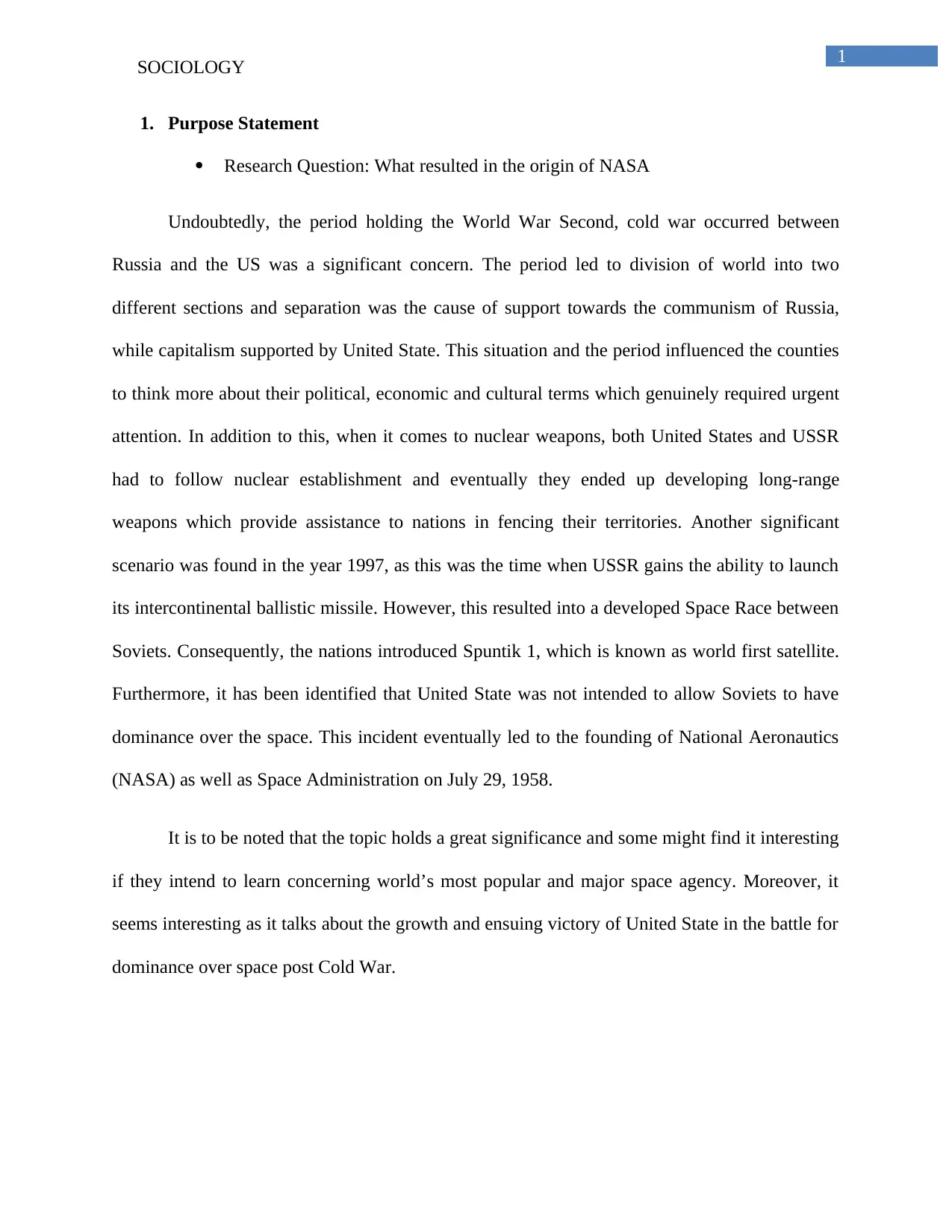
1. Purpose Statement
Research Question: What resulted in the origin of NASA
Undoubtedly, the period holding the World War Second, cold war occurred between
Russia and the US was a significant concern. The period led to division of world into two
different sections and separation was the cause of support towards the communism of Russia,
while capitalism supported by United State. This situation and the period influenced the counties
to think more about their political, economic and cultural terms which genuinely required urgent
attention. In addition to this, when it comes to nuclear weapons, both United States and USSR
had to follow nuclear establishment and eventually they ended up developing long-range
weapons which provide assistance to nations in fencing their territories. Another significant
scenario was found in the year 1997, as this was the time when USSR gains the ability to launch
its intercontinental ballistic missile. However, this resulted into a developed Space Race between
Soviets. Consequently, the nations introduced Spuntik 1, which is known as world first satellite.
Furthermore, it has been identified that United State was not intended to allow Soviets to have
dominance over the space. This incident eventually led to the founding of National Aeronautics
(NASA) as well as Space Administration on July 29, 1958.
It is to be noted that the topic holds a great significance and some might find it interesting
if they intend to learn concerning world’s most popular and major space agency. Moreover, it
seems interesting as it talks about the growth and ensuing victory of United State in the battle for
dominance over space post Cold War.
SOCIOLOGY
1. Purpose Statement
Research Question: What resulted in the origin of NASA
Undoubtedly, the period holding the World War Second, cold war occurred between
Russia and the US was a significant concern. The period led to division of world into two
different sections and separation was the cause of support towards the communism of Russia,
while capitalism supported by United State. This situation and the period influenced the counties
to think more about their political, economic and cultural terms which genuinely required urgent
attention. In addition to this, when it comes to nuclear weapons, both United States and USSR
had to follow nuclear establishment and eventually they ended up developing long-range
weapons which provide assistance to nations in fencing their territories. Another significant
scenario was found in the year 1997, as this was the time when USSR gains the ability to launch
its intercontinental ballistic missile. However, this resulted into a developed Space Race between
Soviets. Consequently, the nations introduced Spuntik 1, which is known as world first satellite.
Furthermore, it has been identified that United State was not intended to allow Soviets to have
dominance over the space. This incident eventually led to the founding of National Aeronautics
(NASA) as well as Space Administration on July 29, 1958.
It is to be noted that the topic holds a great significance and some might find it interesting
if they intend to learn concerning world’s most popular and major space agency. Moreover, it
seems interesting as it talks about the growth and ensuing victory of United State in the battle for
dominance over space post Cold War.

2
SOCIOLOGY
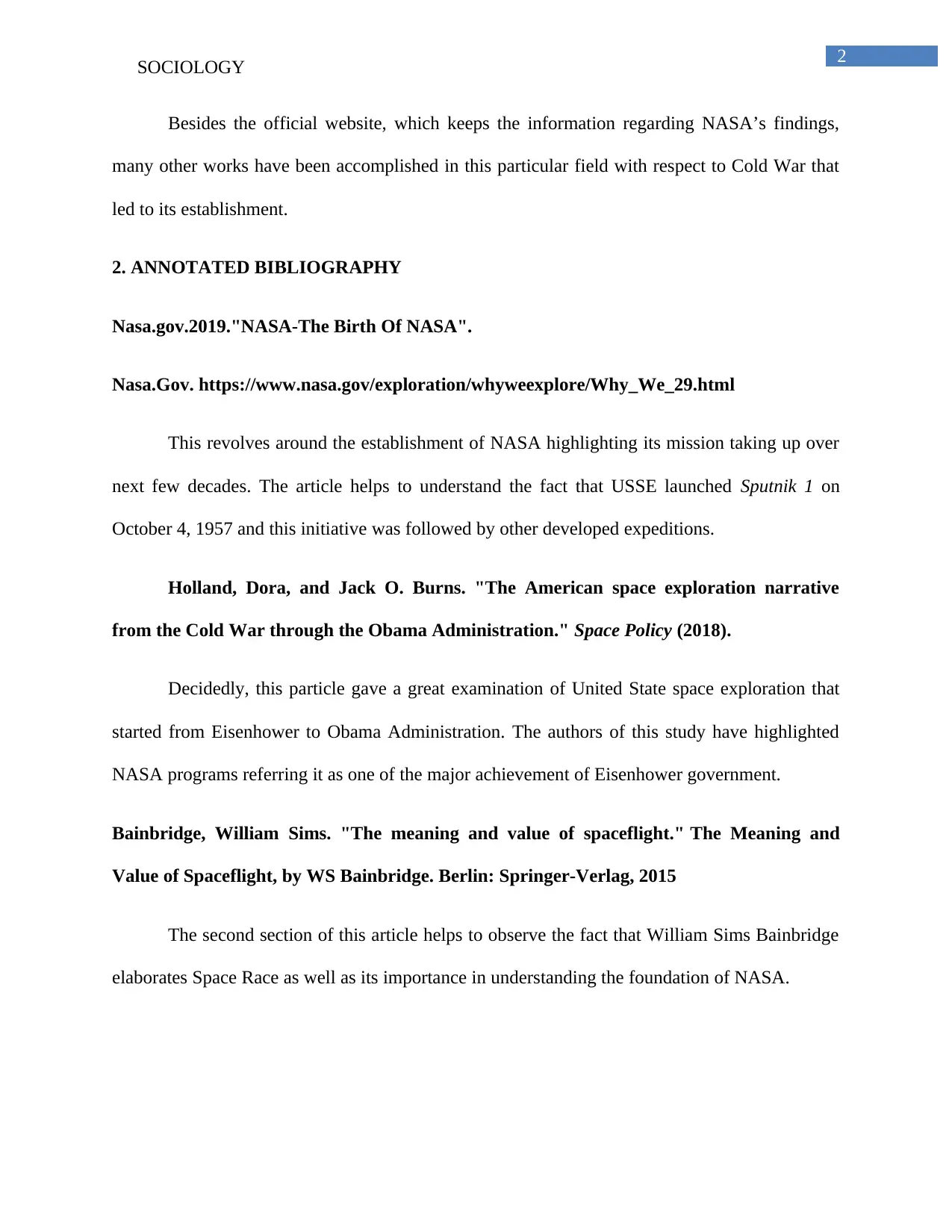
Besides the official website, which keeps the information regarding NASA’s findings,
many other works have been accomplished in this particular field with respect to Cold War that
led to its establishment.
2. ANNOTATED BIBLIOGRAPHY
Nasa.gov.2019."NASA-The Birth Of NASA".
Nasa.Gov. https://www.nasa.gov/exploration/whyweexplore/Why_We_29.html
This revolves around the establishment of NASA highlighting its mission taking up over
next few decades. The article helps to understand the fact that USSE launched Sputnik 1 on
October 4, 1957 and this initiative was followed by other developed expeditions.
Holland, Dora, and Jack O. Burns. "The American space exploration narrative
from the Cold War through the Obama Administration." Space Policy (2018).
Decidedly, this particle gave a great examination of United State space exploration that
started from Eisenhower to Obama Administration. The authors of this study have highlighted
NASA programs referring it as one of the major achievement of Eisenhower government.
Bainbridge, William Sims. "The meaning and value of spaceflight." The Meaning and
Value of Spaceflight, by WS Bainbridge. Berlin: Springer-Verlag, 2015
The second section of this article helps to observe the fact that William Sims Bainbridge
elaborates Space Race as well as its importance in understanding the foundation of NASA.
SOCIOLOGY
Besides the official website, which keeps the information regarding NASA’s findings,
many other works have been accomplished in this particular field with respect to Cold War that
led to its establishment.
2. ANNOTATED BIBLIOGRAPHY
Nasa.gov.2019."NASA-The Birth Of NASA".
Nasa.Gov. https://www.nasa.gov/exploration/whyweexplore/Why_We_29.html
This revolves around the establishment of NASA highlighting its mission taking up over
next few decades. The article helps to understand the fact that USSE launched Sputnik 1 on
October 4, 1957 and this initiative was followed by other developed expeditions.
Holland, Dora, and Jack O. Burns. "The American space exploration narrative
from the Cold War through the Obama Administration." Space Policy (2018).
Decidedly, this particle gave a great examination of United State space exploration that
started from Eisenhower to Obama Administration. The authors of this study have highlighted
NASA programs referring it as one of the major achievement of Eisenhower government.
Bainbridge, William Sims. "The meaning and value of spaceflight." The Meaning and
Value of Spaceflight, by WS Bainbridge. Berlin: Springer-Verlag, 2015
The second section of this article helps to observe the fact that William Sims Bainbridge
elaborates Space Race as well as its importance in understanding the foundation of NASA.
⊘ This is a preview!⊘
Do you want full access?
Subscribe today to unlock all pages.

Trusted by 1+ million students worldwide

3
SOCIOLOGY
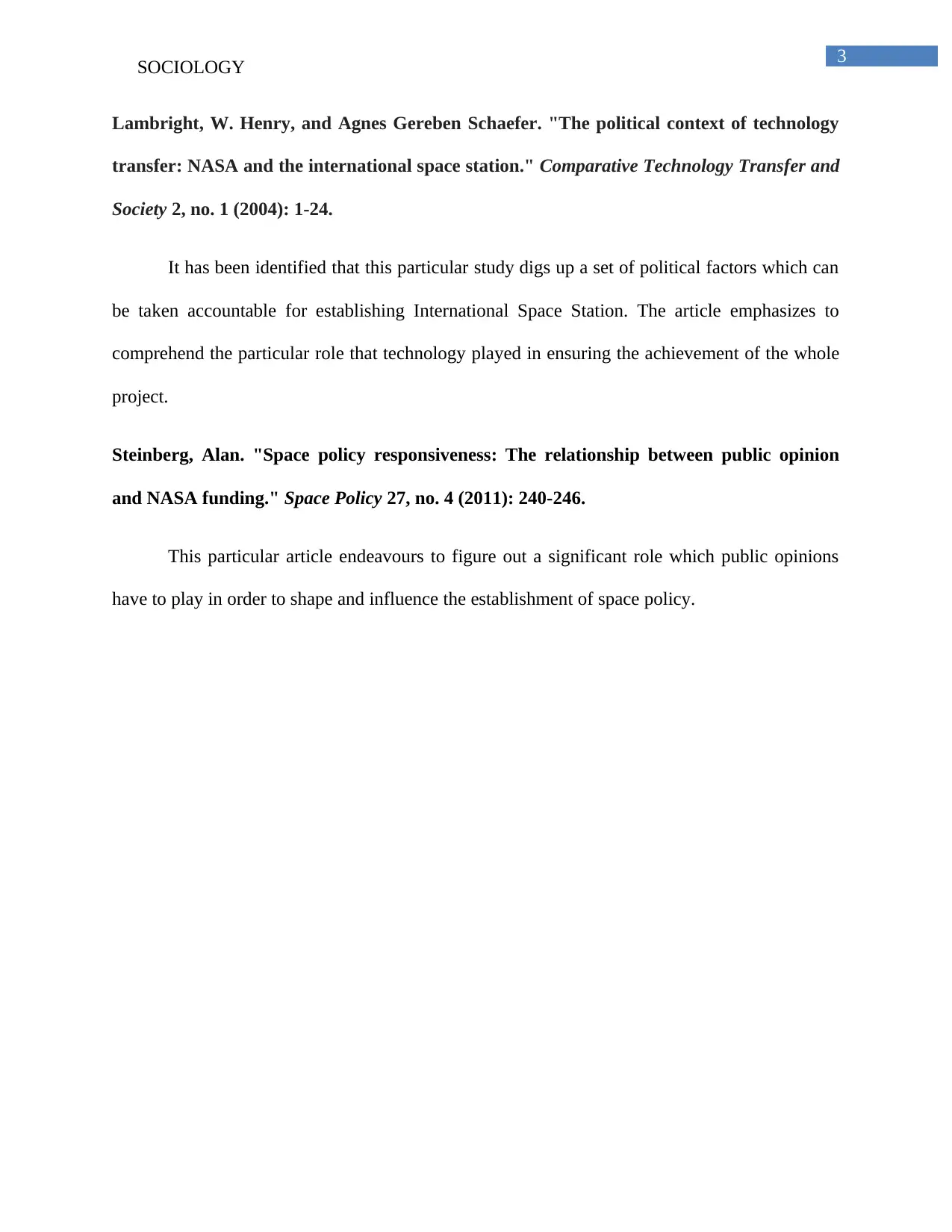
Lambright, W. Henry, and Agnes Gereben Schaefer. "The political context of technology
transfer: NASA and the international space station." Comparative Technology Transfer and
Society 2, no. 1 (2004): 1-24.
It has been identified that this particular study digs up a set of political factors which can
be taken accountable for establishing International Space Station. The article emphasizes to
comprehend the particular role that technology played in ensuring the achievement of the whole
project.
Steinberg, Alan. "Space policy responsiveness: The relationship between public opinion
and NASA funding." Space Policy 27, no. 4 (2011): 240-246.
This particular article endeavours to figure out a significant role which public opinions
have to play in order to shape and influence the establishment of space policy.
SOCIOLOGY
Lambright, W. Henry, and Agnes Gereben Schaefer. "The political context of technology
transfer: NASA and the international space station." Comparative Technology Transfer and
Society 2, no. 1 (2004): 1-24.
It has been identified that this particular study digs up a set of political factors which can
be taken accountable for establishing International Space Station. The article emphasizes to
comprehend the particular role that technology played in ensuring the achievement of the whole
project.
Steinberg, Alan. "Space policy responsiveness: The relationship between public opinion
and NASA funding." Space Policy 27, no. 4 (2011): 240-246.
This particular article endeavours to figure out a significant role which public opinions
have to play in order to shape and influence the establishment of space policy.
Paraphrase This Document
Need a fresh take? Get an instant paraphrase of this document with our AI Paraphraser

4
SOCIOLOGY
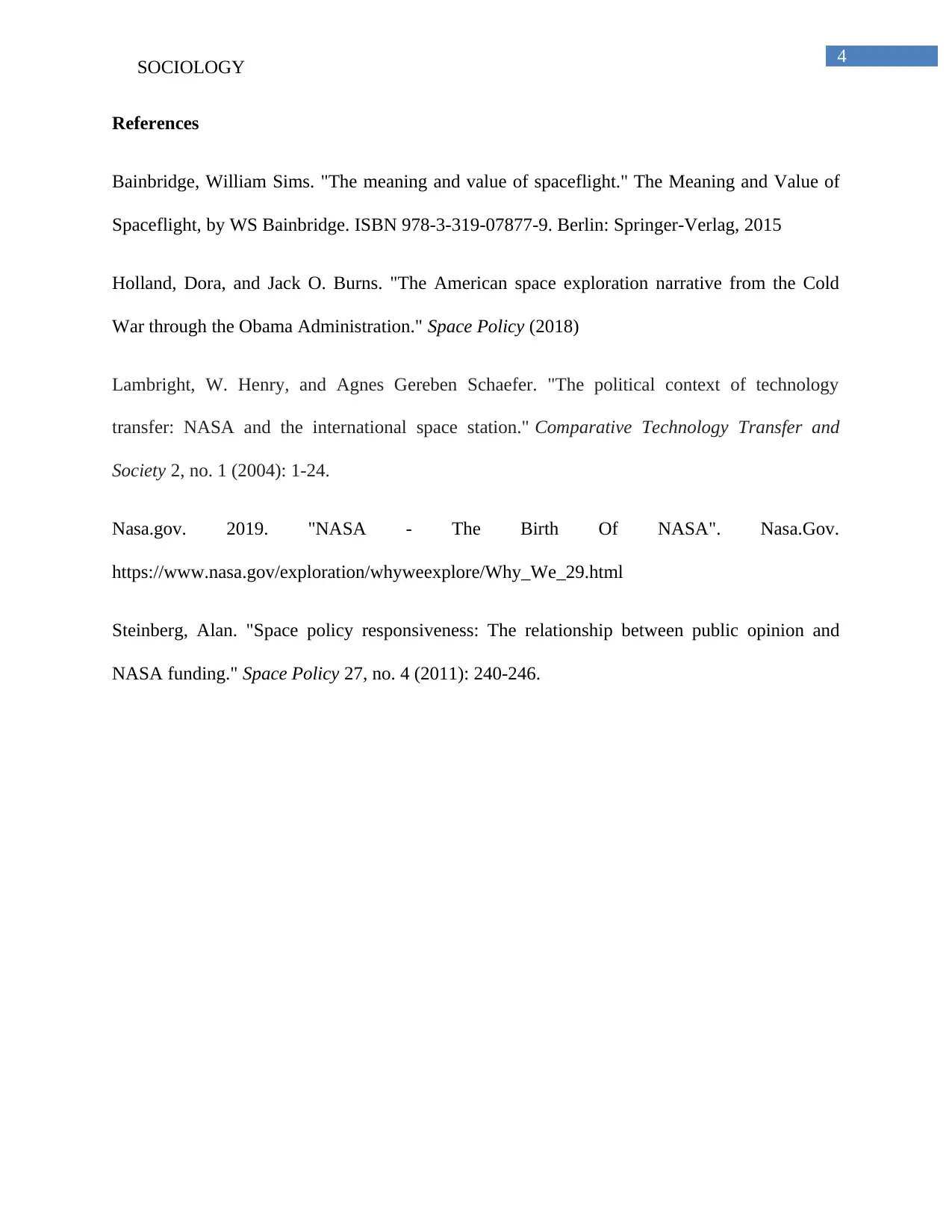
References
Bainbridge, William Sims. "The meaning and value of spaceflight." The Meaning and Value of
Spaceflight, by WS Bainbridge. ISBN 978-3-319-07877-9. Berlin: Springer-Verlag, 2015
Holland, Dora, and Jack O. Burns. "The American space exploration narrative from the Cold
War through the Obama Administration." Space Policy (2018)
Lambright, W. Henry, and Agnes Gereben Schaefer. "The political context of technology
transfer: NASA and the international space station." Comparative Technology Transfer and
Society 2, no. 1 (2004): 1-24.
Nasa.gov. 2019. "NASA - The Birth Of NASA". Nasa.Gov.
https://www.nasa.gov/exploration/whyweexplore/Why_We_29.html
Steinberg, Alan. "Space policy responsiveness: The relationship between public opinion and
NASA funding." Space Policy 27, no. 4 (2011): 240-246.
SOCIOLOGY
References
Bainbridge, William Sims. "The meaning and value of spaceflight." The Meaning and Value of
Spaceflight, by WS Bainbridge. ISBN 978-3-319-07877-9. Berlin: Springer-Verlag, 2015
Holland, Dora, and Jack O. Burns. "The American space exploration narrative from the Cold
War through the Obama Administration." Space Policy (2018)
Lambright, W. Henry, and Agnes Gereben Schaefer. "The political context of technology
transfer: NASA and the international space station." Comparative Technology Transfer and
Society 2, no. 1 (2004): 1-24.
Nasa.gov. 2019. "NASA - The Birth Of NASA". Nasa.Gov.
https://www.nasa.gov/exploration/whyweexplore/Why_We_29.html
Steinberg, Alan. "Space policy responsiveness: The relationship between public opinion and
NASA funding." Space Policy 27, no. 4 (2011): 240-246.

5
SOCIOLOGY
References:
Bainbridge, William Sims. "The meaning and value of spaceflight." The Meaning and Value of
Spaceflight, by WS Bainbridge. ISBN 978-3-319-07877-9. Berlin: Springer-Verlag,
2015 (2015).
Holland, Dora, and Jack O. Burns. "The American space exploration narrative from the Cold
War through the Obama Administration." Space Policy (2018).
Nasa.gov. 2019. "NASA - The Birth Of NASA". Nasa.Gov.
https://www.nasa.gov/exploration/whyweexplore/Why_We_29.html
SOCIOLOGY
References:
Bainbridge, William Sims. "The meaning and value of spaceflight." The Meaning and Value of
Spaceflight, by WS Bainbridge. ISBN 978-3-319-07877-9. Berlin: Springer-Verlag,
2015 (2015).
Holland, Dora, and Jack O. Burns. "The American space exploration narrative from the Cold
War through the Obama Administration." Space Policy (2018).
Nasa.gov. 2019. "NASA - The Birth Of NASA". Nasa.Gov.
https://www.nasa.gov/exploration/whyweexplore/Why_We_29.html
⊘ This is a preview!⊘
Do you want full access?
Subscribe today to unlock all pages.

Trusted by 1+ million students worldwide
1 out of 6
Related Documents
Your All-in-One AI-Powered Toolkit for Academic Success.
+13062052269
info@desklib.com
Available 24*7 on WhatsApp / Email
Unlock your academic potential
Copyright © 2020–2025 A2Z Services. All Rights Reserved. Developed and managed by ZUCOL.