Natech Events: Comparative Case Study of Challenger and Fukushima
VerifiedAdded on 2023/06/07
|17
|3153
|88
Case Study
AI Summary
This assignment provides a comprehensive analysis of Natech (Natural Hazard Triggering Technological Disaster) risks through two case studies: the Challenger space shuttle disaster and the Fukushima Daiichi nuclear power plant accident. The analysis includes a detailed description of each case, setting the boundaries for the analysis, stakeholder identification and their roles, inherent risk determination, and causal chain analysis. For the Challenger disaster, the focus is on the flawed decision-making process influenced by external pressures, leading to the explosion. In the Fukushima case, the report examines the impact of the earthquake and tsunami on the nuclear plant, the failure of emergency systems, and the subsequent nuclear meltdown, further analyzing the roles and responsibilities of TEPCO, government officials, and other stakeholders. The study emphasizes the importance of risk assessment, mitigation strategies, and effective communication in preventing and managing Natech events, providing valuable insights into the interconnectedness of natural disasters and industrial accidents.
Topic and case study
analysis
analysis

Paraphrase This Document
Need a fresh take? Get an instant paraphrase of this document with our AI Paraphraser
Table of Contents
Introduction......................................................................................................................................2
Chapter 1 Case Study I....................................................................................................................3
Description of the case and Setting the Boundaries...............................................................3
CASE STUDY 2..............................................................................................................................1
Case descriptions as well as settings the boundaries.......................................................................1
Fukushima Daiichi Nuclear power point................................................................................1
Setting the boundaries............................................................................................................1
Inherent risk determinations...................................................................................................4
Inherent challenges.................................................................................................................5
Overall inherent risk ranking..................................................................................................5
Casual chain analysis..............................................................................................................5
Conclusion.......................................................................................................................................6
REFERENCES................................................................................................................................7
Assessment Task 1
Topic and Case Study Analysis
Introduction......................................................................................................................................2
Chapter 1 Case Study I....................................................................................................................3
Description of the case and Setting the Boundaries...............................................................3
CASE STUDY 2..............................................................................................................................1
Case descriptions as well as settings the boundaries.......................................................................1
Fukushima Daiichi Nuclear power point................................................................................1
Setting the boundaries............................................................................................................1
Inherent risk determinations...................................................................................................4
Inherent challenges.................................................................................................................5
Overall inherent risk ranking..................................................................................................5
Casual chain analysis..............................................................................................................5
Conclusion.......................................................................................................................................6
REFERENCES................................................................................................................................7
Assessment Task 1
Topic and Case Study Analysis

⊘ This is a preview!⊘
Do you want full access?
Subscribe today to unlock all pages.

Trusted by 1+ million students worldwide
2
Introduction
The following task need to cover while choosing one topic out of three which is given.
Natech is the chosen topic for this assessment. Natech means the interaction between natural
disasters and industrial accidents. Few of the examples of such hazardous events leakage of
hazardous materials, heavy storm, earthquake, or flooding. It is essential for various
companies in various industries to analyze the impact of such risks and make mitigation
strategies.
This report is conducted to identify the risk, their consequences and their impact on social
community. Causes and effects are well determined and the series of events interconnecting
them are also described.
Risk analysis is one of the most important task for any company because it will help them to
get prepared for obstacles so that they will manage their resources effectively for future use.
The following report cover two case studies which further describe the background of the
case studies, analyzing the stakeholder and their roles for local people benefit and control risk
strategies. Tables are used to describe the risk and risk mitigation strategies effectively.
Tables and charts will help to understand the concept in better ways.
Introduction
The following task need to cover while choosing one topic out of three which is given.
Natech is the chosen topic for this assessment. Natech means the interaction between natural
disasters and industrial accidents. Few of the examples of such hazardous events leakage of
hazardous materials, heavy storm, earthquake, or flooding. It is essential for various
companies in various industries to analyze the impact of such risks and make mitigation
strategies.
This report is conducted to identify the risk, their consequences and their impact on social
community. Causes and effects are well determined and the series of events interconnecting
them are also described.
Risk analysis is one of the most important task for any company because it will help them to
get prepared for obstacles so that they will manage their resources effectively for future use.
The following report cover two case studies which further describe the background of the
case studies, analyzing the stakeholder and their roles for local people benefit and control risk
strategies. Tables are used to describe the risk and risk mitigation strategies effectively.
Tables and charts will help to understand the concept in better ways.
Paraphrase This Document
Need a fresh take? Get an instant paraphrase of this document with our AI Paraphraser
3
Chapter 1 Case Study I
Description of the case and Setting the Boundaries
Challenger space shuttle is chosen for this section.
1.1.1 Space Shuttle Challenger Disaster
January 28th, 1986, this is the date when whether is shown decreasing temperature and it was
a high cold. On this day millions of people are excited to watch the Challenger Space Shuttle
which is going to launch. During this morning, the staff members went to remove ice from
their way but they noticed a huge obstacle of lot of ice around them. An urgent meeting is
held between contractor, Thiokol Corporation and NASA. A group of staff members of that
company suggested to postpone the launch due to extreme cold weather and ice fall to avoid
any big accident at the site. The weather will effects the elasticity of O-rings which the seal
of the joints in the rocket motor which could lead to explosion.
During that time, both Thiokol Company was also on the verge of losing their niche spot if
they delay the launch same as NASA which was also well behind the expected schedule of a
self-funding space program. Together with the consideration of future funding from the
Congress, NASA officials decided to not delay the launch sharing the same recommendation
from Thiokol’s senior managers despite the engineers’ request to caucus. The next morning,
immediately after the launch, the shuttle failed and exploded losing the lives of crew
members [1].
1.1.2 Setting the Boundaries
As per this case study, the Thiokol senior managers, NASA and the engineers of Thiokol
company are building internal relationship to manage the risk.. All strategy of NASA and
Thiokol Corporation are getting failed due to extreme cold weather and icefall on the way to
mission.
1.2 Stakeholder analysis including Indigenous communities
Stakeholders are those individuals or companies who are having interest in the project and
who invested in the project as well as monitor the project for success. As per the case study,
stakeholders have huge role to mitigate the risk for NASA. The main aim of the Challenger is
to test their devices. Hence, the NASA is required to put themselves in the place of users group
like engineers and crew members to analyze their problems to work in such weather. The main
stakeholders of this case are NASA, Thikol Corporation managers and engineers and crew
members. Due to the significant interest and influences, the NASA officials, Thiokol senior
managers and general public is added in the mission.. NASA, Thiokol Corporation, and the
public should be considered as major beneficiaries. Decision makers group should be
comprised of NASA officials, senior management team from Thiokol.
Chapter 1 Case Study I
Description of the case and Setting the Boundaries
Challenger space shuttle is chosen for this section.
1.1.1 Space Shuttle Challenger Disaster
January 28th, 1986, this is the date when whether is shown decreasing temperature and it was
a high cold. On this day millions of people are excited to watch the Challenger Space Shuttle
which is going to launch. During this morning, the staff members went to remove ice from
their way but they noticed a huge obstacle of lot of ice around them. An urgent meeting is
held between contractor, Thiokol Corporation and NASA. A group of staff members of that
company suggested to postpone the launch due to extreme cold weather and ice fall to avoid
any big accident at the site. The weather will effects the elasticity of O-rings which the seal
of the joints in the rocket motor which could lead to explosion.
During that time, both Thiokol Company was also on the verge of losing their niche spot if
they delay the launch same as NASA which was also well behind the expected schedule of a
self-funding space program. Together with the consideration of future funding from the
Congress, NASA officials decided to not delay the launch sharing the same recommendation
from Thiokol’s senior managers despite the engineers’ request to caucus. The next morning,
immediately after the launch, the shuttle failed and exploded losing the lives of crew
members [1].
1.1.2 Setting the Boundaries
As per this case study, the Thiokol senior managers, NASA and the engineers of Thiokol
company are building internal relationship to manage the risk.. All strategy of NASA and
Thiokol Corporation are getting failed due to extreme cold weather and icefall on the way to
mission.
1.2 Stakeholder analysis including Indigenous communities
Stakeholders are those individuals or companies who are having interest in the project and
who invested in the project as well as monitor the project for success. As per the case study,
stakeholders have huge role to mitigate the risk for NASA. The main aim of the Challenger is
to test their devices. Hence, the NASA is required to put themselves in the place of users group
like engineers and crew members to analyze their problems to work in such weather. The main
stakeholders of this case are NASA, Thikol Corporation managers and engineers and crew
members. Due to the significant interest and influences, the NASA officials, Thiokol senior
managers and general public is added in the mission.. NASA, Thiokol Corporation, and the
public should be considered as major beneficiaries. Decision makers group should be
comprised of NASA officials, senior management team from Thiokol.
4
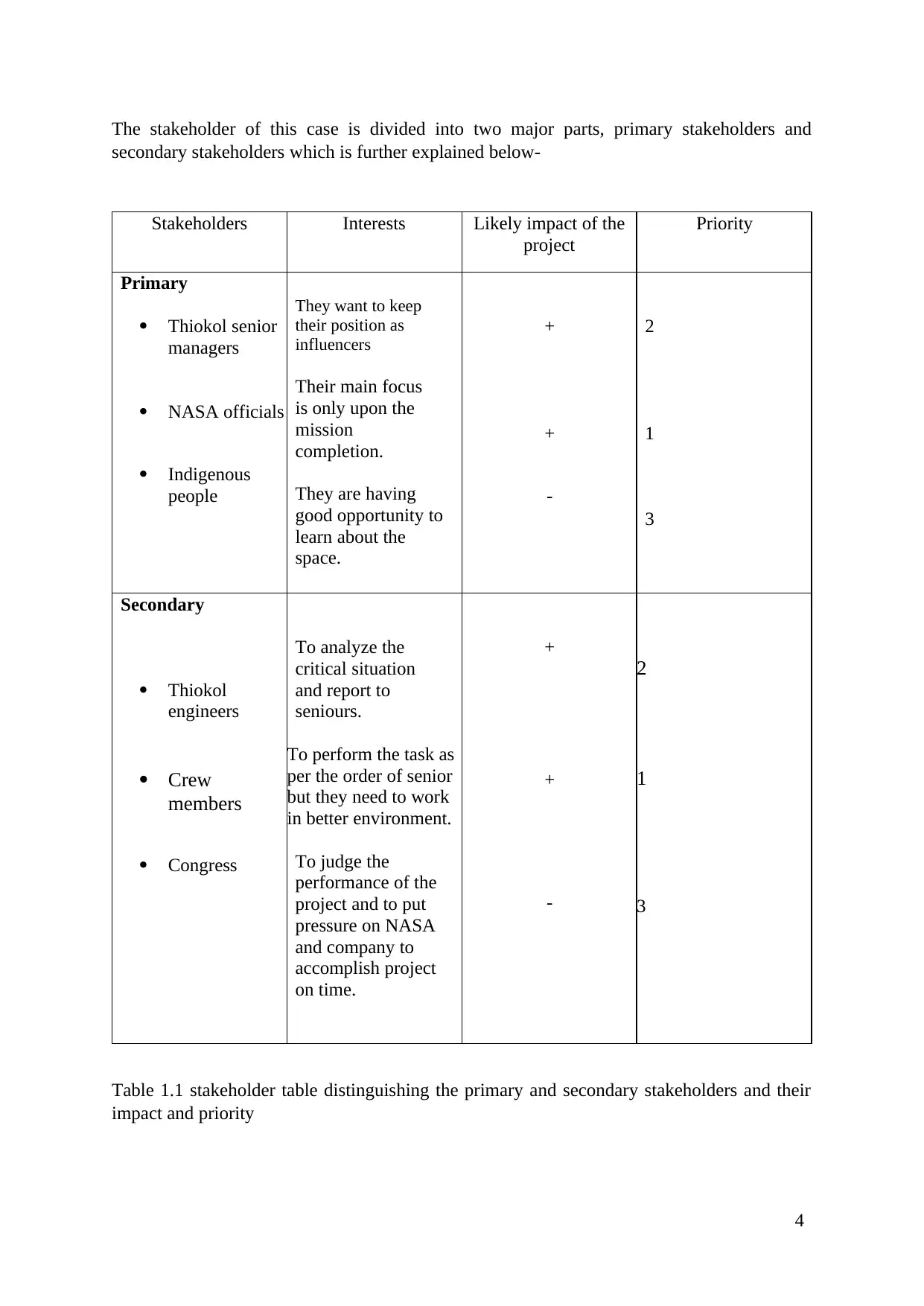
The stakeholder of this case is divided into two major parts, primary stakeholders and
secondary stakeholders which is further explained below-
Stakeholders Interests Likely impact of the
project
Priority
Primary
Thiokol senior
managers
NASA officials
Indigenous
people
They want to keep
their position as
influencers
Their main focus
is only upon the
mission
completion.
They are having
good opportunity to
learn about the
space.
+
+
-
2
1
3
Secondary
Thiokol
engineers
Crew
members
Congress
To analyze the
critical situation
and report to
seniours.
To perform the task as
per the order of senior
but they need to work
in better environment.
To judge the
performance of the
project and to put
pressure on NASA
and company to
accomplish project
on time.
+
+
-
2
1
3
Table 1.1 stakeholder table distinguishing the primary and secondary stakeholders and their
impact and priority
The stakeholder of this case is divided into two major parts, primary stakeholders and
secondary stakeholders which is further explained below-
Stakeholders Interests Likely impact of the
project
Priority
Primary
Thiokol senior
managers
NASA officials
Indigenous
people
They want to keep
their position as
influencers
Their main focus
is only upon the
mission
completion.
They are having
good opportunity to
learn about the
space.
+
+
-
2
1
3
Secondary
Thiokol
engineers
Crew
members
Congress
To analyze the
critical situation
and report to
seniours.
To perform the task as
per the order of senior
but they need to work
in better environment.
To judge the
performance of the
project and to put
pressure on NASA
and company to
accomplish project
on time.
+
+
-
2
1
3
Table 1.1 stakeholder table distinguishing the primary and secondary stakeholders and their
impact and priority
⊘ This is a preview!⊘
Do you want full access?
Subscribe today to unlock all pages.
Trusted by 1+ million students worldwide
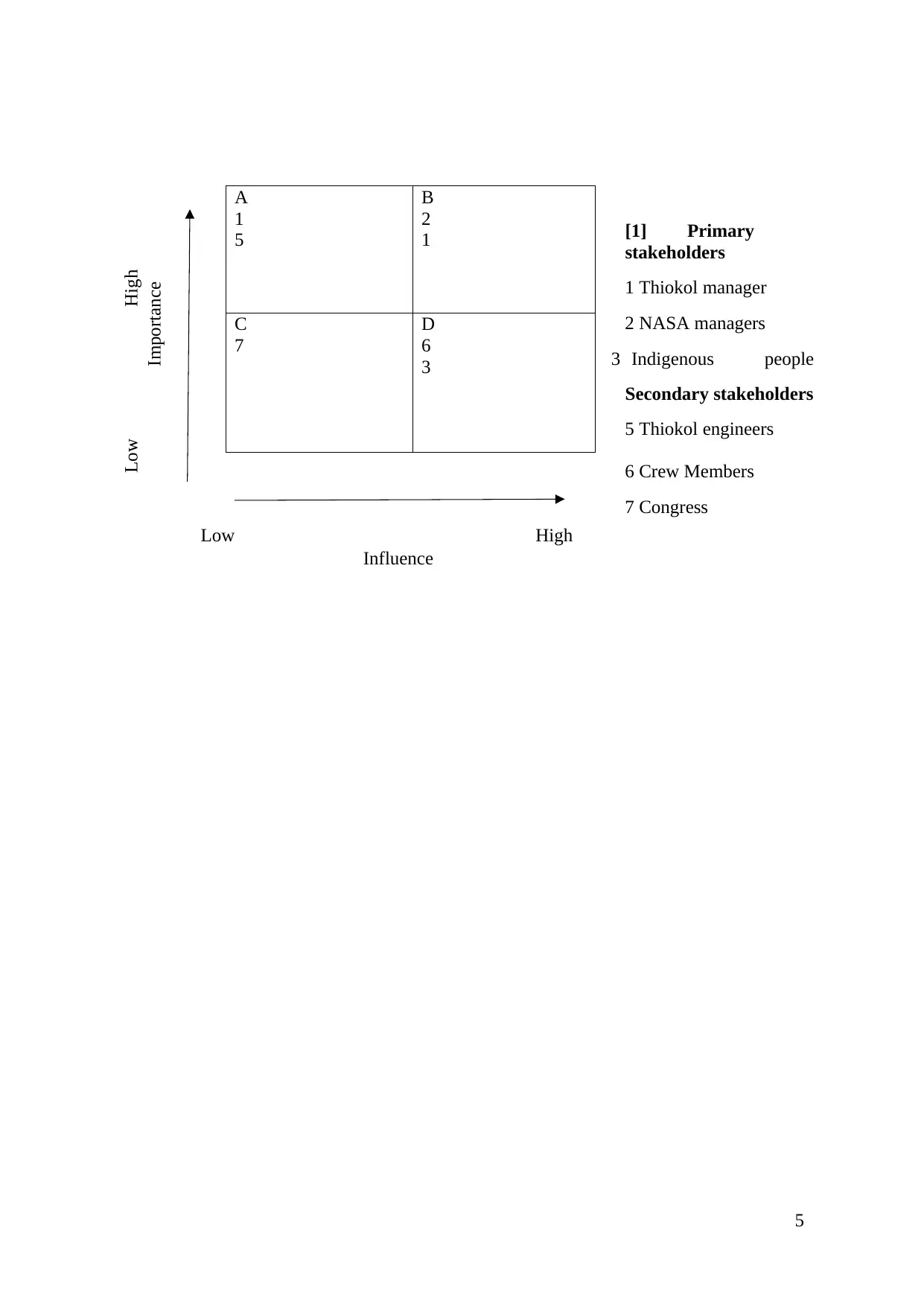
5
Low
Influence
High
[1] Primary
stakeholders
1 Thiokol manager
2 NASA managers
3 Indigenous people
Secondary stakeholders
5 Thiokol engineers
6 Crew Members
7 Congress
Low High
Importance
A
1
5
B
2
1
C
7
D
6
3
s
Low
Influence
High
[1] Primary
stakeholders
1 Thiokol manager
2 NASA managers
3 Indigenous people
Secondary stakeholders
5 Thiokol engineers
6 Crew Members
7 Congress
Low High
Importance
A
1
5
B
2
1
C
7
D
6
3
s
Paraphrase This Document
Need a fresh take? Get an instant paraphrase of this document with our AI Paraphraser
1.3 Inherent Risk Determination
Inherent Risk is defines as those risk which are having direct impact upon the main objectives
of the project. It is essential in the case study to NASA and the Company to consider the
suggestions of their crew members and engineers and did not make their life risky for the
situation.
For each risk, Inherent likelihood, inherent consequence and overall inherent risk ranking will
be considered.
1.3.1. Inherent likelihood
This is the situation where the team have no control over the risk due to critical situation. In
context of case study, the NASA officials and the Company did not have control over
weather but they can minimize the risk which can created by this bad weather. The bad
decisions of management team of Thiokol company and NASA for not listening their
engineers and crew managers will consider bad impact upon their performance. Another
factor for risk occurring is fault of machines.
1.3.2. Inherent consequence
Delay of launch, inadequate financial management, avoiding technicians advices and few
others are the bad consequences of the situation. This will further result in explosion during
launch, leakage of hazardous liquid and gasses. This will further cause earthquake, flood,
environmental damage and few other damages to common people of that area.
1.3.3. Overall inherent risk ranking
The name which is given to the inherent risk of the case study is Type III events such as
natural disasters and unpredictable black swan events need to be put at the highest inherent
risk level. Type II events are given name for the consequnces of these risks such as human
death and other losses. For human errors affecting the schedule or losses of certain number of
resources can be well categorized as Type I events with modest inherent risks.
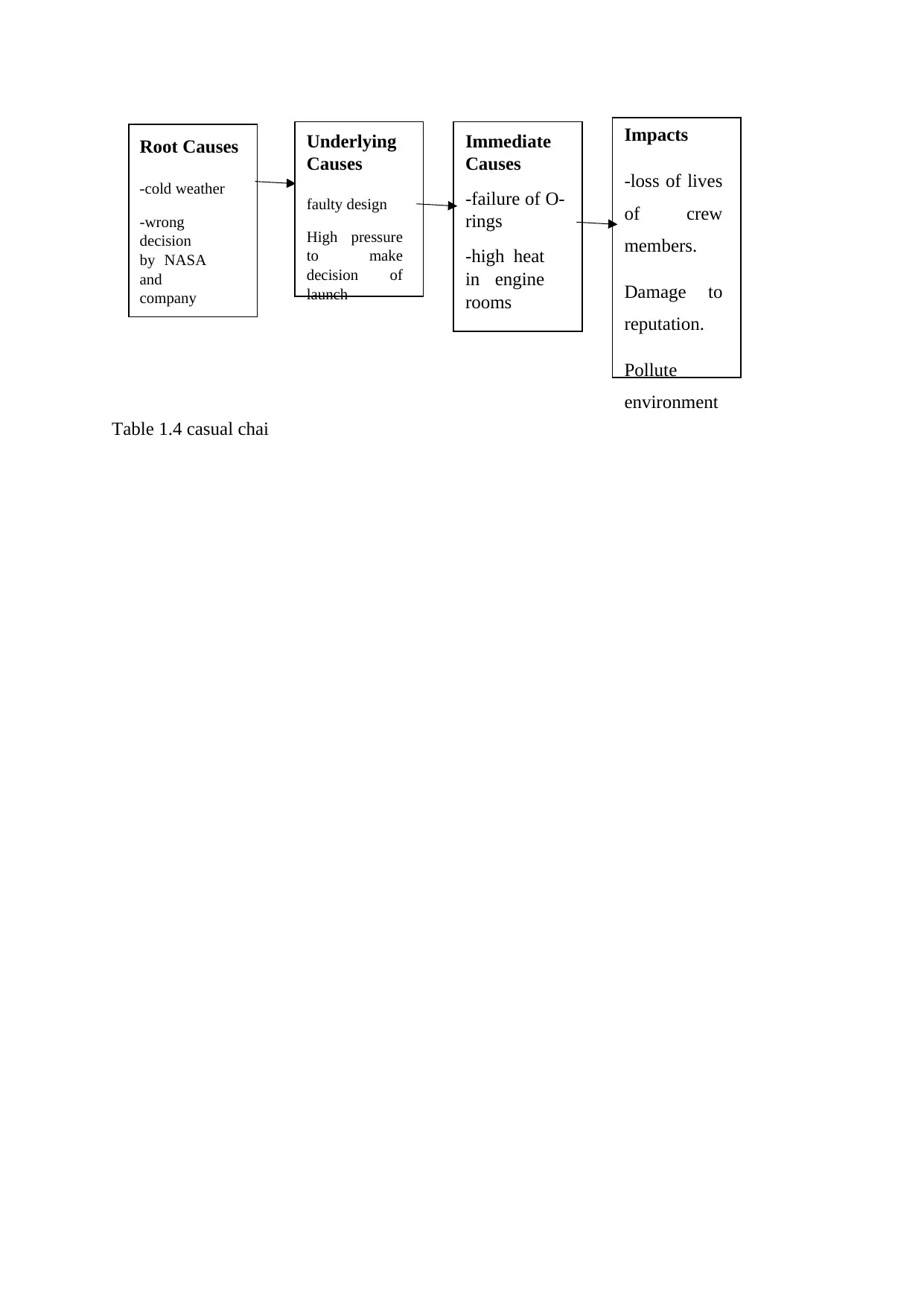
1.4. Casual Chain Analysis
Causal chain is commonly defined as the sequence of event happening within an situation so
that the stakeholders will connect those events with their effects and consequences. This will
help to analyze that which event happen first and which one happened later.
It is essential to analyze the risk on environment for this critical evaluation of casual chain.
The root of the issues is identified as the extreme cold weather and wrong decision taken by
the company. Faulty design of the O-ring is another issue. Launching in cold weather is
immediate effect which cause immediate heat in the engine rooms. Impact of these incident is
the death of few crew members.
Inherent Risk is defines as those risk which are having direct impact upon the main objectives
of the project. It is essential in the case study to NASA and the Company to consider the
suggestions of their crew members and engineers and did not make their life risky for the
situation.
For each risk, Inherent likelihood, inherent consequence and overall inherent risk ranking will
be considered.
1.3.1. Inherent likelihood
This is the situation where the team have no control over the risk due to critical situation. In
context of case study, the NASA officials and the Company did not have control over
weather but they can minimize the risk which can created by this bad weather. The bad
decisions of management team of Thiokol company and NASA for not listening their
engineers and crew managers will consider bad impact upon their performance. Another
factor for risk occurring is fault of machines.
1.3.2. Inherent consequence
Delay of launch, inadequate financial management, avoiding technicians advices and few
others are the bad consequences of the situation. This will further result in explosion during
launch, leakage of hazardous liquid and gasses. This will further cause earthquake, flood,
environmental damage and few other damages to common people of that area.
1.3.3. Overall inherent risk ranking
The name which is given to the inherent risk of the case study is Type III events such as
natural disasters and unpredictable black swan events need to be put at the highest inherent
risk level. Type II events are given name for the consequnces of these risks such as human
death and other losses. For human errors affecting the schedule or losses of certain number of
resources can be well categorized as Type I events with modest inherent risks.
1.4. Casual Chain Analysis
Causal chain is commonly defined as the sequence of event happening within an situation so
that the stakeholders will connect those events with their effects and consequences. This will
help to analyze that which event happen first and which one happened later.
It is essential to analyze the risk on environment for this critical evaluation of casual chain.
The root of the issues is identified as the extreme cold weather and wrong decision taken by
the company. Faulty design of the O-ring is another issue. Launching in cold weather is
immediate effect which cause immediate heat in the engine rooms. Impact of these incident is
the death of few crew members.
Underlying
Causes
faulty design
High pressure
to make
decision of
launch
Immediate
Causes
-failure of O-
rings
-high heat
in engine
rooms
Impacts
-loss of lives
of crew
members.
Damage to
reputation.
Pollute
environment
Root Causes
-cold weather
-wrong
decision
by NASA
and
company
Table 1.4 casual chai
Causes
faulty design
High pressure
to make
decision of
launch
Immediate
Causes
-failure of O-
rings
-high heat
in engine
rooms
Impacts
-loss of lives
of crew
members.
Damage to
reputation.
Pollute
environment
Root Causes
-cold weather
-wrong
decision
by NASA
and
company
Table 1.4 casual chai
⊘ This is a preview!⊘
Do you want full access?
Subscribe today to unlock all pages.
Trusted by 1+ million students worldwide
CASE STUDY 2
Case descriptions as well as settings the boundaries
The very popular case study such as Fukushima Daiichi Nuclear power point is chosen for this
assessment.
Fukushima Daiichi Nuclear power point
In march 2011, a 9.1 larger scale earthquake hit the land of Japan along with after 1 hour
there was tsunami which impacted the coastal area of japan that destroyed the life of people and
properties. addition to this Fukushima Daiichi Nuclear power point was affected badly with this
disaster. at the time of Tsunami, the water of the sea has reached the power plant as well as
submerged its lower level which leads to failure emergency diesel generators and backup power
system. after all these coolant substances are not pumped up properly in order to reduce the heat
as well as heat exchangers malfunctions to falling-off heat into the sea. the shortage of effective
water circulation functions and reactor cooling directed to various explosion and nuclear
meltdown regarding to that.
The owner of this power plant is TEPCO, it is a leading industrial company along with
having strong connection with political leaders and government officials. at the time disaster top
management of TEPCO, asked to the engineers to give full information related to plant but they
did not provide it to them because they have no access to plant as well as safety engineers
already know about the issue. SPEEDI scientist did not pay attention to it and ignore it by saying
number did not matter.
After few days there were a meeting which is organised by experts and ministers related to
the issue and make decisions in order to avoid panicking among people and news which is spread
inn all over. further, information is gathered from US and then sent it to government of Japan but
they refuse to use due to it come from foreign country. the migration of millions of people is
happened after news and data is spread in media of US.
Setting the boundaries
In this case study, the internal boundaries included experts, ministers and government of
Japan, technicians, safety engineers, speedi, and people of plant. the external or environmental
boundaries includes public, media of US, and other like Tsunami. It is appearing as good system
1
High
Case descriptions as well as settings the boundaries
The very popular case study such as Fukushima Daiichi Nuclear power point is chosen for this
assessment.
Fukushima Daiichi Nuclear power point
In march 2011, a 9.1 larger scale earthquake hit the land of Japan along with after 1 hour
there was tsunami which impacted the coastal area of japan that destroyed the life of people and
properties. addition to this Fukushima Daiichi Nuclear power point was affected badly with this
disaster. at the time of Tsunami, the water of the sea has reached the power plant as well as
submerged its lower level which leads to failure emergency diesel generators and backup power
system. after all these coolant substances are not pumped up properly in order to reduce the heat
as well as heat exchangers malfunctions to falling-off heat into the sea. the shortage of effective
water circulation functions and reactor cooling directed to various explosion and nuclear
meltdown regarding to that.
The owner of this power plant is TEPCO, it is a leading industrial company along with
having strong connection with political leaders and government officials. at the time disaster top
management of TEPCO, asked to the engineers to give full information related to plant but they
did not provide it to them because they have no access to plant as well as safety engineers
already know about the issue. SPEEDI scientist did not pay attention to it and ignore it by saying
number did not matter.
After few days there were a meeting which is organised by experts and ministers related to
the issue and make decisions in order to avoid panicking among people and news which is spread
inn all over. further, information is gathered from US and then sent it to government of Japan but
they refuse to use due to it come from foreign country. the migration of millions of people is
happened after news and data is spread in media of US.
Setting the boundaries
In this case study, the internal boundaries included experts, ministers and government of
Japan, technicians, safety engineers, speedi, and people of plant. the external or environmental
boundaries includes public, media of US, and other like Tsunami. It is appearing as good system
1
High
Paraphrase This Document
Need a fresh take? Get an instant paraphrase of this document with our AI Paraphraser
along with there is Impacts and interactions from outside the stakeholders which influenced the
behaviour of system. for better information, public, government, media of US forced the
Japanese government to compromise their values or country beliefs.
For internal stakeholders like technician, safety engineers, operators and other who have
direct right to operate the power system. The public get advantage as they consumed power from
plant. the government of Japan also get advantage for nuclear power plant. The another
stakeholders like Japanese experts, government, ministers, TEPCO, media, public and other must
be involved due to their huge influences and interest. These are the main beneficiaries along with
decision makers are the only top management, experts and government. Other like US, media,
public and many more has no right for decision making.
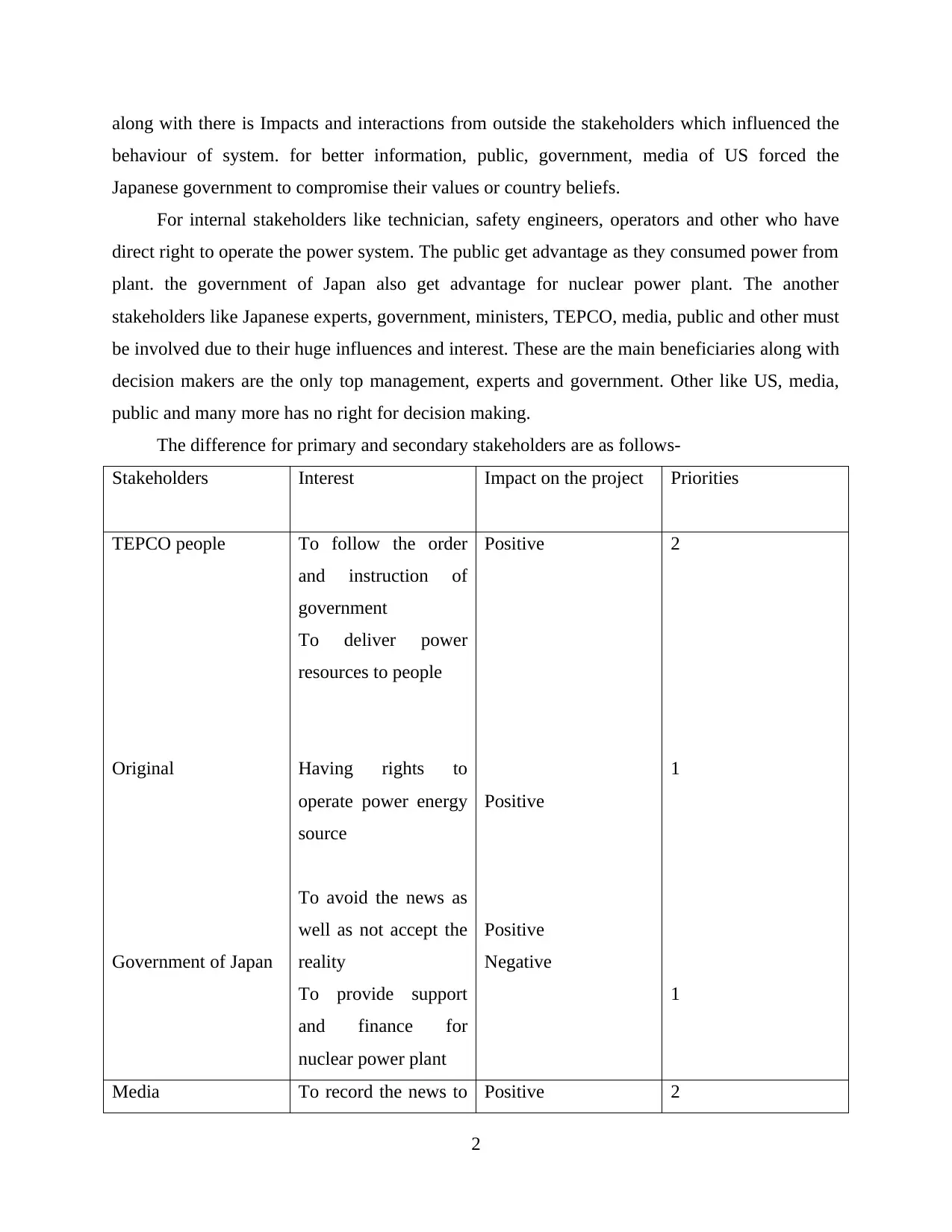
The difference for primary and secondary stakeholders are as follows-
Stakeholders Interest Impact on the project Priorities
TEPCO people
Original
Government of Japan
To follow the order
and instruction of
government
To deliver power
resources to people
Having rights to
operate power energy
source
To avoid the news as
well as not accept the
reality
To provide support
and finance for
nuclear power plant
Positive
Positive
Positive
Negative
2
1
1
Media To record the news to Positive 2
2
behaviour of system. for better information, public, government, media of US forced the
Japanese government to compromise their values or country beliefs.
For internal stakeholders like technician, safety engineers, operators and other who have
direct right to operate the power system. The public get advantage as they consumed power from
plant. the government of Japan also get advantage for nuclear power plant. The another
stakeholders like Japanese experts, government, ministers, TEPCO, media, public and other must
be involved due to their huge influences and interest. These are the main beneficiaries along with
decision makers are the only top management, experts and government. Other like US, media,
public and many more has no right for decision making.
The difference for primary and secondary stakeholders are as follows-
Stakeholders Interest Impact on the project Priorities
TEPCO people
Original
Government of Japan
To follow the order
and instruction of
government
To deliver power
resources to people
Having rights to
operate power energy
source
To avoid the news as
well as not accept the
reality
To provide support
and finance for
nuclear power plant
Positive
Positive
Positive
Negative
2
1
1
Media To record the news to Positive 2
2
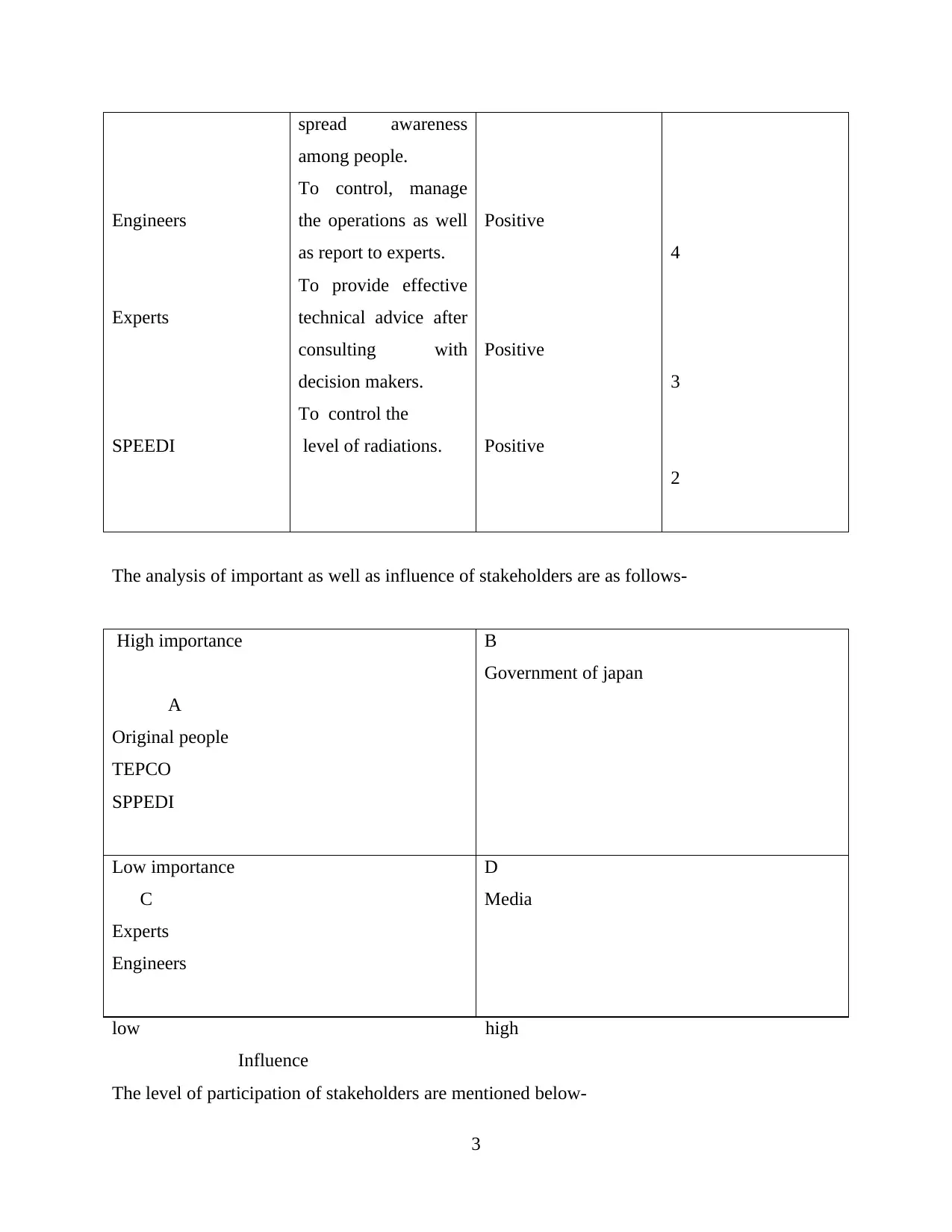
Engineers
Experts
SPEEDI
spread awareness
among people.
To control, manage
the operations as well
as report to experts.
To provide effective
technical advice after
consulting with
decision makers.
To control the
level of radiations.
Positive
Positive
Positive
4
3
2
The analysis of important as well as influence of stakeholders are as follows-
High importance
A
Original people
TEPCO
SPPEDI
B
Government of japan
Low importance
C
Experts
Engineers
D
Media
low high
Influence
The level of participation of stakeholders are mentioned below-
3
Experts
SPEEDI
spread awareness
among people.
To control, manage
the operations as well
as report to experts.
To provide effective
technical advice after
consulting with
decision makers.
To control the
level of radiations.
Positive
Positive
Positive
4
3
2
The analysis of important as well as influence of stakeholders are as follows-
High importance
A
Original people
TEPCO
SPPEDI
B
Government of japan
Low importance
C
Experts
Engineers
D
Media
low high
Influence
The level of participation of stakeholders are mentioned below-
3
⊘ This is a preview!⊘
Do you want full access?
Subscribe today to unlock all pages.
Trusted by 1+ million students worldwide

1 out of 17


Your All-in-One AI-Powered Toolkit for Academic Success.
+13062052269
info@desklib.com
Available 24*7 on WhatsApp / Email
![[object Object]](/_next/static/media/star-bottom.7253800d.svg)
Unlock your academic potential
Copyright © 2020–2026 A2Z Services. All Rights Reserved. Developed and managed by ZUCOL.