BSBCNV506A: Establishing and Managing Trust Accounts Assignment
VerifiedAdded on 2020/02/03
|18
|5142
|197
Homework Assignment
AI Summary
This assignment solution comprehensively addresses the establishment, management, and administration of trust accounts, focusing on the BSBCNV506A unit. It covers essential documents, policies, and procedures required for maintaining accurate trust records, including sales reports, cash receipts, and journal entries. The solution outlines the role of a professional third party for auditing and ensuring compliance with legislative requirements. It further explores various accounting systems, such as manual and electronic methods, and highlights the importance of source documents like bank statements and invoices. The assignment delves into sections of the Act addressing deficiencies and irregularities, defines trust types, and clarifies the powers and duties of trustees. It also explains the winding-up procedures, manual and electronic transactions, client fund protection, and disbursement methods. The solution includes details on CPD needs, key trust components, and actions after receiving trust money. It also provides a file note completion, references and addresses communication and confirmation to the client.

Trust Account

Paraphrase This Document
Need a fresh take? Get an instant paraphrase of this document with our AI Paraphraser
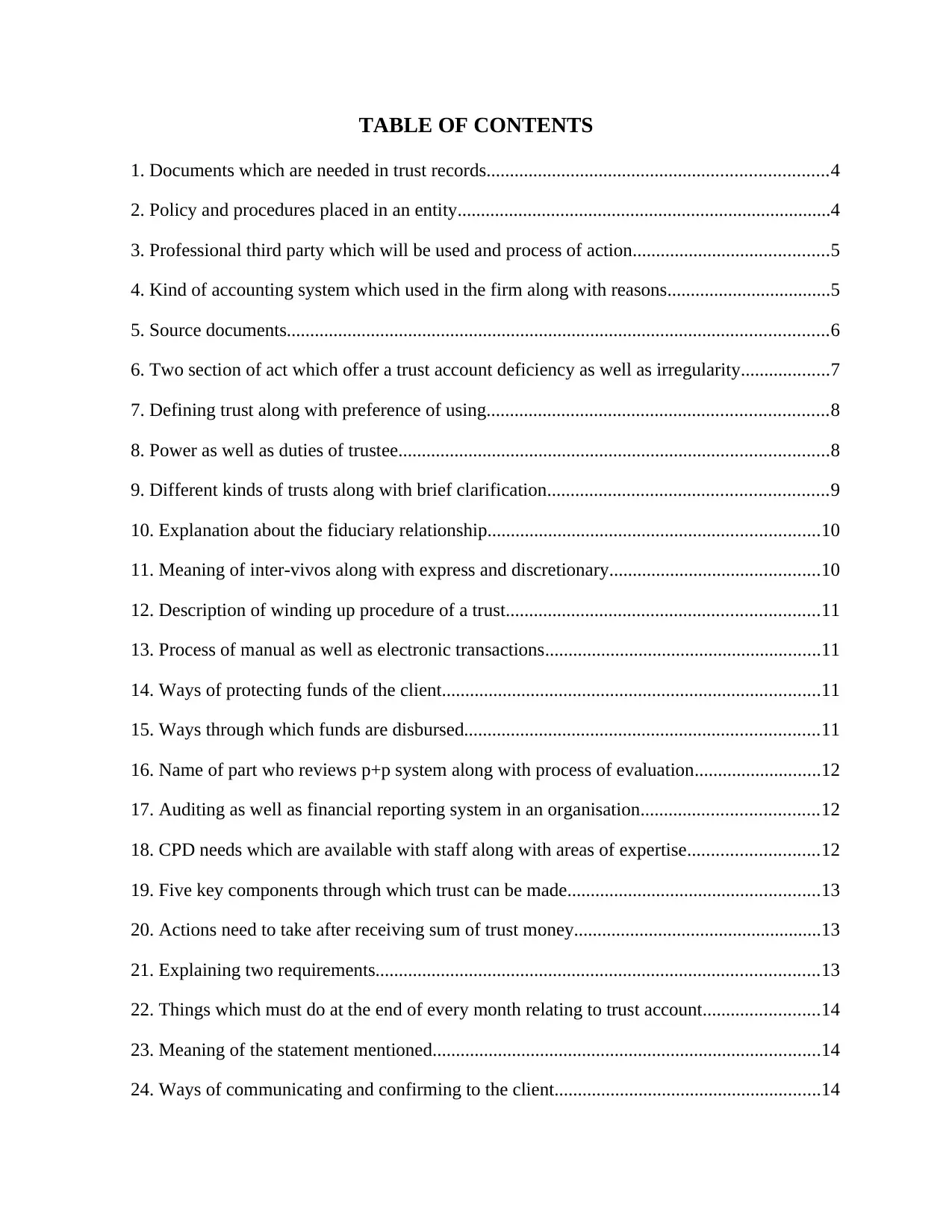
TABLE OF CONTENTS
1. Documents which are needed in trust records.........................................................................4
2. Policy and procedures placed in an entity................................................................................4
3. Professional third party which will be used and process of action..........................................5
4. Kind of accounting system which used in the firm along with reasons...................................5
5. Source documents....................................................................................................................6
6. Two section of act which offer a trust account deficiency as well as irregularity...................7
7. Defining trust along with preference of using.........................................................................8
8. Power as well as duties of trustee............................................................................................8
9. Different kinds of trusts along with brief clarification............................................................9
10. Explanation about the fiduciary relationship.......................................................................10
11. Meaning of inter-vivos along with express and discretionary.............................................10
12. Description of winding up procedure of a trust...................................................................11
13. Process of manual as well as electronic transactions...........................................................11
14. Ways of protecting funds of the client.................................................................................11
15. Ways through which funds are disbursed............................................................................11
16. Name of part who reviews p+p system along with process of evaluation...........................12
17. Auditing as well as financial reporting system in an organisation......................................12
18. CPD needs which are available with staff along with areas of expertise............................12
19. Five key components through which trust can be made......................................................13
20. Actions need to take after receiving sum of trust money.....................................................13
21. Explaining two requirements...............................................................................................13
22. Things which must do at the end of every month relating to trust account.........................14
23. Meaning of the statement mentioned...................................................................................14
24. Ways of communicating and confirming to the client.........................................................14
1. Documents which are needed in trust records.........................................................................4
2. Policy and procedures placed in an entity................................................................................4
3. Professional third party which will be used and process of action..........................................5
4. Kind of accounting system which used in the firm along with reasons...................................5
5. Source documents....................................................................................................................6
6. Two section of act which offer a trust account deficiency as well as irregularity...................7
7. Defining trust along with preference of using.........................................................................8
8. Power as well as duties of trustee............................................................................................8
9. Different kinds of trusts along with brief clarification............................................................9
10. Explanation about the fiduciary relationship.......................................................................10
11. Meaning of inter-vivos along with express and discretionary.............................................10
12. Description of winding up procedure of a trust...................................................................11
13. Process of manual as well as electronic transactions...........................................................11
14. Ways of protecting funds of the client.................................................................................11
15. Ways through which funds are disbursed............................................................................11
16. Name of part who reviews p+p system along with process of evaluation...........................12
17. Auditing as well as financial reporting system in an organisation......................................12
18. CPD needs which are available with staff along with areas of expertise............................12
19. Five key components through which trust can be made......................................................13
20. Actions need to take after receiving sum of trust money.....................................................13
21. Explaining two requirements...............................................................................................13
22. Things which must do at the end of every month relating to trust account.........................14
23. Meaning of the statement mentioned...................................................................................14
24. Ways of communicating and confirming to the client.........................................................14
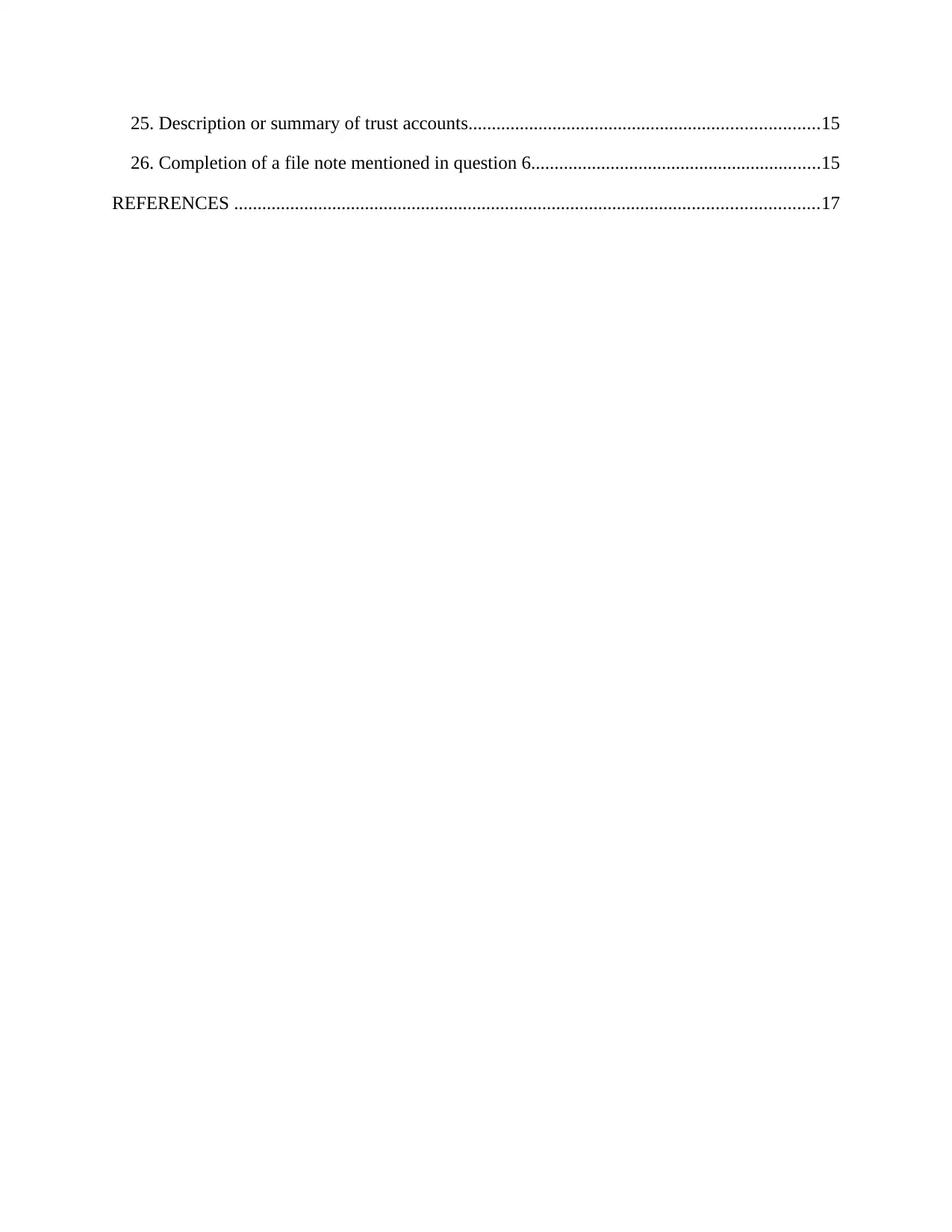
25. Description or summary of trust accounts...........................................................................15
26. Completion of a file note mentioned in question 6..............................................................15
REFERENCES .............................................................................................................................17
26. Completion of a file note mentioned in question 6..............................................................15
REFERENCES .............................................................................................................................17
⊘ This is a preview!⊘
Do you want full access?
Subscribe today to unlock all pages.

Trusted by 1+ million students worldwide
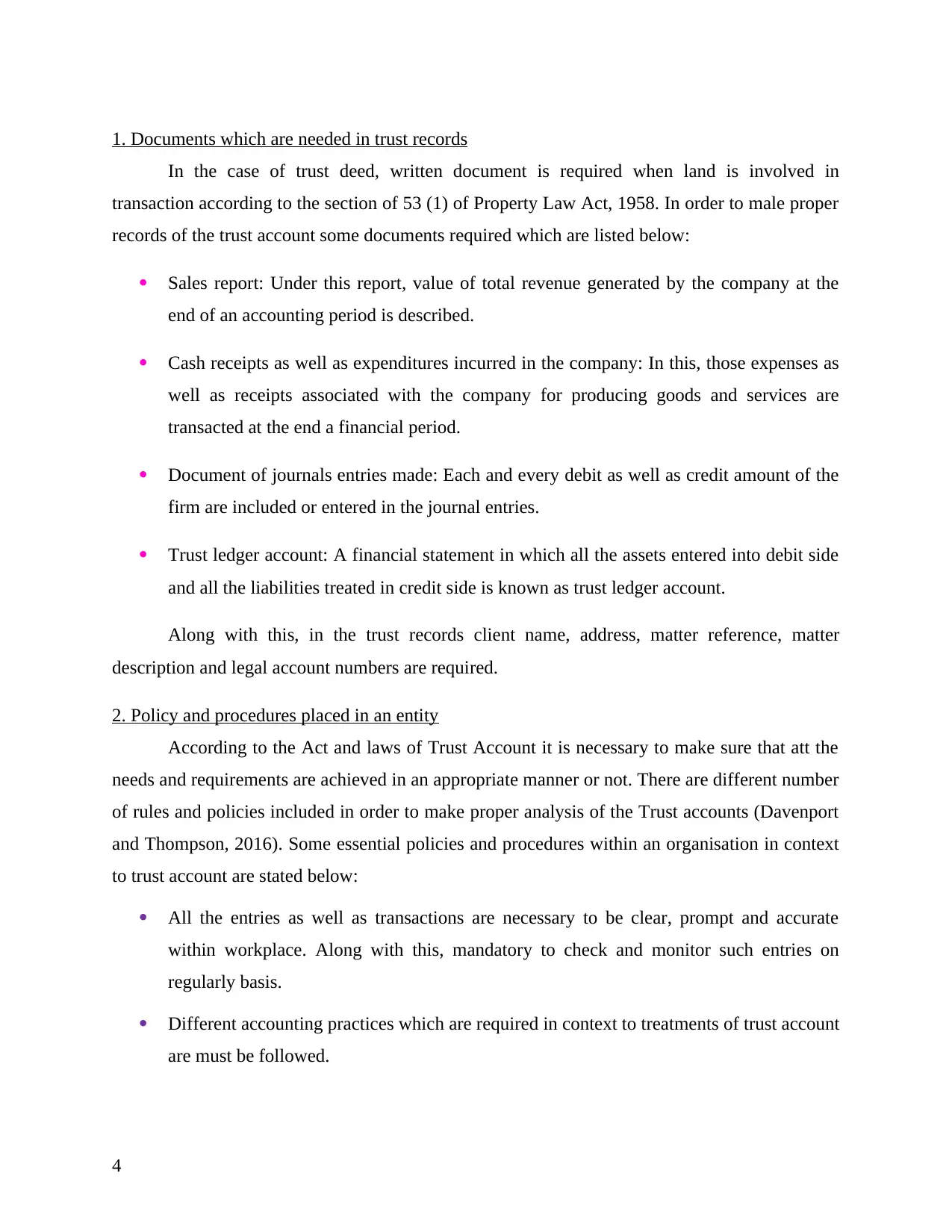
1. Documents which are needed in trust records
In the case of trust deed, written document is required when land is involved in
transaction according to the section of 53 (1) of Property Law Act, 1958. In order to male proper
records of the trust account some documents required which are listed below:
Sales report: Under this report, value of total revenue generated by the company at the
end of an accounting period is described.
Cash receipts as well as expenditures incurred in the company: In this, those expenses as
well as receipts associated with the company for producing goods and services are
transacted at the end a financial period.
Document of journals entries made: Each and every debit as well as credit amount of the
firm are included or entered in the journal entries.
Trust ledger account: A financial statement in which all the assets entered into debit side
and all the liabilities treated in credit side is known as trust ledger account.
Along with this, in the trust records client name, address, matter reference, matter
description and legal account numbers are required.
2. Policy and procedures placed in an entity
According to the Act and laws of Trust Account it is necessary to make sure that att the
needs and requirements are achieved in an appropriate manner or not. There are different number
of rules and policies included in order to make proper analysis of the Trust accounts (Davenport
and Thompson, 2016). Some essential policies and procedures within an organisation in context
to trust account are stated below:
All the entries as well as transactions are necessary to be clear, prompt and accurate
within workplace. Along with this, mandatory to check and monitor such entries on
regularly basis.
Different accounting practices which are required in context to treatments of trust account
are must be followed.
4
In the case of trust deed, written document is required when land is involved in
transaction according to the section of 53 (1) of Property Law Act, 1958. In order to male proper
records of the trust account some documents required which are listed below:
Sales report: Under this report, value of total revenue generated by the company at the
end of an accounting period is described.
Cash receipts as well as expenditures incurred in the company: In this, those expenses as
well as receipts associated with the company for producing goods and services are
transacted at the end a financial period.
Document of journals entries made: Each and every debit as well as credit amount of the
firm are included or entered in the journal entries.
Trust ledger account: A financial statement in which all the assets entered into debit side
and all the liabilities treated in credit side is known as trust ledger account.
Along with this, in the trust records client name, address, matter reference, matter
description and legal account numbers are required.
2. Policy and procedures placed in an entity
According to the Act and laws of Trust Account it is necessary to make sure that att the
needs and requirements are achieved in an appropriate manner or not. There are different number
of rules and policies included in order to make proper analysis of the Trust accounts (Davenport
and Thompson, 2016). Some essential policies and procedures within an organisation in context
to trust account are stated below:
All the entries as well as transactions are necessary to be clear, prompt and accurate
within workplace. Along with this, mandatory to check and monitor such entries on
regularly basis.
Different accounting practices which are required in context to treatments of trust account
are must be followed.
4
Paraphrase This Document
Need a fresh take? Get an instant paraphrase of this document with our AI Paraphraser
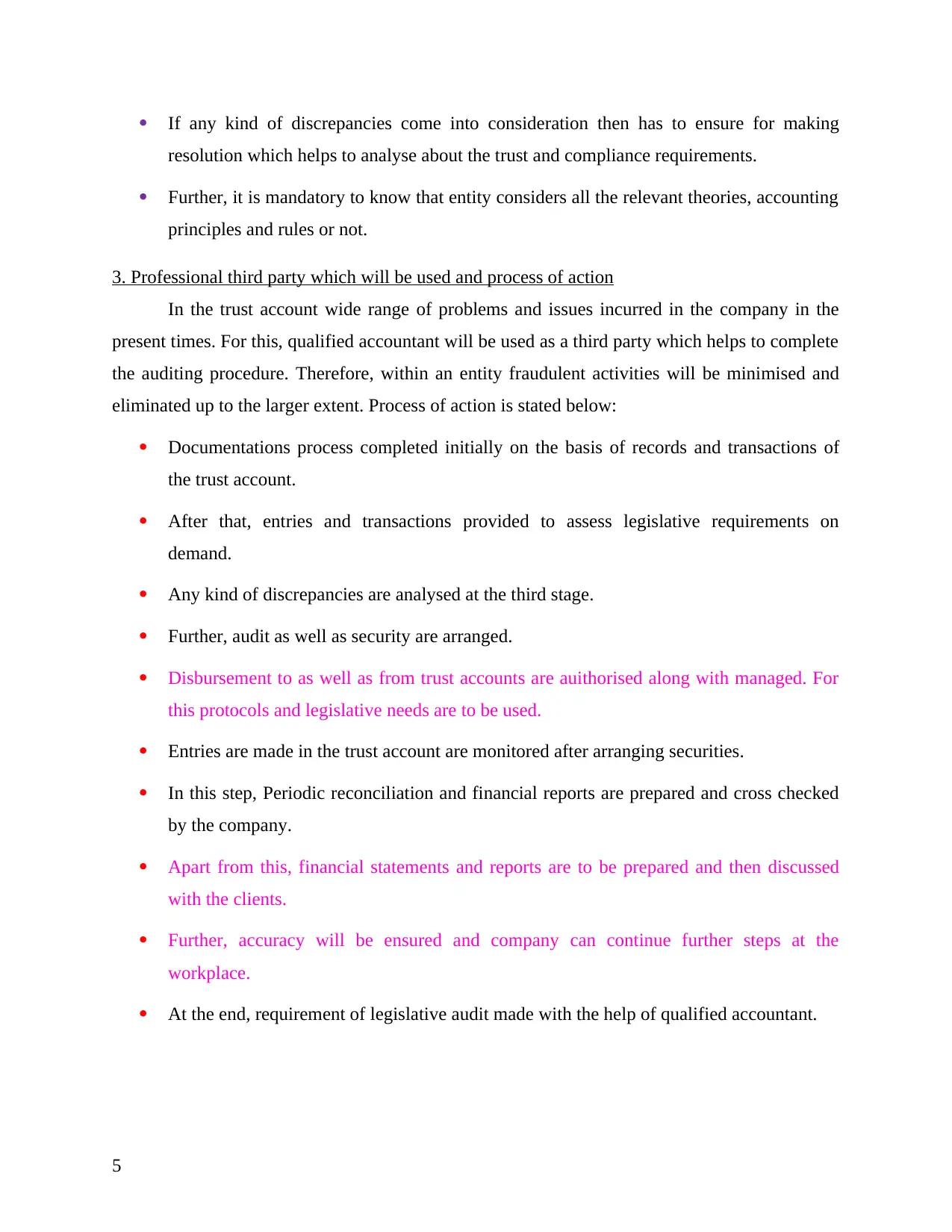
If any kind of discrepancies come into consideration then has to ensure for making
resolution which helps to analyse about the trust and compliance requirements.
Further, it is mandatory to know that entity considers all the relevant theories, accounting
principles and rules or not.
3. Professional third party which will be used and process of action
In the trust account wide range of problems and issues incurred in the company in the
present times. For this, qualified accountant will be used as a third party which helps to complete
the auditing procedure. Therefore, within an entity fraudulent activities will be minimised and
eliminated up to the larger extent. Process of action is stated below:
Documentations process completed initially on the basis of records and transactions of
the trust account.
After that, entries and transactions provided to assess legislative requirements on
demand.
Any kind of discrepancies are analysed at the third stage.
Further, audit as well as security are arranged.
Disbursement to as well as from trust accounts are auithorised along with managed. For
this protocols and legislative needs are to be used.
Entries are made in the trust account are monitored after arranging securities.
In this step, Periodic reconciliation and financial reports are prepared and cross checked
by the company.
Apart from this, financial statements and reports are to be prepared and then discussed
with the clients.
Further, accuracy will be ensured and company can continue further steps at the
workplace.
At the end, requirement of legislative audit made with the help of qualified accountant.
5
resolution which helps to analyse about the trust and compliance requirements.
Further, it is mandatory to know that entity considers all the relevant theories, accounting
principles and rules or not.
3. Professional third party which will be used and process of action
In the trust account wide range of problems and issues incurred in the company in the
present times. For this, qualified accountant will be used as a third party which helps to complete
the auditing procedure. Therefore, within an entity fraudulent activities will be minimised and
eliminated up to the larger extent. Process of action is stated below:
Documentations process completed initially on the basis of records and transactions of
the trust account.
After that, entries and transactions provided to assess legislative requirements on
demand.
Any kind of discrepancies are analysed at the third stage.
Further, audit as well as security are arranged.
Disbursement to as well as from trust accounts are auithorised along with managed. For
this protocols and legislative needs are to be used.
Entries are made in the trust account are monitored after arranging securities.
In this step, Periodic reconciliation and financial reports are prepared and cross checked
by the company.
Apart from this, financial statements and reports are to be prepared and then discussed
with the clients.
Further, accuracy will be ensured and company can continue further steps at the
workplace.
At the end, requirement of legislative audit made with the help of qualified accountant.
5
In order to communicate with the employees, notes of the financials used while preparing
the final accounts are undertaken. Apart from this, channels, authentication of recording
payments and incomes etc. are also used for communicating with employees.
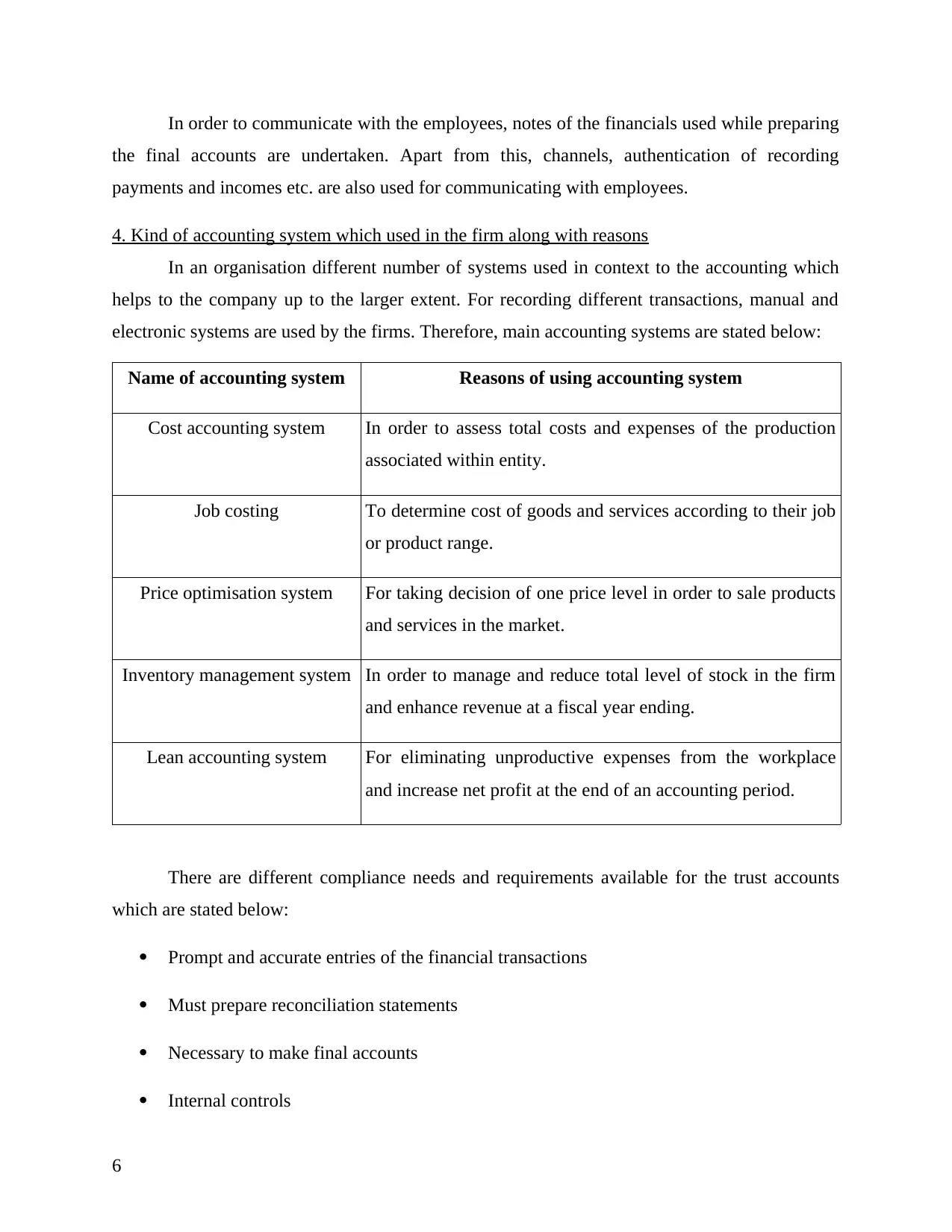
4. Kind of accounting system which used in the firm along with reasons
In an organisation different number of systems used in context to the accounting which
helps to the company up to the larger extent. For recording different transactions, manual and
electronic systems are used by the firms. Therefore, main accounting systems are stated below:
Name of accounting system Reasons of using accounting system
Cost accounting system In order to assess total costs and expenses of the production
associated within entity.
Job costing To determine cost of goods and services according to their job
or product range.
Price optimisation system For taking decision of one price level in order to sale products
and services in the market.
Inventory management system In order to manage and reduce total level of stock in the firm
and enhance revenue at a fiscal year ending.
Lean accounting system For eliminating unproductive expenses from the workplace
and increase net profit at the end of an accounting period.
There are different compliance needs and requirements available for the trust accounts
which are stated below:
Prompt and accurate entries of the financial transactions
Must prepare reconciliation statements
Necessary to make final accounts
Internal controls
6
the final accounts are undertaken. Apart from this, channels, authentication of recording
payments and incomes etc. are also used for communicating with employees.
4. Kind of accounting system which used in the firm along with reasons
In an organisation different number of systems used in context to the accounting which
helps to the company up to the larger extent. For recording different transactions, manual and
electronic systems are used by the firms. Therefore, main accounting systems are stated below:
Name of accounting system Reasons of using accounting system
Cost accounting system In order to assess total costs and expenses of the production
associated within entity.
Job costing To determine cost of goods and services according to their job
or product range.
Price optimisation system For taking decision of one price level in order to sale products
and services in the market.
Inventory management system In order to manage and reduce total level of stock in the firm
and enhance revenue at a fiscal year ending.
Lean accounting system For eliminating unproductive expenses from the workplace
and increase net profit at the end of an accounting period.
There are different compliance needs and requirements available for the trust accounts
which are stated below:
Prompt and accurate entries of the financial transactions
Must prepare reconciliation statements
Necessary to make final accounts
Internal controls
6
⊘ This is a preview!⊘
Do you want full access?
Subscribe today to unlock all pages.
Trusted by 1+ million students worldwide
Proper audit system
Disbursements
Policies and procedures
Monthly trust binder etc.
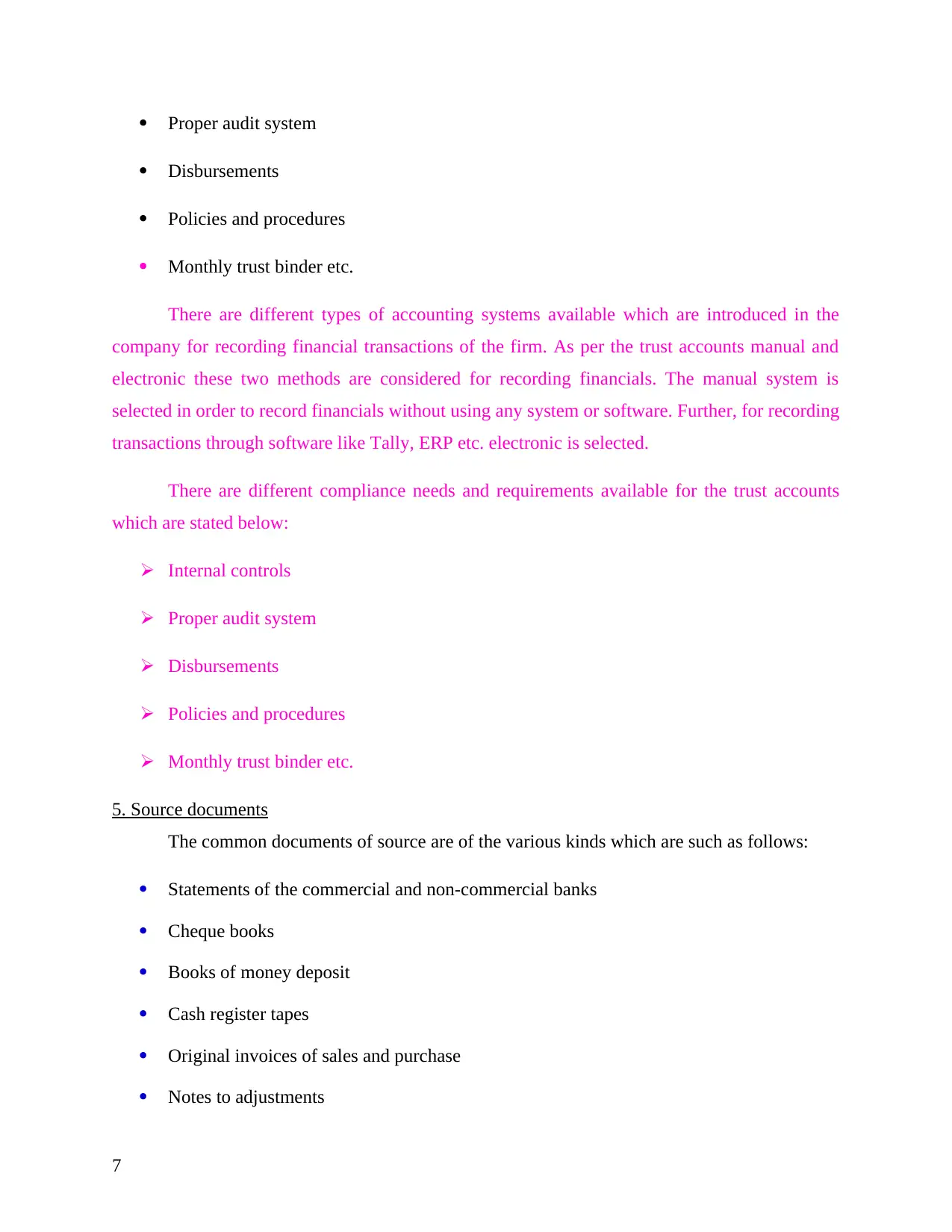
There are different types of accounting systems available which are introduced in the
company for recording financial transactions of the firm. As per the trust accounts manual and
electronic these two methods are considered for recording financials. The manual system is
selected in order to record financials without using any system or software. Further, for recording
transactions through software like Tally, ERP etc. electronic is selected.
There are different compliance needs and requirements available for the trust accounts
which are stated below:
Internal controls
Proper audit system
Disbursements
Policies and procedures
Monthly trust binder etc.
5. Source documents
The common documents of source are of the various kinds which are such as follows:
Statements of the commercial and non-commercial banks
Cheque books
Books of money deposit
Cash register tapes
Original invoices of sales and purchase
Notes to adjustments
7
Disbursements
Policies and procedures
Monthly trust binder etc.
There are different types of accounting systems available which are introduced in the
company for recording financial transactions of the firm. As per the trust accounts manual and
electronic these two methods are considered for recording financials. The manual system is
selected in order to record financials without using any system or software. Further, for recording
transactions through software like Tally, ERP etc. electronic is selected.
There are different compliance needs and requirements available for the trust accounts
which are stated below:
Internal controls
Proper audit system
Disbursements
Policies and procedures
Monthly trust binder etc.
5. Source documents
The common documents of source are of the various kinds which are such as follows:
Statements of the commercial and non-commercial banks
Cheque books
Books of money deposit
Cash register tapes
Original invoices of sales and purchase
Notes to adjustments
7
Paraphrase This Document
Need a fresh take? Get an instant paraphrase of this document with our AI Paraphraser
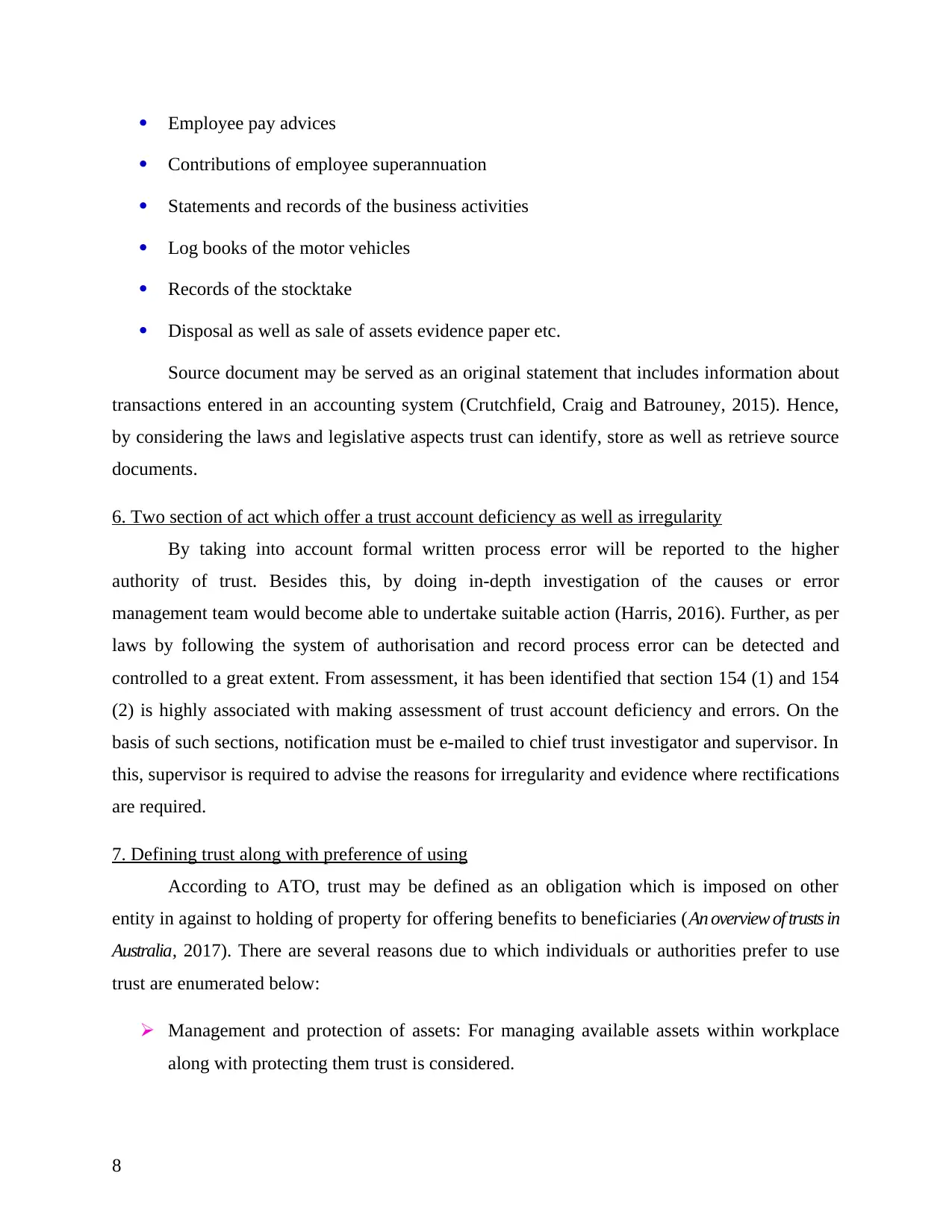
Employee pay advices
Contributions of employee superannuation
Statements and records of the business activities
Log books of the motor vehicles
Records of the stocktake
Disposal as well as sale of assets evidence paper etc.
Source document may be served as an original statement that includes information about
transactions entered in an accounting system (Crutchfield, Craig and Batrouney, 2015). Hence,
by considering the laws and legislative aspects trust can identify, store as well as retrieve source
documents.
6. Two section of act which offer a trust account deficiency as well as irregularity
By taking into account formal written process error will be reported to the higher
authority of trust. Besides this, by doing in-depth investigation of the causes or error
management team would become able to undertake suitable action (Harris, 2016). Further, as per
laws by following the system of authorisation and record process error can be detected and
controlled to a great extent. From assessment, it has been identified that section 154 (1) and 154
(2) is highly associated with making assessment of trust account deficiency and errors. On the
basis of such sections, notification must be e-mailed to chief trust investigator and supervisor. In
this, supervisor is required to advise the reasons for irregularity and evidence where rectifications
are required.
7. Defining trust along with preference of using
According to ATO, trust may be defined as an obligation which is imposed on other
entity in against to holding of property for offering benefits to beneficiaries (An overview of trusts in
Australia, 2017). There are several reasons due to which individuals or authorities prefer to use
trust are enumerated below:
Management and protection of assets: For managing available assets within workplace
along with protecting them trust is considered.
8
Contributions of employee superannuation
Statements and records of the business activities
Log books of the motor vehicles
Records of the stocktake
Disposal as well as sale of assets evidence paper etc.
Source document may be served as an original statement that includes information about
transactions entered in an accounting system (Crutchfield, Craig and Batrouney, 2015). Hence,
by considering the laws and legislative aspects trust can identify, store as well as retrieve source
documents.
6. Two section of act which offer a trust account deficiency as well as irregularity
By taking into account formal written process error will be reported to the higher
authority of trust. Besides this, by doing in-depth investigation of the causes or error
management team would become able to undertake suitable action (Harris, 2016). Further, as per
laws by following the system of authorisation and record process error can be detected and
controlled to a great extent. From assessment, it has been identified that section 154 (1) and 154
(2) is highly associated with making assessment of trust account deficiency and errors. On the
basis of such sections, notification must be e-mailed to chief trust investigator and supervisor. In
this, supervisor is required to advise the reasons for irregularity and evidence where rectifications
are required.
7. Defining trust along with preference of using
According to ATO, trust may be defined as an obligation which is imposed on other
entity in against to holding of property for offering benefits to beneficiaries (An overview of trusts in
Australia, 2017). There are several reasons due to which individuals or authorities prefer to use
trust are enumerated below:
Management and protection of assets: For managing available assets within workplace
along with protecting them trust is considered.
8
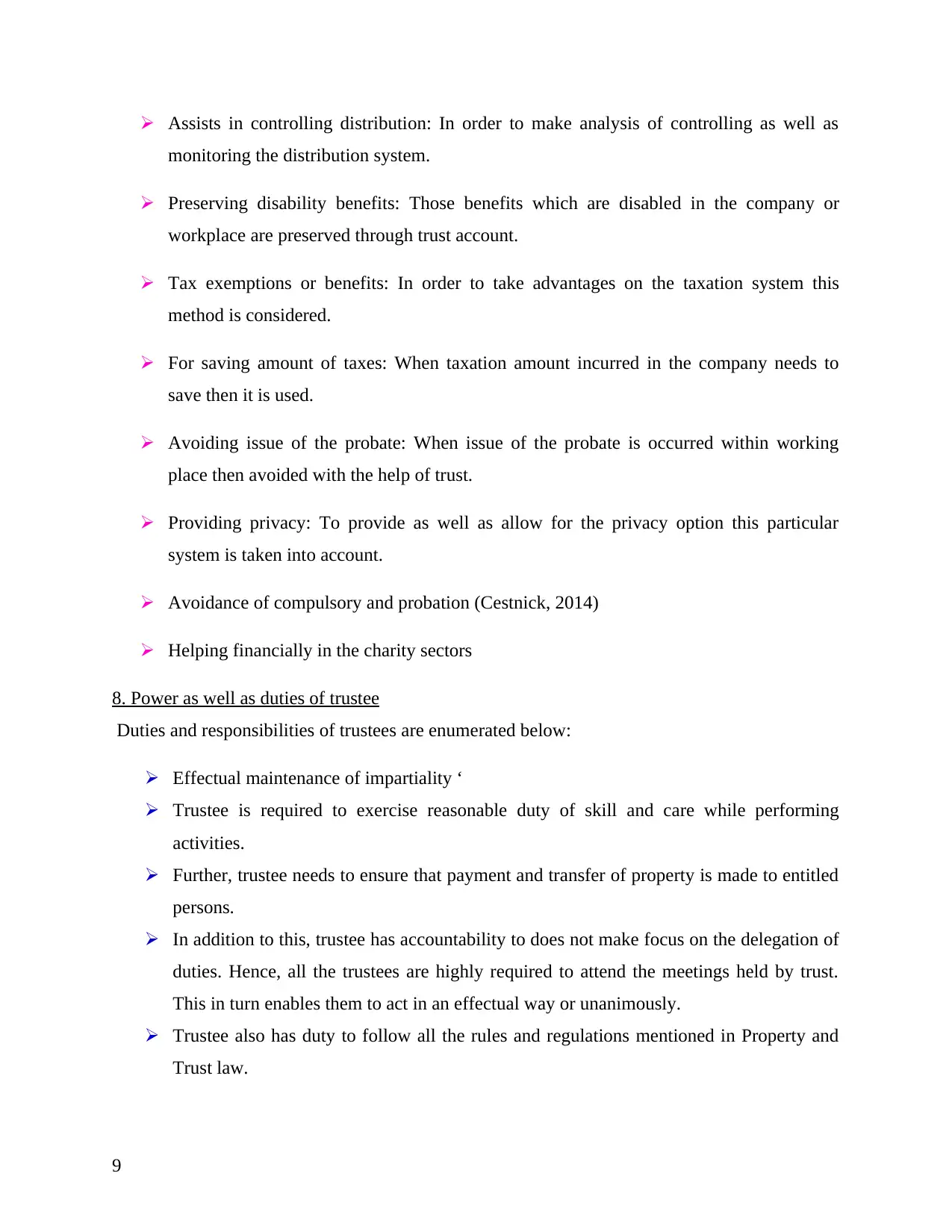
Assists in controlling distribution: In order to make analysis of controlling as well as
monitoring the distribution system.
Preserving disability benefits: Those benefits which are disabled in the company or
workplace are preserved through trust account.
Tax exemptions or benefits: In order to take advantages on the taxation system this
method is considered.
For saving amount of taxes: When taxation amount incurred in the company needs to
save then it is used.
Avoiding issue of the probate: When issue of the probate is occurred within working
place then avoided with the help of trust.
Providing privacy: To provide as well as allow for the privacy option this particular
system is taken into account.
Avoidance of compulsory and probation (Cestnick, 2014)
Helping financially in the charity sectors
8. Power as well as duties of trustee
Duties and responsibilities of trustees are enumerated below:
Effectual maintenance of impartiality ‘
Trustee is required to exercise reasonable duty of skill and care while performing
activities.
Further, trustee needs to ensure that payment and transfer of property is made to entitled
persons.
In addition to this, trustee has accountability to does not make focus on the delegation of
duties. Hence, all the trustees are highly required to attend the meetings held by trust.
This in turn enables them to act in an effectual way or unanimously.
Trustee also has duty to follow all the rules and regulations mentioned in Property and
Trust law.
9
monitoring the distribution system.
Preserving disability benefits: Those benefits which are disabled in the company or
workplace are preserved through trust account.
Tax exemptions or benefits: In order to take advantages on the taxation system this
method is considered.
For saving amount of taxes: When taxation amount incurred in the company needs to
save then it is used.
Avoiding issue of the probate: When issue of the probate is occurred within working
place then avoided with the help of trust.
Providing privacy: To provide as well as allow for the privacy option this particular
system is taken into account.
Avoidance of compulsory and probation (Cestnick, 2014)
Helping financially in the charity sectors
8. Power as well as duties of trustee
Duties and responsibilities of trustees are enumerated below:
Effectual maintenance of impartiality ‘
Trustee is required to exercise reasonable duty of skill and care while performing
activities.
Further, trustee needs to ensure that payment and transfer of property is made to entitled
persons.
In addition to this, trustee has accountability to does not make focus on the delegation of
duties. Hence, all the trustees are highly required to attend the meetings held by trust.
This in turn enables them to act in an effectual way or unanimously.
Trustee also has duty to follow all the rules and regulations mentioned in Property and
Trust law.
9
⊘ This is a preview!⊘
Do you want full access?
Subscribe today to unlock all pages.
Trusted by 1+ million students worldwide
It is the accountability of trustee to maintain proper record of financial aspects and
provide beneficiaries with highly relevant information (Trust accounts, 2016).
Standard duty of care and loyalty also must be followed by trustees.
9. Different kinds of trusts along with brief clarification
There are different types of trust which have varied features or aspects such as:
Express trusts: It refers to the one which is created through the intentional declaration of
settlor. Express terms can be distinguished in four other parts such as discretionary,
executed, bare and constituted. Non-express trusts: Unlike express trust, non-express trusts are created without having
any intentional declaration and communication. Further, non-express terms can be
divided into types such as implied and constructive. Unit trusts: In this, trust lays high level of emphasis on dividing the ownership of trust
property into units. Hence, such trust highly differs from discretionary one because it is
held for unit holder.
Trading trusts: This trust is highly used for the trust and its beneficiaries which in turn
help in attaining benefits in relation to the taxation aspect (Accounting for trust money -
estate agents, 2016).
Discretionary trust: Such trusts are created with the motive to manage, protect and pass
family assets more effectually. In this, family assets include shares, personal property and
business.
10. Explanation about the fiduciary relationship
Fiduciary relationship may be served as a combination of trust and confidence. Hence,
such kind of relationship arises when one person is obliged to act in a good way for the interests
of other entity. In the context of trust, fiduciary relationship arises from two sources such as
agency and relationship of ascendancy. Further, when trustee performs activities for private
benefits then they are considered as breached.
Main features of fiduciary relationship are as follows:
10
provide beneficiaries with highly relevant information (Trust accounts, 2016).
Standard duty of care and loyalty also must be followed by trustees.
9. Different kinds of trusts along with brief clarification
There are different types of trust which have varied features or aspects such as:
Express trusts: It refers to the one which is created through the intentional declaration of
settlor. Express terms can be distinguished in four other parts such as discretionary,
executed, bare and constituted. Non-express trusts: Unlike express trust, non-express trusts are created without having
any intentional declaration and communication. Further, non-express terms can be
divided into types such as implied and constructive. Unit trusts: In this, trust lays high level of emphasis on dividing the ownership of trust
property into units. Hence, such trust highly differs from discretionary one because it is
held for unit holder.
Trading trusts: This trust is highly used for the trust and its beneficiaries which in turn
help in attaining benefits in relation to the taxation aspect (Accounting for trust money -
estate agents, 2016).
Discretionary trust: Such trusts are created with the motive to manage, protect and pass
family assets more effectually. In this, family assets include shares, personal property and
business.
10. Explanation about the fiduciary relationship
Fiduciary relationship may be served as a combination of trust and confidence. Hence,
such kind of relationship arises when one person is obliged to act in a good way for the interests
of other entity. In the context of trust, fiduciary relationship arises from two sources such as
agency and relationship of ascendancy. Further, when trustee performs activities for private
benefits then they are considered as breached.
Main features of fiduciary relationship are as follows:
10
Paraphrase This Document
Need a fresh take? Get an instant paraphrase of this document with our AI Paraphraser
In fiduciary relationship, existence of trust and confidence in the form beneficiary and
partner is highly required. This in turn enables one individual to influence the decision
making aspect of others.
Under this, one person relies on other entity due to having relationship such as trust and
confidence.
Individuals who have fiduciary obligations include beneficiary and executor, company
promoter & firm, director of the company & firm, principal & agent, solicitor & client as well as
guardian & ward. Thus, activities performed by all such entities may result into rise in fiduciary
relationship.
11. Meaning of inter-vivos along with express and discretionary
Inter-Vivo trust may be defined as one which is developed for managing certain assets
and offering support to beneficiaries. Such trust is governed on the basis of deed, not on the basis
of will. Hence, under Inter-Vivo trust, assets are managed on the behalf of beneficiaries.
Discretionary trust is the main examples of Inter-Vivo trust which come under the category of
express aspect (Inter-vivos trust, 2017). Hence, such trust implies for the one where interest of
beneficiaries is not determined when it is created. Thus, it can be stated that inter-vivo trust
implies for the fiduciary relationship that is used in estate planning. Further, inter vivo trusts are
also known as living trust the one that can be created during the lifetime of the trustor. It includes
mainly two trusts which are enumerated below:
Express trust: As per Australian rules, such trusts implies for the one that are deliberately
created by the settlor. By creating such trust concerned authority can preserve or enhance
wealth to a great extent.
Discretionary trust: In such trust, beneficiaries have no right to claim for the property and
their debts which in turn provides high level of flexibility. Hence, in this
12. Description of winding up procedure of a trust
Specifically, there are mainly three options that can be considered for winding up trust
are as follows:
11
partner is highly required. This in turn enables one individual to influence the decision
making aspect of others.
Under this, one person relies on other entity due to having relationship such as trust and
confidence.
Individuals who have fiduciary obligations include beneficiary and executor, company
promoter & firm, director of the company & firm, principal & agent, solicitor & client as well as
guardian & ward. Thus, activities performed by all such entities may result into rise in fiduciary
relationship.
11. Meaning of inter-vivos along with express and discretionary
Inter-Vivo trust may be defined as one which is developed for managing certain assets
and offering support to beneficiaries. Such trust is governed on the basis of deed, not on the basis
of will. Hence, under Inter-Vivo trust, assets are managed on the behalf of beneficiaries.
Discretionary trust is the main examples of Inter-Vivo trust which come under the category of
express aspect (Inter-vivos trust, 2017). Hence, such trust implies for the one where interest of
beneficiaries is not determined when it is created. Thus, it can be stated that inter-vivo trust
implies for the fiduciary relationship that is used in estate planning. Further, inter vivo trusts are
also known as living trust the one that can be created during the lifetime of the trustor. It includes
mainly two trusts which are enumerated below:
Express trust: As per Australian rules, such trusts implies for the one that are deliberately
created by the settlor. By creating such trust concerned authority can preserve or enhance
wealth to a great extent.
Discretionary trust: In such trust, beneficiaries have no right to claim for the property and
their debts which in turn provides high level of flexibility. Hence, in this
12. Description of winding up procedure of a trust
Specifically, there are mainly three options that can be considered for winding up trust
are as follows:
11
By distributing either trust assets or cash to the beneficiaries according to the terms of
instrument trust can be winded up. In this regard, terms of instrument include power of
appointment; accelerate vesting, maintenance as well as advancements.
Further, by releasing or fulfilling trust obligations one can either trustee, beneficiary or
legal authority wind trust operations (Trusts, 2017).
In addition to this, by selling concerned property trust can be winded.
13. Process of manual as well as electronic transactions
There is a significant difference takes place in electronic and manual transaction system.
Moreover, in the case of electronic system by entering data set one can generate receipt or do
transaction within the less time (McLean and Paull, 2017). On the other side, manual system
requires more time and thereby directly affects the effectiveness of transaction.
14. Ways of protecting funds of the client
Funds of the clients are necessary to protect and manage within every organisation and
for which some methods included. According to the fund protection act and rules, audit and
security arrangement is one of the best way for protecting fund of the clients. However, all the
monetary or transactions are come in front of the auditor which lead to lost the privacy. Hence, it
can be said that, issue regarding to privacy is up to the higher extent included with this protection
system. By following act of the data protection as well as the fund protection, amount of the
customers or clients can be protected in an effective manner. Along with this, procedure of
auditing is also one of the effectual method. Arranging auditing procedure as well as securities,
the company able to protect fund and capitals of the client in proper direction. Apart from this, if
specific authorisation party is not recruited then management cannot give appropriate protection
to funds which is of the clients.
15. Ways through which funds are disbursed
In accordance with Trust law communication should be clear and precise regarding fund
disbursement. Hence, for the maintenance of high level of accuracy in the accounts trust needs to
follow documentary process in line with the legislative requirements. Besides this, for the
prevention of fraudulent activities audit and security arrangements have made. Thus, by
providing adequate protection for the client confidentiality audit is conducted by the
12
instrument trust can be winded up. In this regard, terms of instrument include power of
appointment; accelerate vesting, maintenance as well as advancements.
Further, by releasing or fulfilling trust obligations one can either trustee, beneficiary or
legal authority wind trust operations (Trusts, 2017).
In addition to this, by selling concerned property trust can be winded.
13. Process of manual as well as electronic transactions
There is a significant difference takes place in electronic and manual transaction system.
Moreover, in the case of electronic system by entering data set one can generate receipt or do
transaction within the less time (McLean and Paull, 2017). On the other side, manual system
requires more time and thereby directly affects the effectiveness of transaction.
14. Ways of protecting funds of the client
Funds of the clients are necessary to protect and manage within every organisation and
for which some methods included. According to the fund protection act and rules, audit and
security arrangement is one of the best way for protecting fund of the clients. However, all the
monetary or transactions are come in front of the auditor which lead to lost the privacy. Hence, it
can be said that, issue regarding to privacy is up to the higher extent included with this protection
system. By following act of the data protection as well as the fund protection, amount of the
customers or clients can be protected in an effective manner. Along with this, procedure of
auditing is also one of the effectual method. Arranging auditing procedure as well as securities,
the company able to protect fund and capitals of the client in proper direction. Apart from this, if
specific authorisation party is not recruited then management cannot give appropriate protection
to funds which is of the clients.
15. Ways through which funds are disbursed
In accordance with Trust law communication should be clear and precise regarding fund
disbursement. Hence, for the maintenance of high level of accuracy in the accounts trust needs to
follow documentary process in line with the legislative requirements. Besides this, for the
prevention of fraudulent activities audit and security arrangements have made. Thus, by
providing adequate protection for the client confidentiality audit is conducted by the
12
⊘ This is a preview!⊘
Do you want full access?
Subscribe today to unlock all pages.
Trusted by 1+ million students worldwide

1 out of 18


Related Documents


Your All-in-One AI-Powered Toolkit for Academic Success.
+13062052269
info@desklib.com
Available 24*7 on WhatsApp / Email
![[object Object]](/_next/static/media/star-bottom.7253800d.svg)
Unlock your academic potential
Copyright © 2020–2026 A2Z Services. All Rights Reserved. Developed and managed by ZUCOL.