Management and Organizations: National Culture Analysis Report
VerifiedAdded on 2022/12/29
|20
|4456
|25
Report
AI Summary
This report provides an in-depth analysis of national culture, examining its definition, key dimensions, and impact on business practices in a global environment. It begins by defining national culture as a set of shared values and beliefs that influence behavior. The report then explores the Hofstede model, outlining dimensions such as power distance, individualism, masculinity, uncertainty avoidance, and long-term orientation. These dimensions are used to compare different countries and their business cultures. The report emphasizes the importance of understanding national culture for successful international business operations, highlighting how cultural awareness can improve relationships and enhance trade. The report also discusses the impact of globalization on business culture and the need for firms to adapt to diverse cultural environments. Finally, the report provides a comparative analysis of different countries, illustrating the practical application of cultural dimensions in real-world business scenarios. The analysis of the countries helps to understand the cultural differences and the ways in which these differences affect the business environment.

Running head: NATIONAL CULTURE
NATIONAL CULTURE
Name of the Student
Name of the University
Author Note
NATIONAL CULTURE
Name of the Student
Name of the University
Author Note

Paraphrase This Document
Need a fresh take? Get an instant paraphrase of this document with our AI Paraphraser
1NATIONAL CULTURE
Executive Summary
The report throws light on the overall concept of national culture. The national culture can be
defined and identified as the set of values and beliefs which are commonly shared by a set of
individuals and can be used to understand the predicted behavior. The Hofstede model was used
as the basis of comparison between the different countries as it identifies the determiners of
national culture in the best possible way The report follows a comprehensive format with respect
to which, the concept of National culture has been discussed and this is then followed by the
discussion on the dimensions of the model which have been identified and discussed for all the
countries which are present.
Executive Summary
The report throws light on the overall concept of national culture. The national culture can be
defined and identified as the set of values and beliefs which are commonly shared by a set of
individuals and can be used to understand the predicted behavior. The Hofstede model was used
as the basis of comparison between the different countries as it identifies the determiners of
national culture in the best possible way The report follows a comprehensive format with respect
to which, the concept of National culture has been discussed and this is then followed by the
discussion on the dimensions of the model which have been identified and discussed for all the
countries which are present.
2NATIONAL CULTURE
Table of Contents
Introduction......................................................................................................................................3
Discussion........................................................................................................................................3
Importance of understanding national culture.............................................................................3
Dimensions used in defining National culture- Hofstede models...............................................5
Comparing the different countries...............................................................................................8
Hofstede Model..........................................................................................................................13
Summary........................................................................................................................................13
Conclusion.....................................................................................................................................14
References......................................................................................................................................16
Table of Contents
Introduction......................................................................................................................................3
Discussion........................................................................................................................................3
Importance of understanding national culture.............................................................................3
Dimensions used in defining National culture- Hofstede models...............................................5
Comparing the different countries...............................................................................................8
Hofstede Model..........................................................................................................................13
Summary........................................................................................................................................13
Conclusion.....................................................................................................................................14
References......................................................................................................................................16
⊘ This is a preview!⊘
Do you want full access?
Subscribe today to unlock all pages.

Trusted by 1+ million students worldwide
3NATIONAL CULTURE
Introduction
The National culture can be essentially defined as a set of norms, behaviors, customs,
beliefs and the values which are essentially shared by the different individuals belonging into a
particular country (Bakir et al. 2015). The national culture can also be broadly defined as the
religion, language, ethnic as well as the racial identity along with the cultural and other related
traditions which lead to the overall environment in the country. The national culture can be
understood to be the culture held by a national group of people. The different dimensions of the
national culture can be defined by the means of power distance, masculinity- femininity, the
individualism and collectivism and the uncertainty avoidance. These aspects are generally
understood to be quantified and provide country specific profiles. Hence, in such a scenario, it
becomes integral to ensure that, these dimensions briefly provide an overview of the national
culture and the national profiles can be used to predict the behavior and hence, should not be
judged to stereotype the other individuals (Beugelsdijk, Kostova and Roth 2017). The primary
aim of the report is to outline the overall concept of National culture, to underline the key aspects
which reflect the National culture and additionally, can also be used to define the manner in
which the national culture can be essentially used to define the way an individual might behave
in the business scenario. In addition to this, the case of five different countries will be chosen
and the manner in which the business culture differs in those countries shall be identified.
Discussion
Importance of understanding national culture
Introduction
The National culture can be essentially defined as a set of norms, behaviors, customs,
beliefs and the values which are essentially shared by the different individuals belonging into a
particular country (Bakir et al. 2015). The national culture can also be broadly defined as the
religion, language, ethnic as well as the racial identity along with the cultural and other related
traditions which lead to the overall environment in the country. The national culture can be
understood to be the culture held by a national group of people. The different dimensions of the
national culture can be defined by the means of power distance, masculinity- femininity, the
individualism and collectivism and the uncertainty avoidance. These aspects are generally
understood to be quantified and provide country specific profiles. Hence, in such a scenario, it
becomes integral to ensure that, these dimensions briefly provide an overview of the national
culture and the national profiles can be used to predict the behavior and hence, should not be
judged to stereotype the other individuals (Beugelsdijk, Kostova and Roth 2017). The primary
aim of the report is to outline the overall concept of National culture, to underline the key aspects
which reflect the National culture and additionally, can also be used to define the manner in
which the national culture can be essentially used to define the way an individual might behave
in the business scenario. In addition to this, the case of five different countries will be chosen
and the manner in which the business culture differs in those countries shall be identified.
Discussion
Importance of understanding national culture
Paraphrase This Document
Need a fresh take? Get an instant paraphrase of this document with our AI Paraphraser
4NATIONAL CULTURE
The Globalization has brought about the different countries closer to one another and all
the firm want to be a part of the larger unit. In line with this, it is integral to ensure that, the
culture of the firm is such that it is successfully able to engage in a sense of connection with the
different firms which it is dealing with (Beugelsdijk, Maseland and Van Hoorn 2015). In line
with this, the firm needs to become unified and become a part of a culture such that, the business
organizations can be carried out conveniently. Having a good understanding of the business
culture or the national culture of the country, the entire country or the firm can solidify the values
and successfully be able to achieve the overall goals (Chen et al. 2015). The national culture
helps in identifying the manner in which the firm can handle the business transactions
successfully and be able to embody the core values of the firm which the team members emulate.
The understanding of the national culture of an organization needs to be such that, the
different firms conducting business in the unit are able to form a high energy, fast growing,
innovative and sound company which makes it convenient for the firm to work in and thereby
enhances trade relationships. A good national culture can be considered to be the one where the
overall energy in the firm is very high and the firms are freely able to celebrate the successes
(Chui, Kwok and Zhou 2016). The firm is also able to inculcate positivity into the business
operations when the national culture of the country is such that it is successfully able to take in
new firms easily and in addition to this, are being able to participate in healthy relationships.
Therefore, it can be understood to be critically crucial that the national culture
understanding is taken seriously. When the firm aims to engage in operations with the different
firms in other countries which are present, they will have to expand the overall national
relationship which exists between the different countries and in line with this, it is crucial that,
the idea about the national culture is gained (Deephouse, Newburry and Soleimani 2016). This
The Globalization has brought about the different countries closer to one another and all
the firm want to be a part of the larger unit. In line with this, it is integral to ensure that, the
culture of the firm is such that it is successfully able to engage in a sense of connection with the
different firms which it is dealing with (Beugelsdijk, Maseland and Van Hoorn 2015). In line
with this, the firm needs to become unified and become a part of a culture such that, the business
organizations can be carried out conveniently. Having a good understanding of the business
culture or the national culture of the country, the entire country or the firm can solidify the values
and successfully be able to achieve the overall goals (Chen et al. 2015). The national culture
helps in identifying the manner in which the firm can handle the business transactions
successfully and be able to embody the core values of the firm which the team members emulate.
The understanding of the national culture of an organization needs to be such that, the
different firms conducting business in the unit are able to form a high energy, fast growing,
innovative and sound company which makes it convenient for the firm to work in and thereby
enhances trade relationships. A good national culture can be considered to be the one where the
overall energy in the firm is very high and the firms are freely able to celebrate the successes
(Chui, Kwok and Zhou 2016). The firm is also able to inculcate positivity into the business
operations when the national culture of the country is such that it is successfully able to take in
new firms easily and in addition to this, are being able to participate in healthy relationships.
Therefore, it can be understood to be critically crucial that the national culture
understanding is taken seriously. When the firm aims to engage in operations with the different
firms in other countries which are present, they will have to expand the overall national
relationship which exists between the different countries and in line with this, it is crucial that,
the idea about the national culture is gained (Deephouse, Newburry and Soleimani 2016). This
5NATIONAL CULTURE
shall help in creating a positive first impression, increases the chances of the contract being
upheld and additionally also ensures that the firm is being able to create successful relationships.
Therefore, all the members of a firm which plans to conduct the business internationally would
be required to see to it that idea about the national culture is gained through various dimensions
and tools so that competitive advantage can be attained (Eisend, Evanschitzky and Gilliland
2016).
Dimensions used in defining National culture- Hofstede models
The Psychologist Geert Hofstede came up with the national cultural dimension models at
the end of the 1970s which has since then become the internationally recognized standard for
understanding of the cultural differences amongst the different countries (Minkov et al. 2017).
The Hofstede carried out this research by undertaking an examination of more than 50 countries.
In line with this, the primary dimensions of the national culture which have been outlined by the
model can be underlined to be as follows:
1. Power Distance Index (high versus low).
2. Individualism Versus Collectivism.
3. Masculinity Versus Femininity.
4. Uncertainty Avoidance Index (high versus low).
5. Long- Versus Short-Term Orientation.
6. Indulgence Versus Restraint.
Power Distance Index (PDI)
shall help in creating a positive first impression, increases the chances of the contract being
upheld and additionally also ensures that the firm is being able to create successful relationships.
Therefore, all the members of a firm which plans to conduct the business internationally would
be required to see to it that idea about the national culture is gained through various dimensions
and tools so that competitive advantage can be attained (Eisend, Evanschitzky and Gilliland
2016).
Dimensions used in defining National culture- Hofstede models
The Psychologist Geert Hofstede came up with the national cultural dimension models at
the end of the 1970s which has since then become the internationally recognized standard for
understanding of the cultural differences amongst the different countries (Minkov et al. 2017).
The Hofstede carried out this research by undertaking an examination of more than 50 countries.
In line with this, the primary dimensions of the national culture which have been outlined by the
model can be underlined to be as follows:
1. Power Distance Index (high versus low).
2. Individualism Versus Collectivism.
3. Masculinity Versus Femininity.
4. Uncertainty Avoidance Index (high versus low).
5. Long- Versus Short-Term Orientation.
6. Indulgence Versus Restraint.
Power Distance Index (PDI)
⊘ This is a preview!⊘
Do you want full access?
Subscribe today to unlock all pages.
Trusted by 1+ million students worldwide
6NATIONAL CULTURE
The first national culture dimension which has to be reviewed can be essentially
identified and described as the Power Distance Index which tends to measure the degree of
inequality which tends to exist and is generally accepted amongst the people who are with or
without the power (El Ghoul and Zheng 2016). A high PDI score depicts that the society is
usually unequal and unacceptable of the equality. In line of this, it also becomes crucial to
understand that, people understand their positioning and place in the system. On the other hand, a
low PDI score indicates that, the power is widely dispersed and shared which means that the
society members do not accept situations where there exists inequality.
Individualism Versus Collectivism (IDV)
The next national cultural dimension can be stated to be relating to the various ties which
the different individuals share with one another within a community. When a country has a high
IDV score it reflects that the interpersonal connection and relationship amongst the individuals is
weak and that they do not consider themselves to be a part of a family. The people generally tend
to take lesser responsibility for the actions of other individuals and do not focus on the outcomes.
On the other hand, when the society is highly collectivist in nature then in such a scenario, they
tend to go to great extents in order to be loyal to the group which they belong to an additionally
defend their overall interests (Griffin et al. 2017). They also undertake considerable
responsibility for one another’s activities and wellbeing.
Masculinity Versus Femininity (MAS)
The third national cultural dimension can be largely understood to be the Masculinity and
the Femininity which brings about and discusses the different roles of the men and women in the
society. It states that in the societies which are masculine in nature, the roles of the women and
The first national culture dimension which has to be reviewed can be essentially
identified and described as the Power Distance Index which tends to measure the degree of
inequality which tends to exist and is generally accepted amongst the people who are with or
without the power (El Ghoul and Zheng 2016). A high PDI score depicts that the society is
usually unequal and unacceptable of the equality. In line of this, it also becomes crucial to
understand that, people understand their positioning and place in the system. On the other hand, a
low PDI score indicates that, the power is widely dispersed and shared which means that the
society members do not accept situations where there exists inequality.
Individualism Versus Collectivism (IDV)
The next national cultural dimension can be stated to be relating to the various ties which
the different individuals share with one another within a community. When a country has a high
IDV score it reflects that the interpersonal connection and relationship amongst the individuals is
weak and that they do not consider themselves to be a part of a family. The people generally tend
to take lesser responsibility for the actions of other individuals and do not focus on the outcomes.
On the other hand, when the society is highly collectivist in nature then in such a scenario, they
tend to go to great extents in order to be loyal to the group which they belong to an additionally
defend their overall interests (Griffin et al. 2017). They also undertake considerable
responsibility for one another’s activities and wellbeing.
Masculinity Versus Femininity (MAS)
The third national cultural dimension can be largely understood to be the Masculinity and
the Femininity which brings about and discusses the different roles of the men and women in the
society. It states that in the societies which are masculine in nature, the roles of the women and
Paraphrase This Document
Need a fresh take? Get an instant paraphrase of this document with our AI Paraphraser
7NATIONAL CULTURE
men tend to overlap less as the men are taken to behave massively and being headstrong,
demonstrating success and other such aspects are viewed as positive traits (Minkov 2018).
However, the case is opposite in relation to the feminine societies whereby there exists a great
deal of overlap between the male and the female roles in the society and modesty is perceived to
be a positive virtue. Good relationships can be considered to be the aspects which are given
greater importance to (Guerber, Rajagoplan and Anand 2016).
Uncertainty Avoidance Index (UAI)
The uncertainty avoidance index tends to disclose and determine the manner in which the
individuals of a particular nation tend to cope up with the anxiety. There are certain societies
where the overall Uncertainty avoidance rate is high and in this case, the different individuals
prefer to be predictable and as controlled as possible (Hallikainen and Laukkanen 2018). In such
a scenario, they attempt to make the life controllable and see to it that they are successfully being
able to lead a secured life. On the other hand, the countries where the UAI score is less, the
people tend to be more open, relaxed in a better manner and inclusive.
Long- Versus Short-Term Orientation
This dimension has been originally known as the Pragmatic Versus Normative. In such a
case, it is integral to understand that, this dimension tends to display the time horizon in which
different people tend to live in (Helmreich and Merritt 2017). The countries which have a
considerably long term orientation are modest, thrifty and pragmatic. On the other hand, the
individuals where the short term orientation is existent, the different people generally tend to
place greater emphasis on the various principles, consistency, truth as well as the religion and
nationalism.
men tend to overlap less as the men are taken to behave massively and being headstrong,
demonstrating success and other such aspects are viewed as positive traits (Minkov 2018).
However, the case is opposite in relation to the feminine societies whereby there exists a great
deal of overlap between the male and the female roles in the society and modesty is perceived to
be a positive virtue. Good relationships can be considered to be the aspects which are given
greater importance to (Guerber, Rajagoplan and Anand 2016).
Uncertainty Avoidance Index (UAI)
The uncertainty avoidance index tends to disclose and determine the manner in which the
individuals of a particular nation tend to cope up with the anxiety. There are certain societies
where the overall Uncertainty avoidance rate is high and in this case, the different individuals
prefer to be predictable and as controlled as possible (Hallikainen and Laukkanen 2018). In such
a scenario, they attempt to make the life controllable and see to it that they are successfully being
able to lead a secured life. On the other hand, the countries where the UAI score is less, the
people tend to be more open, relaxed in a better manner and inclusive.
Long- Versus Short-Term Orientation
This dimension has been originally known as the Pragmatic Versus Normative. In such a
case, it is integral to understand that, this dimension tends to display the time horizon in which
different people tend to live in (Helmreich and Merritt 2017). The countries which have a
considerably long term orientation are modest, thrifty and pragmatic. On the other hand, the
individuals where the short term orientation is existent, the different people generally tend to
place greater emphasis on the various principles, consistency, truth as well as the religion and
nationalism.
8NATIONAL CULTURE
Indulgence Versus Restraint (IVR)
The last cultural dimension can be understood to be related to the Indulgence Versus
Restraint. This dimension tends to state that, the countries which perform higher in this note tend
to reflect gratification and are driven by the emotions (López‐Duarte, Vidal‐Suárez and
González‐Díaz 2016). In line with this, it becomes considerably integral to see to it that, the
society with a low score is generally driven by more emphasis on surpassing the gratification and
additionally, tends to reflect more regulation on the conduct of the behavior of the people and
stricter norms of the society (Hofstede-insights.com 2019). In line with it can be understood that
the cultural norms have a key role to play in maintaining the overall relationship of the different
individuals at the workplace. In line with this, it becomes integral to ensure that, the behavioral
norms of the society need to be considered adequately when conducting business and hence,
conducting the business operations with people who belong to the similar culture can be highly
beneficial and result in an overall strong relationships which underlie the business operations
(Nazarian, Atkinson and Foroudi 2017).
The national culture of a business becomes more crucial to ensure when the business is
generally carried out with respect to the foreign countries and it becomes important for the firm
to ensure that they are not causing any offence. Hence, using the Hofstede as a starting point, it
shall become easy for the different businesses to ensure that they are successfully able to
evaluate the approach, the decisions and other such relevant aspects and thereby contribute
effectively to the trade dealings (Petersen, Kushwaha and Kumar 2015). All countries can be
considered to be unique and hence, a business relationship can be effectively strengthened, when
the mistakes made are very few.
Indulgence Versus Restraint (IVR)
The last cultural dimension can be understood to be related to the Indulgence Versus
Restraint. This dimension tends to state that, the countries which perform higher in this note tend
to reflect gratification and are driven by the emotions (López‐Duarte, Vidal‐Suárez and
González‐Díaz 2016). In line with this, it becomes considerably integral to see to it that, the
society with a low score is generally driven by more emphasis on surpassing the gratification and
additionally, tends to reflect more regulation on the conduct of the behavior of the people and
stricter norms of the society (Hofstede-insights.com 2019). In line with it can be understood that
the cultural norms have a key role to play in maintaining the overall relationship of the different
individuals at the workplace. In line with this, it becomes integral to ensure that, the behavioral
norms of the society need to be considered adequately when conducting business and hence,
conducting the business operations with people who belong to the similar culture can be highly
beneficial and result in an overall strong relationships which underlie the business operations
(Nazarian, Atkinson and Foroudi 2017).
The national culture of a business becomes more crucial to ensure when the business is
generally carried out with respect to the foreign countries and it becomes important for the firm
to ensure that they are not causing any offence. Hence, using the Hofstede as a starting point, it
shall become easy for the different businesses to ensure that they are successfully able to
evaluate the approach, the decisions and other such relevant aspects and thereby contribute
effectively to the trade dealings (Petersen, Kushwaha and Kumar 2015). All countries can be
considered to be unique and hence, a business relationship can be effectively strengthened, when
the mistakes made are very few.
⊘ This is a preview!⊘
Do you want full access?
Subscribe today to unlock all pages.
Trusted by 1+ million students worldwide
9NATIONAL CULTURE
Comparing the different countries
For the purpose of the analysis, the following sections will analyze certain countries
which are different in culture from one another and in line with this, it becomes integral to
understand that, this analysis will assist in understanding how different these countries are from
one another.
Australia
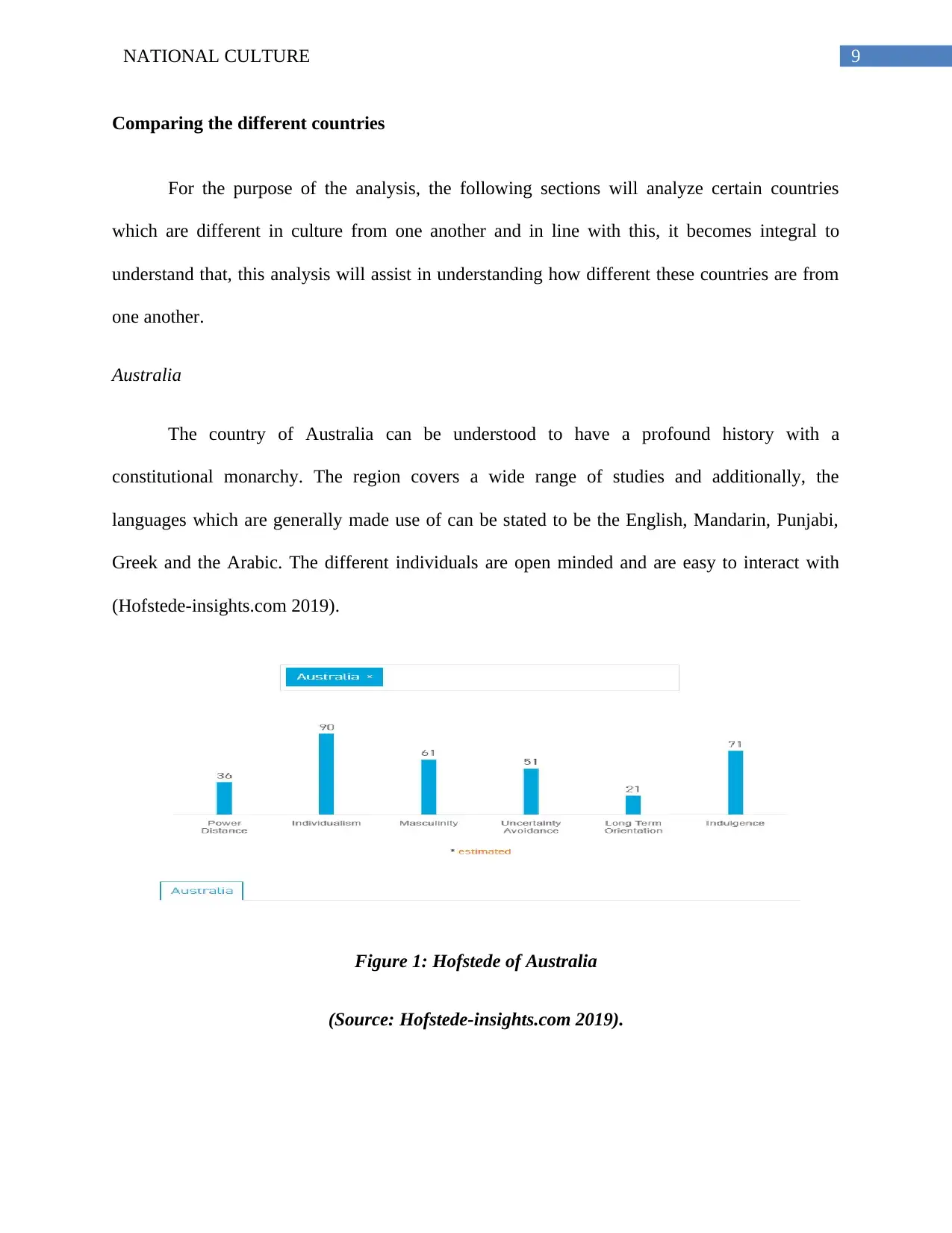
The country of Australia can be understood to have a profound history with a
constitutional monarchy. The region covers a wide range of studies and additionally, the
languages which are generally made use of can be stated to be the English, Mandarin, Punjabi,
Greek and the Arabic. The different individuals are open minded and are easy to interact with
(Hofstede-insights.com 2019).
Figure 1: Hofstede of Australia
(Source: Hofstede-insights.com 2019).
Comparing the different countries
For the purpose of the analysis, the following sections will analyze certain countries
which are different in culture from one another and in line with this, it becomes integral to
understand that, this analysis will assist in understanding how different these countries are from
one another.
Australia
The country of Australia can be understood to have a profound history with a
constitutional monarchy. The region covers a wide range of studies and additionally, the
languages which are generally made use of can be stated to be the English, Mandarin, Punjabi,
Greek and the Arabic. The different individuals are open minded and are easy to interact with
(Hofstede-insights.com 2019).
Figure 1: Hofstede of Australia
(Source: Hofstede-insights.com 2019).
Paraphrase This Document
Need a fresh take? Get an instant paraphrase of this document with our AI Paraphraser

10NATIONAL CULTURE
Hence, with this, it can be rightfully understood that the equality can be considered to be
a greater aspect in Australia has a considerably higher individualistic culture. The society can be
understood to be losing knit in such a case (Steers and Sánchez‐Runde 2017). The Australian
society can be understood to be a Masculine society whereby people are generally encouraged to
be the best version of themselves. The country of Australian can be understood to have a
normative culture and are greater inclined towards optimism in the society.
United Kingdom
The United Kingdom is a major country in Europe which has been formed with four
different regions like the England, Scotland, Wales and the Northern Island. The common law of
the country is largely based on the Monarch and Parliamentary system (Hofstede-insights.com
2019). In line with this, English is the most commonly spoken language and additionally the
different individuals tend to follow a rather formal and reserved approach.
Figure 2: Hofstede of United Kingdom
(Source: Hofstede-insights.com 2019).
Hence, with this, it can be rightfully understood that the equality can be considered to be
a greater aspect in Australia has a considerably higher individualistic culture. The society can be
understood to be losing knit in such a case (Steers and Sánchez‐Runde 2017). The Australian
society can be understood to be a Masculine society whereby people are generally encouraged to
be the best version of themselves. The country of Australian can be understood to have a
normative culture and are greater inclined towards optimism in the society.
United Kingdom
The United Kingdom is a major country in Europe which has been formed with four
different regions like the England, Scotland, Wales and the Northern Island. The common law of
the country is largely based on the Monarch and Parliamentary system (Hofstede-insights.com
2019). In line with this, English is the most commonly spoken language and additionally the
different individuals tend to follow a rather formal and reserved approach.
Figure 2: Hofstede of United Kingdom
(Source: Hofstede-insights.com 2019).
11NATIONAL CULTURE
With respect to the Hofstede Model, the society at UK believes that UK lies considerably
low on the rankings of the Power distance and the society can be understood to be a society
which believes that the inequalities in the society need to be minimized. The UK society can be
understood to be an individualistic society and the people are very private amongst themselves.
The society like Australia is a Masculine society and score low on the Uncertainty Avoidance
index. In line with this, it becomes considerably important to understand that, the end goal of the
work is given most importance to (Watson et al. 2019). The society can be understood to be an
indulgent society and in relation to this, the individuals like to enjoy life.
China
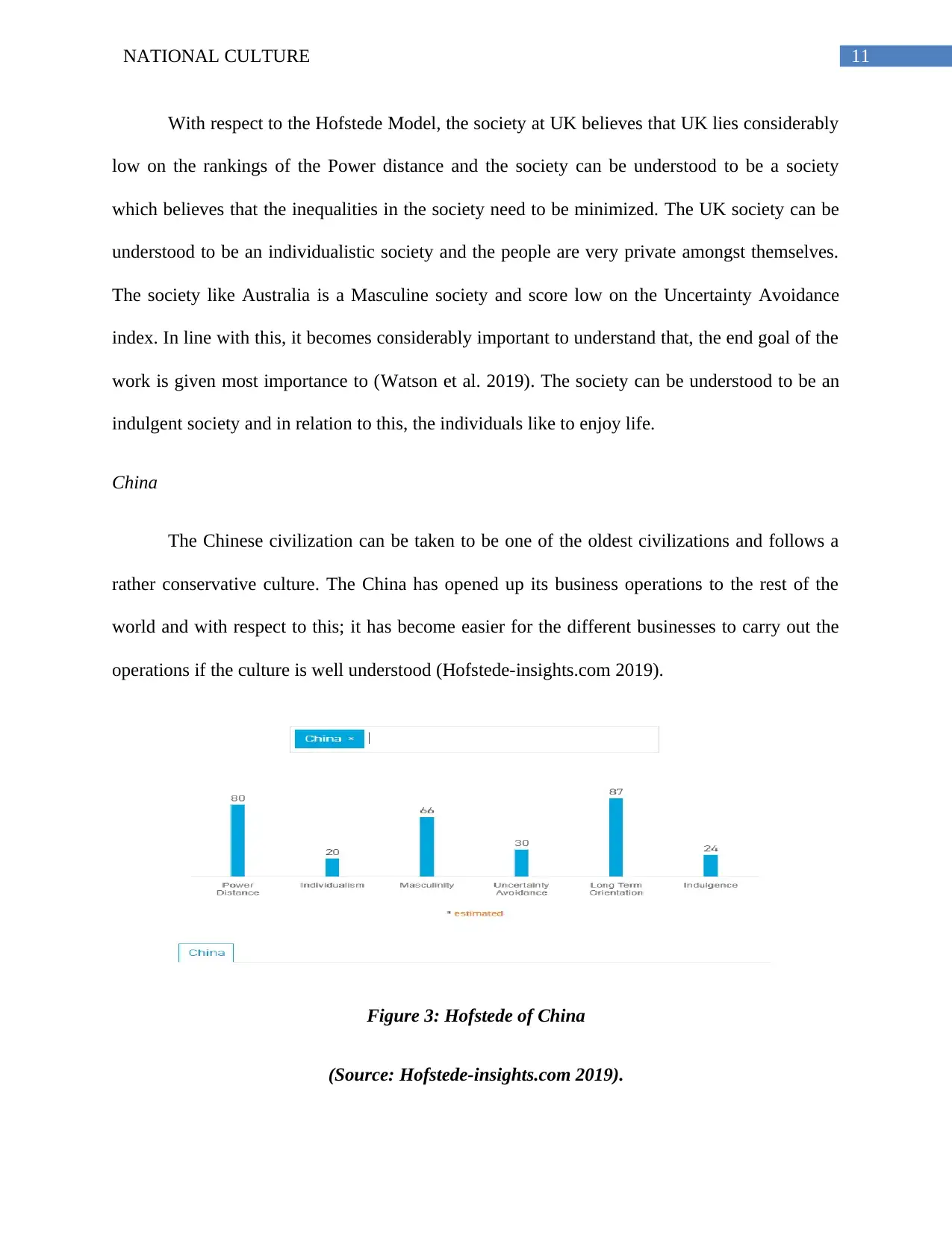
The Chinese civilization can be taken to be one of the oldest civilizations and follows a
rather conservative culture. The China has opened up its business operations to the rest of the
world and with respect to this; it has become easier for the different businesses to carry out the
operations if the culture is well understood (Hofstede-insights.com 2019).
Figure 3: Hofstede of China
(Source: Hofstede-insights.com 2019).
With respect to the Hofstede Model, the society at UK believes that UK lies considerably
low on the rankings of the Power distance and the society can be understood to be a society
which believes that the inequalities in the society need to be minimized. The UK society can be
understood to be an individualistic society and the people are very private amongst themselves.
The society like Australia is a Masculine society and score low on the Uncertainty Avoidance
index. In line with this, it becomes considerably important to understand that, the end goal of the
work is given most importance to (Watson et al. 2019). The society can be understood to be an
indulgent society and in relation to this, the individuals like to enjoy life.
China
The Chinese civilization can be taken to be one of the oldest civilizations and follows a
rather conservative culture. The China has opened up its business operations to the rest of the
world and with respect to this; it has become easier for the different businesses to carry out the
operations if the culture is well understood (Hofstede-insights.com 2019).
Figure 3: Hofstede of China
(Source: Hofstede-insights.com 2019).
⊘ This is a preview!⊘
Do you want full access?
Subscribe today to unlock all pages.
Trusted by 1+ million students worldwide

1 out of 20


Related Documents


Your All-in-One AI-Powered Toolkit for Academic Success.
+13062052269
info@desklib.com
Available 24*7 on WhatsApp / Email
![[object Object]](/_next/static/media/star-bottom.7253800d.svg)
Unlock your academic potential
Copyright © 2020–2026 A2Z Services. All Rights Reserved. Developed and managed by ZUCOL.