Impact and Management of a National Health Priority: Dementia Report
VerifiedAdded on 2022/10/12
|12
|2945
|229
Report
AI Summary
This report investigates dementia as a critical national health priority in Australia, focusing on its impact and effective management strategies. It begins by defining dementia, outlining its prevalence, and providing relevant statistical data, including the increasing mortality rates and financial burden. The report then delves into the crucial role of local communities in addressing this health issue, emphasizing the rationale behind community involvement and providing evidence of successful initiatives like dementia-friendly communities. It highlights how social engagement and participation in community activities can improve the quality of life for individuals with dementia. The report underscores the importance of awareness, understanding, and supportive relationships to mitigate the negative impacts of the disease. The findings emphasize the need for integrated healthcare and social care to support affected individuals, their families, and caregivers. This report contributes to a comprehensive understanding of dementia and the importance of community-based interventions.
Running Head: IMPACT AND MANAGEMENT OF A NATIONAL HEALTH
PRIORITY
Impact and Management of a National Health Priority
Name of Student:
Name of the University:
Author Note:
PRIORITY
Impact and Management of a National Health Priority
Name of Student:
Name of the University:
Author Note:

Paraphrase This Document
Need a fresh take? Get an instant paraphrase of this document with our AI Paraphraser
1Impact and Management of a National Health Priority
Abstract
Dementia is considered to be identifiable, abnormal conditions characterised by organic
causes along with progressive stages. It impacts the memory, cognition, behaviour, and
communication as well as performing daily activities of the affected individual. It is affecting
the health of the elderly population and a main contributor of mortality rate worldwide as
reported by the World Health Organization (WHO). This article enlightens on one of the nine
national health priorities of Australia. It discusses on the efficacy of the dementia friendly
communities on the treatment of the people with dementia.
Table of Content
Abstract
Dementia is considered to be identifiable, abnormal conditions characterised by organic
causes along with progressive stages. It impacts the memory, cognition, behaviour, and
communication as well as performing daily activities of the affected individual. It is affecting
the health of the elderly population and a main contributor of mortality rate worldwide as
reported by the World Health Organization (WHO). This article enlightens on one of the nine
national health priorities of Australia. It discusses on the efficacy of the dementia friendly
communities on the treatment of the people with dementia.
Table of Content
2Impact and Management of a National Health Priority
s
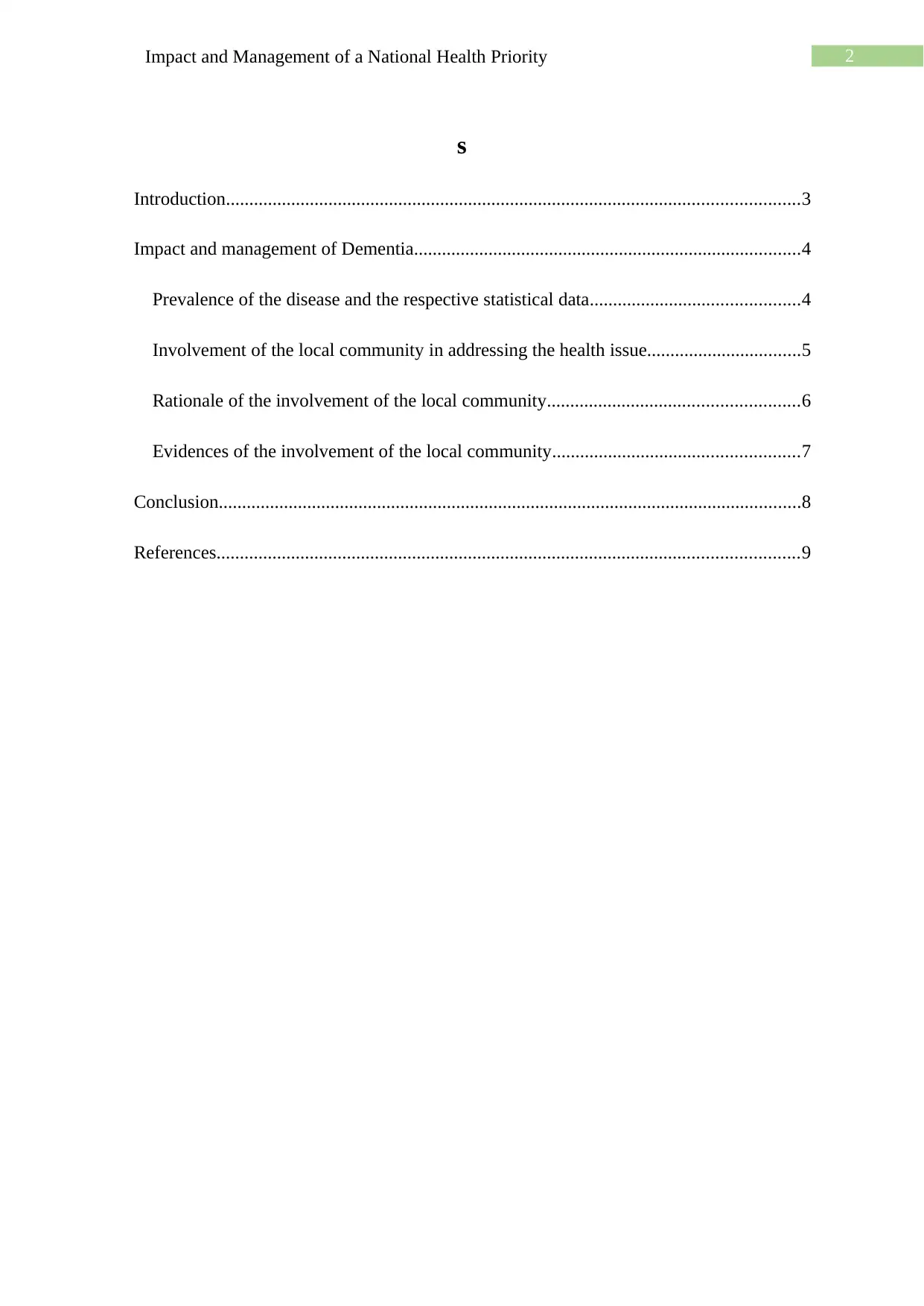
Introduction...........................................................................................................................3
Impact and management of Dementia...................................................................................4
Prevalence of the disease and the respective statistical data.............................................4
Involvement of the local community in addressing the health issue.................................5
Rationale of the involvement of the local community......................................................6
Evidences of the involvement of the local community.....................................................7
Conclusion.............................................................................................................................8
References.............................................................................................................................9
s
Introduction...........................................................................................................................3
Impact and management of Dementia...................................................................................4
Prevalence of the disease and the respective statistical data.............................................4
Involvement of the local community in addressing the health issue.................................5
Rationale of the involvement of the local community......................................................6
Evidences of the involvement of the local community.....................................................7
Conclusion.............................................................................................................................8
References.............................................................................................................................9
⊘ This is a preview!⊘
Do you want full access?
Subscribe today to unlock all pages.

Trusted by 1+ million students worldwide
3Impact and Management of a National Health Priority
Introduction
Dementia is recognised as a public health priority by World Health Organisation
(WHO) and the Alzheimer’s disease International. This was to promote an awareness about
dementia and to articulate an approach with respect to public health and advocate the action
at the global level. There are 35.6 million people affected by dementia worldwide (Smith,
Ali & Quach, 2014). According to the research based studies this number is expected to get
doubled by 2030 and tripled by 2050. This disease is prodigious to the affected individual as
well as their families and the respective care givers as well. The limited awareness and
understanding about the disease lead to stigmatization, hindrance to diagnosis and care
simultaneously that has a negative impact on the families, societies and the care givers
affecting them psychologically, economically and physically. In the year 2012, dementia was
added to the Australian National Health Priority list in order to aim at understanding as well
as measuring the effect of the disease on the population (Chan et al., 2013). From 2015
onwards the Australian Coding Standard has made it mandatory to record the person being
admitted with the disease in the hospital records irrespective of the reason of admission. The
purpose of making it a health priority was to address the negative impact of the disease in the
population and promote the efficacious healthcare and social care for the affected individuals
(Lin, Becker & Belza, 2014).
Introduction
Dementia is recognised as a public health priority by World Health Organisation
(WHO) and the Alzheimer’s disease International. This was to promote an awareness about
dementia and to articulate an approach with respect to public health and advocate the action
at the global level. There are 35.6 million people affected by dementia worldwide (Smith,
Ali & Quach, 2014). According to the research based studies this number is expected to get
doubled by 2030 and tripled by 2050. This disease is prodigious to the affected individual as
well as their families and the respective care givers as well. The limited awareness and
understanding about the disease lead to stigmatization, hindrance to diagnosis and care
simultaneously that has a negative impact on the families, societies and the care givers
affecting them psychologically, economically and physically. In the year 2012, dementia was
added to the Australian National Health Priority list in order to aim at understanding as well
as measuring the effect of the disease on the population (Chan et al., 2013). From 2015
onwards the Australian Coding Standard has made it mandatory to record the person being
admitted with the disease in the hospital records irrespective of the reason of admission. The
purpose of making it a health priority was to address the negative impact of the disease in the
population and promote the efficacious healthcare and social care for the affected individuals
(Lin, Becker & Belza, 2014).
Paraphrase This Document
Need a fresh take? Get an instant paraphrase of this document with our AI Paraphraser
4Impact and Management of a National Health Priority
Impact and management of Dementia
Prevalence of the disease and the respective statistical data
Dementia defines a group of prime neurocognitive conditions of the brain which is
not considered as a normal process of ageing. Dementia according to International
Classification of Disease is defined as a syndrome caused due to a diseased brain which can
be regarded as chronic or progressive in nature which includes disturbance of multiple higher
cortical functions which includes memory, thinking, judgement, calculation, capability to
learn, comprehension and orientation (Bayles, McCullough, & Tomoeda, 2018). Multiple
factors play an influential role in the life of an individual affected with dementia.
The most crucial unmodifiable risk factor for dementia is age. The percentage of people
acquiring dementia is higher in the age group above 65 years of age. People affected by
dementia and is less than 65 years of age is referred to as ‘younger onset dementia’ (Prince et
al, 2013). The estimated number of individuals affected by dementia in the year 2018 is
376,300. The latest population level data analysis showed that of the 180,417 people
inhabiting in the Australian aged care facilities in the year 2017 to 2018, the individuals
affected with dementia have higher cognition and behaviour care needs and required higher
activities of daily living needs compared to those who do not have dementia. Dementia is the
second leading reason for mortality in Australians that contributes 5.4% of all deaths in males
and about 10.6% of all the deaths occurring in females each year (Li et al., 2014). In the year
2016 dementia was the prime cause of death in Australian females, surpassing cardiac
diseases which is the cause of death for both the males and the females observed from the
early 20th century. 64.4% deaths of all the dementia related deaths accounts for females. At
present it is estimated that about 250 people are adding to the existing population of people
with dementia. This rate is expected to increase without a medical breakthrough to 318
Impact and management of Dementia
Prevalence of the disease and the respective statistical data
Dementia defines a group of prime neurocognitive conditions of the brain which is
not considered as a normal process of ageing. Dementia according to International
Classification of Disease is defined as a syndrome caused due to a diseased brain which can
be regarded as chronic or progressive in nature which includes disturbance of multiple higher
cortical functions which includes memory, thinking, judgement, calculation, capability to
learn, comprehension and orientation (Bayles, McCullough, & Tomoeda, 2018). Multiple
factors play an influential role in the life of an individual affected with dementia.
The most crucial unmodifiable risk factor for dementia is age. The percentage of people
acquiring dementia is higher in the age group above 65 years of age. People affected by
dementia and is less than 65 years of age is referred to as ‘younger onset dementia’ (Prince et
al, 2013). The estimated number of individuals affected by dementia in the year 2018 is
376,300. The latest population level data analysis showed that of the 180,417 people
inhabiting in the Australian aged care facilities in the year 2017 to 2018, the individuals
affected with dementia have higher cognition and behaviour care needs and required higher
activities of daily living needs compared to those who do not have dementia. Dementia is the
second leading reason for mortality in Australians that contributes 5.4% of all deaths in males
and about 10.6% of all the deaths occurring in females each year (Li et al., 2014). In the year
2016 dementia was the prime cause of death in Australian females, surpassing cardiac
diseases which is the cause of death for both the males and the females observed from the
early 20th century. 64.4% deaths of all the dementia related deaths accounts for females. At
present it is estimated that about 250 people are adding to the existing population of people
with dementia. This rate is expected to increase without a medical breakthrough to 318
5Impact and Management of a National Health Priority
people per day by 2025 and almost about an addition of 650 people per day by 2056 (Radford
et al., 2015). About 3 in 10 people above the age of 85 years and one in 10 people above the
age of 65 years have dementia. In 2018, there is an approximation of 26,443 people with
younger onset dementia, which is predicted to rise to 29,375 people by 2025. A mean of 36
people expire each day due to dementia in the year 2016. Of the 13,126 people who expired
due to dementia, 8,447 amongst them were females (Hampel & Lista, 2016).
In the year 2015 the Federal government helped with an additional $200 million for the
research on dementia which aided in significantly increasing the fund for the dementia
research sector in Australia as well as the Medical Research council and National institute of
Dementia Research to promote the dementia research is coordinated, communicated and
funded. The Dementia Australia Research Foundation receives donations from the public and
plays a crucial role in the effort and funds numerous new career researchers through project
grants and scholarships (Carone, Tischler, & Dening, 2016).
According to the report of 2018, the health priority concern involving dementia has
estimated to incur an expensive of about $15 billion. It is expected that by 2025 the predicted
cost would rise to almost $18.7 billion and by 2056 to more than $36.8 billion. This health
concern is the leading cause of the disability observed in the older population of Australia
(aged beyond 65years) and it is the third leading overall disability burden. Almost about 52%
percent elder adults of all the residents in the residential aged care facilities are fighting
dementia (Wimo et al., 2013).
Involvement of the local community in addressing the health issue
The dementia friendly communities play a vital role in aiding the people with dementia to
live a quality life and is valued as an individual. It is essential for them to feel a part of that
community (Rafnsson et al., 2017). When a large number of people combat dementia have a
people per day by 2025 and almost about an addition of 650 people per day by 2056 (Radford
et al., 2015). About 3 in 10 people above the age of 85 years and one in 10 people above the
age of 65 years have dementia. In 2018, there is an approximation of 26,443 people with
younger onset dementia, which is predicted to rise to 29,375 people by 2025. A mean of 36
people expire each day due to dementia in the year 2016. Of the 13,126 people who expired
due to dementia, 8,447 amongst them were females (Hampel & Lista, 2016).
In the year 2015 the Federal government helped with an additional $200 million for the
research on dementia which aided in significantly increasing the fund for the dementia
research sector in Australia as well as the Medical Research council and National institute of
Dementia Research to promote the dementia research is coordinated, communicated and
funded. The Dementia Australia Research Foundation receives donations from the public and
plays a crucial role in the effort and funds numerous new career researchers through project
grants and scholarships (Carone, Tischler, & Dening, 2016).
According to the report of 2018, the health priority concern involving dementia has
estimated to incur an expensive of about $15 billion. It is expected that by 2025 the predicted
cost would rise to almost $18.7 billion and by 2056 to more than $36.8 billion. This health
concern is the leading cause of the disability observed in the older population of Australia
(aged beyond 65years) and it is the third leading overall disability burden. Almost about 52%
percent elder adults of all the residents in the residential aged care facilities are fighting
dementia (Wimo et al., 2013).
Involvement of the local community in addressing the health issue
The dementia friendly communities play a vital role in aiding the people with dementia to
live a quality life and is valued as an individual. It is essential for them to feel a part of that
community (Rafnsson et al., 2017). When a large number of people combat dementia have a
⊘ This is a preview!⊘
Do you want full access?
Subscribe today to unlock all pages.
Trusted by 1+ million students worldwide
6Impact and Management of a National Health Priority
feeling that society is not able to understand their conditions in which they live and how to
interact with them. As the condition progresses in dementia these elderly people try to
withdraw themselves from their community and hence fall prey to social isolation. Hence,
they tend to feel lonely and bored. People combating dementia can still be an active part of
social activities in their community if supported appropriately. They can play an active and a
valuable role even after being diagnosed with the disease to prevent social isolation. All
individuals starting from the government and local book stores to libraries and churches aid
in playing a crucial role in making a dementia friendly community where the affected
individuals feel valued and can take active participation in activities. The affected individuals
play the most vital role in any dementia friendly community. These communities help them
to connect themselves and share their experiences, the sole purpose of these communities is
to understand the needs of the people with dementia and prevent them from social isolation.
Rationale of the involvement of the local community
According to the recent studies it is observed that elderly individuals who frequently
participate in social, mental and productive activities have a lower risk of attaining dementia.
The reduction in the cognitive activities can be prevented if the level of participation in social
activities is high among community dwellers. A socially integrated active lifestyle in the
elderly ages helps to prevent Alzheimer’s disease and dementia (Wimo et al., 2013). Older
individuals who are socially disengaged with low social connections are at a higher risk of
dementia. Hence it can be conferred that social relations and cognitive functions go hand in
hand. Both impact each other positively which means that a higher social connectivity and
social engagement at the later stages of life will lead to better mental and other cognitive
functions. It also shows that high rates of physical activities were linked with reduction in the
rate of dementia incidence. Loneliness and boredom and consecutively social isolation
impacts the mental health of the elderly individuals causing reduced cognitive functions.
feeling that society is not able to understand their conditions in which they live and how to
interact with them. As the condition progresses in dementia these elderly people try to
withdraw themselves from their community and hence fall prey to social isolation. Hence,
they tend to feel lonely and bored. People combating dementia can still be an active part of
social activities in their community if supported appropriately. They can play an active and a
valuable role even after being diagnosed with the disease to prevent social isolation. All
individuals starting from the government and local book stores to libraries and churches aid
in playing a crucial role in making a dementia friendly community where the affected
individuals feel valued and can take active participation in activities. The affected individuals
play the most vital role in any dementia friendly community. These communities help them
to connect themselves and share their experiences, the sole purpose of these communities is
to understand the needs of the people with dementia and prevent them from social isolation.
Rationale of the involvement of the local community
According to the recent studies it is observed that elderly individuals who frequently
participate in social, mental and productive activities have a lower risk of attaining dementia.
The reduction in the cognitive activities can be prevented if the level of participation in social
activities is high among community dwellers. A socially integrated active lifestyle in the
elderly ages helps to prevent Alzheimer’s disease and dementia (Wimo et al., 2013). Older
individuals who are socially disengaged with low social connections are at a higher risk of
dementia. Hence it can be conferred that social relations and cognitive functions go hand in
hand. Both impact each other positively which means that a higher social connectivity and
social engagement at the later stages of life will lead to better mental and other cognitive
functions. It also shows that high rates of physical activities were linked with reduction in the
rate of dementia incidence. Loneliness and boredom and consecutively social isolation
impacts the mental health of the elderly individuals causing reduced cognitive functions.
Paraphrase This Document
Need a fresh take? Get an instant paraphrase of this document with our AI Paraphraser
7Impact and Management of a National Health Priority
Leisure activities among the elderly people promotes healthy ageing. The main
contributing factor was the reduction of the services among older people who require only
limited assistance and services for the rural areas. The absence of age discrimination and
reduced social activity also played a role. Hence, these research studies narrow down to one
road that is the increased participation in community based health care professional helps
combat dementia efficaciously (Lin & Lewis, 2015).
Evidences of the involvement of the local community
Alzheimer Society of Ireland was an initiative taken in the year 2016 to create a visual
information about dementia for the people who have low literacy rates in the traveller
community (Heward et al., 2017). There were programs that received international
recognition like UK’s Dementia Friends programme and the Netherlands’ Alzheimer Café.
The Dementia Friends programme has been successfully executed in more than 10 countries
and the Alzheimer’s café in more than 15 countries in the year 2016 (Fleming et al., 2017).
The studies of the involvement of the dementia friendly communities were exploratory and
qualitative in nature. These investigations helped in echoing the increased demand for care of
patients with dementia human rights in shaping the dementia-friendly communities (Innes,
2013). It enabled to clearly point out the issues and challenges that are brought into
consideration for development of such communities.
The Dementia friendly community in Bradford was done to promote the awareness about
the disease and develop good practice. Small community organisations and larger companies
took part in development of a scheme for dementia friendly community that included a
branch of Lloyds TSB, the Diocese of Bradford, Bolton road Gurudwara and a local
pharmacy. The funding was provided by the Bradford Council and the Joseph Roundtree
foundation. The second stage involved the elderly people from the council ward and also
included the council officers as well as the ward councillors and the small communities
Leisure activities among the elderly people promotes healthy ageing. The main
contributing factor was the reduction of the services among older people who require only
limited assistance and services for the rural areas. The absence of age discrimination and
reduced social activity also played a role. Hence, these research studies narrow down to one
road that is the increased participation in community based health care professional helps
combat dementia efficaciously (Lin & Lewis, 2015).
Evidences of the involvement of the local community
Alzheimer Society of Ireland was an initiative taken in the year 2016 to create a visual
information about dementia for the people who have low literacy rates in the traveller
community (Heward et al., 2017). There were programs that received international
recognition like UK’s Dementia Friends programme and the Netherlands’ Alzheimer Café.
The Dementia Friends programme has been successfully executed in more than 10 countries
and the Alzheimer’s café in more than 15 countries in the year 2016 (Fleming et al., 2017).
The studies of the involvement of the dementia friendly communities were exploratory and
qualitative in nature. These investigations helped in echoing the increased demand for care of
patients with dementia human rights in shaping the dementia-friendly communities (Innes,
2013). It enabled to clearly point out the issues and challenges that are brought into
consideration for development of such communities.
The Dementia friendly community in Bradford was done to promote the awareness about
the disease and develop good practice. Small community organisations and larger companies
took part in development of a scheme for dementia friendly community that included a
branch of Lloyds TSB, the Diocese of Bradford, Bolton road Gurudwara and a local
pharmacy. The funding was provided by the Bradford Council and the Joseph Roundtree
foundation. The second stage involved the elderly people from the council ward and also
included the council officers as well as the ward councillors and the small communities
8Impact and Management of a National Health Priority
consisting of the community groups, shops and businesses. The benefit observed in this
developmental plan by Bradford for the people with dementia was the information and
inhabiting in as well as being linked to an active enthusiastic community that is ready to
provide immediate support. The Gurudwara is a motivating approach to culturally specific
engagement for people with dementia. This has won a dementia friendly award and it gained
popularity worldwide (Smith et al., 2016).
Conclusion
It can be concluded from the article that the health priority concern with respect to
dementia is a crucial issue in Australian community especially in the aged group affecting the
respective care and health systems. The individual affected as well as their family and care
giver is devastatingly affected. Since there is no medication to eradicate the brain disease
effective treatment exploits delaying of the disease progression or prevention of the same,
improve the quality of life of the affected individual and the reduction in symptoms. The
article suggests that at all stages of dementia people are active to participate in various social
activities, staying independent and staying connected socially with aid of caring and
supportive relationships, and valuable activities that are provided in a safe as well as pleasant
environment. Thus, local communities that promote to be a dementia friendly community
aids the aged people with dementia.
consisting of the community groups, shops and businesses. The benefit observed in this
developmental plan by Bradford for the people with dementia was the information and
inhabiting in as well as being linked to an active enthusiastic community that is ready to
provide immediate support. The Gurudwara is a motivating approach to culturally specific
engagement for people with dementia. This has won a dementia friendly award and it gained
popularity worldwide (Smith et al., 2016).
Conclusion
It can be concluded from the article that the health priority concern with respect to
dementia is a crucial issue in Australian community especially in the aged group affecting the
respective care and health systems. The individual affected as well as their family and care
giver is devastatingly affected. Since there is no medication to eradicate the brain disease
effective treatment exploits delaying of the disease progression or prevention of the same,
improve the quality of life of the affected individual and the reduction in symptoms. The
article suggests that at all stages of dementia people are active to participate in various social
activities, staying independent and staying connected socially with aid of caring and
supportive relationships, and valuable activities that are provided in a safe as well as pleasant
environment. Thus, local communities that promote to be a dementia friendly community
aids the aged people with dementia.
⊘ This is a preview!⊘
Do you want full access?
Subscribe today to unlock all pages.
Trusted by 1+ million students worldwide
9Impact and Management of a National Health Priority
References
Bayles, K., McCullough, K., & Tomoeda, C. K. (2018). Cognitive-communication Disorders
of MCI and Dementia: Definition, Assessment, and Clinical Management. Plural
Publishing.
Carone, L., Tischler, V., & Dening, T. (2016). Football and dementia: A qualitative
investigation of a community based sports group for men with early onset
dementia. Dementia, 15(6), 1358-1376.
Chan, K. Y., Wang, W., Wu, J. J., Liu, L., Theodoratou, E., Car, J., ... & Rudan, I. (2013).
Epidemiology of Alzheimer's disease and other forms of dementia in China, 1990–
2010: a systematic review and analysis. The Lancet, 381(9882), 2016-2023.
Fleming, R., Bennett, K., Preece, T., & Phillipson, L. (2017). The development and testing of
the dementia friendly communities environment assessment tool (DFC
EAT). International psychogeriatrics, 29(2), 303-311.
Hampel, H., & Lista, S. (2016). Dementia: The rising global tide of cognitive
impairment. Nature Reviews Neurology, 12(3), 131.
Heward, M., Innes, A., Cutler, C., & Hambidge, S. (2017). Dementia‐friendly communities:
challenges and strategies for achieving stakeholder involvement. Health & social
care in the community, 25(3), 858-867.
Innes, A. (2013). Working towards dementia friendly societies. Perspectives in public
health, 133(3), 141.
Li, S. Q., Guthridge, S. L., Eswara Aratchige, P., Lowe, M. P., Wang, Z., Zhao, Y., &
Krause, V. (2014). Dementia prevalence and incidence among the Indigenous and
References
Bayles, K., McCullough, K., & Tomoeda, C. K. (2018). Cognitive-communication Disorders
of MCI and Dementia: Definition, Assessment, and Clinical Management. Plural
Publishing.
Carone, L., Tischler, V., & Dening, T. (2016). Football and dementia: A qualitative
investigation of a community based sports group for men with early onset
dementia. Dementia, 15(6), 1358-1376.
Chan, K. Y., Wang, W., Wu, J. J., Liu, L., Theodoratou, E., Car, J., ... & Rudan, I. (2013).
Epidemiology of Alzheimer's disease and other forms of dementia in China, 1990–
2010: a systematic review and analysis. The Lancet, 381(9882), 2016-2023.
Fleming, R., Bennett, K., Preece, T., & Phillipson, L. (2017). The development and testing of
the dementia friendly communities environment assessment tool (DFC
EAT). International psychogeriatrics, 29(2), 303-311.
Hampel, H., & Lista, S. (2016). Dementia: The rising global tide of cognitive
impairment. Nature Reviews Neurology, 12(3), 131.
Heward, M., Innes, A., Cutler, C., & Hambidge, S. (2017). Dementia‐friendly communities:
challenges and strategies for achieving stakeholder involvement. Health & social
care in the community, 25(3), 858-867.
Innes, A. (2013). Working towards dementia friendly societies. Perspectives in public
health, 133(3), 141.
Li, S. Q., Guthridge, S. L., Eswara Aratchige, P., Lowe, M. P., Wang, Z., Zhao, Y., &
Krause, V. (2014). Dementia prevalence and incidence among the Indigenous and
Paraphrase This Document
Need a fresh take? Get an instant paraphrase of this document with our AI Paraphraser
10Impact and Management of a National Health Priority
non‐Indigenous populations of the Northern Territory. Medical Journal of
Australia, 200(8), 465-469.
Lin, S. Y., & Lewis, F. M. (2015). Dementia friendly, dementia capable, and dementia
positive: concepts to prepare for the future. The Gerontologist, 55(2), 237-244.
Lin, S. Y., Becker, M., & Belza, B. (2014). From dementia fearful to dementia friendly: Be a
champion in your community. Journal of gerontological nursing, 40(12), 3-5.
Prince, M., Bryce, R., Albanese, E., Wimo, A., Ribeiro, W., & Ferri, C. P. (2013). The global
prevalence of dementia: a systematic review and metaanalysis. Alzheimer's &
dementia, 9(1), 63-75.
Radford, K., Mack, H. A., Draper, B., Chalkley, S., Daylight, G., Cumming, R., ... & Broe,
G. A. (2015). Prevalence of dementia in urban and regional Aboriginal
Australians. Alzheimer's & Dementia, 11(3), 271-279.
Rafnsson, S. B., Orrell, M., d’Orsi, E., Hogervorst, E., & Steptoe, A. (2017). Loneliness,
social integration, and incident dementia over 6 years: prospective findings from the
English Longitudinal Study of Ageing. The Journals of Gerontology: Series B.
Smith, B. J., Ali, S., & Quach, H. (2014). Public knowledge and beliefs about dementia risk
reduction: a national survey of Australians. BMC Public Health, 14(1), 661.
Smith, K., Gee, S., Sharrock, T., & Croucher, M. (2016). Developing a dementia‐friendly C
hristchurch: Perspectives of people with dementia. Australasian journal on
ageing, 35(3), 188-192.
Wimo, A., Jönsson, L., Bond, J., Prince, M., Winblad, B., & International, A. D. (2013). The
worldwide economic impact of dementia 2010. Alzheimer's & Dementia, 9(1), 1-11.
non‐Indigenous populations of the Northern Territory. Medical Journal of
Australia, 200(8), 465-469.
Lin, S. Y., & Lewis, F. M. (2015). Dementia friendly, dementia capable, and dementia
positive: concepts to prepare for the future. The Gerontologist, 55(2), 237-244.
Lin, S. Y., Becker, M., & Belza, B. (2014). From dementia fearful to dementia friendly: Be a
champion in your community. Journal of gerontological nursing, 40(12), 3-5.
Prince, M., Bryce, R., Albanese, E., Wimo, A., Ribeiro, W., & Ferri, C. P. (2013). The global
prevalence of dementia: a systematic review and metaanalysis. Alzheimer's &
dementia, 9(1), 63-75.
Radford, K., Mack, H. A., Draper, B., Chalkley, S., Daylight, G., Cumming, R., ... & Broe,
G. A. (2015). Prevalence of dementia in urban and regional Aboriginal
Australians. Alzheimer's & Dementia, 11(3), 271-279.
Rafnsson, S. B., Orrell, M., d’Orsi, E., Hogervorst, E., & Steptoe, A. (2017). Loneliness,
social integration, and incident dementia over 6 years: prospective findings from the
English Longitudinal Study of Ageing. The Journals of Gerontology: Series B.
Smith, B. J., Ali, S., & Quach, H. (2014). Public knowledge and beliefs about dementia risk
reduction: a national survey of Australians. BMC Public Health, 14(1), 661.
Smith, K., Gee, S., Sharrock, T., & Croucher, M. (2016). Developing a dementia‐friendly C
hristchurch: Perspectives of people with dementia. Australasian journal on
ageing, 35(3), 188-192.
Wimo, A., Jönsson, L., Bond, J., Prince, M., Winblad, B., & International, A. D. (2013). The
worldwide economic impact of dementia 2010. Alzheimer's & Dementia, 9(1), 1-11.

11Impact and Management of a National Health Priority
⊘ This is a preview!⊘
Do you want full access?
Subscribe today to unlock all pages.
Trusted by 1+ million students worldwide

1 out of 12


Related Documents


Your All-in-One AI-Powered Toolkit for Academic Success.
+13062052269
info@desklib.com
Available 24*7 on WhatsApp / Email
![[object Object]](/_next/static/media/star-bottom.7253800d.svg)
Unlock your academic potential
Copyright © 2020–2026 A2Z Services. All Rights Reserved. Developed and managed by ZUCOL.