National Income Accounting: Concepts and Calculation Methods
VerifiedAdded on 2023/01/18
|31
|10325
|40
Report
AI Summary
This report, prepared by MBA-IB students at Amity University, Noida, comprehensively examines national income accounting. It defines national income, differentiating between various concepts like GDP, NDP, GNP, and NNP, and GNI, and explores their significance. The report details the methods of calculating national income, including the product/value-added, income, and expenditure approaches, providing formulas and step-by-step explanations. It also discusses the circular flow of income, the importance and challenges of national income analysis, and the limitations of measuring national income. Furthermore, the report highlights the inter-relationships among different national income concepts, offering a detailed understanding of macroeconomic principles.
1 | P a g e
Amity University Noida, Uttar Pradesh
Amity International Business School
PSDA
Managerial Economics
Topic:
National Income Accounting
Submitted By:
Arjun Kaul A-15
Manvi Thakur A-53
Swasti Jain A-51
Yash Singhal A-19
MBA-IB (Sec. B)
Submitted To: Dr. Kshamta Chauhan Ma’am
Amity University Noida, Uttar Pradesh
Amity International Business School
PSDA
Managerial Economics
Topic:
National Income Accounting
Submitted By:
Arjun Kaul A-15
Manvi Thakur A-53
Swasti Jain A-51
Yash Singhal A-19
MBA-IB (Sec. B)
Submitted To: Dr. Kshamta Chauhan Ma’am

Paraphrase This Document
Need a fresh take? Get an instant paraphrase of this document with our AI Paraphraser

2 | P a g e
ACKNOWLEDGEMENTS
One of the pleasant aspects of preparing a project
report is the opportunity to thank those who have
contributed to make this project possible.
We are extremely thankful to
Dr. Kshamta Chauhan
For giving us this project. Her active interest and
insight has helped us to formulate, redefine and
implement our approach to the project.
Thank You
ACKNOWLEDGEMENTS
One of the pleasant aspects of preparing a project
report is the opportunity to thank those who have
contributed to make this project possible.
We are extremely thankful to
Dr. Kshamta Chauhan
For giving us this project. Her active interest and
insight has helped us to formulate, redefine and
implement our approach to the project.
Thank You
3 | P a g e
PREFACE
As part of our MBA IB curriculum and to gain
knowledge in the field of management, we are
required to make a report on
"National Income Accounting.”
The Basic Objective behind doing this project
report is to gain a better understanding of various
concepts of Macro-economics.
In this project report we have included the
different topics covered in National Income
Accounting like its types, their differences,
advantages and disadvantages and methods to
calculate it. We have also included the concept of
circular flow of income.
Through this project we came to know about the
importance of teamwork and the role of devotion
towards work.
PREFACE
As part of our MBA IB curriculum and to gain
knowledge in the field of management, we are
required to make a report on
"National Income Accounting.”
The Basic Objective behind doing this project
report is to gain a better understanding of various
concepts of Macro-economics.
In this project report we have included the
different topics covered in National Income
Accounting like its types, their differences,
advantages and disadvantages and methods to
calculate it. We have also included the concept of
circular flow of income.
Through this project we came to know about the
importance of teamwork and the role of devotion
towards work.
⊘ This is a preview!⊘
Do you want full access?
Subscribe today to unlock all pages.

Trusted by 1+ million students worldwide
4 | P a g e
INDEX
Particulars Page No.
Introduction 5
Methods To Calculate National Income 6
Gross Domestic Product (GDP) 9
Net Domestic Product (NDP) 13
Gross National Product (GNP) 14
Net National Product (NNP) 17
Gross National Income (GNI) 19
National Income as Good Indicator for Economic
Health
20
National Income as Bad Indicator for Economic
Health
21
Types of Income 22
Circular Flow of Income 25
Importance of National Income Analysis 27
Challenges of National Income Analysis 28
Limitations in Measuring National Income 29
Inter-Relationship Among Different Concepts of NI 30
Summary 31
INDEX
Particulars Page No.
Introduction 5
Methods To Calculate National Income 6
Gross Domestic Product (GDP) 9
Net Domestic Product (NDP) 13
Gross National Product (GNP) 14
Net National Product (NNP) 17
Gross National Income (GNI) 19
National Income as Good Indicator for Economic
Health
20
National Income as Bad Indicator for Economic
Health
21
Types of Income 22
Circular Flow of Income 25
Importance of National Income Analysis 27
Challenges of National Income Analysis 28
Limitations in Measuring National Income 29
Inter-Relationship Among Different Concepts of NI 30
Summary 31
Paraphrase This Document
Need a fresh take? Get an instant paraphrase of this document with our AI Paraphraser
5 | P a g e
INTRODUCTION
National income is an uncertain term which is used interchangeably with national dividend,
national output and national expenditure. On this basis, national income has been defined in a
number of ways. In common parlance, national income means the total value of goods and
services produced annually in a country. In other words, the total amount of income accruing
to a country from economic activities in a year’s time is known as national income. It includes
payments made to all resources in the form of wages, interest, rent and profits. The progress
of a country can be determined by the growth of the national income of the country.
Net national income encompasses the income of households, businesses, and the
government. Net national income is defined as gross domestic product plus net receipts
of wages, salaries and property income from abroad, minus the depreciation of fixed capital
assets (dwellings, buildings, machinery, transport equipment and physical infrastructure)
through wear and tear and obsolescence.
The Marshallian Definition:
According to Marshall: “The labour and capital of a country acting on its natural resources
produce annually a certain net aggregate of commodities, material and immaterial including
services of all kinds. …This is the true net annual income or revenue of the country or
national dividend.” In this definition, the word ‘net’ refers to deductions from the gross
national income in respect of depreciation and wearing out of machines. And to this, must be
added income from abroad.
The Pigouvian Definition:
Marshall’s follower, A.C. Pigou, has in his definition of national income included that income
which can be measured in terms of money. In the words of Pigou, “National income is that
part of objective income of the community, including of course income derived from abroad
which can be measured in money.”
The aggregate economic performance of a nation is calculated with the help of National
income data. The basic purpose of national income is to throw light on aggregate output and
income and provide a basis for the government to formulate their policy, programmes, to
maximize the national welfare of the people. Central Statistical organisation calculates the
national income in India.
INTRODUCTION
National income is an uncertain term which is used interchangeably with national dividend,
national output and national expenditure. On this basis, national income has been defined in a
number of ways. In common parlance, national income means the total value of goods and
services produced annually in a country. In other words, the total amount of income accruing
to a country from economic activities in a year’s time is known as national income. It includes
payments made to all resources in the form of wages, interest, rent and profits. The progress
of a country can be determined by the growth of the national income of the country.
Net national income encompasses the income of households, businesses, and the
government. Net national income is defined as gross domestic product plus net receipts
of wages, salaries and property income from abroad, minus the depreciation of fixed capital
assets (dwellings, buildings, machinery, transport equipment and physical infrastructure)
through wear and tear and obsolescence.
The Marshallian Definition:
According to Marshall: “The labour and capital of a country acting on its natural resources
produce annually a certain net aggregate of commodities, material and immaterial including
services of all kinds. …This is the true net annual income or revenue of the country or
national dividend.” In this definition, the word ‘net’ refers to deductions from the gross
national income in respect of depreciation and wearing out of machines. And to this, must be
added income from abroad.
The Pigouvian Definition:
Marshall’s follower, A.C. Pigou, has in his definition of national income included that income
which can be measured in terms of money. In the words of Pigou, “National income is that
part of objective income of the community, including of course income derived from abroad
which can be measured in money.”
The aggregate economic performance of a nation is calculated with the help of National
income data. The basic purpose of national income is to throw light on aggregate output and
income and provide a basis for the government to formulate their policy, programmes, to
maximize the national welfare of the people. Central Statistical organisation calculates the
national income in India.
6 | P a g e
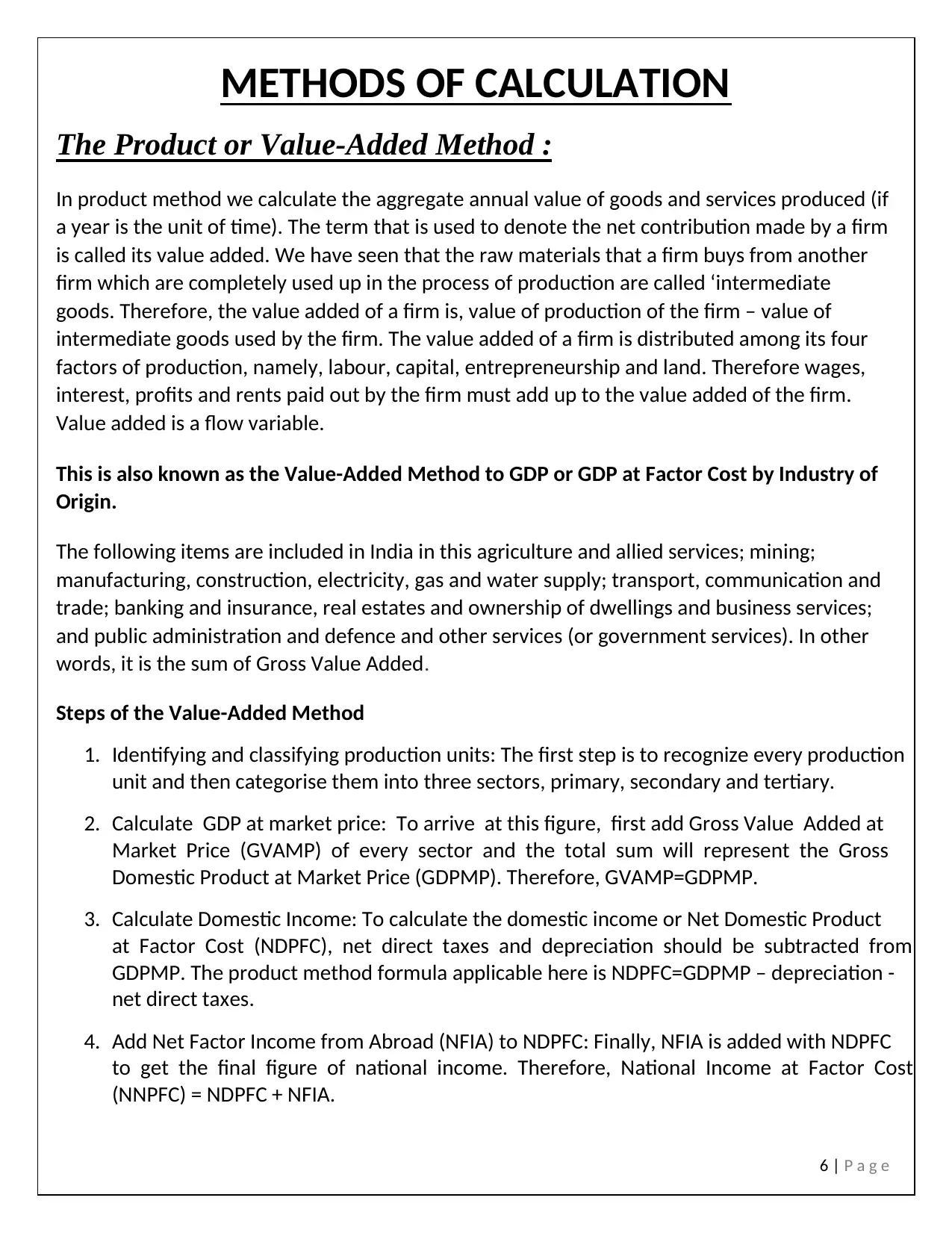
METHODS OF CALCULATION
The Product or Value-Added Method :
In product method we calculate the aggregate annual value of goods and services produced (if
a year is the unit of time). The term that is used to denote the net contribution made by a firm
is called its value added. We have seen that the raw materials that a firm buys from another
firm which are completely used up in the process of production are called ‘intermediate
goods. Therefore, the value added of a firm is, value of production of the firm – value of
intermediate goods used by the firm. The value added of a firm is distributed among its four
factors of production, namely, labour, capital, entrepreneurship and land. Therefore wages,
interest, profits and rents paid out by the firm must add up to the value added of the firm.
Value added is a flow variable.
This is also known as the Value-Added Method to GDP or GDP at Factor Cost by Industry of
Origin.
The following items are included in India in this agriculture and allied services; mining;
manufacturing, construction, electricity, gas and water supply; transport, communication and
trade; banking and insurance, real estates and ownership of dwellings and business services;
and public administration and defence and other services (or government services). In other
words, it is the sum of Gross Value Added.
Steps of the Value-Added Method
1. Identifying and classifying production units: The first step is to recognize every production
unit and then categorise them into three sectors, primary, secondary and tertiary.
2. Calculate GDP at market price: To arrive at this figure, first add Gross Value Added at
Market Price (GVAMP) of every sector and the total sum will represent the Gross
Domestic Product at Market Price (GDPMP). Therefore, GVAMP=GDPMP.
3. Calculate Domestic Income: To calculate the domestic income or Net Domestic Product
at Factor Cost (NDPFC), net direct taxes and depreciation should be subtracted from
GDPMP. The product method formula applicable here is NDPFC=GDPMP – depreciation -
net direct taxes.
4. Add Net Factor Income from Abroad (NFIA) to NDPFC: Finally, NFIA is added with NDPFC
to get the final figure of national income. Therefore, National Income at Factor Cost
(NNPFC) = NDPFC + NFIA.
METHODS OF CALCULATION
The Product or Value-Added Method :
In product method we calculate the aggregate annual value of goods and services produced (if
a year is the unit of time). The term that is used to denote the net contribution made by a firm
is called its value added. We have seen that the raw materials that a firm buys from another
firm which are completely used up in the process of production are called ‘intermediate
goods. Therefore, the value added of a firm is, value of production of the firm – value of
intermediate goods used by the firm. The value added of a firm is distributed among its four
factors of production, namely, labour, capital, entrepreneurship and land. Therefore wages,
interest, profits and rents paid out by the firm must add up to the value added of the firm.
Value added is a flow variable.
This is also known as the Value-Added Method to GDP or GDP at Factor Cost by Industry of
Origin.
The following items are included in India in this agriculture and allied services; mining;
manufacturing, construction, electricity, gas and water supply; transport, communication and
trade; banking and insurance, real estates and ownership of dwellings and business services;
and public administration and defence and other services (or government services). In other
words, it is the sum of Gross Value Added.
Steps of the Value-Added Method
1. Identifying and classifying production units: The first step is to recognize every production
unit and then categorise them into three sectors, primary, secondary and tertiary.
2. Calculate GDP at market price: To arrive at this figure, first add Gross Value Added at
Market Price (GVAMP) of every sector and the total sum will represent the Gross
Domestic Product at Market Price (GDPMP). Therefore, GVAMP=GDPMP.
3. Calculate Domestic Income: To calculate the domestic income or Net Domestic Product
at Factor Cost (NDPFC), net direct taxes and depreciation should be subtracted from
GDPMP. The product method formula applicable here is NDPFC=GDPMP – depreciation -
net direct taxes.
4. Add Net Factor Income from Abroad (NFIA) to NDPFC: Finally, NFIA is added with NDPFC
to get the final figure of national income. Therefore, National Income at Factor Cost
(NNPFC) = NDPFC + NFIA.
⊘ This is a preview!⊘
Do you want full access?
Subscribe today to unlock all pages.
Trusted by 1+ million students worldwide
7 | P a g e
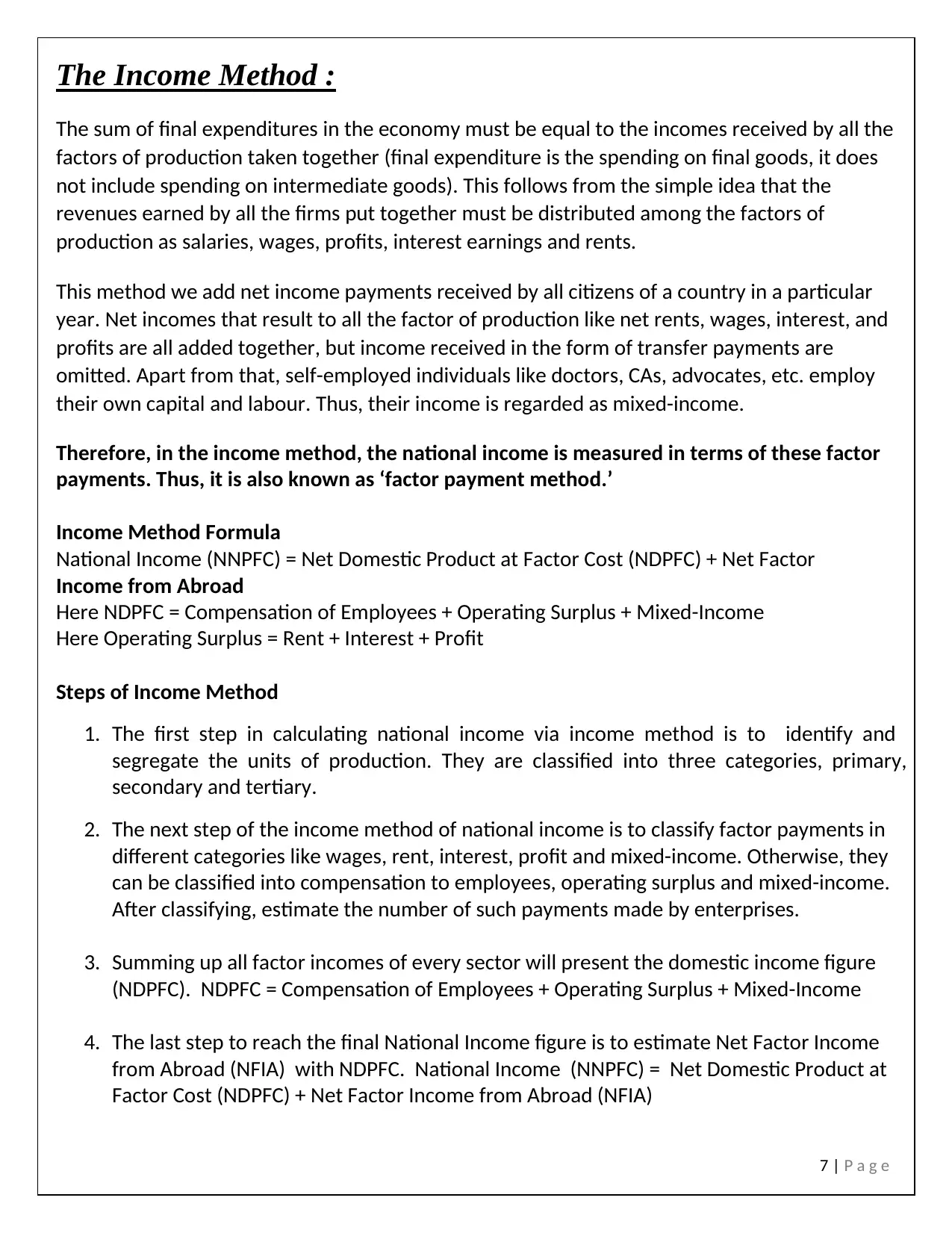
The Income Method :
The sum of final expenditures in the economy must be equal to the incomes received by all the
factors of production taken together (final expenditure is the spending on final goods, it does
not include spending on intermediate goods). This follows from the simple idea that the
revenues earned by all the firms put together must be distributed among the factors of
production as salaries, wages, profits, interest earnings and rents.
This method we add net income payments received by all citizens of a country in a particular
year. Net incomes that result to all the factor of production like net rents, wages, interest, and
profits are all added together, but income received in the form of transfer payments are
omitted. Apart from that, self-employed individuals like doctors, CAs, advocates, etc. employ
their own capital and labour. Thus, their income is regarded as mixed-income.
Therefore, in the income method, the national income is measured in terms of these factor
payments. Thus, it is also known as ‘factor payment method.’
Income Method Formula
National Income (NNPFC) = Net Domestic Product at Factor Cost (NDPFC) + Net Factor
Income from Abroad
Here NDPFC = Compensation of Employees + Operating Surplus + Mixed-Income
Here Operating Surplus = Rent + Interest + Profit
Steps of Income Method
1. The first step in calculating national income via income method is to identify and
segregate the units of production. They are classified into three categories, primary,
secondary and tertiary.
2. The next step of the income method of national income is to classify factor payments in
different categories like wages, rent, interest, profit and mixed-income. Otherwise, they
can be classified into compensation to employees, operating surplus and mixed-income.
After classifying, estimate the number of such payments made by enterprises.
3. Summing up all factor incomes of every sector will present the domestic income figure
(NDPFC). NDPFC = Compensation of Employees + Operating Surplus + Mixed-Income
4. The last step to reach the final National Income figure is to estimate Net Factor Income
from Abroad (NFIA) with NDPFC. National Income (NNPFC) = Net Domestic Product at
Factor Cost (NDPFC) + Net Factor Income from Abroad (NFIA)
The Income Method :
The sum of final expenditures in the economy must be equal to the incomes received by all the
factors of production taken together (final expenditure is the spending on final goods, it does
not include spending on intermediate goods). This follows from the simple idea that the
revenues earned by all the firms put together must be distributed among the factors of
production as salaries, wages, profits, interest earnings and rents.
This method we add net income payments received by all citizens of a country in a particular
year. Net incomes that result to all the factor of production like net rents, wages, interest, and
profits are all added together, but income received in the form of transfer payments are
omitted. Apart from that, self-employed individuals like doctors, CAs, advocates, etc. employ
their own capital and labour. Thus, their income is regarded as mixed-income.
Therefore, in the income method, the national income is measured in terms of these factor
payments. Thus, it is also known as ‘factor payment method.’
Income Method Formula
National Income (NNPFC) = Net Domestic Product at Factor Cost (NDPFC) + Net Factor
Income from Abroad
Here NDPFC = Compensation of Employees + Operating Surplus + Mixed-Income
Here Operating Surplus = Rent + Interest + Profit
Steps of Income Method
1. The first step in calculating national income via income method is to identify and
segregate the units of production. They are classified into three categories, primary,
secondary and tertiary.
2. The next step of the income method of national income is to classify factor payments in
different categories like wages, rent, interest, profit and mixed-income. Otherwise, they
can be classified into compensation to employees, operating surplus and mixed-income.
After classifying, estimate the number of such payments made by enterprises.
3. Summing up all factor incomes of every sector will present the domestic income figure
(NDPFC). NDPFC = Compensation of Employees + Operating Surplus + Mixed-Income
4. The last step to reach the final National Income figure is to estimate Net Factor Income
from Abroad (NFIA) with NDPFC. National Income (NNPFC) = Net Domestic Product at
Factor Cost (NDPFC) + Net Factor Income from Abroad (NFIA)
Paraphrase This Document
Need a fresh take? Get an instant paraphrase of this document with our AI Paraphraser
8 | P a g e
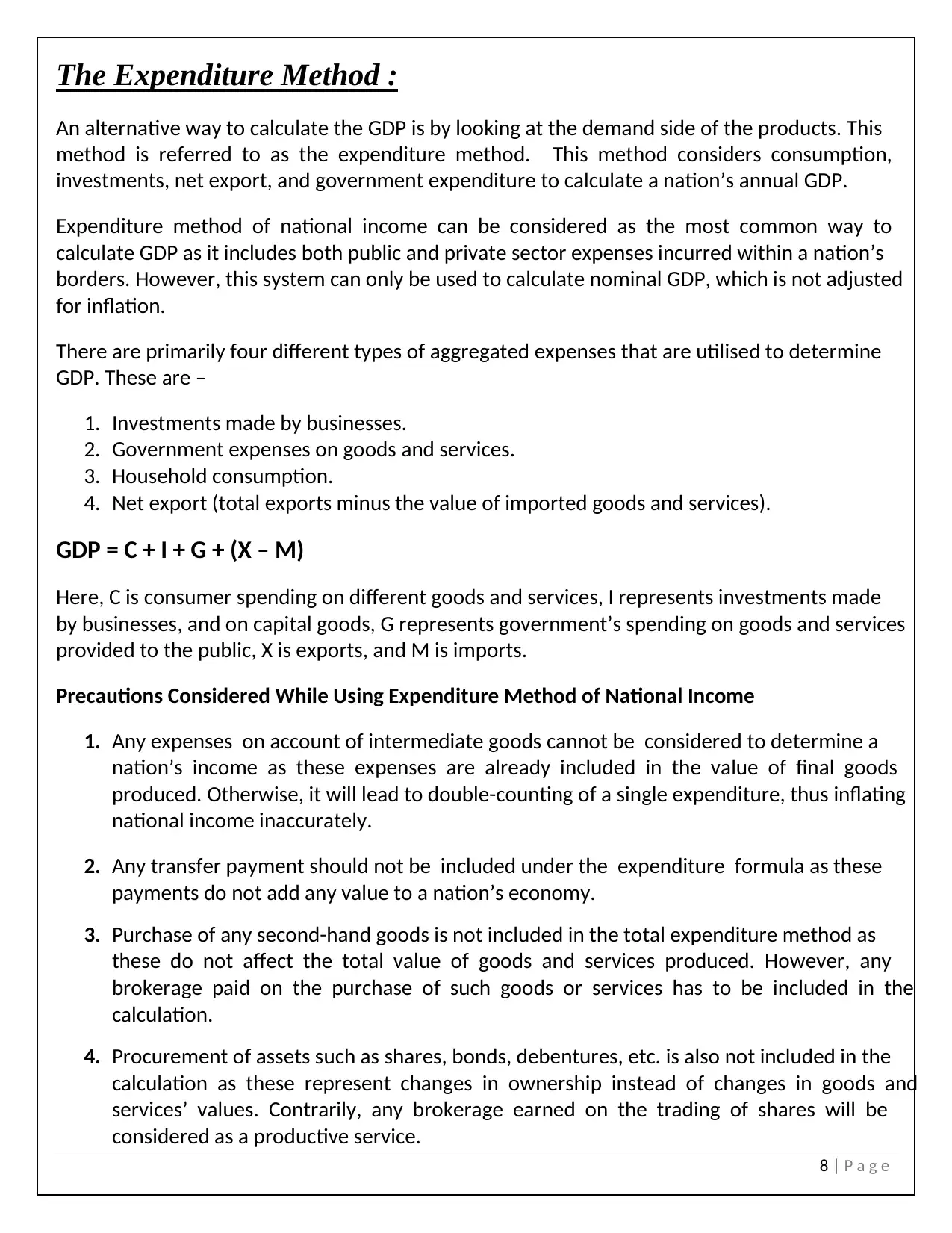
The Expenditure Method :
An alternative way to calculate the GDP is by looking at the demand side of the products. This
method is referred to as the expenditure method. This method considers consumption,
investments, net export, and government expenditure to calculate a nation’s annual GDP.
Expenditure method of national income can be considered as the most common way to
calculate GDP as it includes both public and private sector expenses incurred within a nation’s
borders. However, this system can only be used to calculate nominal GDP, which is not adjusted
for inflation.
There are primarily four different types of aggregated expenses that are utilised to determine
GDP. These are –
1. Investments made by businesses.
2. Government expenses on goods and services.
3. Household consumption.
4. Net export (total exports minus the value of imported goods and services).
GDP = C + I + G + (X – M)
Here, C is consumer spending on different goods and services, I represents investments made
by businesses, and on capital goods, G represents government’s spending on goods and services
provided to the public, X is exports, and M is imports.
Precautions Considered While Using Expenditure Method of National Income
1. Any expenses on account of intermediate goods cannot be considered to determine a
nation’s income as these expenses are already included in the value of final goods
produced. Otherwise, it will lead to double-counting of a single expenditure, thus inflating
national income inaccurately.
2. Any transfer payment should not be included under the expenditure formula as these
payments do not add any value to a nation’s economy.
3. Purchase of any second-hand goods is not included in the total expenditure method as
these do not affect the total value of goods and services produced. However, any
brokerage paid on the purchase of such goods or services has to be included in the
calculation.
4. Procurement of assets such as shares, bonds, debentures, etc. is also not included in the
calculation as these represent changes in ownership instead of changes in goods and
services’ values. Contrarily, any brokerage earned on the trading of shares will be
considered as a productive service.
The Expenditure Method :
An alternative way to calculate the GDP is by looking at the demand side of the products. This
method is referred to as the expenditure method. This method considers consumption,
investments, net export, and government expenditure to calculate a nation’s annual GDP.
Expenditure method of national income can be considered as the most common way to
calculate GDP as it includes both public and private sector expenses incurred within a nation’s
borders. However, this system can only be used to calculate nominal GDP, which is not adjusted
for inflation.
There are primarily four different types of aggregated expenses that are utilised to determine
GDP. These are –
1. Investments made by businesses.
2. Government expenses on goods and services.
3. Household consumption.
4. Net export (total exports minus the value of imported goods and services).
GDP = C + I + G + (X – M)
Here, C is consumer spending on different goods and services, I represents investments made
by businesses, and on capital goods, G represents government’s spending on goods and services
provided to the public, X is exports, and M is imports.
Precautions Considered While Using Expenditure Method of National Income
1. Any expenses on account of intermediate goods cannot be considered to determine a
nation’s income as these expenses are already included in the value of final goods
produced. Otherwise, it will lead to double-counting of a single expenditure, thus inflating
national income inaccurately.
2. Any transfer payment should not be included under the expenditure formula as these
payments do not add any value to a nation’s economy.
3. Purchase of any second-hand goods is not included in the total expenditure method as
these do not affect the total value of goods and services produced. However, any
brokerage paid on the purchase of such goods or services has to be included in the
calculation.
4. Procurement of assets such as shares, bonds, debentures, etc. is also not included in the
calculation as these represent changes in ownership instead of changes in goods and
services’ values. Contrarily, any brokerage earned on the trading of shares will be
considered as a productive service.
9 | P a g e
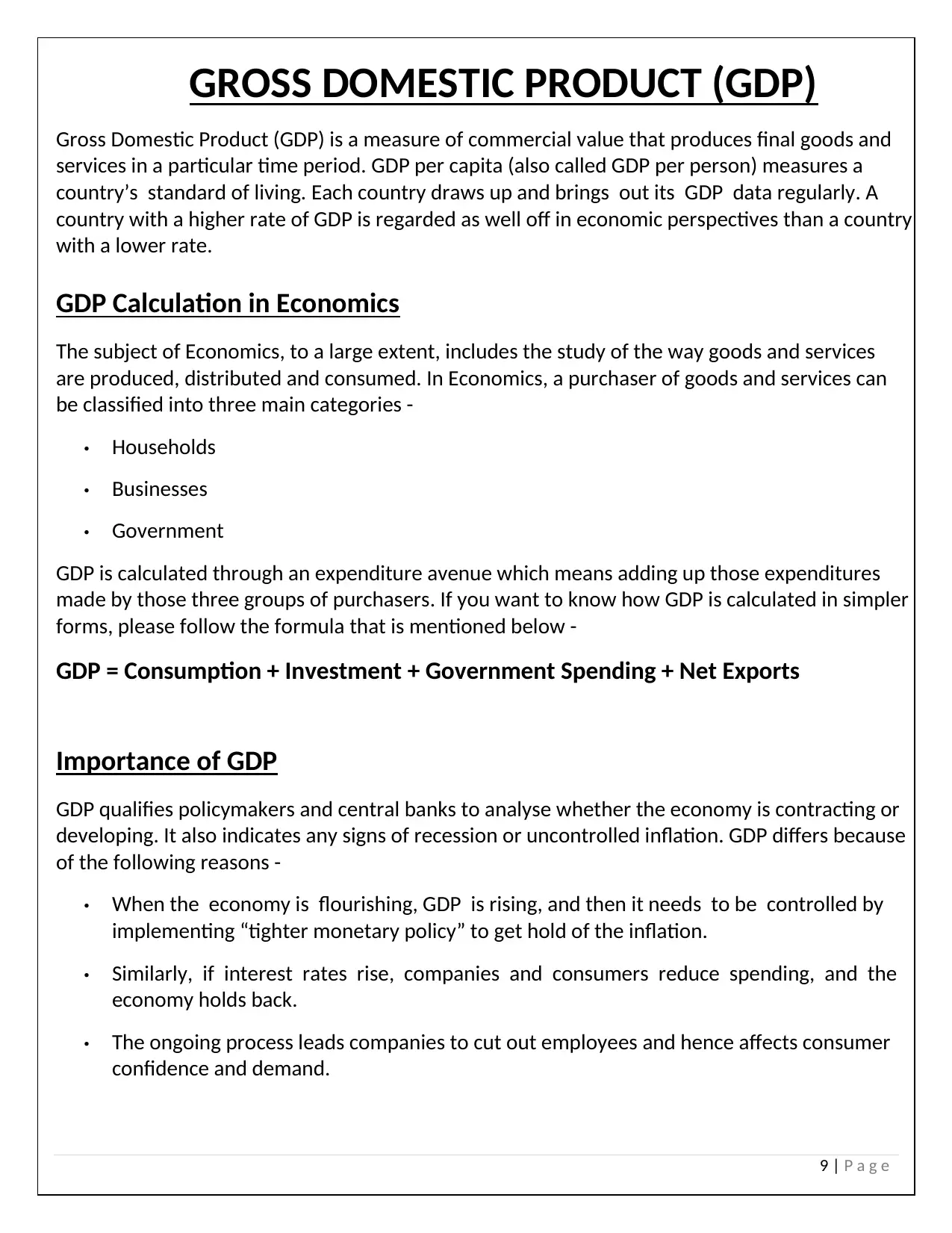
GROSS DOMESTIC PRODUCT (GDP)
Gross Domestic Product (GDP) is a measure of commercial value that produces final goods and
services in a particular time period. GDP per capita (also called GDP per person) measures a
country’s standard of living. Each country draws up and brings out its GDP data regularly. A
country with a higher rate of GDP is regarded as well off in economic perspectives than a country
with a lower rate.
GDP Calculation in Economics
The subject of Economics, to a large extent, includes the study of the way goods and services
are produced, distributed and consumed. In Economics, a purchaser of goods and services can
be classified into three main categories -
• Households
• Businesses
• Government
GDP is calculated through an expenditure avenue which means adding up those expenditures
made by those three groups of purchasers. If you want to know how GDP is calculated in simpler
forms, please follow the formula that is mentioned below -
GDP = Consumption + Investment + Government Spending + Net Exports
Importance of GDP
GDP qualifies policymakers and central banks to analyse whether the economy is contracting or
developing. It also indicates any signs of recession or uncontrolled inflation. GDP differs because
of the following reasons -
• When the economy is flourishing, GDP is rising, and then it needs to be controlled by
implementing “tighter monetary policy” to get hold of the inflation.
• Similarly, if interest rates rise, companies and consumers reduce spending, and the
economy holds back.
• The ongoing process leads companies to cut out employees and hence affects consumer
confidence and demand.
GROSS DOMESTIC PRODUCT (GDP)
Gross Domestic Product (GDP) is a measure of commercial value that produces final goods and
services in a particular time period. GDP per capita (also called GDP per person) measures a
country’s standard of living. Each country draws up and brings out its GDP data regularly. A
country with a higher rate of GDP is regarded as well off in economic perspectives than a country
with a lower rate.
GDP Calculation in Economics
The subject of Economics, to a large extent, includes the study of the way goods and services
are produced, distributed and consumed. In Economics, a purchaser of goods and services can
be classified into three main categories -
• Households
• Businesses
• Government
GDP is calculated through an expenditure avenue which means adding up those expenditures
made by those three groups of purchasers. If you want to know how GDP is calculated in simpler
forms, please follow the formula that is mentioned below -
GDP = Consumption + Investment + Government Spending + Net Exports
Importance of GDP
GDP qualifies policymakers and central banks to analyse whether the economy is contracting or
developing. It also indicates any signs of recession or uncontrolled inflation. GDP differs because
of the following reasons -
• When the economy is flourishing, GDP is rising, and then it needs to be controlled by
implementing “tighter monetary policy” to get hold of the inflation.
• Similarly, if interest rates rise, companies and consumers reduce spending, and the
economy holds back.
• The ongoing process leads companies to cut out employees and hence affects consumer
confidence and demand.
⊘ This is a preview!⊘
Do you want full access?
Subscribe today to unlock all pages.
Trusted by 1+ million students worldwide
10 | P a g e
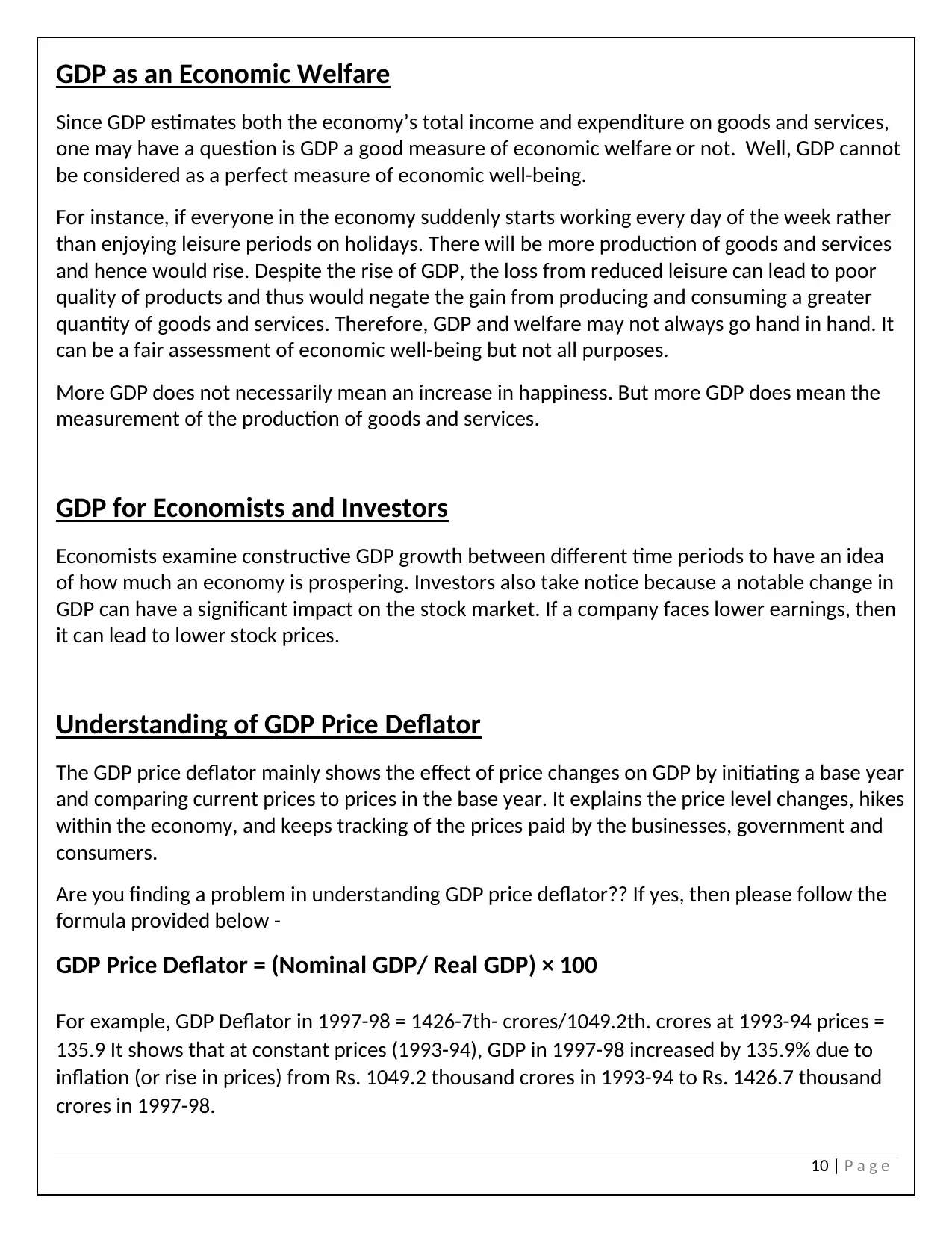
GDP as an Economic Welfare
Since GDP estimates both the economy’s total income and expenditure on goods and services,
one may have a question is GDP a good measure of economic welfare or not. Well, GDP cannot
be considered as a perfect measure of economic well-being.
For instance, if everyone in the economy suddenly starts working every day of the week rather
than enjoying leisure periods on holidays. There will be more production of goods and services
and hence would rise. Despite the rise of GDP, the loss from reduced leisure can lead to poor
quality of products and thus would negate the gain from producing and consuming a greater
quantity of goods and services. Therefore, GDP and welfare may not always go hand in hand. It
can be a fair assessment of economic well-being but not all purposes.
More GDP does not necessarily mean an increase in happiness. But more GDP does mean the
measurement of the production of goods and services.
GDP for Economists and Investors
Economists examine constructive GDP growth between different time periods to have an idea
of how much an economy is prospering. Investors also take notice because a notable change in
GDP can have a significant impact on the stock market. If a company faces lower earnings, then
it can lead to lower stock prices.
Understanding of GDP Price Deflator
The GDP price deflator mainly shows the effect of price changes on GDP by initiating a base year
and comparing current prices to prices in the base year. It explains the price level changes, hikes
within the economy, and keeps tracking of the prices paid by the businesses, government and
consumers.
Are you finding a problem in understanding GDP price deflator?? If yes, then please follow the
formula provided below -
GDP Price Deflator = (Nominal GDP/ Real GDP) × 100
For example, GDP Deflator in 1997-98 = 1426-7th- crores/1049.2th. crores at 1993-94 prices =
135.9 It shows that at constant prices (1993-94), GDP in 1997-98 increased by 135.9% due to
inflation (or rise in prices) from Rs. 1049.2 thousand crores in 1993-94 to Rs. 1426.7 thousand
crores in 1997-98.
GDP as an Economic Welfare
Since GDP estimates both the economy’s total income and expenditure on goods and services,
one may have a question is GDP a good measure of economic welfare or not. Well, GDP cannot
be considered as a perfect measure of economic well-being.
For instance, if everyone in the economy suddenly starts working every day of the week rather
than enjoying leisure periods on holidays. There will be more production of goods and services
and hence would rise. Despite the rise of GDP, the loss from reduced leisure can lead to poor
quality of products and thus would negate the gain from producing and consuming a greater
quantity of goods and services. Therefore, GDP and welfare may not always go hand in hand. It
can be a fair assessment of economic well-being but not all purposes.
More GDP does not necessarily mean an increase in happiness. But more GDP does mean the
measurement of the production of goods and services.
GDP for Economists and Investors
Economists examine constructive GDP growth between different time periods to have an idea
of how much an economy is prospering. Investors also take notice because a notable change in
GDP can have a significant impact on the stock market. If a company faces lower earnings, then
it can lead to lower stock prices.
Understanding of GDP Price Deflator
The GDP price deflator mainly shows the effect of price changes on GDP by initiating a base year
and comparing current prices to prices in the base year. It explains the price level changes, hikes
within the economy, and keeps tracking of the prices paid by the businesses, government and
consumers.
Are you finding a problem in understanding GDP price deflator?? If yes, then please follow the
formula provided below -
GDP Price Deflator = (Nominal GDP/ Real GDP) × 100
For example, GDP Deflator in 1997-98 = 1426-7th- crores/1049.2th. crores at 1993-94 prices =
135.9 It shows that at constant prices (1993-94), GDP in 1997-98 increased by 135.9% due to
inflation (or rise in prices) from Rs. 1049.2 thousand crores in 1993-94 to Rs. 1426.7 thousand
crores in 1997-98.
Paraphrase This Document
Need a fresh take? Get an instant paraphrase of this document with our AI Paraphraser
11 | P a g e
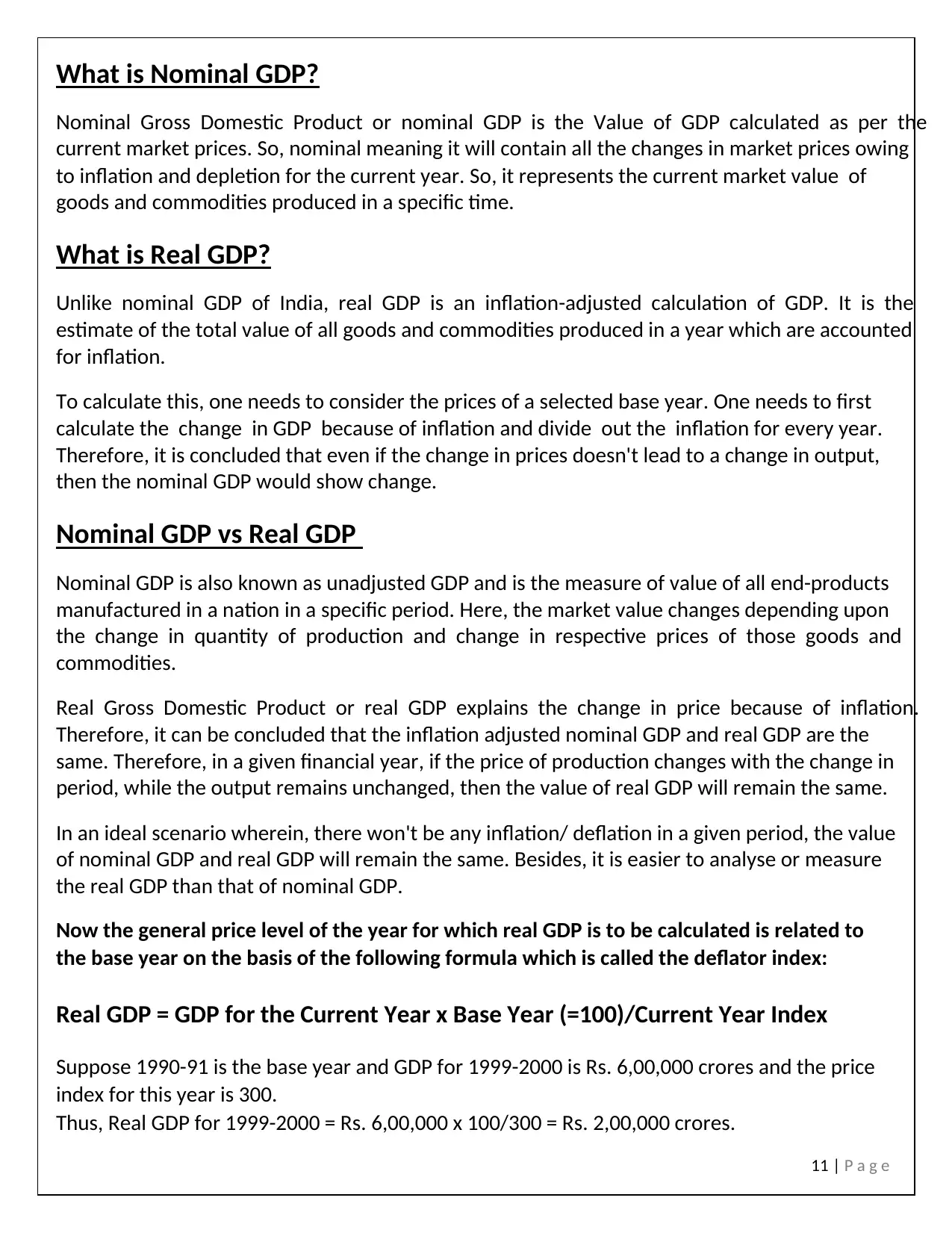
What is Nominal GDP?
Nominal Gross Domestic Product or nominal GDP is the Value of GDP calculated as per the
current market prices. So, nominal meaning it will contain all the changes in market prices owing
to inflation and depletion for the current year. So, it represents the current market value of
goods and commodities produced in a specific time.
What is Real GDP?
Unlike nominal GDP of India, real GDP is an inflation-adjusted calculation of GDP. It is the
estimate of the total value of all goods and commodities produced in a year which are accounted
for inflation.
To calculate this, one needs to consider the prices of a selected base year. One needs to first
calculate the change in GDP because of inflation and divide out the inflation for every year.
Therefore, it is concluded that even if the change in prices doesn't lead to a change in output,
then the nominal GDP would show change.
Nominal GDP vs Real GDP
Nominal GDP is also known as unadjusted GDP and is the measure of value of all end-products
manufactured in a nation in a specific period. Here, the market value changes depending upon
the change in quantity of production and change in respective prices of those goods and
commodities.
Real Gross Domestic Product or real GDP explains the change in price because of inflation.
Therefore, it can be concluded that the inflation adjusted nominal GDP and real GDP are the
same. Therefore, in a given financial year, if the price of production changes with the change in
period, while the output remains unchanged, then the value of real GDP will remain the same.
In an ideal scenario wherein, there won't be any inflation/ deflation in a given period, the value
of nominal GDP and real GDP will remain the same. Besides, it is easier to analyse or measure
the real GDP than that of nominal GDP.
Now the general price level of the year for which real GDP is to be calculated is related to
the base year on the basis of the following formula which is called the deflator index:
Real GDP = GDP for the Current Year x Base Year (=100)/Current Year Index
Suppose 1990-91 is the base year and GDP for 1999-2000 is Rs. 6,00,000 crores and the price
index for this year is 300.
Thus, Real GDP for 1999-2000 = Rs. 6,00,000 x 100/300 = Rs. 2,00,000 crores.
What is Nominal GDP?
Nominal Gross Domestic Product or nominal GDP is the Value of GDP calculated as per the
current market prices. So, nominal meaning it will contain all the changes in market prices owing
to inflation and depletion for the current year. So, it represents the current market value of
goods and commodities produced in a specific time.
What is Real GDP?
Unlike nominal GDP of India, real GDP is an inflation-adjusted calculation of GDP. It is the
estimate of the total value of all goods and commodities produced in a year which are accounted
for inflation.
To calculate this, one needs to consider the prices of a selected base year. One needs to first
calculate the change in GDP because of inflation and divide out the inflation for every year.
Therefore, it is concluded that even if the change in prices doesn't lead to a change in output,
then the nominal GDP would show change.
Nominal GDP vs Real GDP
Nominal GDP is also known as unadjusted GDP and is the measure of value of all end-products
manufactured in a nation in a specific period. Here, the market value changes depending upon
the change in quantity of production and change in respective prices of those goods and
commodities.
Real Gross Domestic Product or real GDP explains the change in price because of inflation.
Therefore, it can be concluded that the inflation adjusted nominal GDP and real GDP are the
same. Therefore, in a given financial year, if the price of production changes with the change in
period, while the output remains unchanged, then the value of real GDP will remain the same.
In an ideal scenario wherein, there won't be any inflation/ deflation in a given period, the value
of nominal GDP and real GDP will remain the same. Besides, it is easier to analyse or measure
the real GDP than that of nominal GDP.
Now the general price level of the year for which real GDP is to be calculated is related to
the base year on the basis of the following formula which is called the deflator index:
Real GDP = GDP for the Current Year x Base Year (=100)/Current Year Index
Suppose 1990-91 is the base year and GDP for 1999-2000 is Rs. 6,00,000 crores and the price
index for this year is 300.
Thus, Real GDP for 1999-2000 = Rs. 6,00,000 x 100/300 = Rs. 2,00,000 crores.
12 | P a g e
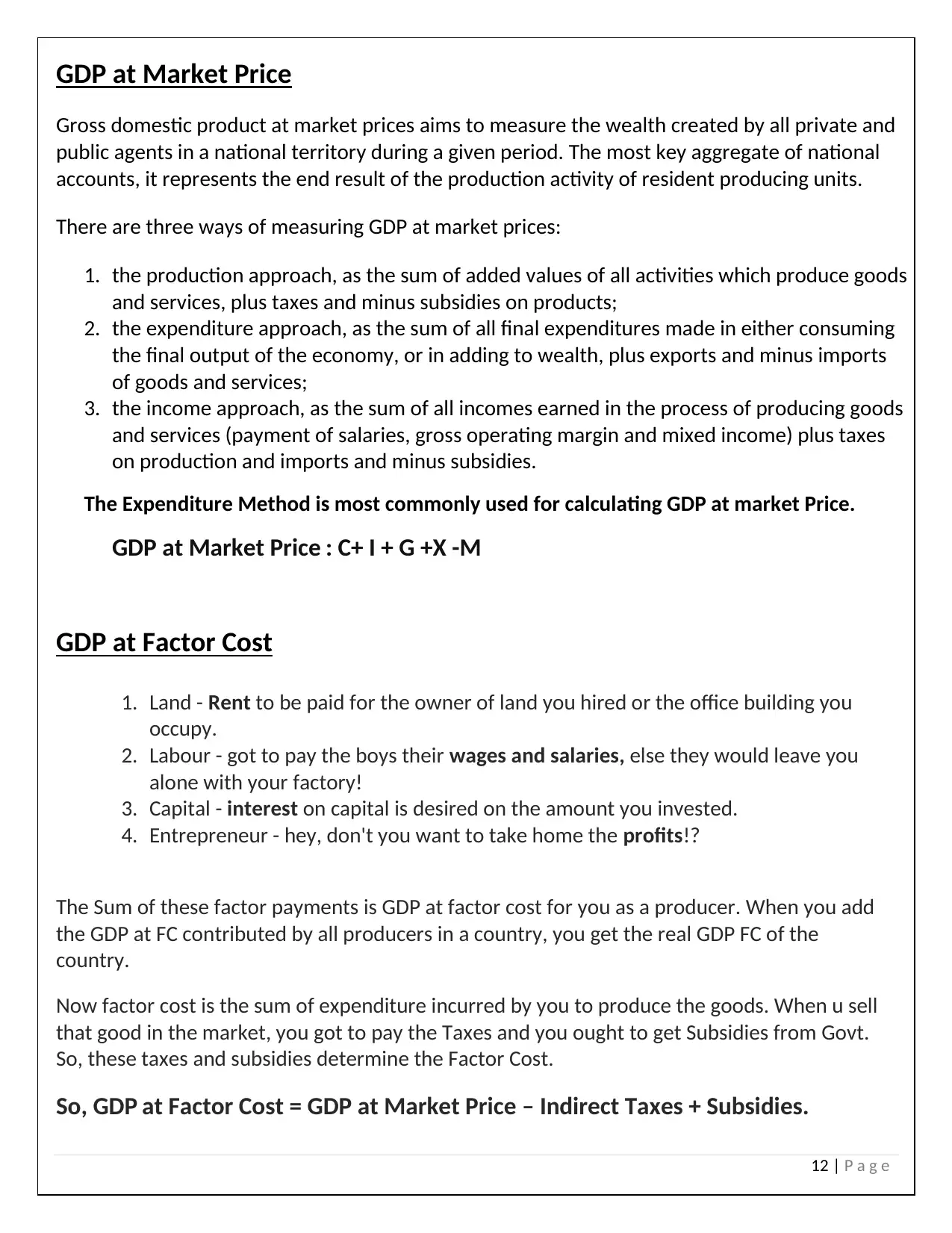
GDP at Market Price
Gross domestic product at market prices aims to measure the wealth created by all private and
public agents in a national territory during a given period. The most key aggregate of national
accounts, it represents the end result of the production activity of resident producing units.
There are three ways of measuring GDP at market prices:
1. the production approach, as the sum of added values of all activities which produce goods
and services, plus taxes and minus subsidies on products;
2. the expenditure approach, as the sum of all final expenditures made in either consuming
the final output of the economy, or in adding to wealth, plus exports and minus imports
of goods and services;
3. the income approach, as the sum of all incomes earned in the process of producing goods
and services (payment of salaries, gross operating margin and mixed income) plus taxes
on production and imports and minus subsidies.
The Expenditure Method is most commonly used for calculating GDP at market Price.
GDP at Market Price : C+ I + G +X -M
GDP at Factor Cost
1. Land - Rent to be paid for the owner of land you hired or the office building you
occupy.
2. Labour - got to pay the boys their wages and salaries, else they would leave you
alone with your factory!
3. Capital - interest on capital is desired on the amount you invested.
4. Entrepreneur - hey, don't you want to take home the profits!?
The Sum of these factor payments is GDP at factor cost for you as a producer. When you add
the GDP at FC contributed by all producers in a country, you get the real GDP FC of the
country.
Now factor cost is the sum of expenditure incurred by you to produce the goods. When u sell
that good in the market, you got to pay the Taxes and you ought to get Subsidies from Govt.
So, these taxes and subsidies determine the Factor Cost.
So, GDP at Factor Cost = GDP at Market Price – Indirect Taxes + Subsidies.
GDP at Market Price
Gross domestic product at market prices aims to measure the wealth created by all private and
public agents in a national territory during a given period. The most key aggregate of national
accounts, it represents the end result of the production activity of resident producing units.
There are three ways of measuring GDP at market prices:
1. the production approach, as the sum of added values of all activities which produce goods
and services, plus taxes and minus subsidies on products;
2. the expenditure approach, as the sum of all final expenditures made in either consuming
the final output of the economy, or in adding to wealth, plus exports and minus imports
of goods and services;
3. the income approach, as the sum of all incomes earned in the process of producing goods
and services (payment of salaries, gross operating margin and mixed income) plus taxes
on production and imports and minus subsidies.
The Expenditure Method is most commonly used for calculating GDP at market Price.
GDP at Market Price : C+ I + G +X -M
GDP at Factor Cost
1. Land - Rent to be paid for the owner of land you hired or the office building you
occupy.
2. Labour - got to pay the boys their wages and salaries, else they would leave you
alone with your factory!
3. Capital - interest on capital is desired on the amount you invested.
4. Entrepreneur - hey, don't you want to take home the profits!?
The Sum of these factor payments is GDP at factor cost for you as a producer. When you add
the GDP at FC contributed by all producers in a country, you get the real GDP FC of the
country.
Now factor cost is the sum of expenditure incurred by you to produce the goods. When u sell
that good in the market, you got to pay the Taxes and you ought to get Subsidies from Govt.
So, these taxes and subsidies determine the Factor Cost.
So, GDP at Factor Cost = GDP at Market Price – Indirect Taxes + Subsidies.
⊘ This is a preview!⊘
Do you want full access?
Subscribe today to unlock all pages.
Trusted by 1+ million students worldwide

1 out of 31


Related Documents


Your All-in-One AI-Powered Toolkit for Academic Success.
+13062052269
info@desklib.com
Available 24*7 on WhatsApp / Email
![[object Object]](/_next/static/media/star-bottom.7253800d.svg)
Unlock your academic potential
Copyright © 2020–2026 A2Z Services. All Rights Reserved. Developed and managed by ZUCOL.