The Theme of Struggle and Suffering in Native American Literature

Verified

Added on  2023/04/25

|4
|1090
|142
Essay
AI Summary
This essay delves into the theme of struggle and suffering as depicted in various Native American novels, drawing upon oral tales and cultural heritage. It analyzes N. Scott Momaday’s 'House Made of Dawn,' focusing on Abel's struggle to readjust to his homeland and his subsequent immoral actions. The essay also examines Diane Glancy’s 'Pushing the Bear,' highlighting the suffering endured by the Cherokee people during the Trail of Tears. Furthermore, it explores Leslie Marmon Silko’s 'Ceremony,' detailing Tayo’s post-traumatic stress disorder and concern for the suffering of others. Finally, LeAnne Howe’s 'Shell Shaker' is discussed, emphasizing the struggle for independence and the corruption faced by Choctaw chiefs. The essay concludes that these novels reflect the rich storytelling tradition of Native American culture, using the theme of suffering to make sense of their world.
Document Page
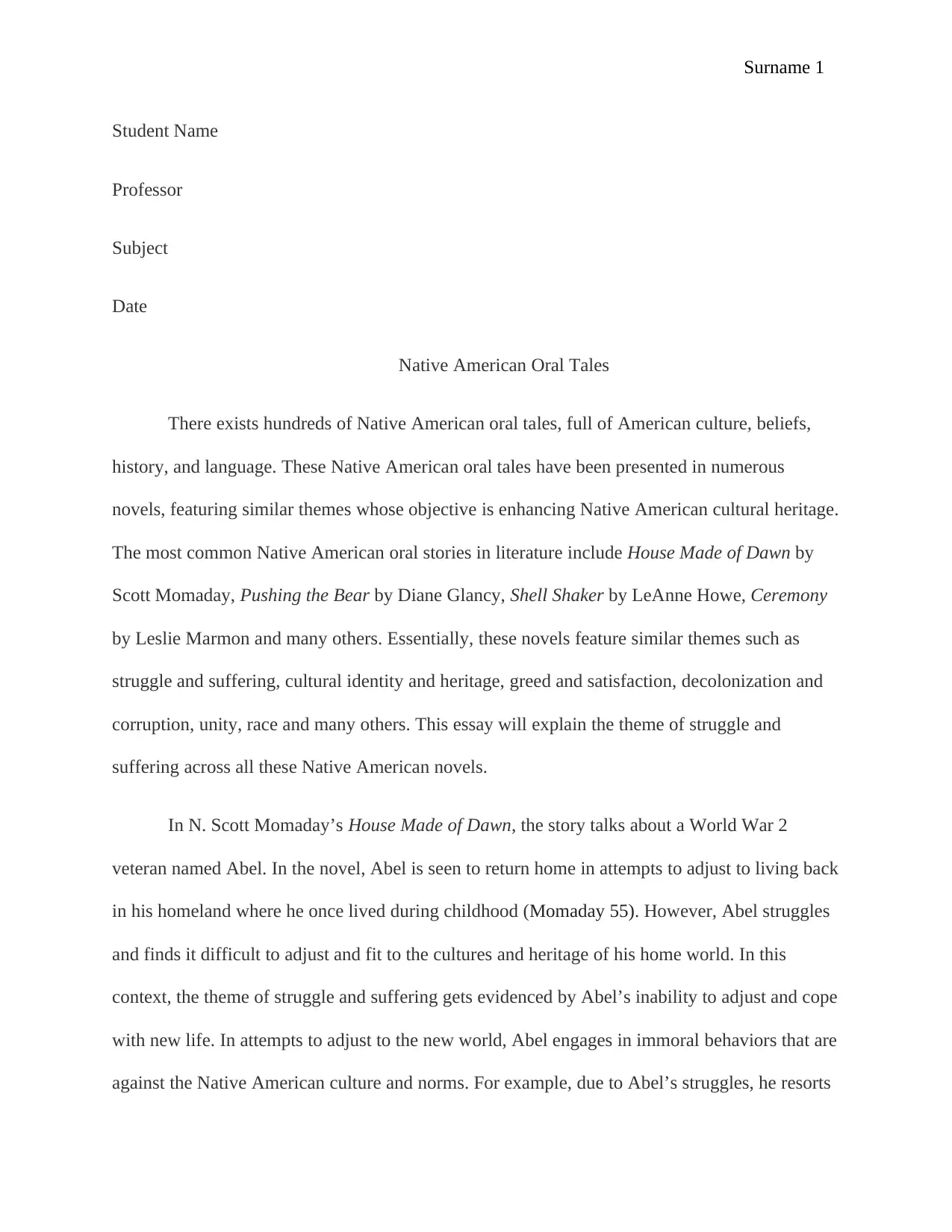
Surname 1
Student Name
Professor
Subject
Date
Native American Oral Tales
There exists hundreds of Native American oral tales, full of American culture, beliefs,
history, and language. These Native American oral tales have been presented in numerous
novels, featuring similar themes whose objective is enhancing Native American cultural heritage.
The most common Native American oral stories in literature include House Made of Dawn by
Scott Momaday, Pushing the Bear by Diane Glancy, Shell Shaker by LeAnne Howe, Ceremony
by Leslie Marmon and many others. Essentially, these novels feature similar themes such as
struggle and suffering, cultural identity and heritage, greed and satisfaction, decolonization and
corruption, unity, race and many others. This essay will explain the theme of struggle and
suffering across all these Native American novels.
In N. Scott Momaday’s House Made of Dawn, the story talks about a World War 2
veteran named Abel. In the novel, Abel is seen to return home in attempts to adjust to living back
in his homeland where he once lived during childhood (Momaday 55). However, Abel struggles
and finds it difficult to adjust and fit to the cultures and heritage of his home world. In this
context, the theme of struggle and suffering gets evidenced by Abel’s inability to adjust and cope
with new life. In attempts to adjust to the new world, Abel engages in immoral behaviors that are
against the Native American culture and norms. For example, due to Abel’s struggles, he resorts
tabler-icon-diamond-filled.svg

Paraphrase This Document

Need a fresh take? Get an instant paraphrase of this document with our AI Paraphraser
Document Page
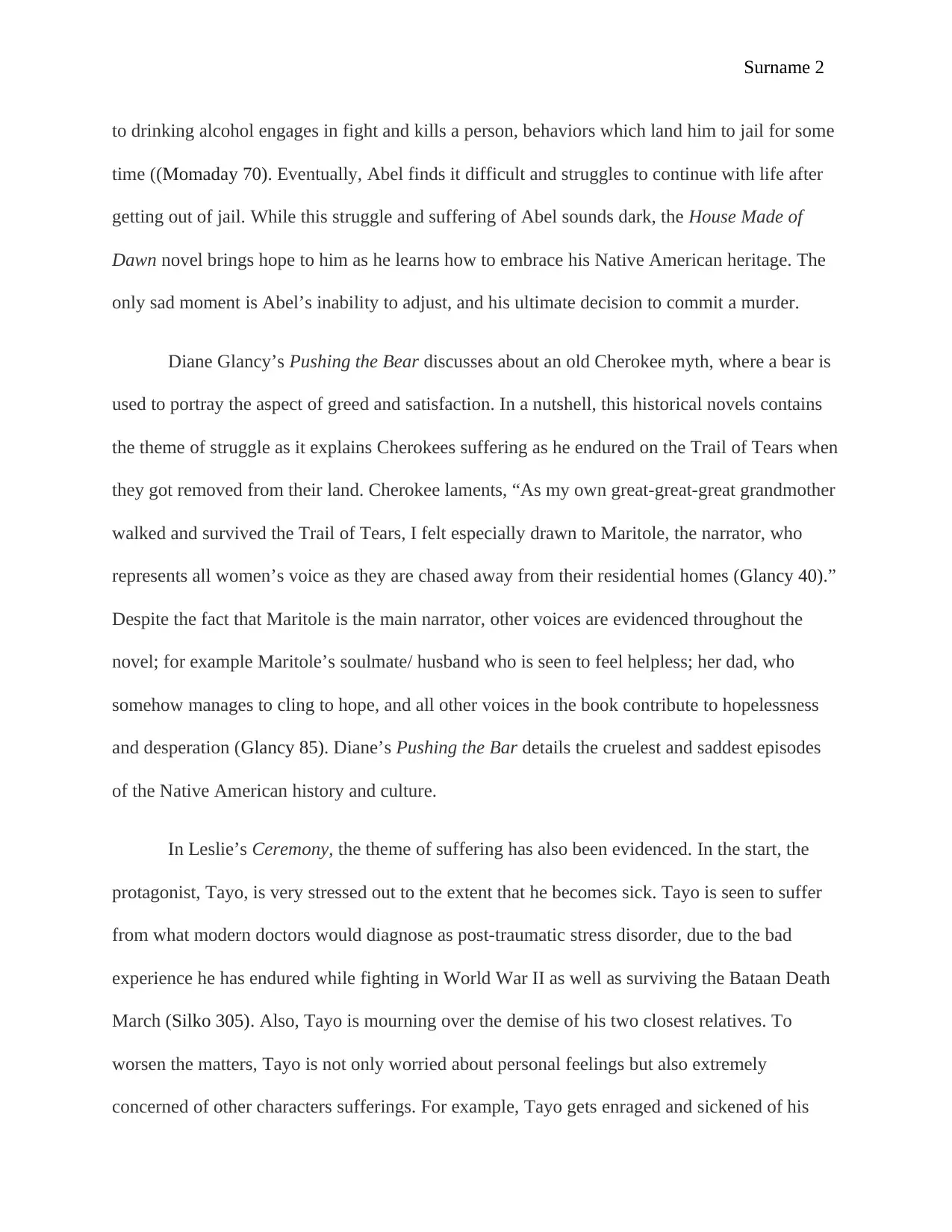
Surname 2
to drinking alcohol engages in fight and kills a person, behaviors which land him to jail for some
time ((Momaday 70). Eventually, Abel finds it difficult and struggles to continue with life after
getting out of jail. While this struggle and suffering of Abel sounds dark, the House Made of
Dawn novel brings hope to him as he learns how to embrace his Native American heritage. The
only sad moment is Abel’s inability to adjust, and his ultimate decision to commit a murder.
Diane Glancy’s Pushing the Bear discusses about an old Cherokee myth, where a bear is
used to portray the aspect of greed and satisfaction. In a nutshell, this historical novels contains
the theme of struggle as it explains Cherokees suffering as he endured on the Trail of Tears when
they got removed from their land. Cherokee laments, “As my own great-great-great grandmother
walked and survived the Trail of Tears, I felt especially drawn to Maritole, the narrator, who
represents all women’s voice as they are chased away from their residential homes (Glancy 40).”
Despite the fact that Maritole is the main narrator, other voices are evidenced throughout the
novel; for example Maritole’s soulmate/ husband who is seen to feel helpless; her dad, who
somehow manages to cling to hope, and all other voices in the book contribute to hopelessness
and desperation (Glancy 85). Diane’s Pushing the Bar details the cruelest and saddest episodes
of the Native American history and culture.
In Leslie’s Ceremony, the theme of suffering has also been evidenced. In the start, the
protagonist, Tayo, is very stressed out to the extent that he becomes sick. Tayo is seen to suffer
from what modern doctors would diagnose as post-traumatic stress disorder, due to the bad
experience he has endured while fighting in World War II as well as surviving the Bataan Death
March (Silko 305). Also, Tayo is mourning over the demise of his two closest relatives. To
worsen the matters, Tayo is not only worried about personal feelings but also extremely
concerned of other characters sufferings. For example, Tayo gets enraged and sickened of his
Document Page
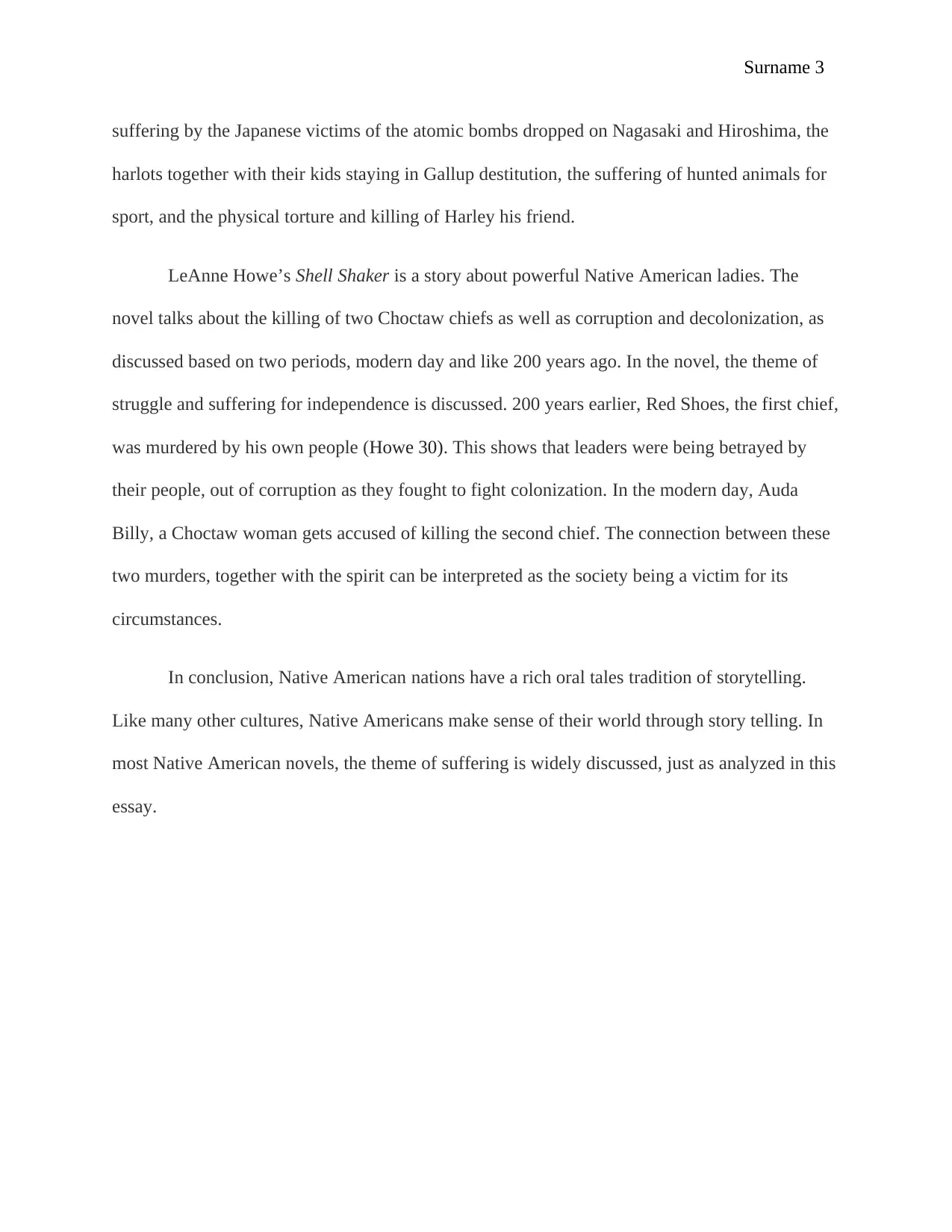
Surname 3
suffering by the Japanese victims of the atomic bombs dropped on Nagasaki and Hiroshima, the
harlots together with their kids staying in Gallup destitution, the suffering of hunted animals for
sport, and the physical torture and killing of Harley his friend.
LeAnne Howe’s Shell Shaker is a story about powerful Native American ladies. The
novel talks about the killing of two Choctaw chiefs as well as corruption and decolonization, as
discussed based on two periods, modern day and like 200 years ago. In the novel, the theme of
struggle and suffering for independence is discussed. 200 years earlier, Red Shoes, the first chief,
was murdered by his own people (Howe 30). This shows that leaders were being betrayed by
their people, out of corruption as they fought to fight colonization. In the modern day, Auda
Billy, a Choctaw woman gets accused of killing the second chief. The connection between these
two murders, together with the spirit can be interpreted as the society being a victim for its
circumstances.
In conclusion, Native American nations have a rich oral tales tradition of storytelling.
Like many other cultures, Native Americans make sense of their world through story telling. In
most Native American novels, the theme of suffering is widely discussed, just as analyzed in this
essay.
Document Page
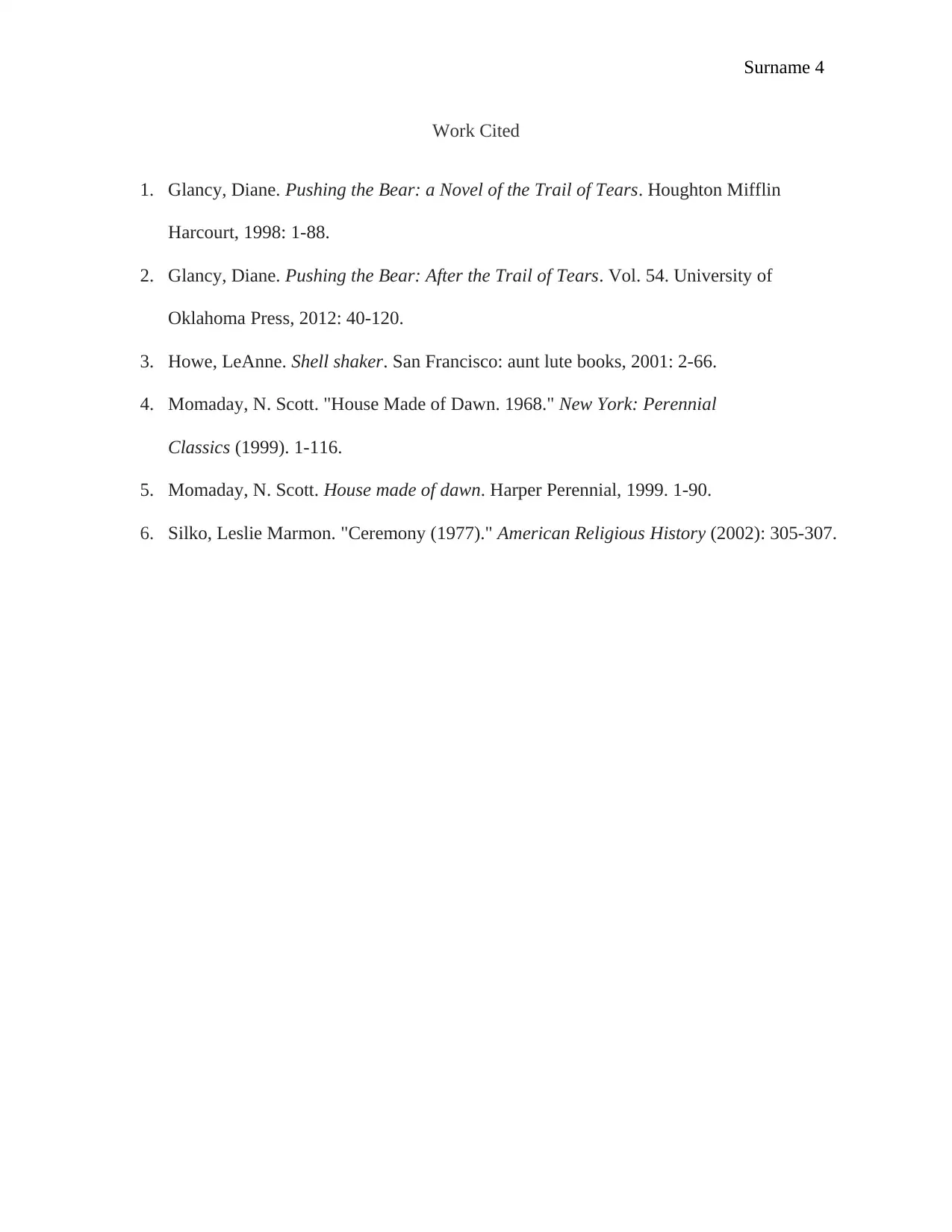
Surname 4
Work Cited
1. Glancy, Diane. Pushing the Bear: a Novel of the Trail of Tears. Houghton Mifflin
Harcourt, 1998: 1-88.
2. Glancy, Diane. Pushing the Bear: After the Trail of Tears. Vol. 54. University of
Oklahoma Press, 2012: 40-120.
3. Howe, LeAnne. Shell shaker. San Francisco: aunt lute books, 2001: 2-66.
4. Momaday, N. Scott. "House Made of Dawn. 1968." New York: Perennial
Classics (1999). 1-116.
5. Momaday, N. Scott. House made of dawn. Harper Perennial, 1999. 1-90.
6. Silko, Leslie Marmon. "Ceremony (1977)." American Religious History (2002): 305-307.
chevron_up_icon
1 out of 4
circle_padding
hide_on_mobile
zoom_out_icon
[object Object]