Behavioral Studies: Self-Efficacy and Post-Traumatic Stress Disorder
VerifiedAdded on 2020/05/11
|10
|2628
|53
Essay
AI Summary
This essay explores the psychological impact of natural disasters, focusing on the prevalence of post-traumatic stress disorder (PTSD) among survivors and the factors that contribute to their recovery. The core argument centers on the critical role of self-efficacy, defined as an individual's perceived ability to achieve desired outcomes, in mitigating the effects of trauma. The essay discusses how coping self-efficacy (CSE) enables individuals to manage internal and external demands, facilitating post-traumatic recovery, and how it acts as a mediator between various factors like optimism, social support, and resource availability, and the level of psychological distress. It highlights that higher CSE levels correlate with better recovery rates and lower PTSD symptoms. The analysis also considers the influence of personality characteristics such as optimism, self-control, and self-esteem in coping with stress and the impact of natural disasters on behavioral traits. The essay also delves into the Conservation Of Resources (COR) theory, and how self-efficacy, self-esteem, and personal control help individuals to cope with stress by enhancing their confidence level, ultimately reducing the impact of PTSD. The essay references various studies and theories to support the argument that self-efficacy is a vital approach to minimize the effect of PTSD that usually occurs due to a natural disaster.
Running head: BEHAVIORAL STUDIES
BEHAVIORAL STUDIES
Name of the Student:
Name of the University:
Author Note:
BEHAVIORAL STUDIES
Name of the Student:
Name of the University:
Author Note:

Paraphrase This Document
Need a fresh take? Get an instant paraphrase of this document with our AI Paraphraser
1BEHAVIORAL STUDIES
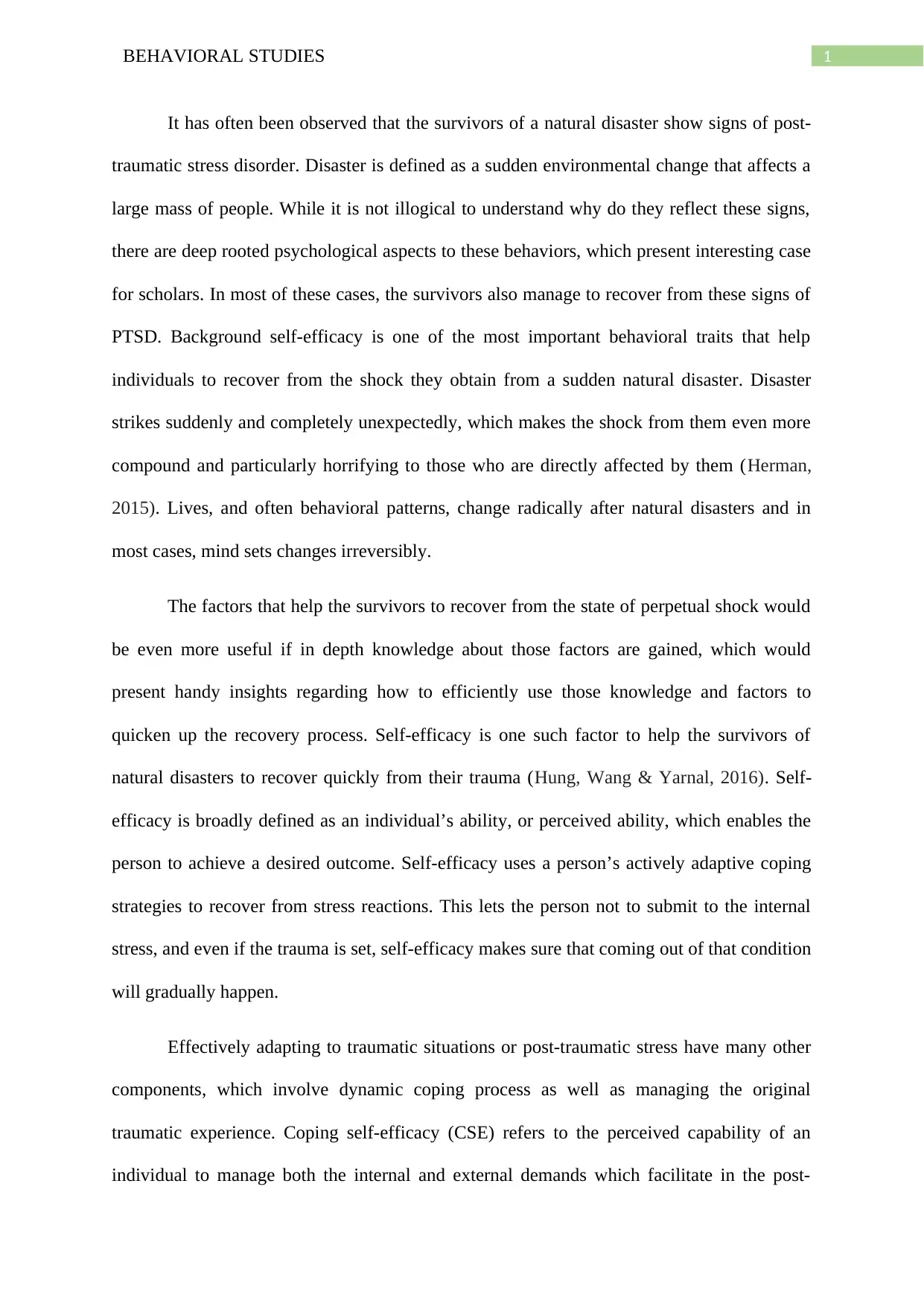
It has often been observed that the survivors of a natural disaster show signs of post-
traumatic stress disorder. Disaster is defined as a sudden environmental change that affects a
large mass of people. While it is not illogical to understand why do they reflect these signs,
there are deep rooted psychological aspects to these behaviors, which present interesting case
for scholars. In most of these cases, the survivors also manage to recover from these signs of
PTSD. Background self-efficacy is one of the most important behavioral traits that help
individuals to recover from the shock they obtain from a sudden natural disaster. Disaster
strikes suddenly and completely unexpectedly, which makes the shock from them even more
compound and particularly horrifying to those who are directly affected by them (Herman,
2015). Lives, and often behavioral patterns, change radically after natural disasters and in
most cases, mind sets changes irreversibly.
The factors that help the survivors to recover from the state of perpetual shock would
be even more useful if in depth knowledge about those factors are gained, which would
present handy insights regarding how to efficiently use those knowledge and factors to
quicken up the recovery process. Self-efficacy is one such factor to help the survivors of
natural disasters to recover quickly from their trauma (Hung, Wang & Yarnal, 2016). Self-
efficacy is broadly defined as an individual’s ability, or perceived ability, which enables the
person to achieve a desired outcome. Self-efficacy uses a person’s actively adaptive coping
strategies to recover from stress reactions. This lets the person not to submit to the internal
stress, and even if the trauma is set, self-efficacy makes sure that coming out of that condition
will gradually happen.
Effectively adapting to traumatic situations or post-traumatic stress have many other
components, which involve dynamic coping process as well as managing the original
traumatic experience. Coping self-efficacy (CSE) refers to the perceived capability of an
individual to manage both the internal and external demands which facilitate in the post-
It has often been observed that the survivors of a natural disaster show signs of post-
traumatic stress disorder. Disaster is defined as a sudden environmental change that affects a
large mass of people. While it is not illogical to understand why do they reflect these signs,
there are deep rooted psychological aspects to these behaviors, which present interesting case
for scholars. In most of these cases, the survivors also manage to recover from these signs of
PTSD. Background self-efficacy is one of the most important behavioral traits that help
individuals to recover from the shock they obtain from a sudden natural disaster. Disaster
strikes suddenly and completely unexpectedly, which makes the shock from them even more
compound and particularly horrifying to those who are directly affected by them (Herman,
2015). Lives, and often behavioral patterns, change radically after natural disasters and in
most cases, mind sets changes irreversibly.
The factors that help the survivors to recover from the state of perpetual shock would
be even more useful if in depth knowledge about those factors are gained, which would
present handy insights regarding how to efficiently use those knowledge and factors to
quicken up the recovery process. Self-efficacy is one such factor to help the survivors of
natural disasters to recover quickly from their trauma (Hung, Wang & Yarnal, 2016). Self-
efficacy is broadly defined as an individual’s ability, or perceived ability, which enables the
person to achieve a desired outcome. Self-efficacy uses a person’s actively adaptive coping
strategies to recover from stress reactions. This lets the person not to submit to the internal
stress, and even if the trauma is set, self-efficacy makes sure that coming out of that condition
will gradually happen.
Effectively adapting to traumatic situations or post-traumatic stress have many other
components, which involve dynamic coping process as well as managing the original
traumatic experience. Coping self-efficacy (CSE) refers to the perceived capability of an
individual to manage both the internal and external demands which facilitate in the post-
2BEHAVIORAL STUDIES
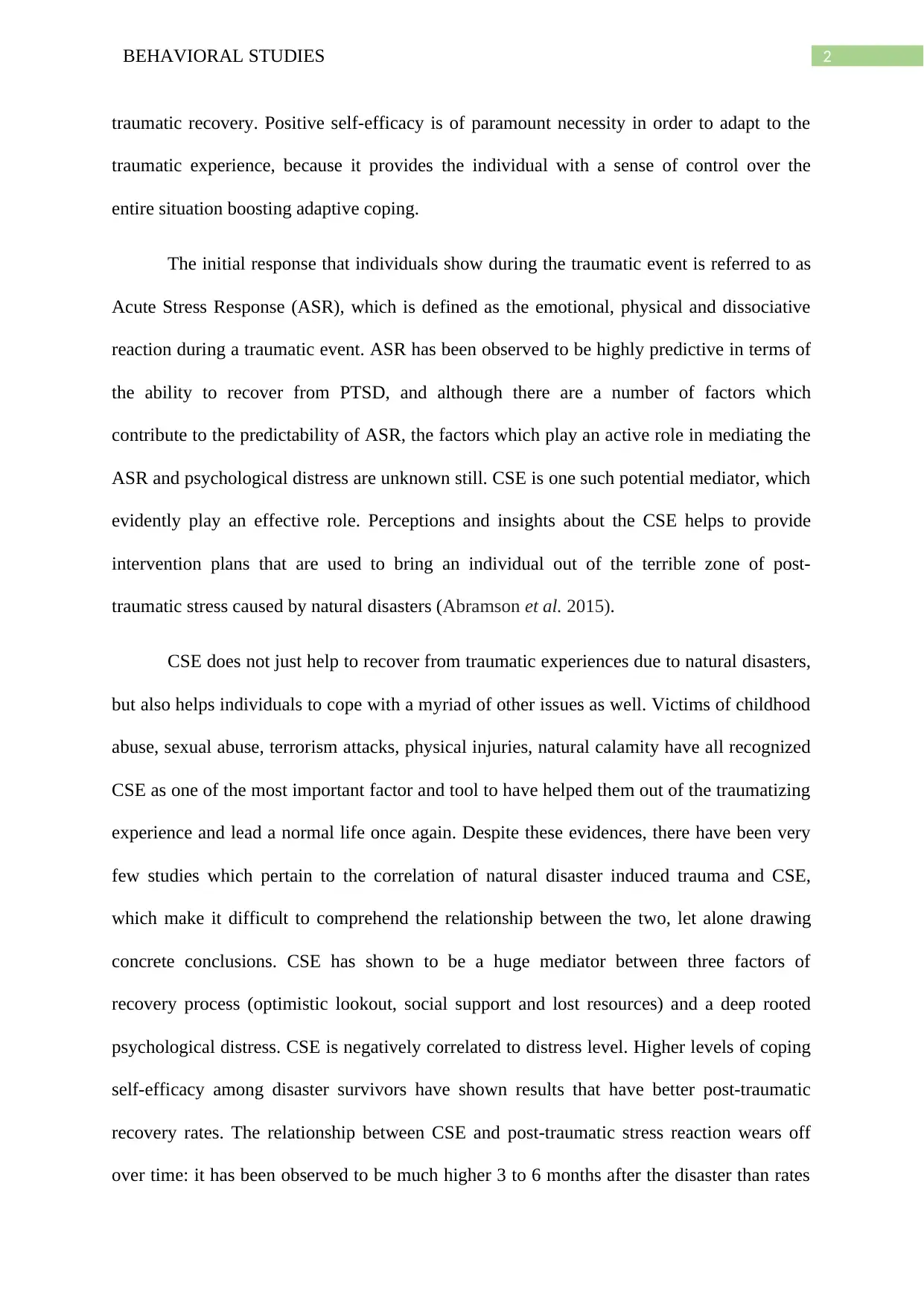
traumatic recovery. Positive self-efficacy is of paramount necessity in order to adapt to the
traumatic experience, because it provides the individual with a sense of control over the
entire situation boosting adaptive coping.
The initial response that individuals show during the traumatic event is referred to as
Acute Stress Response (ASR), which is defined as the emotional, physical and dissociative
reaction during a traumatic event. ASR has been observed to be highly predictive in terms of
the ability to recover from PTSD, and although there are a number of factors which
contribute to the predictability of ASR, the factors which play an active role in mediating the
ASR and psychological distress are unknown still. CSE is one such potential mediator, which
evidently play an effective role. Perceptions and insights about the CSE helps to provide
intervention plans that are used to bring an individual out of the terrible zone of post-
traumatic stress caused by natural disasters (Abramson et al. 2015).
CSE does not just help to recover from traumatic experiences due to natural disasters,
but also helps individuals to cope with a myriad of other issues as well. Victims of childhood
abuse, sexual abuse, terrorism attacks, physical injuries, natural calamity have all recognized
CSE as one of the most important factor and tool to have helped them out of the traumatizing
experience and lead a normal life once again. Despite these evidences, there have been very
few studies which pertain to the correlation of natural disaster induced trauma and CSE,
which make it difficult to comprehend the relationship between the two, let alone drawing
concrete conclusions. CSE has shown to be a huge mediator between three factors of
recovery process (optimistic lookout, social support and lost resources) and a deep rooted
psychological distress. CSE is negatively correlated to distress level. Higher levels of coping
self-efficacy among disaster survivors have shown results that have better post-traumatic
recovery rates. The relationship between CSE and post-traumatic stress reaction wears off
over time: it has been observed to be much higher 3 to 6 months after the disaster than rates
traumatic recovery. Positive self-efficacy is of paramount necessity in order to adapt to the
traumatic experience, because it provides the individual with a sense of control over the
entire situation boosting adaptive coping.
The initial response that individuals show during the traumatic event is referred to as
Acute Stress Response (ASR), which is defined as the emotional, physical and dissociative
reaction during a traumatic event. ASR has been observed to be highly predictive in terms of
the ability to recover from PTSD, and although there are a number of factors which
contribute to the predictability of ASR, the factors which play an active role in mediating the
ASR and psychological distress are unknown still. CSE is one such potential mediator, which
evidently play an effective role. Perceptions and insights about the CSE helps to provide
intervention plans that are used to bring an individual out of the terrible zone of post-
traumatic stress caused by natural disasters (Abramson et al. 2015).
CSE does not just help to recover from traumatic experiences due to natural disasters,
but also helps individuals to cope with a myriad of other issues as well. Victims of childhood
abuse, sexual abuse, terrorism attacks, physical injuries, natural calamity have all recognized
CSE as one of the most important factor and tool to have helped them out of the traumatizing
experience and lead a normal life once again. Despite these evidences, there have been very
few studies which pertain to the correlation of natural disaster induced trauma and CSE,
which make it difficult to comprehend the relationship between the two, let alone drawing
concrete conclusions. CSE has shown to be a huge mediator between three factors of
recovery process (optimistic lookout, social support and lost resources) and a deep rooted
psychological distress. CSE is negatively correlated to distress level. Higher levels of coping
self-efficacy among disaster survivors have shown results that have better post-traumatic
recovery rates. The relationship between CSE and post-traumatic stress reaction wears off
over time: it has been observed to be much higher 3 to 6 months after the disaster than rates
⊘ This is a preview!⊘
Do you want full access?
Subscribe today to unlock all pages.

Trusted by 1+ million students worldwide
3BEHAVIORAL STUDIES
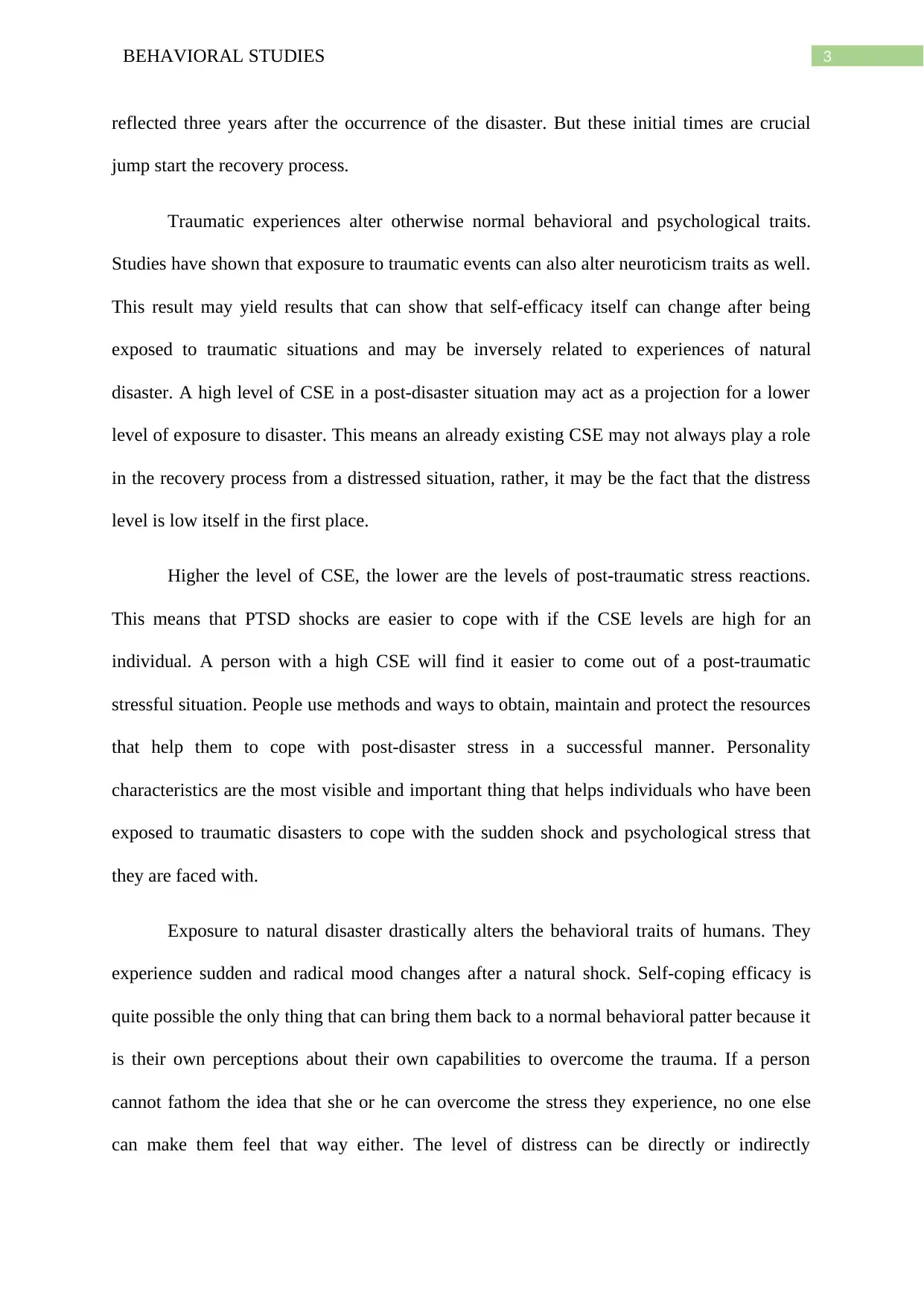
reflected three years after the occurrence of the disaster. But these initial times are crucial
jump start the recovery process.
Traumatic experiences alter otherwise normal behavioral and psychological traits.
Studies have shown that exposure to traumatic events can also alter neuroticism traits as well.
This result may yield results that can show that self-efficacy itself can change after being
exposed to traumatic situations and may be inversely related to experiences of natural
disaster. A high level of CSE in a post-disaster situation may act as a projection for a lower
level of exposure to disaster. This means an already existing CSE may not always play a role
in the recovery process from a distressed situation, rather, it may be the fact that the distress
level is low itself in the first place.
Higher the level of CSE, the lower are the levels of post-traumatic stress reactions.
This means that PTSD shocks are easier to cope with if the CSE levels are high for an
individual. A person with a high CSE will find it easier to come out of a post-traumatic
stressful situation. People use methods and ways to obtain, maintain and protect the resources
that help them to cope with post-disaster stress in a successful manner. Personality
characteristics are the most visible and important thing that helps individuals who have been
exposed to traumatic disasters to cope with the sudden shock and psychological stress that
they are faced with.
Exposure to natural disaster drastically alters the behavioral traits of humans. They
experience sudden and radical mood changes after a natural shock. Self-coping efficacy is
quite possible the only thing that can bring them back to a normal behavioral patter because it
is their own perceptions about their own capabilities to overcome the trauma. If a person
cannot fathom the idea that she or he can overcome the stress they experience, no one else
can make them feel that way either. The level of distress can be directly or indirectly
reflected three years after the occurrence of the disaster. But these initial times are crucial
jump start the recovery process.
Traumatic experiences alter otherwise normal behavioral and psychological traits.
Studies have shown that exposure to traumatic events can also alter neuroticism traits as well.
This result may yield results that can show that self-efficacy itself can change after being
exposed to traumatic situations and may be inversely related to experiences of natural
disaster. A high level of CSE in a post-disaster situation may act as a projection for a lower
level of exposure to disaster. This means an already existing CSE may not always play a role
in the recovery process from a distressed situation, rather, it may be the fact that the distress
level is low itself in the first place.
Higher the level of CSE, the lower are the levels of post-traumatic stress reactions.
This means that PTSD shocks are easier to cope with if the CSE levels are high for an
individual. A person with a high CSE will find it easier to come out of a post-traumatic
stressful situation. People use methods and ways to obtain, maintain and protect the resources
that help them to cope with post-disaster stress in a successful manner. Personality
characteristics are the most visible and important thing that helps individuals who have been
exposed to traumatic disasters to cope with the sudden shock and psychological stress that
they are faced with.
Exposure to natural disaster drastically alters the behavioral traits of humans. They
experience sudden and radical mood changes after a natural shock. Self-coping efficacy is
quite possible the only thing that can bring them back to a normal behavioral patter because it
is their own perceptions about their own capabilities to overcome the trauma. If a person
cannot fathom the idea that she or he can overcome the stress they experience, no one else
can make them feel that way either. The level of distress can be directly or indirectly
Paraphrase This Document
Need a fresh take? Get an instant paraphrase of this document with our AI Paraphraser
4BEHAVIORAL STUDIES
influenced by moderating the links between stress and potential psychopathology. Personality
characteristics such as optimism, perceived self control, self-esteem all provide with the
required personality traits that are needed to influence the stress levels and reverse the
damages done by natural disasters.
Self-efficacy highlights on the belief of an individual regarding his or her ability to
overcome any stressful situation. However, an individual will be motivated through self-
efficacy. Posttraumatic Stress Disorder or PTSD is the mental health issue that affects the
mind of the people. In order to recover the effect PTSD that is occurred due to the natural
disaster, self-efficacy is the best way for the individuals. According to the statistical data
approx, 2 million people have been affected by the natural disaster in every year, which leads
them to face mental stress due to loss of financial and other resources. CSE or coping self-
efficacy allows the people to recover the effect of PTSD (Dahlgren et al., 2017).
Disaster victims often face PTSD due to the loss of resources and such losses are
often immediate. According to the Social Cognitive Theory or SCT that human being is self-
reflective in nature and involve in a self-evaluating method to achieve their desired pursuits
in terms of recovery of the resources that are lost due to the natural disaster
(Tandfonline.com.ezproxy.lib.monash.edu.au, 2017). It has been received that Self-
evaluation of the individuals arises from the coping abilities that influence psychological
distress occurs from the disaster. However, loss of the resources leaves a negative impact on
the perception of CSE. Hence, losses related to the natural disaster develops a pressure that
leads the human being to show coping responses. Such coping responses are the part of self-
efficacy that reduces the effects of such losses. According to the Conservation Of Resources
or COR theory generally, the coping behavior of the individuals occur after such type of
severe loss in the natural disaster. Global self-efficacy reduces the psychological distress or
PTSD.
influenced by moderating the links between stress and potential psychopathology. Personality
characteristics such as optimism, perceived self control, self-esteem all provide with the
required personality traits that are needed to influence the stress levels and reverse the
damages done by natural disasters.
Self-efficacy highlights on the belief of an individual regarding his or her ability to
overcome any stressful situation. However, an individual will be motivated through self-
efficacy. Posttraumatic Stress Disorder or PTSD is the mental health issue that affects the
mind of the people. In order to recover the effect PTSD that is occurred due to the natural
disaster, self-efficacy is the best way for the individuals. According to the statistical data
approx, 2 million people have been affected by the natural disaster in every year, which leads
them to face mental stress due to loss of financial and other resources. CSE or coping self-
efficacy allows the people to recover the effect of PTSD (Dahlgren et al., 2017).
Disaster victims often face PTSD due to the loss of resources and such losses are
often immediate. According to the Social Cognitive Theory or SCT that human being is self-
reflective in nature and involve in a self-evaluating method to achieve their desired pursuits
in terms of recovery of the resources that are lost due to the natural disaster
(Tandfonline.com.ezproxy.lib.monash.edu.au, 2017). It has been received that Self-
evaluation of the individuals arises from the coping abilities that influence psychological
distress occurs from the disaster. However, loss of the resources leaves a negative impact on
the perception of CSE. Hence, losses related to the natural disaster develops a pressure that
leads the human being to show coping responses. Such coping responses are the part of self-
efficacy that reduces the effects of such losses. According to the Conservation Of Resources
or COR theory generally, the coping behavior of the individuals occur after such type of
severe loss in the natural disaster. Global self-efficacy reduces the psychological distress or
PTSD.
5BEHAVIORAL STUDIES
Low CSE is associated with the greater PTSD symptoms that occur from the natural
disaster. However, CSE is crucial to tackle the emotion of the individuals. On the other hand,
trauma-specific CSE is directly associated with the coping need during the psychological
stress. Self-esteem enables the individuals to gain confidence; as a result, they are able to
accept the loss. This will be effective to recover the psychological stress or PTSD. In the
August 1999 earthquake occurs in Marmara that destroys many lives approx 18,000 people
died in this disaster and the survivors were facing PTSD due to the severity of such disaster
(Onlinelibrary.wiley.com.ezproxy.lib.monash.edu.au, 2017). Hence, COR theory is helpful
for this condition to understand the coping behavior of the people in this particular situation.
How to coping the stress can be identified by COR model. Application of the COR model
enables the people to motivated that leads them to protect, retain and valued socially.
Therefore, they congruent the resources and achieve success by coping with the
psychological stress. Self-efficacy enables the people to reduce the effect of loss and to
maximize their resources under the critical environment. However, self-esteem and personal
control help the individuals to cope with the stress by enhancing their confidence level.
Therefore, through moderating the connection between the psychopathology and the stress
PTSD can be reduced. Hence, it has been received that self-efficacy is a vital approach to
minimize the effect of PTSD that usually occurs due to a natural disaster.
Natural disasters like earthquakes, hurricanes, volcanic eruptions are uncontrollable,
sudden and unpredictable. An individual with high self-esteem can much better cope with
stress than a person who does not possess those qualities. Individuals with low self-control
and self-esteem are prone to many psychological problems after experiencing natural
disasters, depression being the most observed emotion observed in individuals who have
experienced trauma (Ferreira & Figley, 2015). Natural disasters cause a number of problems
to humans, including loss of property, money, loss in the sense of a community and a massive
Low CSE is associated with the greater PTSD symptoms that occur from the natural
disaster. However, CSE is crucial to tackle the emotion of the individuals. On the other hand,
trauma-specific CSE is directly associated with the coping need during the psychological
stress. Self-esteem enables the individuals to gain confidence; as a result, they are able to
accept the loss. This will be effective to recover the psychological stress or PTSD. In the
August 1999 earthquake occurs in Marmara that destroys many lives approx 18,000 people
died in this disaster and the survivors were facing PTSD due to the severity of such disaster
(Onlinelibrary.wiley.com.ezproxy.lib.monash.edu.au, 2017). Hence, COR theory is helpful
for this condition to understand the coping behavior of the people in this particular situation.
How to coping the stress can be identified by COR model. Application of the COR model
enables the people to motivated that leads them to protect, retain and valued socially.
Therefore, they congruent the resources and achieve success by coping with the
psychological stress. Self-efficacy enables the people to reduce the effect of loss and to
maximize their resources under the critical environment. However, self-esteem and personal
control help the individuals to cope with the stress by enhancing their confidence level.
Therefore, through moderating the connection between the psychopathology and the stress
PTSD can be reduced. Hence, it has been received that self-efficacy is a vital approach to
minimize the effect of PTSD that usually occurs due to a natural disaster.
Natural disasters like earthquakes, hurricanes, volcanic eruptions are uncontrollable,
sudden and unpredictable. An individual with high self-esteem can much better cope with
stress than a person who does not possess those qualities. Individuals with low self-control
and self-esteem are prone to many psychological problems after experiencing natural
disasters, depression being the most observed emotion observed in individuals who have
experienced trauma (Ferreira & Figley, 2015). Natural disasters cause a number of problems
to humans, including loss of property, money, loss in the sense of a community and a massive
⊘ This is a preview!⊘
Do you want full access?
Subscribe today to unlock all pages.
Trusted by 1+ million students worldwide
6BEHAVIORAL STUDIES
loss of resources. These losses, in a combined and cumulative way, impacts humans in a
significant way which causes them to experience post-traumatic stress. Even human induced
calamity, like the Chernobyl disaster or the Bhopal gas leak in India, can have lasting and
significant psychological impact on human behavior and mentality. The bigger issue with
these human created disasters are that they adversely affect the environment, which in turn,
may result in natural disasters themselves, making the whole process a cyclical pattern and a
chain reaction is induced. Traumatic CSE is significantly and negatively related to worry and
depression. Affirmation is one of the best ways to enhance self-efficacy. People with levels of
personal resources show higher levels of CSE, which help to keep the distress levels at a
lower range. Optimism and self-esteem are the two most important tenets of CSE, which
mediates the links between general distress and personal resources. However, perceiving g a
high threat level during the times of a disaster can make individuals vulnerable to thinking in
an intrusive way and enhances the levels of general distress. But these aspects apparently do
not have any effects on CSE.
Self-efficacy can be the most important reason behind both developing a distressed
mindset when exposed to a traumatic situation, as well as helping individuals, who have been
suffering from post-traumatic distress, to come out of it. Optimism, self-control and self-
esteem are the most influential in this aspect of recovery. Interestingly, it has been seen that
individuals with a low level of CSE have intrusive thoughts even in situations with low threat
levels (Paton & Johnston, 2017). Humans keep continuously re-evaluating their abilities to
cope with traumatic situations. Individuals who have a high level of CSE always try to turn
situations with high threat levels into something more manageable. Their own self-esteem
prompts them to take actions, which they think they can handle more efficiently. In a way,
CSE does not only help individuals to cope with distress and natural disaster induced trauma,
but it also helps them to take necessary actions that reduce the impact of the environmental
loss of resources. These losses, in a combined and cumulative way, impacts humans in a
significant way which causes them to experience post-traumatic stress. Even human induced
calamity, like the Chernobyl disaster or the Bhopal gas leak in India, can have lasting and
significant psychological impact on human behavior and mentality. The bigger issue with
these human created disasters are that they adversely affect the environment, which in turn,
may result in natural disasters themselves, making the whole process a cyclical pattern and a
chain reaction is induced. Traumatic CSE is significantly and negatively related to worry and
depression. Affirmation is one of the best ways to enhance self-efficacy. People with levels of
personal resources show higher levels of CSE, which help to keep the distress levels at a
lower range. Optimism and self-esteem are the two most important tenets of CSE, which
mediates the links between general distress and personal resources. However, perceiving g a
high threat level during the times of a disaster can make individuals vulnerable to thinking in
an intrusive way and enhances the levels of general distress. But these aspects apparently do
not have any effects on CSE.
Self-efficacy can be the most important reason behind both developing a distressed
mindset when exposed to a traumatic situation, as well as helping individuals, who have been
suffering from post-traumatic distress, to come out of it. Optimism, self-control and self-
esteem are the most influential in this aspect of recovery. Interestingly, it has been seen that
individuals with a low level of CSE have intrusive thoughts even in situations with low threat
levels (Paton & Johnston, 2017). Humans keep continuously re-evaluating their abilities to
cope with traumatic situations. Individuals who have a high level of CSE always try to turn
situations with high threat levels into something more manageable. Their own self-esteem
prompts them to take actions, which they think they can handle more efficiently. In a way,
CSE does not only help individuals to cope with distress and natural disaster induced trauma,
but it also helps them to take necessary actions that reduce the impact of the environmental
Paraphrase This Document
Need a fresh take? Get an instant paraphrase of this document with our AI Paraphraser
7BEHAVIORAL STUDIES
disasters in the first place. These steps help to be more mentally prepared even if there is a
natural disaster.
disasters in the first place. These steps help to be more mentally prepared even if there is a
natural disaster.
8BEHAVIORAL STUDIES
References
Abramson, D. M., Grattan, L. M., Mayer, B., Colten, C. E., Arosemena, F. A., Bedimo-Rung,
A., & Lichtveld, M. (2015). The resilience activation framework: a conceptual model
of how access to social resources promotes adaptation and rapid recovery in post-
disaster settings. The journal of behavioral health services & research, 42(1), 42-57.
Dahlgren, M. K., Laifer, L. M., VanElzakker, M. B., Offringa, R., Hughes, K. C., Staples-
Bradley, L. K., ... & Pitman, R. K. (2017). Diminished medial prefrontal cortex
activation during the recollection of stressful events is an acquired characteristic of
PTSD. Psychological Medicine, 1-13.
Ferreira, R. J., & Figley, C. R. (2015). Longer-term mental health needs of disaster survivors.
In Handbook of public health in natural disasters: Nutrition, food, remediation and
preparation (pp. 215-229). Wageningen Academic Publishers.
Herman, J. L. (2015). Trauma and recovery: The aftermath of violence--from domestic abuse
to political terror. Hachette UK.
Hung, L. S., Wang, C., & Yarnal, B. (2016). Vulnerability of families and households to
natural hazards: A case study of storm surge flooding in Sarasota County,
Florida. Applied geography, 76, 184-197.
Onlinelibrary.wiley.com.ezproxy.lib.monash.edu.au. (2017). Personal Resources, Coping
Self-Efficacy, and QuakeExposure as Predictors of Psychological DistressFollowing
the 1999 Earthquake in Turkey. Retrieved 10 October 2017, from
http://onlinelibrary.wiley.com.ezproxy.lib.monash.edu.au/doi/10.1002/jts.20032/epdf
Paton, D., & Johnston, D. (2017). Disaster resilience: an integrated approach. Charles C
Thomas Publisher.
References
Abramson, D. M., Grattan, L. M., Mayer, B., Colten, C. E., Arosemena, F. A., Bedimo-Rung,
A., & Lichtveld, M. (2015). The resilience activation framework: a conceptual model
of how access to social resources promotes adaptation and rapid recovery in post-
disaster settings. The journal of behavioral health services & research, 42(1), 42-57.
Dahlgren, M. K., Laifer, L. M., VanElzakker, M. B., Offringa, R., Hughes, K. C., Staples-
Bradley, L. K., ... & Pitman, R. K. (2017). Diminished medial prefrontal cortex
activation during the recollection of stressful events is an acquired characteristic of
PTSD. Psychological Medicine, 1-13.
Ferreira, R. J., & Figley, C. R. (2015). Longer-term mental health needs of disaster survivors.
In Handbook of public health in natural disasters: Nutrition, food, remediation and
preparation (pp. 215-229). Wageningen Academic Publishers.
Herman, J. L. (2015). Trauma and recovery: The aftermath of violence--from domestic abuse
to political terror. Hachette UK.
Hung, L. S., Wang, C., & Yarnal, B. (2016). Vulnerability of families and households to
natural hazards: A case study of storm surge flooding in Sarasota County,
Florida. Applied geography, 76, 184-197.
Onlinelibrary.wiley.com.ezproxy.lib.monash.edu.au. (2017). Personal Resources, Coping
Self-Efficacy, and QuakeExposure as Predictors of Psychological DistressFollowing
the 1999 Earthquake in Turkey. Retrieved 10 October 2017, from
http://onlinelibrary.wiley.com.ezproxy.lib.monash.edu.au/doi/10.1002/jts.20032/epdf
Paton, D., & Johnston, D. (2017). Disaster resilience: an integrated approach. Charles C
Thomas Publisher.
⊘ This is a preview!⊘
Do you want full access?
Subscribe today to unlock all pages.
Trusted by 1+ million students worldwide
9BEHAVIORAL STUDIES
Tandfonline.com.ezproxy.lib.monash.edu.au. (2017). Conservation of resources and coping
self-efficacy predicting distress following a natural disaster: A causal model analysis
where the environment meets the mind. Retrieved 10 October 2017, from
http://www.tandfonline.com.ezproxy.lib.monash.edu.au/doi/pdf/10.1080/1061580990
8248325?needAccess=true&
Tandfonline.com.ezproxy.lib.monash.edu.au. (2017). Conservation of resources and coping
self-efficacy predicting distress following a natural disaster: A causal model analysis
where the environment meets the mind. Retrieved 10 October 2017, from
http://www.tandfonline.com.ezproxy.lib.monash.edu.au/doi/pdf/10.1080/1061580990
8248325?needAccess=true&

1 out of 10


Related Documents


Your All-in-One AI-Powered Toolkit for Academic Success.
+13062052269
info@desklib.com
Available 24*7 on WhatsApp / Email
![[object Object]](/_next/static/media/star-bottom.7253800d.svg)
Unlock your academic potential
Copyright © 2020–2026 A2Z Services. All Rights Reserved. Developed and managed by ZUCOL.