Natural Gas & LNG: Production, Advantages, and Qatar's Role
VerifiedAdded on 2023/06/15
|19
|4250
|381
Report
AI Summary
This report explores the potential of natural gas and liquefied natural gas (LNG) as mainstream fuel sources. It discusses the advantages and disadvantages of natural gas compared to other fossil fuels, highlighting its cleaner emissions and greater reserves. The report also examines the production and export scenarios of LNG, with a particular focus on Qatar's significant role in the global market, especially its North Field, one of the largest natural gas reserves in the world. Furthermore, the processes involved in developing LNG, such as dehydration and sweetening, are described. The report concludes that while natural gas is a cleaner alternative to conventional fossil fuels, it still poses environmental challenges, and Qatar is poised to maintain a leading position in the global natural gas market.

Running head: NATURAL GAS AND LNG
Natural gas and LNG
Name of the student
Name of the university
Author note
Natural gas and LNG
Name of the student
Name of the university
Author note

Paraphrase This Document
Need a fresh take? Get an instant paraphrase of this document with our AI Paraphraser
1NATURAL GAS AND LNG
Executive summary
The aim of this report is to discuss about the potential of natural gas and liquefied natural gas in
being the mainstream source of fuel in the current scenario. This report discussed about the
advantages and disadvantages of natural gas along with discussion on the liquefied natural gas.
In addition, countries having the largest source of natural gas had also been identified and
analyzed. This report concludes that, Qatar is one country, which is growing at significant rate in
the production of natural gas. It is being seen that, Russia, United States, Iran and Qatar are the
countries holding the majority market share in the global market in terms of natural gas.
Moreover, with the ownership of the largest gas reserve in the world, Qatar is eyeing to hold the
status of market leader in the global market of natural gas.
Executive summary
The aim of this report is to discuss about the potential of natural gas and liquefied natural gas in
being the mainstream source of fuel in the current scenario. This report discussed about the
advantages and disadvantages of natural gas along with discussion on the liquefied natural gas.
In addition, countries having the largest source of natural gas had also been identified and
analyzed. This report concludes that, Qatar is one country, which is growing at significant rate in
the production of natural gas. It is being seen that, Russia, United States, Iran and Qatar are the
countries holding the majority market share in the global market in terms of natural gas.
Moreover, with the ownership of the largest gas reserve in the world, Qatar is eyeing to hold the
status of market leader in the global market of natural gas.
2NATURAL GAS AND LNG
Table of Contents
Introduction......................................................................................................................................3
Natural gas – Definition...................................................................................................................3
Importance of natural gas................................................................................................................4
Advantages of natural gas................................................................................................................5
Disadvantages of natural gas...........................................................................................................6
Liquefied natural gas – definition....................................................................................................7
Advantages of liquefied natural gas................................................................................................7
Disadvantages of liquefied natural gas............................................................................................7
Current scenario of production of liquefied natural gas..................................................................8
Scenario of production of natural gas in Qatar................................................................................8
Scenario of North field, Qatar.....................................................................................................9
Process of developing liquefied natural gas....................................................................................9
Dehydration process..................................................................................................................10
Sweetening process....................................................................................................................12
Export scenario of liquefied natural gas of Qatar..........................................................................13
Conclusion.....................................................................................................................................14
Reference.......................................................................................................................................15
Table of Contents
Introduction......................................................................................................................................3
Natural gas – Definition...................................................................................................................3
Importance of natural gas................................................................................................................4
Advantages of natural gas................................................................................................................5
Disadvantages of natural gas...........................................................................................................6
Liquefied natural gas – definition....................................................................................................7
Advantages of liquefied natural gas................................................................................................7
Disadvantages of liquefied natural gas............................................................................................7
Current scenario of production of liquefied natural gas..................................................................8
Scenario of production of natural gas in Qatar................................................................................8
Scenario of North field, Qatar.....................................................................................................9
Process of developing liquefied natural gas....................................................................................9
Dehydration process..................................................................................................................10
Sweetening process....................................................................................................................12
Export scenario of liquefied natural gas of Qatar..........................................................................13
Conclusion.....................................................................................................................................14
Reference.......................................................................................................................................15
⊘ This is a preview!⊘
Do you want full access?
Subscribe today to unlock all pages.

Trusted by 1+ million students worldwide

3NATURAL GAS AND LNG
Paraphrase This Document
Need a fresh take? Get an instant paraphrase of this document with our AI Paraphraser
4NATURAL GAS AND LNG
Introduction
The key source of rapid development of the civilization is the fossil fuels. This is due to
the reason that, the development in terms of technology, industry and lifestyle of the current
civilization is all depended on the energy being source from the burning of the fossil fuels.
However, there are several disadvantages are also being emerged from the burning of the fossil
fuels. On one hand, rapid growth is being possible with the burning of the fossil fuel and on the
other hand, burning of fossil fuel is causing huge environmental impact, which pose threat for
the current generation. In addition, fossil fuel is non renewable type of energy and thus, there
will an end to its supply. Hence, it is of urgent need to reduce the dependency from the fossil fuel
before it get exhausted (Hook & Tang, 2013). In addition, impact of the burning of fossil fuel is
also increasing rapidly and it is also important to mitigate. Accordingly various newer alternative
energies are being promoted, which will have less impact on the environment. Natural gas is one
such alternative, which is non renewable source but still it is cleaner than the conventional fuels
being used (York, 2012).
This report will discuss about the advantages and disadvantages of natural gas along with
discussion on the liquefied natural gas. Merits and demerits of liquefied natural gas will also be
discussed. In addition, countries having the largest source of natural gas will also be identified
and analyzed. More concentration will be given to the scenario of natural gas in Qatar. The
process of developing liquefied natural gas from the natural gas will also be discussed.
Introduction
The key source of rapid development of the civilization is the fossil fuels. This is due to
the reason that, the development in terms of technology, industry and lifestyle of the current
civilization is all depended on the energy being source from the burning of the fossil fuels.
However, there are several disadvantages are also being emerged from the burning of the fossil
fuels. On one hand, rapid growth is being possible with the burning of the fossil fuel and on the
other hand, burning of fossil fuel is causing huge environmental impact, which pose threat for
the current generation. In addition, fossil fuel is non renewable type of energy and thus, there
will an end to its supply. Hence, it is of urgent need to reduce the dependency from the fossil fuel
before it get exhausted (Hook & Tang, 2013). In addition, impact of the burning of fossil fuel is
also increasing rapidly and it is also important to mitigate. Accordingly various newer alternative
energies are being promoted, which will have less impact on the environment. Natural gas is one
such alternative, which is non renewable source but still it is cleaner than the conventional fuels
being used (York, 2012).
This report will discuss about the advantages and disadvantages of natural gas along with
discussion on the liquefied natural gas. Merits and demerits of liquefied natural gas will also be
discussed. In addition, countries having the largest source of natural gas will also be identified
and analyzed. More concentration will be given to the scenario of natural gas in Qatar. The
process of developing liquefied natural gas from the natural gas will also be discussed.
5NATURAL GAS AND LNG
Natural gas – Definition
Natural gas is a type of fossil fuel mainly obtained from the mining and extraction of the
petroleum oil. Natural gas is being obtained as the byproduct of the mining of crude petroleum
oil. Not only from the oil field, but natural gas is also found from the decomposition of the plant
and animal waste under the earth (Gao et al., 2012). It is being generated when the
decomposition of the animal and plant matter mix up with the heat under the earth. In the case of
the oil field, natural gas remained as cushion over the petroleum bed. Natural gas being
generated from the oil field is known as thermogenic and gas generated from the landfills and
decomposition of the waste is known as biogenic. Though, it is a type of fossil fuel, but it
provides cleaner emission compared to other petroleum products.
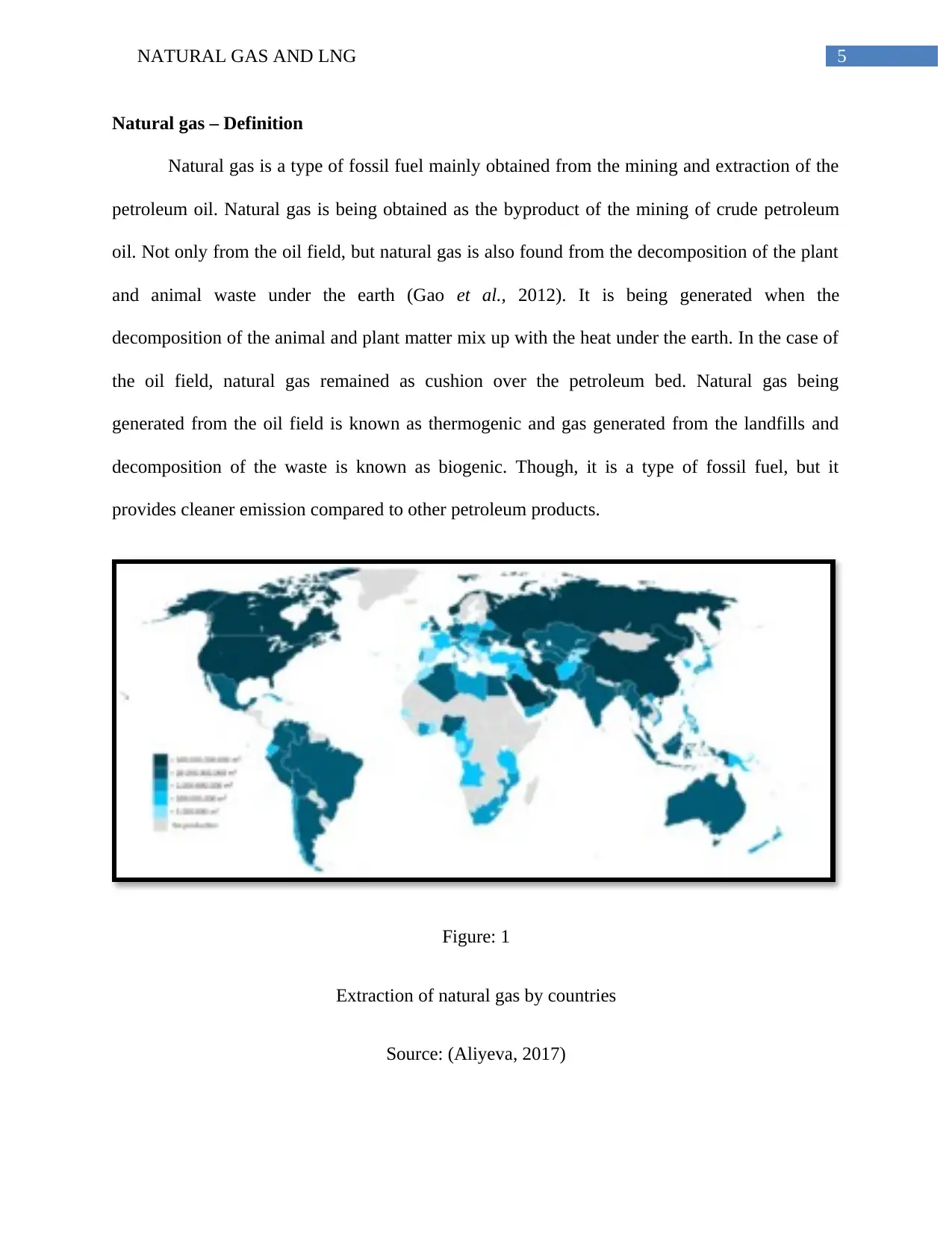
Figure: 1
Extraction of natural gas by countries
Source: (Aliyeva, 2017)
Natural gas – Definition
Natural gas is a type of fossil fuel mainly obtained from the mining and extraction of the
petroleum oil. Natural gas is being obtained as the byproduct of the mining of crude petroleum
oil. Not only from the oil field, but natural gas is also found from the decomposition of the plant
and animal waste under the earth (Gao et al., 2012). It is being generated when the
decomposition of the animal and plant matter mix up with the heat under the earth. In the case of
the oil field, natural gas remained as cushion over the petroleum bed. Natural gas being
generated from the oil field is known as thermogenic and gas generated from the landfills and
decomposition of the waste is known as biogenic. Though, it is a type of fossil fuel, but it
provides cleaner emission compared to other petroleum products.
Figure: 1
Extraction of natural gas by countries
Source: (Aliyeva, 2017)
⊘ This is a preview!⊘
Do you want full access?
Subscribe today to unlock all pages.
Trusted by 1+ million students worldwide
6NATURAL GAS AND LNG
Importance of natural gas
In the current scarcity of the fossil fuel in the global scenario, natural gas holds prime
importance for the world economy. This is due to the reason that, as discussed earlier, burning of
the natural gas produces less pollutant compared to other conventional sources. According to
various reports, burning of natural gas produce half of the carbon dioxide compared to the
burning of same amount of coal. Thus the impact of pollution will be less in case of natural gas,
which is important in the current scenario. The generation of greenhouse gas will get reduced
with the more consumption of natural gas. In the current scenario, scarcity of the fossil fuel is
one of the key issues being faced by the world economy (Gold, 2013). This is due to the reason
that, though various renewable energies are being introduced in the market, but still they are not
became mainstream as the fossil fuel. Thus, being a non renewable source of energy, fossil fuel
is facing the threat of exhaustion in the following years.
In this case also, natural gas plays an important role in mitigating the risk of exhaustion
of fossil fuels. This is due to the reason that, it is being estimated that, the reserve of natural gas
is 50 percent more than that of the reserve of petroleum oils (Clemente, 2017). Moreover, with
the increase in the discovery of various natural gas fields in the recent times, the lasting period of
natural gas is gradually increasing. Thus, the risk of scarcity of fuel can be partially mitigated.
Advantages of natural gas
One of the key advantages of natural gas is the cleaner emission. As discussed earlier,
burning of fossil fuel emits less pollutant compared to the burning of the petroleum fuels.
Moreover, with the introduction of the new technologies, the pollutants being generated
Importance of natural gas
In the current scarcity of the fossil fuel in the global scenario, natural gas holds prime
importance for the world economy. This is due to the reason that, as discussed earlier, burning of
the natural gas produces less pollutant compared to other conventional sources. According to
various reports, burning of natural gas produce half of the carbon dioxide compared to the
burning of same amount of coal. Thus the impact of pollution will be less in case of natural gas,
which is important in the current scenario. The generation of greenhouse gas will get reduced
with the more consumption of natural gas. In the current scenario, scarcity of the fossil fuel is
one of the key issues being faced by the world economy (Gold, 2013). This is due to the reason
that, though various renewable energies are being introduced in the market, but still they are not
became mainstream as the fossil fuel. Thus, being a non renewable source of energy, fossil fuel
is facing the threat of exhaustion in the following years.
In this case also, natural gas plays an important role in mitigating the risk of exhaustion
of fossil fuels. This is due to the reason that, it is being estimated that, the reserve of natural gas
is 50 percent more than that of the reserve of petroleum oils (Clemente, 2017). Moreover, with
the increase in the discovery of various natural gas fields in the recent times, the lasting period of
natural gas is gradually increasing. Thus, the risk of scarcity of fuel can be partially mitigated.
Advantages of natural gas
One of the key advantages of natural gas is the cleaner emission. As discussed earlier,
burning of fossil fuel emits less pollutant compared to the burning of the petroleum fuels.
Moreover, with the introduction of the new technologies, the pollutants being generated
Paraphrase This Document
Need a fresh take? Get an instant paraphrase of this document with our AI Paraphraser
7NATURAL GAS AND LNG
from the burning of the natural gas can be reduces, which will further enhance the
cleanliness of the natural gas (Rufford et al., 2012).
Natural gas burns to the fullest, which shows by its blue flame. Thus, the remaining
particles are lower compared to the conventional fuels. This also enhances the utility of
the natural gas. Moreover, it is more economical compared to other fossil fuels.
Natural gas is convenient for the customers also. This is due to the reason that, it can be
transported through pipelines to the customers. In addition, transportation of the natural
gas is less risky affairs compared to the petroleum fuels.
Another key advantage for natural gas is multiple and alternate uses. It can be used for
the purpose of cooking, transportation, production of electricity and heating. Thus, the
advantage of this fuel is that, having alternate uses from the single state of the natural gas,
which is not possible with the conventional petroleum fuels.
Disadvantages of natural gas
Though, transportation of the natural gas is safe compared to the petroleum gas, but still
it involves risk of combustion due to mishandling (Tollefson, 2013). Mishandling of the
natural gas can cause explosion, which makes it a risky affairs to use it in vehicles.
Natural gas is also a type of non renewable source of energy. Though the reserve of
natural gas is more than the petroleum fuels, but still it will also come to an end with
having more uses (Alvarez et al., 2012).
Natural gas emits less pollutant compared to the petroleum fuels, but still emits some sort
of greenhouse gas, which will enhance the issue of global warming. Thus, the problem of
impact on the environment cannot be mitigated.
from the burning of the natural gas can be reduces, which will further enhance the
cleanliness of the natural gas (Rufford et al., 2012).
Natural gas burns to the fullest, which shows by its blue flame. Thus, the remaining
particles are lower compared to the conventional fuels. This also enhances the utility of
the natural gas. Moreover, it is more economical compared to other fossil fuels.
Natural gas is convenient for the customers also. This is due to the reason that, it can be
transported through pipelines to the customers. In addition, transportation of the natural
gas is less risky affairs compared to the petroleum fuels.
Another key advantage for natural gas is multiple and alternate uses. It can be used for
the purpose of cooking, transportation, production of electricity and heating. Thus, the
advantage of this fuel is that, having alternate uses from the single state of the natural gas,
which is not possible with the conventional petroleum fuels.
Disadvantages of natural gas
Though, transportation of the natural gas is safe compared to the petroleum gas, but still
it involves risk of combustion due to mishandling (Tollefson, 2013). Mishandling of the
natural gas can cause explosion, which makes it a risky affairs to use it in vehicles.
Natural gas is also a type of non renewable source of energy. Though the reserve of
natural gas is more than the petroleum fuels, but still it will also come to an end with
having more uses (Alvarez et al., 2012).
Natural gas emits less pollutant compared to the petroleum fuels, but still emits some sort
of greenhouse gas, which will enhance the issue of global warming. Thus, the problem of
impact on the environment cannot be mitigated.
8NATURAL GAS AND LNG
Liquefied natural gas – definition
Liquefied natural gas is natural gas that is been converted in the liquid formation. Thus, it
helps in transporting easily and with more safety. It also helps in transporting the natural gas in
more volume due to the reason that, natural gas in liquefied form holds 1/6ooth of the volume in
the gaseous states. Moreover, with the development and initiation of the updated technologies,
liquefied natural gas is being used in alternate areas powering the motor vehicles.
Advantages of liquefied natural gas
Delivery of the gas is simpler due to the liquid formation. Thus, transportation of the
natural gas become easy and can be transported to areas where natural gas in gaseous
formation cannot be transported. Marine transportation of the natural gas is difficult and
requires more areas, which are being mitigated with the help of the liquefied natural gas.
It helps in various alternate uses such as cooking purpose and powering og motor
vehicles.
Formation of liquefied natural gas helps in storing more natural gas in small areas.
Maintenance cost in the case of liquefied natural gas is low compared to other petroleum
fuels.
Disadvantages of liquefied natural gas
Development of liquefied natural gas from natural gas involves huge cost and thus, it is
expensive to produce liquefied natural gas. Eventually it will increase the cost of gas in
the market.
The shipping cost of the liquefied natural gas is also more compared to the other
conventional fuels (Mason, Veenstra & Long, 2014). This is due to the reason that,
Liquefied natural gas – definition
Liquefied natural gas is natural gas that is been converted in the liquid formation. Thus, it
helps in transporting easily and with more safety. It also helps in transporting the natural gas in
more volume due to the reason that, natural gas in liquefied form holds 1/6ooth of the volume in
the gaseous states. Moreover, with the development and initiation of the updated technologies,
liquefied natural gas is being used in alternate areas powering the motor vehicles.
Advantages of liquefied natural gas
Delivery of the gas is simpler due to the liquid formation. Thus, transportation of the
natural gas become easy and can be transported to areas where natural gas in gaseous
formation cannot be transported. Marine transportation of the natural gas is difficult and
requires more areas, which are being mitigated with the help of the liquefied natural gas.
It helps in various alternate uses such as cooking purpose and powering og motor
vehicles.
Formation of liquefied natural gas helps in storing more natural gas in small areas.
Maintenance cost in the case of liquefied natural gas is low compared to other petroleum
fuels.
Disadvantages of liquefied natural gas
Development of liquefied natural gas from natural gas involves huge cost and thus, it is
expensive to produce liquefied natural gas. Eventually it will increase the cost of gas in
the market.
The shipping cost of the liquefied natural gas is also more compared to the other
conventional fuels (Mason, Veenstra & Long, 2014). This is due to the reason that,
⊘ This is a preview!⊘
Do you want full access?
Subscribe today to unlock all pages.
Trusted by 1+ million students worldwide
9NATURAL GAS AND LNG
transportation of the liquefied natural gas involves various restrictions and precautions
along with security guidelines, which increase the cost.
Burning of liquefied natural gas also emits greenhouse gases in the atmosphere. Thus, the
issue of environmental impact cannot get mitigated by using this (McKenzie et al., 2012).
It is also highly inflammable and prone to combustion. Thus, transportation of the
liquefied natural gas also involves risk. Mismanagement in the transportation of the
liquefied natural gas may pose huge threat to the safety and security.
Current scenario of production of liquefied natural gas
With the increase in the demand for natural gas and with discovery of more reserves for
natural gas, more countries are getting in the map of producers and exporters of natural gas.
Currently, United States is the largest producer of natural gas in the world by constituting 19.8
percent of the global production of natural gas. They are marginally followed by Russia with
having 19.3 percent of global production of natural gas (Mitrova, 2013). Iran comes third with
5.86 percent of total production of the natural gas. Qatar is the fourth largest exporter of natural
gas with having 4.6 percent of global production of natural gas. Russia was the largest country in
terms of production of natural gas till 2009, when United States overtook them. However, one
country that is doing significant development in the natural gas production is Qatar (Corbeau &
Ledesma, 2016). Following section will discuss about the natural gas scenario in Qatar.
Scenario of production of natural gas in Qatar
Qatar is strategically situated in the available bed of natural gas in the world. As per
estimates, they are having more than 896 trillion cubic feet of natural gas. In terms of their
available reserves, Qatar is just behind Russia and Iran in the global scenario. They have also
transportation of the liquefied natural gas involves various restrictions and precautions
along with security guidelines, which increase the cost.
Burning of liquefied natural gas also emits greenhouse gases in the atmosphere. Thus, the
issue of environmental impact cannot get mitigated by using this (McKenzie et al., 2012).
It is also highly inflammable and prone to combustion. Thus, transportation of the
liquefied natural gas also involves risk. Mismanagement in the transportation of the
liquefied natural gas may pose huge threat to the safety and security.
Current scenario of production of liquefied natural gas
With the increase in the demand for natural gas and with discovery of more reserves for
natural gas, more countries are getting in the map of producers and exporters of natural gas.
Currently, United States is the largest producer of natural gas in the world by constituting 19.8
percent of the global production of natural gas. They are marginally followed by Russia with
having 19.3 percent of global production of natural gas (Mitrova, 2013). Iran comes third with
5.86 percent of total production of the natural gas. Qatar is the fourth largest exporter of natural
gas with having 4.6 percent of global production of natural gas. Russia was the largest country in
terms of production of natural gas till 2009, when United States overtook them. However, one
country that is doing significant development in the natural gas production is Qatar (Corbeau &
Ledesma, 2016). Following section will discuss about the natural gas scenario in Qatar.
Scenario of production of natural gas in Qatar
Qatar is strategically situated in the available bed of natural gas in the world. As per
estimates, they are having more than 896 trillion cubic feet of natural gas. In terms of their
available reserves, Qatar is just behind Russia and Iran in the global scenario. They have also
Paraphrase This Document
Need a fresh take? Get an instant paraphrase of this document with our AI Paraphraser
10NATURAL GAS AND LNG
done significant growth in the production of liquefied natural gas. In 2006, they overtook
Indonesia to become the largest producer of liquefied natural gas in the world (Wood, 2012).
With the rapid development in the natural gas industry, this industry constitutes more than 60
percent of the GDP of Qatar. Qatar is having their major share of the natural gas in north field. It
is located in Persian Gulf. In addition, north field is the largest reserve of natural gas in the
world. However, Iran is also having the ownership of north field with Qatar.
Scenario of North field, Qatar
North field was discovered in 1971 and by 1989, production and extraction of natural gas
started from the field. In terms of reserve of natural gas, north field jointly owned by Iran and
Qatar is the largest field in the world. According to the report of International energy agency,
north field is having more than 1800 trillion cubic feet of natural gas, which can be extracted.
Moreover, north field is having the most number of reserves that can be recovered compared to
other gas fields in the world. It is offshore gas reserve located in the Persian Gulf. Due to being
an offshore gas filed, Qatar is having offshore drilling rigs to extract the natural gas. Moreover,
north field is shallow type of offshore well due to the reason that, the water depth in the location
of the north field is less than 150 meters.
Process of developing liquefied natural gas
Process of producing liquefied natural gas from the natural gas involves various steps
such as mercury recovery, dehydration and sweetening. In addition, there are other units and
processes are being available in the production of liquefied natural gas (Lee, Long & Lee, 2012).
All these process involves specific utility, which convert the natural gas in liquefied natural gas.
However, this report will only talk about dehydration and sweetening process due to the reason
done significant growth in the production of liquefied natural gas. In 2006, they overtook
Indonesia to become the largest producer of liquefied natural gas in the world (Wood, 2012).
With the rapid development in the natural gas industry, this industry constitutes more than 60
percent of the GDP of Qatar. Qatar is having their major share of the natural gas in north field. It
is located in Persian Gulf. In addition, north field is the largest reserve of natural gas in the
world. However, Iran is also having the ownership of north field with Qatar.
Scenario of North field, Qatar
North field was discovered in 1971 and by 1989, production and extraction of natural gas
started from the field. In terms of reserve of natural gas, north field jointly owned by Iran and
Qatar is the largest field in the world. According to the report of International energy agency,
north field is having more than 1800 trillion cubic feet of natural gas, which can be extracted.
Moreover, north field is having the most number of reserves that can be recovered compared to
other gas fields in the world. It is offshore gas reserve located in the Persian Gulf. Due to being
an offshore gas filed, Qatar is having offshore drilling rigs to extract the natural gas. Moreover,
north field is shallow type of offshore well due to the reason that, the water depth in the location
of the north field is less than 150 meters.
Process of developing liquefied natural gas
Process of producing liquefied natural gas from the natural gas involves various steps
such as mercury recovery, dehydration and sweetening. In addition, there are other units and
processes are being available in the production of liquefied natural gas (Lee, Long & Lee, 2012).
All these process involves specific utility, which convert the natural gas in liquefied natural gas.
However, this report will only talk about dehydration and sweetening process due to the reason
11NATURAL GAS AND LNG
that, these two processes is the most popular and commonly used in the process of production of
liquefied natural gas.
Dehydration process
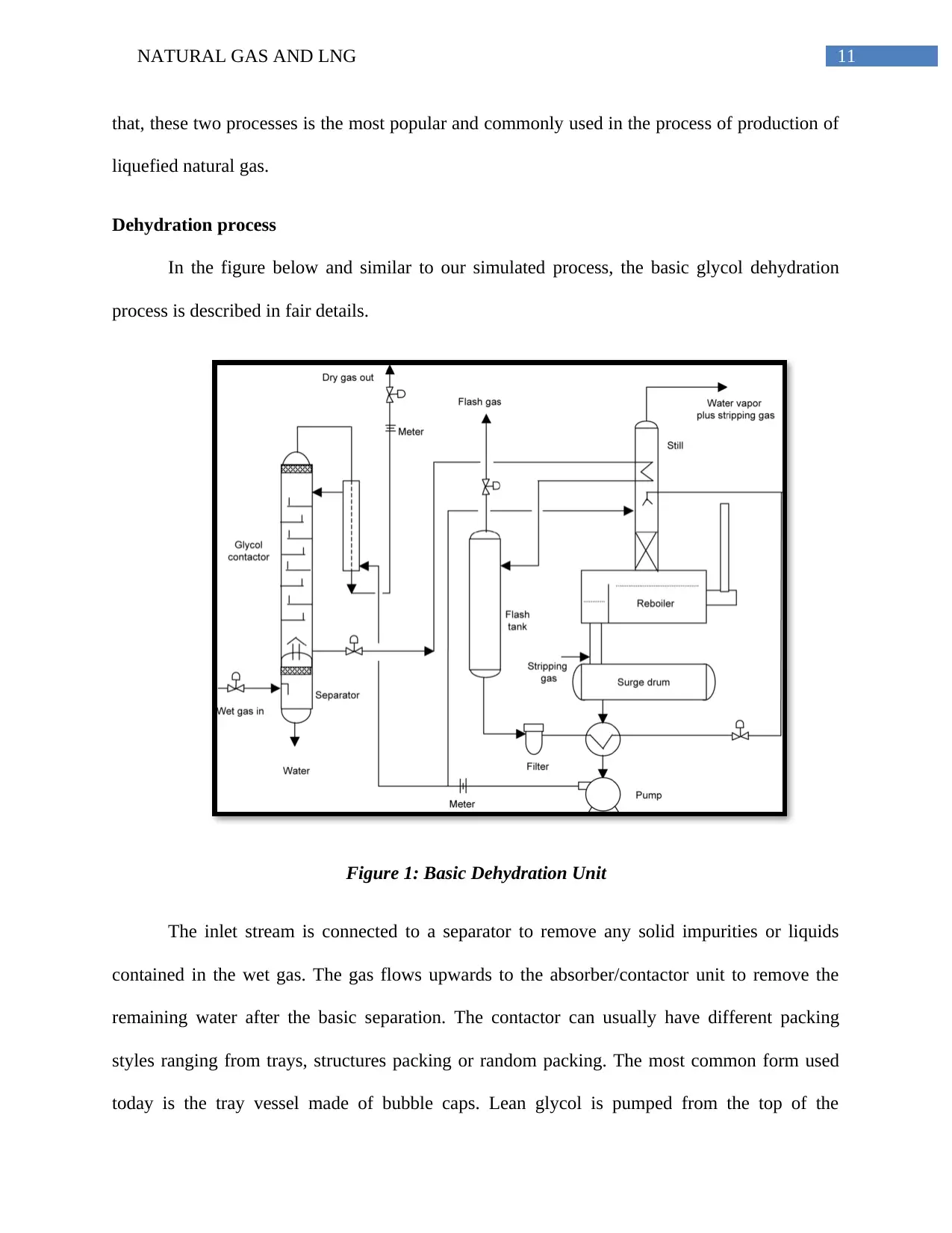
In the figure below and similar to our simulated process, the basic glycol dehydration
process is described in fair details.
Figure 1: Basic Dehydration Unit
The inlet stream is connected to a separator to remove any solid impurities or liquids
contained in the wet gas. The gas flows upwards to the absorber/contactor unit to remove the
remaining water after the basic separation. The contactor can usually have different packing
styles ranging from trays, structures packing or random packing. The most common form used
today is the tray vessel made of bubble caps. Lean glycol is pumped from the top of the
that, these two processes is the most popular and commonly used in the process of production of
liquefied natural gas.
Dehydration process
In the figure below and similar to our simulated process, the basic glycol dehydration
process is described in fair details.
Figure 1: Basic Dehydration Unit
The inlet stream is connected to a separator to remove any solid impurities or liquids
contained in the wet gas. The gas flows upwards to the absorber/contactor unit to remove the
remaining water after the basic separation. The contactor can usually have different packing
styles ranging from trays, structures packing or random packing. The most common form used
today is the tray vessel made of bubble caps. Lean glycol is pumped from the top of the
⊘ This is a preview!⊘
Do you want full access?
Subscribe today to unlock all pages.
Trusted by 1+ million students worldwide

1 out of 19


Related Documents


Your All-in-One AI-Powered Toolkit for Academic Success.
+13062052269
info@desklib.com
Available 24*7 on WhatsApp / Email
![[object Object]](/_next/static/media/star-bottom.7253800d.svg)
Unlock your academic potential
Copyright © 2020–2026 A2Z Services. All Rights Reserved. Developed and managed by ZUCOL.