Natural Monopoly in Economics: Analysis, Examples, and Regulation
VerifiedAdded on 2020/02/24
|11
|2553
|73
Essay
AI Summary
This economics assignment delves into the concept of natural monopoly, a market structure characterized by a single seller of a unique product with high fixed costs or unique technology, leading to barriers to entry. The assignment defines natural monopoly, examines its pricing strategies, and identifies potential problems like asymmetric information and inefficient resource allocation, often resulting in sub-optimal production. It highlights real-life examples such as railway systems, energy production, and telecom networks, demonstrating the need for government intervention to maximize efficiency and protect consumers. The paper discusses various regulatory approaches, including price controls and subsidies, and emphasizes the role of government in ensuring fair competition and preventing market failure. The conclusion stresses the importance of government regulation in addressing the challenges posed by natural monopolies and promoting economic well-being.
Running head: ASSIGNMENT ON ECONOMICS
Assignment on Economics
Name of the Student:
Name of the University:
Author Note:
Assignment on Economics
Name of the Student:
Name of the University:
Author Note:

Paraphrase This Document
Need a fresh take? Get an instant paraphrase of this document with our AI Paraphraser
1ASSIGNMENT ON ECONOMICS
Table of Contents
Introduction:...............................................................................................................................2
Concept, theory and explanation:...............................................................................................3
Definition and Pricing:...........................................................................................................3
Problem or Flaws of Natural Monopoly:...............................................................................5
Real-life examples of Natural Monopoly:..............................................................................5
Government regulation to maximize efficiency:....................................................................6
Conclusion:................................................................................................................................8
References:.................................................................................................................................9
Table of Contents
Introduction:...............................................................................................................................2
Concept, theory and explanation:...............................................................................................3
Definition and Pricing:...........................................................................................................3
Problem or Flaws of Natural Monopoly:...............................................................................5
Real-life examples of Natural Monopoly:..............................................................................5
Government regulation to maximize efficiency:....................................................................6
Conclusion:................................................................................................................................8
References:.................................................................................................................................9
2ASSIGNMENT ON ECONOMICS
Introduction:
The global economy runs efficiently based on international trade. At the heart of this
international trade lies the question of what and in how much quantity things should be
produced and who is going to be the targeted consumer for whom the goods are being
produced. The market in which different firms operates have been classified by the
economists based on certain characteristics it possessed. Amongst the classification made by
the economists, perfect competition and monopoly are the two extreme segmentations. There
also exists segmentation named as oligopoly, monopolistic and monopsony market.
This write-up deals with the case of natural monopoly. In the next segment of this
article, the concept of natural monopoly has been elaborated. In addition the ways in which
firms operating under this market structure can be regulated has been discussed. It is the
government of any country who can take initiative and lay down some regulations based on
which the firms can be restricted to operate in full-swing. In addition, the need for such
control over any particular firm has also been discussed followed by real life examples. The
last section of this write up summarizes the entire findings and tries to justify the usefulness
of government intervention if any.
Introduction:
The global economy runs efficiently based on international trade. At the heart of this
international trade lies the question of what and in how much quantity things should be
produced and who is going to be the targeted consumer for whom the goods are being
produced. The market in which different firms operates have been classified by the
economists based on certain characteristics it possessed. Amongst the classification made by
the economists, perfect competition and monopoly are the two extreme segmentations. There
also exists segmentation named as oligopoly, monopolistic and monopsony market.
This write-up deals with the case of natural monopoly. In the next segment of this
article, the concept of natural monopoly has been elaborated. In addition the ways in which
firms operating under this market structure can be regulated has been discussed. It is the
government of any country who can take initiative and lay down some regulations based on
which the firms can be restricted to operate in full-swing. In addition, the need for such
control over any particular firm has also been discussed followed by real life examples. The
last section of this write up summarizes the entire findings and tries to justify the usefulness
of government intervention if any.
⊘ This is a preview!⊘
Do you want full access?
Subscribe today to unlock all pages.

Trusted by 1+ million students worldwide
3ASSIGNMENT ON ECONOMICS
Concept, theory and explanation:
Monopoly market has been classified by the economists as the market structure where
a unique product is sold by a single seller and faces no competition from others. Henceforth,
they enjoy the right of quoting prices according to their own terms and often it has been
observed that the prices quoted by them is much higher than the expected price if they had
operated under any other market structure. In other words, there is absolutely strict restriction
in the entry of firms in the market as made up the existing firm.
Definition and Pricing:
According to (Stiglitz & Rosengard, 2015) natural monopoly is an unique
phenomenon in market structure which has been characterised by either high fixed cost,
unique technology used or specific raw materials required in production of the goods. Usually
the lack of similar technology or a high level start up cost often barred the other enthusiast
entrepreneur from entering into the market. A better depth into the concept and pricing under
natural monopoly can give a clear vision about the need for government intervention under
such market structure. According to (Hawley, 2015) whenever a single firm within a
particular market structure can operate more efficiently than any other firms enter the market
is known as natural monopoly. Under this structure, the single operating firm is able to reap
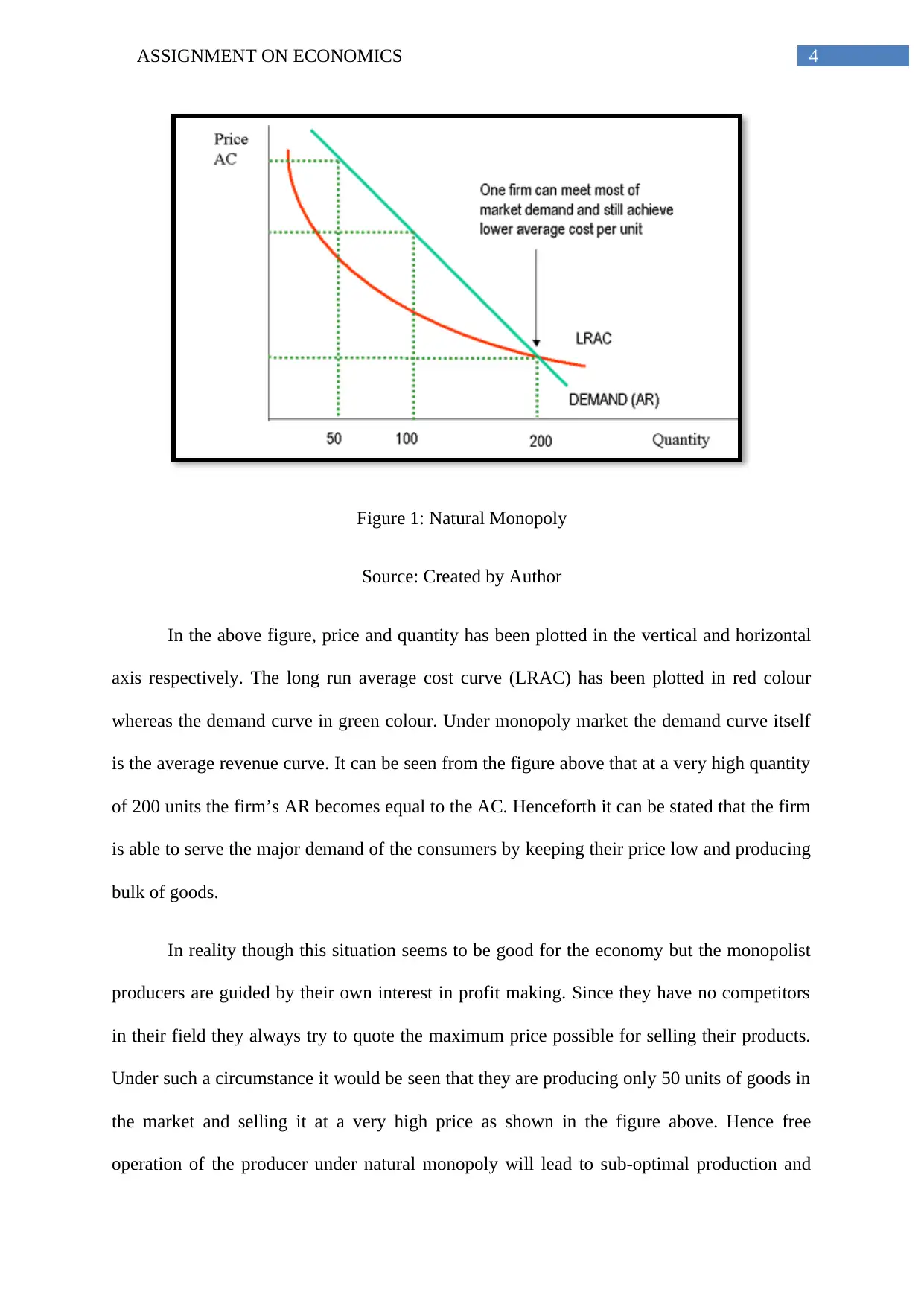
the maximum benefit within the industry. The figure drawn below is going to help us in
understanding this market structure.
Concept, theory and explanation:
Monopoly market has been classified by the economists as the market structure where
a unique product is sold by a single seller and faces no competition from others. Henceforth,
they enjoy the right of quoting prices according to their own terms and often it has been
observed that the prices quoted by them is much higher than the expected price if they had
operated under any other market structure. In other words, there is absolutely strict restriction
in the entry of firms in the market as made up the existing firm.
Definition and Pricing:
According to (Stiglitz & Rosengard, 2015) natural monopoly is an unique
phenomenon in market structure which has been characterised by either high fixed cost,
unique technology used or specific raw materials required in production of the goods. Usually
the lack of similar technology or a high level start up cost often barred the other enthusiast
entrepreneur from entering into the market. A better depth into the concept and pricing under
natural monopoly can give a clear vision about the need for government intervention under
such market structure. According to (Hawley, 2015) whenever a single firm within a
particular market structure can operate more efficiently than any other firms enter the market
is known as natural monopoly. Under this structure, the single operating firm is able to reap
the maximum benefit within the industry. The figure drawn below is going to help us in
understanding this market structure.
Paraphrase This Document
Need a fresh take? Get an instant paraphrase of this document with our AI Paraphraser
4ASSIGNMENT ON ECONOMICS
Figure 1: Natural Monopoly
Source: Created by Author
In the above figure, price and quantity has been plotted in the vertical and horizontal
axis respectively. The long run average cost curve (LRAC) has been plotted in red colour
whereas the demand curve in green colour. Under monopoly market the demand curve itself
is the average revenue curve. It can be seen from the figure above that at a very high quantity
of 200 units the firm’s AR becomes equal to the AC. Henceforth it can be stated that the firm
is able to serve the major demand of the consumers by keeping their price low and producing
bulk of goods.
In reality though this situation seems to be good for the economy but the monopolist
producers are guided by their own interest in profit making. Since they have no competitors
in their field they always try to quote the maximum price possible for selling their products.
Under such a circumstance it would be seen that they are producing only 50 units of goods in
the market and selling it at a very high price as shown in the figure above. Hence free
operation of the producer under natural monopoly will lead to sub-optimal production and
Figure 1: Natural Monopoly
Source: Created by Author
In the above figure, price and quantity has been plotted in the vertical and horizontal
axis respectively. The long run average cost curve (LRAC) has been plotted in red colour
whereas the demand curve in green colour. Under monopoly market the demand curve itself
is the average revenue curve. It can be seen from the figure above that at a very high quantity
of 200 units the firm’s AR becomes equal to the AC. Henceforth it can be stated that the firm
is able to serve the major demand of the consumers by keeping their price low and producing
bulk of goods.
In reality though this situation seems to be good for the economy but the monopolist
producers are guided by their own interest in profit making. Since they have no competitors
in their field they always try to quote the maximum price possible for selling their products.
Under such a circumstance it would be seen that they are producing only 50 units of goods in
the market and selling it at a very high price as shown in the figure above. Hence free
operation of the producer under natural monopoly will lead to sub-optimal production and
5ASSIGNMENT ON ECONOMICS
inefficient resource allocation. In addition, many consumers will be deprived of their demand
due to fierce competition and lack of available goods. Hence, under this situation often the
government intervenes and tries to regulate the market through various tools available at their
disposal.
Problem or Flaws of Natural Monopoly:
The main problems that arise when a firm operates under natural monopoly are that of
asymmetric information, moral hazards and inefficient allocation of resources giving rise to
sub-optimal level of production if remain un-regulated (Lim & Yurukoglu, 2015). If the
goods and services remain un-regulated and are privatized then the producer will charge
prices so high that people will stop demanding for the same. Hence, the resources that could
have been used to produce bulk of goods will then be used for producing lesser quantity of
goods as per the demand of the consumer. This will lead to inefficient allocation.
There have been several theories put forward by the economist in regards to the steps
that can be taken by the governing authority of any country in controlling the natural
monopoly firm. Amongst them the well-known and effective steps have been either putting
up a quota on the minimum goods produced or maximum price that can be charged for the
goods. Other than that the government may provide subsidy to keep the price at check and
allowing more people to reap the benefit of the goods (Vikharev, 2013). Few real life
examples of natural monopoly are given below and the ways in which the government
regulated it have been discussed thereafter.
Real-life examples of Natural Monopoly:
The railway system in India and China is a classic example of natural monopoly.
However it is not regulated by any private sector but the government of India bears the sole
responsibility of operating this system (Bordie, Wilson, & Kuang, 2014). Other than that the
inefficient resource allocation. In addition, many consumers will be deprived of their demand
due to fierce competition and lack of available goods. Hence, under this situation often the
government intervenes and tries to regulate the market through various tools available at their
disposal.
Problem or Flaws of Natural Monopoly:
The main problems that arise when a firm operates under natural monopoly are that of
asymmetric information, moral hazards and inefficient allocation of resources giving rise to
sub-optimal level of production if remain un-regulated (Lim & Yurukoglu, 2015). If the
goods and services remain un-regulated and are privatized then the producer will charge
prices so high that people will stop demanding for the same. Hence, the resources that could
have been used to produce bulk of goods will then be used for producing lesser quantity of
goods as per the demand of the consumer. This will lead to inefficient allocation.
There have been several theories put forward by the economist in regards to the steps
that can be taken by the governing authority of any country in controlling the natural
monopoly firm. Amongst them the well-known and effective steps have been either putting
up a quota on the minimum goods produced or maximum price that can be charged for the
goods. Other than that the government may provide subsidy to keep the price at check and
allowing more people to reap the benefit of the goods (Vikharev, 2013). Few real life
examples of natural monopoly are given below and the ways in which the government
regulated it have been discussed thereafter.
Real-life examples of Natural Monopoly:
The railway system in India and China is a classic example of natural monopoly.
However it is not regulated by any private sector but the government of India bears the sole
responsibility of operating this system (Bordie, Wilson, & Kuang, 2014). Other than that the
⊘ This is a preview!⊘
Do you want full access?
Subscribe today to unlock all pages.
Trusted by 1+ million students worldwide
6ASSIGNMENT ON ECONOMICS
energy production in the form of oil and natural gas also is a part of natural monopoly with
one company enjoying economies of scale and providing service to almost the entire nation.
In case of United Kingdom and United States, the telecom building network and its
maintenance comes under the natural monopoly market (Borenstein & Bushnell, 2015). In
U.S.A. the supply of electricity has also been considered under natural monopoly. In the case
of telecom service and electric supply it has been seen that there is existence of more than
one supplier but dominance of a particular supplier and their ability to reap benefits from
economies of scale makes these sectors an example of natural monopoly. The ways in which
these sectors have been regulated is discussed hereafter.
Government regulation to maximize efficiency:
Research has been carried out by several economists in studying the efficiency of the
most important transportation service in the world. According to a research economists have
taken up 20 countries and surveyed their railway network system. Unanimously they have
found out that in all these countries this vital transportation system has been regulated by the
government and minimal privatization have been involved (Borenstein & Bushnell, 2015).
Further studies has shown that this similarity is due to the fact that providing this service
requires huge initial cost followed by constant recurring investment in the forms of
maintaining signal, traffic and other infrastructure. Under this circumstances if things were
left to private companies then they would have been able to efficiently supply the service but
at an excessive high cost. This would lead to market failure. Hence, the government felt the
need to control this natural monopoly market by providing the service by them. In case of
Indian economy, the government pays a huge amount of subsidy in the local trains and tries
to collect as much revenue possible from the goods train to balance their expenditure
(Laurino, Ramella, & Beria, 2015).
energy production in the form of oil and natural gas also is a part of natural monopoly with
one company enjoying economies of scale and providing service to almost the entire nation.
In case of United Kingdom and United States, the telecom building network and its
maintenance comes under the natural monopoly market (Borenstein & Bushnell, 2015). In
U.S.A. the supply of electricity has also been considered under natural monopoly. In the case
of telecom service and electric supply it has been seen that there is existence of more than
one supplier but dominance of a particular supplier and their ability to reap benefits from
economies of scale makes these sectors an example of natural monopoly. The ways in which
these sectors have been regulated is discussed hereafter.
Government regulation to maximize efficiency:
Research has been carried out by several economists in studying the efficiency of the
most important transportation service in the world. According to a research economists have
taken up 20 countries and surveyed their railway network system. Unanimously they have
found out that in all these countries this vital transportation system has been regulated by the
government and minimal privatization have been involved (Borenstein & Bushnell, 2015).
Further studies has shown that this similarity is due to the fact that providing this service
requires huge initial cost followed by constant recurring investment in the forms of
maintaining signal, traffic and other infrastructure. Under this circumstances if things were
left to private companies then they would have been able to efficiently supply the service but
at an excessive high cost. This would lead to market failure. Hence, the government felt the
need to control this natural monopoly market by providing the service by them. In case of
Indian economy, the government pays a huge amount of subsidy in the local trains and tries
to collect as much revenue possible from the goods train to balance their expenditure
(Laurino, Ramella, & Beria, 2015).
Paraphrase This Document
Need a fresh take? Get an instant paraphrase of this document with our AI Paraphraser
7ASSIGNMENT ON ECONOMICS
Another paper tries to find out the reason behind intervention of the government of
USA in regulating the supply of electricity and water services in the country (Nepal &
Jamasb, 2015). It has been observed that these two services also fall under the category of
natural monopoly. Cost-benefit analysis have shown that if multiple company operates in
providing drinking water within any particular region of the country then it is going to lead
market failure. Construction of pipelines of different companies into each household will
incur a huge cost and people will only use any one of them, while others will be unused.
Hence, the government has intervened and set up regulations to properly distribute drinking
water to the people through proper distribution rights to the company dealing with it.
Similarly supply of electricity and telecommunication system within the city incurs huge
fixed cost and henceforth the government intervened by implementing proper competition
policy and maintained peace in trade and commerce amongst the electric supply companies
(Cherry, 2014).
Natural monopoly exists in case of supply of essential goods like oil and natural gas.
It can be debated that there are several companies engaged in the world in extraction of oil
and natural gas but when it comes to market power only a few company from the OECD
countries reap the major benefits. In addition, they have become so powerful that they can
often cause harm to the world by curtailing their production or through artificial price hike.
Hence, the government of almost all countries are very sensitive about the supply of this
particular commodity (Mehrotra, 2017). They are also sensitive about the international trade
regulation regarding oil and natural gas and always try to maintain a balance between the
price and supply of the goods. In case of India, it is the ONGC who have the major share of
the market. In China, amongst the top 5 energy supplying companies, 3 are solely owned by
the government and the other two are regulated to a great extent (Hu & Dong, 2015). In USA,
it is Chevron who rules the market along with few other major companies. It has been noticed
Another paper tries to find out the reason behind intervention of the government of
USA in regulating the supply of electricity and water services in the country (Nepal &
Jamasb, 2015). It has been observed that these two services also fall under the category of
natural monopoly. Cost-benefit analysis have shown that if multiple company operates in
providing drinking water within any particular region of the country then it is going to lead
market failure. Construction of pipelines of different companies into each household will
incur a huge cost and people will only use any one of them, while others will be unused.
Hence, the government has intervened and set up regulations to properly distribute drinking
water to the people through proper distribution rights to the company dealing with it.
Similarly supply of electricity and telecommunication system within the city incurs huge
fixed cost and henceforth the government intervened by implementing proper competition
policy and maintained peace in trade and commerce amongst the electric supply companies
(Cherry, 2014).
Natural monopoly exists in case of supply of essential goods like oil and natural gas.
It can be debated that there are several companies engaged in the world in extraction of oil
and natural gas but when it comes to market power only a few company from the OECD
countries reap the major benefits. In addition, they have become so powerful that they can
often cause harm to the world by curtailing their production or through artificial price hike.
Hence, the government of almost all countries are very sensitive about the supply of this
particular commodity (Mehrotra, 2017). They are also sensitive about the international trade
regulation regarding oil and natural gas and always try to maintain a balance between the
price and supply of the goods. In case of India, it is the ONGC who have the major share of
the market. In China, amongst the top 5 energy supplying companies, 3 are solely owned by
the government and the other two are regulated to a great extent (Hu & Dong, 2015). In USA,
it is Chevron who rules the market along with few other major companies. It has been noticed
8ASSIGNMENT ON ECONOMICS
that in all these companies there exist one similarity and that is though some are state owned
and some are privatised but all of them are stringently regulated by the government of the
respective nation.
Conclusion:
Hereby it can be said that there exist different market structure within an economy
depending upon the number of buyers, sellers, start-up cost, barriers to entry and exit and
other such factors. Amongst all these types, perfect completion and monopoly are the
extreme scenario where the former is an utopian situation and the later exists with some level
of discrepancies. It has been seen that within the monopoly structure whenever a firm is
characterised by high level of fixed cost and continuous falling average cost it naturally bars
other firms from taking part into the competition. Often this can be the cause of market
failure and hence under such a situation it has been found that the government of that
economy intervenes and regulates the market. It has been observed that in most cases it is the
essential public goods that fall under natural monopoly like the supply of electricity,
transportation via railway network, supply of drinking water, etc. The greatest threat
possessed under this market structure is that of market failure and sub-optimal utilization of
resources. Hence all over the world researches are carried out by taking both quantitative and
qualitative data in finding out a proper solution of this problem. It has been seen that it is only
the higher authority that is the government through proper implementation of trade rules and
competition policy can curb the problem posed by the firms under the market structure of
natural monopoly. The economists through regular debates and continuous researches are
trying to find out if any alternative situation can be create which might lead to lack of market
failure. There lies further scope of research about the role and the need of the government in
curbing the problem of natural monopoly throughout the global economy.
that in all these companies there exist one similarity and that is though some are state owned
and some are privatised but all of them are stringently regulated by the government of the
respective nation.
Conclusion:
Hereby it can be said that there exist different market structure within an economy
depending upon the number of buyers, sellers, start-up cost, barriers to entry and exit and
other such factors. Amongst all these types, perfect completion and monopoly are the
extreme scenario where the former is an utopian situation and the later exists with some level
of discrepancies. It has been seen that within the monopoly structure whenever a firm is
characterised by high level of fixed cost and continuous falling average cost it naturally bars
other firms from taking part into the competition. Often this can be the cause of market
failure and hence under such a situation it has been found that the government of that
economy intervenes and regulates the market. It has been observed that in most cases it is the
essential public goods that fall under natural monopoly like the supply of electricity,
transportation via railway network, supply of drinking water, etc. The greatest threat
possessed under this market structure is that of market failure and sub-optimal utilization of
resources. Hence all over the world researches are carried out by taking both quantitative and
qualitative data in finding out a proper solution of this problem. It has been seen that it is only
the higher authority that is the government through proper implementation of trade rules and
competition policy can curb the problem posed by the firms under the market structure of
natural monopoly. The economists through regular debates and continuous researches are
trying to find out if any alternative situation can be create which might lead to lack of market
failure. There lies further scope of research about the role and the need of the government in
curbing the problem of natural monopoly throughout the global economy.
⊘ This is a preview!⊘
Do you want full access?
Subscribe today to unlock all pages.
Trusted by 1+ million students worldwide
9ASSIGNMENT ON ECONOMICS
References:
Bordie, R., Wilson, S., & Kuang, J. (2014). The Importance, Development and Reform
Challenges of China’s Rail Sector.
Borenstein, S., & Bushnell, J. (2015). The US electricity industry after 20 years of
restructuring. Annual Rev. Econ , 437-463.
Cherry, A. B. (2014). Historical mutilation: How misuse of'public utility and'natural
monopoly'misdirects US telecommunications policy development.
Hawley, E. W. (2015). The New Deal and the problem of monopoly. Princeton University
Press.
Hu, A., & Dong, Q. (2015). On natural gas pricing reform in China. Natural Gas Industry .
Laurino, A., Ramella, F., & Beria, P. (2015). The economic regulation of railway networks:
A worldwide survey. The economic regulation of railway networks: A worldwide
survey. . Transportation Research Part A: Policy and Practice , 202-212.
Lim, C. S., & Yurukoglu, A. (2015). Dynamic natural monopoly regulation: Time
inconsistency, moral hazard, and political environments. . Journal of Political
Economy.
Mehrotra, A. (2017). Issues and Challenges in Development of Efficient Gas Market. In
Natural Gas Markets in India . Springer Singapore.
Nepal, R., & Jamasb, T. (2015). Caught between theory and practice: Government, market,
and regulatory failure in electricity sector reforms. Economic Analysis and Policy ,
References:
Bordie, R., Wilson, S., & Kuang, J. (2014). The Importance, Development and Reform
Challenges of China’s Rail Sector.
Borenstein, S., & Bushnell, J. (2015). The US electricity industry after 20 years of
restructuring. Annual Rev. Econ , 437-463.
Cherry, A. B. (2014). Historical mutilation: How misuse of'public utility and'natural
monopoly'misdirects US telecommunications policy development.
Hawley, E. W. (2015). The New Deal and the problem of monopoly. Princeton University
Press.
Hu, A., & Dong, Q. (2015). On natural gas pricing reform in China. Natural Gas Industry .
Laurino, A., Ramella, F., & Beria, P. (2015). The economic regulation of railway networks:
A worldwide survey. The economic regulation of railway networks: A worldwide
survey. . Transportation Research Part A: Policy and Practice , 202-212.
Lim, C. S., & Yurukoglu, A. (2015). Dynamic natural monopoly regulation: Time
inconsistency, moral hazard, and political environments. . Journal of Political
Economy.
Mehrotra, A. (2017). Issues and Challenges in Development of Efficient Gas Market. In
Natural Gas Markets in India . Springer Singapore.
Nepal, R., & Jamasb, T. (2015). Caught between theory and practice: Government, market,
and regulatory failure in electricity sector reforms. Economic Analysis and Policy ,
Paraphrase This Document
Need a fresh take? Get an instant paraphrase of this document with our AI Paraphraser
10ASSIGNMENT ON ECONOMICS
16-24.
Stiglitz, J. E., & Rosengard, J. K. (2015). Economics of the Public Sector: Fourth
International Student Edition. . WW Norton & Company.
Vikharev, S. (2013). Mathematical modeling of development and reconciling cooperation
programs between natural monopoly and regional authorities.
16-24.
Stiglitz, J. E., & Rosengard, J. K. (2015). Economics of the Public Sector: Fourth
International Student Edition. . WW Norton & Company.
Vikharev, S. (2013). Mathematical modeling of development and reconciling cooperation
programs between natural monopoly and regional authorities.

1 out of 11


Related Documents


Your All-in-One AI-Powered Toolkit for Academic Success.
+13062052269
info@desklib.com
Available 24*7 on WhatsApp / Email
![[object Object]](/_next/static/media/star-bottom.7253800d.svg)
Unlock your academic potential
Copyright © 2020–2025 A2Z Services. All Rights Reserved. Developed and managed by ZUCOL.