NatWest Bank and the Business Environment: A Detailed Report
VerifiedAdded on 2020/06/06
|12
|3445
|44
Report
AI Summary
This report provides a comprehensive analysis of NatWest's business environment, exploring its impact on the financial institution. The report begins with an introduction to business environments, highlighting micro and macro components and their influence on organizational strategies. It then focuses on NatWest, examining its services, size, and scope. Task 1 delves into different types of business organizations, including sole traders, partnerships, private, public, and voluntary entities, providing examples and outlining their aims and objectives. Task 2 analyzes the organizational structure of NatWest and its parent company, Royal Bank of Scotland, focusing on divisional structure and its implications. The report covers key departments within NatWest, such as finance and human resources, and their roles in achieving organizational goals. The report utilizes the provided content to explain how the business environment affects NatWest and its operations. This report examines the banking environment and the impact on the business.
Business Environment

Paraphrase This Document
Need a fresh take? Get an instant paraphrase of this document with our AI Paraphraser
Table of Contents
INTRODUCTION...........................................................................................................................1
TASK 1............................................................................................................................................1
Different types, size and scope of organisation......................................................................1
TASK 2............................................................................................................................................4
Organisational structure of two different entities...................................................................4
TASK 3............................................................................................................................................7
Covered in PPT.......................................................................................................................7
TASK 4............................................................................................................................................7
Covered in PPT.......................................................................................................................7
CONCLUSION................................................................................................................................7
REFERENCES................................................................................................................................8
INTRODUCTION...........................................................................................................................1
TASK 1............................................................................................................................................1
Different types, size and scope of organisation......................................................................1
TASK 2............................................................................................................................................4
Organisational structure of two different entities...................................................................4
TASK 3............................................................................................................................................7
Covered in PPT.......................................................................................................................7
TASK 4............................................................................................................................................7
Covered in PPT.......................................................................................................................7
CONCLUSION................................................................................................................................7
REFERENCES................................................................................................................................8

⊘ This is a preview!⊘
Do you want full access?
Subscribe today to unlock all pages.

Trusted by 1+ million students worldwide
INTRODUCTION
Business refers to an entity that has been established for serving a social or personal
needs and to ear profits. These enterprises work in an environment which is full of dynamic
factors that can change anytime and hamper organisational activities. Basically, there are two
types of elements which are known as micro and macro components. The inter-relationship
between these factors forces organisation to change its policies and plans for accommodating
change as per requirement (Agarwal, Grassl and Pahl, 2012). Furthermore, it can be said whole
environment is mere an aggregate of various conditions that prevails in market. Today business
environment has become very dynamic and all organisation working in it have to keep on
analysing all factors as to ensure that their productivity and operational capabilities remain intact.
The micro environment is controllable but macro environment can not be controlled and has to
be managed or adopted in a effective manner or it will hinder all process. This report is based on
NatWest which is one of the biggest commercialised banking service provider in united
Kingdom.
This assignment will assist readers in understand how business environment impacts an
organisation and its working. Since 2000, the banking entity became a part of Royal Bank of
Scotland. It is providing its services to customers via Ulster bank Subsidy. The prime goal of
organisation is to open its branch in rural as well as urban parts of country (Boons and Lüdeke-
Freund, 2013). In this report various types of business with their size and scope will be briefly
explained. Also inter-relationship between organisation and its structure is stated. There are
different types of impacts on ability of NatWest which is briefly described.
TASK 1
Different types, size and scope of organisation
NatWest is a financial institution that is currently providing services to consumers who
are spread into a substantial area. The bank have a very large network as it have more than 970
branches and have 3500 cash machines across Great Britain. They have 24 hours action line
telephones and online banking services to customers (Carlin and Schaffer, 2012). The number of
consumers is more than 8 million which are personal accounts while there are 9 hundred
thousand small business accounts. The company is basically currently trying to get new
consumers who can be served with qualitative services. With industrial age types of business
1
Business refers to an entity that has been established for serving a social or personal
needs and to ear profits. These enterprises work in an environment which is full of dynamic
factors that can change anytime and hamper organisational activities. Basically, there are two
types of elements which are known as micro and macro components. The inter-relationship
between these factors forces organisation to change its policies and plans for accommodating
change as per requirement (Agarwal, Grassl and Pahl, 2012). Furthermore, it can be said whole
environment is mere an aggregate of various conditions that prevails in market. Today business
environment has become very dynamic and all organisation working in it have to keep on
analysing all factors as to ensure that their productivity and operational capabilities remain intact.
The micro environment is controllable but macro environment can not be controlled and has to
be managed or adopted in a effective manner or it will hinder all process. This report is based on
NatWest which is one of the biggest commercialised banking service provider in united
Kingdom.
This assignment will assist readers in understand how business environment impacts an
organisation and its working. Since 2000, the banking entity became a part of Royal Bank of
Scotland. It is providing its services to customers via Ulster bank Subsidy. The prime goal of
organisation is to open its branch in rural as well as urban parts of country (Boons and Lüdeke-
Freund, 2013). In this report various types of business with their size and scope will be briefly
explained. Also inter-relationship between organisation and its structure is stated. There are
different types of impacts on ability of NatWest which is briefly described.
TASK 1
Different types, size and scope of organisation
NatWest is a financial institution that is currently providing services to consumers who
are spread into a substantial area. The bank have a very large network as it have more than 970
branches and have 3500 cash machines across Great Britain. They have 24 hours action line
telephones and online banking services to customers (Carlin and Schaffer, 2012). The number of
consumers is more than 8 million which are personal accounts while there are 9 hundred
thousand small business accounts. The company is basically currently trying to get new
consumers who can be served with qualitative services. With industrial age types of business
1
Paraphrase This Document
Need a fresh take? Get an instant paraphrase of this document with our AI Paraphraser
organisation have evolved. From being a sole proprietorship to being a conglomerate
multinational company. These organisations use different types of strategy and technologies as to
ensure that they survive in market for longest period of time. Different types of business
enterprises are mentioned below, also their aim, purpose will be stated: Sole Trader: This is a type of business organisation where one person is responsible for
taking all decision related to company and its process. Basically this type favours
statements like one man can run business or one man brands (Cassell and Blake, 2012).
In this business type individual is self employed and runs his business as per his own
requirement. He is the owner of his own company and has to bear unlimited liability. For
example, Exon motors is a sole trader firm. It deal in spare parts of cars and provide
different services to consumers related to repair and modification. The current owner is
liable for all the profits and loss that company has to bear. The basic purpose of having
this type of business is that the person have total control over the activities of business
enterprise. He gets the profits and all decisions are taken by him only as there is no
interference from any party. Also the financial data can be kept confidential but there are
certain disadvantage of this type. All the losses also has to be paid by owner, he has a
unlimited liability meaning his own property can be sold for recovering losses. Partnership: It is a type of business enterprise where two or more individuals start a
business enterprise as to earn profits and share liabilities. It is a improved form of
business while there are still certain loopholes like the unlimited liability shared by all
partners. This form of organisation is considered to be better than sole trader as it has
more resources that can be used for increasing the impact of organisation to a greater
level. The main purpose of starting a partnership firm is to earn maximum profits while
sharing all the losses collectively. It allows partners in exploiting growth aspects which
could not be done in sole trader (Cuervo‐Cazurra, 2011). The advantage of this type of
business enterprise is that partners can share all the losses together while there are more
resources which are present to be used. Also the idea sharing and screening process is
improved as there are more people and more idea's and methods. But there are certain
disadvantages, such as sharing of profits will be as per the investment ratio in the
business. Also if any partner conducts a wrong activity then all can be punished as one of
the member can represent all others.
2
multinational company. These organisations use different types of strategy and technologies as to
ensure that they survive in market for longest period of time. Different types of business
enterprises are mentioned below, also their aim, purpose will be stated: Sole Trader: This is a type of business organisation where one person is responsible for
taking all decision related to company and its process. Basically this type favours
statements like one man can run business or one man brands (Cassell and Blake, 2012).
In this business type individual is self employed and runs his business as per his own
requirement. He is the owner of his own company and has to bear unlimited liability. For
example, Exon motors is a sole trader firm. It deal in spare parts of cars and provide
different services to consumers related to repair and modification. The current owner is
liable for all the profits and loss that company has to bear. The basic purpose of having
this type of business is that the person have total control over the activities of business
enterprise. He gets the profits and all decisions are taken by him only as there is no
interference from any party. Also the financial data can be kept confidential but there are
certain disadvantage of this type. All the losses also has to be paid by owner, he has a
unlimited liability meaning his own property can be sold for recovering losses. Partnership: It is a type of business enterprise where two or more individuals start a
business enterprise as to earn profits and share liabilities. It is a improved form of
business while there are still certain loopholes like the unlimited liability shared by all
partners. This form of organisation is considered to be better than sole trader as it has
more resources that can be used for increasing the impact of organisation to a greater
level. The main purpose of starting a partnership firm is to earn maximum profits while
sharing all the losses collectively. It allows partners in exploiting growth aspects which
could not be done in sole trader (Cuervo‐Cazurra, 2011). The advantage of this type of
business enterprise is that partners can share all the losses together while there are more
resources which are present to be used. Also the idea sharing and screening process is
improved as there are more people and more idea's and methods. But there are certain
disadvantages, such as sharing of profits will be as per the investment ratio in the
business. Also if any partner conducts a wrong activity then all can be punished as one of
the member can represent all others.
2
Private: Theses types of firms are those entities which are wholly owned by a group of
people or a private individual who has grown his company size and scope. They aim to
earn profits and ensure that all standards are maintained while consumers are served. A
private company is a far better option when it comes to investment as all the shareholders
or individuals involved in the process do not have a unlimited liability (De Jonge, 2011).
The aim of business is to earn higher level of profits while gaining market share that will
support retain-ship in market. The best example of this type of business is NatWest which
is a private banking institution.
It is providing different types of financial services to different customers. The bank is
catering to the needs of all types of consumers and they are providing services to them with a
standard. Also the aim of bank is to gain market share which can be converted into a profitable
business. The financial institution is serving under the Tertiary sector as it is providing
commercial services to different types of consumers (Griffin and Pustay, 2012). Tertiary sector is
the one which includes different activities that are related to service industry. The prime
objective of company is that they are aiming to gain higher level of consumer base so that it can
increase its profitability levels and ensure that it is able to overcome the threat that is there due to
its competitors. Also the company is focusing on identification of various consumer needs and
wants so that it can provide better qualitative services to them and satisfy their needs. Public: These are the organisations which are formed as to promote goodwill and
facilities for public. There are many companies which are formed by government as to
enhance the working and the core business in the country. They provide the basic
stability that is required to keep economy in a healthy shape. These companies are ran on
the funds that are provided by the public taxes and revenue generated by government in
financial year. The best example of this type of firm is BBC (Guglielmetti, 2011). In
expanded form it is called as British Broadcasting Corporation which is established as to
act as a news broadcaster. The company has more than 35000 individuals working in it
out of which more than 21 thousand are permanent and rest are temporary or trainee. The
objective of this company is to gain maximum market share while providing unbiased
news reporting to the viewers. BBC is funded by the government via taxpayer money but
it is not controlled by it. It was enacted by a royal charter in 1924 and since then it is
operating in the filed of media and broadcasting successfully. There are many
3
people or a private individual who has grown his company size and scope. They aim to
earn profits and ensure that all standards are maintained while consumers are served. A
private company is a far better option when it comes to investment as all the shareholders
or individuals involved in the process do not have a unlimited liability (De Jonge, 2011).
The aim of business is to earn higher level of profits while gaining market share that will
support retain-ship in market. The best example of this type of business is NatWest which
is a private banking institution.
It is providing different types of financial services to different customers. The bank is
catering to the needs of all types of consumers and they are providing services to them with a
standard. Also the aim of bank is to gain market share which can be converted into a profitable
business. The financial institution is serving under the Tertiary sector as it is providing
commercial services to different types of consumers (Griffin and Pustay, 2012). Tertiary sector is
the one which includes different activities that are related to service industry. The prime
objective of company is that they are aiming to gain higher level of consumer base so that it can
increase its profitability levels and ensure that it is able to overcome the threat that is there due to
its competitors. Also the company is focusing on identification of various consumer needs and
wants so that it can provide better qualitative services to them and satisfy their needs. Public: These are the organisations which are formed as to promote goodwill and
facilities for public. There are many companies which are formed by government as to
enhance the working and the core business in the country. They provide the basic
stability that is required to keep economy in a healthy shape. These companies are ran on
the funds that are provided by the public taxes and revenue generated by government in
financial year. The best example of this type of firm is BBC (Guglielmetti, 2011). In
expanded form it is called as British Broadcasting Corporation which is established as to
act as a news broadcaster. The company has more than 35000 individuals working in it
out of which more than 21 thousand are permanent and rest are temporary or trainee. The
objective of this company is to gain maximum market share while providing unbiased
news reporting to the viewers. BBC is funded by the government via taxpayer money but
it is not controlled by it. It was enacted by a royal charter in 1924 and since then it is
operating in the filed of media and broadcasting successfully. There are many
3
⊘ This is a preview!⊘
Do you want full access?
Subscribe today to unlock all pages.
Trusted by 1+ million students worldwide
competitors present in the market which pose a threat to the company. The programmes
made by BBC are related to news and other regional issues.
Voluntary: This is a sector which is directly involved in solving various social issues that
can hinder normal life of people living in the region. They do not earn any type of profits
and even if they do, it is distributed in the various activities. The people associated in this
sector are free to move in and out as it is voluntary and not forceful (Halbert and Ingulli,
2011). They are also called as non governmental organisations or non profitable
organisations that aims to achieve a higher level of effectiveness in solving social issues.
These firms are handled by the management committee which are composed of various
members who are engaged in the operations of organisation. The prime aim of the
company is to provide a better standard of living to the people who are living in society.
They assist in enhancing the quality of services that are being provided to consumers in
the market.
TASK 2
Organisational structure of two different entities
There are various types of organisations which differs on the basis of their purpose or
legal structure. The organisation structure is also different with change in the size and scope of
companies. Basically this is a factors which differentiates them from others. NatWest is one of
the biggest financial institution present in Britain and it is currently working in the filed to
provide better services to consumers (Hamilton and Webster, 2015). There are different types of
departments that are prevalent in this sector. All these functions have a specified roles and
responsibilities which needs to be performed in accordance to the organisational goals. For
example, the finance department is engaged in analysing various cost as well as it keeps a check
that all activities have sufficient amount of resources. The budgeting and also salary and wages is
transferred by this department. Also they assist other functions in maintaining or enhancing their
capabilities.
The objective of this bank is to increase more market share and gain more consumer base
so that it can improve its profitability (Harison, 2012). They aim to improve the connectivity of
firms by providing a online portal services to users. This will enable the users in accessing their
accounts in a more convenient manner. For this service the banking institution requires a
4
made by BBC are related to news and other regional issues.
Voluntary: This is a sector which is directly involved in solving various social issues that
can hinder normal life of people living in the region. They do not earn any type of profits
and even if they do, it is distributed in the various activities. The people associated in this
sector are free to move in and out as it is voluntary and not forceful (Halbert and Ingulli,
2011). They are also called as non governmental organisations or non profitable
organisations that aims to achieve a higher level of effectiveness in solving social issues.
These firms are handled by the management committee which are composed of various
members who are engaged in the operations of organisation. The prime aim of the
company is to provide a better standard of living to the people who are living in society.
They assist in enhancing the quality of services that are being provided to consumers in
the market.
TASK 2
Organisational structure of two different entities
There are various types of organisations which differs on the basis of their purpose or
legal structure. The organisation structure is also different with change in the size and scope of
companies. Basically this is a factors which differentiates them from others. NatWest is one of
the biggest financial institution present in Britain and it is currently working in the filed to
provide better services to consumers (Hamilton and Webster, 2015). There are different types of
departments that are prevalent in this sector. All these functions have a specified roles and
responsibilities which needs to be performed in accordance to the organisational goals. For
example, the finance department is engaged in analysing various cost as well as it keeps a check
that all activities have sufficient amount of resources. The budgeting and also salary and wages is
transferred by this department. Also they assist other functions in maintaining or enhancing their
capabilities.
The objective of this bank is to increase more market share and gain more consumer base
so that it can improve its profitability (Harison, 2012). They aim to improve the connectivity of
firms by providing a online portal services to users. This will enable the users in accessing their
accounts in a more convenient manner. For this service the banking institution requires a
4
Paraphrase This Document
Need a fresh take? Get an instant paraphrase of this document with our AI Paraphraser
professional information technology department which will keep the online transactions secure.
There are various training modules that have to be provided to the staff members as this will
prepare them for future contingencies (Harrison, 2011). The human resources department is
responsible for all the training and development activities taking place within organisation. It
ensures that all vacant positions are filled and company have required level of human resource.
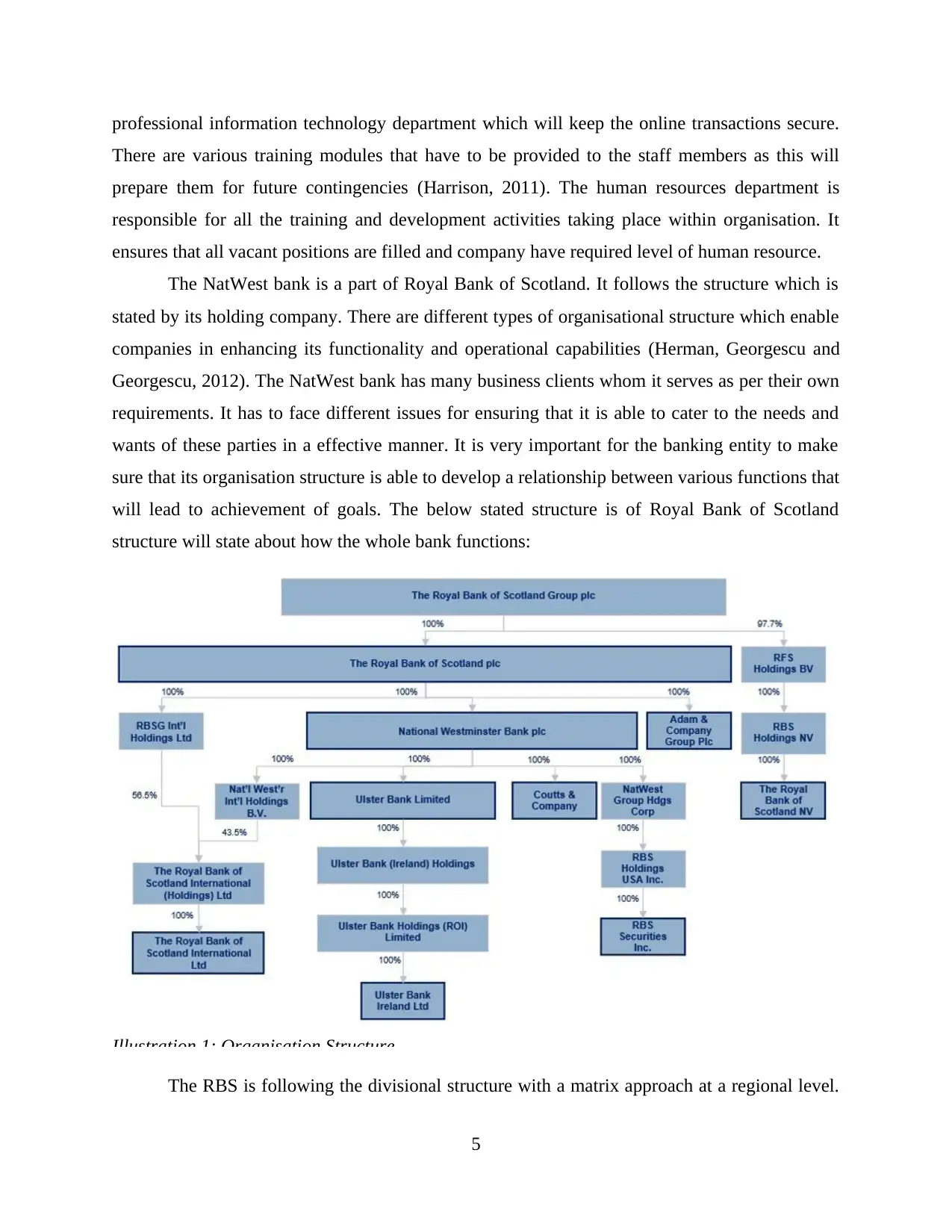
The NatWest bank is a part of Royal Bank of Scotland. It follows the structure which is
stated by its holding company. There are different types of organisational structure which enable
companies in enhancing its functionality and operational capabilities (Herman, Georgescu and
Georgescu, 2012). The NatWest bank has many business clients whom it serves as per their own
requirements. It has to face different issues for ensuring that it is able to cater to the needs and
wants of these parties in a effective manner. It is very important for the banking entity to make
sure that its organisation structure is able to develop a relationship between various functions that
will lead to achievement of goals. The below stated structure is of Royal Bank of Scotland
structure will state about how the whole bank functions:
Illustration 1: Organisation Structure
The RBS is following the divisional structure with a matrix approach at a regional level.
5
There are various training modules that have to be provided to the staff members as this will
prepare them for future contingencies (Harrison, 2011). The human resources department is
responsible for all the training and development activities taking place within organisation. It
ensures that all vacant positions are filled and company have required level of human resource.
The NatWest bank is a part of Royal Bank of Scotland. It follows the structure which is
stated by its holding company. There are different types of organisational structure which enable
companies in enhancing its functionality and operational capabilities (Herman, Georgescu and
Georgescu, 2012). The NatWest bank has many business clients whom it serves as per their own
requirements. It has to face different issues for ensuring that it is able to cater to the needs and
wants of these parties in a effective manner. It is very important for the banking entity to make
sure that its organisation structure is able to develop a relationship between various functions that
will lead to achievement of goals. The below stated structure is of Royal Bank of Scotland
structure will state about how the whole bank functions:
Illustration 1: Organisation Structure
The RBS is following the divisional structure with a matrix approach at a regional level.
5
It is a top hierarchy structure which is made to divide authority and responsibility in a effective
manner. The banking institution is able to run all of its subsidiaries through this model that aids
in keeping all channels of communication smooth. All the divisions are made to cater to the
needs of different consumers living in various parts of world (Lee, Sohn and Ju, 2011). Also the
employees and departments are allotted as per the requirement of subsidiary.
There are different types of companies which are being supported by the cited banking
entity. One of them is Tesco which is UK biggest and world third largest retailer of grocery and
other products. It uses completely different organisation structure which enables it in running its
operations smoothly (López-Gamero, Molina-Azorín and Claver-Cortés, 2011). Basically it
depends on the size, scope and needs of company as to which organisation structure will be used
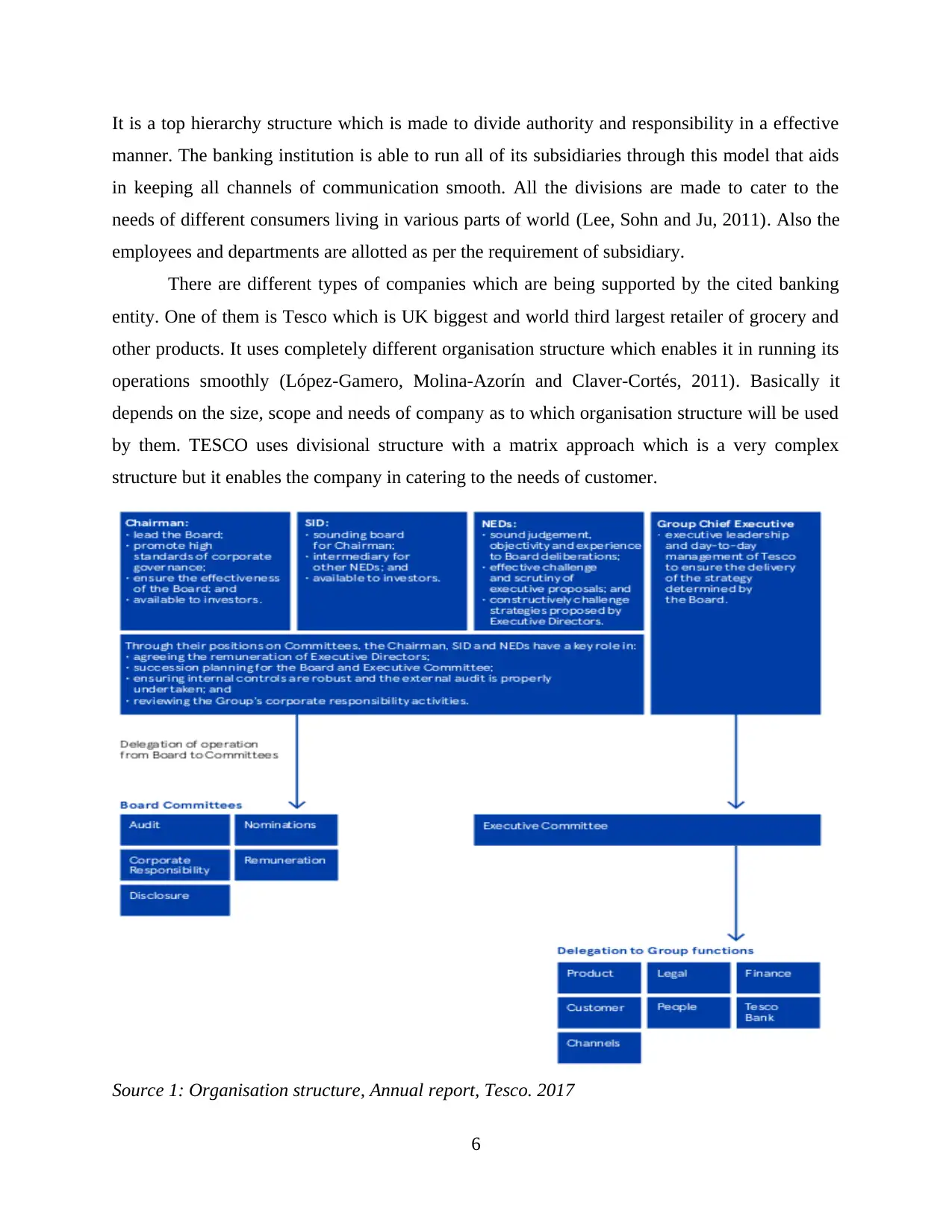
by them. TESCO uses divisional structure with a matrix approach which is a very complex
structure but it enables the company in catering to the needs of customer.
Source 1: Organisation structure, Annual report, Tesco. 2017
6
manner. The banking institution is able to run all of its subsidiaries through this model that aids
in keeping all channels of communication smooth. All the divisions are made to cater to the
needs of different consumers living in various parts of world (Lee, Sohn and Ju, 2011). Also the
employees and departments are allotted as per the requirement of subsidiary.
There are different types of companies which are being supported by the cited banking
entity. One of them is Tesco which is UK biggest and world third largest retailer of grocery and
other products. It uses completely different organisation structure which enables it in running its
operations smoothly (López-Gamero, Molina-Azorín and Claver-Cortés, 2011). Basically it
depends on the size, scope and needs of company as to which organisation structure will be used
by them. TESCO uses divisional structure with a matrix approach which is a very complex
structure but it enables the company in catering to the needs of customer.
Source 1: Organisation structure, Annual report, Tesco. 2017
6
⊘ This is a preview!⊘
Do you want full access?
Subscribe today to unlock all pages.
Trusted by 1+ million students worldwide
As it can be seen Tesco divided its departments in a group which ensures that they work
together as a team and assist company in achieving goals. NatWest provides retailer financial as
well as corporate advice which enables the management in taking right decisions. TESCO has
divided its work and organisational structure in a very tactical manner (Welford, 2013)
(Wetherly and Otter, 2014) . All the departments in company are kept in a group which enables
it in developing a inter-relationship between them. For example, the marketing department aids
product, and HR function by providing important data regarding market trends and pool of
manpower respectively. The finance department is engaged with other functions as to ensure that
all of the activities and programmes have sufficient funds.
Basically these functions inter-relationship assist NatWest in understanding the overall
organisation activities that are taking place in TESCO (Yoon, 2012). They provide right report to
the banking entity and it is able to investigate all the resources that are consumed in a effective
manner.
TASK 3
Covered in PPT
TASK 4
Covered in PPT
CONCLUSION
Business environment is a dynamic force that has to be properly analysed and evaluated
in order to gain from it and avoid any loss. NatWest is a well established and known banking
institution in UK and it has a very sound consumer base. The company is growing at a very rapid
speed and it aims to achieve a global market share of 2% in next one year. There are various
factors that have to be analysed by company so that they do not hinder organisational capabilities
in any way. It is also important for firm to ensure that all functions are inter-related and the
capabilities are directed on a path that will lead to achievement of goals. It can use various tools
and techniques to analyse micro and macro factors, example of these tools is SWOT and
PESTLE analysis.
7
together as a team and assist company in achieving goals. NatWest provides retailer financial as
well as corporate advice which enables the management in taking right decisions. TESCO has
divided its work and organisational structure in a very tactical manner (Welford, 2013)
(Wetherly and Otter, 2014) . All the departments in company are kept in a group which enables
it in developing a inter-relationship between them. For example, the marketing department aids
product, and HR function by providing important data regarding market trends and pool of
manpower respectively. The finance department is engaged with other functions as to ensure that
all of the activities and programmes have sufficient funds.
Basically these functions inter-relationship assist NatWest in understanding the overall
organisation activities that are taking place in TESCO (Yoon, 2012). They provide right report to
the banking entity and it is able to investigate all the resources that are consumed in a effective
manner.
TASK 3
Covered in PPT
TASK 4
Covered in PPT
CONCLUSION
Business environment is a dynamic force that has to be properly analysed and evaluated
in order to gain from it and avoid any loss. NatWest is a well established and known banking
institution in UK and it has a very sound consumer base. The company is growing at a very rapid
speed and it aims to achieve a global market share of 2% in next one year. There are various
factors that have to be analysed by company so that they do not hinder organisational capabilities
in any way. It is also important for firm to ensure that all functions are inter-related and the
capabilities are directed on a path that will lead to achievement of goals. It can use various tools
and techniques to analyse micro and macro factors, example of these tools is SWOT and
PESTLE analysis.
7
Paraphrase This Document
Need a fresh take? Get an instant paraphrase of this document with our AI Paraphraser
REFERENCES
Books and journals
Agarwal, R., Grassl, W. and Pahl, J., 2012. Meta-SWOT: introducing a new strategic planning
tool. Journal of Business Strategy. 33(2). pp.12-21.
Boons, F. and Lüdeke-Freund, F., 2013. Business models for sustainable innovation: state-of-
the-art and steps towards a research agenda. Journal of Cleaner Production. 45. pp.9-19.
Carlin, W. and Schaffer, M. E., 2012. Understanding the business environment in South Asia:
evidence from firm-level surveys.
Cassell, M. A. and Blake, R. J., 2012. Analysis of Hofstede's 5-D model: the implications of
conducting business in Saudi Arabia. International Journal of Management &
Information Systems (Online). 16(2). p.151.
Cuervo‐Cazurra, A., 2011. Global strategy and global business environment: the direct and
indirect influences of the home country on a firm's global strategy. Global Strategy
Journal. 1(3‐4). pp.382-386.
De Jonge, A., 2011. Transnational corporations and international law: accountability in the
global business environment. Edward Elgar Publishing.
Griffin, R. W. and Pustay, M. W., 2012. International business. Pearson Higher Ed.
Guglielmetti, C., 2011. Measuring the business environment for entrepreneurship in fragile
states. In Entrepreneurship and Economic Development (pp. 124-143). Palgrave
Macmillan UK.
Halbert, T. and Ingulli, E., 2011. Law and ethics in the business environment. Cengage Learning.
Hamilton, L. and Webster, P., 2015. The international business environment. Oxford University
Press, USA.
Harison, E., 2012. Critical success factors of business intelligence system implementations:
evidence from the energy sector. International Journal of Enterprise Information Systems
(IJEIS). 8(2). pp.1-13.
Harrison, R., 2011. Learning and development. Development and Learning in Organizations: An
International Journal. 26(1).
Herman, E., Georgescu, M. A. and Georgescu, A., 2012. Ethics between theory and practice–
social responsibility in the Romanian business environment. Procedia-Social and
behavioral sciences. 58. pp.703-713.
Lee, J. H., Sohn, S. Y. and Ju, Y. H., 2011. How effective is government support for Korean
women entrepreneurs in small and medium enterprises?. Journal of Small Business
Management. 49(4). pp.599-616.
López-Gamero, M. D., Molina-Azorín, J. F. and Claver-Cortés, E., 2011. Environmental
uncertainty and environmental management perception: A multiple case study. Journal of
Business Research. 64(4). pp.427-435.
Moutinho, L. ed., 2011. Strategic management in tourism. Cabi.
Porter, M. E. and Rivkin, J. W., 2012. The looming challenge to US competitiveness. Harvard
Business Review. 90(3). pp.54-61.
Ratten, V., 2014. Future research directions for collective entrepreneurship in developing
countries: a small and medium-sized enterprise perspective. International Journal of
Entrepreneurship and Small Business. 22(2). pp.266-274.
Welford, R., 2013. Hijacking environmentalism: Corporate responses to sustainable
development. Routledge.
8
Books and journals
Agarwal, R., Grassl, W. and Pahl, J., 2012. Meta-SWOT: introducing a new strategic planning
tool. Journal of Business Strategy. 33(2). pp.12-21.
Boons, F. and Lüdeke-Freund, F., 2013. Business models for sustainable innovation: state-of-
the-art and steps towards a research agenda. Journal of Cleaner Production. 45. pp.9-19.
Carlin, W. and Schaffer, M. E., 2012. Understanding the business environment in South Asia:
evidence from firm-level surveys.
Cassell, M. A. and Blake, R. J., 2012. Analysis of Hofstede's 5-D model: the implications of
conducting business in Saudi Arabia. International Journal of Management &
Information Systems (Online). 16(2). p.151.
Cuervo‐Cazurra, A., 2011. Global strategy and global business environment: the direct and
indirect influences of the home country on a firm's global strategy. Global Strategy
Journal. 1(3‐4). pp.382-386.
De Jonge, A., 2011. Transnational corporations and international law: accountability in the
global business environment. Edward Elgar Publishing.
Griffin, R. W. and Pustay, M. W., 2012. International business. Pearson Higher Ed.
Guglielmetti, C., 2011. Measuring the business environment for entrepreneurship in fragile
states. In Entrepreneurship and Economic Development (pp. 124-143). Palgrave
Macmillan UK.
Halbert, T. and Ingulli, E., 2011. Law and ethics in the business environment. Cengage Learning.
Hamilton, L. and Webster, P., 2015. The international business environment. Oxford University
Press, USA.
Harison, E., 2012. Critical success factors of business intelligence system implementations:
evidence from the energy sector. International Journal of Enterprise Information Systems
(IJEIS). 8(2). pp.1-13.
Harrison, R., 2011. Learning and development. Development and Learning in Organizations: An
International Journal. 26(1).
Herman, E., Georgescu, M. A. and Georgescu, A., 2012. Ethics between theory and practice–
social responsibility in the Romanian business environment. Procedia-Social and
behavioral sciences. 58. pp.703-713.
Lee, J. H., Sohn, S. Y. and Ju, Y. H., 2011. How effective is government support for Korean
women entrepreneurs in small and medium enterprises?. Journal of Small Business
Management. 49(4). pp.599-616.
López-Gamero, M. D., Molina-Azorín, J. F. and Claver-Cortés, E., 2011. Environmental
uncertainty and environmental management perception: A multiple case study. Journal of
Business Research. 64(4). pp.427-435.
Moutinho, L. ed., 2011. Strategic management in tourism. Cabi.
Porter, M. E. and Rivkin, J. W., 2012. The looming challenge to US competitiveness. Harvard
Business Review. 90(3). pp.54-61.
Ratten, V., 2014. Future research directions for collective entrepreneurship in developing
countries: a small and medium-sized enterprise perspective. International Journal of
Entrepreneurship and Small Business. 22(2). pp.266-274.
Welford, R., 2013. Hijacking environmentalism: Corporate responses to sustainable
development. Routledge.
8
Wetherly, P. and Otter, D. eds., 2014. The business environment: themes and issues in a
globalizing world. Oxford University Press.
Yoon, J., 2012. Detecting weak signals for long-term business opportunities using text mining of
Web news. Expert Systems with Applications. 39(16). pp.12543-12550.
Online
Organisation Structure. 2013. [Online]. Available through:
<http://www.lightinghomes.net/gallery/legal-entity-structure-chart.html>. [Accessed on
24th August 2017].
Pest Analysis. 2010. [Online]. Available through:
<http://www.managementparadise.com/forums/principles-management-p-o-m/208865-
pest-analysis-bank-america-corporation.html>. [Accessed on 24th August 2017].
Organization Structure, Annual Report. 2017. [Online]. Avaialble through:
<https://www.tescoplc.com/media/392373/68336_tesco_ar_digital_interactive_250417.
pdf>. [Accessed on 24th August 2017].
9
globalizing world. Oxford University Press.
Yoon, J., 2012. Detecting weak signals for long-term business opportunities using text mining of
Web news. Expert Systems with Applications. 39(16). pp.12543-12550.
Online
Organisation Structure. 2013. [Online]. Available through:
<http://www.lightinghomes.net/gallery/legal-entity-structure-chart.html>. [Accessed on
24th August 2017].
Pest Analysis. 2010. [Online]. Available through:
<http://www.managementparadise.com/forums/principles-management-p-o-m/208865-
pest-analysis-bank-america-corporation.html>. [Accessed on 24th August 2017].
Organization Structure, Annual Report. 2017. [Online]. Avaialble through:
<https://www.tescoplc.com/media/392373/68336_tesco_ar_digital_interactive_250417.
pdf>. [Accessed on 24th August 2017].
9
⊘ This is a preview!⊘
Do you want full access?
Subscribe today to unlock all pages.
Trusted by 1+ million students worldwide

1 out of 12


Related Documents


Your All-in-One AI-Powered Toolkit for Academic Success.
+13062052269
info@desklib.com
Available 24*7 on WhatsApp / Email
![[object Object]](/_next/static/media/star-bottom.7253800d.svg)
Unlock your academic potential
Copyright © 2020–2026 A2Z Services. All Rights Reserved. Developed and managed by ZUCOL.