Comprehensive Report: Negligence and Contract in Business Law (UK)
VerifiedAdded on 2020/01/07
|16
|5595
|170
Report
AI Summary
This report delves into the critical aspects of negligence and contract law within the context of UK business. It begins by outlining the essential elements required for a valid contract, differentiating between various contract categories and assessing the impact of contractual terms. The report then explores the application of these contractual elements in business scenarios, examining the legal implications of different contract types. Furthermore, it provides an in-depth understanding of liability principles related to negligence in business activities, comparing and contrasting liabilities in tort and contract, and identifying businesses that may be vicariously liable. Finally, the report applies these liability principles to specific business scenarios, analyzing wrongful acts, defenses, and the elements of vicarious liability. The report aims to familiarize the audience with the rules and regulations related to contracts required in various business fields, supported by case scenarios.
ASPECTS OF NEGLIGENCE AND CONTRACT RELATED TO
BUSINESS
STUDENT NAME:
STUDENT NAME:
UNIVERSITY:
BUSINESS
STUDENT NAME:
STUDENT NAME:
UNIVERSITY:

Paraphrase This Document
Need a fresh take? Get an instant paraphrase of this document with our AI Paraphraser
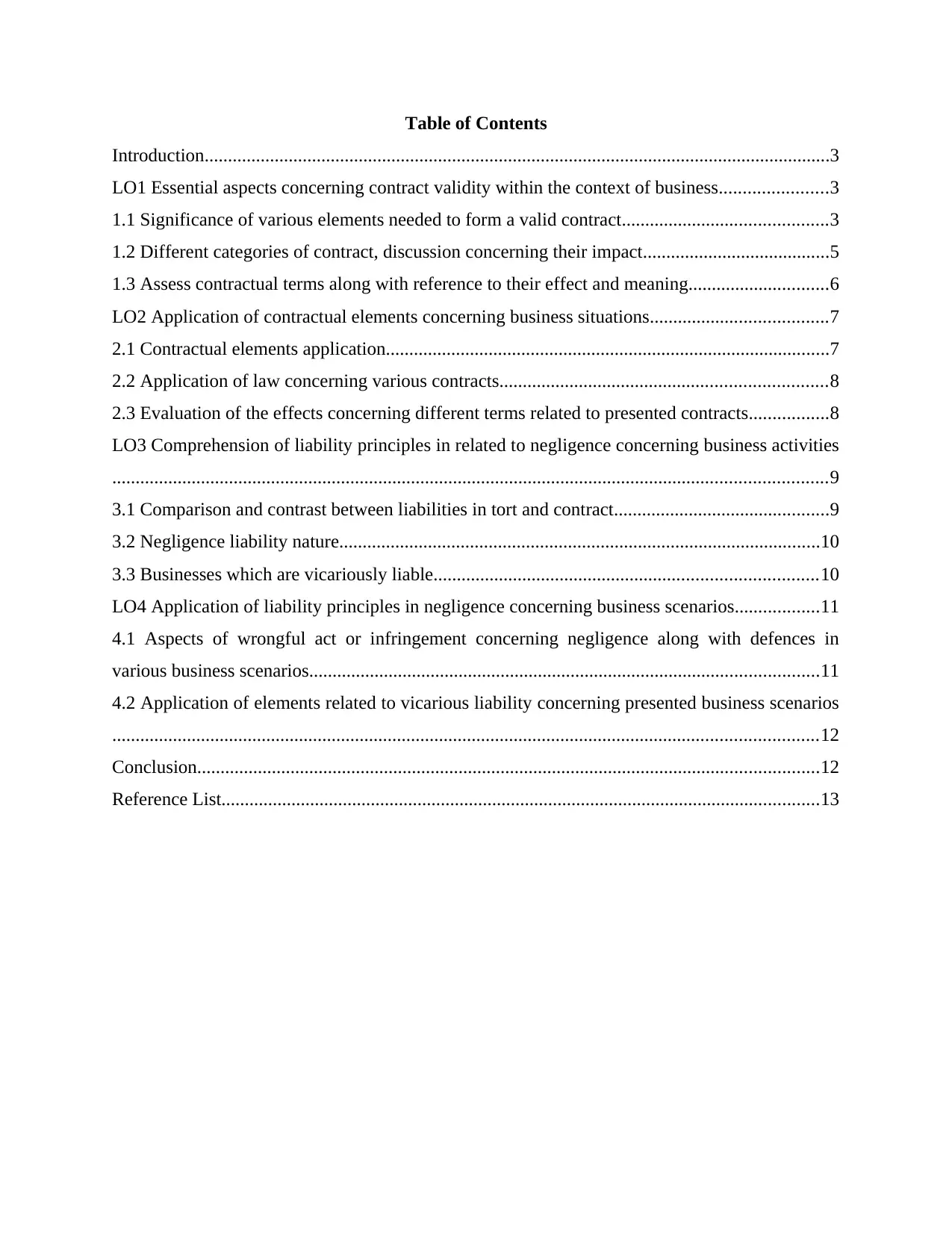
Table of Contents
Introduction......................................................................................................................................3
LO1 Essential aspects concerning contract validity within the context of business.......................3
1.1 Significance of various elements needed to form a valid contract............................................3
1.2 Different categories of contract, discussion concerning their impact........................................5
1.3 Assess contractual terms along with reference to their effect and meaning..............................6
LO2 Application of contractual elements concerning business situations......................................7
2.1 Contractual elements application...............................................................................................7
2.2 Application of law concerning various contracts......................................................................8
2.3 Evaluation of the effects concerning different terms related to presented contracts.................8
LO3 Comprehension of liability principles in related to negligence concerning business activities
.........................................................................................................................................................9
3.1 Comparison and contrast between liabilities in tort and contract..............................................9
3.2 Negligence liability nature.......................................................................................................10
3.3 Businesses which are vicariously liable..................................................................................10
LO4 Application of liability principles in negligence concerning business scenarios..................11
4.1 Aspects of wrongful act or infringement concerning negligence along with defences in
various business scenarios.............................................................................................................11
4.2 Application of elements related to vicarious liability concerning presented business scenarios
.......................................................................................................................................................12
Conclusion.....................................................................................................................................12
Reference List................................................................................................................................13
Introduction......................................................................................................................................3
LO1 Essential aspects concerning contract validity within the context of business.......................3
1.1 Significance of various elements needed to form a valid contract............................................3
1.2 Different categories of contract, discussion concerning their impact........................................5
1.3 Assess contractual terms along with reference to their effect and meaning..............................6
LO2 Application of contractual elements concerning business situations......................................7
2.1 Contractual elements application...............................................................................................7
2.2 Application of law concerning various contracts......................................................................8
2.3 Evaluation of the effects concerning different terms related to presented contracts.................8
LO3 Comprehension of liability principles in related to negligence concerning business activities
.........................................................................................................................................................9
3.1 Comparison and contrast between liabilities in tort and contract..............................................9
3.2 Negligence liability nature.......................................................................................................10
3.3 Businesses which are vicariously liable..................................................................................10
LO4 Application of liability principles in negligence concerning business scenarios..................11
4.1 Aspects of wrongful act or infringement concerning negligence along with defences in
various business scenarios.............................................................................................................11
4.2 Application of elements related to vicarious liability concerning presented business scenarios
.......................................................................................................................................................12
Conclusion.....................................................................................................................................12
Reference List................................................................................................................................13
Introduction
In every business related activities and in other situations as well, the factor of contractual law
plays an important role. In order to deal with various critical situations and circumstances, it is
important to be aware of the various aspects concerning Negligence and Contract of Business
present throughout the United Kingdom. Hence, the chief objective of the presented assignment
is to make the audience aware and familiar with the various rules and regulations related to
contracts required in various business fields. In order to achieve the objective, explanation of
various important elements concerning contract validity within the business context is presented.
An attempt is made to use contractual elements in business scenarios. The description is also
presented regarding liability principles concerning negligence in business scenarios. Lastly, an
attempt has been made to use liability principles related to negligence with the help of suitable
case scenarios for the purpose.
LO1 Essential aspects concerning contract validity within the context of business
1.1 Significance of various elements needed to form a valid contract
Knowing and maintaining the different elements of a valid contract is very much important
which needs to be followed in dealing various business activities and situations. Not obliging
with theses stated rules may lead a business to conduct a violation of the business law of the UK,
which in turn, can make the business encounter various obstacles. Hence, in order to avoid such
problematic situations, it is important to know and have a proper, clear idea concerning the
various elements which make a particular contract legit and valid (Waemustafa and Suriani,
2016, p.27).
A contract is basically a concurrence that takes place between two individuals/parties,
concerning any type of dealings. This deal is conducted as per stated legal rules of the concerned
country. A contract between or among two or more parties/people can take place verbally, it can
be done in three ways: written (in paper or by digital means, i.e., in website and in other digital
forms; by inference, conduct or act; by employing any or all of the previously mentioned
methods (Scott, 2013, p.10).
In the UK, in order to attain validity, every contract must possess certain characteristics:
In every business related activities and in other situations as well, the factor of contractual law
plays an important role. In order to deal with various critical situations and circumstances, it is
important to be aware of the various aspects concerning Negligence and Contract of Business
present throughout the United Kingdom. Hence, the chief objective of the presented assignment
is to make the audience aware and familiar with the various rules and regulations related to
contracts required in various business fields. In order to achieve the objective, explanation of
various important elements concerning contract validity within the business context is presented.
An attempt is made to use contractual elements in business scenarios. The description is also
presented regarding liability principles concerning negligence in business scenarios. Lastly, an
attempt has been made to use liability principles related to negligence with the help of suitable
case scenarios for the purpose.
LO1 Essential aspects concerning contract validity within the context of business
1.1 Significance of various elements needed to form a valid contract
Knowing and maintaining the different elements of a valid contract is very much important
which needs to be followed in dealing various business activities and situations. Not obliging
with theses stated rules may lead a business to conduct a violation of the business law of the UK,
which in turn, can make the business encounter various obstacles. Hence, in order to avoid such
problematic situations, it is important to know and have a proper, clear idea concerning the
various elements which make a particular contract legit and valid (Waemustafa and Suriani,
2016, p.27).
A contract is basically a concurrence that takes place between two individuals/parties,
concerning any type of dealings. This deal is conducted as per stated legal rules of the concerned
country. A contract between or among two or more parties/people can take place verbally, it can
be done in three ways: written (in paper or by digital means, i.e., in website and in other digital
forms; by inference, conduct or act; by employing any or all of the previously mentioned
methods (Scott, 2013, p.10).
In the UK, in order to attain validity, every contract must possess certain characteristics:
⊘ This is a preview!⊘
Do you want full access?
Subscribe today to unlock all pages.

Trusted by 1+ million students worldwide
· Offer
· Acceptance
· Consideration
· Intention for creating legal relations
Acceptance concerning an offer happens when both the concerned parties have accepted and
acknowledged all the stated terms of the offer. However, cases of conforming with all the terms
hardly occur, hence the process of negotiation is generally observed. New conditions and terms
made through negotiation give rise to counter-offers related to the actual offer, hence the
cancellation of terms concerning original offer is conducted.
Conducting communication concerning acceptance is important. The parties/people related to the
offer of the contract must communicate with each other regarding the various terms and
conditions which are made and decided. Each member involved in the formation of the contract
must have clear idea and understanding regarding the content and objective of the said contract.
As a common rule, in order to express acceptance, silence should not be maintained (NAZAT,
2016, p.84).
The factor of consideration is an important part in order to make a contract attain validity. It
means reciprocal obligations of the connected people/parties are needed to make the contract
valid. Consideration means some of the kind of exchange is done between two parties, such as
exchange of promises concerning certain matter.
Terms concerning contact need to be considered. Contracts might be written, verbal done
between two parties. Consent must be achieved from the concerned parties to make contract
valid. After attaining all these elements it is important to be aware whether or not the contract
objects is legit (Levy et al. 2016, p.54). Hence, certain legal criteria must be observed:
Forbidden and acceptance rules concerning the object
Content must not be fraudulent in nature
The contractual object must not be injurious to any individual neither to his property
Hence, it can be observed in order to make a particular contract valid, it is important to maintain
and follow all of the presented elements.
· Acceptance
· Consideration
· Intention for creating legal relations
Acceptance concerning an offer happens when both the concerned parties have accepted and
acknowledged all the stated terms of the offer. However, cases of conforming with all the terms
hardly occur, hence the process of negotiation is generally observed. New conditions and terms
made through negotiation give rise to counter-offers related to the actual offer, hence the
cancellation of terms concerning original offer is conducted.
Conducting communication concerning acceptance is important. The parties/people related to the
offer of the contract must communicate with each other regarding the various terms and
conditions which are made and decided. Each member involved in the formation of the contract
must have clear idea and understanding regarding the content and objective of the said contract.
As a common rule, in order to express acceptance, silence should not be maintained (NAZAT,
2016, p.84).
The factor of consideration is an important part in order to make a contract attain validity. It
means reciprocal obligations of the connected people/parties are needed to make the contract
valid. Consideration means some of the kind of exchange is done between two parties, such as
exchange of promises concerning certain matter.
Terms concerning contact need to be considered. Contracts might be written, verbal done
between two parties. Consent must be achieved from the concerned parties to make contract
valid. After attaining all these elements it is important to be aware whether or not the contract
objects is legit (Levy et al. 2016, p.54). Hence, certain legal criteria must be observed:
Forbidden and acceptance rules concerning the object
Content must not be fraudulent in nature
The contractual object must not be injurious to any individual neither to his property
Hence, it can be observed in order to make a particular contract valid, it is important to maintain
and follow all of the presented elements.
Paraphrase This Document
Need a fresh take? Get an instant paraphrase of this document with our AI Paraphraser
1.2 Different categories of contract, discussion concerning their impact
It needs to be mentioned that based on the existing law of UK, a different type of contracts is
present. It must be mentioned in the given assignment that there are nine categories of contracts
based on the contractual law of UK (Idowu et al. 2013, p.7).
Sealed contracts
It is a type of contract that is traditional in nature. As per this type of contract, a document can be
considered legally valid if it is stamped with a particular seal. The seal shows that the concerned
parties have made an agreement to follow legal consequences. No legal advantage or detriment is
required concerning either of the parties. This is because the seal acts as the emblem of solemn
acceptance of legal consequences and effect concerning the agreement. However, in
contemporary times the importance of sealed contract has significantly diminished. This type of
contract was observed to be in practice in earlier times of UK, for instance in royal families
(Hartmann and Rutherford,2015, p.170).
Implied contracts
This type of contract is basically a kind of legal substitute instead of a contract. This contract
creates a concurrence made by the involved parties; however it is not spoken or written, hence it
can be said it is based on assumption. One form of this type of contract is implied warranty. An
implied warranty is automatically provided by law. This can be explained with an example.
When buying a certain product, it is expected that the product will be fit for proper use.
Express contracts
In this type of contract, terms are stated by the concerned parties, the statement can be made in
written form or verbally during the duration of contract formation. A definite verbal or oral offer
is made, which the particular offeree (it refers to the individual to whom the specific offer is
given) in a way which explicitly shows consent concerning the related terms (Hargreaves and
Price, 2015, p.9).
Unilateral and bilateral contracts
Bilateral contracts indicate the contract type where both the promises and the promisor, vows for
doing something and then conduct their part accordingly. For instance, the role played by a buyer
and a seller.
It needs to be mentioned that based on the existing law of UK, a different type of contracts is
present. It must be mentioned in the given assignment that there are nine categories of contracts
based on the contractual law of UK (Idowu et al. 2013, p.7).
Sealed contracts
It is a type of contract that is traditional in nature. As per this type of contract, a document can be
considered legally valid if it is stamped with a particular seal. The seal shows that the concerned
parties have made an agreement to follow legal consequences. No legal advantage or detriment is
required concerning either of the parties. This is because the seal acts as the emblem of solemn
acceptance of legal consequences and effect concerning the agreement. However, in
contemporary times the importance of sealed contract has significantly diminished. This type of
contract was observed to be in practice in earlier times of UK, for instance in royal families
(Hartmann and Rutherford,2015, p.170).
Implied contracts
This type of contract is basically a kind of legal substitute instead of a contract. This contract
creates a concurrence made by the involved parties; however it is not spoken or written, hence it
can be said it is based on assumption. One form of this type of contract is implied warranty. An
implied warranty is automatically provided by law. This can be explained with an example.
When buying a certain product, it is expected that the product will be fit for proper use.
Express contracts
In this type of contract, terms are stated by the concerned parties, the statement can be made in
written form or verbally during the duration of contract formation. A definite verbal or oral offer
is made, which the particular offeree (it refers to the individual to whom the specific offer is
given) in a way which explicitly shows consent concerning the related terms (Hargreaves and
Price, 2015, p.9).
Unilateral and bilateral contracts
Bilateral contracts indicate the contract type where both the promises and the promisor, vows for
doing something and then conduct their part accordingly. For instance, the role played by a buyer
and a seller.
Unilateral type of contracts refers to the type of contract where only a single party makes the
promise while the opposite party accepts the concerned offer by executing and following the
respected condition, for instance, Carlill v Carbolic Smoke Ball Co (Davies, 2015, p.17).
Executory and executed contracts
Executed contract suggests that both the parties connected to the particular contract have fulfilled
and completed their respective obligations concerning contract content. The executory contract,
on the other hand, indicates that both the parties connected with the contract are yet to conduct
their respective duties as per the content of the contract.
Adhesion contracts
The main objective of this type of contract is taking or leaves it. The chief feature of this type of
contract is that it legally binds a concurrence between two or more individuals/parties in order to
do a particular thing. The chief feature of adhesion contracts is that one party possesses and uses
the bargaining power, taking the advantage concerning the particular content. This kind of
contract is observed in product/service purchase schemes (Folsom et al. 2013, p.67).
Voidable and void contracts
A voidable contract is one that can be ended or discontinued, i.e. put aside by aggrieved
individuals/parties. Unless and it is aborted, it is a feasible contract. In this party obliges to the
stated terms and conditions until its cancellation. In this contract, the party might refund the
advantage to the opponent aggrieved party. Contracts which are formed as a result of undue
influence, coercion, misinterpretation and fraud are considered to be avoidable. On the other
hand, void contracts refer to the agreement that is void from the start. Hence, this type of contract
must not be called as a contract. An agreement which is void cannot be enforceable right from
the start. For example, contracts which are caused by accident become void (Clarke and
Lancaster, 2013, p.224).
1.3 Assess contractual terms along with reference to their effect and meaning
It is to be mentioned that in order to conduct a business it is necessary to be aware of certain
particular regulations and rules and these must be obliged. These are the rules when get enforced
as per legal framework takes the shape of a contract. The contracts which are made are based on
some important terms which must be known to everyone.
promise while the opposite party accepts the concerned offer by executing and following the
respected condition, for instance, Carlill v Carbolic Smoke Ball Co (Davies, 2015, p.17).
Executory and executed contracts
Executed contract suggests that both the parties connected to the particular contract have fulfilled
and completed their respective obligations concerning contract content. The executory contract,
on the other hand, indicates that both the parties connected with the contract are yet to conduct
their respective duties as per the content of the contract.
Adhesion contracts
The main objective of this type of contract is taking or leaves it. The chief feature of this type of
contract is that it legally binds a concurrence between two or more individuals/parties in order to
do a particular thing. The chief feature of adhesion contracts is that one party possesses and uses
the bargaining power, taking the advantage concerning the particular content. This kind of
contract is observed in product/service purchase schemes (Folsom et al. 2013, p.67).
Voidable and void contracts
A voidable contract is one that can be ended or discontinued, i.e. put aside by aggrieved
individuals/parties. Unless and it is aborted, it is a feasible contract. In this party obliges to the
stated terms and conditions until its cancellation. In this contract, the party might refund the
advantage to the opponent aggrieved party. Contracts which are formed as a result of undue
influence, coercion, misinterpretation and fraud are considered to be avoidable. On the other
hand, void contracts refer to the agreement that is void from the start. Hence, this type of contract
must not be called as a contract. An agreement which is void cannot be enforceable right from
the start. For example, contracts which are caused by accident become void (Clarke and
Lancaster, 2013, p.224).
1.3 Assess contractual terms along with reference to their effect and meaning
It is to be mentioned that in order to conduct a business it is necessary to be aware of certain
particular regulations and rules and these must be obliged. These are the rules when get enforced
as per legal framework takes the shape of a contract. The contracts which are made are based on
some important terms which must be known to everyone.
⊘ This is a preview!⊘
Do you want full access?
Subscribe today to unlock all pages.
Trusted by 1+ million students worldwide
· Offering and accepting: Offer is given to one individual/party, by the second or another
party. On the other hand, the second party willingly accepts the offer. Acceptance, as well as
offers, must be conducted as per law (Carroll and Buchholtz, 2014, p.11)
· Consideration: Appropriate consideration must be maintained concerning terms related to
exchange values
· Capacity for fulfilling requirements: The parties should be able to fulfil the objective
stated in the contract.
· Clear meanings: The concerned content must be well-understood by both the contract
holders.
· Possibility of performance: The activity which is mentioned in the content of the particular
contract must be realistically applicable and feasible.
At the very beginning, a contract is defined by written or said things from both of the parties. If
there are statements made during a contract negotiation, generally they are acceptable as the
terms of a contract.
Conditions: Condition helps in finding out the stipulated and enforced areas that describe
purpose of the contract. In case of breach of contract, the affected party might claim
damages and court will consider on offering the damages. In this respect the case of Possuard v
spiers (1876) can be referred.
Warranties: This is less important term and breach of any warranty only give the part a way to
claim damage. The case of Bettini vs Gye (1876) can be referred here
Intermediate terms: These are referred to cases only where a condition can be applied after
breaking of a breach. If the affected party’s loss is only a minor, the compensation will be
restricted into damage only. In this aspect case of, The Mihails Angelos can be referred to as an
example.
party. On the other hand, the second party willingly accepts the offer. Acceptance, as well as
offers, must be conducted as per law (Carroll and Buchholtz, 2014, p.11)
· Consideration: Appropriate consideration must be maintained concerning terms related to
exchange values
· Capacity for fulfilling requirements: The parties should be able to fulfil the objective
stated in the contract.
· Clear meanings: The concerned content must be well-understood by both the contract
holders.
· Possibility of performance: The activity which is mentioned in the content of the particular
contract must be realistically applicable and feasible.
At the very beginning, a contract is defined by written or said things from both of the parties. If
there are statements made during a contract negotiation, generally they are acceptable as the
terms of a contract.
Conditions: Condition helps in finding out the stipulated and enforced areas that describe
purpose of the contract. In case of breach of contract, the affected party might claim
damages and court will consider on offering the damages. In this respect the case of Possuard v
spiers (1876) can be referred.
Warranties: This is less important term and breach of any warranty only give the part a way to
claim damage. The case of Bettini vs Gye (1876) can be referred here
Intermediate terms: These are referred to cases only where a condition can be applied after
breaking of a breach. If the affected party’s loss is only a minor, the compensation will be
restricted into damage only. In this aspect case of, The Mihails Angelos can be referred to as an
example.
Paraphrase This Document
Need a fresh take? Get an instant paraphrase of this document with our AI Paraphraser
LO2 Application of contractual elements concerning business situations
2.1 Contractual elements application
In accordance with the contract of sales it can be said that although Ivan is ready to pay the price
of the books, it will not be possible for Todor to offer the book to him. Since the contract of sales
suggests that any product is considered to be sold to another party if it is transferred in exchange
for a certain price (Davies, 2015, p.5). Apart from that, the contract also suggests that an
agreement of transfer also makes the procedure valid. Since Todor states that the book has
already been sold to Carl, it becomes evident that the ownership of the book has been transferred
as well. Hence, Carl does not hold any right to resell the same product which is yet to be
delivered to the rightful owner.
It can be said that it was negligent on the part of Todor to not remove the book from the shelf.
However, since there were no promises which were extended by Todor of offering the book to
Ivan, it cannot be said that there was any sort of written or oral contract established between
these two parties.
Since a contract is set to be established only when both the parties agree to certain terms and
conditions, Todor will not be considered liable in any way to Ivan. Thus, even though Ivan may
be upset regarding the entire scenario, Todor will have the advantage in this situation.
After assessing the case study, it is found that consideration element was not done properly in
case of the book selling. Todor first considered selling the books to Ivan instead of knowing the
fact that it has already been sold to ownership problem arises here. Todor has also promised to
deliver the book to Carl by very nature of the explicit terms, which implies that once a
contractual relation is established, a party cannot sell out the property without prior permission
from buyer. Negligence is also a relative matter here because in spite of selling of the book, , he
did not remove it from the showcase and ignores possibilities of the fact that it might attract
other customers.
2.2 Application of law concerning various contracts
The possible consequences of classifying such term are as follows:
2.1 Contractual elements application
In accordance with the contract of sales it can be said that although Ivan is ready to pay the price
of the books, it will not be possible for Todor to offer the book to him. Since the contract of sales
suggests that any product is considered to be sold to another party if it is transferred in exchange
for a certain price (Davies, 2015, p.5). Apart from that, the contract also suggests that an
agreement of transfer also makes the procedure valid. Since Todor states that the book has
already been sold to Carl, it becomes evident that the ownership of the book has been transferred
as well. Hence, Carl does not hold any right to resell the same product which is yet to be
delivered to the rightful owner.
It can be said that it was negligent on the part of Todor to not remove the book from the shelf.
However, since there were no promises which were extended by Todor of offering the book to
Ivan, it cannot be said that there was any sort of written or oral contract established between
these two parties.
Since a contract is set to be established only when both the parties agree to certain terms and
conditions, Todor will not be considered liable in any way to Ivan. Thus, even though Ivan may
be upset regarding the entire scenario, Todor will have the advantage in this situation.
After assessing the case study, it is found that consideration element was not done properly in
case of the book selling. Todor first considered selling the books to Ivan instead of knowing the
fact that it has already been sold to ownership problem arises here. Todor has also promised to
deliver the book to Carl by very nature of the explicit terms, which implies that once a
contractual relation is established, a party cannot sell out the property without prior permission
from buyer. Negligence is also a relative matter here because in spite of selling of the book, , he
did not remove it from the showcase and ignores possibilities of the fact that it might attract
other customers.
2.2 Application of law concerning various contracts
The possible consequences of classifying such term are as follows:
a) A condition – Primarily, a condition is the root of any particular contract that has been
formed within a contract law. It is an important factor that brings identification towards one
condition in accordance with the contract (Clarke and Lancaster, 2013, p.219). Supposedly, if an
individual fails to maintain or keep the condition as per the contract then it is to be considered as
an infringement. In the given scenario there was no condition between Todor and Ivan in regard
to selling the particular book. A condition here can also be meant that terms in a contract only be
applicable if a certain rule or agreement damages. Therefore, it restricts the plaintiff from enforce
the legalities except something happened. In such cases, the conditions are known as precedent
condition or subsequent condition.
b) A warranty – It is primarily an agreement or assurance that has to be made with the other
party with an intention to form an understanding in regard to its period of presence and quality
(Levy et al. 2016, p.3). Breach or infringement to this regard usually does not exist, however, a
penalty or fine need to be paid as per the law compliance with it. On the other hand, it has no
involvement as well engagement in terms of finishing or ending up a valid contract. Warranties
are not enforceable always, unless the service provider has mentioned it in the terms. Warranty
does not always include monetary compensations to the damages. The court or the presiding
authority needs to check validity of a damage claim after warranty. However, warranty proposes
some terms to restrict the user from lodging complaint against any situation.
c) An innominate term – Mainly, an innominate term is an in-between term that signifies that it
is neither a condition nor a warranty. It primarily views to the outcome of the infringement and
enquires the guiltless party that whether the infringement to be disadvantaged towards the
considerable advantage of the administration (Zamore, 2016, p.7).
2.3 Evaluation of the effects concerning different terms related to presented contracts
Considering the mentioned case, it can be said that the local council can be considered liable. It
can be termed as the failure on the part of the local government to ensure safety for the visitors
which is maintained by them (Waemustafa and Suriani, 2016, p.1). John can sue the council on
the terms of negligence on their behalf. It is important for John to make sure that he provides
enough evidence that the injury was caused in the local area.
formed within a contract law. It is an important factor that brings identification towards one
condition in accordance with the contract (Clarke and Lancaster, 2013, p.219). Supposedly, if an
individual fails to maintain or keep the condition as per the contract then it is to be considered as
an infringement. In the given scenario there was no condition between Todor and Ivan in regard
to selling the particular book. A condition here can also be meant that terms in a contract only be
applicable if a certain rule or agreement damages. Therefore, it restricts the plaintiff from enforce
the legalities except something happened. In such cases, the conditions are known as precedent
condition or subsequent condition.
b) A warranty – It is primarily an agreement or assurance that has to be made with the other
party with an intention to form an understanding in regard to its period of presence and quality
(Levy et al. 2016, p.3). Breach or infringement to this regard usually does not exist, however, a
penalty or fine need to be paid as per the law compliance with it. On the other hand, it has no
involvement as well engagement in terms of finishing or ending up a valid contract. Warranties
are not enforceable always, unless the service provider has mentioned it in the terms. Warranty
does not always include monetary compensations to the damages. The court or the presiding
authority needs to check validity of a damage claim after warranty. However, warranty proposes
some terms to restrict the user from lodging complaint against any situation.
c) An innominate term – Mainly, an innominate term is an in-between term that signifies that it
is neither a condition nor a warranty. It primarily views to the outcome of the infringement and
enquires the guiltless party that whether the infringement to be disadvantaged towards the
considerable advantage of the administration (Zamore, 2016, p.7).
2.3 Evaluation of the effects concerning different terms related to presented contracts
Considering the mentioned case, it can be said that the local council can be considered liable. It
can be termed as the failure on the part of the local government to ensure safety for the visitors
which is maintained by them (Waemustafa and Suriani, 2016, p.1). John can sue the council on
the terms of negligence on their behalf. It is important for John to make sure that he provides
enough evidence that the injury was caused in the local area.
⊘ This is a preview!⊘
Do you want full access?
Subscribe today to unlock all pages.
Trusted by 1+ million students worldwide
However, it may be also kept in mind that John may not be able to avail the full compensation
from the council (Scott, 2013, p.4). Since it was already mentioned by the council that it will not
be liable for any injury which has been caused by the hired property, it will reduce the chances of
John to get the required facilities. However, it doesn’t change the responsibility of the council
towards the visitors ensuring their security.
Thus, it can be said that the above-mentioned case has equal chances of being in favour of any
party. While there is certain exclusion because, the council may be still subject to pay a certain
amount of fine and take appropriate measures to ensure the safety of the visitors (Smith, 2015,
p.6).
For a service provider, it has become sheer responsibility of him to provide customers with
respective measures of safety. It lies in the implicit terms to provide safety to the customers who
seek the service. In case, some damage done from our end, it can only be set as the fault from
management or council end in this case.
LO3 Comprehension of liability principles in related to negligence concerning business
activities
3.1 Comparison and contrast between liabilities in tort and contract
When it comes to liabilities, the tort and contractual vary from each other in different terms. It
can be said that the contractual liabilities are extended on the basis of the agreement between two
parties, while on the other hand the Tort liabilities are drawn by the law. The liabilities in both
the cases are different from one another. In the case of the tort, the liabilities are not ascertained
in comparison to that of the contractual counterparts. In the case of the contract liability, though,
the liquidated variables play a major role (NAZAT, 2016, p.74). The party imposing the breach
of contract on the other party will be considered valid only in case of damages which are pre-
settled or liquidated.
While tort laws are owed to the large community, there is no such obligation in the contractual
liability. The duties imposed are drawn by the law in this case, while on the other hand, the
breach of contract affects either both the parties involved or only one of the parties. It has
nothing to do with the community at large. Another major distinction between these two
liabilities is that while in the case of tort liability the laws are not appropriately codified.
from the council (Scott, 2013, p.4). Since it was already mentioned by the council that it will not
be liable for any injury which has been caused by the hired property, it will reduce the chances of
John to get the required facilities. However, it doesn’t change the responsibility of the council
towards the visitors ensuring their security.
Thus, it can be said that the above-mentioned case has equal chances of being in favour of any
party. While there is certain exclusion because, the council may be still subject to pay a certain
amount of fine and take appropriate measures to ensure the safety of the visitors (Smith, 2015,
p.6).
For a service provider, it has become sheer responsibility of him to provide customers with
respective measures of safety. It lies in the implicit terms to provide safety to the customers who
seek the service. In case, some damage done from our end, it can only be set as the fault from
management or council end in this case.
LO3 Comprehension of liability principles in related to negligence concerning business
activities
3.1 Comparison and contrast between liabilities in tort and contract
When it comes to liabilities, the tort and contractual vary from each other in different terms. It
can be said that the contractual liabilities are extended on the basis of the agreement between two
parties, while on the other hand the Tort liabilities are drawn by the law. The liabilities in both
the cases are different from one another. In the case of the tort, the liabilities are not ascertained
in comparison to that of the contractual counterparts. In the case of the contract liability, though,
the liquidated variables play a major role (NAZAT, 2016, p.74). The party imposing the breach
of contract on the other party will be considered valid only in case of damages which are pre-
settled or liquidated.
While tort laws are owed to the large community, there is no such obligation in the contractual
liability. The duties imposed are drawn by the law in this case, while on the other hand, the
breach of contract affects either both the parties involved or only one of the parties. It has
nothing to do with the community at large. Another major distinction between these two
liabilities is that while in the case of tort liability the laws are not appropriately codified.
Paraphrase This Document
Need a fresh take? Get an instant paraphrase of this document with our AI Paraphraser
However, it is not the case in breach of contract (Idowu et al. 2013, p.3). While in the case of
tort, the laws are, in the majority of the times, made by the judge, the contract is composed of
codified law. While any party in case of breach of contract is required to be entitled only to the
damages which are actual, the tort laws may also include exemplary or vindictive damages.
At a general, liability in tort is applicable in case of a civil wrong but contractual liability is
proposed for ascertaining safety for one party in a business contract. Contractual liability comes
to the case, when a party agrees liability for another party’s act or actions. Liability in tort might
not always be written but a contractual liability should have been written or signed. Liability in
tort is applied once the damage is done or prevails though, contractual liability is signed up so
that a person can be protected from unfair terms in a contract.
3.2 Negligence liability nature
When it comes to negligence, it falls under the category of civil wrongs, that is, tort liability. If a
party is responsible for causing potential harm either in form of injury or other economic
damage, that party is considered to be the subject to civil liability. When it comes to the
application of negligence in accordance with tort law, there are certain factors which are
essential to be considered. The first is that the defendant should be responsible for extending
certain duty or responsibility either to a specific party or to a larger community. The second
factor which is needed to be established is that the duties which the defender is required to fulfil
are not done in an appropriate manner by him/her (Hartmann and Rutherford, 2015, p.158). Only
if the defender failed to comply with the responsibility, shall he be considered being liable to the
negligence tort. The third factor incorporates that the failure to fulfil a certain duty by the
defender has caused damage to a specific party or community in some way, which can include
physical injuries, economic loss or emotional damage (Folsom et al. 2013, p.2). The tort law
cannot be applicable for any person of it does not do not any individual or group in an adverse
manner. The fourth and the final factor is that the damage which has been caused by the defender
has been identified and the failure gets reported. Thus, on the basis of these factors in a
sequential manner, the negligence in tort gets established.
However, there are certain exceptions to these laws which are required to be taken into
consideration as well. For instance, the standards for children vary from that of an adult. Apart
tort, the laws are, in the majority of the times, made by the judge, the contract is composed of
codified law. While any party in case of breach of contract is required to be entitled only to the
damages which are actual, the tort laws may also include exemplary or vindictive damages.
At a general, liability in tort is applicable in case of a civil wrong but contractual liability is
proposed for ascertaining safety for one party in a business contract. Contractual liability comes
to the case, when a party agrees liability for another party’s act or actions. Liability in tort might
not always be written but a contractual liability should have been written or signed. Liability in
tort is applied once the damage is done or prevails though, contractual liability is signed up so
that a person can be protected from unfair terms in a contract.
3.2 Negligence liability nature
When it comes to negligence, it falls under the category of civil wrongs, that is, tort liability. If a
party is responsible for causing potential harm either in form of injury or other economic
damage, that party is considered to be the subject to civil liability. When it comes to the
application of negligence in accordance with tort law, there are certain factors which are
essential to be considered. The first is that the defendant should be responsible for extending
certain duty or responsibility either to a specific party or to a larger community. The second
factor which is needed to be established is that the duties which the defender is required to fulfil
are not done in an appropriate manner by him/her (Hartmann and Rutherford, 2015, p.158). Only
if the defender failed to comply with the responsibility, shall he be considered being liable to the
negligence tort. The third factor incorporates that the failure to fulfil a certain duty by the
defender has caused damage to a specific party or community in some way, which can include
physical injuries, economic loss or emotional damage (Folsom et al. 2013, p.2). The tort law
cannot be applicable for any person of it does not do not any individual or group in an adverse
manner. The fourth and the final factor is that the damage which has been caused by the defender
has been identified and the failure gets reported. Thus, on the basis of these factors in a
sequential manner, the negligence in tort gets established.
However, there are certain exceptions to these laws which are required to be taken into
consideration as well. For instance, the standards for children vary from that of an adult. Apart
from that, if two parties are involved in some kind of disputes, the one who has to suffer major
damages can sue the counterpart (Hargreaves and Price, 2015, p.2).
3.3 Businesses which are vicariously liable
Vicarious liability explains the responsibility of certain faults that has to be undertaken by a
superior which has been done by a subordinate. In a business context, vicarious liability refers to
a situation when the employers in a business are required to compensate for the damage which
has been caused by the employee (Hunter, 2015, p.4). It can be said that the employers are
considered responsible for any sort of act performed by the employee within the organisation
which has caused harm to any third party in some way or the other.
One of the most relevant examples of vicarious liability of any business is the case of Lister Vs
Hesley Hall (Davies, 2015, p.5). In this particular case, the Hesley Hall, a boarding house of
children with emotional problems was subjected to vicarious liability since the warden of the
Hall, Mr. Graine was found guilty of sexually assaulting the students in the boarding. The
boarding was sued on many other tort terms like negligence as well.
It can be said that apart from the own tort, any employer is also liable for the agents that have
extended certain damages to a third party who may or may not be associated with the
organisation (Clarke and Lancaster, 2013, p.219). It can be said that it is the responsibility of the
employee to consider certain factors like providing appropriate insurance to the employees and
making sure that the suitable employees are being hired along with providing them fitting
training.
Many employers are yet unknown of the fact that they can still be vicariously liable for actions
such as bullying or harassing by the employees. Discriminatory act and violent behavior in the
workplace can lead to breach of employment contract and thus, bring vicarious liability. The law
also permits to take action against the employer depending on the behavior of its clients or own
employees. However, there would be relative confusion over the fact that whether the action took
place during the period of employment or it was a personal interest of the employee.
damages can sue the counterpart (Hargreaves and Price, 2015, p.2).
3.3 Businesses which are vicariously liable
Vicarious liability explains the responsibility of certain faults that has to be undertaken by a
superior which has been done by a subordinate. In a business context, vicarious liability refers to
a situation when the employers in a business are required to compensate for the damage which
has been caused by the employee (Hunter, 2015, p.4). It can be said that the employers are
considered responsible for any sort of act performed by the employee within the organisation
which has caused harm to any third party in some way or the other.
One of the most relevant examples of vicarious liability of any business is the case of Lister Vs
Hesley Hall (Davies, 2015, p.5). In this particular case, the Hesley Hall, a boarding house of
children with emotional problems was subjected to vicarious liability since the warden of the
Hall, Mr. Graine was found guilty of sexually assaulting the students in the boarding. The
boarding was sued on many other tort terms like negligence as well.
It can be said that apart from the own tort, any employer is also liable for the agents that have
extended certain damages to a third party who may or may not be associated with the
organisation (Clarke and Lancaster, 2013, p.219). It can be said that it is the responsibility of the
employee to consider certain factors like providing appropriate insurance to the employees and
making sure that the suitable employees are being hired along with providing them fitting
training.
Many employers are yet unknown of the fact that they can still be vicariously liable for actions
such as bullying or harassing by the employees. Discriminatory act and violent behavior in the
workplace can lead to breach of employment contract and thus, bring vicarious liability. The law
also permits to take action against the employer depending on the behavior of its clients or own
employees. However, there would be relative confusion over the fact that whether the action took
place during the period of employment or it was a personal interest of the employee.
⊘ This is a preview!⊘
Do you want full access?
Subscribe today to unlock all pages.
Trusted by 1+ million students worldwide

1 out of 16


Related Documents


Your All-in-One AI-Powered Toolkit for Academic Success.
+13062052269
info@desklib.com
Available 24*7 on WhatsApp / Email
![[object Object]](/_next/static/media/star-bottom.7253800d.svg)
Unlock your academic potential
Copyright © 2020–2026 A2Z Services. All Rights Reserved. Developed and managed by ZUCOL.