Legal Analysis: Negligence, Occupiers' Liability, and Contracts
VerifiedAdded on 2023/06/05
|8
|1980
|252
Case Study
AI Summary
This assignment presents a detailed case study involving two distinct legal issues: negligence and contract law. The first part examines a negligence claim against a cinema due to an injury sustained by a visitor. It explores the principles of occupiers' liability, duty of care, breach of duty, and the defenses available to the cinema, including contributory negligence. The second part analyzes a contract law dispute, focusing on a unilateral offer made through an advertisement and the subsequent acceptance. It examines the essential elements of a contract, including offer, acceptance, and the implications of a unilateral offer. The assignment applies relevant legal principles to the facts of each case, providing a comprehensive analysis of the legal issues and potential outcomes.
1
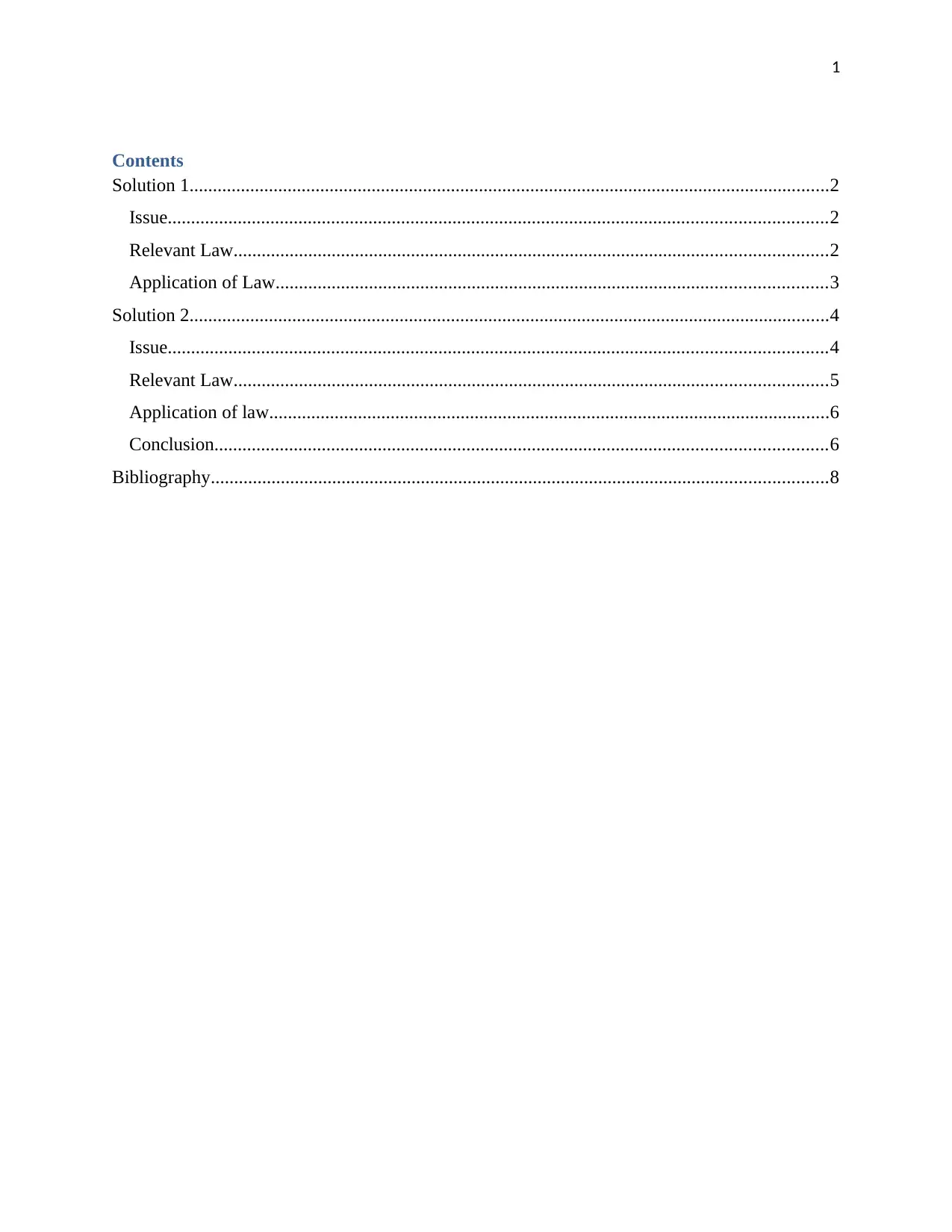
Contents
Solution 1.........................................................................................................................................2
Issue.............................................................................................................................................2
Relevant Law...............................................................................................................................2
Application of Law......................................................................................................................3
Solution 2.........................................................................................................................................4
Issue.............................................................................................................................................4
Relevant Law...............................................................................................................................5
Application of law........................................................................................................................6
Conclusion...................................................................................................................................6
Bibliography....................................................................................................................................8
Contents
Solution 1.........................................................................................................................................2
Issue.............................................................................................................................................2
Relevant Law...............................................................................................................................2
Application of Law......................................................................................................................3
Solution 2.........................................................................................................................................4
Issue.............................................................................................................................................4
Relevant Law...............................................................................................................................5
Application of law........................................................................................................................6
Conclusion...................................................................................................................................6
Bibliography....................................................................................................................................8
Paraphrase This Document
Need a fresh take? Get an instant paraphrase of this document with our AI Paraphraser

2
Solution 1
Issue
i. Whether Todd can sue the cinemas for the injury suffered by him?
ii. Whether the cinemas can protect themselves in any of the defenses?
Relevant Law
The law of negligence imposes penalties on the defendant for the loss that is caused to the
plaintiff because of his careless acts (Donoghue v Stevenson, 1932). The law of negligence is
also applicable on the occupiers of the premises. As per section 3 of the Occupier Liability Act,
1990 the duty is imposed on the occupier to make sure that no action of his must cause any loss
to the visitor as the visitor is in proximate relationship with him (Waldick v. Malcolm, 1997) and
(Gardiner v.Thunder Bay Regional Hospital, 1999). (Stolberg, 2018)
Thus, in order to prove occupier negligent there three requirements:
i. Duty of care – Every defendant has a duty that his acts must be carried out carefully
and to make sure that no loss is caused to any plaintiff. But, in (Childs v.
Desormeaux, 2006) to impose duty, there is a certain relationship that is required to
be maintained. (Bourboun, 2014)
a. It is necessary that the plaintiff and the defendant are the neighbors of each other.
In (Crocker v. Sundance Northwest Resorts Ltd, 1988) principle of neighborhood
submits that the plaintiff is positioned at such a place that he will get affected by
defendants acts/omission.
b. There is a need that the defendant has the ability to reasonably foresee the
plaintiff (Gabrysh v. Milenkovic, 2009).
Solution 1
Issue
i. Whether Todd can sue the cinemas for the injury suffered by him?
ii. Whether the cinemas can protect themselves in any of the defenses?
Relevant Law
The law of negligence imposes penalties on the defendant for the loss that is caused to the
plaintiff because of his careless acts (Donoghue v Stevenson, 1932). The law of negligence is
also applicable on the occupiers of the premises. As per section 3 of the Occupier Liability Act,
1990 the duty is imposed on the occupier to make sure that no action of his must cause any loss
to the visitor as the visitor is in proximate relationship with him (Waldick v. Malcolm, 1997) and
(Gardiner v.Thunder Bay Regional Hospital, 1999). (Stolberg, 2018)
Thus, in order to prove occupier negligent there three requirements:
i. Duty of care – Every defendant has a duty that his acts must be carried out carefully
and to make sure that no loss is caused to any plaintiff. But, in (Childs v.
Desormeaux, 2006) to impose duty, there is a certain relationship that is required to
be maintained. (Bourboun, 2014)
a. It is necessary that the plaintiff and the defendant are the neighbors of each other.
In (Crocker v. Sundance Northwest Resorts Ltd, 1988) principle of neighborhood
submits that the plaintiff is positioned at such a place that he will get affected by
defendants acts/omission.
b. There is a need that the defendant has the ability to reasonably foresee the
plaintiff (Gabrysh v. Milenkovic, 2009).

3
ii. Breach– When the defendant is aware that he is under the legal duty, then, the acts
should be carried so that the level/degree that is required must be met. The duty is not
comply with when the defendant behaves not what a normal and reasonable man will
act in the given situation (Mitchell v. Canadian National Railway Co, 1975).
iii. Damages –When the defendant is found to be in violation of his duties, then, there is
some harm that is caused to the plaintiff. But, the damages that is caused is essentially
to be proximate, that is, losses are caused to the plaintiff because of the acts of the
defendant ( Kennedy v Waterloo County Board of Education). Also, the losses
should not be remote. If any loss is caused which no normal person can anticipate,
then, the defendant is not liable for such loss. The general damages (damage for loss
of enjoyment of life and pain and suffering) and social damages (medical cost, future
cost, out of pocket expenses) can be claimed. (Tomlinson, McGlashan, Mutcheson,
Katzman, & Aubin, 2018)
There are two defenses that can be avail by the defendant:
i. Volenti non fit injuria – Defendant can prove that the loss that is inflicted on the plaintiff
is because of the negligence of the plaintiff alone incurred voluntarily;
ii. Contributory – When the loss is because of the wrongful acts of the plaintiff and
defendant both so the defendant is liable for liabilities which are caused because of him.
Application of Law
Todd took 2 for 1’ ticket from the cinemas. Now, Todd is visiting the cinema and cinema is the
occupier of the premises. Thus, as per (Waldick v. Malcolm, 1997)the occupier is under the duty
to make sure that no loss is caused to Todd because of its action. The cinema is duty bound
ii. Breach– When the defendant is aware that he is under the legal duty, then, the acts
should be carried so that the level/degree that is required must be met. The duty is not
comply with when the defendant behaves not what a normal and reasonable man will
act in the given situation (Mitchell v. Canadian National Railway Co, 1975).
iii. Damages –When the defendant is found to be in violation of his duties, then, there is
some harm that is caused to the plaintiff. But, the damages that is caused is essentially
to be proximate, that is, losses are caused to the plaintiff because of the acts of the
defendant ( Kennedy v Waterloo County Board of Education). Also, the losses
should not be remote. If any loss is caused which no normal person can anticipate,
then, the defendant is not liable for such loss. The general damages (damage for loss
of enjoyment of life and pain and suffering) and social damages (medical cost, future
cost, out of pocket expenses) can be claimed. (Tomlinson, McGlashan, Mutcheson,
Katzman, & Aubin, 2018)
There are two defenses that can be avail by the defendant:
i. Volenti non fit injuria – Defendant can prove that the loss that is inflicted on the plaintiff
is because of the negligence of the plaintiff alone incurred voluntarily;
ii. Contributory – When the loss is because of the wrongful acts of the plaintiff and
defendant both so the defendant is liable for liabilities which are caused because of him.
Application of Law
Todd took 2 for 1’ ticket from the cinemas. Now, Todd is visiting the cinema and cinema is the
occupier of the premises. Thus, as per (Waldick v. Malcolm, 1997)the occupier is under the duty
to make sure that no loss is caused to Todd because of its action. The cinema is duty bound
⊘ This is a preview!⊘
Do you want full access?
Subscribe today to unlock all pages.

Trusted by 1+ million students worldwide

4
towards Todd because, Todd is its neighbor and the cinemas can reasonably foresee Todd. Todd
entered the cinema 2 where there was no attendant and he slip on the spilled pop and suffered
injury on his tail bone. It is submitted that the cinema is under the duty to make sure that no loss
is caused to Todd because of its action. But, the duty is not cater by the cinema. It is the duty of
cinema that the hall should be cleaned after every movie, but, by not cleaning the spoiled pop,
the level of care that is required to be met is violated. So, the cinema is in breach of duty.
Because of breach Todd has suffered fractured on his tail bone which is the result of the breach
of duty of cinema and the damage is also not remote. But, later Todd was bedridden for three
months and lost his employment. Now, the cinema is not answerable for such losses as these
losses are very remote in nature and is not predictable. The cinema also cannot predict that the
incident will become viral by a post on YouTube and thus the cause of humiliation and
embarrassment was too remote and the cinema is not liable. Further, cinema can prove that the
fracture that is caused to Todd become grave because he kept on sitting in the movie hall even
after the injury. Thus, the aggravation of the injury is also because of the acts f Todd, thus, the
cinema can rely on contributory negligence.
Solution 2
Thus, the cinema is liable to the loss of Todd but the same can be reduced proportionally as the
loss was also caused to Todd by his own negligence.
Issue
Whether there is a valid contract amid Julie and Katherine?
towards Todd because, Todd is its neighbor and the cinemas can reasonably foresee Todd. Todd
entered the cinema 2 where there was no attendant and he slip on the spilled pop and suffered
injury on his tail bone. It is submitted that the cinema is under the duty to make sure that no loss
is caused to Todd because of its action. But, the duty is not cater by the cinema. It is the duty of
cinema that the hall should be cleaned after every movie, but, by not cleaning the spoiled pop,
the level of care that is required to be met is violated. So, the cinema is in breach of duty.
Because of breach Todd has suffered fractured on his tail bone which is the result of the breach
of duty of cinema and the damage is also not remote. But, later Todd was bedridden for three
months and lost his employment. Now, the cinema is not answerable for such losses as these
losses are very remote in nature and is not predictable. The cinema also cannot predict that the
incident will become viral by a post on YouTube and thus the cause of humiliation and
embarrassment was too remote and the cinema is not liable. Further, cinema can prove that the
fracture that is caused to Todd become grave because he kept on sitting in the movie hall even
after the injury. Thus, the aggravation of the injury is also because of the acts f Todd, thus, the
cinema can rely on contributory negligence.
Solution 2
Thus, the cinema is liable to the loss of Todd but the same can be reduced proportionally as the
loss was also caused to Todd by his own negligence.
Issue
Whether there is a valid contract amid Julie and Katherine?
Paraphrase This Document
Need a fresh take? Get an instant paraphrase of this document with our AI Paraphraser

5
Relevant Law
The law of contract guides the relationship amid two private parties who wants to establish
contractual relationship. The essential element includes offer, acceptance, consideration, legal
intention and party’s capacity.
When the offeror transfers his intention in the form of the statement with a hope of the content
from the offeree on such term that is mentioned in the statement, then, it is an offer. An offer can
be made in any form, like, by words, by actions or in written form. But, it was held in
(Goldthorpe v. Logan,, 1943) that the communication of the acceptance is complete only when it
is in the knowledge of the offeree.
Now, when the offeree confirms the offer made without any changes, then, it is an acceptance in
law. Further, an acceptance when made should come in the knowledge of offeror in order to
consider the same as binding and valid. In (Felthouse v Bindley, 1862) silence is considered as
not an acceptance in law.
Now, t times no offer is initiated by a person but offers are desires to be invited by the persons,
this, can be done by invitation. The offer which is so received if confirmed by the inviter results
in a contract. An invitation can be made by an advertisement, by auction, tenders, display of
goods etc ( R. v. Ron Engineering & Construction Ltd, 1981). But, at times, advertisements are
issued wherein statements are made along with the compliance or the mode which the inviter
expects the interested person to comply with. In such situation, such advertisements are not
considered to be an invitation. In the (Carlill v Carbolic Smoke Ball Co, 1892), it was held that
when any person makes any statements, that he will abide by the statements that he is making
provided the other party acts as per the manners and modes that are provided, then, if any person
Relevant Law
The law of contract guides the relationship amid two private parties who wants to establish
contractual relationship. The essential element includes offer, acceptance, consideration, legal
intention and party’s capacity.
When the offeror transfers his intention in the form of the statement with a hope of the content
from the offeree on such term that is mentioned in the statement, then, it is an offer. An offer can
be made in any form, like, by words, by actions or in written form. But, it was held in
(Goldthorpe v. Logan,, 1943) that the communication of the acceptance is complete only when it
is in the knowledge of the offeree.
Now, when the offeree confirms the offer made without any changes, then, it is an acceptance in
law. Further, an acceptance when made should come in the knowledge of offeror in order to
consider the same as binding and valid. In (Felthouse v Bindley, 1862) silence is considered as
not an acceptance in law.
Now, t times no offer is initiated by a person but offers are desires to be invited by the persons,
this, can be done by invitation. The offer which is so received if confirmed by the inviter results
in a contract. An invitation can be made by an advertisement, by auction, tenders, display of
goods etc ( R. v. Ron Engineering & Construction Ltd, 1981). But, at times, advertisements are
issued wherein statements are made along with the compliance or the mode which the inviter
expects the interested person to comply with. In such situation, such advertisements are not
considered to be an invitation. In the (Carlill v Carbolic Smoke Ball Co, 1892), it was held that
when any person makes any statements, that he will abide by the statements that he is making
provided the other party acts as per the manners and modes that are provided, then, if any person

6
acts as per the modes so prescribed, then, it is considered as a deem acceptance and the
advertisement is considered to be a unilateral offer.
Application of law
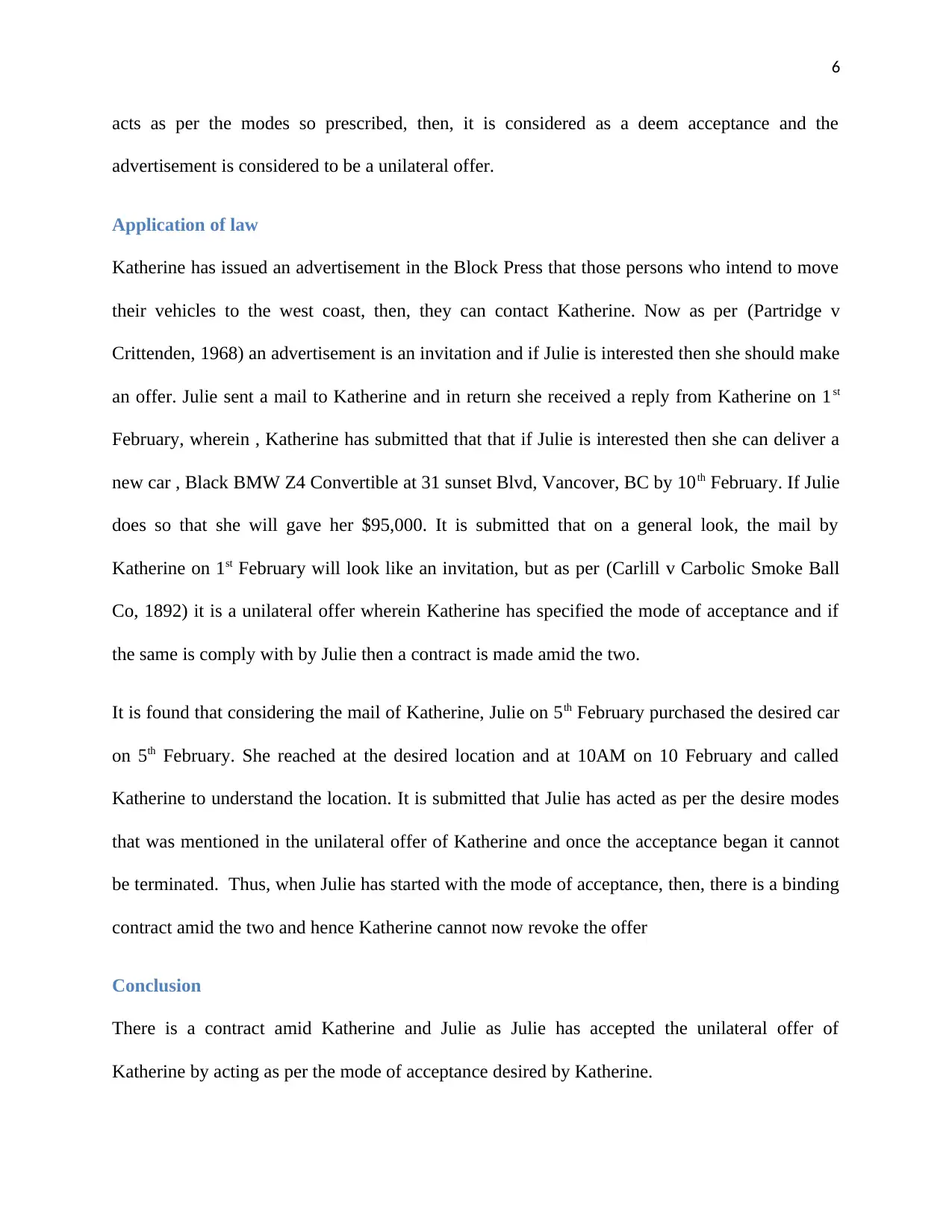
Katherine has issued an advertisement in the Block Press that those persons who intend to move
their vehicles to the west coast, then, they can contact Katherine. Now as per (Partridge v
Crittenden, 1968) an advertisement is an invitation and if Julie is interested then she should make
an offer. Julie sent a mail to Katherine and in return she received a reply from Katherine on 1st
February, wherein , Katherine has submitted that that if Julie is interested then she can deliver a
new car , Black BMW Z4 Convertible at 31 sunset Blvd, Vancover, BC by 10th February. If Julie
does so that she will gave her $95,000. It is submitted that on a general look, the mail by
Katherine on 1st February will look like an invitation, but as per (Carlill v Carbolic Smoke Ball
Co, 1892) it is a unilateral offer wherein Katherine has specified the mode of acceptance and if
the same is comply with by Julie then a contract is made amid the two.
It is found that considering the mail of Katherine, Julie on 5th February purchased the desired car
on 5th February. She reached at the desired location and at 10AM on 10 February and called
Katherine to understand the location. It is submitted that Julie has acted as per the desire modes
that was mentioned in the unilateral offer of Katherine and once the acceptance began it cannot
be terminated. Thus, when Julie has started with the mode of acceptance, then, there is a binding
contract amid the two and hence Katherine cannot now revoke the offer
Conclusion
There is a contract amid Katherine and Julie as Julie has accepted the unilateral offer of
Katherine by acting as per the mode of acceptance desired by Katherine.
acts as per the modes so prescribed, then, it is considered as a deem acceptance and the
advertisement is considered to be a unilateral offer.
Application of law
Katherine has issued an advertisement in the Block Press that those persons who intend to move
their vehicles to the west coast, then, they can contact Katherine. Now as per (Partridge v
Crittenden, 1968) an advertisement is an invitation and if Julie is interested then she should make
an offer. Julie sent a mail to Katherine and in return she received a reply from Katherine on 1st
February, wherein , Katherine has submitted that that if Julie is interested then she can deliver a
new car , Black BMW Z4 Convertible at 31 sunset Blvd, Vancover, BC by 10th February. If Julie
does so that she will gave her $95,000. It is submitted that on a general look, the mail by
Katherine on 1st February will look like an invitation, but as per (Carlill v Carbolic Smoke Ball
Co, 1892) it is a unilateral offer wherein Katherine has specified the mode of acceptance and if
the same is comply with by Julie then a contract is made amid the two.
It is found that considering the mail of Katherine, Julie on 5th February purchased the desired car
on 5th February. She reached at the desired location and at 10AM on 10 February and called
Katherine to understand the location. It is submitted that Julie has acted as per the desire modes
that was mentioned in the unilateral offer of Katherine and once the acceptance began it cannot
be terminated. Thus, when Julie has started with the mode of acceptance, then, there is a binding
contract amid the two and hence Katherine cannot now revoke the offer
Conclusion
There is a contract amid Katherine and Julie as Julie has accepted the unilateral offer of
Katherine by acting as per the mode of acceptance desired by Katherine.
⊘ This is a preview!⊘
Do you want full access?
Subscribe today to unlock all pages.

Trusted by 1+ million students worldwide

7
Paraphrase This Document
Need a fresh take? Get an instant paraphrase of this document with our AI Paraphraser

8
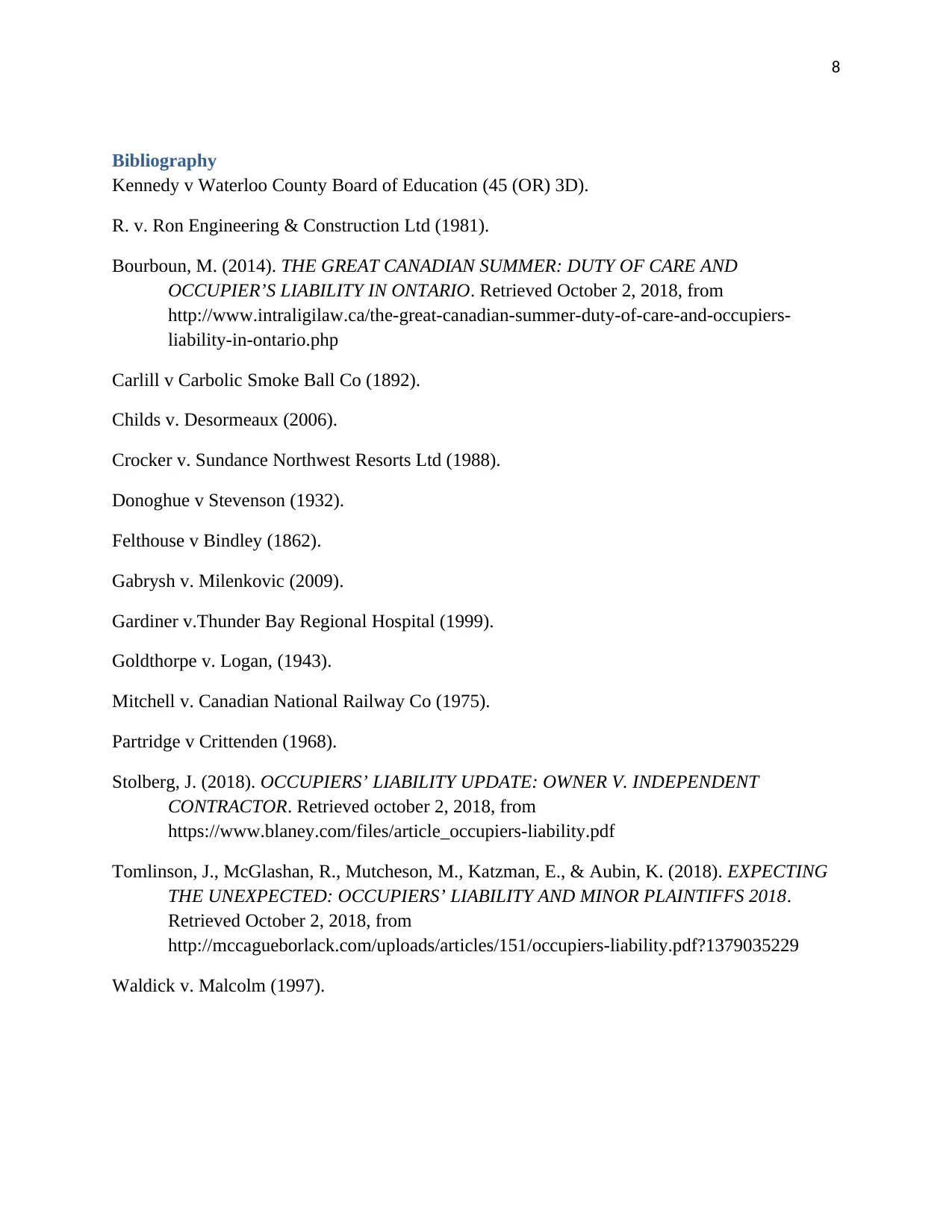
Bibliography
Kennedy v Waterloo County Board of Education (45 (OR) 3D).
R. v. Ron Engineering & Construction Ltd (1981).
Bourboun, M. (2014). THE GREAT CANADIAN SUMMER: DUTY OF CARE AND
OCCUPIER’S LIABILITY IN ONTARIO. Retrieved October 2, 2018, from
http://www.intraligilaw.ca/the-great-canadian-summer-duty-of-care-and-occupiers-
liability-in-ontario.php
Carlill v Carbolic Smoke Ball Co (1892).
Childs v. Desormeaux (2006).
Crocker v. Sundance Northwest Resorts Ltd (1988).
Donoghue v Stevenson (1932).
Felthouse v Bindley (1862).
Gabrysh v. Milenkovic (2009).
Gardiner v.Thunder Bay Regional Hospital (1999).
Goldthorpe v. Logan, (1943).
Mitchell v. Canadian National Railway Co (1975).
Partridge v Crittenden (1968).
Stolberg, J. (2018). OCCUPIERS’ LIABILITY UPDATE: OWNER V. INDEPENDENT
CONTRACTOR. Retrieved october 2, 2018, from
https://www.blaney.com/files/article_occupiers-liability.pdf
Tomlinson, J., McGlashan, R., Mutcheson, M., Katzman, E., & Aubin, K. (2018). EXPECTING
THE UNEXPECTED: OCCUPIERS’ LIABILITY AND MINOR PLAINTIFFS 2018.
Retrieved October 2, 2018, from
http://mccagueborlack.com/uploads/articles/151/occupiers-liability.pdf?1379035229
Waldick v. Malcolm (1997).
Bibliography
Kennedy v Waterloo County Board of Education (45 (OR) 3D).
R. v. Ron Engineering & Construction Ltd (1981).
Bourboun, M. (2014). THE GREAT CANADIAN SUMMER: DUTY OF CARE AND
OCCUPIER’S LIABILITY IN ONTARIO. Retrieved October 2, 2018, from
http://www.intraligilaw.ca/the-great-canadian-summer-duty-of-care-and-occupiers-
liability-in-ontario.php
Carlill v Carbolic Smoke Ball Co (1892).
Childs v. Desormeaux (2006).
Crocker v. Sundance Northwest Resorts Ltd (1988).
Donoghue v Stevenson (1932).
Felthouse v Bindley (1862).
Gabrysh v. Milenkovic (2009).
Gardiner v.Thunder Bay Regional Hospital (1999).
Goldthorpe v. Logan, (1943).
Mitchell v. Canadian National Railway Co (1975).
Partridge v Crittenden (1968).
Stolberg, J. (2018). OCCUPIERS’ LIABILITY UPDATE: OWNER V. INDEPENDENT
CONTRACTOR. Retrieved october 2, 2018, from
https://www.blaney.com/files/article_occupiers-liability.pdf
Tomlinson, J., McGlashan, R., Mutcheson, M., Katzman, E., & Aubin, K. (2018). EXPECTING
THE UNEXPECTED: OCCUPIERS’ LIABILITY AND MINOR PLAINTIFFS 2018.
Retrieved October 2, 2018, from
http://mccagueborlack.com/uploads/articles/151/occupiers-liability.pdf?1379035229
Waldick v. Malcolm (1997).
1 out of 8
Related Documents
Your All-in-One AI-Powered Toolkit for Academic Success.
+13062052269
info@desklib.com
Available 24*7 on WhatsApp / Email
Unlock your academic potential
Copyright © 2020–2025 A2Z Services. All Rights Reserved. Developed and managed by ZUCOL.