Commercial Law 6: Negligence Case Analysis - Duty of Care and Defenses

Verified

Added on  2020/04/07

|7
|1486
|38
Homework Assignment
AI Summary
This assignment analyzes a commercial law negligence case involving a car accident where both drivers were intoxicated. The analysis addresses key issues, including whether Michelle owed Rebacca a duty of care, if Michelle breached her duty, if Rebacca’s injuries were caused by Michelle's actions, and whether Michelle could use the defenses of contributory negligence and voluntary assumption of risk. The assignment applies tort law principles and relevant case precedents, such as Donoghue v Stevenson, Vaughn v Menlove, and Morris v Murray. It concludes that Michelle owed Rebacca a duty of care, breached her standard of care, and her actions caused Rebacca's injuries. However, it also suggests Michelle could potentially use the defenses of contributory negligence and voluntary assumption of risk due to Rebacca's own actions and knowledge of the situation.
Document Page
Running head: COMMERCIAL LAW
Negligence
Name of the student:
Name of the university:
Author note
tabler-icon-diamond-filled.svg

Paraphrase This Document

Need a fresh take? Get an instant paraphrase of this document with our AI Paraphraser
Document Page
1COMMERCIAL LAW
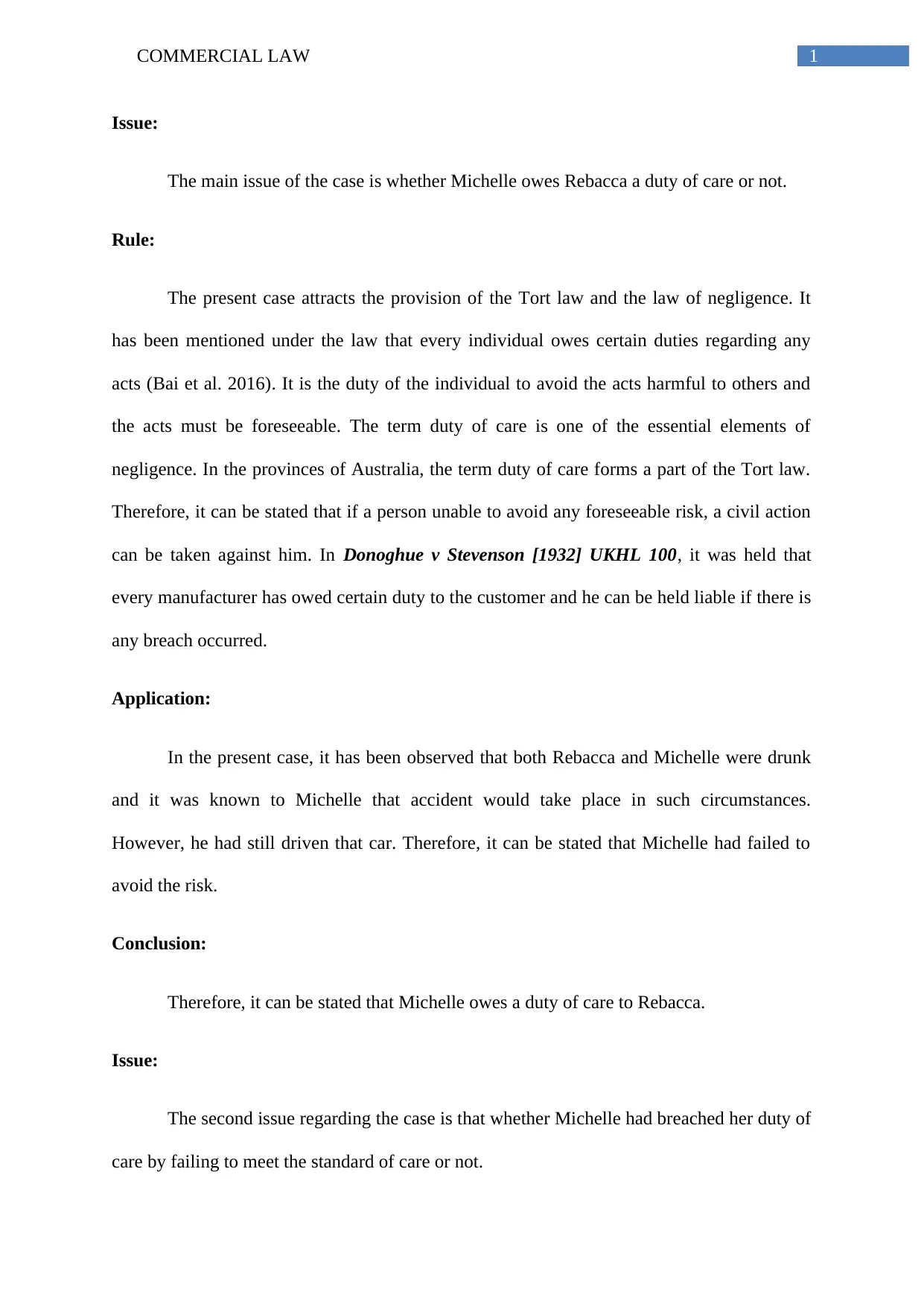
Issue:
The main issue of the case is whether Michelle owes Rebacca a duty of care or not.
Rule:
The present case attracts the provision of the Tort law and the law of negligence. It
has been mentioned under the law that every individual owes certain duties regarding any
acts (Bai et al. 2016). It is the duty of the individual to avoid the acts harmful to others and
the acts must be foreseeable. The term duty of care is one of the essential elements of
negligence. In the provinces of Australia, the term duty of care forms a part of the Tort law.
Therefore, it can be stated that if a person unable to avoid any foreseeable risk, a civil action
can be taken against him. In Donoghue v Stevenson [1932] UKHL 100, it was held that
every manufacturer has owed certain duty to the customer and he can be held liable if there is
any breach occurred.
Application:
In the present case, it has been observed that both Rebacca and Michelle were drunk
and it was known to Michelle that accident would take place in such circumstances.
However, he had still driven that car. Therefore, it can be stated that Michelle had failed to
avoid the risk.
Conclusion:
Therefore, it can be stated that Michelle owes a duty of care to Rebacca.
Issue:
The second issue regarding the case is that whether Michelle had breached her duty of
care by failing to meet the standard of care or not.
Document Page
2COMMERCIAL LAW
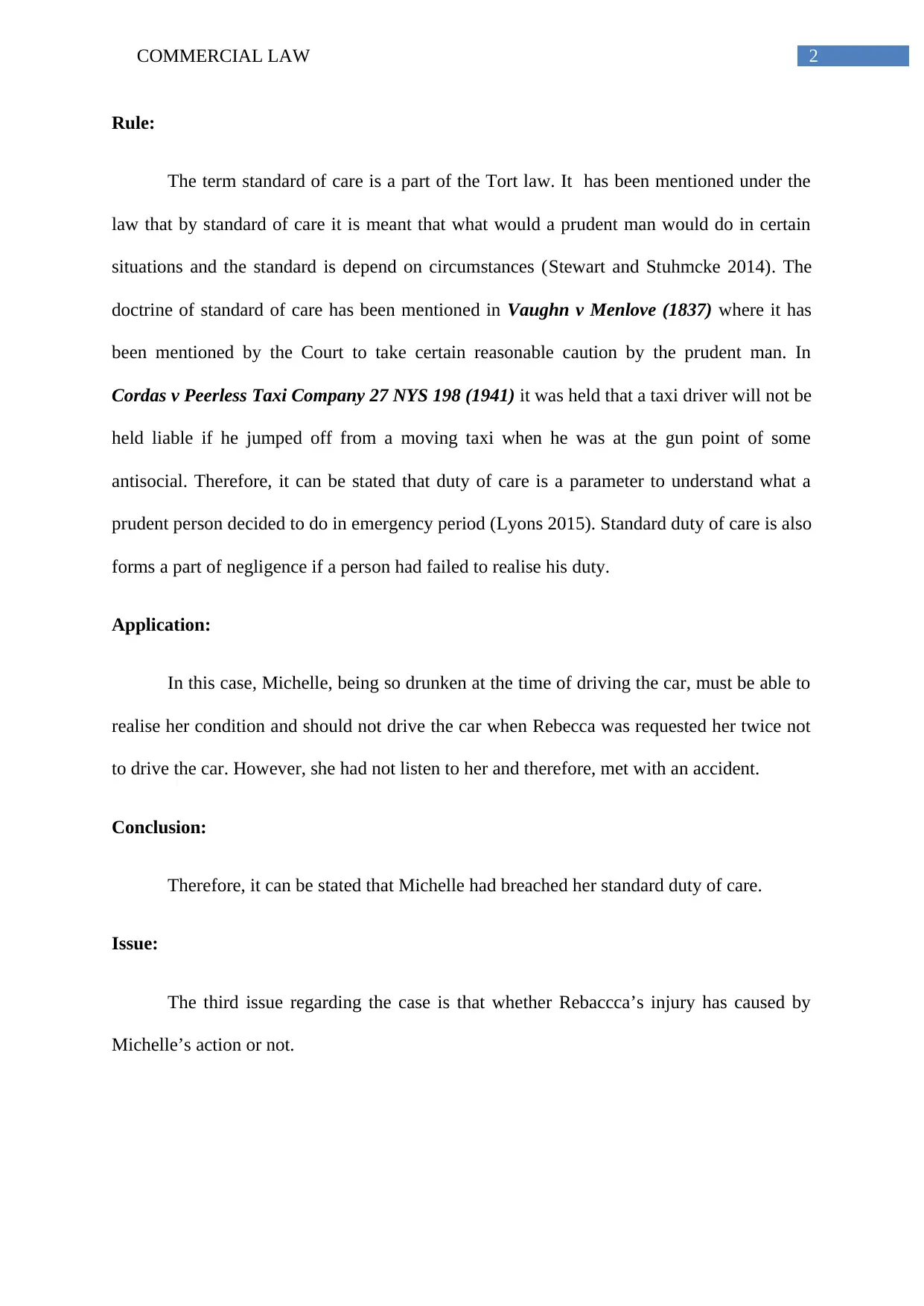
Rule:
The term standard of care is a part of the Tort law. It has been mentioned under the
law that by standard of care it is meant that what would a prudent man would do in certain
situations and the standard is depend on circumstances (Stewart and Stuhmcke 2014). The
doctrine of standard of care has been mentioned in Vaughn v Menlove (1837) where it has
been mentioned by the Court to take certain reasonable caution by the prudent man. In
Cordas v Peerless Taxi Company 27 NYS 198 (1941) it was held that a taxi driver will not be
held liable if he jumped off from a moving taxi when he was at the gun point of some
antisocial. Therefore, it can be stated that duty of care is a parameter to understand what a
prudent person decided to do in emergency period (Lyons 2015). Standard duty of care is also
forms a part of negligence if a person had failed to realise his duty.
Application:
In this case, Michelle, being so drunken at the time of driving the car, must be able to
realise her condition and should not drive the car when Rebecca was requested her twice not
to drive the car. However, she had not listen to her and therefore, met with an accident.
Conclusion:
Therefore, it can be stated that Michelle had breached her standard duty of care.
Issue:
The third issue regarding the case is that whether Rebaccca’s injury has caused by
Michelle’s action or not.
Document Page
3COMMERCIAL LAW
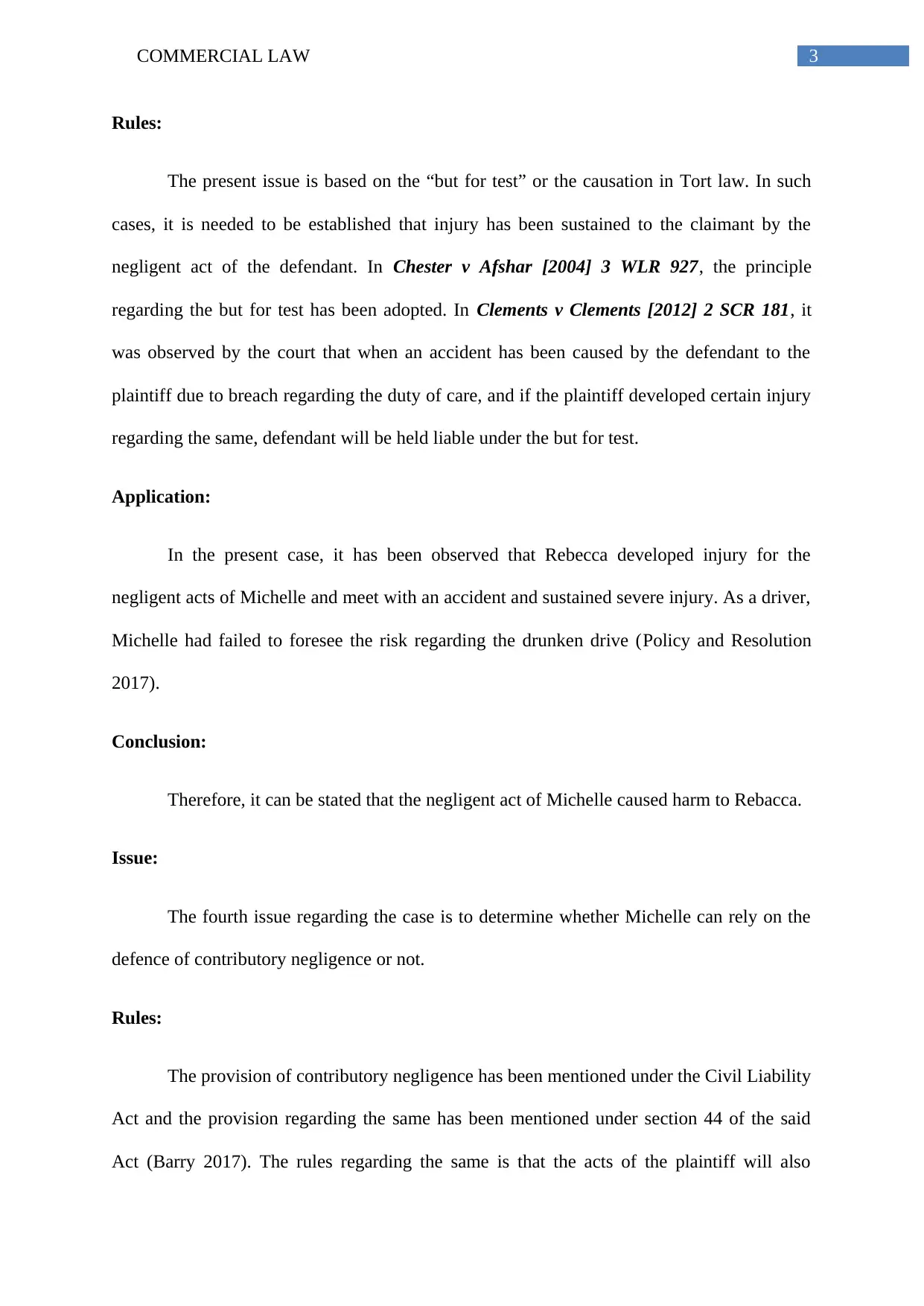
Rules:
The present issue is based on the “but for test” or the causation in Tort law. In such
cases, it is needed to be established that injury has been sustained to the claimant by the
negligent act of the defendant. In Chester v Afshar [2004] 3 WLR 927, the principle
regarding the but for test has been adopted. In Clements v Clements [2012] 2 SCR 181, it
was observed by the court that when an accident has been caused by the defendant to the
plaintiff due to breach regarding the duty of care, and if the plaintiff developed certain injury
regarding the same, defendant will be held liable under the but for test.
Application:
In the present case, it has been observed that Rebecca developed injury for the
negligent acts of Michelle and meet with an accident and sustained severe injury. As a driver,
Michelle had failed to foresee the risk regarding the drunken drive (Policy and Resolution
2017).
Conclusion:
Therefore, it can be stated that the negligent act of Michelle caused harm to Rebacca.
Issue:
The fourth issue regarding the case is to determine whether Michelle can rely on the
defence of contributory negligence or not.
Rules:
The provision of contributory negligence has been mentioned under the Civil Liability
Act and the provision regarding the same has been mentioned under section 44 of the said
Act (Barry 2017). The rules regarding the same is that the acts of the plaintiff will also
tabler-icon-diamond-filled.svg

Paraphrase This Document

Need a fresh take? Get an instant paraphrase of this document with our AI Paraphraser
Document Page
4COMMERCIAL LAW
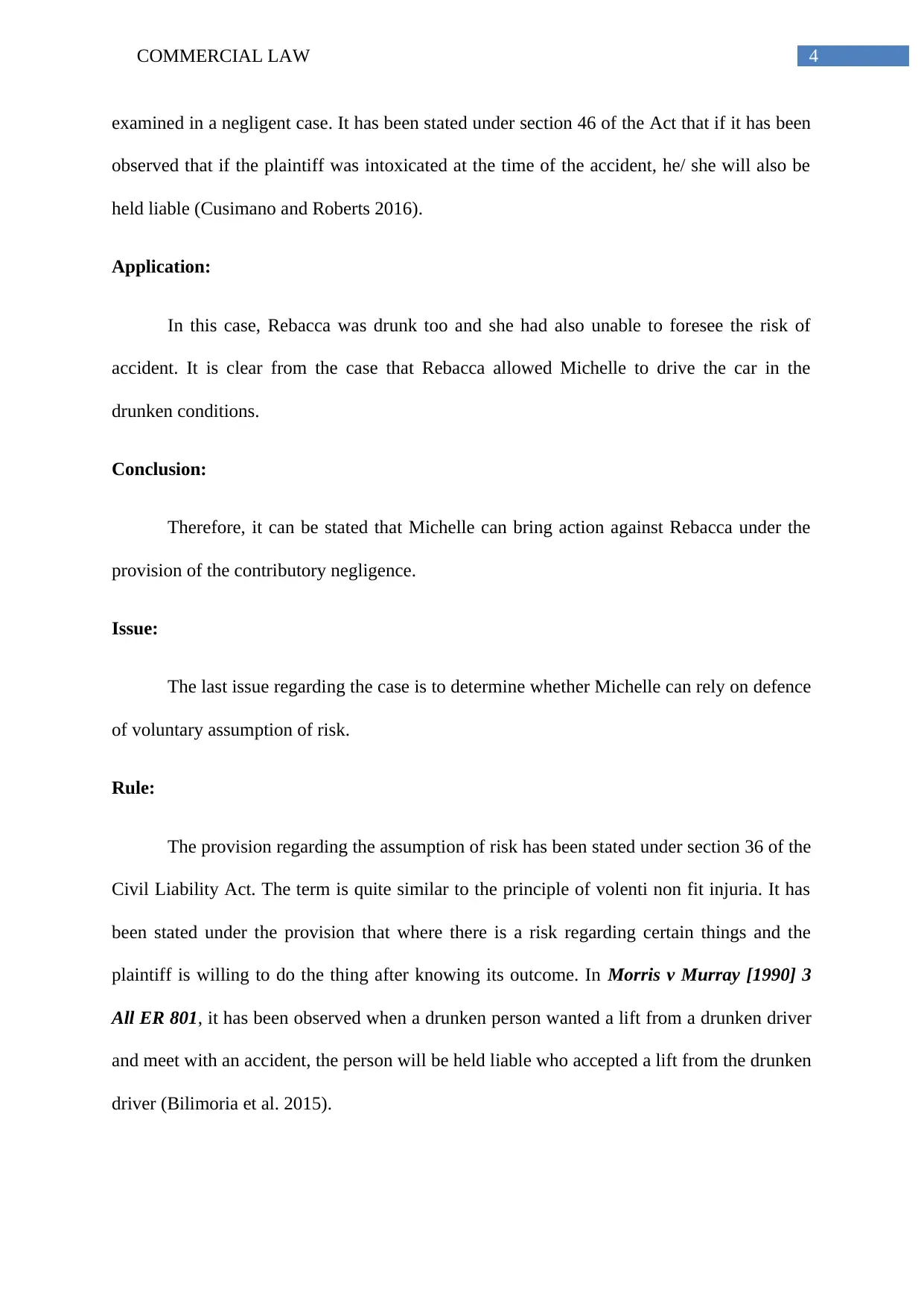
examined in a negligent case. It has been stated under section 46 of the Act that if it has been
observed that if the plaintiff was intoxicated at the time of the accident, he/ she will also be
held liable (Cusimano and Roberts 2016).
Application:
In this case, Rebacca was drunk too and she had also unable to foresee the risk of
accident. It is clear from the case that Rebacca allowed Michelle to drive the car in the
drunken conditions.
Conclusion:
Therefore, it can be stated that Michelle can bring action against Rebacca under the
provision of the contributory negligence.
Issue:
The last issue regarding the case is to determine whether Michelle can rely on defence
of voluntary assumption of risk.
Rule:
The provision regarding the assumption of risk has been stated under section 36 of the
Civil Liability Act. The term is quite similar to the principle of volenti non fit injuria. It has
been stated under the provision that where there is a risk regarding certain things and the
plaintiff is willing to do the thing after knowing its outcome. In Morris v Murray [1990] 3
All ER 801, it has been observed when a drunken person wanted a lift from a drunken driver
and meet with an accident, the person will be held liable who accepted a lift from the drunken
driver (Bilimoria et al. 2015).
Document Page
5COMMERCIAL LAW
Application:
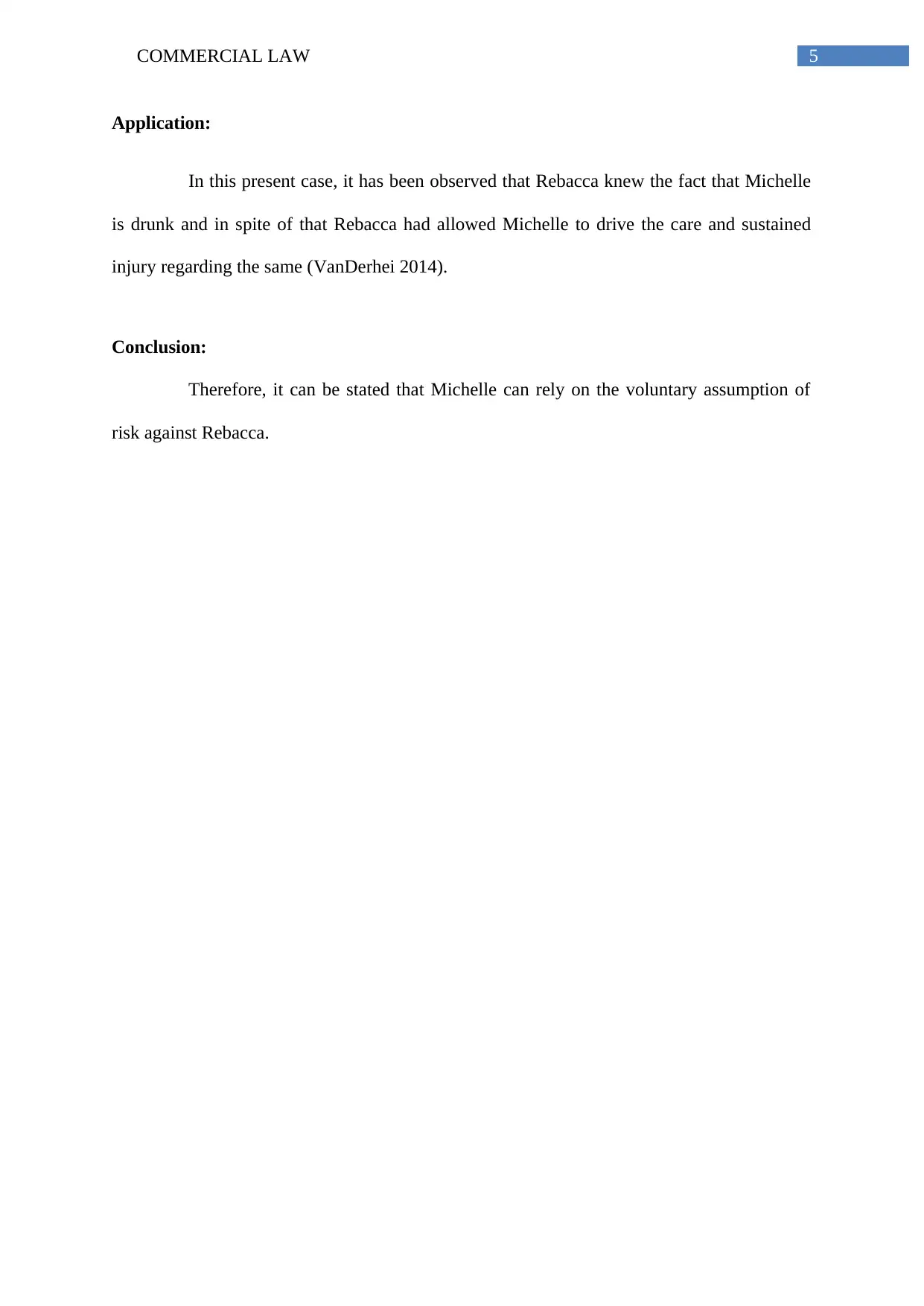
In this present case, it has been observed that Rebacca knew the fact that Michelle
is drunk and in spite of that Rebacca had allowed Michelle to drive the care and sustained
injury regarding the same (VanDerhei 2014).
Conclusion:
Therefore, it can be stated that Michelle can rely on the voluntary assumption of
risk against Rebacca.
Document Page
6COMMERCIAL LAW
Reference:
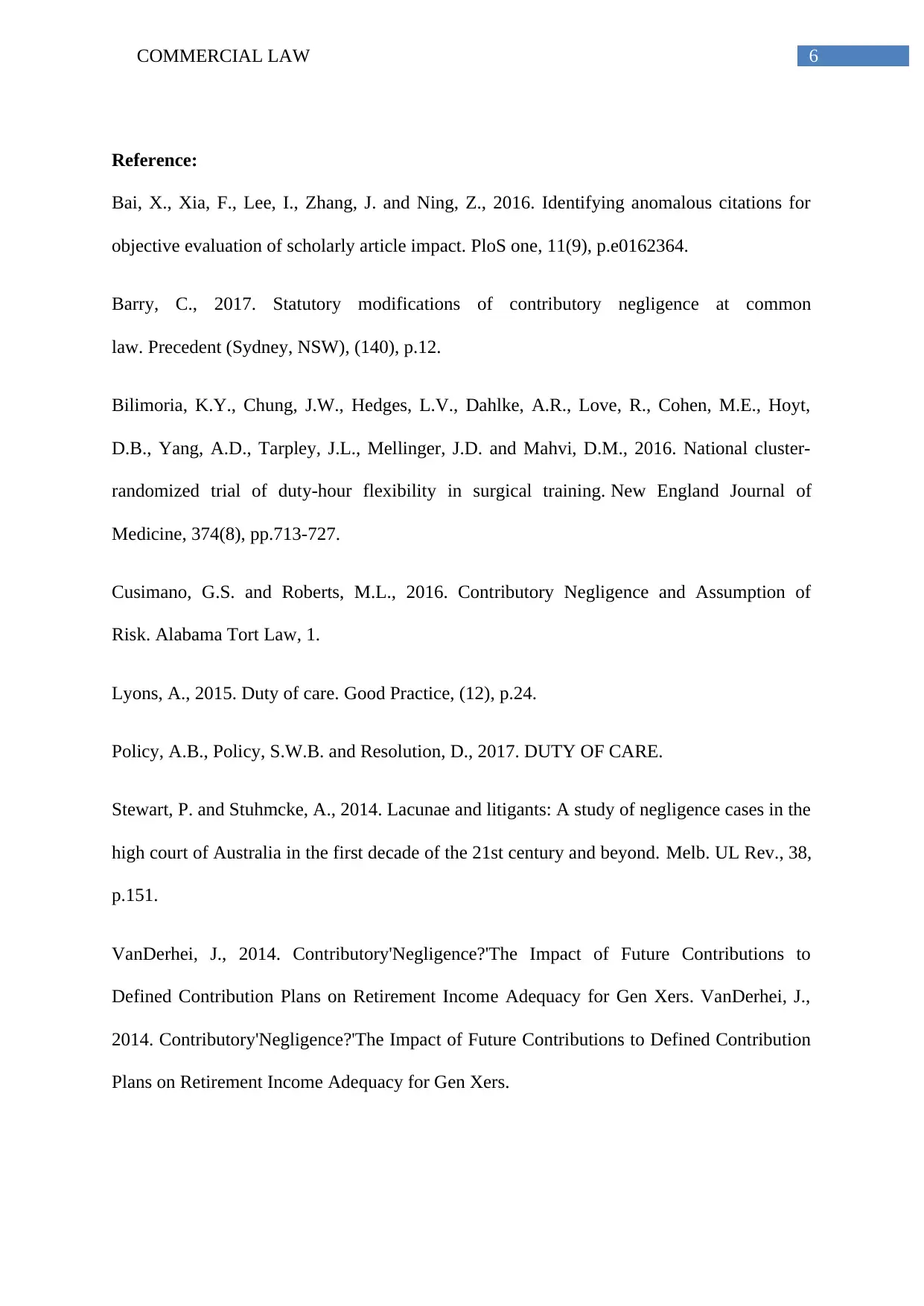
Bai, X., Xia, F., Lee, I., Zhang, J. and Ning, Z., 2016. Identifying anomalous citations for
objective evaluation of scholarly article impact. PloS one, 11(9), p.e0162364.
Barry, C., 2017. Statutory modifications of contributory negligence at common
law. Precedent (Sydney, NSW), (140), p.12.
Bilimoria, K.Y., Chung, J.W., Hedges, L.V., Dahlke, A.R., Love, R., Cohen, M.E., Hoyt,
D.B., Yang, A.D., Tarpley, J.L., Mellinger, J.D. and Mahvi, D.M., 2016. National cluster-
randomized trial of duty-hour flexibility in surgical training. New England Journal of
Medicine, 374(8), pp.713-727.
Cusimano, G.S. and Roberts, M.L., 2016. Contributory Negligence and Assumption of
Risk. Alabama Tort Law, 1.
Lyons, A., 2015. Duty of care. Good Practice, (12), p.24.
Policy, A.B., Policy, S.W.B. and Resolution, D., 2017. DUTY OF CARE.
Stewart, P. and Stuhmcke, A., 2014. Lacunae and litigants: A study of negligence cases in the
high court of Australia in the first decade of the 21st century and beyond. Melb. UL Rev., 38,
p.151.
VanDerhei, J., 2014. Contributory'Negligence?'The Impact of Future Contributions to
Defined Contribution Plans on Retirement Income Adequacy for Gen Xers. VanDerhei, J.,
2014. Contributory'Negligence?'The Impact of Future Contributions to Defined Contribution
Plans on Retirement Income Adequacy for Gen Xers.
chevron_up_icon
1 out of 7
circle_padding
hide_on_mobile
zoom_out_icon
[object Object]