Case Study: Examining Negligence, Duty of Care, and Defenses in Law
VerifiedAdded on  2023/01/17
|7
|1773
|57
Case Study
AI Summary
This case study analyzes a negligence claim involving Jack and Maeve. The central issue revolves around whether Jack has a valid claim against Maeve due to a car accident caused by Maeve's negligence while using her phone. The analysis delves into the legal principles of negligence, including the establishment of a duty of care, its breach, and the causation of harm. The case study references key legal precedents such as Donoghue v Stevenson and Chapman v Hearse to support its arguments. The application section examines Maeve's duty to ensure road safety and refrain from phone use, concluding that she breached this duty, causing Jack's brain injury. Furthermore, the case study explores potential defenses available to Maeve, specifically considering Jack's contributory negligence for not wearing a helmet. The conclusion states that Maeve can avail of the defense of contributory negligence, which may reduce the damages. The case study offers a comprehensive review of negligence law, with detailed legal reasoning and case citations.
Running head: CASE STUDY
Case Study
Name of the Student
Name of the University
Author Note
Case Study
Name of the Student
Name of the University
Author Note
Paraphrase This Document
Need a fresh take? Get an instant paraphrase of this document with our AI Paraphraser

1CASE STUDY
Issue 1
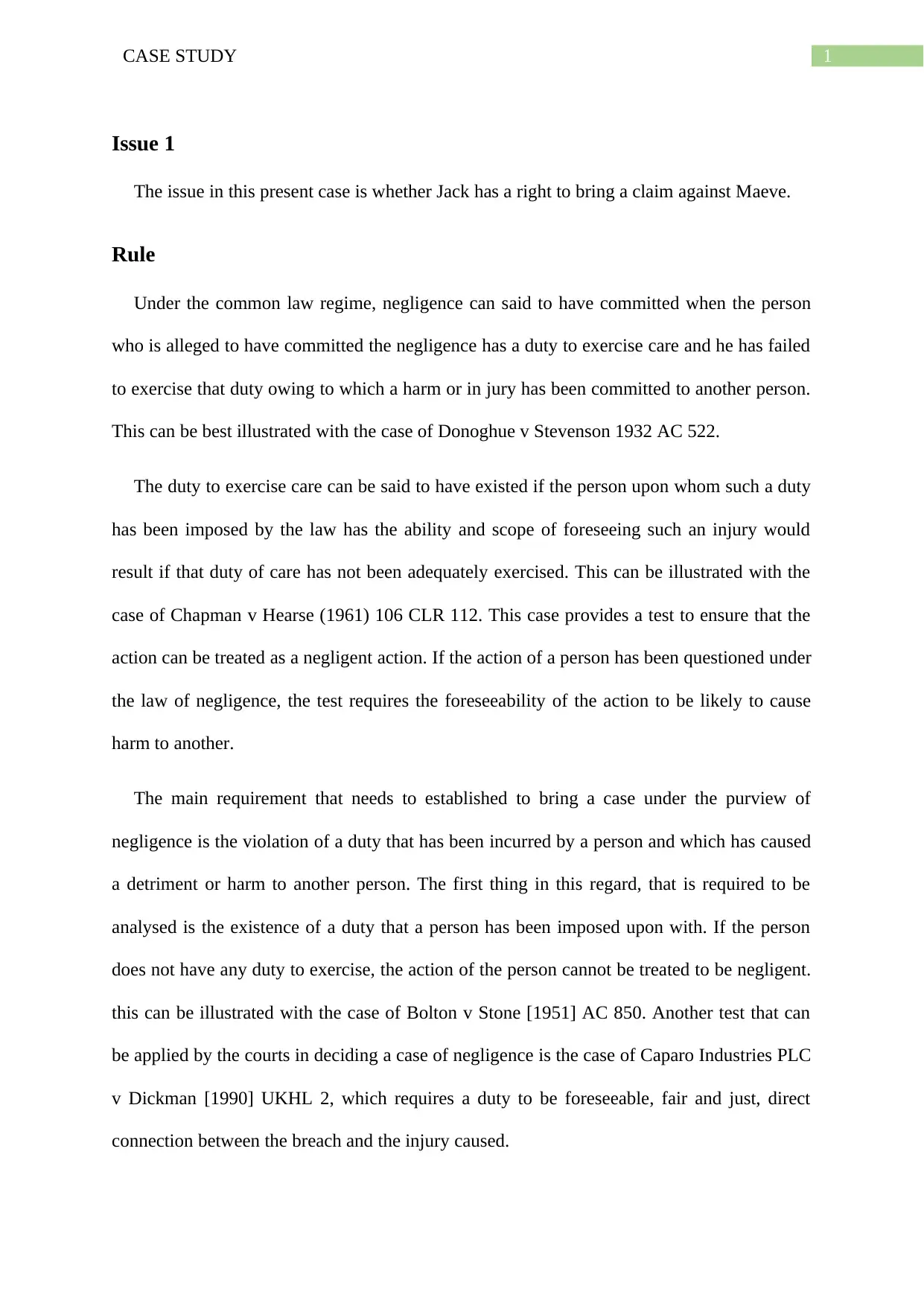
The issue in this present case is whether Jack has a right to bring a claim against Maeve.
Rule
Under the common law regime, negligence can said to have committed when the person
who is alleged to have committed the negligence has a duty to exercise care and he has failed
to exercise that duty owing to which a harm or in jury has been committed to another person.
This can be best illustrated with the case of Donoghue v Stevenson 1932 AC 522.
The duty to exercise care can be said to have existed if the person upon whom such a duty
has been imposed by the law has the ability and scope of foreseeing such an injury would
result if that duty of care has not been adequately exercised. This can be illustrated with the
case of Chapman v Hearse (1961) 106 CLR 112. This case provides a test to ensure that the
action can be treated as a negligent action. If the action of a person has been questioned under
the law of negligence, the test requires the foreseeability of the action to be likely to cause
harm to another.
The main requirement that needs to established to bring a case under the purview of
negligence is the violation of a duty that has been incurred by a person and which has caused
a detriment or harm to another person. The first thing in this regard, that is required to be
analysed is the existence of a duty that a person has been imposed upon with. If the person
does not have any duty to exercise, the action of the person cannot be treated to be negligent.
this can be illustrated with the case of Bolton v Stone [1951] AC 850. Another test that can
be applied by the courts in deciding a case of negligence is the case of Caparo Industries PLC
v Dickman [1990] UKHL 2, which requires a duty to be foreseeable, fair and just, direct
connection between the breach and the injury caused.
Issue 1
The issue in this present case is whether Jack has a right to bring a claim against Maeve.
Rule
Under the common law regime, negligence can said to have committed when the person
who is alleged to have committed the negligence has a duty to exercise care and he has failed
to exercise that duty owing to which a harm or in jury has been committed to another person.
This can be best illustrated with the case of Donoghue v Stevenson 1932 AC 522.
The duty to exercise care can be said to have existed if the person upon whom such a duty
has been imposed by the law has the ability and scope of foreseeing such an injury would
result if that duty of care has not been adequately exercised. This can be illustrated with the
case of Chapman v Hearse (1961) 106 CLR 112. This case provides a test to ensure that the
action can be treated as a negligent action. If the action of a person has been questioned under
the law of negligence, the test requires the foreseeability of the action to be likely to cause
harm to another.
The main requirement that needs to established to bring a case under the purview of
negligence is the violation of a duty that has been incurred by a person and which has caused
a detriment or harm to another person. The first thing in this regard, that is required to be
analysed is the existence of a duty that a person has been imposed upon with. If the person
does not have any duty to exercise, the action of the person cannot be treated to be negligent.
this can be illustrated with the case of Bolton v Stone [1951] AC 850. Another test that can
be applied by the courts in deciding a case of negligence is the case of Caparo Industries PLC
v Dickman [1990] UKHL 2, which requires a duty to be foreseeable, fair and just, direct
connection between the breach and the injury caused.

2CASE STUDY
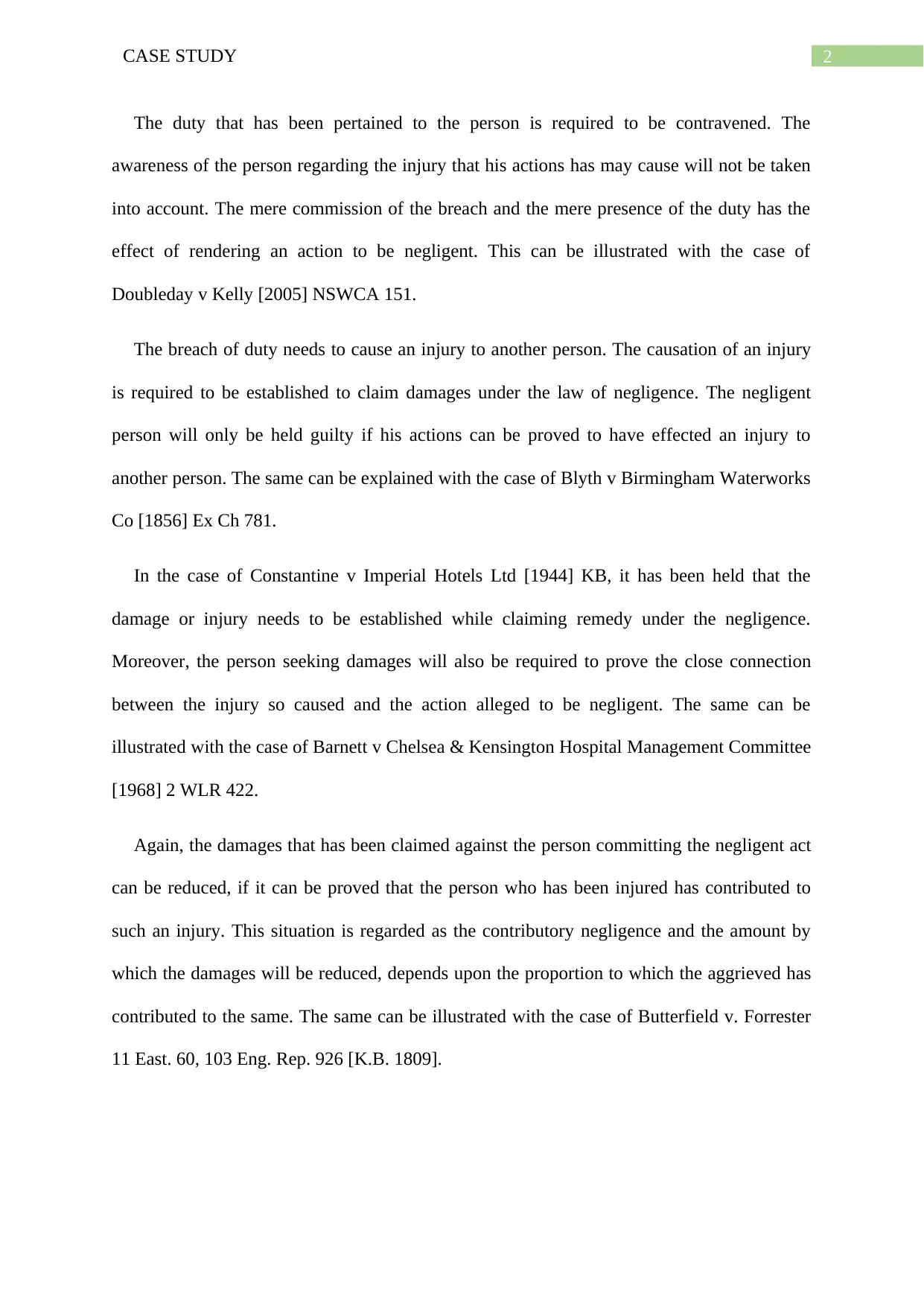
The duty that has been pertained to the person is required to be contravened. The
awareness of the person regarding the injury that his actions has may cause will not be taken
into account. The mere commission of the breach and the mere presence of the duty has the
effect of rendering an action to be negligent. This can be illustrated with the case of
Doubleday v Kelly [2005] NSWCA 151.
The breach of duty needs to cause an injury to another person. The causation of an injury
is required to be established to claim damages under the law of negligence. The negligent
person will only be held guilty if his actions can be proved to have effected an injury to
another person. The same can be explained with the case of Blyth v Birmingham Waterworks
Co [1856] Ex Ch 781.
In the case of Constantine v Imperial Hotels Ltd [1944] KB, it has been held that the
damage or injury needs to be established while claiming remedy under the negligence.
Moreover, the person seeking damages will also be required to prove the close connection
between the injury so caused and the action alleged to be negligent. The same can be
illustrated with the case of Barnett v Chelsea & Kensington Hospital Management Committee
[1968] 2 WLR 422.
Again, the damages that has been claimed against the person committing the negligent act
can be reduced, if it can be proved that the person who has been injured has contributed to
such an injury. This situation is regarded as the contributory negligence and the amount by
which the damages will be reduced, depends upon the proportion to which the aggrieved has
contributed to the same. The same can be illustrated with the case of Butterfield v. Forrester
11 East. 60, 103 Eng. Rep. 926 [K.B. 1809].
The duty that has been pertained to the person is required to be contravened. The
awareness of the person regarding the injury that his actions has may cause will not be taken
into account. The mere commission of the breach and the mere presence of the duty has the
effect of rendering an action to be negligent. This can be illustrated with the case of
Doubleday v Kelly [2005] NSWCA 151.
The breach of duty needs to cause an injury to another person. The causation of an injury
is required to be established to claim damages under the law of negligence. The negligent
person will only be held guilty if his actions can be proved to have effected an injury to
another person. The same can be explained with the case of Blyth v Birmingham Waterworks
Co [1856] Ex Ch 781.
In the case of Constantine v Imperial Hotels Ltd [1944] KB, it has been held that the
damage or injury needs to be established while claiming remedy under the negligence.
Moreover, the person seeking damages will also be required to prove the close connection
between the injury so caused and the action alleged to be negligent. The same can be
illustrated with the case of Barnett v Chelsea & Kensington Hospital Management Committee
[1968] 2 WLR 422.
Again, the damages that has been claimed against the person committing the negligent act
can be reduced, if it can be proved that the person who has been injured has contributed to
such an injury. This situation is regarded as the contributory negligence and the amount by
which the damages will be reduced, depends upon the proportion to which the aggrieved has
contributed to the same. The same can be illustrated with the case of Butterfield v. Forrester
11 East. 60, 103 Eng. Rep. 926 [K.B. 1809].
⊘ This is a preview!⊘
Do you want full access?
Subscribe today to unlock all pages.

Trusted by 1+ million students worldwide

3CASE STUDY
Application
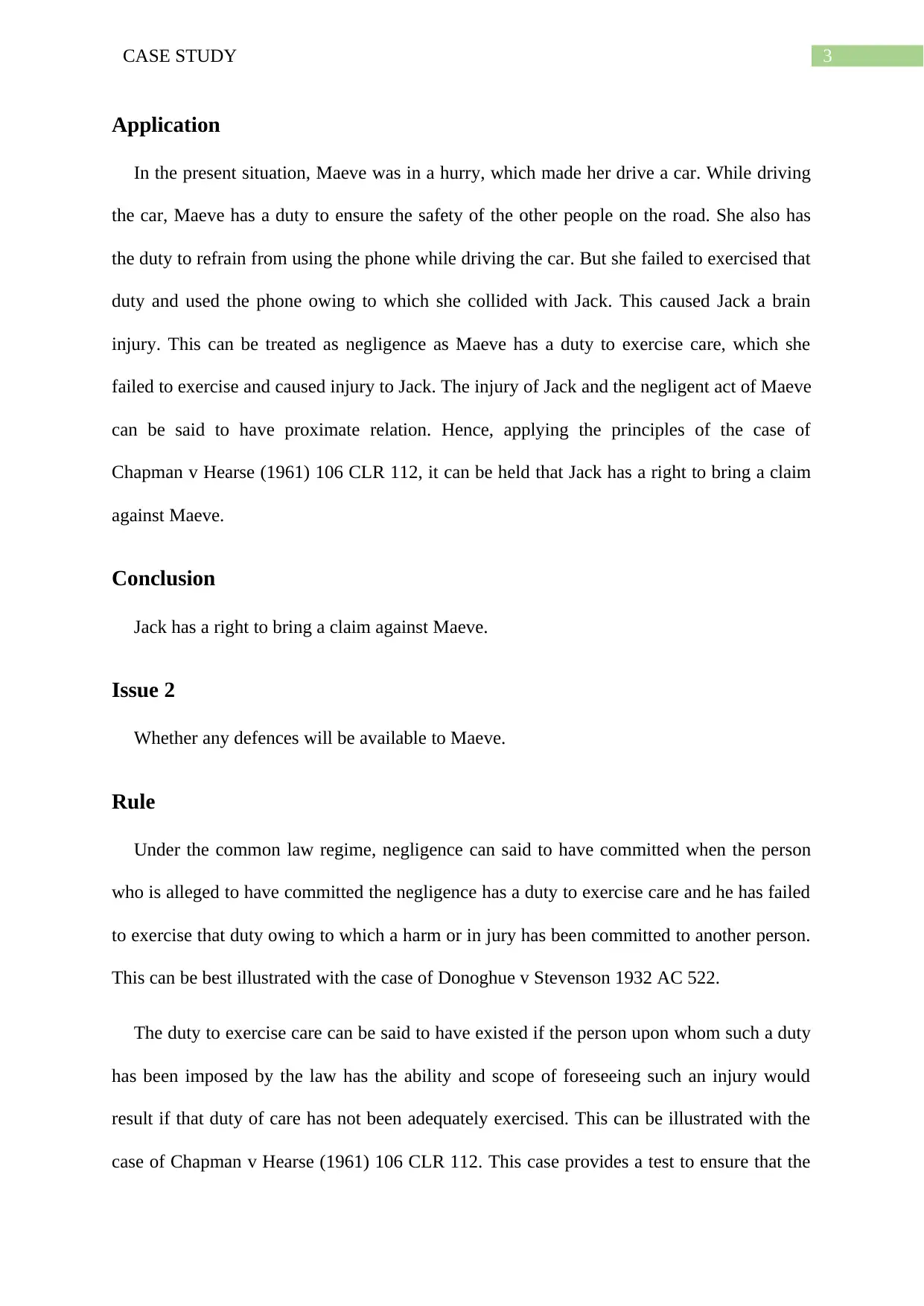
In the present situation, Maeve was in a hurry, which made her drive a car. While driving
the car, Maeve has a duty to ensure the safety of the other people on the road. She also has
the duty to refrain from using the phone while driving the car. But she failed to exercised that
duty and used the phone owing to which she collided with Jack. This caused Jack a brain
injury. This can be treated as negligence as Maeve has a duty to exercise care, which she
failed to exercise and caused injury to Jack. The injury of Jack and the negligent act of Maeve
can be said to have proximate relation. Hence, applying the principles of the case of
Chapman v Hearse (1961) 106 CLR 112, it can be held that Jack has a right to bring a claim
against Maeve.
Conclusion
Jack has a right to bring a claim against Maeve.
Issue 2
Whether any defences will be available to Maeve.
Rule
Under the common law regime, negligence can said to have committed when the person
who is alleged to have committed the negligence has a duty to exercise care and he has failed
to exercise that duty owing to which a harm or in jury has been committed to another person.
This can be best illustrated with the case of Donoghue v Stevenson 1932 AC 522.
The duty to exercise care can be said to have existed if the person upon whom such a duty
has been imposed by the law has the ability and scope of foreseeing such an injury would
result if that duty of care has not been adequately exercised. This can be illustrated with the
case of Chapman v Hearse (1961) 106 CLR 112. This case provides a test to ensure that the
Application
In the present situation, Maeve was in a hurry, which made her drive a car. While driving
the car, Maeve has a duty to ensure the safety of the other people on the road. She also has
the duty to refrain from using the phone while driving the car. But she failed to exercised that
duty and used the phone owing to which she collided with Jack. This caused Jack a brain
injury. This can be treated as negligence as Maeve has a duty to exercise care, which she
failed to exercise and caused injury to Jack. The injury of Jack and the negligent act of Maeve
can be said to have proximate relation. Hence, applying the principles of the case of
Chapman v Hearse (1961) 106 CLR 112, it can be held that Jack has a right to bring a claim
against Maeve.
Conclusion
Jack has a right to bring a claim against Maeve.
Issue 2
Whether any defences will be available to Maeve.
Rule
Under the common law regime, negligence can said to have committed when the person
who is alleged to have committed the negligence has a duty to exercise care and he has failed
to exercise that duty owing to which a harm or in jury has been committed to another person.
This can be best illustrated with the case of Donoghue v Stevenson 1932 AC 522.
The duty to exercise care can be said to have existed if the person upon whom such a duty
has been imposed by the law has the ability and scope of foreseeing such an injury would
result if that duty of care has not been adequately exercised. This can be illustrated with the
case of Chapman v Hearse (1961) 106 CLR 112. This case provides a test to ensure that the
Paraphrase This Document
Need a fresh take? Get an instant paraphrase of this document with our AI Paraphraser

4CASE STUDY
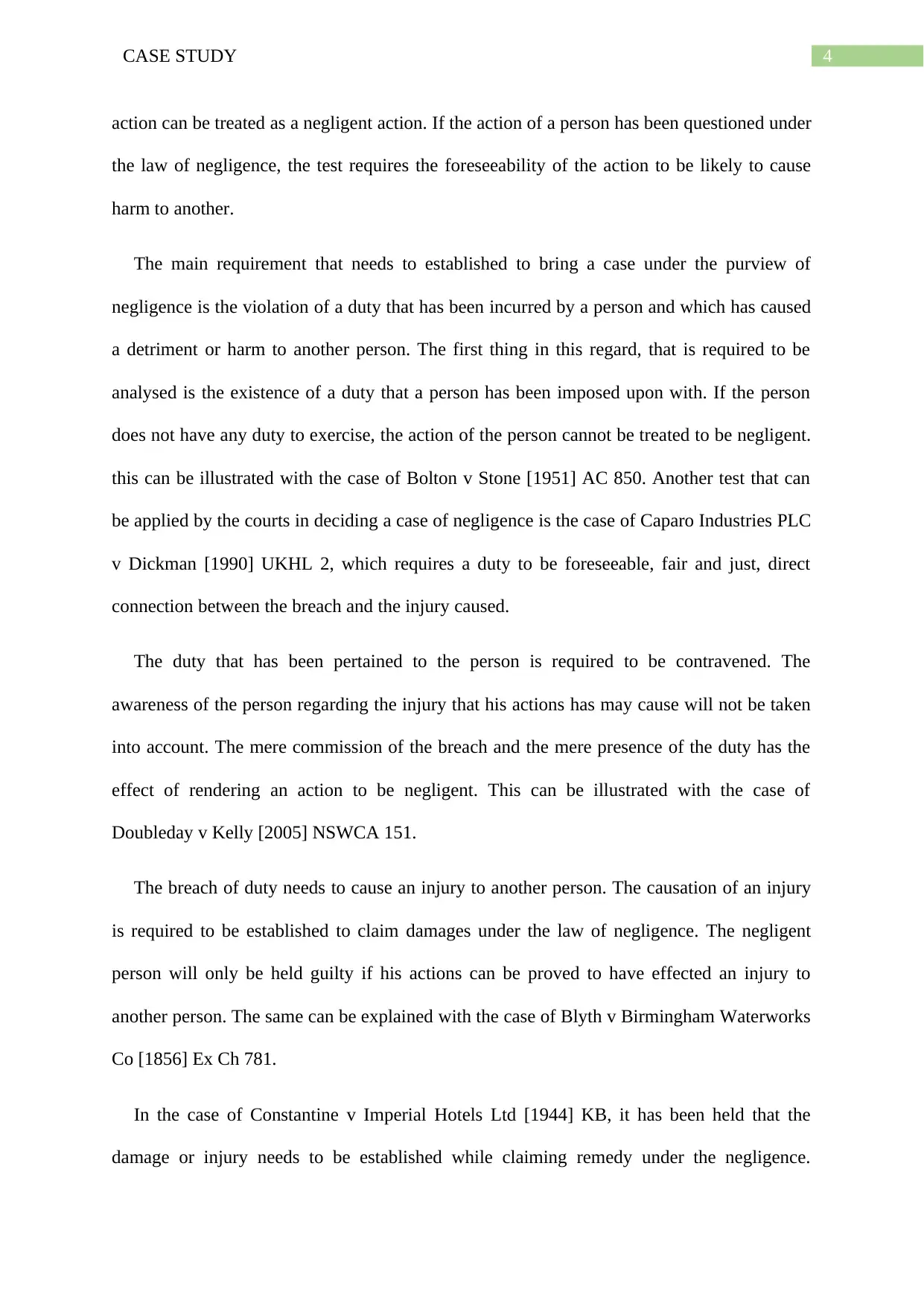
action can be treated as a negligent action. If the action of a person has been questioned under
the law of negligence, the test requires the foreseeability of the action to be likely to cause
harm to another.
The main requirement that needs to established to bring a case under the purview of
negligence is the violation of a duty that has been incurred by a person and which has caused
a detriment or harm to another person. The first thing in this regard, that is required to be
analysed is the existence of a duty that a person has been imposed upon with. If the person
does not have any duty to exercise, the action of the person cannot be treated to be negligent.
this can be illustrated with the case of Bolton v Stone [1951] AC 850. Another test that can
be applied by the courts in deciding a case of negligence is the case of Caparo Industries PLC
v Dickman [1990] UKHL 2, which requires a duty to be foreseeable, fair and just, direct
connection between the breach and the injury caused.
The duty that has been pertained to the person is required to be contravened. The
awareness of the person regarding the injury that his actions has may cause will not be taken
into account. The mere commission of the breach and the mere presence of the duty has the
effect of rendering an action to be negligent. This can be illustrated with the case of
Doubleday v Kelly [2005] NSWCA 151.
The breach of duty needs to cause an injury to another person. The causation of an injury
is required to be established to claim damages under the law of negligence. The negligent
person will only be held guilty if his actions can be proved to have effected an injury to
another person. The same can be explained with the case of Blyth v Birmingham Waterworks
Co [1856] Ex Ch 781.
In the case of Constantine v Imperial Hotels Ltd [1944] KB, it has been held that the
damage or injury needs to be established while claiming remedy under the negligence.
action can be treated as a negligent action. If the action of a person has been questioned under
the law of negligence, the test requires the foreseeability of the action to be likely to cause
harm to another.
The main requirement that needs to established to bring a case under the purview of
negligence is the violation of a duty that has been incurred by a person and which has caused
a detriment or harm to another person. The first thing in this regard, that is required to be
analysed is the existence of a duty that a person has been imposed upon with. If the person
does not have any duty to exercise, the action of the person cannot be treated to be negligent.
this can be illustrated with the case of Bolton v Stone [1951] AC 850. Another test that can
be applied by the courts in deciding a case of negligence is the case of Caparo Industries PLC
v Dickman [1990] UKHL 2, which requires a duty to be foreseeable, fair and just, direct
connection between the breach and the injury caused.
The duty that has been pertained to the person is required to be contravened. The
awareness of the person regarding the injury that his actions has may cause will not be taken
into account. The mere commission of the breach and the mere presence of the duty has the
effect of rendering an action to be negligent. This can be illustrated with the case of
Doubleday v Kelly [2005] NSWCA 151.
The breach of duty needs to cause an injury to another person. The causation of an injury
is required to be established to claim damages under the law of negligence. The negligent
person will only be held guilty if his actions can be proved to have effected an injury to
another person. The same can be explained with the case of Blyth v Birmingham Waterworks
Co [1856] Ex Ch 781.
In the case of Constantine v Imperial Hotels Ltd [1944] KB, it has been held that the
damage or injury needs to be established while claiming remedy under the negligence.

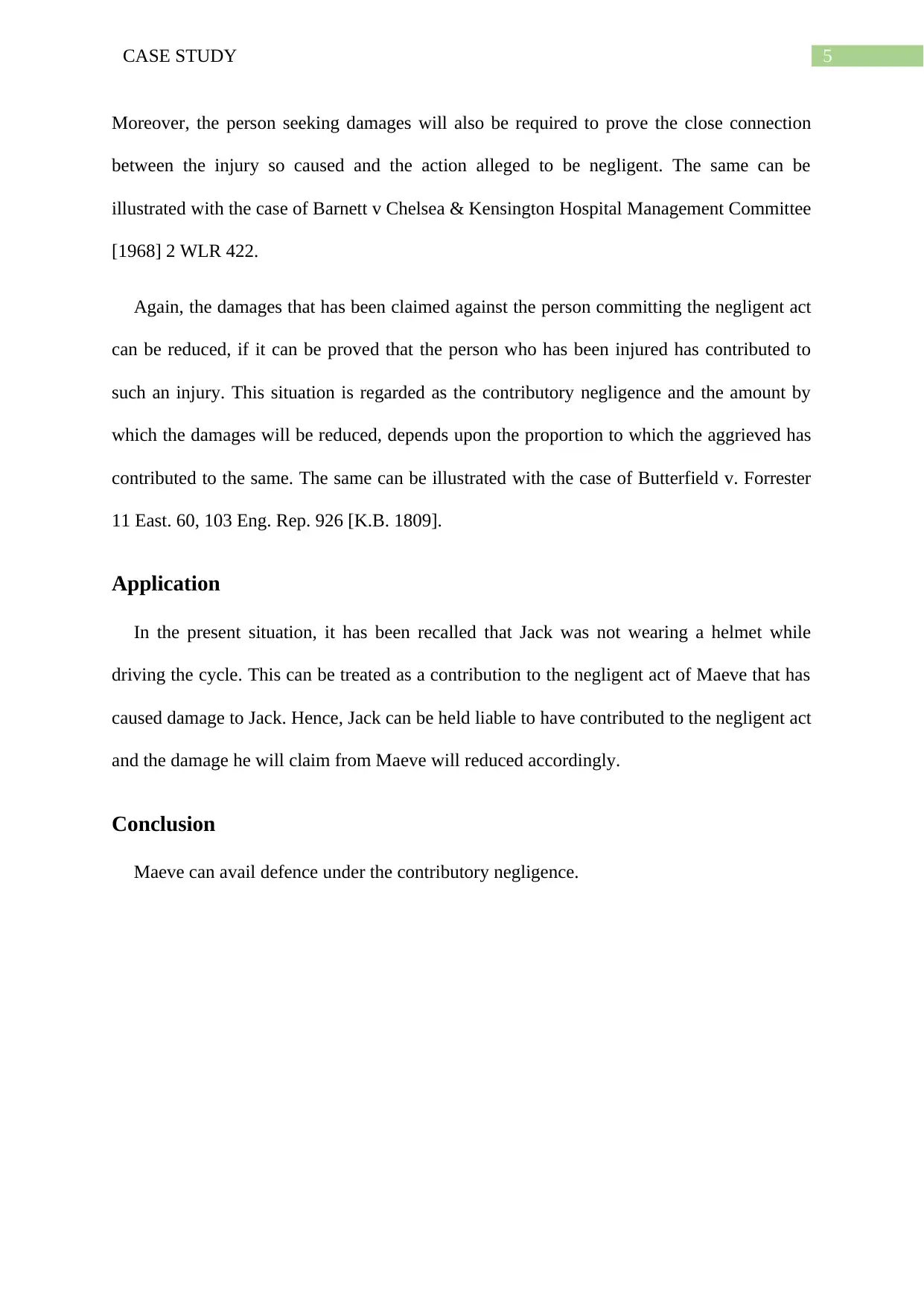
5CASE STUDY
Moreover, the person seeking damages will also be required to prove the close connection
between the injury so caused and the action alleged to be negligent. The same can be
illustrated with the case of Barnett v Chelsea & Kensington Hospital Management Committee
[1968] 2 WLR 422.
Again, the damages that has been claimed against the person committing the negligent act
can be reduced, if it can be proved that the person who has been injured has contributed to
such an injury. This situation is regarded as the contributory negligence and the amount by
which the damages will be reduced, depends upon the proportion to which the aggrieved has
contributed to the same. The same can be illustrated with the case of Butterfield v. Forrester
11 East. 60, 103 Eng. Rep. 926 [K.B. 1809].
Application
In the present situation, it has been recalled that Jack was not wearing a helmet while
driving the cycle. This can be treated as a contribution to the negligent act of Maeve that has
caused damage to Jack. Hence, Jack can be held liable to have contributed to the negligent act
and the damage he will claim from Maeve will reduced accordingly.
Conclusion
Maeve can avail defence under the contributory negligence.
Moreover, the person seeking damages will also be required to prove the close connection
between the injury so caused and the action alleged to be negligent. The same can be
illustrated with the case of Barnett v Chelsea & Kensington Hospital Management Committee
[1968] 2 WLR 422.
Again, the damages that has been claimed against the person committing the negligent act
can be reduced, if it can be proved that the person who has been injured has contributed to
such an injury. This situation is regarded as the contributory negligence and the amount by
which the damages will be reduced, depends upon the proportion to which the aggrieved has
contributed to the same. The same can be illustrated with the case of Butterfield v. Forrester
11 East. 60, 103 Eng. Rep. 926 [K.B. 1809].
Application
In the present situation, it has been recalled that Jack was not wearing a helmet while
driving the cycle. This can be treated as a contribution to the negligent act of Maeve that has
caused damage to Jack. Hence, Jack can be held liable to have contributed to the negligent act
and the damage he will claim from Maeve will reduced accordingly.
Conclusion
Maeve can avail defence under the contributory negligence.
⊘ This is a preview!⊘
Do you want full access?
Subscribe today to unlock all pages.

Trusted by 1+ million students worldwide

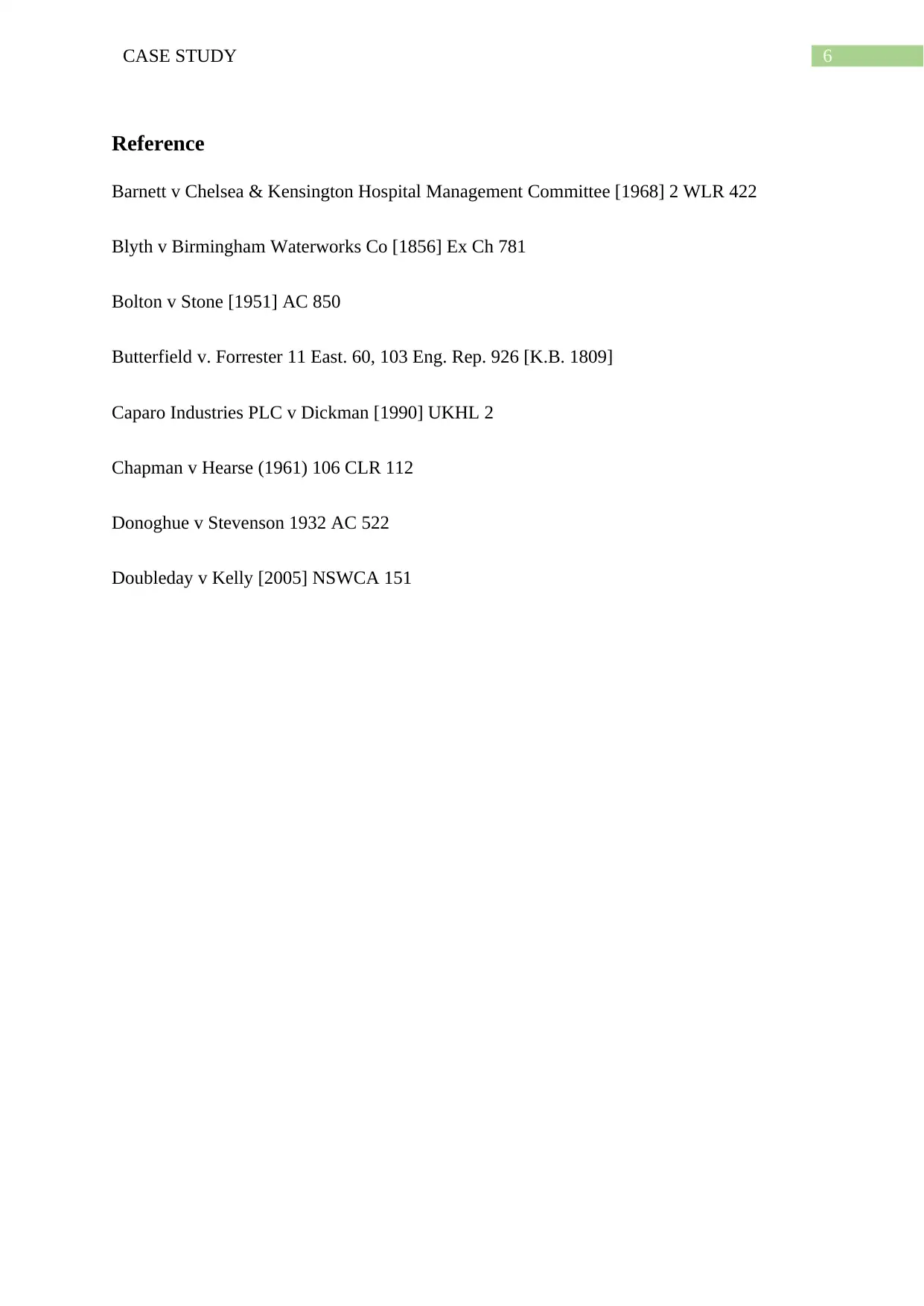
6CASE STUDY
Reference
Barnett v Chelsea & Kensington Hospital Management Committee [1968] 2 WLR 422
Blyth v Birmingham Waterworks Co [1856] Ex Ch 781
Bolton v Stone [1951] AC 850
Butterfield v. Forrester 11 East. 60, 103 Eng. Rep. 926 [K.B. 1809]
Caparo Industries PLC v Dickman [1990] UKHL 2
Chapman v Hearse (1961) 106 CLR 112
Donoghue v Stevenson 1932 AC 522
Doubleday v Kelly [2005] NSWCA 151
Reference
Barnett v Chelsea & Kensington Hospital Management Committee [1968] 2 WLR 422
Blyth v Birmingham Waterworks Co [1856] Ex Ch 781
Bolton v Stone [1951] AC 850
Butterfield v. Forrester 11 East. 60, 103 Eng. Rep. 926 [K.B. 1809]
Caparo Industries PLC v Dickman [1990] UKHL 2
Chapman v Hearse (1961) 106 CLR 112
Donoghue v Stevenson 1932 AC 522
Doubleday v Kelly [2005] NSWCA 151
1 out of 7
Related Documents
Your All-in-One AI-Powered Toolkit for Academic Success.
 +13062052269
info@desklib.com
Available 24*7 on WhatsApp / Email
Unlock your academic potential
Copyright © 2020–2025 A2Z Services. All Rights Reserved. Developed and managed by ZUCOL.