Negotiation Case Report: Distributive Bargaining Strategy Analysis

Verified

Added on  2022/08/19

|7
|1081
|10
Report
AI Summary
This report presents an analysis of a negotiation case study, examining the application of distributive bargaining strategies. The case involves a negotiation between two parties, focusing on their approaches, tactics, and the final agreement. The report explores the actions of each party, assessing their understanding of the situation, their negotiation skills, and the elements of distributive bargaining they employed. It identifies the key issues, such as the handling of information and the setting of goals. The analysis includes an evaluation of the strengths and weaknesses of each negotiator's approach, with a focus on the tactics used to influence the other party's perceptions and the management of the negotiation process. The report also includes a review of the elements of distributive bargaining applied in the case, with a focus on competition and collaboration. Ultimately, the report concludes with an evaluation of the negotiation's outcome.
Document Page
Running Head: NEGOTIATION CASE REPORT 1
Negotiation case report
Student’s name
Institution affiliation
tabler-icon-diamond-filled.svg

Paraphrase This Document

Need a fresh take? Get an instant paraphrase of this document with our AI Paraphraser
Document Page
NEGOTIATION CASE REPORT 2
Case’s video report
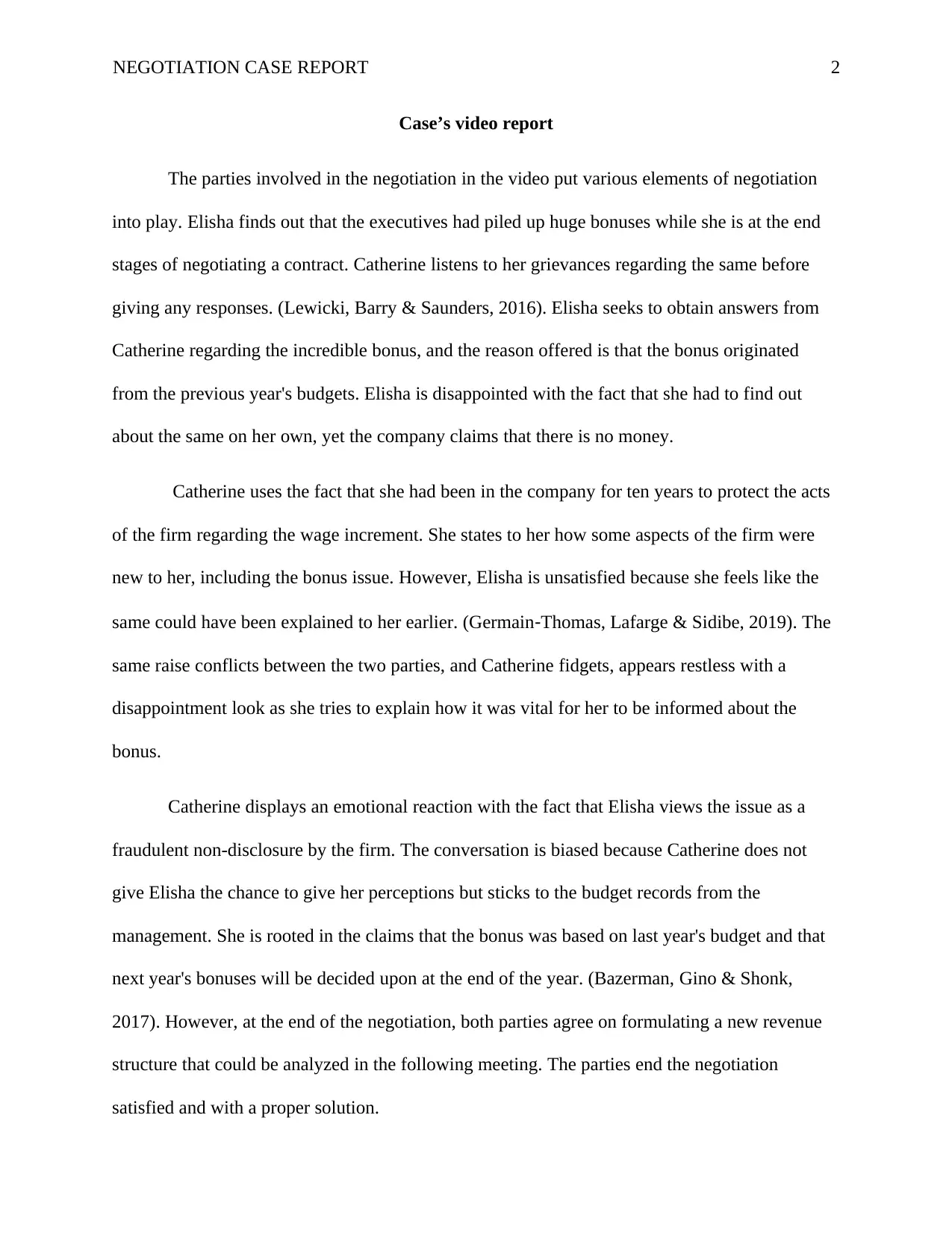
The parties involved in the negotiation in the video put various elements of negotiation
into play. Elisha finds out that the executives had piled up huge bonuses while she is at the end
stages of negotiating a contract. Catherine listens to her grievances regarding the same before
giving any responses. (Lewicki, Barry & Saunders, 2016). Elisha seeks to obtain answers from
Catherine regarding the incredible bonus, and the reason offered is that the bonus originated
from the previous year's budgets. Elisha is disappointed with the fact that she had to find out
about the same on her own, yet the company claims that there is no money.
Catherine uses the fact that she had been in the company for ten years to protect the acts
of the firm regarding the wage increment. She states to her how some aspects of the firm were
new to her, including the bonus issue. However, Elisha is unsatisfied because she feels like the
same could have been explained to her earlier. (GermainThomas, Lafarge & Sidibe, 2019). The
same raise conflicts between the two parties, and Catherine fidgets, appears restless with a
disappointment look as she tries to explain how it was vital for her to be informed about the
bonus.
Catherine displays an emotional reaction with the fact that Elisha views the issue as a
fraudulent non-disclosure by the firm. The conversation is biased because Catherine does not
give Elisha the chance to give her perceptions but sticks to the budget records from the
management. She is rooted in the claims that the bonus was based on last year's budget and that
next year's bonuses will be decided upon at the end of the year. (Bazerman, Gino & Shonk,
2017). However, at the end of the negotiation, both parties agree on formulating a new revenue
structure that could be analyzed in the following meeting. The parties end the negotiation
satisfied and with a proper solution.
Document Page
NEGOTIATION CASE REPORT 3
Analysis of each party’s situation
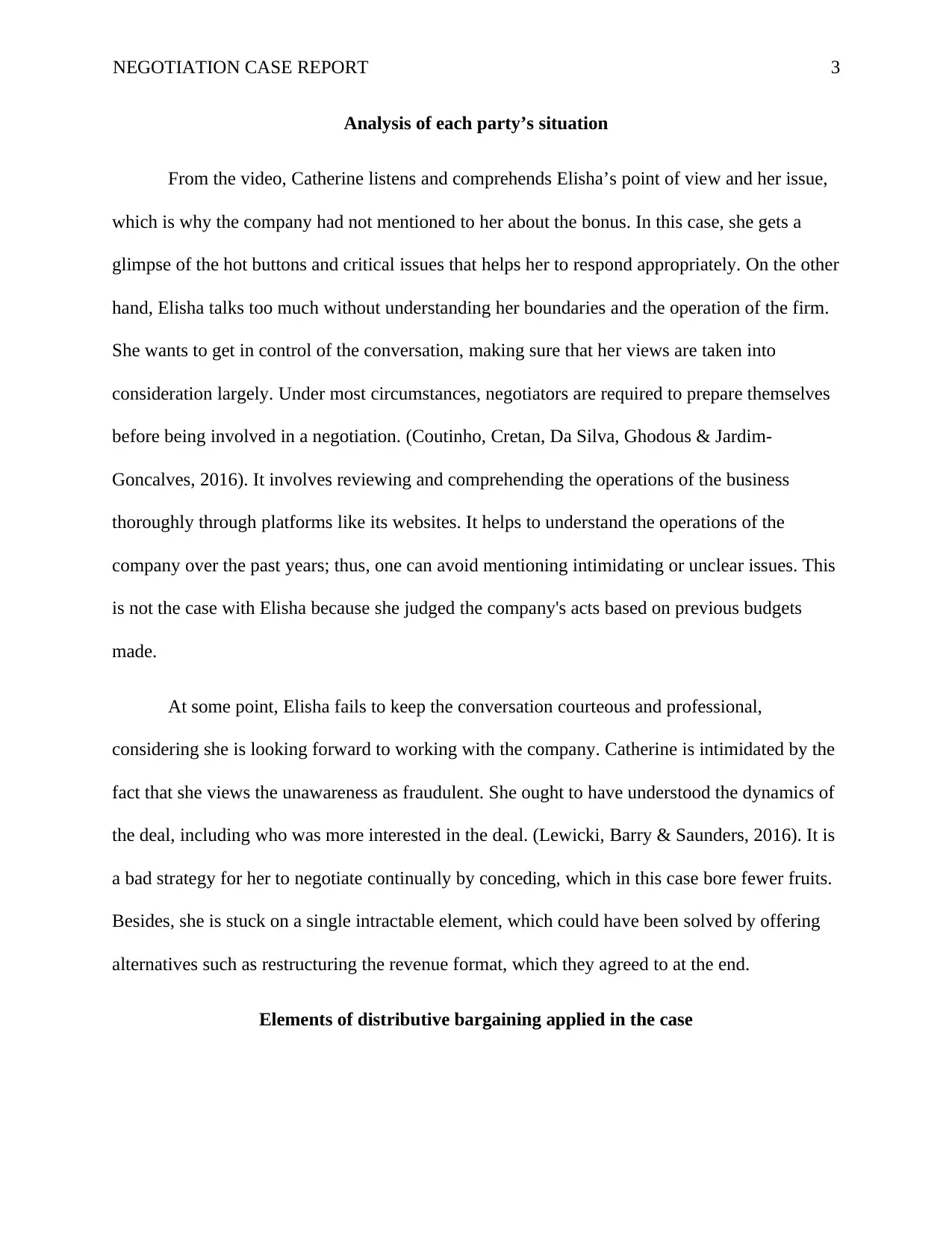
From the video, Catherine listens and comprehends Elisha’s point of view and her issue,
which is why the company had not mentioned to her about the bonus. In this case, she gets a
glimpse of the hot buttons and critical issues that helps her to respond appropriately. On the other
hand, Elisha talks too much without understanding her boundaries and the operation of the firm.
She wants to get in control of the conversation, making sure that her views are taken into
consideration largely. Under most circumstances, negotiators are required to prepare themselves
before being involved in a negotiation. (Coutinho, Cretan, Da Silva, Ghodous & Jardim-
Goncalves, 2016). It involves reviewing and comprehending the operations of the business
thoroughly through platforms like its websites. It helps to understand the operations of the
company over the past years; thus, one can avoid mentioning intimidating or unclear issues. This
is not the case with Elisha because she judged the company's acts based on previous budgets
made.
At some point, Elisha fails to keep the conversation courteous and professional,
considering she is looking forward to working with the company. Catherine is intimidated by the
fact that she views the unawareness as fraudulent. She ought to have understood the dynamics of
the deal, including who was more interested in the deal. (Lewicki, Barry & Saunders, 2016). It is
a bad strategy for her to negotiate continually by conceding, which in this case bore fewer fruits.
Besides, she is stuck on a single intractable element, which could have been solved by offering
alternatives such as restructuring the revenue format, which they agreed to at the end.
Elements of distributive bargaining applied in the case
Document Page
NEGOTIATION CASE REPORT 4
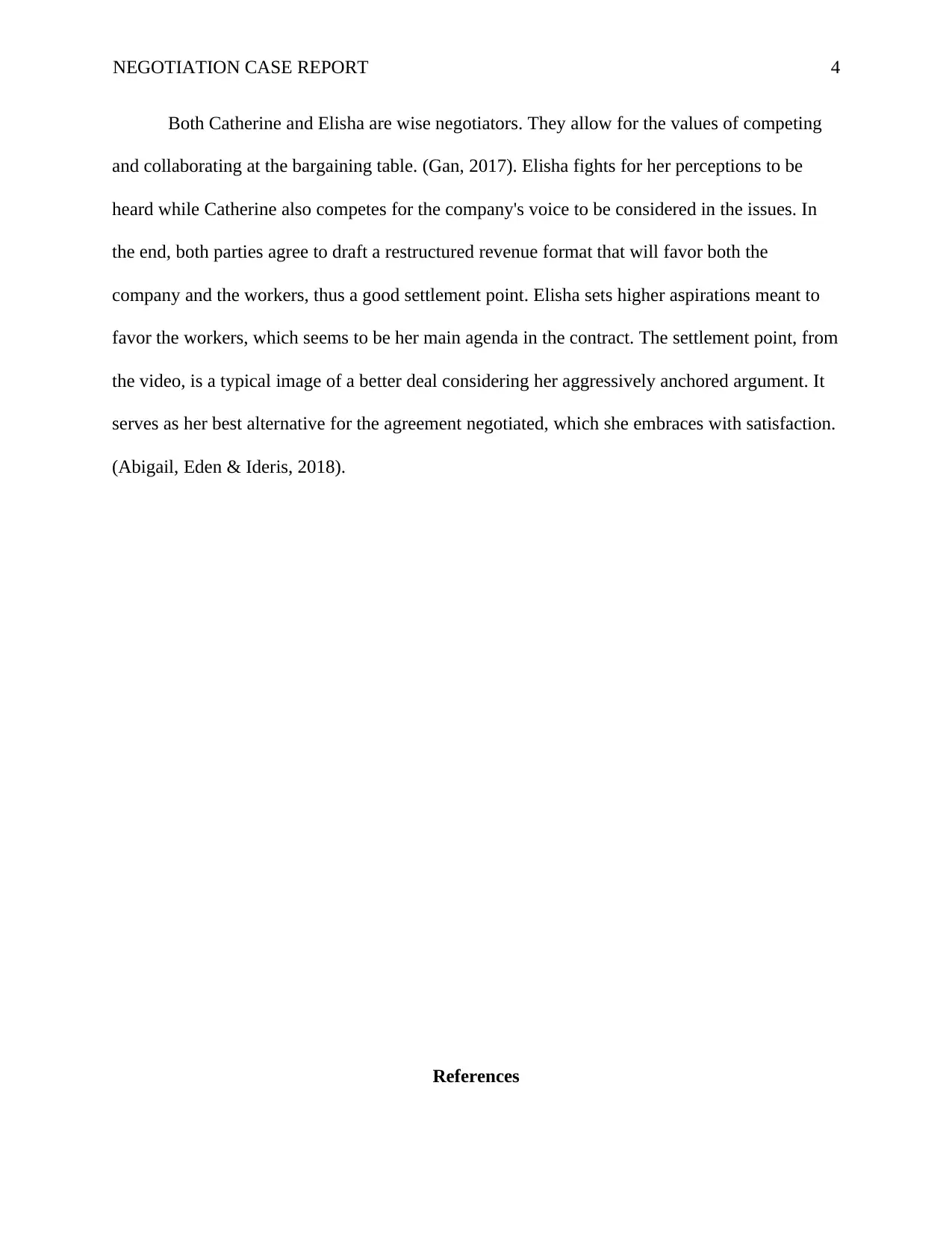
Both Catherine and Elisha are wise negotiators. They allow for the values of competing
and collaborating at the bargaining table. (Gan, 2017). Elisha fights for her perceptions to be
heard while Catherine also competes for the company's voice to be considered in the issues. In
the end, both parties agree to draft a restructured revenue format that will favor both the
company and the workers, thus a good settlement point. Elisha sets higher aspirations meant to
favor the workers, which seems to be her main agenda in the contract. The settlement point, from
the video, is a typical image of a better deal considering her aggressively anchored argument. It
serves as her best alternative for the agreement negotiated, which she embraces with satisfaction.
(Abigail, Eden & Ideris, 2018).
References
tabler-icon-diamond-filled.svg

Paraphrase This Document

Need a fresh take? Get an instant paraphrase of this document with our AI Paraphraser
Document Page
NEGOTIATION CASE REPORT 5
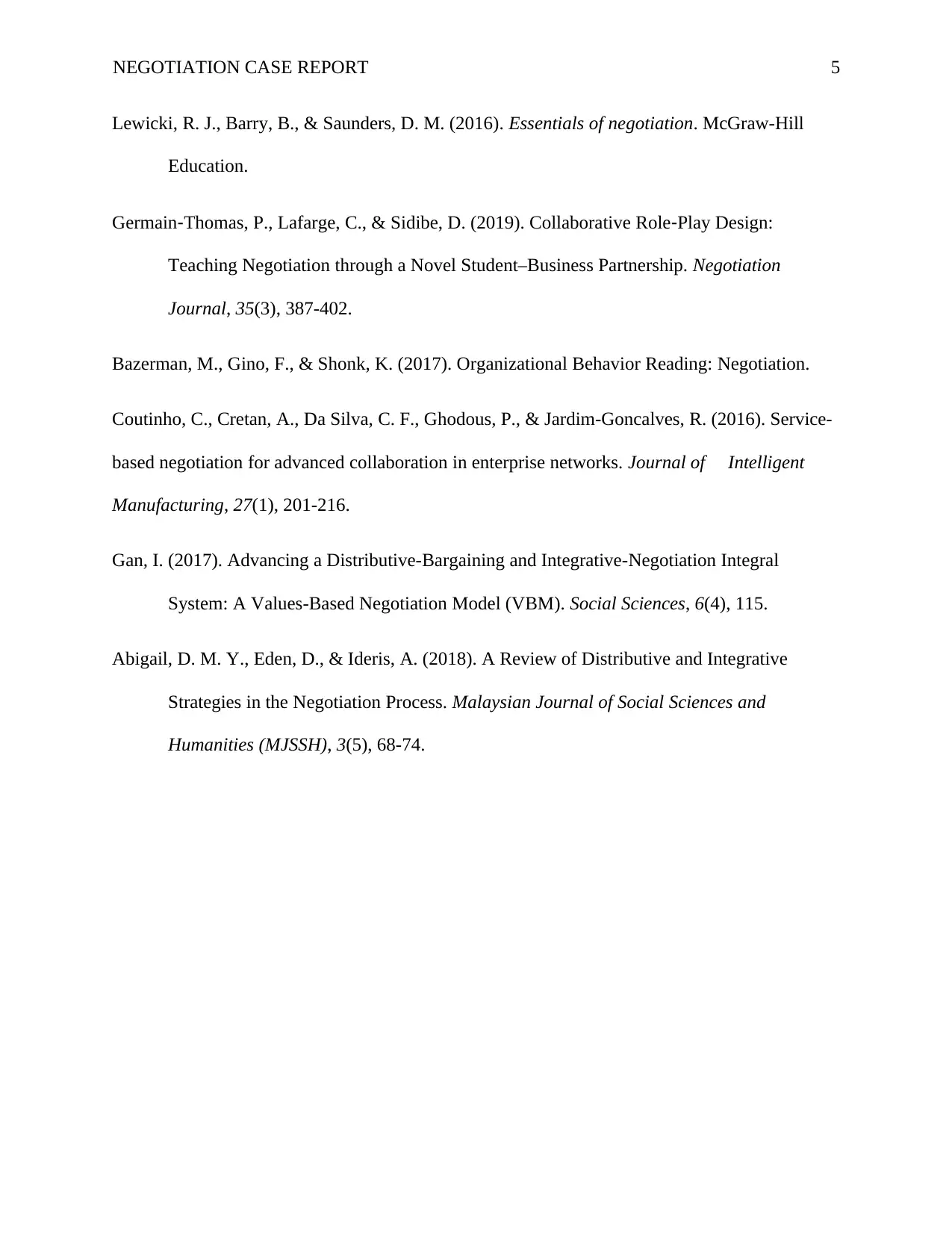
Lewicki, R. J., Barry, B., & Saunders, D. M. (2016). Essentials of negotiation. McGraw-Hill
Education.
GermainThomas, P., Lafarge, C., & Sidibe, D. (2019). Collaborative RolePlay Design:
Teaching Negotiation through a Novel Student–Business Partnership. Negotiation
Journal, 35(3), 387-402.
Bazerman, M., Gino, F., & Shonk, K. (2017). Organizational Behavior Reading: Negotiation.
Coutinho, C., Cretan, A., Da Silva, C. F., Ghodous, P., & Jardim-Goncalves, R. (2016). Service-
based negotiation for advanced collaboration in enterprise networks. Journal of Intelligent
Manufacturing, 27(1), 201-216.
Gan, I. (2017). Advancing a Distributive-Bargaining and Integrative-Negotiation Integral
System: A Values-Based Negotiation Model (VBM). Social Sciences, 6(4), 115.
Abigail, D. M. Y., Eden, D., & Ideris, A. (2018). A Review of Distributive and Integrative
Strategies in the Negotiation Process. Malaysian Journal of Social Sciences and
Humanities (MJSSH), 3(5), 68-74.
Document Page
NEGOTIATION CASE REPORT 6
Document Page
NEGOTIATION CASE REPORT 7
chevron_up_icon
1 out of 7
circle_padding
hide_on_mobile
zoom_out_icon
[object Object]