Negotiation Strategies, Skills, Techniques, and Cultural Awareness
VerifiedAdded on 2021/05/26
|5
|1312
|241
Essay
AI Summary
This essay provides a comprehensive introduction to negotiation, defining it as a process of conflict resolution through compromise and settlement. It explores theory-based strategies, emphasizing interest-based negotiation, anticipating biases, and considering multilateral agreements. The essay details evidence-based approaches, including preparation, understanding your reservation point (RP), target point (TP), and Best Alternative to a Negotiated Agreement (BATNA). It highlights the importance of knowing your counterparty and the principles of effective negotiation, such as separating people from issues, focusing on interests, exploring mutual benefits, and using objective criteria. The essay also emphasizes the significance of cultural awareness in negotiation and provides insights into negotiation styles in the UK. It concludes by underscoring the need for international managers to understand cultural nuances and employ effective techniques for successful business agreements.

Negotiation
Paraphrase This Document
Need a fresh take? Get an instant paraphrase of this document with our AI Paraphraser

Introduction
Negotiation is a process by which conflicts are resolved by individuals. It is a method by which
settlement or compromise is achieved while preventing conflict and argument.
People apparently try to obtain the best possible result with their role in any conflict (or perhaps
an organization they represent). The ideals of justice, the quest for shared gain and the
continuation of a relationship are therefore the keys to a good result.
Theory based strategy relating to the principles of negotiation
Negotiation philosophy finds that the best method of determining the other side and explore new
forms of meaning is a constructive strategy.
The philosophy of negotiating suggests you that to concentrate on goals, not positions, and aim
to create deals that are almost self-enforcing. There are three concepts of negotiating strategy
that can be extremely useful in attempts to negotiate solutions to several issues:
Interest focus: Interest-based negotiation, which entails discussing the deeper objectives
underlying the roles identified by negotiators, will help parties recognize possible
tradeoffs and mutual benefit opportunities.
Anticipate points of bias: We are also subject to predictable biases and other perceptual
failures under the best case scenarios. In-group bias, for example, will prevent people
from equitably allocating resources among classes.
Agreement between groups: A host of other agreements are also required with every
agreement we achieve. Multilateral negotiation is also needed in many conflicts and
business negotiations.
This is why, while still integrating all stakeholders, negotiation theory has to take into account
the existing experiences of those at the table. Negotiators need to anticipate anyone who will
have to suffer the detrimental effects of a contract, including their coworkers, children, and
neighborhoods, in order to reach sustainable agreements.
Evidence based approaches relating to the skills and techniques needed to be an effective
negotiator:
Preparation:
Negotiating progress is assured by training. Negotiation is a process, not an occurrence, and
preparing is part of what goes into a good negotiation. If you brace for the forthcoming
negotiations, there are two things to ask yourself:
Negotiation is a process by which conflicts are resolved by individuals. It is a method by which
settlement or compromise is achieved while preventing conflict and argument.
People apparently try to obtain the best possible result with their role in any conflict (or perhaps
an organization they represent). The ideals of justice, the quest for shared gain and the
continuation of a relationship are therefore the keys to a good result.
Theory based strategy relating to the principles of negotiation
Negotiation philosophy finds that the best method of determining the other side and explore new
forms of meaning is a constructive strategy.
The philosophy of negotiating suggests you that to concentrate on goals, not positions, and aim
to create deals that are almost self-enforcing. There are three concepts of negotiating strategy
that can be extremely useful in attempts to negotiate solutions to several issues:
Interest focus: Interest-based negotiation, which entails discussing the deeper objectives
underlying the roles identified by negotiators, will help parties recognize possible
tradeoffs and mutual benefit opportunities.
Anticipate points of bias: We are also subject to predictable biases and other perceptual
failures under the best case scenarios. In-group bias, for example, will prevent people
from equitably allocating resources among classes.
Agreement between groups: A host of other agreements are also required with every
agreement we achieve. Multilateral negotiation is also needed in many conflicts and
business negotiations.
This is why, while still integrating all stakeholders, negotiation theory has to take into account
the existing experiences of those at the table. Negotiators need to anticipate anyone who will
have to suffer the detrimental effects of a contract, including their coworkers, children, and
neighborhoods, in order to reach sustainable agreements.
Evidence based approaches relating to the skills and techniques needed to be an effective
negotiator:
Preparation:
Negotiating progress is assured by training. Negotiation is a process, not an occurrence, and
preparing is part of what goes into a good negotiation. If you brace for the forthcoming
negotiations, there are two things to ask yourself:

What would I want?
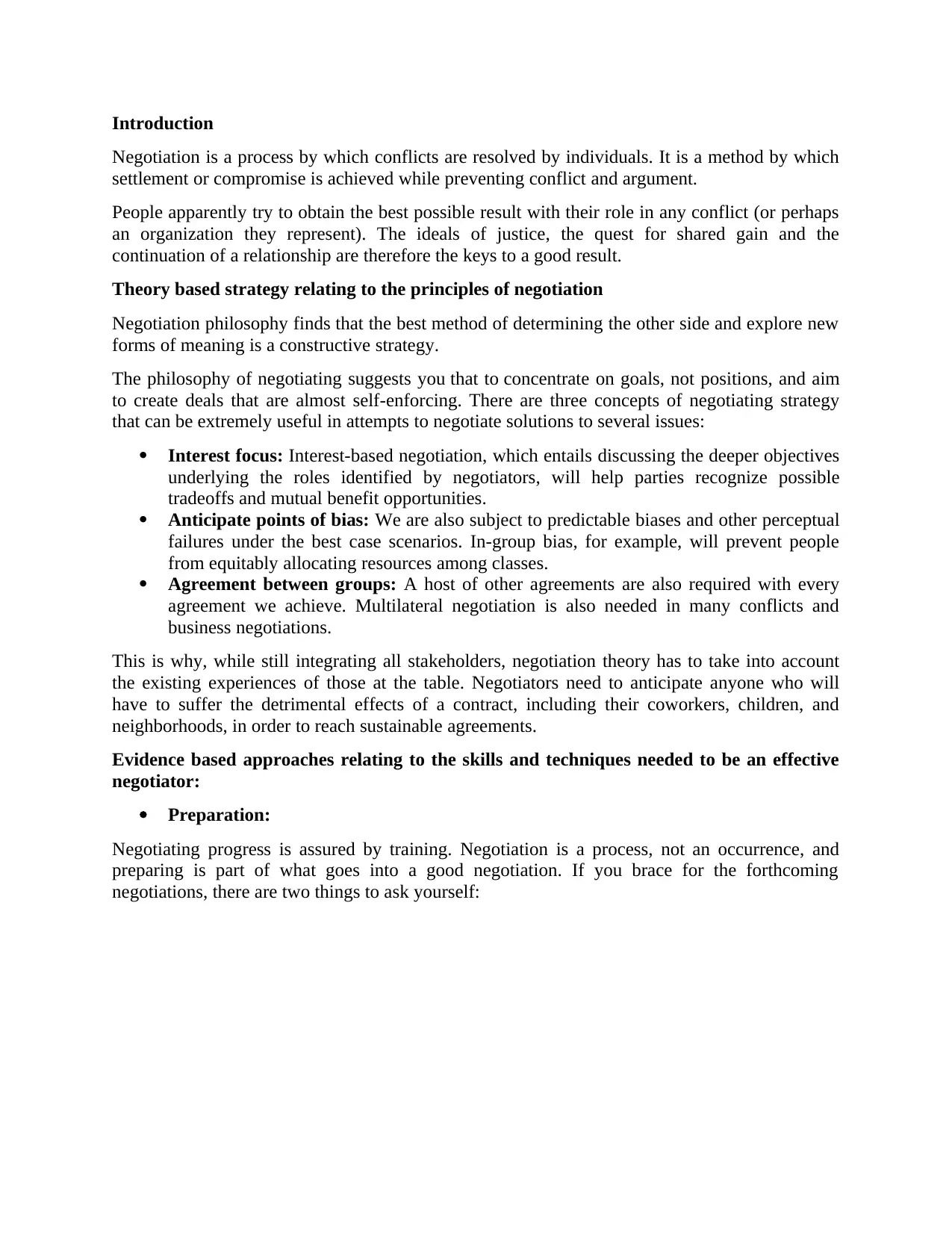
In a deal, what you want is considered your target point (TP). You must comprehend your
desires in order to decide this. The ''why'' of the agreement are your desires and the better you
know your ''why'' the better you can describe your TP, and build new ways to do so.
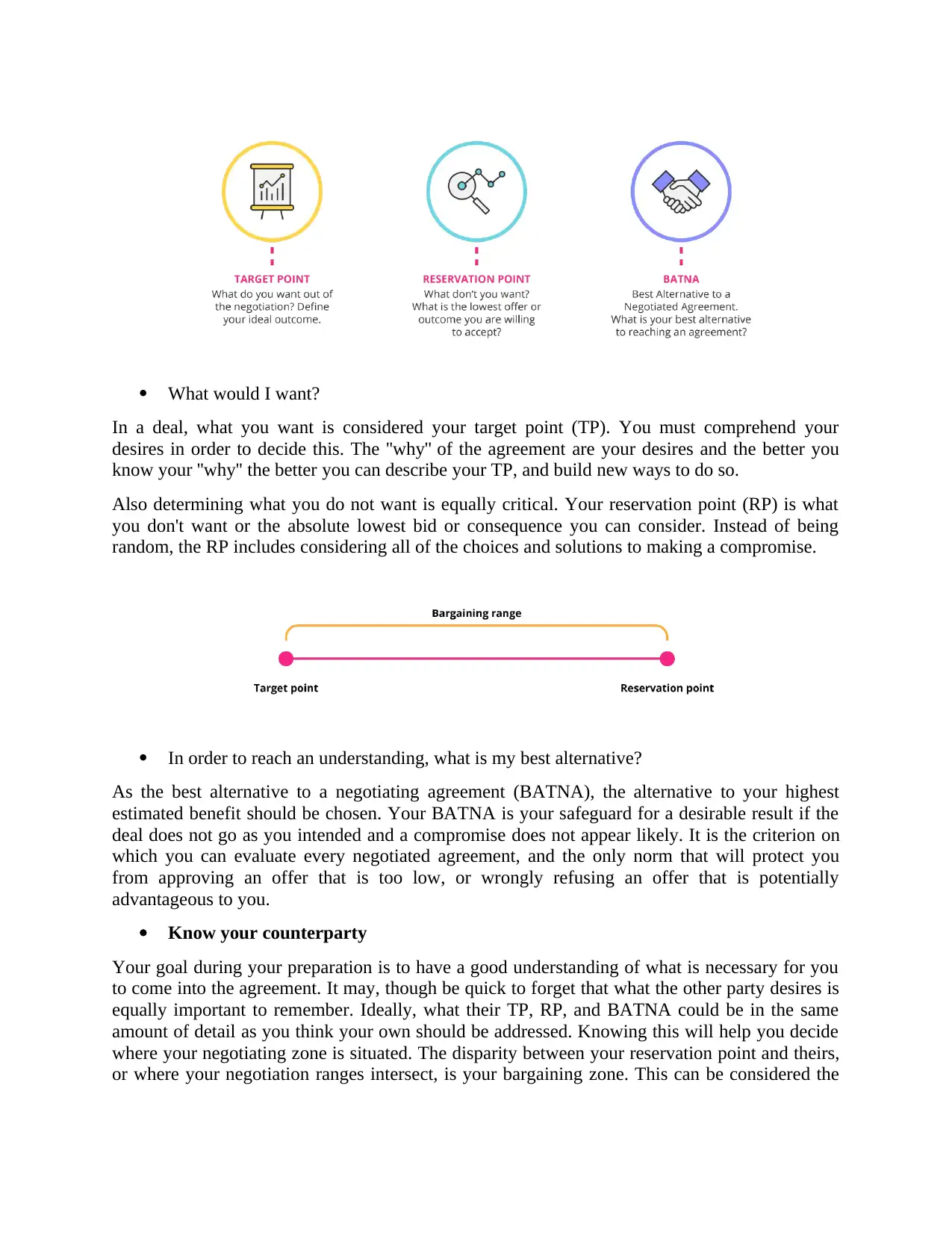
Also determining what you do not want is equally critical. Your reservation point (RP) is what
you don't want or the absolute lowest bid or consequence you can consider. Instead of being
random, the RP includes considering all of the choices and solutions to making a compromise.
In order to reach an understanding, what is my best alternative?
As the best alternative to a negotiating agreement (BATNA), the alternative to your highest
estimated benefit should be chosen. Your BATNA is your safeguard for a desirable result if the
deal does not go as you intended and a compromise does not appear likely. It is the criterion on
which you can evaluate every negotiated agreement, and the only norm that will protect you
from approving an offer that is too low, or wrongly refusing an offer that is potentially
advantageous to you.
Know your counterparty
Your goal during your preparation is to have a good understanding of what is necessary for you
to come into the agreement. It may, though be quick to forget that what the other party desires is
equally important to remember. Ideally, what their TP, RP, and BATNA could be in the same
amount of detail as you think your own should be addressed. Knowing this will help you decide
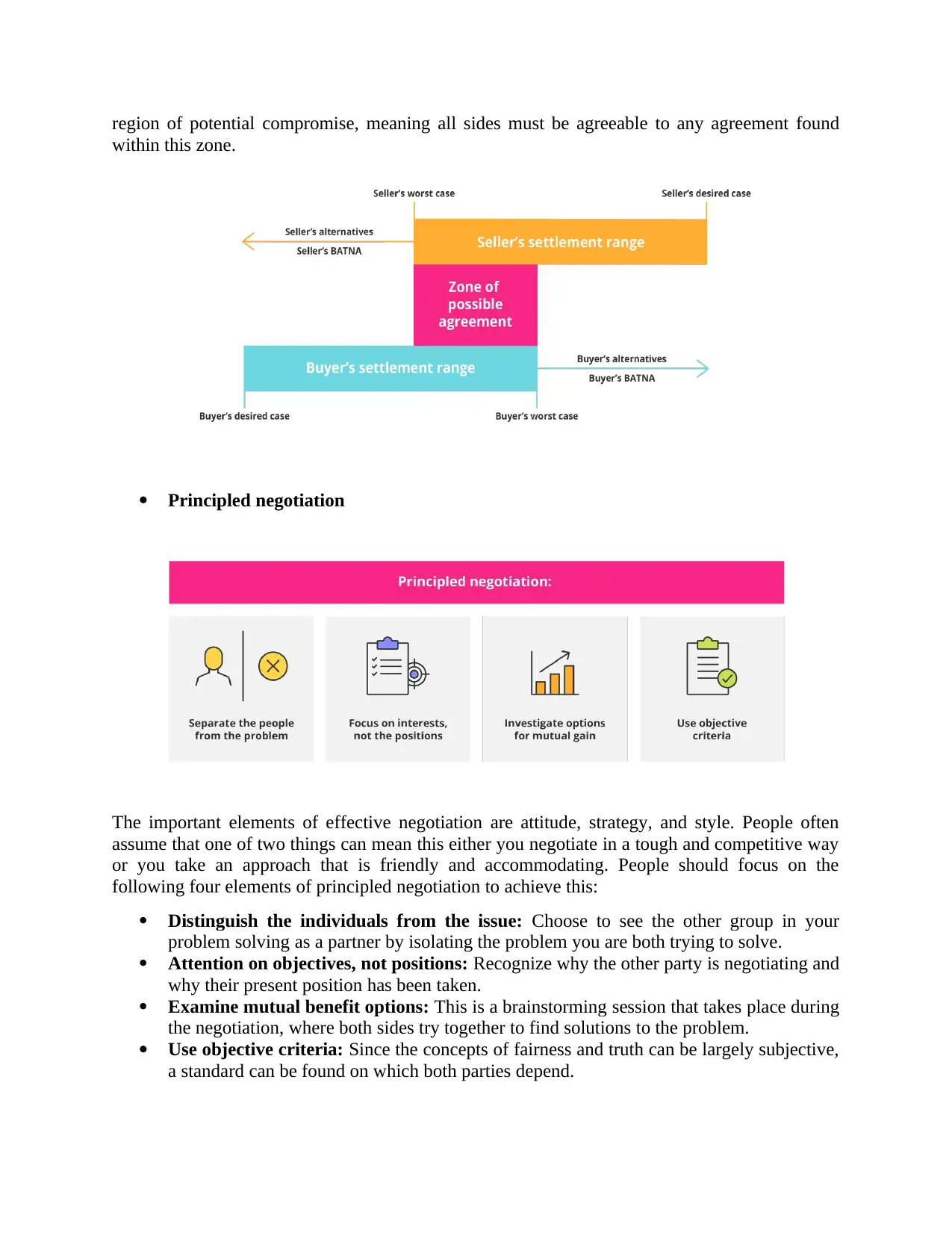
where your negotiating zone is situated. The disparity between your reservation point and theirs,
or where your negotiation ranges intersect, is your bargaining zone. This can be considered the
In a deal, what you want is considered your target point (TP). You must comprehend your
desires in order to decide this. The ''why'' of the agreement are your desires and the better you
know your ''why'' the better you can describe your TP, and build new ways to do so.
Also determining what you do not want is equally critical. Your reservation point (RP) is what
you don't want or the absolute lowest bid or consequence you can consider. Instead of being
random, the RP includes considering all of the choices and solutions to making a compromise.
In order to reach an understanding, what is my best alternative?
As the best alternative to a negotiating agreement (BATNA), the alternative to your highest
estimated benefit should be chosen. Your BATNA is your safeguard for a desirable result if the
deal does not go as you intended and a compromise does not appear likely. It is the criterion on
which you can evaluate every negotiated agreement, and the only norm that will protect you
from approving an offer that is too low, or wrongly refusing an offer that is potentially
advantageous to you.
Know your counterparty
Your goal during your preparation is to have a good understanding of what is necessary for you
to come into the agreement. It may, though be quick to forget that what the other party desires is
equally important to remember. Ideally, what their TP, RP, and BATNA could be in the same
amount of detail as you think your own should be addressed. Knowing this will help you decide
where your negotiating zone is situated. The disparity between your reservation point and theirs,
or where your negotiation ranges intersect, is your bargaining zone. This can be considered the
⊘ This is a preview!⊘
Do you want full access?
Subscribe today to unlock all pages.

Trusted by 1+ million students worldwide

region of potential compromise, meaning all sides must be agreeable to any agreement found
within this zone.
Principled negotiation
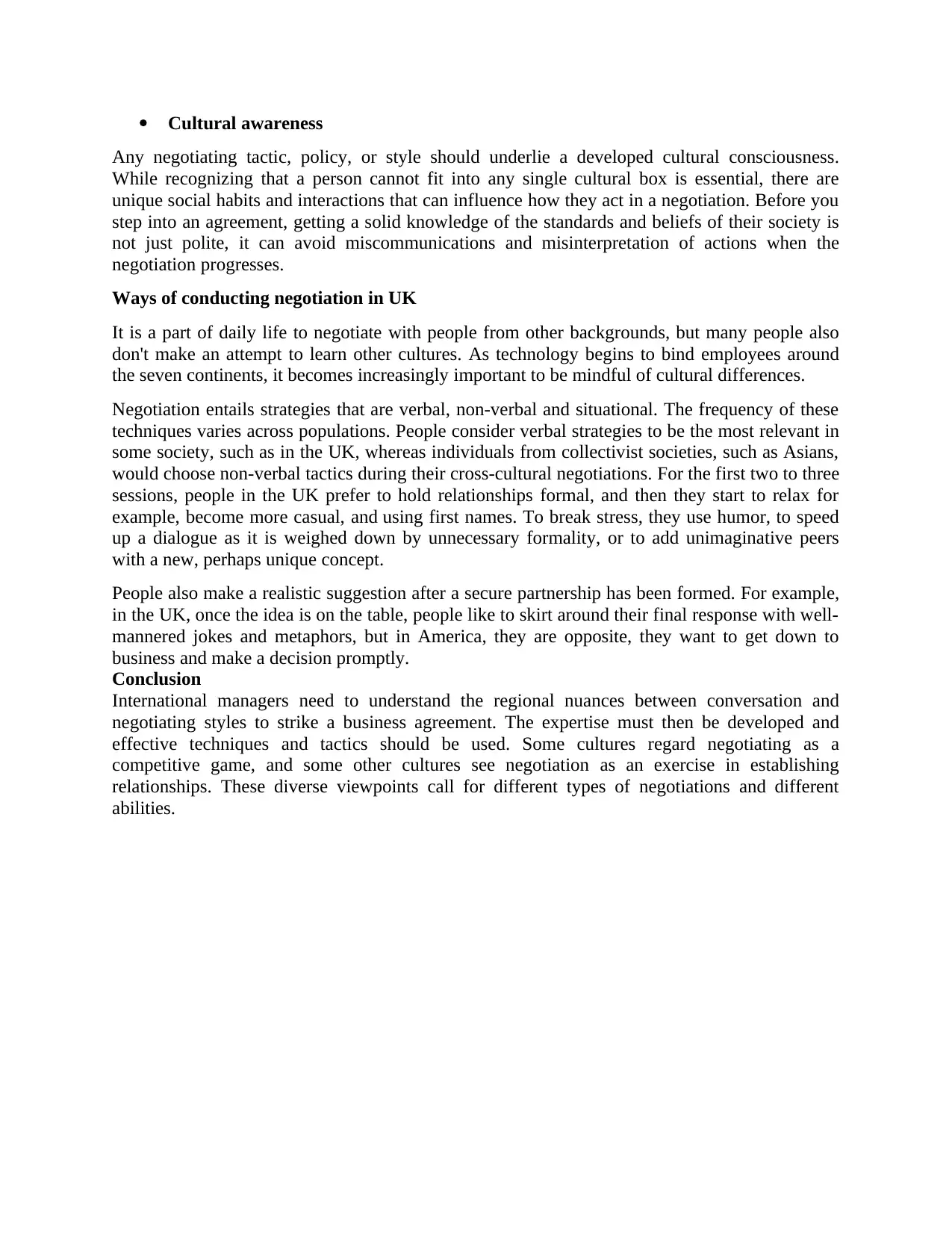
The important elements of effective negotiation are attitude, strategy, and style. People often
assume that one of two things can mean this either you negotiate in a tough and competitive way
or you take an approach that is friendly and accommodating. People should focus on the
following four elements of principled negotiation to achieve this:
Distinguish the individuals from the issue: Choose to see the other group in your
problem solving as a partner by isolating the problem you are both trying to solve.
Attention on objectives, not positions: Recognize why the other party is negotiating and
why their present position has been taken.
Examine mutual benefit options: This is a brainstorming session that takes place during
the negotiation, where both sides try together to find solutions to the problem.
Use objective criteria: Since the concepts of fairness and truth can be largely subjective,
a standard can be found on which both parties depend.
within this zone.
Principled negotiation
The important elements of effective negotiation are attitude, strategy, and style. People often
assume that one of two things can mean this either you negotiate in a tough and competitive way
or you take an approach that is friendly and accommodating. People should focus on the
following four elements of principled negotiation to achieve this:
Distinguish the individuals from the issue: Choose to see the other group in your
problem solving as a partner by isolating the problem you are both trying to solve.
Attention on objectives, not positions: Recognize why the other party is negotiating and
why their present position has been taken.
Examine mutual benefit options: This is a brainstorming session that takes place during
the negotiation, where both sides try together to find solutions to the problem.
Use objective criteria: Since the concepts of fairness and truth can be largely subjective,
a standard can be found on which both parties depend.
Paraphrase This Document
Need a fresh take? Get an instant paraphrase of this document with our AI Paraphraser

Cultural awareness
Any negotiating tactic, policy, or style should underlie a developed cultural consciousness.
While recognizing that a person cannot fit into any single cultural box is essential, there are
unique social habits and interactions that can influence how they act in a negotiation. Before you
step into an agreement, getting a solid knowledge of the standards and beliefs of their society is
not just polite, it can avoid miscommunications and misinterpretation of actions when the
negotiation progresses.
Ways of conducting negotiation in UK
It is a part of daily life to negotiate with people from other backgrounds, but many people also
don't make an attempt to learn other cultures. As technology begins to bind employees around
the seven continents, it becomes increasingly important to be mindful of cultural differences.
Negotiation entails strategies that are verbal, non-verbal and situational. The frequency of these
techniques varies across populations. People consider verbal strategies to be the most relevant in
some society, such as in the UK, whereas individuals from collectivist societies, such as Asians,
would choose non-verbal tactics during their cross-cultural negotiations. For the first two to three
sessions, people in the UK prefer to hold relationships formal, and then they start to relax for
example, become more casual, and using first names. To break stress, they use humor, to speed
up a dialogue as it is weighed down by unnecessary formality, or to add unimaginative peers
with a new, perhaps unique concept.
People also make a realistic suggestion after a secure partnership has been formed. For example,
in the UK, once the idea is on the table, people like to skirt around their final response with well-
mannered jokes and metaphors, but in America, they are opposite, they want to get down to
business and make a decision promptly.
Conclusion
International managers need to understand the regional nuances between conversation and
negotiating styles to strike a business agreement. The expertise must then be developed and
effective techniques and tactics should be used. Some cultures regard negotiating as a
competitive game, and some other cultures see negotiation as an exercise in establishing
relationships. These diverse viewpoints call for different types of negotiations and different
abilities.
Any negotiating tactic, policy, or style should underlie a developed cultural consciousness.
While recognizing that a person cannot fit into any single cultural box is essential, there are
unique social habits and interactions that can influence how they act in a negotiation. Before you
step into an agreement, getting a solid knowledge of the standards and beliefs of their society is
not just polite, it can avoid miscommunications and misinterpretation of actions when the
negotiation progresses.
Ways of conducting negotiation in UK
It is a part of daily life to negotiate with people from other backgrounds, but many people also
don't make an attempt to learn other cultures. As technology begins to bind employees around
the seven continents, it becomes increasingly important to be mindful of cultural differences.
Negotiation entails strategies that are verbal, non-verbal and situational. The frequency of these
techniques varies across populations. People consider verbal strategies to be the most relevant in
some society, such as in the UK, whereas individuals from collectivist societies, such as Asians,
would choose non-verbal tactics during their cross-cultural negotiations. For the first two to three
sessions, people in the UK prefer to hold relationships formal, and then they start to relax for
example, become more casual, and using first names. To break stress, they use humor, to speed
up a dialogue as it is weighed down by unnecessary formality, or to add unimaginative peers
with a new, perhaps unique concept.
People also make a realistic suggestion after a secure partnership has been formed. For example,
in the UK, once the idea is on the table, people like to skirt around their final response with well-
mannered jokes and metaphors, but in America, they are opposite, they want to get down to
business and make a decision promptly.
Conclusion
International managers need to understand the regional nuances between conversation and
negotiating styles to strike a business agreement. The expertise must then be developed and
effective techniques and tactics should be used. Some cultures regard negotiating as a
competitive game, and some other cultures see negotiation as an exercise in establishing
relationships. These diverse viewpoints call for different types of negotiations and different
abilities.
1 out of 5
Related Documents
Your All-in-One AI-Powered Toolkit for Academic Success.
+13062052269
info@desklib.com
Available 24*7 on WhatsApp / Email
Unlock your academic potential
Copyright © 2020–2025 A2Z Services. All Rights Reserved. Developed and managed by ZUCOL.