Corporate Law Exercises: Negotiation Skills and Strategies
VerifiedAdded on 2023/01/23
|36
|9589
|51
Homework Assignment
AI Summary
This document presents solutions to a series of corporate law exercises focused on negotiation skills and value creation. The exercises cover a range of topics, including self-assessment of negotiation effectiveness, identifying challenges in professional and personal life, and exploring strategies to improve negotiation outcomes. The assignment delves into practical applications such as creating and claiming value, improving fact-finding, developing effective opening statements, asking high-yield questions, turning issues into interests, identifying hidden interests, and using appropriate communication styles. Furthermore, the exercises explore perspective management, the power of reasonable people, and the importance of doing the unexpected in negotiations. The student analyzes their own negotiation experiences, rates their effectiveness, and identifies areas for improvement in both creating and claiming value. The document offers a comprehensive overview of negotiation techniques within a corporate law framework, providing valuable insights for anyone seeking to enhance their negotiation skills.

EXERCISE (CORPORATE LAW)
Corporate Business law
[DATE]
[Company address]
Corporate Business law
[DATE]
[Company address]

Paraphrase This Document
Need a fresh take? Get an instant paraphrase of this document with our AI Paraphraser
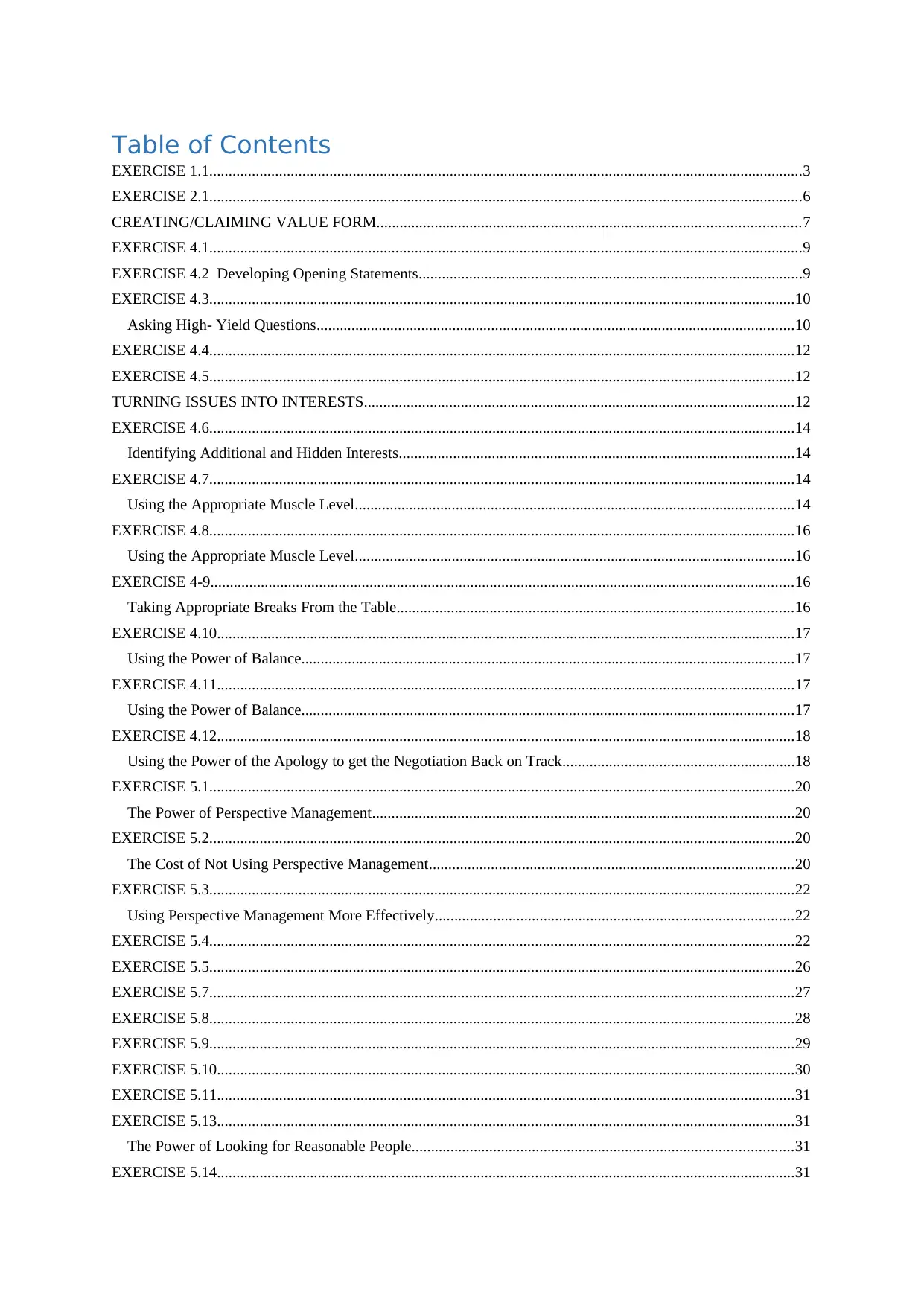
Table of Contents
EXERCISE 1.1.........................................................................................................................................................3
EXERCISE 2.1.........................................................................................................................................................6
CREATING/CLAIMING VALUE FORM.............................................................................................................7
EXERCISE 4.1.........................................................................................................................................................9
EXERCISE 4.2 Developing Opening Statements...................................................................................................9
EXERCISE 4.3.......................................................................................................................................................10
Asking High- Yield Questions...........................................................................................................................10
EXERCISE 4.4.......................................................................................................................................................12
EXERCISE 4.5.......................................................................................................................................................12
TURNING ISSUES INTO INTERESTS...............................................................................................................12
EXERCISE 4.6.......................................................................................................................................................14
Identifying Additional and Hidden Interests......................................................................................................14
EXERCISE 4.7.......................................................................................................................................................14
Using the Appropriate Muscle Level.................................................................................................................14
EXERCISE 4.8.......................................................................................................................................................16
Using the Appropriate Muscle Level.................................................................................................................16
EXERCISE 4-9......................................................................................................................................................16
Taking Appropriate Breaks From the Table......................................................................................................16
EXERCISE 4.10.....................................................................................................................................................17
Using the Power of Balance...............................................................................................................................17
EXERCISE 4.11.....................................................................................................................................................17
Using the Power of Balance...............................................................................................................................17
EXERCISE 4.12.....................................................................................................................................................18
Using the Power of the Apology to get the Negotiation Back on Track............................................................18
EXERCISE 5.1.......................................................................................................................................................20
The Power of Perspective Management.............................................................................................................20
EXERCISE 5.2.......................................................................................................................................................20
The Cost of Not Using Perspective Management..............................................................................................20
EXERCISE 5.3.......................................................................................................................................................22
Using Perspective Management More Effectively............................................................................................22
EXERCISE 5.4.......................................................................................................................................................22
EXERCISE 5.5.......................................................................................................................................................26
EXERCISE 5.7.......................................................................................................................................................27
EXERCISE 5.8.......................................................................................................................................................28
EXERCISE 5.9.......................................................................................................................................................29
EXERCISE 5.10.....................................................................................................................................................30
EXERCISE 5.11.....................................................................................................................................................31
EXERCISE 5.13.....................................................................................................................................................31
The Power of Looking for Reasonable People..................................................................................................31
EXERCISE 5.14.....................................................................................................................................................31
EXERCISE 1.1.........................................................................................................................................................3
EXERCISE 2.1.........................................................................................................................................................6
CREATING/CLAIMING VALUE FORM.............................................................................................................7
EXERCISE 4.1.........................................................................................................................................................9
EXERCISE 4.2 Developing Opening Statements...................................................................................................9
EXERCISE 4.3.......................................................................................................................................................10
Asking High- Yield Questions...........................................................................................................................10
EXERCISE 4.4.......................................................................................................................................................12
EXERCISE 4.5.......................................................................................................................................................12
TURNING ISSUES INTO INTERESTS...............................................................................................................12
EXERCISE 4.6.......................................................................................................................................................14
Identifying Additional and Hidden Interests......................................................................................................14
EXERCISE 4.7.......................................................................................................................................................14
Using the Appropriate Muscle Level.................................................................................................................14
EXERCISE 4.8.......................................................................................................................................................16
Using the Appropriate Muscle Level.................................................................................................................16
EXERCISE 4-9......................................................................................................................................................16
Taking Appropriate Breaks From the Table......................................................................................................16
EXERCISE 4.10.....................................................................................................................................................17
Using the Power of Balance...............................................................................................................................17
EXERCISE 4.11.....................................................................................................................................................17
Using the Power of Balance...............................................................................................................................17
EXERCISE 4.12.....................................................................................................................................................18
Using the Power of the Apology to get the Negotiation Back on Track............................................................18
EXERCISE 5.1.......................................................................................................................................................20
The Power of Perspective Management.............................................................................................................20
EXERCISE 5.2.......................................................................................................................................................20
The Cost of Not Using Perspective Management..............................................................................................20
EXERCISE 5.3.......................................................................................................................................................22
Using Perspective Management More Effectively............................................................................................22
EXERCISE 5.4.......................................................................................................................................................22
EXERCISE 5.5.......................................................................................................................................................26
EXERCISE 5.7.......................................................................................................................................................27
EXERCISE 5.8.......................................................................................................................................................28
EXERCISE 5.9.......................................................................................................................................................29
EXERCISE 5.10.....................................................................................................................................................30
EXERCISE 5.11.....................................................................................................................................................31
EXERCISE 5.13.....................................................................................................................................................31
The Power of Looking for Reasonable People..................................................................................................31
EXERCISE 5.14.....................................................................................................................................................31

The Power of Doing the Unexpected.................................................................................................................31
EXERCISE 5.15.....................................................................................................................................................32
EXERCISE 5.15.....................................................................................................................................................32
⊘ This is a preview!⊘
Do you want full access?
Subscribe today to unlock all pages.

Trusted by 1+ million students worldwide
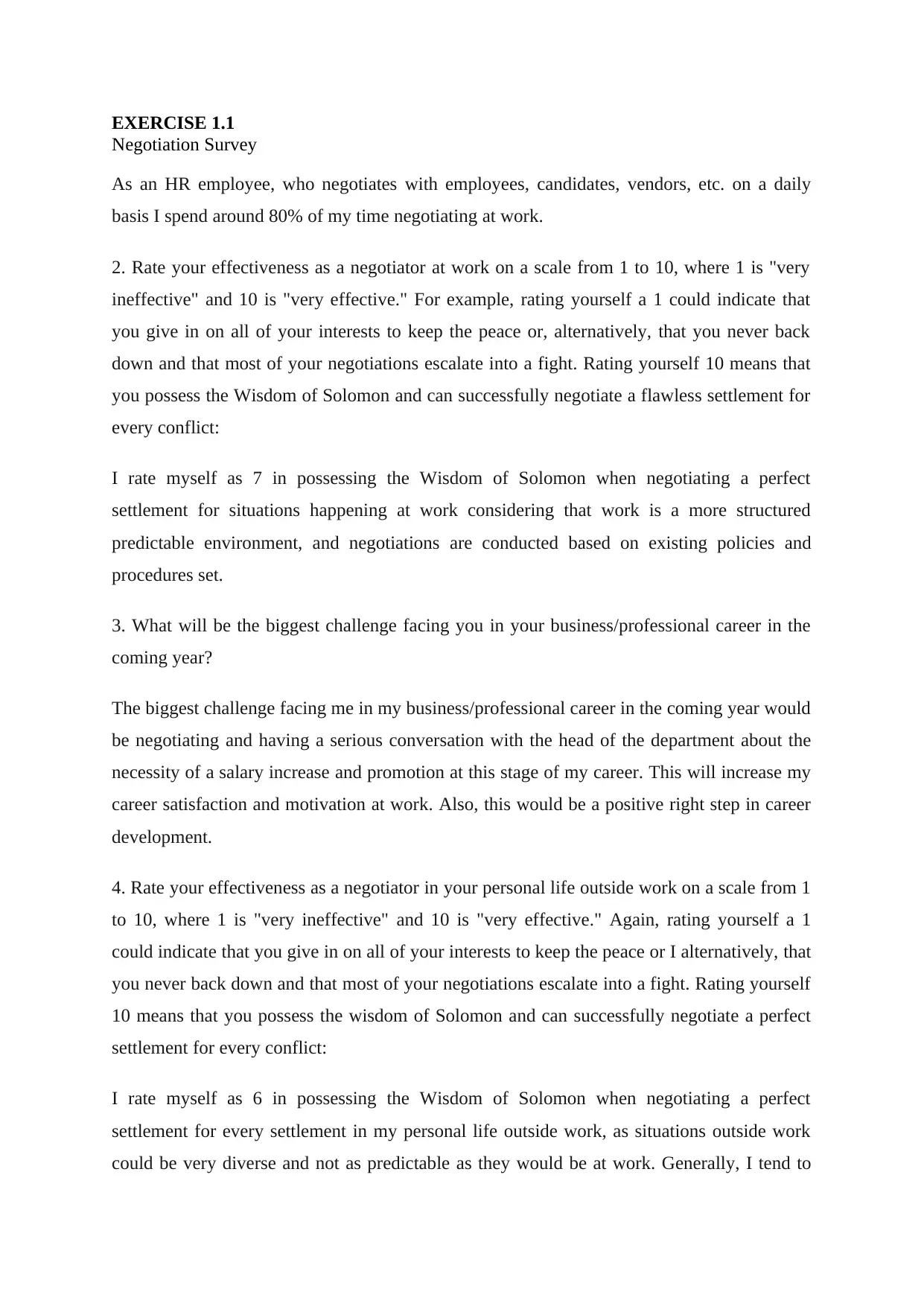
EXERCISE 1.1
Negotiation Survey
As an HR employee, who negotiates with employees, candidates, vendors, etc. on a daily
basis I spend around 80% of my time negotiating at work.
2. Rate your effectiveness as a negotiator at work on a scale from 1 to 10, where 1 is "very
ineffective" and 10 is "very effective." For example, rating yourself a 1 could indicate that
you give in on all of your interests to keep the peace or, alternatively, that you never back
down and that most of your negotiations escalate into a fight. Rating yourself 10 means that
you possess the Wisdom of Solomon and can successfully negotiate a flawless settlement for
every conflict:
I rate myself as 7 in possessing the Wisdom of Solomon when negotiating a perfect
settlement for situations happening at work considering that work is a more structured
predictable environment, and negotiations are conducted based on existing policies and
procedures set.
3. What will be the biggest challenge facing you in your business/professional career in the
coming year?
The biggest challenge facing me in my business/professional career in the coming year would
be negotiating and having a serious conversation with the head of the department about the
necessity of a salary increase and promotion at this stage of my career. This will increase my
career satisfaction and motivation at work. Also, this would be a positive right step in career
development.
4. Rate your effectiveness as a negotiator in your personal life outside work on a scale from 1
to 10, where 1 is "very ineffective" and 10 is "very effective." Again, rating yourself a 1
could indicate that you give in on all of your interests to keep the peace or I alternatively, that
you never back down and that most of your negotiations escalate into a fight. Rating yourself
10 means that you possess the wisdom of Solomon and can successfully negotiate a perfect
settlement for every conflict:
I rate myself as 6 in possessing the Wisdom of Solomon when negotiating a perfect
settlement for every settlement in my personal life outside work, as situations outside work
could be very diverse and not as predictable as they would be at work. Generally, I tend to
Negotiation Survey
As an HR employee, who negotiates with employees, candidates, vendors, etc. on a daily
basis I spend around 80% of my time negotiating at work.
2. Rate your effectiveness as a negotiator at work on a scale from 1 to 10, where 1 is "very
ineffective" and 10 is "very effective." For example, rating yourself a 1 could indicate that
you give in on all of your interests to keep the peace or, alternatively, that you never back
down and that most of your negotiations escalate into a fight. Rating yourself 10 means that
you possess the Wisdom of Solomon and can successfully negotiate a flawless settlement for
every conflict:
I rate myself as 7 in possessing the Wisdom of Solomon when negotiating a perfect
settlement for situations happening at work considering that work is a more structured
predictable environment, and negotiations are conducted based on existing policies and
procedures set.
3. What will be the biggest challenge facing you in your business/professional career in the
coming year?
The biggest challenge facing me in my business/professional career in the coming year would
be negotiating and having a serious conversation with the head of the department about the
necessity of a salary increase and promotion at this stage of my career. This will increase my
career satisfaction and motivation at work. Also, this would be a positive right step in career
development.
4. Rate your effectiveness as a negotiator in your personal life outside work on a scale from 1
to 10, where 1 is "very ineffective" and 10 is "very effective." Again, rating yourself a 1
could indicate that you give in on all of your interests to keep the peace or I alternatively, that
you never back down and that most of your negotiations escalate into a fight. Rating yourself
10 means that you possess the wisdom of Solomon and can successfully negotiate a perfect
settlement for every conflict:
I rate myself as 6 in possessing the Wisdom of Solomon when negotiating a perfect
settlement for every settlement in my personal life outside work, as situations outside work
could be very diverse and not as predictable as they would be at work. Generally, I tend to
Paraphrase This Document
Need a fresh take? Get an instant paraphrase of this document with our AI Paraphraser
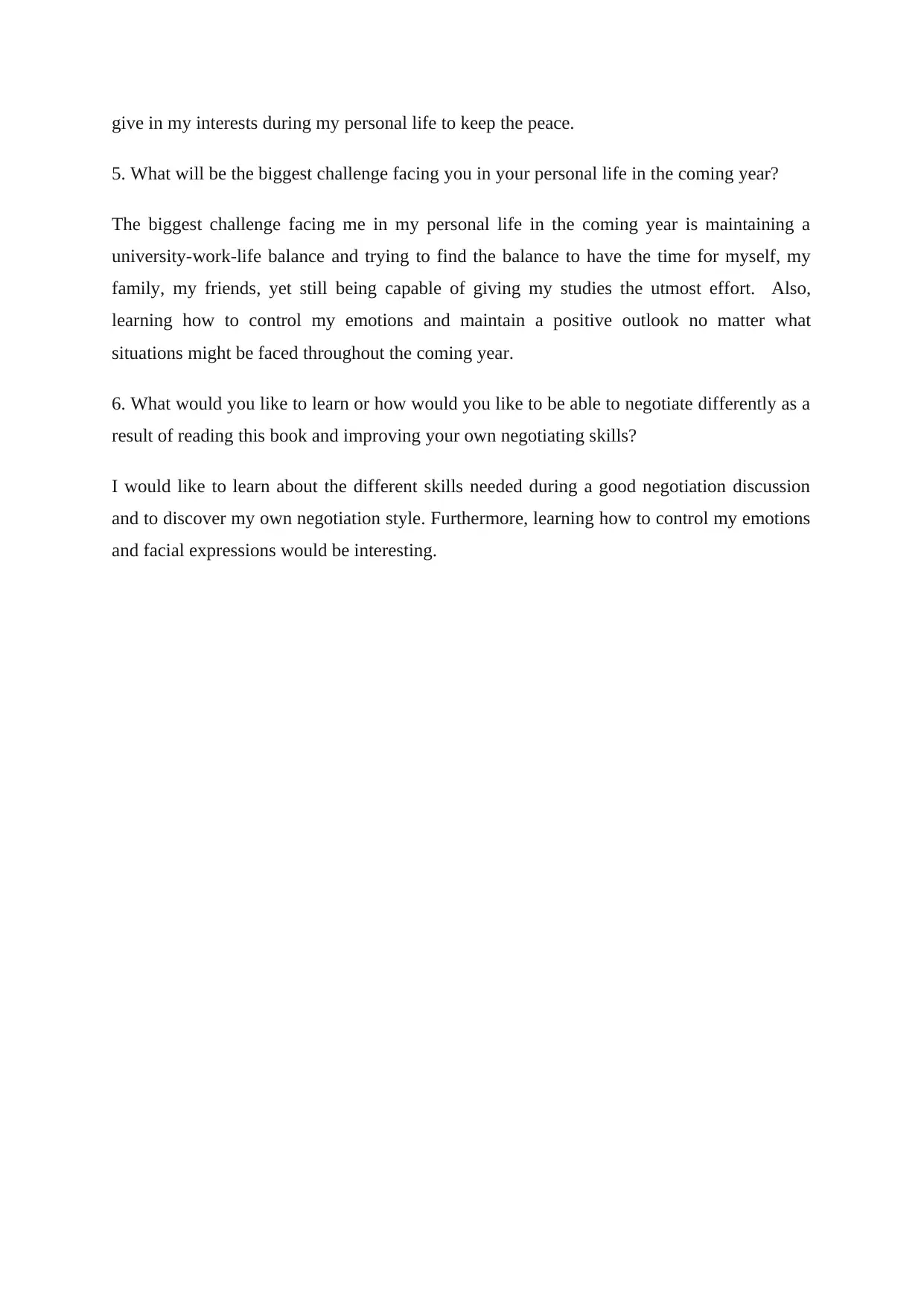
give in my interests during my personal life to keep the peace.
5. What will be the biggest challenge facing you in your personal life in the coming year?
The biggest challenge facing me in my personal life in the coming year is maintaining a
university-work-life balance and trying to find the balance to have the time for myself, my
family, my friends, yet still being capable of giving my studies the utmost effort. Also,
learning how to control my emotions and maintain a positive outlook no matter what
situations might be faced throughout the coming year.
6. What would you like to learn or how would you like to be able to negotiate differently as a
result of reading this book and improving your own negotiating skills?
I would like to learn about the different skills needed during a good negotiation discussion
and to discover my own negotiation style. Furthermore, learning how to control my emotions
and facial expressions would be interesting.
5. What will be the biggest challenge facing you in your personal life in the coming year?
The biggest challenge facing me in my personal life in the coming year is maintaining a
university-work-life balance and trying to find the balance to have the time for myself, my
family, my friends, yet still being capable of giving my studies the utmost effort. Also,
learning how to control my emotions and maintain a positive outlook no matter what
situations might be faced throughout the coming year.
6. What would you like to learn or how would you like to be able to negotiate differently as a
result of reading this book and improving your own negotiating skills?
I would like to learn about the different skills needed during a good negotiation discussion
and to discover my own negotiation style. Furthermore, learning how to control my emotions
and facial expressions would be interesting.
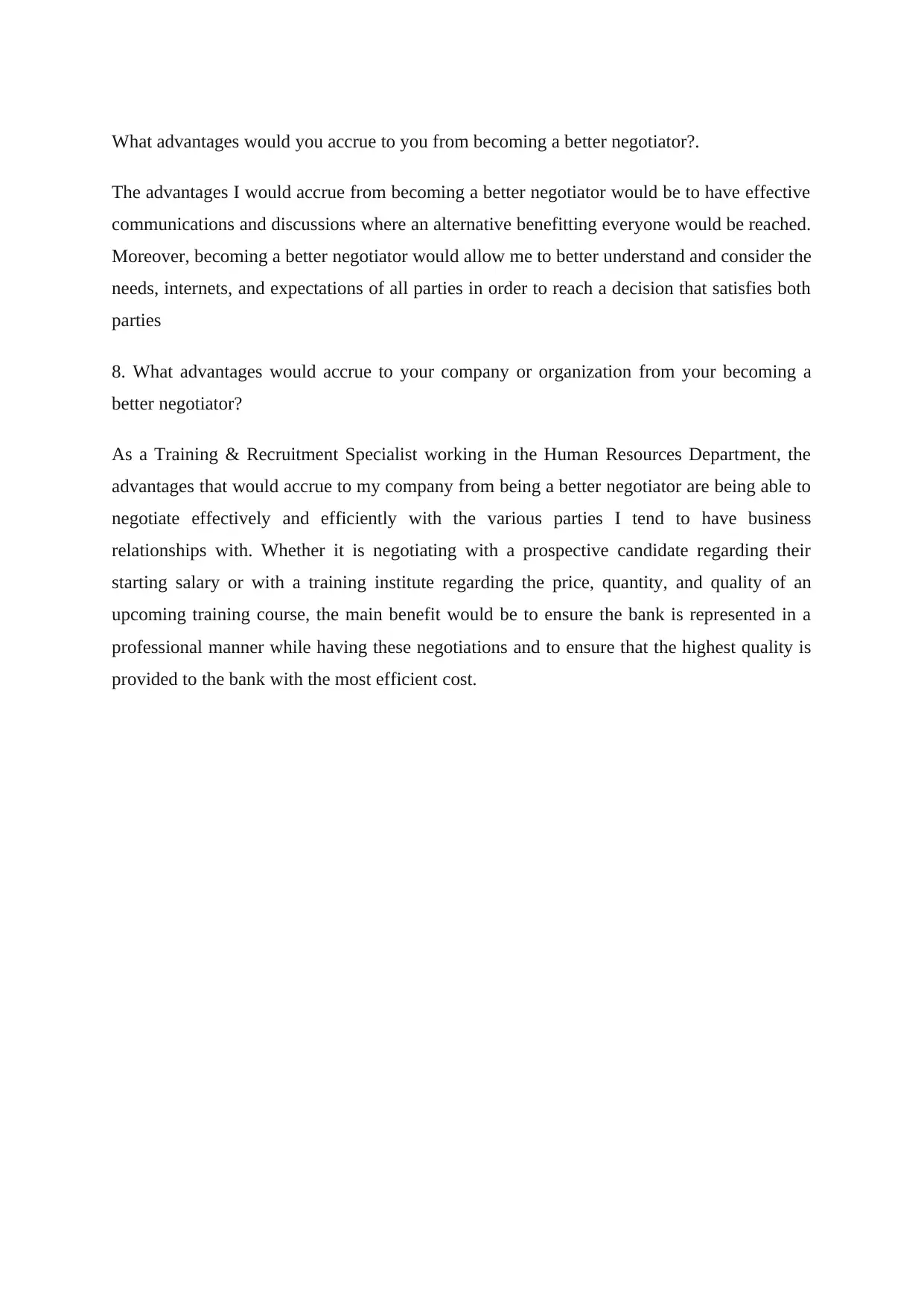
What advantages would you accrue to you from becoming a better negotiator?.
The advantages I would accrue from becoming a better negotiator would be to have effective
communications and discussions where an alternative benefitting everyone would be reached.
Moreover, becoming a better negotiator would allow me to better understand and consider the
needs, internets, and expectations of all parties in order to reach a decision that satisfies both
parties
8. What advantages would accrue to your company or organization from your becoming a
better negotiator?
As a Training & Recruitment Specialist working in the Human Resources Department, the
advantages that would accrue to my company from being a better negotiator are being able to
negotiate effectively and efficiently with the various parties I tend to have business
relationships with. Whether it is negotiating with a prospective candidate regarding their
starting salary or with a training institute regarding the price, quantity, and quality of an
upcoming training course, the main benefit would be to ensure the bank is represented in a
professional manner while having these negotiations and to ensure that the highest quality is
provided to the bank with the most efficient cost.
The advantages I would accrue from becoming a better negotiator would be to have effective
communications and discussions where an alternative benefitting everyone would be reached.
Moreover, becoming a better negotiator would allow me to better understand and consider the
needs, internets, and expectations of all parties in order to reach a decision that satisfies both
parties
8. What advantages would accrue to your company or organization from your becoming a
better negotiator?
As a Training & Recruitment Specialist working in the Human Resources Department, the
advantages that would accrue to my company from being a better negotiator are being able to
negotiate effectively and efficiently with the various parties I tend to have business
relationships with. Whether it is negotiating with a prospective candidate regarding their
starting salary or with a training institute regarding the price, quantity, and quality of an
upcoming training course, the main benefit would be to ensure the bank is represented in a
professional manner while having these negotiations and to ensure that the highest quality is
provided to the bank with the most efficient cost.
⊘ This is a preview!⊘
Do you want full access?
Subscribe today to unlock all pages.
Trusted by 1+ million students worldwide
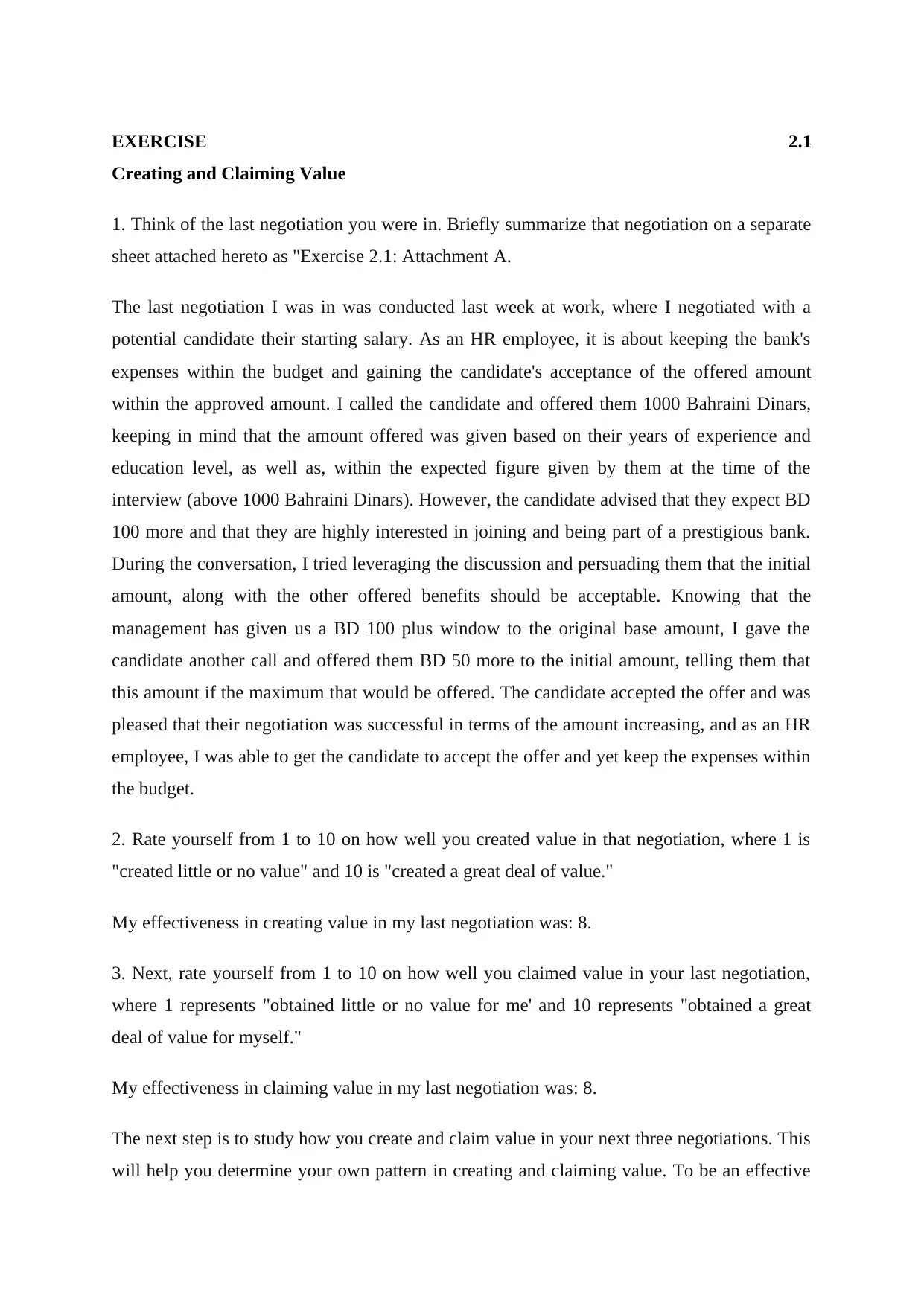
EXERCISE 2.1
Creating and Claiming Value
1. Think of the last negotiation you were in. Briefly summarize that negotiation on a separate
sheet attached hereto as "Exercise 2.1: Attachment A.
The last negotiation I was in was conducted last week at work, where I negotiated with a
potential candidate their starting salary. As an HR employee, it is about keeping the bank's
expenses within the budget and gaining the candidate's acceptance of the offered amount
within the approved amount. I called the candidate and offered them 1000 Bahraini Dinars,
keeping in mind that the amount offered was given based on their years of experience and
education level, as well as, within the expected figure given by them at the time of the
interview (above 1000 Bahraini Dinars). However, the candidate advised that they expect BD
100 more and that they are highly interested in joining and being part of a prestigious bank.
During the conversation, I tried leveraging the discussion and persuading them that the initial
amount, along with the other offered benefits should be acceptable. Knowing that the
management has given us a BD 100 plus window to the original base amount, I gave the
candidate another call and offered them BD 50 more to the initial amount, telling them that
this amount if the maximum that would be offered. The candidate accepted the offer and was
pleased that their negotiation was successful in terms of the amount increasing, and as an HR
employee, I was able to get the candidate to accept the offer and yet keep the expenses within
the budget.
2. Rate yourself from 1 to 10 on how well you created value in that negotiation, where 1 is
"created little or no value" and 10 is "created a great deal of value."
My effectiveness in creating value in my last negotiation was: 8.
3. Next, rate yourself from 1 to 10 on how well you claimed value in your last negotiation,
where 1 represents "obtained little or no value for me' and 10 represents "obtained a great
deal of value for myself."
My effectiveness in claiming value in my last negotiation was: 8.
The next step is to study how you create and claim value in your next three negotiations. This
will help you determine your own pattern in creating and claiming value. To be an effective
Creating and Claiming Value
1. Think of the last negotiation you were in. Briefly summarize that negotiation on a separate
sheet attached hereto as "Exercise 2.1: Attachment A.
The last negotiation I was in was conducted last week at work, where I negotiated with a
potential candidate their starting salary. As an HR employee, it is about keeping the bank's
expenses within the budget and gaining the candidate's acceptance of the offered amount
within the approved amount. I called the candidate and offered them 1000 Bahraini Dinars,
keeping in mind that the amount offered was given based on their years of experience and
education level, as well as, within the expected figure given by them at the time of the
interview (above 1000 Bahraini Dinars). However, the candidate advised that they expect BD
100 more and that they are highly interested in joining and being part of a prestigious bank.
During the conversation, I tried leveraging the discussion and persuading them that the initial
amount, along with the other offered benefits should be acceptable. Knowing that the
management has given us a BD 100 plus window to the original base amount, I gave the
candidate another call and offered them BD 50 more to the initial amount, telling them that
this amount if the maximum that would be offered. The candidate accepted the offer and was
pleased that their negotiation was successful in terms of the amount increasing, and as an HR
employee, I was able to get the candidate to accept the offer and yet keep the expenses within
the budget.
2. Rate yourself from 1 to 10 on how well you created value in that negotiation, where 1 is
"created little or no value" and 10 is "created a great deal of value."
My effectiveness in creating value in my last negotiation was: 8.
3. Next, rate yourself from 1 to 10 on how well you claimed value in your last negotiation,
where 1 represents "obtained little or no value for me' and 10 represents "obtained a great
deal of value for myself."
My effectiveness in claiming value in my last negotiation was: 8.
The next step is to study how you create and claim value in your next three negotiations. This
will help you determine your own pattern in creating and claiming value. To be an effective
Paraphrase This Document
Need a fresh take? Get an instant paraphrase of this document with our AI Paraphraser
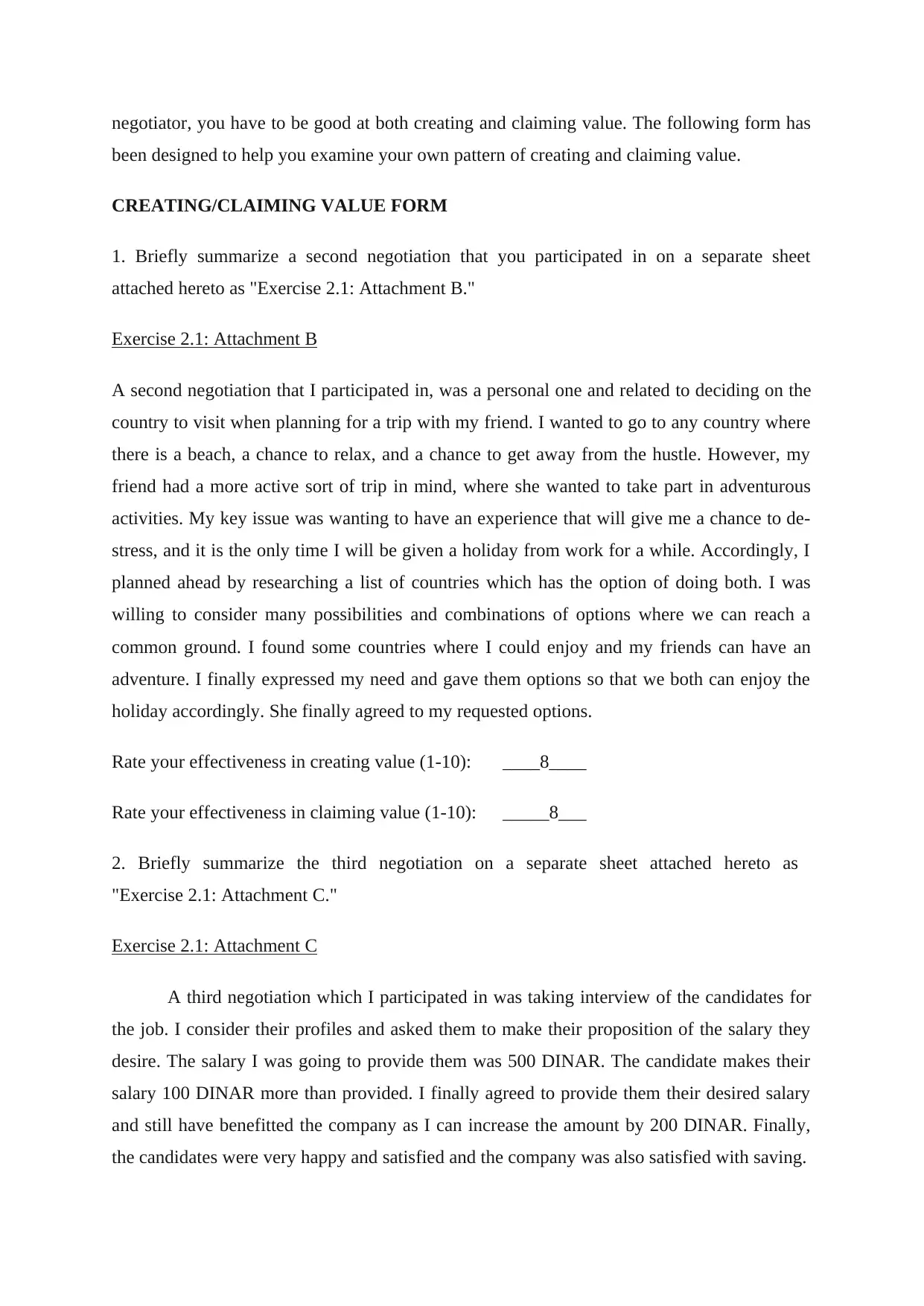
negotiator, you have to be good at both creating and claiming value. The following form has
been designed to help you examine your own pattern of creating and claiming value.
CREATING/CLAIMING VALUE FORM
1. Briefly summarize a second negotiation that you participated in on a separate sheet
attached hereto as "Exercise 2.1: Attachment B."
Exercise 2.1: Attachment B
A second negotiation that I participated in, was a personal one and related to deciding on the
country to visit when planning for a trip with my friend. I wanted to go to any country where
there is a beach, a chance to relax, and a chance to get away from the hustle. However, my
friend had a more active sort of trip in mind, where she wanted to take part in adventurous
activities. My key issue was wanting to have an experience that will give me a chance to de-
stress, and it is the only time I will be given a holiday from work for a while. Accordingly, I
planned ahead by researching a list of countries which has the option of doing both. I was
willing to consider many possibilities and combinations of options where we can reach a
common ground. I found some countries where I could enjoy and my friends can have an
adventure. I finally expressed my need and gave them options so that we both can enjoy the
holiday accordingly. She finally agreed to my requested options.
Rate your effectiveness in creating value (1-10): ____8____
Rate your effectiveness in claiming value (1-10): _____8___
2. Briefly summarize the third negotiation on a separate sheet attached hereto as
"Exercise 2.1: Attachment C."
Exercise 2.1: Attachment C
A third negotiation which I participated in was taking interview of the candidates for
the job. I consider their profiles and asked them to make their proposition of the salary they
desire. The salary I was going to provide them was 500 DINAR. The candidate makes their
salary 100 DINAR more than provided. I finally agreed to provide them their desired salary
and still have benefitted the company as I can increase the amount by 200 DINAR. Finally,
the candidates were very happy and satisfied and the company was also satisfied with saving.
been designed to help you examine your own pattern of creating and claiming value.
CREATING/CLAIMING VALUE FORM
1. Briefly summarize a second negotiation that you participated in on a separate sheet
attached hereto as "Exercise 2.1: Attachment B."
Exercise 2.1: Attachment B
A second negotiation that I participated in, was a personal one and related to deciding on the
country to visit when planning for a trip with my friend. I wanted to go to any country where
there is a beach, a chance to relax, and a chance to get away from the hustle. However, my
friend had a more active sort of trip in mind, where she wanted to take part in adventurous
activities. My key issue was wanting to have an experience that will give me a chance to de-
stress, and it is the only time I will be given a holiday from work for a while. Accordingly, I
planned ahead by researching a list of countries which has the option of doing both. I was
willing to consider many possibilities and combinations of options where we can reach a
common ground. I found some countries where I could enjoy and my friends can have an
adventure. I finally expressed my need and gave them options so that we both can enjoy the
holiday accordingly. She finally agreed to my requested options.
Rate your effectiveness in creating value (1-10): ____8____
Rate your effectiveness in claiming value (1-10): _____8___
2. Briefly summarize the third negotiation on a separate sheet attached hereto as
"Exercise 2.1: Attachment C."
Exercise 2.1: Attachment C
A third negotiation which I participated in was taking interview of the candidates for
the job. I consider their profiles and asked them to make their proposition of the salary they
desire. The salary I was going to provide them was 500 DINAR. The candidate makes their
salary 100 DINAR more than provided. I finally agreed to provide them their desired salary
and still have benefitted the company as I can increase the amount by 200 DINAR. Finally,
the candidates were very happy and satisfied and the company was also satisfied with saving.
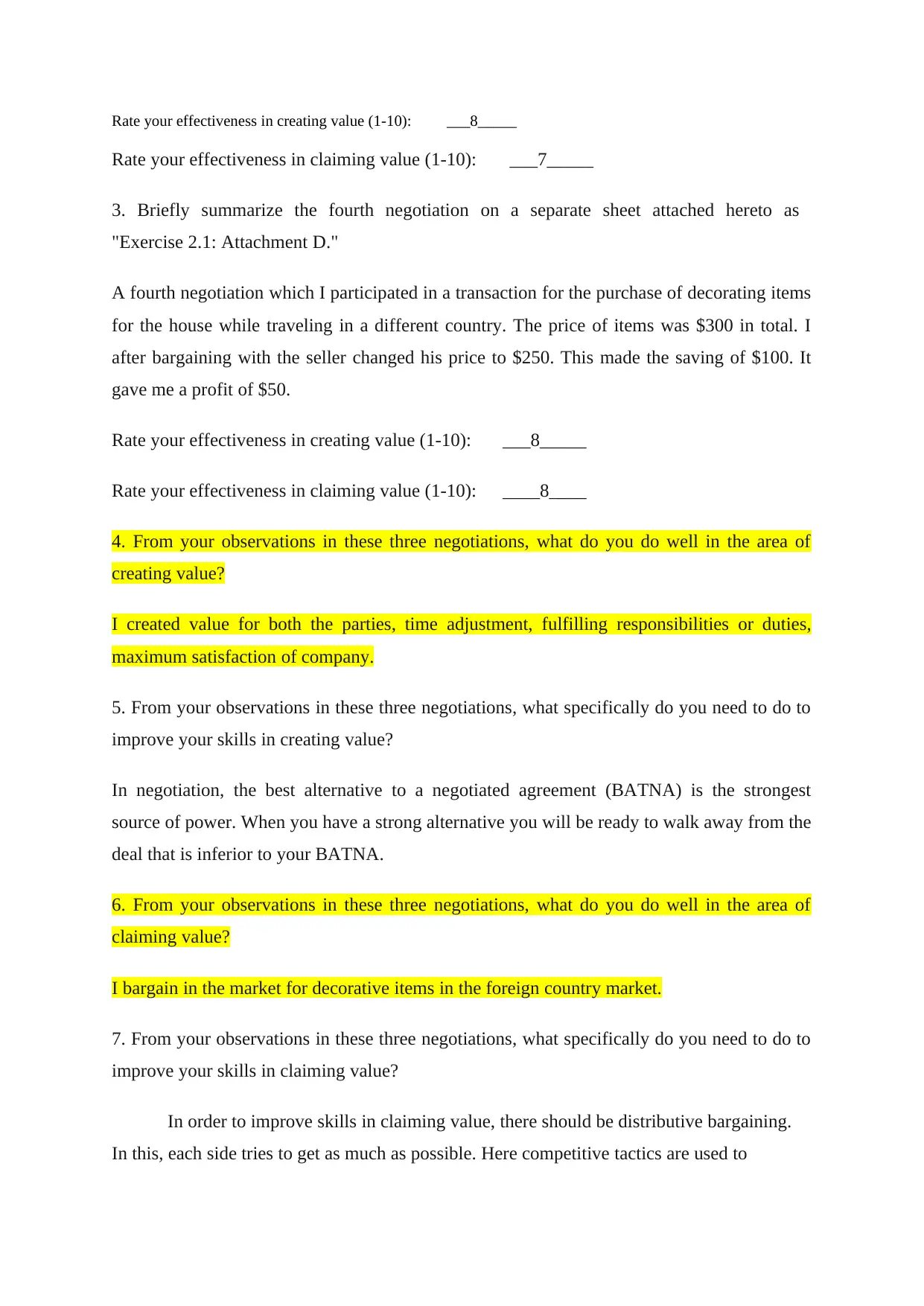
Rate your effectiveness in creating value (1-10): ___8_____
Rate your effectiveness in claiming value (1-10): ___7_____
3. Briefly summarize the fourth negotiation on a separate sheet attached hereto as
"Exercise 2.1: Attachment D."
A fourth negotiation which I participated in a transaction for the purchase of decorating items
for the house while traveling in a different country. The price of items was $300 in total. I
after bargaining with the seller changed his price to $250. This made the saving of $100. It
gave me a profit of $50.
Rate your effectiveness in creating value (1-10): ___8_____
Rate your effectiveness in claiming value (1-10): ____8____
4. From your observations in these three negotiations, what do you do well in the area of
creating value?
I created value for both the parties, time adjustment, fulfilling responsibilities or duties,
maximum satisfaction of company.
5. From your observations in these three negotiations, what specifically do you need to do to
improve your skills in creating value?
In negotiation, the best alternative to a negotiated agreement (BATNA) is the strongest
source of power. When you have a strong alternative you will be ready to walk away from the
deal that is inferior to your BATNA.
6. From your observations in these three negotiations, what do you do well in the area of
claiming value?
I bargain in the market for decorative items in the foreign country market.
7. From your observations in these three negotiations, what specifically do you need to do to
improve your skills in claiming value?
In order to improve skills in claiming value, there should be distributive bargaining.
In this, each side tries to get as much as possible. Here competitive tactics are used to
Rate your effectiveness in claiming value (1-10): ___7_____
3. Briefly summarize the fourth negotiation on a separate sheet attached hereto as
"Exercise 2.1: Attachment D."
A fourth negotiation which I participated in a transaction for the purchase of decorating items
for the house while traveling in a different country. The price of items was $300 in total. I
after bargaining with the seller changed his price to $250. This made the saving of $100. It
gave me a profit of $50.
Rate your effectiveness in creating value (1-10): ___8_____
Rate your effectiveness in claiming value (1-10): ____8____
4. From your observations in these three negotiations, what do you do well in the area of
creating value?
I created value for both the parties, time adjustment, fulfilling responsibilities or duties,
maximum satisfaction of company.
5. From your observations in these three negotiations, what specifically do you need to do to
improve your skills in creating value?
In negotiation, the best alternative to a negotiated agreement (BATNA) is the strongest
source of power. When you have a strong alternative you will be ready to walk away from the
deal that is inferior to your BATNA.
6. From your observations in these three negotiations, what do you do well in the area of
claiming value?
I bargain in the market for decorative items in the foreign country market.
7. From your observations in these three negotiations, what specifically do you need to do to
improve your skills in claiming value?
In order to improve skills in claiming value, there should be distributive bargaining.
In this, each side tries to get as much as possible. Here competitive tactics are used to
⊘ This is a preview!⊘
Do you want full access?
Subscribe today to unlock all pages.
Trusted by 1+ million students worldwide
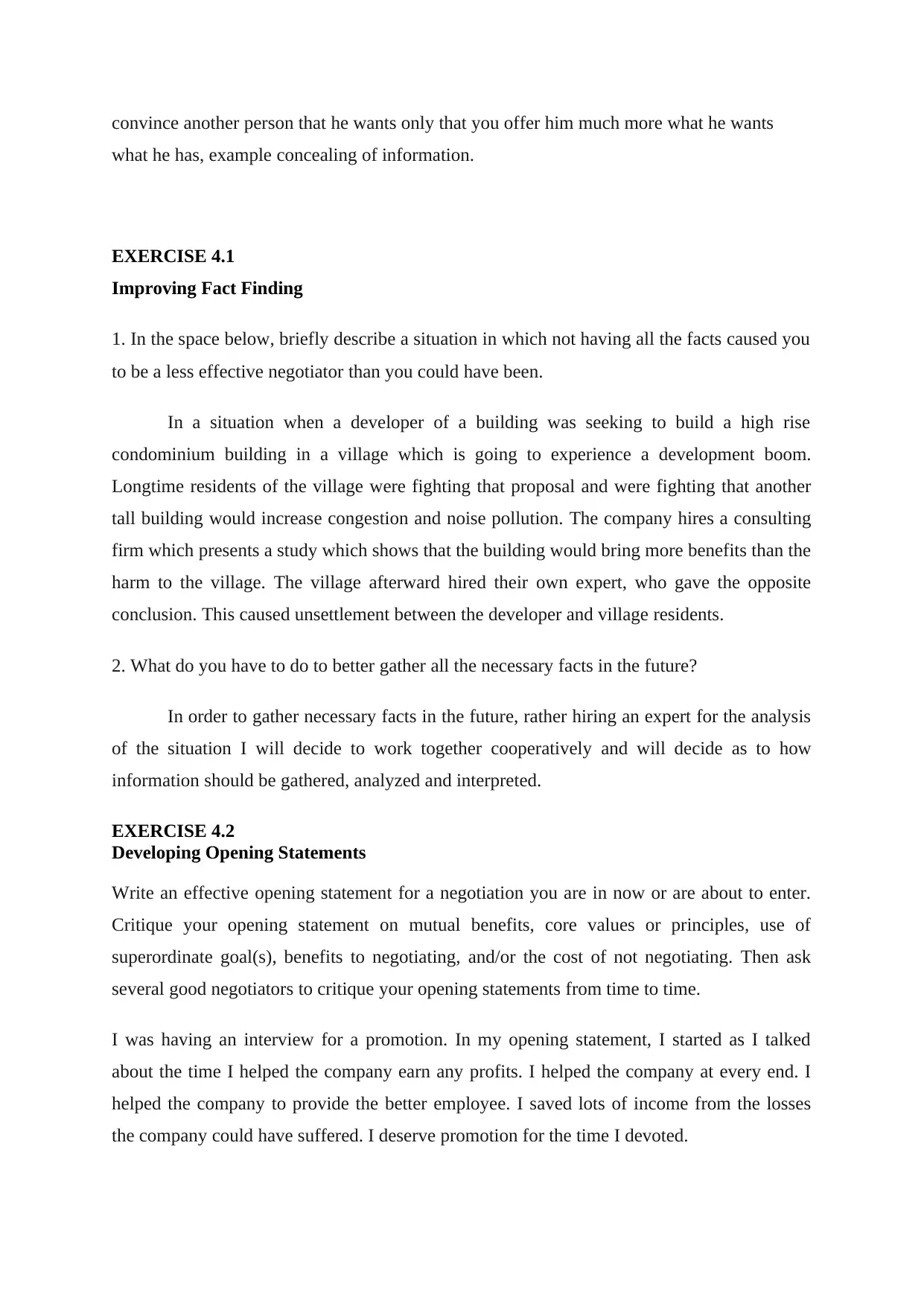
convince another person that he wants only that you offer him much more what he wants
what he has, example concealing of information.
EXERCISE 4.1
Improving Fact Finding
1. In the space below, briefly describe a situation in which not having all the facts caused you
to be a less effective negotiator than you could have been.
In a situation when a developer of a building was seeking to build a high rise
condominium building in a village which is going to experience a development boom.
Longtime residents of the village were fighting that proposal and were fighting that another
tall building would increase congestion and noise pollution. The company hires a consulting
firm which presents a study which shows that the building would bring more benefits than the
harm to the village. The village afterward hired their own expert, who gave the opposite
conclusion. This caused unsettlement between the developer and village residents.
2. What do you have to do to better gather all the necessary facts in the future?
In order to gather necessary facts in the future, rather hiring an expert for the analysis
of the situation I will decide to work together cooperatively and will decide as to how
information should be gathered, analyzed and interpreted.
EXERCISE 4.2
Developing Opening Statements
Write an effective opening statement for a negotiation you are in now or are about to enter.
Critique your opening statement on mutual benefits, core values or principles, use of
superordinate goal(s), benefits to negotiating, and/or the cost of not negotiating. Then ask
several good negotiators to critique your opening statements from time to time.
I was having an interview for a promotion. In my opening statement, I started as I talked
about the time I helped the company earn any profits. I helped the company at every end. I
helped the company to provide the better employee. I saved lots of income from the losses
the company could have suffered. I deserve promotion for the time I devoted.
what he has, example concealing of information.
EXERCISE 4.1
Improving Fact Finding
1. In the space below, briefly describe a situation in which not having all the facts caused you
to be a less effective negotiator than you could have been.
In a situation when a developer of a building was seeking to build a high rise
condominium building in a village which is going to experience a development boom.
Longtime residents of the village were fighting that proposal and were fighting that another
tall building would increase congestion and noise pollution. The company hires a consulting
firm which presents a study which shows that the building would bring more benefits than the
harm to the village. The village afterward hired their own expert, who gave the opposite
conclusion. This caused unsettlement between the developer and village residents.
2. What do you have to do to better gather all the necessary facts in the future?
In order to gather necessary facts in the future, rather hiring an expert for the analysis
of the situation I will decide to work together cooperatively and will decide as to how
information should be gathered, analyzed and interpreted.
EXERCISE 4.2
Developing Opening Statements
Write an effective opening statement for a negotiation you are in now or are about to enter.
Critique your opening statement on mutual benefits, core values or principles, use of
superordinate goal(s), benefits to negotiating, and/or the cost of not negotiating. Then ask
several good negotiators to critique your opening statements from time to time.
I was having an interview for a promotion. In my opening statement, I started as I talked
about the time I helped the company earn any profits. I helped the company at every end. I
helped the company to provide the better employee. I saved lots of income from the losses
the company could have suffered. I deserve promotion for the time I devoted.
Paraphrase This Document
Need a fresh take? Get an instant paraphrase of this document with our AI Paraphraser
Now criticizing the opening statement as talked above. The statement used opening statement
should be in terms of mutual benefit as it has not only benefited the company but also helped
in the development of the employee working in the company. They helped each other in
every part possible. They are like family taking care of each other. The core values of the
company were followed by the employee at every point and believed that it is always better
to follow the principles laid down by the company as it helps to keep the company and its
employee in the better position and status from other companies. The goals provided by the
company are the goals for the employees. They should consider the goal of the company as
the goal of their also. They should work hard to achieve those goals.
According to the good negotiators they stated that the employee shall always consider these
things for the opening statement. The first impression is the last impression and every
employee shall give their best to make that impression as the best one. There shall be a set
tone of the meeting or the interview for a promotion, which is a polite one. One should have a
polite tone and shall express everything politely so that the company or the authority could
easily understand what you want to express and shall not lose temper. The employee shall
outline his goals similar to that of the company so that if the goal of the company becomes
the goal of the employees. They shall set out the principles which would be followed by the
employees of the company.
EXERCISE 4.3
Asking High- Yield Questions
Observe several of your own negotiations and those of others. Were high-yield
questions used? What was the impact of the presence or absence of high-yield
questions? What have you learned that will increase your effectiveness in asking high-yield
questions? In the space below I write down what you have learned and then prepare several
high-yield questions for your next negotiation.
Yes, high-yield questions were used. It has a very important presence at the time of the
interview because at the time of the interview it helps the interviewer to identify the mentality
and the thought process about the job for which he is pursuing an interview. It helps to
identify the thinking about the things he or she considers the company. High-yields questions
help to identify the reason behind choosing this job. It helps in controlling the unqualified
people and those who are not suitable for the job. I have learned that whenever high-yield
questions are asked it helps in identifying the suitable person for the jobs. It helps in getting
should be in terms of mutual benefit as it has not only benefited the company but also helped
in the development of the employee working in the company. They helped each other in
every part possible. They are like family taking care of each other. The core values of the
company were followed by the employee at every point and believed that it is always better
to follow the principles laid down by the company as it helps to keep the company and its
employee in the better position and status from other companies. The goals provided by the
company are the goals for the employees. They should consider the goal of the company as
the goal of their also. They should work hard to achieve those goals.
According to the good negotiators they stated that the employee shall always consider these
things for the opening statement. The first impression is the last impression and every
employee shall give their best to make that impression as the best one. There shall be a set
tone of the meeting or the interview for a promotion, which is a polite one. One should have a
polite tone and shall express everything politely so that the company or the authority could
easily understand what you want to express and shall not lose temper. The employee shall
outline his goals similar to that of the company so that if the goal of the company becomes
the goal of the employees. They shall set out the principles which would be followed by the
employees of the company.
EXERCISE 4.3
Asking High- Yield Questions
Observe several of your own negotiations and those of others. Were high-yield
questions used? What was the impact of the presence or absence of high-yield
questions? What have you learned that will increase your effectiveness in asking high-yield
questions? In the space below I write down what you have learned and then prepare several
high-yield questions for your next negotiation.
Yes, high-yield questions were used. It has a very important presence at the time of the
interview because at the time of the interview it helps the interviewer to identify the mentality
and the thought process about the job for which he is pursuing an interview. It helps to
identify the thinking about the things he or she considers the company. High-yields questions
help to identify the reason behind choosing this job. It helps in controlling the unqualified
people and those who are not suitable for the job. I have learned that whenever high-yield
questions are asked it helps in identifying the suitable person for the jobs. It helps in getting
the right person for the job. The high-yield questions are basically used to identify the
detailed concern about the job, its positive and negative aspects of the company, changes
which the company should do in order to get better for the future. I learned that high-yield
questions are very important for the company. They help in determining the proper and
suitable member of the company. There can be many members or the employee of the
company but not the proper or suitable one. So for that, there are some high-yield questions
designed by me for better negotiation.
a. What reason would you give for your position?
b. Is there any reason that you cannot do?
c. Why do you think this is a fair or reasonable condition?
d. Why this provision or point is important?
e. What proposal concerns you the most?
f. What document and proof you will provide to validate your position?
g. What else do you think I should know?
detailed concern about the job, its positive and negative aspects of the company, changes
which the company should do in order to get better for the future. I learned that high-yield
questions are very important for the company. They help in determining the proper and
suitable member of the company. There can be many members or the employee of the
company but not the proper or suitable one. So for that, there are some high-yield questions
designed by me for better negotiation.
a. What reason would you give for your position?
b. Is there any reason that you cannot do?
c. Why do you think this is a fair or reasonable condition?
d. Why this provision or point is important?
e. What proposal concerns you the most?
f. What document and proof you will provide to validate your position?
g. What else do you think I should know?
⊘ This is a preview!⊘
Do you want full access?
Subscribe today to unlock all pages.
Trusted by 1+ million students worldwide

1 out of 36


Related Documents


Your All-in-One AI-Powered Toolkit for Academic Success.
+13062052269
info@desklib.com
Available 24*7 on WhatsApp / Email
![[object Object]](/_next/static/media/star-bottom.7253800d.svg)
Unlock your academic potential
Copyright © 2020–2025 A2Z Services. All Rights Reserved. Developed and managed by ZUCOL.