Financial Decision Making and Ratio Analysis Report (Finance)

Verified

Added on  2023/02/01

|13
|1224
|70
Report
AI Summary
This report provides an in-depth analysis of financial decision-making, focusing on two key areas: the role of accounting and finance departments within Nestle and a ratio analysis of Alpha Limited. The first section examines the importance of the accounting and finance departments within Nestle, highlighting their functions in financial accounting, management accounting, tax compliance, auditing, investment, financing, dividend policies, and working capital management. The second section presents a detailed ratio analysis of Alpha Limited, including calculations and interpretations of operating return on capital employed, net profit margin, current ratio, debtors collection period, and creditors payable period. The report concludes that sound financial decisions are crucial for a firm's profitability and operational stability, emphasizing the significance of both departments and financial ratios in assessing financial performance.

Document Page
Financial
Decision
Making
tabler-icon-diamond-filled.svg

Paraphrase This Document

Need a fresh take? Get an instant paraphrase of this document with our AI Paraphraser
Document Page
INTRODUCTION
It acts as the crucial decision that the financial manager has to take
in relation to its sufficient availability of the funds in the future so
that changing conditions can be met effectively and efficiently. The
present study involves two task where first task is based on the Nestle
company and another task is based on the Alpha Limited company.
Document Page
TASK 1- Significance of the accounting and the finance
department
Introduction of company
Nestle is the multinational company formed in the year 1905
by merger of Anglo-Swiss milk corporate which is set up
during the year 1866 by the brothers Charles page and
George page, founded by Henri Nestle. The company deals
in various range of the products that includes medical food,
breakfast cereals, baby food, bottled water, coffee, tea, dairy
products, snacks, pet foods, ice-cream and frozen food.
Document Page
CONTINUE…
Importance of Accounting and Finance Department
Accounting department- This department plays a crucial role for the Nestle company as it
relates with several activities which are very much essential for the firm to run its operations
smoothly. . It involves the financial accounting, management accounting, tax functions and the
auditing function.
Financial accounting- Accounting department ensures the effectiveness and efficiency in
performing these functions which leads to adequate reporting of the financial transactions.
Management accounting- This leads to the effectiveness of the management accounting as
well which is also a major role that the accounting department plays with the Nestle.
Tax function-This department facilitates for the timely payment of the taxes with compliance
of all the accounting standards which is very important for Nestle to function its business
ethically across the globe.
Auditing function- It also provides for appropriate auditing of the financial which helps the
firm in enhancing the reliability and validity of the information. Auditing is made keeping in
account all the principles and the standards that are mentioned or provisioned which assists
Nestle company in building its reputation or goodwill in the international market
tabler-icon-diamond-filled.svg

Paraphrase This Document

Need a fresh take? Get an instant paraphrase of this document with our AI Paraphraser
Document Page
Continue..
Finance department- This department is necessary for Nestle company for managing its money. The
major functions that the finance department involves are planning, auditing, organizing and accounting
for controlling the finances of the company.
Investment function- One of the most important function of the finance department is to allocate the
capital of the company into the long term or non-current assets so that maximum returns can be generated
in the near future.
Financing function- It is another important function that the finance department performs. For making the
wise decisions in relation to the acquisition of the funds, financing function is of major importance.
Dividend function- Earning the profits and the positive returns is the common goal of all businesses. It is
the key function of the finance department to decide whether the profits gained need to be distributed
wholly to the shareholders of the Nestle or retaining the profits entirely or in part for reinvesting in the new
projects or business for making more expansion and diversification
Working capital function- For maintaining the liquidity position of Nestle it is very essential for the
finance managers to manage the current assets and the liabilities of the company effectively so that
insolvency can be avoided.
Document Page
TASK 2- a. Calculation of the ratio analysis of Alpha
Limited
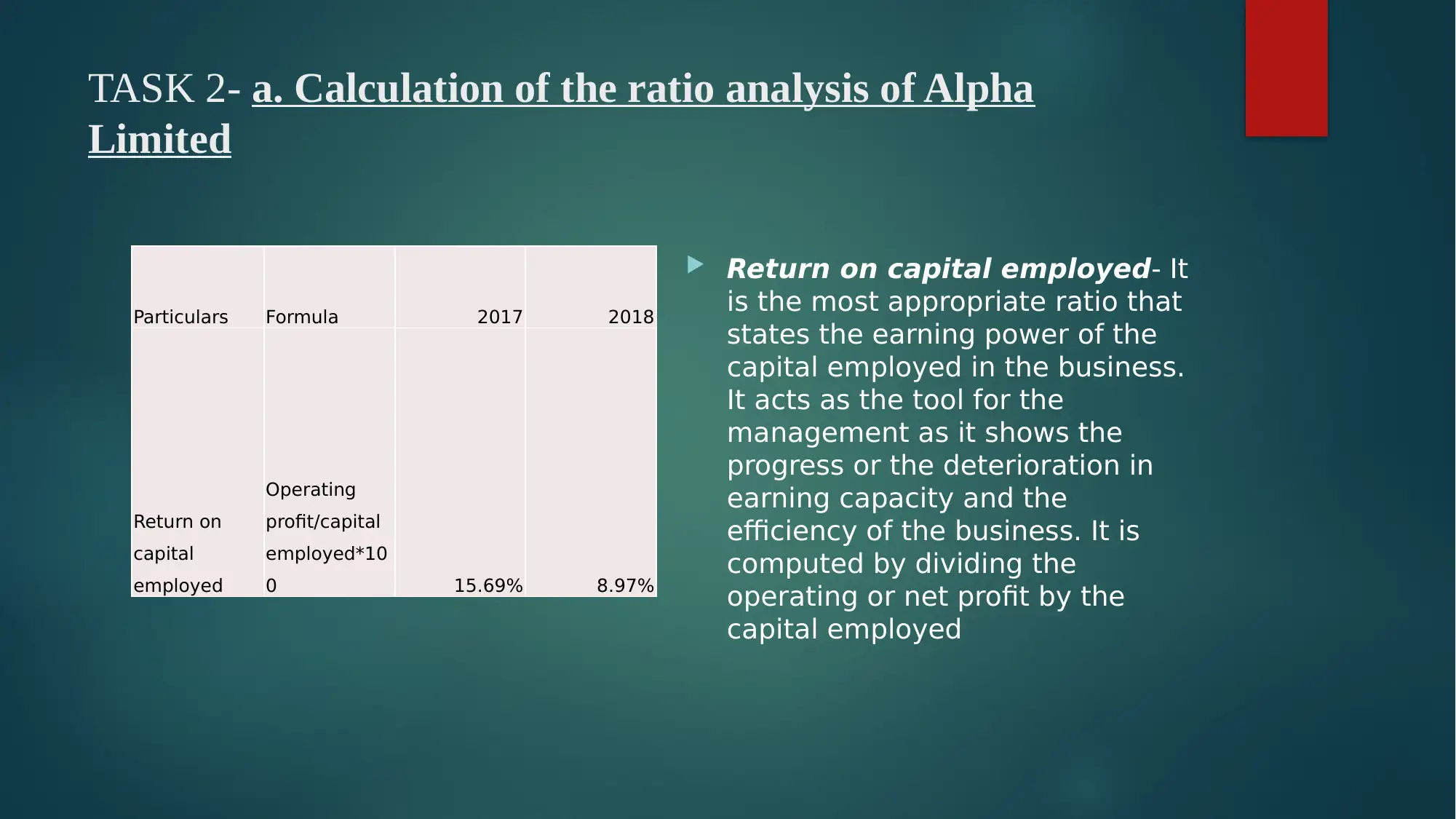
Particulars Formula 2017 2018
Return on
capital
employed
Operating
profit/capital
employed*10
0 15.69% 8.97%
Return on capital employed- It
is the most appropriate ratio that
states the earning power of the
capital employed in the business.
It acts as the tool for the
management as it shows the
progress or the deterioration in
earning capacity and the
efficiency of the business. It is
computed by dividing the
operating or net profit by the
capital employed
Document Page
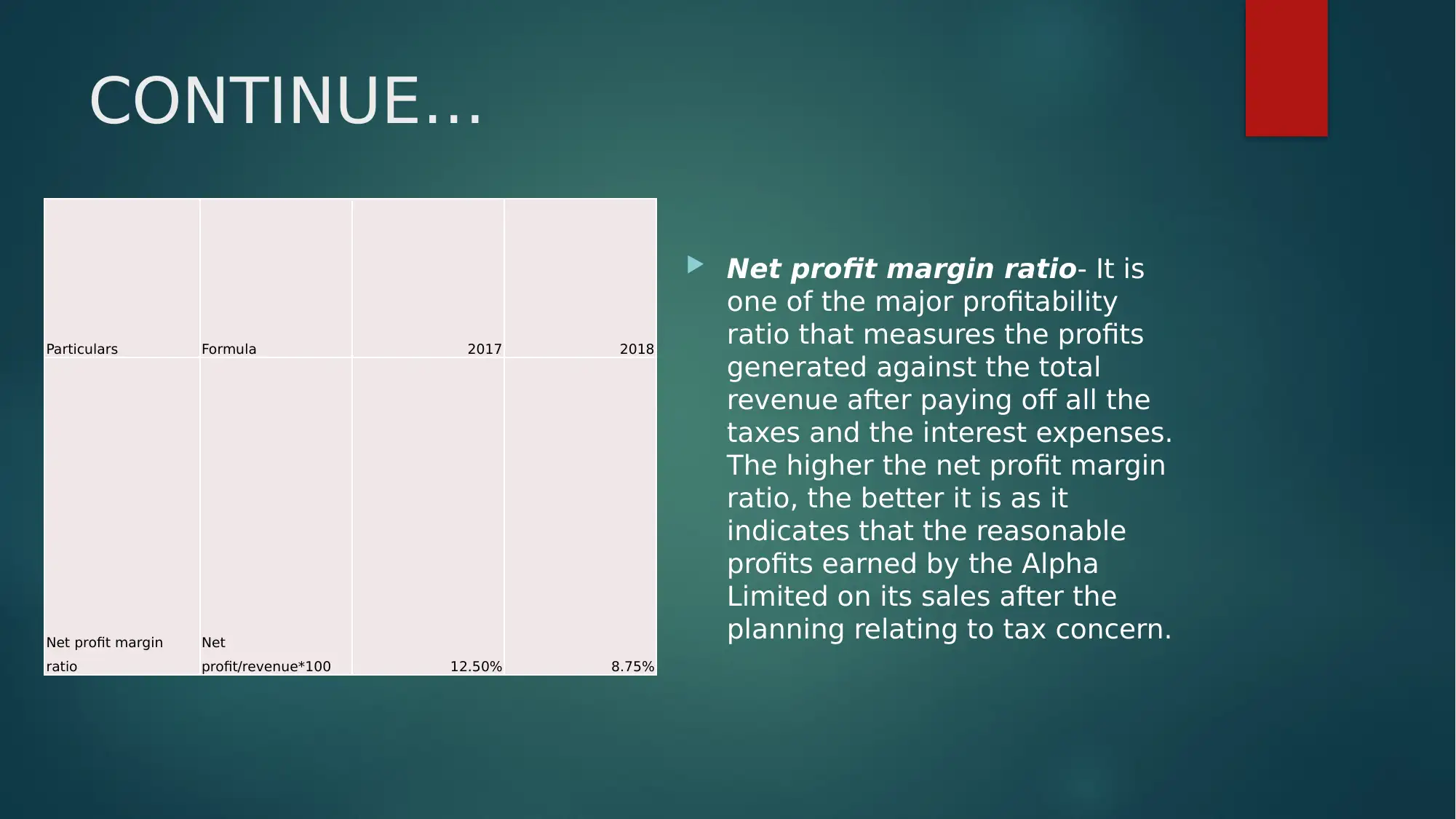
Particulars Formula 2017 2018
Net profit margin
ratio
Net
profit/revenue*100 12.50% 8.75%
Net profit margin ratio- It is
one of the major profitability
ratio that measures the profits
generated against the total
revenue after paying off all the
taxes and the interest expenses.
The higher the net profit margin
ratio, the better it is as it
indicates that the reasonable
profits earned by the Alpha
Limited on its sales after the
planning relating to tax concern.
CONTINUE…
tabler-icon-diamond-filled.svg

Paraphrase This Document

Need a fresh take? Get an instant paraphrase of this document with our AI Paraphraser
Document Page
CONTINUE…
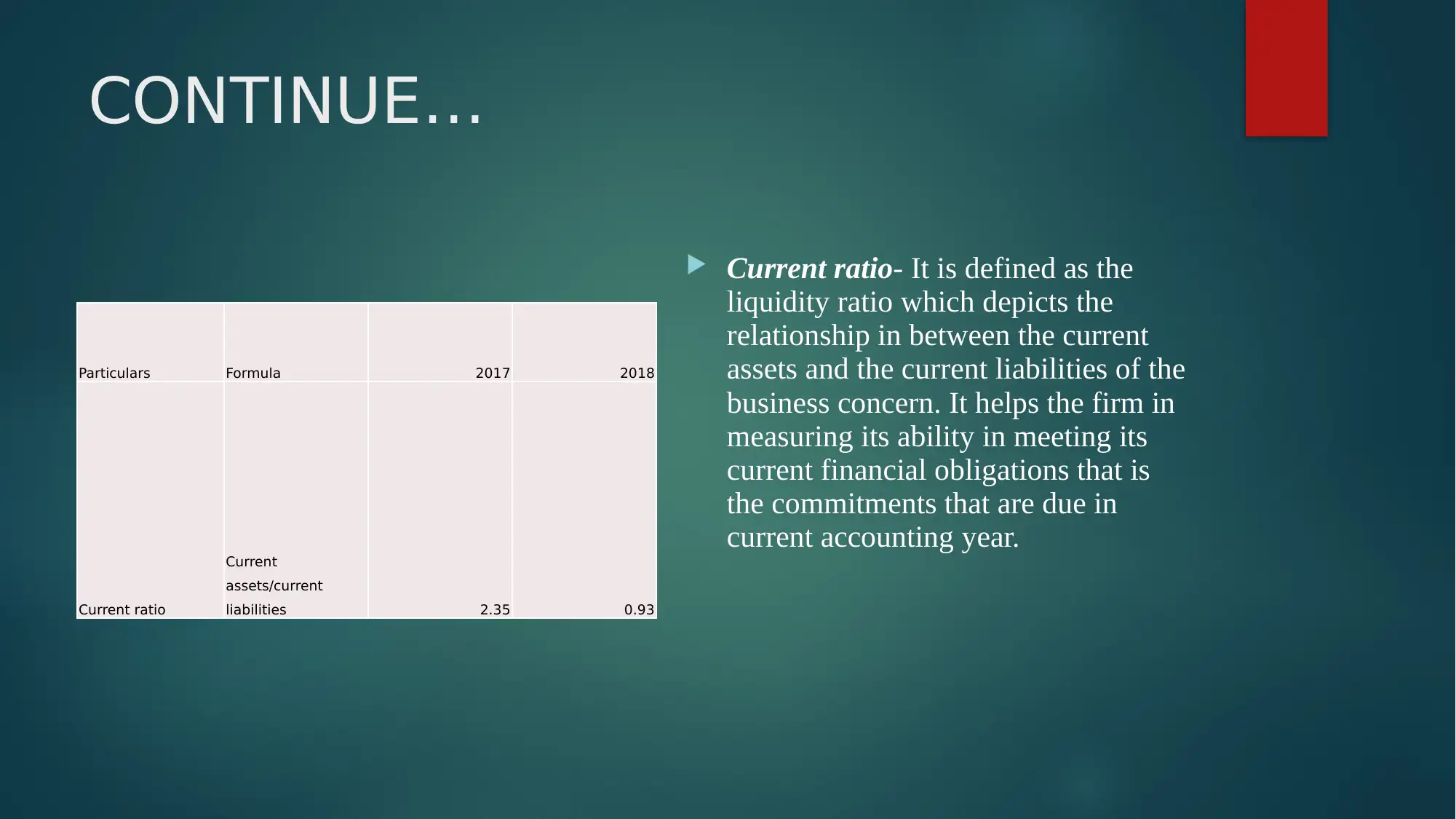
Particulars Formula 2017 2018
Current ratio
Current
assets/current
liabilities 2.35 0.93
Current ratio- It is defined as the
liquidity ratio which depicts the
relationship in between the current
assets and the current liabilities of the
business concern. It helps the firm in
measuring its ability in meeting its
current financial obligations that is
the commitments that are due in
current accounting year.
Document Page
CONTINUE…
Particulars Formula 2017 2018
Debtor collection
period
Trade
receivables/revenue*
365 68.4 73
Debtors collection period- It is the
efficiency ratio that looks at the time
taken by the company in collecting
its money owed from its debtors or
the customers. The lower the period,
the better it is because in limited
duration the cash could be
ascertained by the firm
Document Page
CONTINUE..
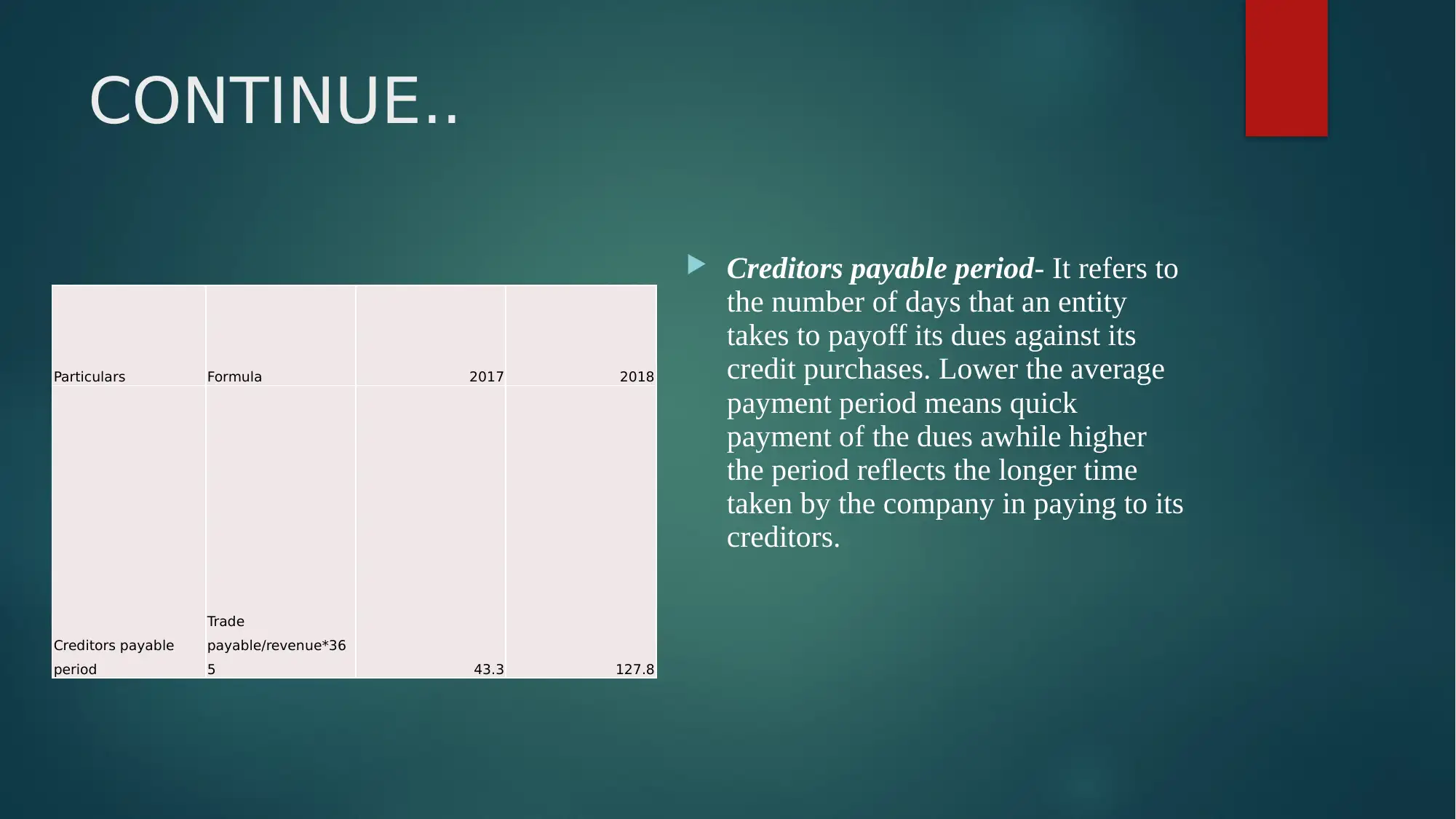
Particulars Formula 2017 2018
Creditors payable
period
Trade
payable/revenue*36
5 43.3 127.8
Creditors payable period- It refers to
the number of days that an entity
takes to payoff its dues against its
credit purchases. Lower the average
payment period means quick
payment of the dues awhile higher
the period reflects the longer time
taken by the company in paying to its
creditors.
tabler-icon-diamond-filled.svg

Paraphrase This Document

Need a fresh take? Get an instant paraphrase of this document with our AI Paraphraser
Document Page
CONCLUSION
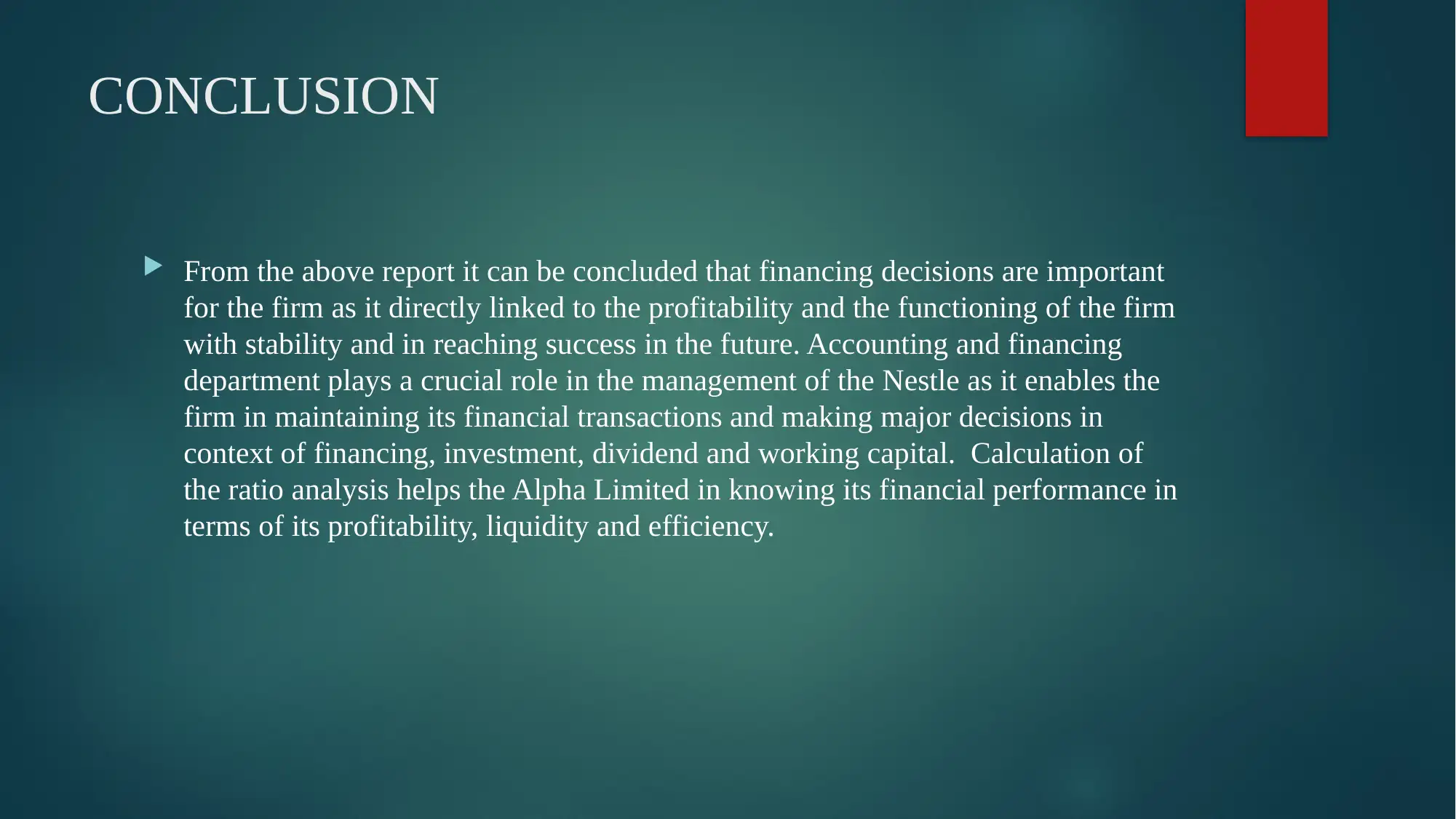
From the above report it can be concluded that financing decisions are important
for the firm as it directly linked to the profitability and the functioning of the firm
with stability and in reaching success in the future. Accounting and financing
department plays a crucial role in the management of the Nestle as it enables the
firm in maintaining its financial transactions and making major decisions in
context of financing, investment, dividend and working capital. Calculation of
the ratio analysis helps the Alpha Limited in knowing its financial performance in
terms of its profitability, liquidity and efficiency.
Document Page
REFERENCES
Chalamandaris, G. and Vlachogiannakis, N. E., 2018. Are financial ratios relevant
for trading credit risk? Evidence from the CDS market. Annals of Operations
Research. 266(1-2). pp.395-440.
Cleary, P. and Quinn, M., 2016. Intellectual capital and business performance: An
exploratory study of the impact of cloud-based accounting and finance
infrastructure. Journal of Intellectual Capital. 17(2). pp.255-278.
Csikosova, A., Janoskova, M. and Culkova, K., 2019. Limitation of Financial
Health Prediction in Companies from Post-Communist Countries. Journal of Risk
and Financial Management. 12(1). p.15.
Hyndman, N. and et.al., 2018. Legitimating change in the public sector: the
introduction of (rational?) accounting practices in the United Kingdom, Italy and
Austria. Public Management Review. 20(9). pp.1374-1399.
chevron_up_icon
1 out of 13
circle_padding
hide_on_mobile
zoom_out_icon
[object Object]