Nestle's Growth Decline: A Case Study
VerifiedAdded on 2019/09/30
|3
|596
|182
Case Study
AI Summary
This case study examines the recent decline in growth experienced by Nestlé, a major consumer goods manufacturer. It highlights the decrease in earnings per share, net profit, operating profit, and sales, leading to a reduction in overall profitability and market attractiveness. The study explores the reasons behind this decline, including reduced consumer demand, pricing issues, and competitive pressures. It also discusses Nestlé's attempts to mitigate these challenges, such as raising prices in Brazil, and the potential impact of restructuring initiatives. The case study concludes by emphasizing the need for strategic actions to address the company's financial and market position.
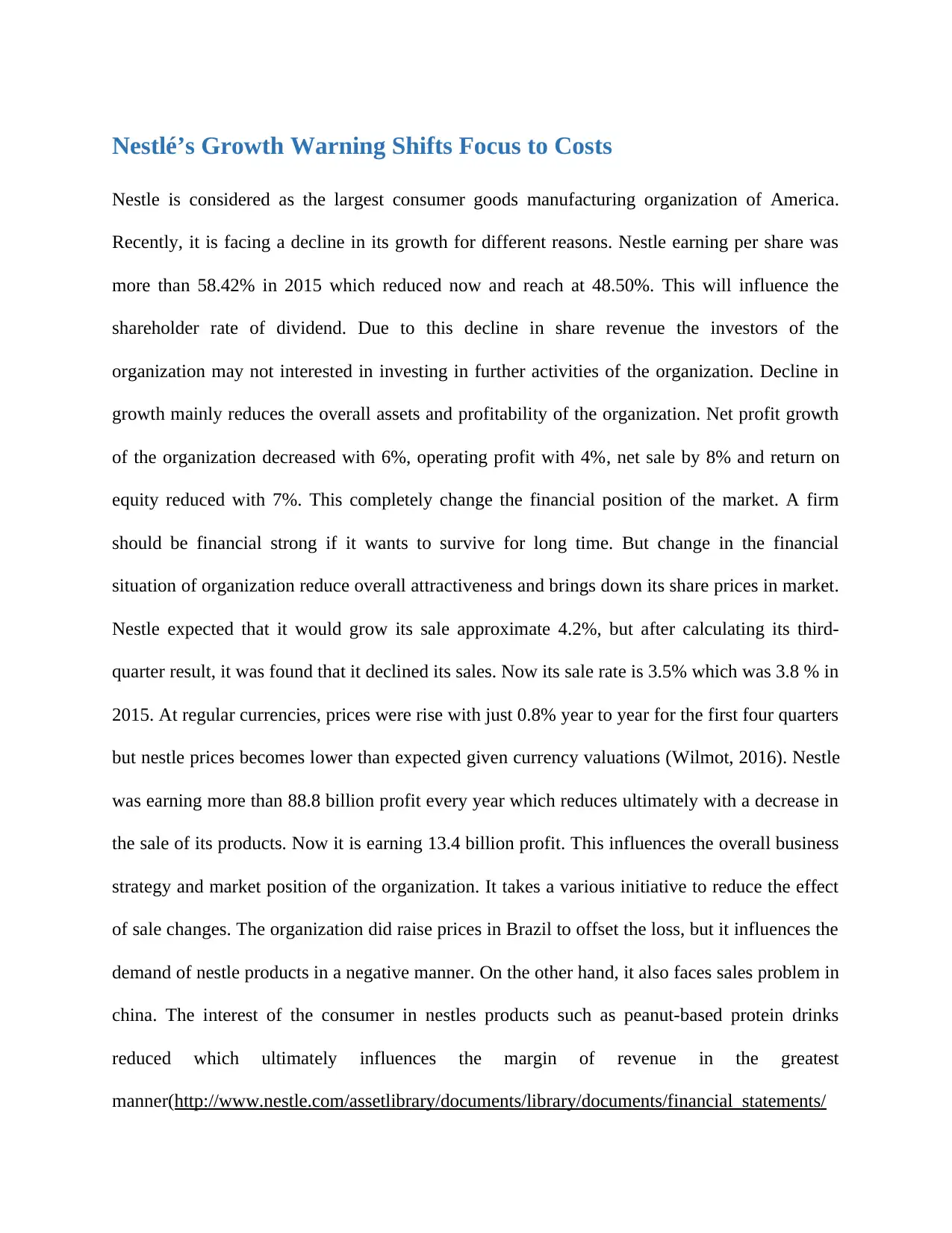
Nestlé’s Growth Warning Shifts Focus to Costs
Nestle is considered as the largest consumer goods manufacturing organization of America.
Recently, it is facing a decline in its growth for different reasons. Nestle earning per share was
more than 58.42% in 2015 which reduced now and reach at 48.50%. This will influence the
shareholder rate of dividend. Due to this decline in share revenue the investors of the
organization may not interested in investing in further activities of the organization. Decline in
growth mainly reduces the overall assets and profitability of the organization. Net profit growth
of the organization decreased with 6%, operating profit with 4%, net sale by 8% and return on
equity reduced with 7%. This completely change the financial position of the market. A firm
should be financial strong if it wants to survive for long time. But change in the financial
situation of organization reduce overall attractiveness and brings down its share prices in market.
Nestle expected that it would grow its sale approximate 4.2%, but after calculating its third-
quarter result, it was found that it declined its sales. Now its sale rate is 3.5% which was 3.8 % in
2015. At regular currencies, prices were rise with just 0.8% year to year for the first four quarters
but nestle prices becomes lower than expected given currency valuations (Wilmot, 2016). Nestle
was earning more than 88.8 billion profit every year which reduces ultimately with a decrease in
the sale of its products. Now it is earning 13.4 billion profit. This influences the overall business
strategy and market position of the organization. It takes a various initiative to reduce the effect
of sale changes. The organization did raise prices in Brazil to offset the loss, but it influences the
demand of nestle products in a negative manner. On the other hand, it also faces sales problem in
china. The interest of the consumer in nestles products such as peanut-based protein drinks
reduced which ultimately influences the margin of revenue in the greatest
manner(http://www.nestle.com/assetlibrary/documents/library/documents/financial_statements/
Nestle is considered as the largest consumer goods manufacturing organization of America.
Recently, it is facing a decline in its growth for different reasons. Nestle earning per share was
more than 58.42% in 2015 which reduced now and reach at 48.50%. This will influence the
shareholder rate of dividend. Due to this decline in share revenue the investors of the
organization may not interested in investing in further activities of the organization. Decline in
growth mainly reduces the overall assets and profitability of the organization. Net profit growth
of the organization decreased with 6%, operating profit with 4%, net sale by 8% and return on
equity reduced with 7%. This completely change the financial position of the market. A firm
should be financial strong if it wants to survive for long time. But change in the financial
situation of organization reduce overall attractiveness and brings down its share prices in market.
Nestle expected that it would grow its sale approximate 4.2%, but after calculating its third-
quarter result, it was found that it declined its sales. Now its sale rate is 3.5% which was 3.8 % in
2015. At regular currencies, prices were rise with just 0.8% year to year for the first four quarters
but nestle prices becomes lower than expected given currency valuations (Wilmot, 2016). Nestle
was earning more than 88.8 billion profit every year which reduces ultimately with a decrease in
the sale of its products. Now it is earning 13.4 billion profit. This influences the overall business
strategy and market position of the organization. It takes a various initiative to reduce the effect
of sale changes. The organization did raise prices in Brazil to offset the loss, but it influences the
demand of nestle products in a negative manner. On the other hand, it also faces sales problem in
china. The interest of the consumer in nestles products such as peanut-based protein drinks
reduced which ultimately influences the margin of revenue in the greatest
manner(http://www.nestle.com/assetlibrary/documents/library/documents/financial_statements/
Paraphrase This Document
Need a fresh take? Get an instant paraphrase of this document with our AI Paraphraser

2015-financial-statements-en.pdf). The management of the organization should take efficient
initiatives to tackle with such problem, but it fails. However, management of the organization
also blamed a more general slowdown in consumer demand across developing and developed
markets. This will influence the perspective of investors towards nestle in largest manner. It has
occurred because Nestle does not have the pricing power in its competitive market. This will be
sluggish down consumer demand and profitability of the organization reduced. This could be a
big problem for the organization in future which influences the overall competitive image in the
market. The management of the organization should identify the areas which require scrutiny.
Restructuring Initiatives can be beneficial for the organization to save itself from the selling risk.
Ulf Mark Schneider, who immediately joins Nestle as chief executive putting more efforts to
take aggressive actions. Stalling growth may boost the bond-like attractions of Nestlé’s
expensive shares. This will facilitate organization to overcome its risk factors in an efficient
manner.
initiatives to tackle with such problem, but it fails. However, management of the organization
also blamed a more general slowdown in consumer demand across developing and developed
markets. This will influence the perspective of investors towards nestle in largest manner. It has
occurred because Nestle does not have the pricing power in its competitive market. This will be
sluggish down consumer demand and profitability of the organization reduced. This could be a
big problem for the organization in future which influences the overall competitive image in the
market. The management of the organization should identify the areas which require scrutiny.
Restructuring Initiatives can be beneficial for the organization to save itself from the selling risk.
Ulf Mark Schneider, who immediately joins Nestle as chief executive putting more efforts to
take aggressive actions. Stalling growth may boost the bond-like attractions of Nestlé’s
expensive shares. This will facilitate organization to overcome its risk factors in an efficient
manner.

References
Wilmot, S. (2016). Nestlé’s Growth Warning Shifts Focus to Costs. WSJ. Retrieved from
http://www.wsj.com/articles/nestles-growth-warning-shifts-focus-to-costs-1476973563
(2015). Retrieved from
http://www.nestle.com/asset-library/documents/library/documents/financial_statements/2015-
financial-statements-en.pdf
Wilmot, S. (2016). Nestlé’s Growth Warning Shifts Focus to Costs. WSJ. Retrieved from
http://www.wsj.com/articles/nestles-growth-warning-shifts-focus-to-costs-1476973563
(2015). Retrieved from
http://www.nestle.com/asset-library/documents/library/documents/financial_statements/2015-
financial-statements-en.pdf
⊘ This is a preview!⊘
Do you want full access?
Subscribe today to unlock all pages.

Trusted by 1+ million students worldwide
1 out of 3
Related Documents
Your All-in-One AI-Powered Toolkit for Academic Success.
+13062052269
info@desklib.com
Available 24*7 on WhatsApp / Email
Unlock your academic potential
Copyright © 2020–2026 A2Z Services. All Rights Reserved. Developed and managed by ZUCOL.