Managing Successful Business Projects: Nestle HR Practices Analysis

Verified

Added on  2020/10/22

|27
|4894
|206
Report
AI Summary
This report analyzes how multinational companies, using Nestle as a case study, improve their recruitment, selection, and training processes to meet international requirements in a globalized environment. The report begins with an introduction to project aims, objectives, and a project management plan, including cost, scope, time, quality, communication, risk, and resources. It includes a work breakdown structure and a Gantt chart. The research employs a small-scale approach using qualitative and quantitative research methods, detailing the research philosophy (Interpretivism), research approach (Inductive), research design (Descriptive), sampling (Random), data collection (primary and secondary), data analysis (Qualitative), and ethical considerations. The quantitative data analysis reveals that managers believe globalization improves recruitment, selection, and training, with training being the most improved HR practice. Equality and diversity are crucial concerns, and managers are generally aware of international policies. The report concludes with an analysis of the data collected from HR managers.

Document Page
Managing Successful Business Projects
(Analysis of improvement in recruitment,
selection, training of employees in multinational
companies to meet International requirements)
tabler-icon-diamond-filled.svg

Paraphrase This Document

Need a fresh take? Get an instant paraphrase of this document with our AI Paraphraser
Document Page
1
Document Page
TOPIC: How the multinational companies improve recruitment, selection, training of their
employees in order to meet International requirements?
INTRODUCTION
Managing successful business is an essential part of organisation and its employers where
focus of individual is on managing every possible change in order to meet changes of business
environment (Petras, 2016). The research will help in evaluating enhancing in hiring, choosing,
training of the workers in multinational organizations in order to meet international
requirements. This research will be based on aim, objectives, project management plan, Work
breakdown structure and a Gantt chart. Further, it will explain Small-scale research by applying
qualitative and quantitative research methods.
TASK 1
P1. Aims of project and objectives
Globalisation refers to process by which businesses or other organizations start operating
at a global level. Changing era of globalisation is leading to major changes in recruitment and
selection process of firms because of differences in ethnic backgrounds, religions and
nationalities (Ramirez, Meyer and Lerch, 2016). International hiring has confidence in driving a
transparent recruitment process which enables the clients to have the assurance of the quality of
services (IMPACT OF GLOBALIZATION ON HR PRACTICES, 2019). However, Recruiting
Team of Nestlé ensures oversee end to end recruitment process with a key focus on client
management. Recruiting experience in a large national or global corporation highly preferable.
The Nestlé Companies are equal employment and affirmative action.
Aim
An investigation on the impact of globalisation on recruitment, selection. and training.: A case
study on Nestle”.
Objectives
To evaluate enhancement in recruitment, selection, training of employees in multinational
firms.
To outline consequences of hiring, selection, training of employees as per international
requirements.
1
Document Page
To derive ways of managing changes in recruitment, selection, training of staff in
globalisation era.
To recommend conducts of managing upgradation in recruitment, selection, training
process of Nestle International requirements.
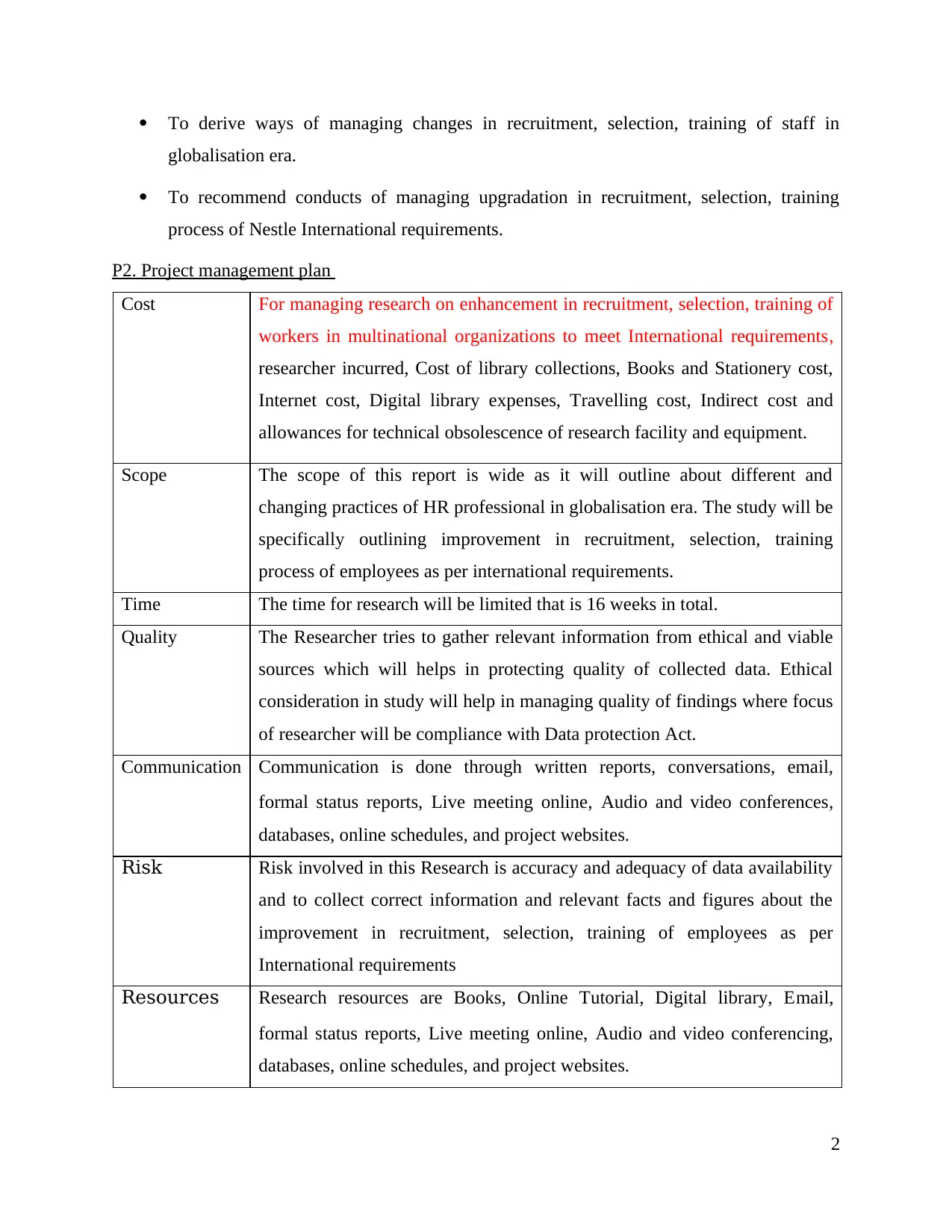
P2. Project management plan
Cost For managing research on enhancement in recruitment, selection, training of
workers in multinational organizations to meet International requirements,
researcher incurred, Cost of library collections, Books and Stationery cost,
Internet cost, Digital library expenses, Travelling cost, Indirect cost and
allowances for technical obsolescence of research facility and equipment.
Scope The scope of this report is wide as it will outline about different and
changing practices of HR professional in globalisation era. The study will be
specifically outlining improvement in recruitment, selection, training
process of employees as per international requirements.
Time The time for research will be limited that is 16 weeks in total.
Quality The Researcher tries to gather relevant information from ethical and viable
sources which will helps in protecting quality of collected data. Ethical
consideration in study will help in managing quality of findings where focus
of researcher will be compliance with Data protection Act.
Communication Communication is done through written reports, conversations, email,
formal status reports, Live meeting online, Audio and video conferences,
databases, online schedules, and project websites.
Risk Risk involved in this Research is accuracy and adequacy of data availability
and to collect correct information and relevant facts and figures about the
improvement in recruitment, selection, training of employees as per
International requirements
Resources Research resources are Books, Online Tutorial, Digital library, Email,
formal status reports, Live meeting online, Audio and video conferencing,
databases, online schedules, and project websites.
2
tabler-icon-diamond-filled.svg

Paraphrase This Document

Need a fresh take? Get an instant paraphrase of this document with our AI Paraphraser
Document Page
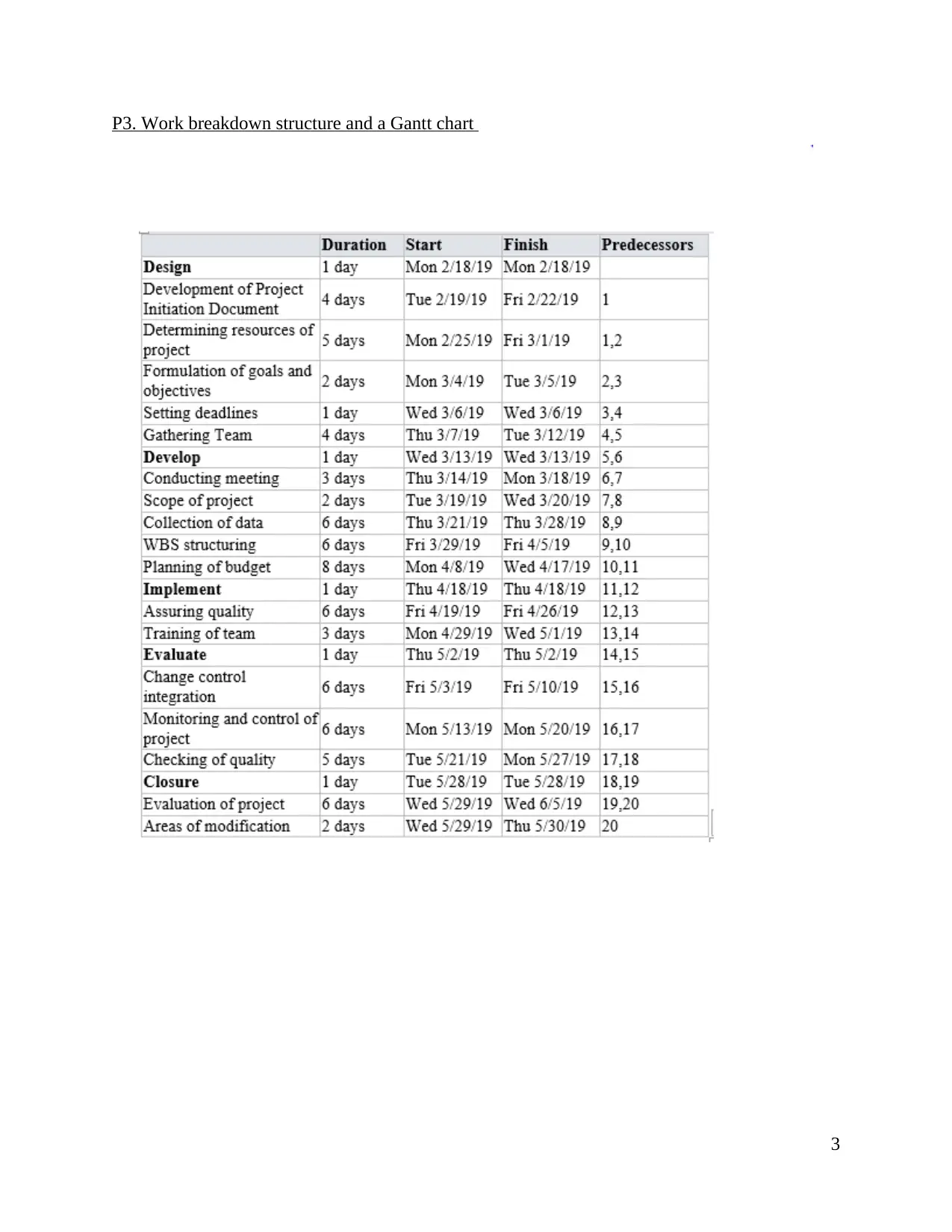
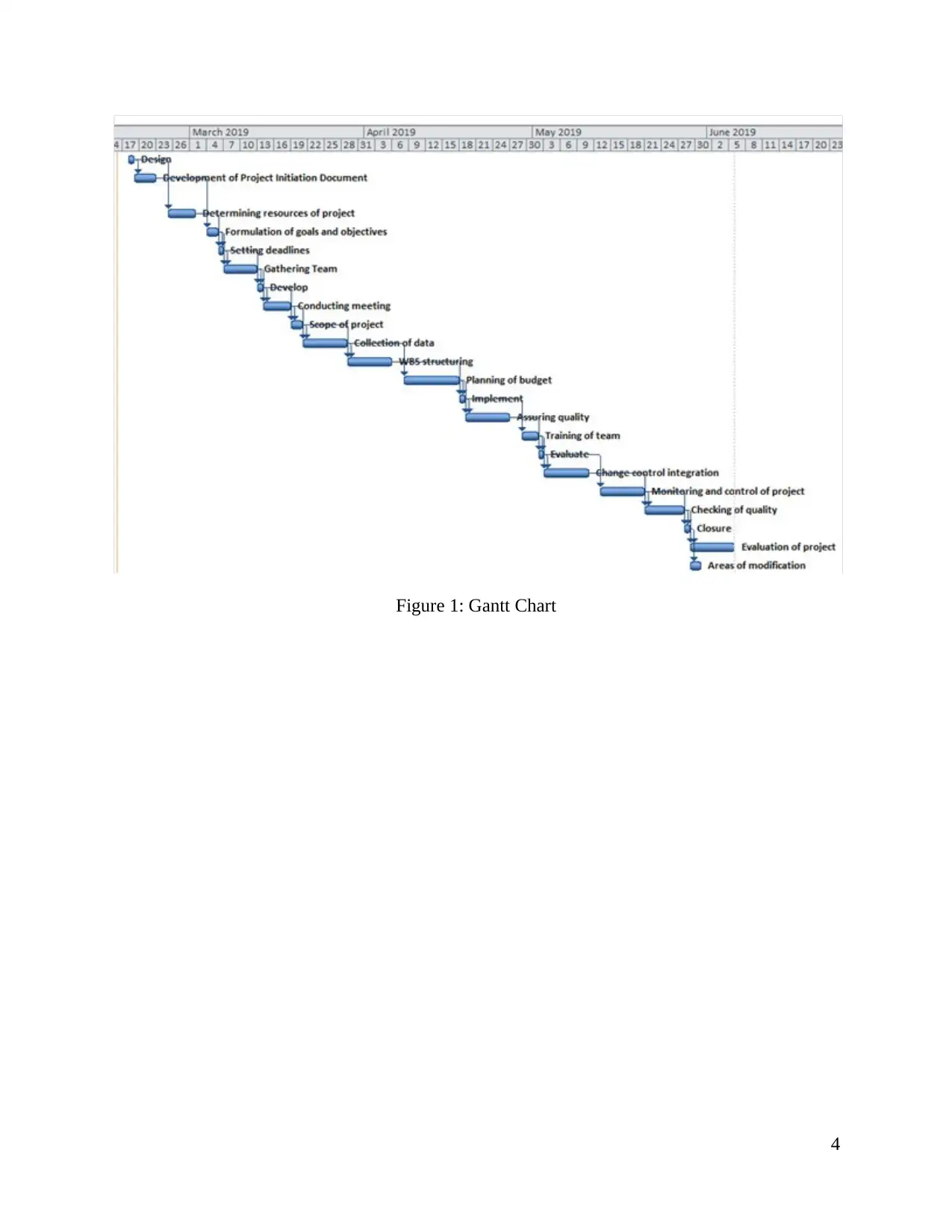
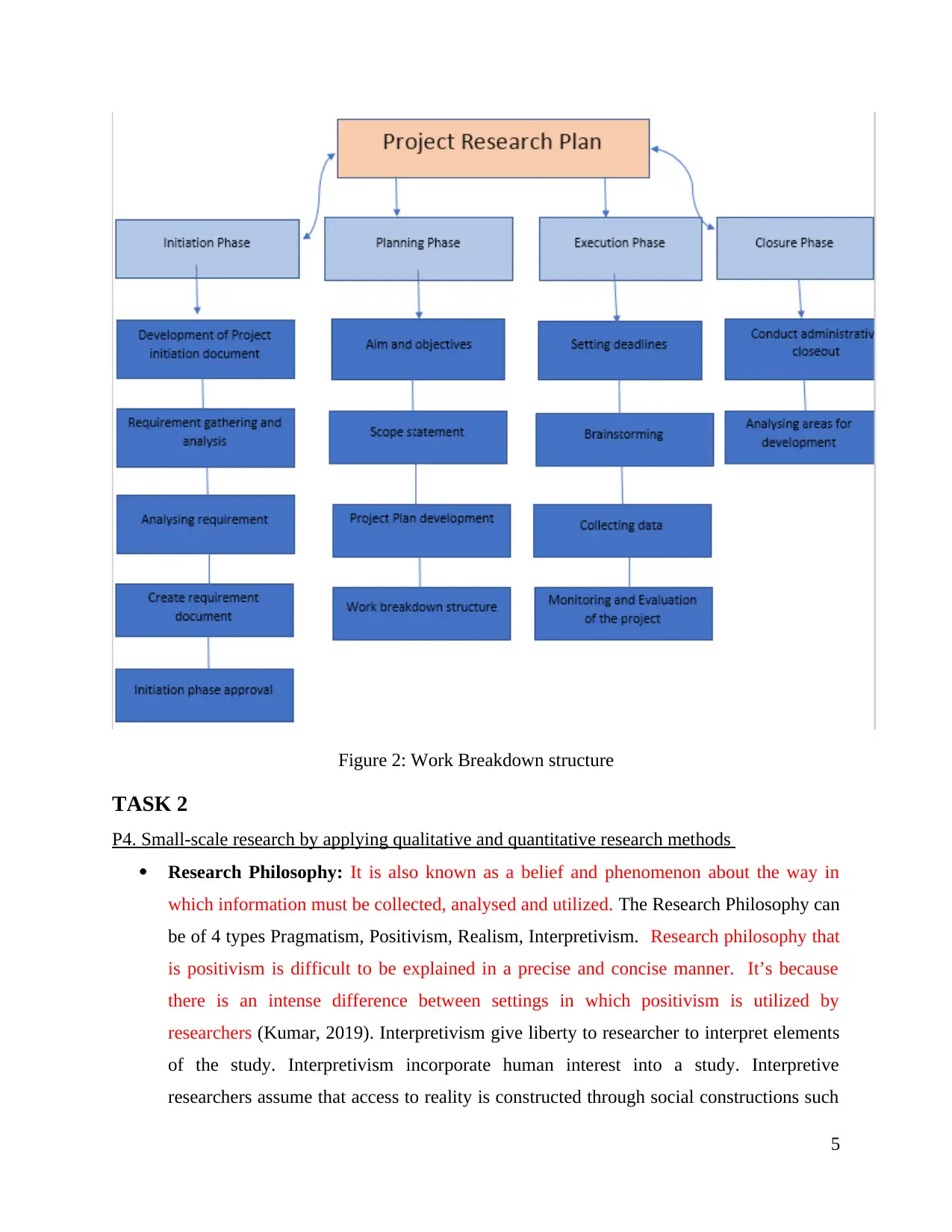
P3. Work breakdown structure and a Gantt chart
3
Document Page
Figure 1: Gantt Chart
4
Document Page
Figure 2: Work Breakdown structure
TASK 2
P4. Small-scale research by applying qualitative and quantitative research methods
Research Philosophy: It is also known as a belief and phenomenon about the way in
which information must be collected, analysed and utilized. The Research Philosophy can
be of 4 types Pragmatism, Positivism, Realism, Interpretivism. Research philosophy that
is positivism is difficult to be explained in a precise and concise manner. It’s because
there is an intense difference between settings in which positivism is utilized by
researchers (Kumar, 2019). Interpretivism give liberty to researcher to interpret elements
of the study. Interpretivism incorporate human interest into a study. Interpretive
researchers assume that access to reality is constructed through social constructions such
5
tabler-icon-diamond-filled.svg

Paraphrase This Document

Need a fresh take? Get an instant paraphrase of this document with our AI Paraphraser
Document Page
as language, consciousness, mutual meanings, and instruments. Researcher has used
Interpretivism Research Philosophy in Research to analyse improvement in recruitment,
selection, training of employees in multinational companies because Interpretivism
research philosophy is helpful in providing real factual data. There is involvement of
human interest in it. Reality is concluded through language, knowingness and shared
meanings.
Research Approach: This approach is a planning and process which consisting the steps
of broad anticipation to in-depth method of collecting data, analysis and interpretation. In
this there are three type of research approach Deductive, Inductive and Abductive
research approach. In Deductive research approach researcher formulates hypothesis.
Inductive research approach consists of Observations, patterns and conceptual framework
(Silverman, 2016). Abductive research approach is a procedure that is being devoted in
explanation of incomplete observations, surprising facts or puzzles. Researcher has used
Inductive Research approach in to evaluate improvement in recruitment, selection,
training of employees in globalisation era. It does not involve formulation of hypothesis.
It begins with questions of research and aims and objectives that need to be achieved
during the research project.
Research Design: It is the set of techniques and procedures used in analysing measures
and collection of the variables specified in the research. Research design includes
research problem, Hypothesis and independent variables. There are four type of research
design which are Explanatory, Descriptive, Diagnostic and Experimental Research
Design. Explanatory research design refers to a research conducted for the problem that
has not been studied more clearly, to develop operations and to improve the final research
design (Fletcher, 2017). Descriptive research design is used to describe characteristics of
a phenomenon that has been studied. Researcher used Descriptive research design in to
analysis improvement in recruitment, selection, training of employees in multinational
companies. It is a scientific method which involves observation and describes the
behaviour of a project topic without influencing it in any way.
Sampling: It is a procedure used in statistical analysis in which a Prerequisites number of
observations are taken from a large number of populations. There are many ways through
which sampling can be done but mostly used are Random, Stratified, Systematic and
6
Document Page
Cluster (Hickson, 2016). Researcher will take Random sampling method in which 10
Human Resource manager of Nestlé are taken from different geographical location as a
sample participant in order to do to analyse enhancement in recruitment, selection,
training of employees in multinational companies to meet International requirements.
Random sampling is helpful because there is equal probability of selection of each
member from the random sample. It is an easiest and simple method because there is less
chances of error in it than a Biased sample. Biased sample can lead towards incorrect
conclusions.
Data collection: Data collection refers to collecting and gathering data on variances in an
established systematic manner that encompasses one to answer stated research questions,
to test the hypotheses, and to evaluate the outcomes. There are two types of information
collection method primary and secondary.
Qualitative Research
Primary data is an original data source it is collected by investigator by its own so there
are high changes of adequacy in data. Secondary data is collected by other sources based
on primary ones. Its lack originality because it is based on someone's assumptions there is
high chances of error in it. There is lack of accuracy in Secondary data. Researcher
collected primary data to outline improvement in recruitment, selection, training of
employees in multinational companies. Through conducting Interview of Sample
participants which are 10 Human Resource manager of Nestlé from different
geographical location.
Data Analysis: It is a procedure of inspecting, changing and modelling of information
with the goal of identify useful data, conclusions and supporting decision-making. It is of
two type Qualitative and Quantitative. Qualitative Data Analysis is based on theoretical
and verbal form. It refers to non-numeric information such as notes, interview transcripts,
video and audio recordings, visual images and text documents. Quantitative data is based
on numerical facts and figures. Researcher used Qualitative data analysis. It provides real
facts in the Project report on which scholar can relay. Qualitative data analysis is being
done through Content, Narrative, Discourse and framework analysis.
Ethical consideration: Ethical consideration means an assemblage of values and
principles that address questions of what is good or bad in human affairs. Researcher
7
Document Page
follows proper rules, guidelines and code of conduct. The researcher will ensure that no
participants is forced to share personal information about company.
TASK 3
P5. Research and data using appropriate tools and techniques
Quantitate research
Data Analysis
Theme 1: Yes, managers believe that globalisation led to improvement in recruitment,
selection and training process
1. Do you believe globalisation led to improvement in recruitment, selection
and training process?
Frequency
Yes 5
May be 3
No 2
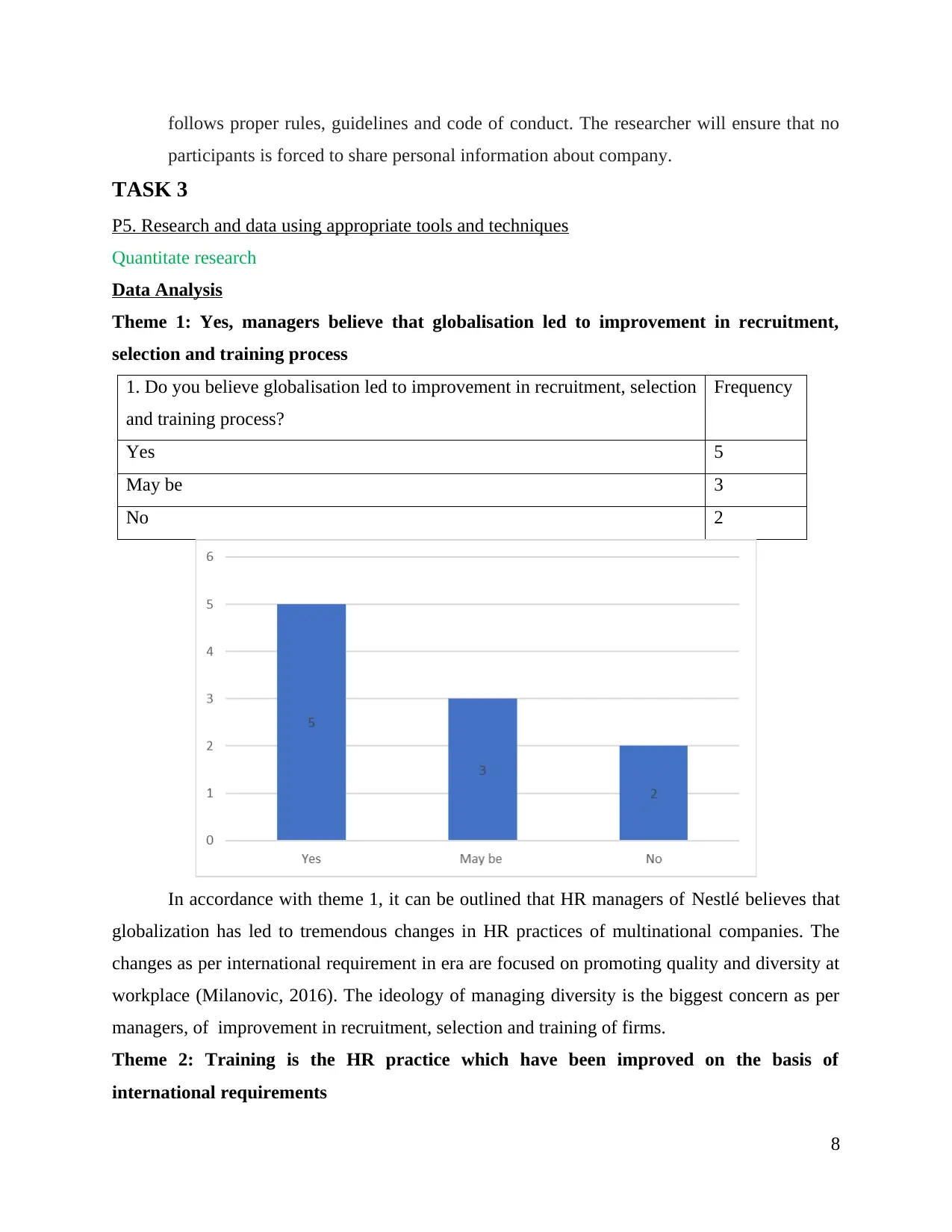
In accordance with theme 1, it can be outlined that HR managers of Nestlé believes that
globalization has led to tremendous changes in HR practices of multinational companies. The
changes as per international requirement in era are focused on promoting quality and diversity at
workplace (Milanovic, 2016). The ideology of managing diversity is the biggest concern as per
managers, of improvement in recruitment, selection and training of firms.
Theme 2: Training is the HR practice which have been improved on the basis of
international requirements
8
tabler-icon-diamond-filled.svg

Paraphrase This Document

Need a fresh take? Get an instant paraphrase of this document with our AI Paraphraser
Document Page
2. What according to you have improved in HR process on the basis of
international requirements?
Frequency
Recruitment 2
Selection 2
Training 6
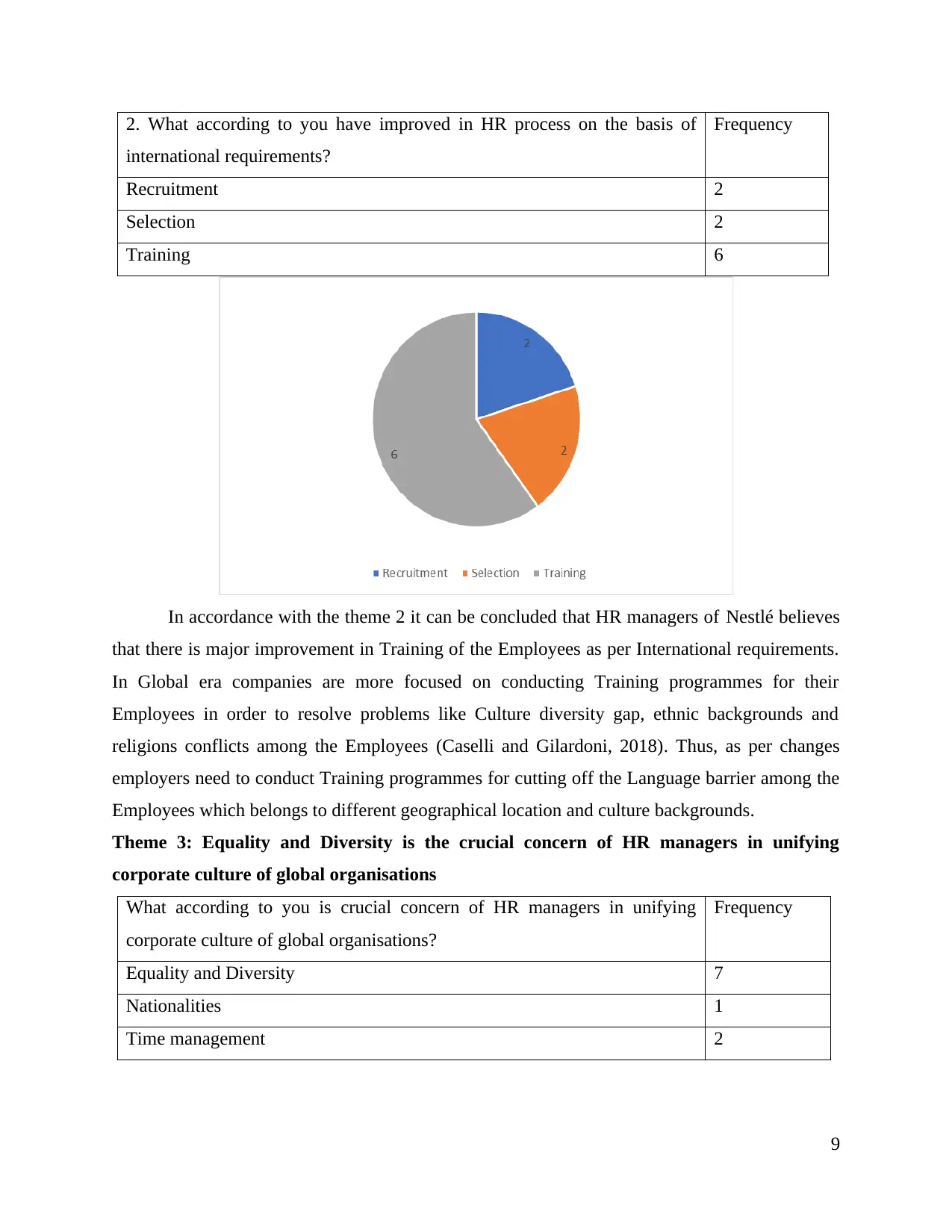
In accordance with the theme 2 it can be concluded that HR managers of Nestlé believes
that there is major improvement in Training of the Employees as per International requirements.
In Global era companies are more focused on conducting Training programmes for their
Employees in order to resolve problems like Culture diversity gap, ethnic backgrounds and
religions conflicts among the Employees (Caselli and Gilardoni, 2018). Thus, as per changes
employers need to conduct Training programmes for cutting off the Language barrier among the
Employees which belongs to different geographical location and culture backgrounds.
Theme 3: Equality and Diversity is the crucial concern of HR managers in unifying
corporate culture of global organisations
What according to you is crucial concern of HR managers in unifying
corporate culture of global organisations?
Frequency
Equality and Diversity 7
Nationalities 1
Time management 2
9
Document Page
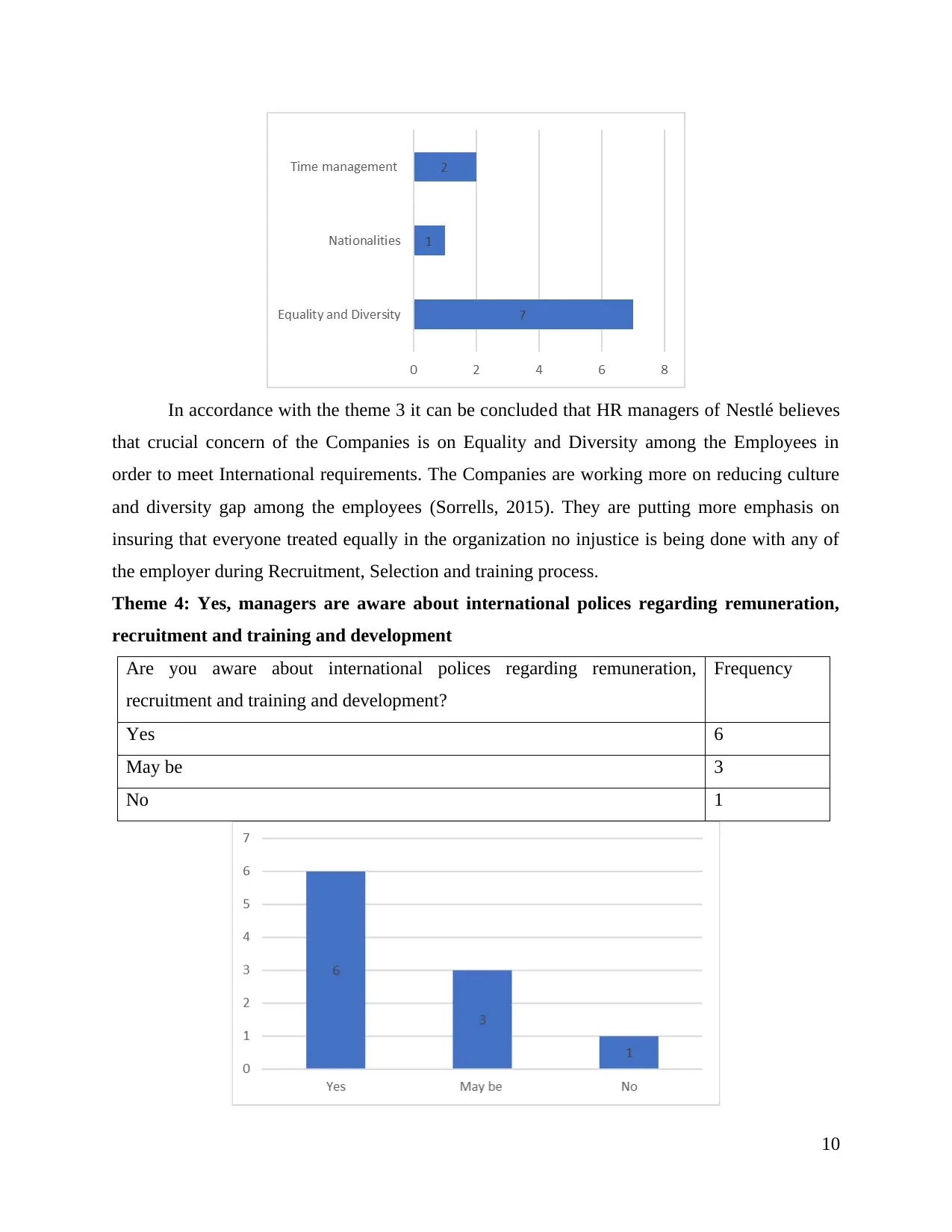
In accordance with the theme 3 it can be concluded that HR managers of Nestlé believes
that crucial concern of the Companies is on Equality and Diversity among the Employees in
order to meet International requirements. The Companies are working more on reducing culture
and diversity gap among the employees (Sorrells, 2015). They are putting more emphasis on
insuring that everyone treated equally in the organization no injustice is being done with any of
the employer during Recruitment, Selection and training process.
Theme 4: Yes, managers are aware about international polices regarding remuneration,
recruitment and training and development
Are you aware about international polices regarding remuneration,
recruitment and training and development?
Frequency
Yes 6
May be 3
No 1
10
chevron_up_icon
1 out of 27
circle_padding
hide_on_mobile
zoom_out_icon
[object Object]