Analysis of Production Process and Cost Sheet of Nestle Maggi Project
VerifiedAdded on 2021/10/29
|28
|5717
|316
Project
AI Summary
This project report, submitted by students of GLS University's I-MBA program, provides an in-depth analysis of Nestle Maggi's production process and cost sheet within the context of the FMCG (Fast-Moving Consumer Goods) industry. The report begins with an overview of the FMCG sector in India, examining market demographics, major competitors, future growth prospects, industry challenges, and a PESTLE analysis. Subsequently, it delves into Nestle's background, including its history, products, infrastructure, public relations, and a SWOT analysis. The core of the report focuses on Maggi, detailing its production process and culminating in a cost sheet analysis. The report concludes with interpretations and findings, offering a comprehensive understanding of Maggi's operations and cost management within the competitive FMCG landscape. The report also provides insights into the competitive landscape of the FMCG industry, with a comparison of major players such as Colgate vs Pepsodent, Amul vs Kwality Walls, Parle vs Britannia, Nestle vs Kraft foods, Pepsi vs Coke, and HUL vs P&G.
PROJECT REPORT
“ANALYSIS OF PRODUCTION PROCESS AND COST SHEET OF NESTLE MAGGI”
( In the partial fulfillment of principle of cost management subject under five years of I-MBA
course of GLS University )
Subject: Principle of Cost Management
Submission Date: 24th September,2020
Submitted to: Prof. Darshana Khakhar
Submitted by:
1. Saffrony Aberneithie (201900510010001)
2. Hemal Choksi (201900510010029)
3. Vinay Jajodia (201900510010086)
4. Smit Padaliya (201900510010146)
5. Jainish Shah (201900510010244)
6. Komal Singh (201900510010351)
FACULTY OF
MANAGEMENT
“ANALYSIS OF PRODUCTION PROCESS AND COST SHEET OF NESTLE MAGGI”
( In the partial fulfillment of principle of cost management subject under five years of I-MBA
course of GLS University )
Subject: Principle of Cost Management
Submission Date: 24th September,2020
Submitted to: Prof. Darshana Khakhar
Submitted by:
1. Saffrony Aberneithie (201900510010001)
2. Hemal Choksi (201900510010029)
3. Vinay Jajodia (201900510010086)
4. Smit Padaliya (201900510010146)
5. Jainish Shah (201900510010244)
6. Komal Singh (201900510010351)
FACULTY OF
MANAGEMENT

Paraphrase This Document
Need a fresh take? Get an instant paraphrase of this document with our AI Paraphraser
P R E F A C E
Industrial visit make students understand the subject to its core. It also gives idea to students
about their job profile once they start working. Industrial visit in the entire field have same
procedure where students are given introduction of the particular organization, they are taken
along to all the departments, and thus in charge of particular one's explains about it. Students are
asked to note down everything because at the end of visit, there is small Q and A session which
they need to undergo. Many organizations also asked their students to write about the visit as a
part of assignment.
This Project has been prepared as a part of the GLS University course curriculum. The topic for
this project “Analysis of production process and cost sheet of Nestle Maggi” We found very
interesting and educative. A practical exposure of working in an organization; although for a
brief period will however benefit me in the long run. This experience will be treasured by me
always.
Most of the people are trying to engage themselves in this sector. Before entering in this sector
one should have knowledge of an overview of how this industry and market operates. This
project is carried out to translate the theoretical knowledge of the HR, Industrial Relations Labor
Law subject in to the practical field work.
Keeping this in mind, it is the matter of great privilege and satisfaction for us to present this
report before the readers. We are sure this attempt of presentation will bridge the gap between
theory and practice.
Industrial visit make students understand the subject to its core. It also gives idea to students
about their job profile once they start working. Industrial visit in the entire field have same
procedure where students are given introduction of the particular organization, they are taken
along to all the departments, and thus in charge of particular one's explains about it. Students are
asked to note down everything because at the end of visit, there is small Q and A session which
they need to undergo. Many organizations also asked their students to write about the visit as a
part of assignment.
This Project has been prepared as a part of the GLS University course curriculum. The topic for
this project “Analysis of production process and cost sheet of Nestle Maggi” We found very
interesting and educative. A practical exposure of working in an organization; although for a
brief period will however benefit me in the long run. This experience will be treasured by me
always.
Most of the people are trying to engage themselves in this sector. Before entering in this sector
one should have knowledge of an overview of how this industry and market operates. This
project is carried out to translate the theoretical knowledge of the HR, Industrial Relations Labor
Law subject in to the practical field work.
Keeping this in mind, it is the matter of great privilege and satisfaction for us to present this
report before the readers. We are sure this attempt of presentation will bridge the gap between
theory and practice.
A C K N O W L E D G E M E N T
Survey is an excellent tool for learning and exploration. No classroom routine can substitute
which
is possible while working in real situation. Application of theoretical knowledge to practical
situation is the bonanzas of this survey.
To make a project of this magnitude is impossible without a dedicated effort and perfect
guidance. We would like to express our deep feeling of gratitude to the under mentioned
officials for their assistant, guidance and inspiration before and throughout the project.
We would like to thank Dr. Hitesh Ruparel (Director, GLS University, School of Management)
for their kind support. Special thanks to Prof. Darshana Khakhar, our project faculty, for
showing us a proper way to walk on, for providing help and guidance throughout the project; She
is always been the source of encouragement. She has ceaselessly guided us all in all the aspects
of the project, with her abundance amount of experience and finer ideas.
Working on the project needs hard work and concentration. What made it possible is the support
we received from those around us. We thank to all the faculties of our college for giving us
guidance, encouragement and right path to work on. We thank everybody who has directly or
indirectly helped us in the project to make it successful.
Survey is an excellent tool for learning and exploration. No classroom routine can substitute
which
is possible while working in real situation. Application of theoretical knowledge to practical
situation is the bonanzas of this survey.
To make a project of this magnitude is impossible without a dedicated effort and perfect
guidance. We would like to express our deep feeling of gratitude to the under mentioned
officials for their assistant, guidance and inspiration before and throughout the project.
We would like to thank Dr. Hitesh Ruparel (Director, GLS University, School of Management)
for their kind support. Special thanks to Prof. Darshana Khakhar, our project faculty, for
showing us a proper way to walk on, for providing help and guidance throughout the project; She
is always been the source of encouragement. She has ceaselessly guided us all in all the aspects
of the project, with her abundance amount of experience and finer ideas.
Working on the project needs hard work and concentration. What made it possible is the support
we received from those around us. We thank to all the faculties of our college for giving us
guidance, encouragement and right path to work on. We thank everybody who has directly or
indirectly helped us in the project to make it successful.
⊘ This is a preview!⊘
Do you want full access?
Subscribe today to unlock all pages.

Trusted by 1+ million students worldwide

Paraphrase This Document
Need a fresh take? Get an instant paraphrase of this document with our AI Paraphraser
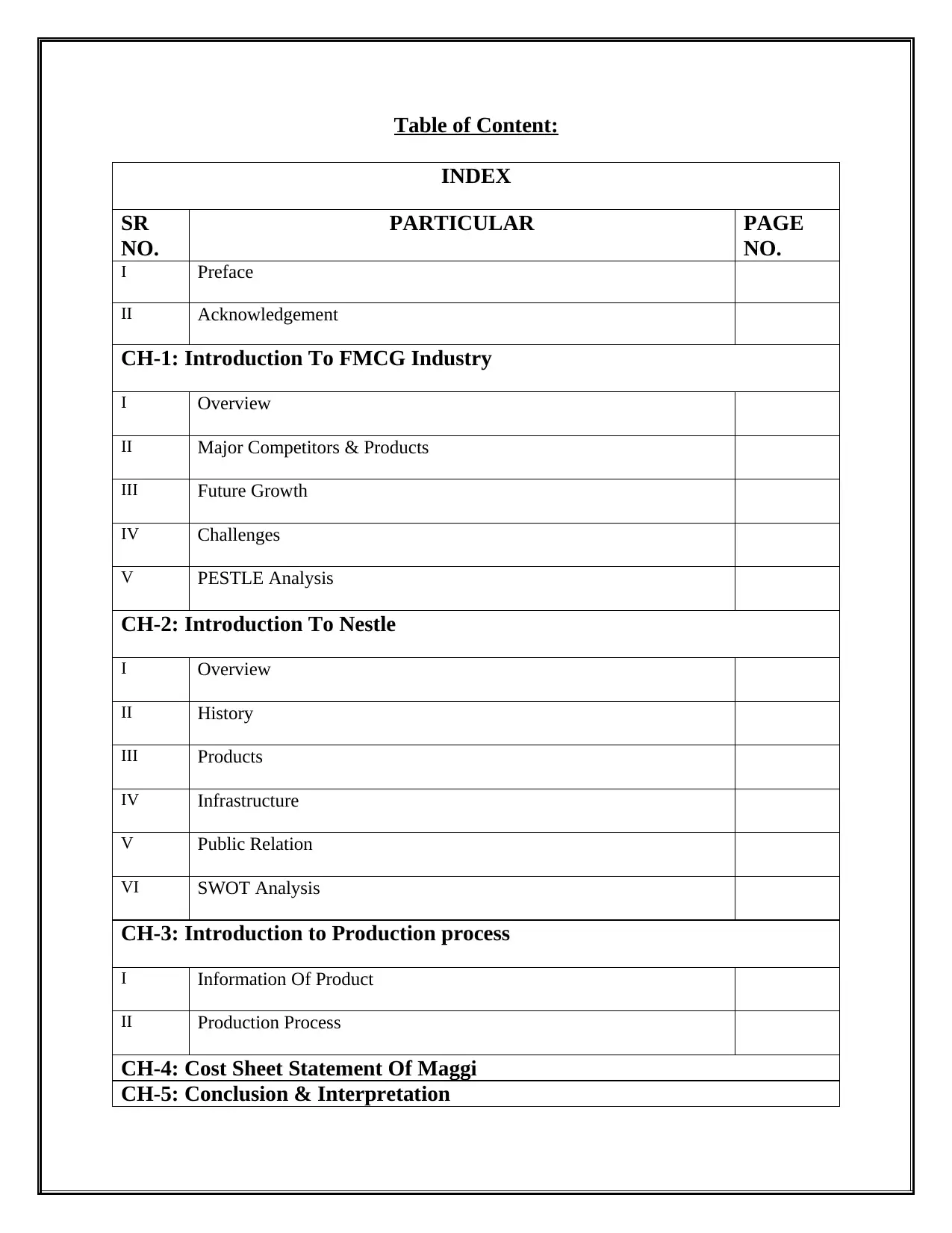
Table of Content:
INDEX
SR
NO.
PARTICULAR PAGE
NO.
I Preface
II Acknowledgement
CH-1: Introduction To FMCG Industry
I Overview
II Major Competitors & Products
III Future Growth
IV Challenges
V PESTLE Analysis
CH-2: Introduction To Nestle
I Overview
II History
III Products
IV Infrastructure
V Public Relation
VI SWOT Analysis
CH-3: Introduction to Production process
I Information Of Product
II Production Process
CH-4: Cost Sheet Statement Of Maggi
CH-5: Conclusion & Interpretation
INDEX
SR
NO.
PARTICULAR PAGE
NO.
I Preface
II Acknowledgement
CH-1: Introduction To FMCG Industry
I Overview
II Major Competitors & Products
III Future Growth
IV Challenges
V PESTLE Analysis
CH-2: Introduction To Nestle
I Overview
II History
III Products
IV Infrastructure
V Public Relation
VI SWOT Analysis
CH-3: Introduction to Production process
I Information Of Product
II Production Process
CH-4: Cost Sheet Statement Of Maggi
CH-5: Conclusion & Interpretation
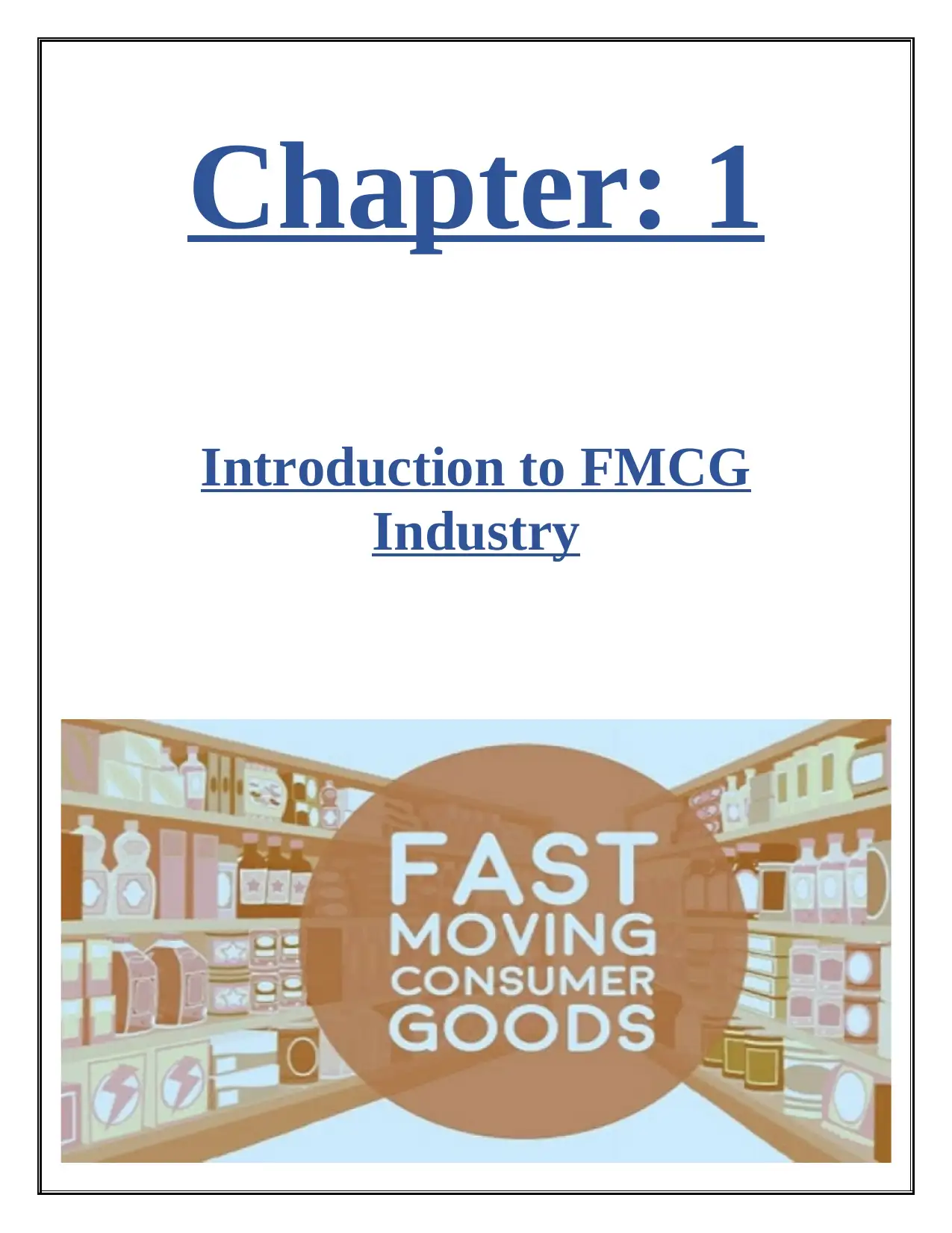
Chapter: 1
Introduction to FMCG
Industry
Introduction to FMCG
Industry
⊘ This is a preview!⊘
Do you want full access?
Subscribe today to unlock all pages.
Trusted by 1+ million students worldwide
I. OVERVIEW:
The FMCG industry in India is divided into the demographics of rural and urban India. The
urban market contributes 60% of the consumption revenue of the FMCG market in India. In
2017, this sector recorded a market size of $ 29.4 bn. While urban areas have spearheaded the
growth of the FMCG industry in India, semi-urban and rural segments are growing at a rate that
cannot be ignored. Semi-urban and rural segments contribute over 40% of the overall revenues
of the FMCG sector in India. FMCG companies in India have witnessed higher growth in rural
areas compared to urban ones. And with 12.2% of the world’s population living in the villages of
India, the Indian rural FMCG market cannot be ignored by investors. Dabur, one of the top
FMCG companies in India, generates over 45% of its domestic revenue through the sale of
packaged consumer goods in rural India. Hindustan Unilever, another name that has consistently
dominated the list of top FMCG companies in India, earns over 35% of its revenue from rural
areas. Rural India accounts for more than 40% of consumption in major FMCG categories such
as personal care, fabric care, and hot beverages. In urban areas, home and personal care
category- including skin care, household care, and feminine hygiene- will continue to grow at
attractive rates. Within the foods segment, it is estimated that processed foods, bakery, and dairy
are long-term growth categories in both rural and urban areas.
The FMCG industry in India is divided into the demographics of rural and urban India. The
urban market contributes 60% of the consumption revenue of the FMCG market in India. In
2017, this sector recorded a market size of $ 29.4 bn. While urban areas have spearheaded the
growth of the FMCG industry in India, semi-urban and rural segments are growing at a rate that
cannot be ignored. Semi-urban and rural segments contribute over 40% of the overall revenues
of the FMCG sector in India. FMCG companies in India have witnessed higher growth in rural
areas compared to urban ones. And with 12.2% of the world’s population living in the villages of
India, the Indian rural FMCG market cannot be ignored by investors. Dabur, one of the top
FMCG companies in India, generates over 45% of its domestic revenue through the sale of
packaged consumer goods in rural India. Hindustan Unilever, another name that has consistently
dominated the list of top FMCG companies in India, earns over 35% of its revenue from rural
areas. Rural India accounts for more than 40% of consumption in major FMCG categories such
as personal care, fabric care, and hot beverages. In urban areas, home and personal care
category- including skin care, household care, and feminine hygiene- will continue to grow at
attractive rates. Within the foods segment, it is estimated that processed foods, bakery, and dairy
are long-term growth categories in both rural and urban areas.
Paraphrase This Document
Need a fresh take? Get an instant paraphrase of this document with our AI Paraphraser
DEMOGRAPHIC SUPPORT
An FMCG industry overview indicated that India’s demographic profile plays a major role in the
growth of this sector. Not only is India’s demographic young, but this segment is also
characterized by increased urbanization and higher expenditure. Urban development initiatives
by the government, as well as the increasing middle class of India, has led to an increase in the
number of attractive markets in the country. Ernst & Young’s research on the cities of India
highlights the emergence of 30 ‘new wave’ cities such as Jaipur and Surat. Consumption in these
cities is growing at a faster rate than that of many of India’s metros. India’s young population is
also characterized by a high degree of technological awareness. Growing penetration of
smartphones and better internet connectivity in India has led to a burgeoning E-Commerce
sector, which has, in turn, helped formalize large sections of the unorganized retail sector. The E-
Commerce segment is projected to contribute 11% of overall Indian FMCG companies’ sales in
2030. The online FMCG market is projected to reach $ 45 bn in 2020. This has been a major
catalyst in the development of the FMCG sector in rural India.
FMCG MARKET IN INDIA
The FMCG sector is one of the largest sectors of the Indian economy. According to an FMCG
industry overview, revenues of the FMCG sector reached $ 52.75 bn in FY18, and are estimated
to reach $ 103.7 bn in 2020. As consumption in India grows at an unprecedented rate, the FMCG
industry remains a key sector for investors. Acknowledging these trends in the FMCG industry
profile, the Government of India has undertaken various initiatives to promote the sector. For
instance, 100% FDI is permitted in SBRT and cash-and-carry models of retail, and the minimum
capitalization for foreign FMCG companies to invest in India is $ 100 mn. Even the
implementation of GST in India has had far-reaching consequences for the sector, as the highest
selling FMCG products such as soap, toothpaste and hair oil now come under the 18% tax
bracket (as opposed to the previous 24%)
An FMCG industry overview indicated that India’s demographic profile plays a major role in the
growth of this sector. Not only is India’s demographic young, but this segment is also
characterized by increased urbanization and higher expenditure. Urban development initiatives
by the government, as well as the increasing middle class of India, has led to an increase in the
number of attractive markets in the country. Ernst & Young’s research on the cities of India
highlights the emergence of 30 ‘new wave’ cities such as Jaipur and Surat. Consumption in these
cities is growing at a faster rate than that of many of India’s metros. India’s young population is
also characterized by a high degree of technological awareness. Growing penetration of
smartphones and better internet connectivity in India has led to a burgeoning E-Commerce
sector, which has, in turn, helped formalize large sections of the unorganized retail sector. The E-
Commerce segment is projected to contribute 11% of overall Indian FMCG companies’ sales in
2030. The online FMCG market is projected to reach $ 45 bn in 2020. This has been a major
catalyst in the development of the FMCG sector in rural India.
FMCG MARKET IN INDIA
The FMCG sector is one of the largest sectors of the Indian economy. According to an FMCG
industry overview, revenues of the FMCG sector reached $ 52.75 bn in FY18, and are estimated
to reach $ 103.7 bn in 2020. As consumption in India grows at an unprecedented rate, the FMCG
industry remains a key sector for investors. Acknowledging these trends in the FMCG industry
profile, the Government of India has undertaken various initiatives to promote the sector. For
instance, 100% FDI is permitted in SBRT and cash-and-carry models of retail, and the minimum
capitalization for foreign FMCG companies to invest in India is $ 100 mn. Even the
implementation of GST in India has had far-reaching consequences for the sector, as the highest
selling FMCG products such as soap, toothpaste and hair oil now come under the 18% tax
bracket (as opposed to the previous 24%)
INVESTMENTS IN FMCG INDUSTRY IN INDIA
Favourable demand drivers such as rising income levels and growing urbanization, among
others, have recently encouraged major and diverse investments in the FMCG sector. While top
FMCG companies are expanding their capacity to feed the growing domestic demand,
homegrown brands have ventured into international markets. Some of these include:
Patanjali- Their success has encouraged the brand to look at the international stage, with plans to
set up a 100% export-oriented manufacturing unit in Milan SEZ, Nagpur
RP-Sanjiv Goenka Group- They have created a venture capital fund of $ 14.74 mn to invest in
FMCG startups. This move was made considering the capital appreciation in the FMCG sector
CONCLUDING REMARKS
The high growth rate of the FMCG industry in India goes beyond growth drivers such as income
growth and urbanization. The consumption habits of India’s new age consumers have resulted in
an attitudinal shift in the market. The India of 2030 will have 370 mn generation Z consumers,
with changed priorities when it comes to purchasing goods. The new Indian consumer is
characterized by high awareness, an affinity for health and nutrition and high expendable
income. This has led to the emergence of new FMCG sub-sectors, such as the air and water
purifier market and organic food staples. These trends will further lead the development of the
FMCG industry profile.
Favourable demand drivers such as rising income levels and growing urbanization, among
others, have recently encouraged major and diverse investments in the FMCG sector. While top
FMCG companies are expanding their capacity to feed the growing domestic demand,
homegrown brands have ventured into international markets. Some of these include:
Patanjali- Their success has encouraged the brand to look at the international stage, with plans to
set up a 100% export-oriented manufacturing unit in Milan SEZ, Nagpur
RP-Sanjiv Goenka Group- They have created a venture capital fund of $ 14.74 mn to invest in
FMCG startups. This move was made considering the capital appreciation in the FMCG sector
CONCLUDING REMARKS
The high growth rate of the FMCG industry in India goes beyond growth drivers such as income
growth and urbanization. The consumption habits of India’s new age consumers have resulted in
an attitudinal shift in the market. The India of 2030 will have 370 mn generation Z consumers,
with changed priorities when it comes to purchasing goods. The new Indian consumer is
characterized by high awareness, an affinity for health and nutrition and high expendable
income. This has led to the emergence of new FMCG sub-sectors, such as the air and water
purifier market and organic food staples. These trends will further lead the development of the
FMCG industry profile.
⊘ This is a preview!⊘
Do you want full access?
Subscribe today to unlock all pages.
Trusted by 1+ million students worldwide
II. MAJOR COMPETITORS & PRODUCTS:
FMCG is an industry where the competition goes on for years. There are so many tactics to
fight competition in FMCG, that the companies do not back off and from time to time they
keep introducing new measures to ward off competitors. Furthermore, this industry is
pockmarked with unorganized competition wherein small and medium manufacturers also
give tough competition to established companies. Here we discuss the top 6 FMCG rivals of
all time, companies which have been in competition with each other for years.
1. Colgate vs Pepsodent (Tooth Paste)
2. Amul vs Kwality walls (Ice cream)
3. Parle vs Britannia (Biscuits)
4. Nestle vs Kraft foods (Chocolates)
5. Pepsi vs Coke (Soft drinks)
6. HUL vs P&G (Detergents, shampoos, soaps)
FMCG is an industry where the competition goes on for years. There are so many tactics to
fight competition in FMCG, that the companies do not back off and from time to time they
keep introducing new measures to ward off competitors. Furthermore, this industry is
pockmarked with unorganized competition wherein small and medium manufacturers also
give tough competition to established companies. Here we discuss the top 6 FMCG rivals of
all time, companies which have been in competition with each other for years.
1. Colgate vs Pepsodent (Tooth Paste)
2. Amul vs Kwality walls (Ice cream)
3. Parle vs Britannia (Biscuits)
4. Nestle vs Kraft foods (Chocolates)
5. Pepsi vs Coke (Soft drinks)
6. HUL vs P&G (Detergents, shampoos, soaps)
Paraphrase This Document
Need a fresh take? Get an instant paraphrase of this document with our AI Paraphraser
1). Colgate vs Pepsodent (Tooth Paste)
One company vs one single product, always at war. Colgate is a complete company with its
major focus being dental health. Hence Colgate has several times come out with variants like
Colgate for sensitive teeth, normal Colgate, Colgate gel etc. However, whatever innovation it
brings, Pepsodent is not far behind. Pepsodent is a strategic business unit of Hindustan unilever
ltd and is one of the toughest competitors for Colgate.
These two toothpaste brands have always been at loggerheads and the situation does not look
like improving in the near future. Where Colgate has the brand value, Pepsodent has the
powerful distribution support of HUL. Because of all other products of HUL, pepsodent reaches
even rural areas easily and hence has a high turnover. Off course, there are other products in the
toothpaste market, but these two are the toughest competitors amongst them all.
2). Amul vs Kwality walls (Ice cream)
If we talk of the FMCG competition, then the ice cream market cannot be left far behind. Having
many local, national as well as international players, the ice cream market has two major
competitors who take away the majority market share within themselves. These two are Kwality
walls and Amul ice cream.
Out of these two, Amul has been an established ice cream player since decades in India.
However, once Kwality walls entered the market, it has taken away the market by storm by
introducing many different types of ice cream which the customers loved. Furthermore, because
of the deep pockets of HUL, Kwality walls could market itself much better. This FMCG rivalry
is in its prime and the war can be seen easily in the market. However, it will be several years
more before any of them exits this rivalry as the clear leader.
One company vs one single product, always at war. Colgate is a complete company with its
major focus being dental health. Hence Colgate has several times come out with variants like
Colgate for sensitive teeth, normal Colgate, Colgate gel etc. However, whatever innovation it
brings, Pepsodent is not far behind. Pepsodent is a strategic business unit of Hindustan unilever
ltd and is one of the toughest competitors for Colgate.
These two toothpaste brands have always been at loggerheads and the situation does not look
like improving in the near future. Where Colgate has the brand value, Pepsodent has the
powerful distribution support of HUL. Because of all other products of HUL, pepsodent reaches
even rural areas easily and hence has a high turnover. Off course, there are other products in the
toothpaste market, but these two are the toughest competitors amongst them all.
2). Amul vs Kwality walls (Ice cream)
If we talk of the FMCG competition, then the ice cream market cannot be left far behind. Having
many local, national as well as international players, the ice cream market has two major
competitors who take away the majority market share within themselves. These two are Kwality
walls and Amul ice cream.
Out of these two, Amul has been an established ice cream player since decades in India.
However, once Kwality walls entered the market, it has taken away the market by storm by
introducing many different types of ice cream which the customers loved. Furthermore, because
of the deep pockets of HUL, Kwality walls could market itself much better. This FMCG rivalry
is in its prime and the war can be seen easily in the market. However, it will be several years
more before any of them exits this rivalry as the clear leader.
3). Parle vs Britannia (Biscuits)
Parle has one of the best-selling and the most widely distributed product in the biscuit market
– Parle G. The product has won many distribution awards in the past few years and it is known
for its packaging as well as for its variants in price. Hence the biscuit sells in low end as well as
middle level markets.
Others like Marie, Hide and seek and Monaco also sell in huge amounts. However, Britannia has
some power house products in its portfolio like Bourbon, good day, little hearts, 50 50 and
others. The competition amongst these two brands is evident when each has a variant of Marie
biscuits. Parle’s is known as “Marie” and Britannia’s is known as “Marie gold”.
4). Nestle vs Kraft foods (Chocolates)
Nestle KitKat, Nestle munch, Alpino, Classic Nestle, Milky bar, eclairs and polo are some of the
top products which come in the chocolate brands for Nestle. All of these products are widely
in demand in the market. And they sell in huge volumes. However, Nestle products just
challengers to the market leader – Dairy milk and Cadbury from Kraft foods.
Dairy milk is one of the most marketed and most liked chocolates across India. At the same time,
Cadbury celebrations is a popular gifting product and targets occasions and festivals with an
emotional touch. In this rivalry, Nestle is quite far behind but has always been the thorn in an
otherwise flawless leadership by Cadbury.
Where Nestle has KitKat, Cadbury has Perk. Similarly, Cadbury has its own version of Eclairs.
Thus, these FMCG rivals are set to be rivals for the coming years. Though, it can be forecasted
that Nestle will remain the challenger and Cadbury the market leader.
Parle has one of the best-selling and the most widely distributed product in the biscuit market
– Parle G. The product has won many distribution awards in the past few years and it is known
for its packaging as well as for its variants in price. Hence the biscuit sells in low end as well as
middle level markets.
Others like Marie, Hide and seek and Monaco also sell in huge amounts. However, Britannia has
some power house products in its portfolio like Bourbon, good day, little hearts, 50 50 and
others. The competition amongst these two brands is evident when each has a variant of Marie
biscuits. Parle’s is known as “Marie” and Britannia’s is known as “Marie gold”.
4). Nestle vs Kraft foods (Chocolates)
Nestle KitKat, Nestle munch, Alpino, Classic Nestle, Milky bar, eclairs and polo are some of the
top products which come in the chocolate brands for Nestle. All of these products are widely
in demand in the market. And they sell in huge volumes. However, Nestle products just
challengers to the market leader – Dairy milk and Cadbury from Kraft foods.
Dairy milk is one of the most marketed and most liked chocolates across India. At the same time,
Cadbury celebrations is a popular gifting product and targets occasions and festivals with an
emotional touch. In this rivalry, Nestle is quite far behind but has always been the thorn in an
otherwise flawless leadership by Cadbury.
Where Nestle has KitKat, Cadbury has Perk. Similarly, Cadbury has its own version of Eclairs.
Thus, these FMCG rivals are set to be rivals for the coming years. Though, it can be forecasted
that Nestle will remain the challenger and Cadbury the market leader.
⊘ This is a preview!⊘
Do you want full access?
Subscribe today to unlock all pages.
Trusted by 1+ million students worldwide

1 out of 28


Your All-in-One AI-Powered Toolkit for Academic Success.
+13062052269
info@desklib.com
Available 24*7 on WhatsApp / Email
![[object Object]](/_next/static/media/star-bottom.7253800d.svg)
Unlock your academic potential
Copyright © 2020–2026 A2Z Services. All Rights Reserved. Developed and managed by ZUCOL.