Marketing Report: Nestle's Marketing Functions and Interrelationships
VerifiedAdded on 2020/10/05
|16
|3969
|322
Report
AI Summary
This report provides a comprehensive analysis of Nestle's marketing operations. It begins with an introduction to marketing and its application within Nestle, a global food and beverage company. The report explores the key roles and responsibilities of the marketing function, including market research, planning, product design, pricing, and promotion, and how these relate to Nestle's business objectives. It examines the interrelationships between marketing and other functional units like HR, operations, finance, and R&D. The report also delves into the impact of the marketing environment, including political, economic, social, technological, environmental, and legal factors. Furthermore, it evaluates the application of the marketing mix, different tactics used by organizations to achieve business objectives, and provides a basic marketing plan for Nestle. The report critically analyzes the key elements of the marketing function and their interrelation with other functional units in an organization.

MARKETING ESSENTIALS

Paraphrase This Document
Need a fresh take? Get an instant paraphrase of this document with our AI Paraphraser
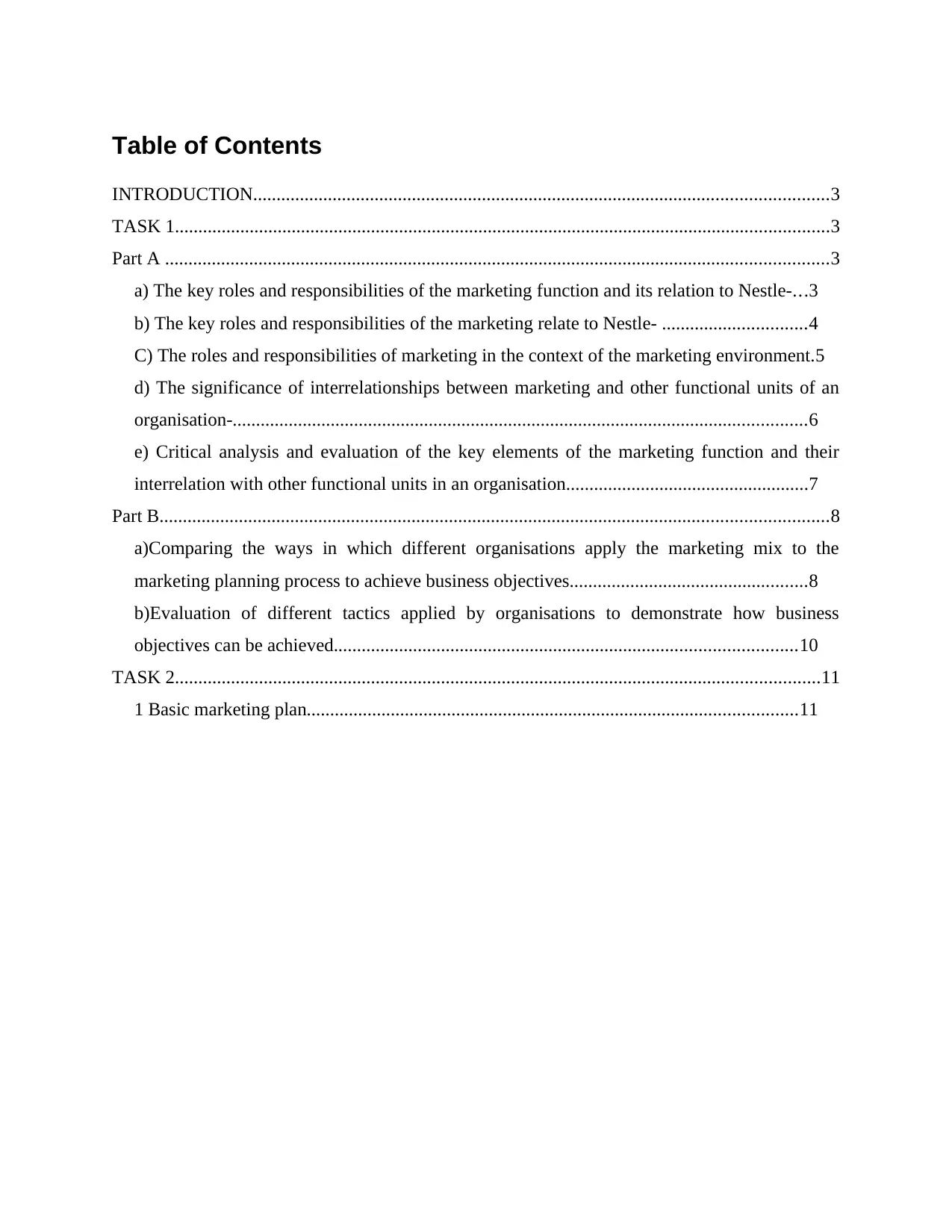
Table of Contents
INTRODUCTION...........................................................................................................................3
TASK 1............................................................................................................................................3
Part A ..............................................................................................................................................3
a) The key roles and responsibilities of the marketing function and its relation to Nestle-...3
b) The key roles and responsibilities of the marketing relate to Nestle- ...............................4
C) The roles and responsibilities of marketing in the context of the marketing environment.5
d) The significance of interrelationships between marketing and other functional units of an
organisation-...........................................................................................................................6
e) Critical analysis and evaluation of the key elements of the marketing function and their
interrelation with other functional units in an organisation....................................................7
Part B...............................................................................................................................................8
a)Comparing the ways in which different organisations apply the marketing mix to the
marketing planning process to achieve business objectives...................................................8
b)Evaluation of different tactics applied by organisations to demonstrate how business
objectives can be achieved...................................................................................................10
TASK 2..........................................................................................................................................11
1 Basic marketing plan.........................................................................................................11
INTRODUCTION...........................................................................................................................3
TASK 1............................................................................................................................................3
Part A ..............................................................................................................................................3
a) The key roles and responsibilities of the marketing function and its relation to Nestle-...3
b) The key roles and responsibilities of the marketing relate to Nestle- ...............................4
C) The roles and responsibilities of marketing in the context of the marketing environment.5
d) The significance of interrelationships between marketing and other functional units of an
organisation-...........................................................................................................................6
e) Critical analysis and evaluation of the key elements of the marketing function and their
interrelation with other functional units in an organisation....................................................7
Part B...............................................................................................................................................8
a)Comparing the ways in which different organisations apply the marketing mix to the
marketing planning process to achieve business objectives...................................................8
b)Evaluation of different tactics applied by organisations to demonstrate how business
objectives can be achieved...................................................................................................10
TASK 2..........................................................................................................................................11
1 Basic marketing plan.........................................................................................................11
INTRODUCTION
Marketing is the management process that identifies, anticipate and satisfy customer
requirements profitably. Report focuses on Nestle. Nestle is a food and drink based Swiss
company having located its headquarters in Vevey, Vaud, Switzerland. Nestle was founded in
1866 by Henri Nestle and currently serving its products in 190 countries Worldwide. Report
highlights the key roles and responsibilities of marketing functions. It also presents marketing
inter-relationship with other functional units. Study lays emphasis on different marketing mix
strategies followed by organisation.
TASK 1
Part A
a) The key roles and responsibilities of the marketing function and its relation to Nestle-
Marketing function is a factor that helps company to identify and source potentially
products for the market in which it operates and promote them through differentiating their own
product from the substitutes. Marketing function includes market research, Planning, product
development, pricing and customer service etc.
The following are the roles and responsibilities of marketing function and its relation to Nestle-
11 Marketing Research- It is the most important function of marketing as it includes
identifying needs, demands and wants of customers and analysing the information to take
decisions (Avraham and Ketter, 2016). This analysis involves strengths and weakness of
the organisation as well as political, social, legal and demographic data of the operational
market. This function has important role in Nestle organisation as company's entire
operational activity and its production will be based on its market research results.
11 Market Planning- Market planning involves achieving company's marketing objectives
such as increase market share, dominating the market, increase sales volume and
promotional activities. This function plays a vital role for Nestle as company's growth is
dependent on market share and its products sold in market.
11 Product Designing- Product design involves in making attractive product to target market
and customers. In today's competitive market, along with cost, product design, shape
styles etc. also matters. So this function, brief Nestle to build an attractive products
design which may gain attraction of customers in market.
Marketing is the management process that identifies, anticipate and satisfy customer
requirements profitably. Report focuses on Nestle. Nestle is a food and drink based Swiss
company having located its headquarters in Vevey, Vaud, Switzerland. Nestle was founded in
1866 by Henri Nestle and currently serving its products in 190 countries Worldwide. Report
highlights the key roles and responsibilities of marketing functions. It also presents marketing
inter-relationship with other functional units. Study lays emphasis on different marketing mix
strategies followed by organisation.
TASK 1
Part A
a) The key roles and responsibilities of the marketing function and its relation to Nestle-
Marketing function is a factor that helps company to identify and source potentially
products for the market in which it operates and promote them through differentiating their own
product from the substitutes. Marketing function includes market research, Planning, product
development, pricing and customer service etc.
The following are the roles and responsibilities of marketing function and its relation to Nestle-
11 Marketing Research- It is the most important function of marketing as it includes
identifying needs, demands and wants of customers and analysing the information to take
decisions (Avraham and Ketter, 2016). This analysis involves strengths and weakness of
the organisation as well as political, social, legal and demographic data of the operational
market. This function has important role in Nestle organisation as company's entire
operational activity and its production will be based on its market research results.
11 Market Planning- Market planning involves achieving company's marketing objectives
such as increase market share, dominating the market, increase sales volume and
promotional activities. This function plays a vital role for Nestle as company's growth is
dependent on market share and its products sold in market.
11 Product Designing- Product design involves in making attractive product to target market
and customers. In today's competitive market, along with cost, product design, shape
styles etc. also matters. So this function, brief Nestle to build an attractive products
design which may gain attraction of customers in market.
⊘ This is a preview!⊘
Do you want full access?
Subscribe today to unlock all pages.

Trusted by 1+ million students worldwide
11 Pricing- It is most important function of marketing as it involves framing price of the
products to be sold in market. As price of a product provide Nestle ton fulfil its primary
goal of earning profit and sales.
11 Promotion- Promotion involves communicating with the customers and providing them
information about product. It includes activities such as advertising, publicity and
maintaining public relations. This function will help Nestle to maintain interaction and
hold on their customers as by building up strong relationship with them (McDonald,
2016).
b) The key roles and responsibilities of the marketing relate to Nestle-
The following are the responsibilities of marketing and their relation with Nestle:
11 Setting Market Strategy- It serves as a process of setting up marketing strategy in
consideration with company's objectives and goals. Strategy may consist of increasing
market share in specific market sector, or to entry into new market or to open a new
channel of distribution such as internet to cover wider geographical area. This function
helps Nestle in expansion of its business in different markets as it frames various
strategies that includes all factors of expansion and growth.
11 Product Development- This function of marketing involves development of new
products or improving existing ones .Marketing department analyzes the sale of existing
products and identifies empty areas in the product range where there will be more
opportunities for the company (Brychkov and Domegan, 2017). Also marketing team
informs development team regarding the customer needs and preferences and help them
to add or remove features to innovate a new product and at last it sets prices and plans to
launch the product. This function provides Nestle the entire scenario of customer and
market and its areas of improvement.
11 Providing Communications and Promotional materials- Marketing department plan
campaigns and develop communication material in order to promote company's products
and services to customers. Considering the annual budget, marketing unit plans various
advertisement activities by outsourcing to advertisement activities. It also plan
promotional activities for the company through distribution of company's brochure. Press
products to be sold in market. As price of a product provide Nestle ton fulfil its primary
goal of earning profit and sales.
11 Promotion- Promotion involves communicating with the customers and providing them
information about product. It includes activities such as advertising, publicity and
maintaining public relations. This function will help Nestle to maintain interaction and
hold on their customers as by building up strong relationship with them (McDonald,
2016).
b) The key roles and responsibilities of the marketing relate to Nestle-
The following are the responsibilities of marketing and their relation with Nestle:
11 Setting Market Strategy- It serves as a process of setting up marketing strategy in
consideration with company's objectives and goals. Strategy may consist of increasing
market share in specific market sector, or to entry into new market or to open a new
channel of distribution such as internet to cover wider geographical area. This function
helps Nestle in expansion of its business in different markets as it frames various
strategies that includes all factors of expansion and growth.
11 Product Development- This function of marketing involves development of new
products or improving existing ones .Marketing department analyzes the sale of existing
products and identifies empty areas in the product range where there will be more
opportunities for the company (Brychkov and Domegan, 2017). Also marketing team
informs development team regarding the customer needs and preferences and help them
to add or remove features to innovate a new product and at last it sets prices and plans to
launch the product. This function provides Nestle the entire scenario of customer and
market and its areas of improvement.
11 Providing Communications and Promotional materials- Marketing department plan
campaigns and develop communication material in order to promote company's products
and services to customers. Considering the annual budget, marketing unit plans various
advertisement activities by outsourcing to advertisement activities. It also plan
promotional activities for the company through distribution of company's brochure. Press
Paraphrase This Document
Need a fresh take? Get an instant paraphrase of this document with our AI Paraphraser
releases etc. This helps in being know the name of Nestle, everywhere in the market and
creates its brand image in the eyes of customers.
11 Customer support- Customer support is the important role of marketing unit as marketing
starts with customer and ends with customer. So its important for company to provide
customer support by providing services such as after sales service, pre sale counselling,
handling the customers complaints, provide them maintenance and other technical
customer information. This will benefit and help Nestle in creating as strong customer
base.
C) The roles and responsibilities of marketing in the context of the marketing environment.
Marketing Department of a firm has to deal with various Macro- environmental factors that
affects business of the organization. This factors comprises of following-
1. Political factors- These factors include all those government intervention activities in the
business directly and indirectly (Cockayne, 2016). It consists of- government policies, tax
rates, foreign trade policy, etc. Marketing unit make a complete study and analysis of
these factors and accordingly suggest the company to invest in the new market or not. For
example. Nestle wants to launch a new product in Asia, the marketing team does the
complete study regarding the market of Asia and considering all those factors it guides
Nestle to enter into the market so as to get maximum benefits.
2. Economic factors- These are the factors that affect economic stability of the company
comprising of its profitability and return on investment. These includes economic growth
rate, exchange rates of currency, inflation, disposable income of the customers etc.
Marketing unit considers all these factors and accordingly advices Nestle so as to gain
maximum profitability in the market and also higher return in investment.
3. Social Factors- Also known as Socio-cultural factors, these factors consists of population
growth, age distribution of people, attitudes and desires of customers. These factors are of
particular interest as they have direct effect on how marketers understand their customer
behaviour and accordingly distribute the products of Nestle in the market so as to make
them buy it.
4. Technological Factors- The name itself suggest that these factors consists of availability
of advance technology in production and distribution of products and the way to
creates its brand image in the eyes of customers.
11 Customer support- Customer support is the important role of marketing unit as marketing
starts with customer and ends with customer. So its important for company to provide
customer support by providing services such as after sales service, pre sale counselling,
handling the customers complaints, provide them maintenance and other technical
customer information. This will benefit and help Nestle in creating as strong customer
base.
C) The roles and responsibilities of marketing in the context of the marketing environment.
Marketing Department of a firm has to deal with various Macro- environmental factors that
affects business of the organization. This factors comprises of following-
1. Political factors- These factors include all those government intervention activities in the
business directly and indirectly (Cockayne, 2016). It consists of- government policies, tax
rates, foreign trade policy, etc. Marketing unit make a complete study and analysis of
these factors and accordingly suggest the company to invest in the new market or not. For
example. Nestle wants to launch a new product in Asia, the marketing team does the
complete study regarding the market of Asia and considering all those factors it guides
Nestle to enter into the market so as to get maximum benefits.
2. Economic factors- These are the factors that affect economic stability of the company
comprising of its profitability and return on investment. These includes economic growth
rate, exchange rates of currency, inflation, disposable income of the customers etc.
Marketing unit considers all these factors and accordingly advices Nestle so as to gain
maximum profitability in the market and also higher return in investment.
3. Social Factors- Also known as Socio-cultural factors, these factors consists of population
growth, age distribution of people, attitudes and desires of customers. These factors are of
particular interest as they have direct effect on how marketers understand their customer
behaviour and accordingly distribute the products of Nestle in the market so as to make
them buy it.
4. Technological Factors- The name itself suggest that these factors consists of availability
of advance technology in production and distribution of products and the way to
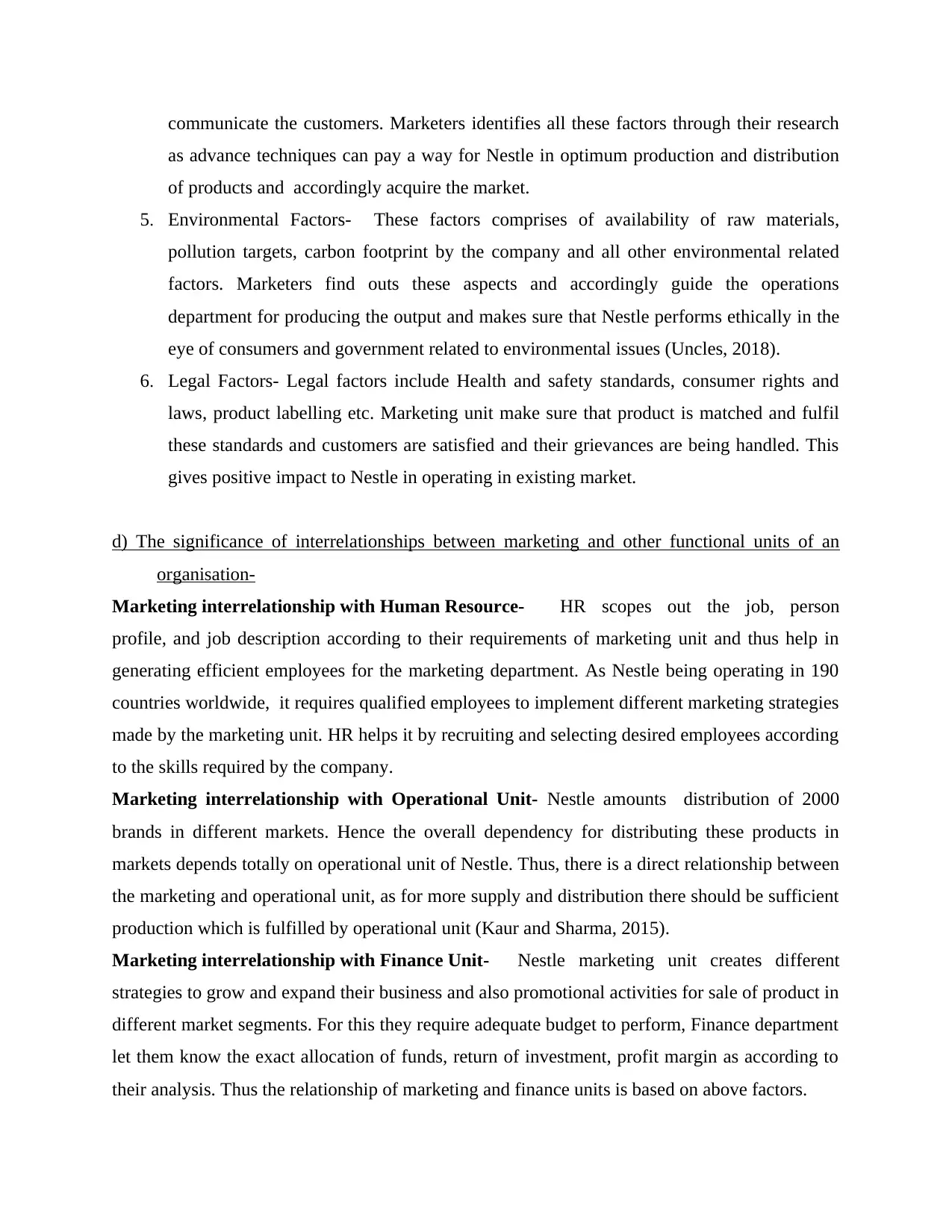
communicate the customers. Marketers identifies all these factors through their research
as advance techniques can pay a way for Nestle in optimum production and distribution
of products and accordingly acquire the market.
5. Environmental Factors- These factors comprises of availability of raw materials,
pollution targets, carbon footprint by the company and all other environmental related
factors. Marketers find outs these aspects and accordingly guide the operations
department for producing the output and makes sure that Nestle performs ethically in the
eye of consumers and government related to environmental issues (Uncles, 2018).
6. Legal Factors- Legal factors include Health and safety standards, consumer rights and
laws, product labelling etc. Marketing unit make sure that product is matched and fulfil
these standards and customers are satisfied and their grievances are being handled. This
gives positive impact to Nestle in operating in existing market.
d) The significance of interrelationships between marketing and other functional units of an
organisation-
Marketing interrelationship with Human Resource- HR scopes out the job, person
profile, and job description according to their requirements of marketing unit and thus help in
generating efficient employees for the marketing department. As Nestle being operating in 190
countries worldwide, it requires qualified employees to implement different marketing strategies
made by the marketing unit. HR helps it by recruiting and selecting desired employees according
to the skills required by the company.
Marketing interrelationship with Operational Unit- Nestle amounts distribution of 2000
brands in different markets. Hence the overall dependency for distributing these products in
markets depends totally on operational unit of Nestle. Thus, there is a direct relationship between
the marketing and operational unit, as for more supply and distribution there should be sufficient
production which is fulfilled by operational unit (Kaur and Sharma, 2015).
Marketing interrelationship with Finance Unit- Nestle marketing unit creates different
strategies to grow and expand their business and also promotional activities for sale of product in
different market segments. For this they require adequate budget to perform, Finance department
let them know the exact allocation of funds, return of investment, profit margin as according to
their analysis. Thus the relationship of marketing and finance units is based on above factors.
as advance techniques can pay a way for Nestle in optimum production and distribution
of products and accordingly acquire the market.
5. Environmental Factors- These factors comprises of availability of raw materials,
pollution targets, carbon footprint by the company and all other environmental related
factors. Marketers find outs these aspects and accordingly guide the operations
department for producing the output and makes sure that Nestle performs ethically in the
eye of consumers and government related to environmental issues (Uncles, 2018).
6. Legal Factors- Legal factors include Health and safety standards, consumer rights and
laws, product labelling etc. Marketing unit make sure that product is matched and fulfil
these standards and customers are satisfied and their grievances are being handled. This
gives positive impact to Nestle in operating in existing market.
d) The significance of interrelationships between marketing and other functional units of an
organisation-
Marketing interrelationship with Human Resource- HR scopes out the job, person
profile, and job description according to their requirements of marketing unit and thus help in
generating efficient employees for the marketing department. As Nestle being operating in 190
countries worldwide, it requires qualified employees to implement different marketing strategies
made by the marketing unit. HR helps it by recruiting and selecting desired employees according
to the skills required by the company.
Marketing interrelationship with Operational Unit- Nestle amounts distribution of 2000
brands in different markets. Hence the overall dependency for distributing these products in
markets depends totally on operational unit of Nestle. Thus, there is a direct relationship between
the marketing and operational unit, as for more supply and distribution there should be sufficient
production which is fulfilled by operational unit (Kaur and Sharma, 2015).
Marketing interrelationship with Finance Unit- Nestle marketing unit creates different
strategies to grow and expand their business and also promotional activities for sale of product in
different market segments. For this they require adequate budget to perform, Finance department
let them know the exact allocation of funds, return of investment, profit margin as according to
their analysis. Thus the relationship of marketing and finance units is based on above factors.
⊘ This is a preview!⊘
Do you want full access?
Subscribe today to unlock all pages.
Trusted by 1+ million students worldwide
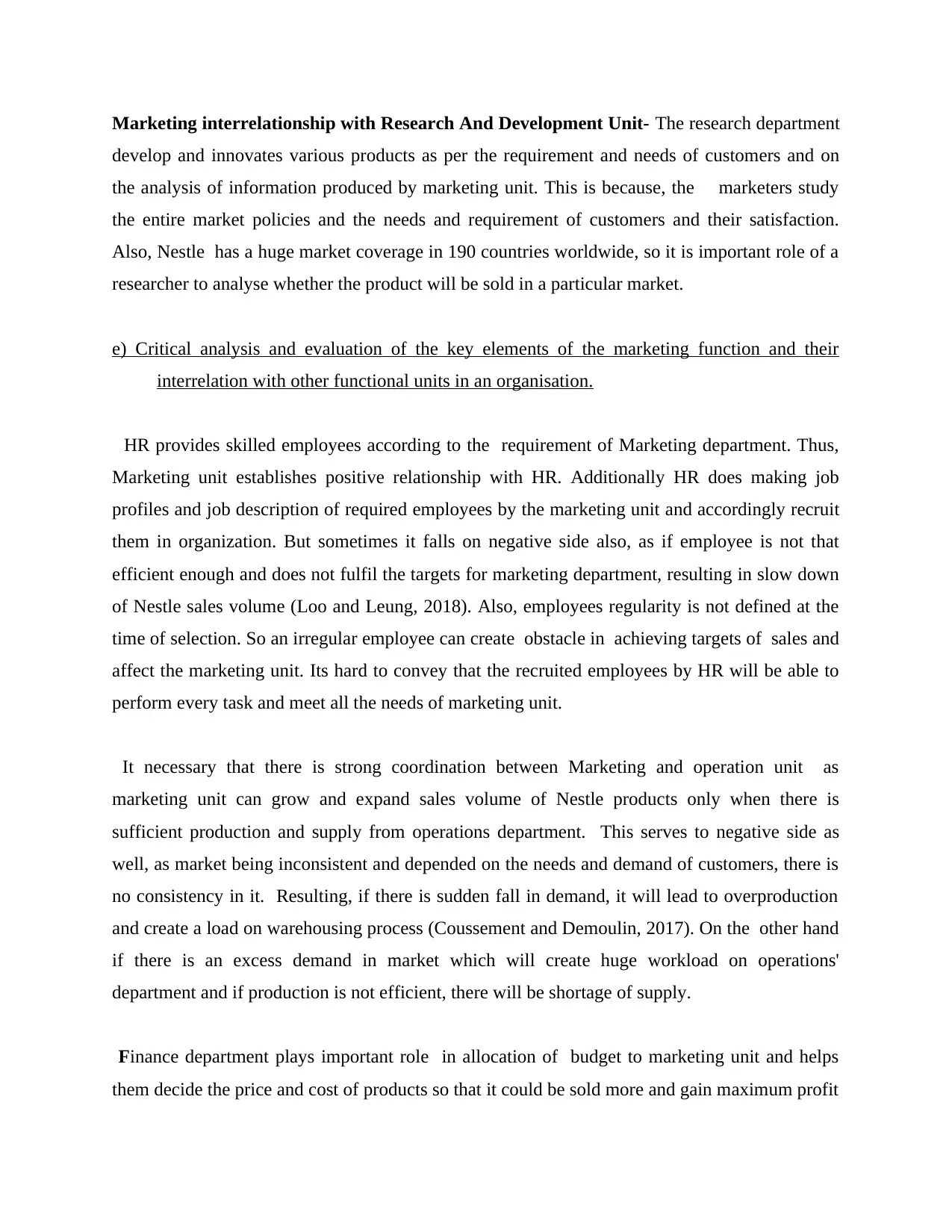
Marketing interrelationship with Research And Development Unit- The research department
develop and innovates various products as per the requirement and needs of customers and on
the analysis of information produced by marketing unit. This is because, the marketers study
the entire market policies and the needs and requirement of customers and their satisfaction.
Also, Nestle has a huge market coverage in 190 countries worldwide, so it is important role of a
researcher to analyse whether the product will be sold in a particular market.
e) Critical analysis and evaluation of the key elements of the marketing function and their
interrelation with other functional units in an organisation.
HR provides skilled employees according to the requirement of Marketing department. Thus,
Marketing unit establishes positive relationship with HR. Additionally HR does making job
profiles and job description of required employees by the marketing unit and accordingly recruit
them in organization. But sometimes it falls on negative side also, as if employee is not that
efficient enough and does not fulfil the targets for marketing department, resulting in slow down
of Nestle sales volume (Loo and Leung, 2018). Also, employees regularity is not defined at the
time of selection. So an irregular employee can create obstacle in achieving targets of sales and
affect the marketing unit. Its hard to convey that the recruited employees by HR will be able to
perform every task and meet all the needs of marketing unit.
It necessary that there is strong coordination between Marketing and operation unit as
marketing unit can grow and expand sales volume of Nestle products only when there is
sufficient production and supply from operations department. This serves to negative side as
well, as market being inconsistent and depended on the needs and demand of customers, there is
no consistency in it. Resulting, if there is sudden fall in demand, it will lead to overproduction
and create a load on warehousing process (Coussement and Demoulin, 2017). On the other hand
if there is an excess demand in market which will create huge workload on operations'
department and if production is not efficient, there will be shortage of supply.
Finance department plays important role in allocation of budget to marketing unit and helps
them decide the price and cost of products so that it could be sold more and gain maximum profit
develop and innovates various products as per the requirement and needs of customers and on
the analysis of information produced by marketing unit. This is because, the marketers study
the entire market policies and the needs and requirement of customers and their satisfaction.
Also, Nestle has a huge market coverage in 190 countries worldwide, so it is important role of a
researcher to analyse whether the product will be sold in a particular market.
e) Critical analysis and evaluation of the key elements of the marketing function and their
interrelation with other functional units in an organisation.
HR provides skilled employees according to the requirement of Marketing department. Thus,
Marketing unit establishes positive relationship with HR. Additionally HR does making job
profiles and job description of required employees by the marketing unit and accordingly recruit
them in organization. But sometimes it falls on negative side also, as if employee is not that
efficient enough and does not fulfil the targets for marketing department, resulting in slow down
of Nestle sales volume (Loo and Leung, 2018). Also, employees regularity is not defined at the
time of selection. So an irregular employee can create obstacle in achieving targets of sales and
affect the marketing unit. Its hard to convey that the recruited employees by HR will be able to
perform every task and meet all the needs of marketing unit.
It necessary that there is strong coordination between Marketing and operation unit as
marketing unit can grow and expand sales volume of Nestle products only when there is
sufficient production and supply from operations department. This serves to negative side as
well, as market being inconsistent and depended on the needs and demand of customers, there is
no consistency in it. Resulting, if there is sudden fall in demand, it will lead to overproduction
and create a load on warehousing process (Coussement and Demoulin, 2017). On the other hand
if there is an excess demand in market which will create huge workload on operations'
department and if production is not efficient, there will be shortage of supply.
Finance department plays important role in allocation of budget to marketing unit and helps
them decide the price and cost of products so that it could be sold more and gain maximum profit
Paraphrase This Document
Need a fresh take? Get an instant paraphrase of this document with our AI Paraphraser
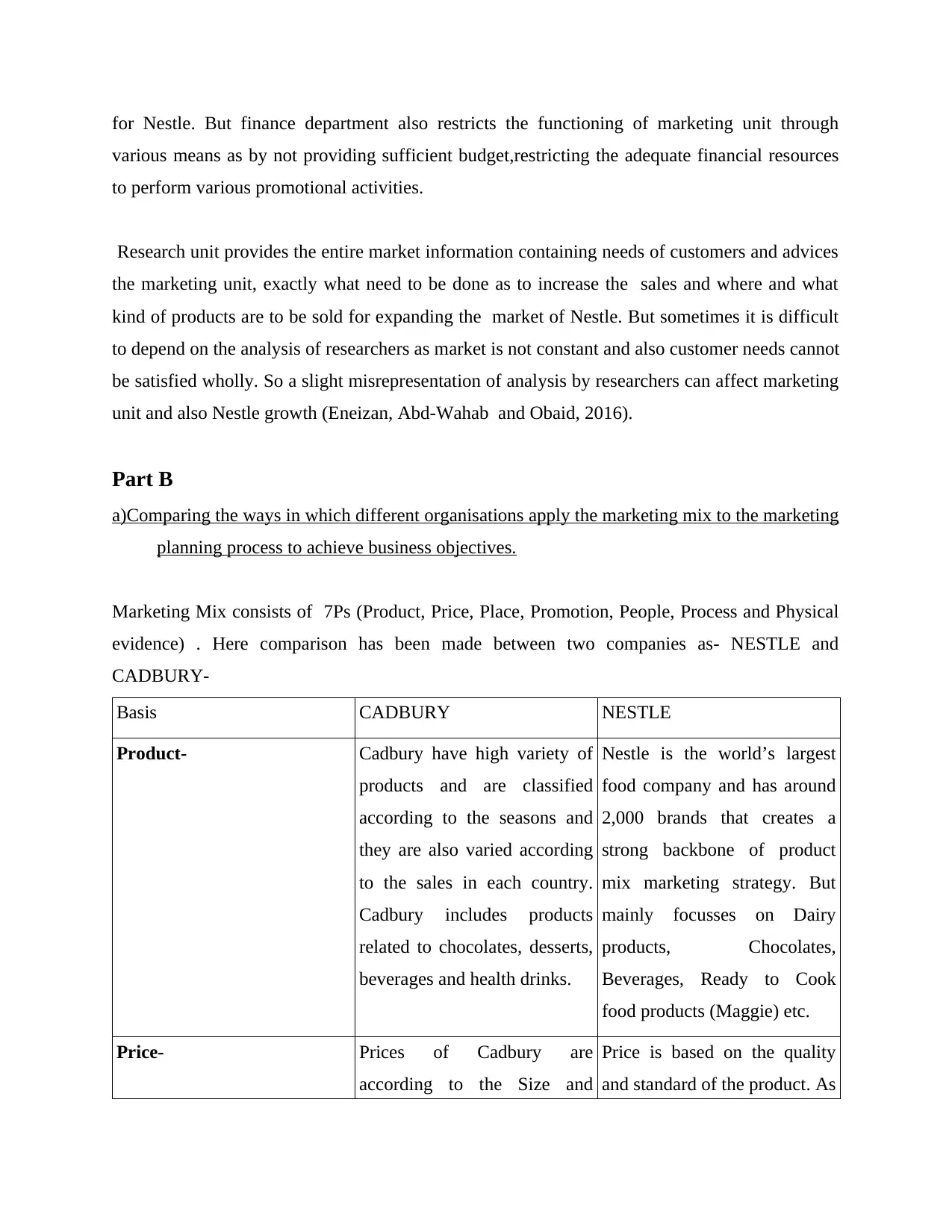
for Nestle. But finance department also restricts the functioning of marketing unit through
various means as by not providing sufficient budget,restricting the adequate financial resources
to perform various promotional activities.
Research unit provides the entire market information containing needs of customers and advices
the marketing unit, exactly what need to be done as to increase the sales and where and what
kind of products are to be sold for expanding the market of Nestle. But sometimes it is difficult
to depend on the analysis of researchers as market is not constant and also customer needs cannot
be satisfied wholly. So a slight misrepresentation of analysis by researchers can affect marketing
unit and also Nestle growth (Eneizan, Abd-Wahab and Obaid, 2016).
Part B
a)Comparing the ways in which different organisations apply the marketing mix to the marketing
planning process to achieve business objectives.
Marketing Mix consists of 7Ps (Product, Price, Place, Promotion, People, Process and Physical
evidence) . Here comparison has been made between two companies as- NESTLE and
CADBURY-
Basis CADBURY NESTLE
Product- Cadbury have high variety of
products and are classified
according to the seasons and
they are also varied according
to the sales in each country.
Cadbury includes products
related to chocolates, desserts,
beverages and health drinks.
Nestle is the world’s largest
food company and has around
2,000 brands that creates a
strong backbone of product
mix marketing strategy. But
mainly focusses on Dairy
products, Chocolates,
Beverages, Ready to Cook
food products (Maggie) etc.
Price- Prices of Cadbury are
according to the Size and
Price is based on the quality
and standard of the product. As
various means as by not providing sufficient budget,restricting the adequate financial resources
to perform various promotional activities.
Research unit provides the entire market information containing needs of customers and advices
the marketing unit, exactly what need to be done as to increase the sales and where and what
kind of products are to be sold for expanding the market of Nestle. But sometimes it is difficult
to depend on the analysis of researchers as market is not constant and also customer needs cannot
be satisfied wholly. So a slight misrepresentation of analysis by researchers can affect marketing
unit and also Nestle growth (Eneizan, Abd-Wahab and Obaid, 2016).
Part B
a)Comparing the ways in which different organisations apply the marketing mix to the marketing
planning process to achieve business objectives.
Marketing Mix consists of 7Ps (Product, Price, Place, Promotion, People, Process and Physical
evidence) . Here comparison has been made between two companies as- NESTLE and
CADBURY-
Basis CADBURY NESTLE
Product- Cadbury have high variety of
products and are classified
according to the seasons and
they are also varied according
to the sales in each country.
Cadbury includes products
related to chocolates, desserts,
beverages and health drinks.
Nestle is the world’s largest
food company and has around
2,000 brands that creates a
strong backbone of product
mix marketing strategy. But
mainly focusses on Dairy
products, Chocolates,
Beverages, Ready to Cook
food products (Maggie) etc.
Price- Prices of Cadbury are
according to the Size and
Price is based on the quality
and standard of the product. As
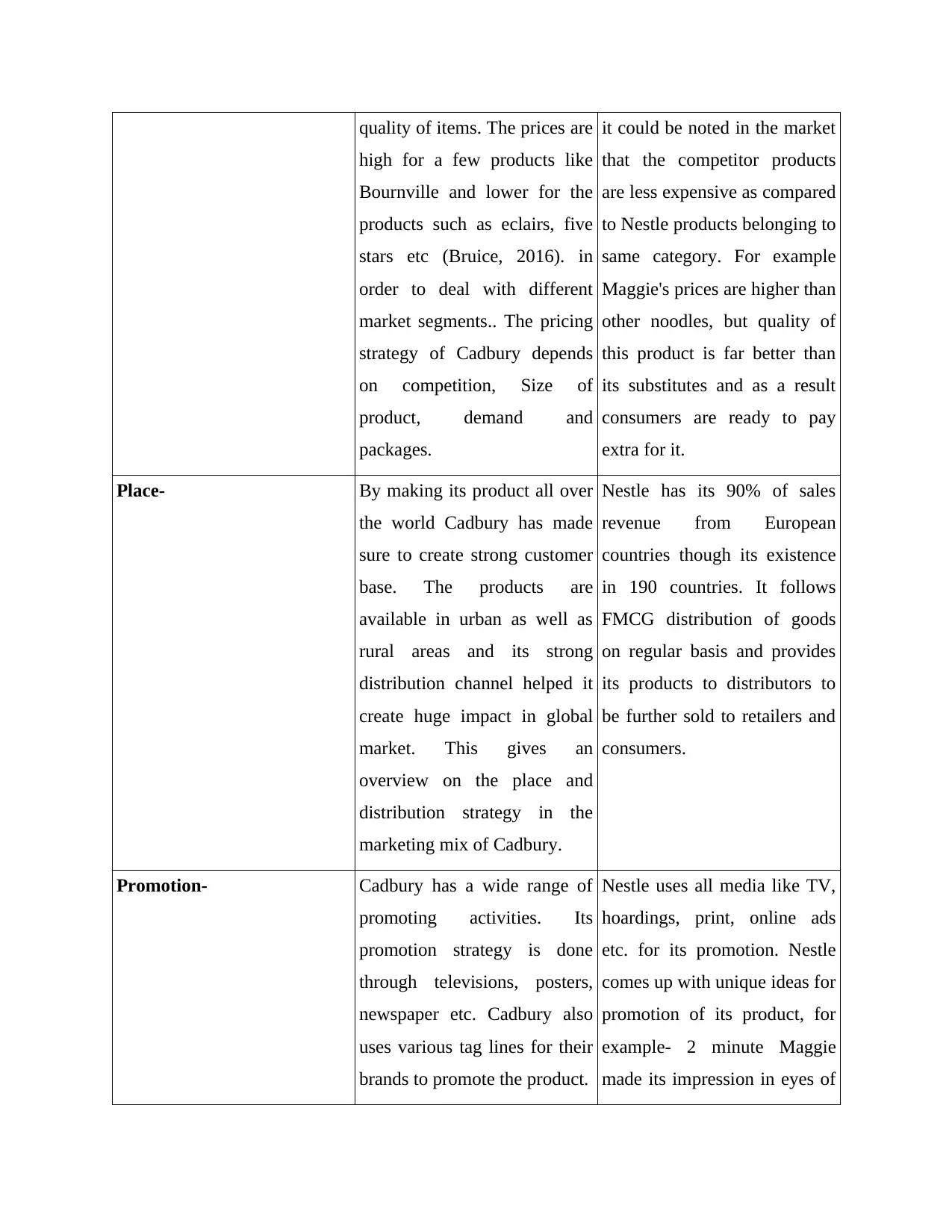
quality of items. The prices are
high for a few products like
Bournville and lower for the
products such as eclairs, five
stars etc (Bruice, 2016). in
order to deal with different
market segments.. The pricing
strategy of Cadbury depends
on competition, Size of
product, demand and
packages.
it could be noted in the market
that the competitor products
are less expensive as compared
to Nestle products belonging to
same category. For example
Maggie's prices are higher than
other noodles, but quality of
this product is far better than
its substitutes and as a result
consumers are ready to pay
extra for it.
Place- By making its product all over
the world Cadbury has made
sure to create strong customer
base. The products are
available in urban as well as
rural areas and its strong
distribution channel helped it
create huge impact in global
market. This gives an
overview on the place and
distribution strategy in the
marketing mix of Cadbury.
Nestle has its 90% of sales
revenue from European
countries though its existence
in 190 countries. It follows
FMCG distribution of goods
on regular basis and provides
its products to distributors to
be further sold to retailers and
consumers.
Promotion- Cadbury has a wide range of
promoting activities. Its
promotion strategy is done
through televisions, posters,
newspaper etc. Cadbury also
uses various tag lines for their
brands to promote the product.
Nestle uses all media like TV,
hoardings, print, online ads
etc. for its promotion. Nestle
comes up with unique ideas for
promotion of its product, for
example- 2 minute Maggie
made its impression in eyes of
high for a few products like
Bournville and lower for the
products such as eclairs, five
stars etc (Bruice, 2016). in
order to deal with different
market segments.. The pricing
strategy of Cadbury depends
on competition, Size of
product, demand and
packages.
it could be noted in the market
that the competitor products
are less expensive as compared
to Nestle products belonging to
same category. For example
Maggie's prices are higher than
other noodles, but quality of
this product is far better than
its substitutes and as a result
consumers are ready to pay
extra for it.
Place- By making its product all over
the world Cadbury has made
sure to create strong customer
base. The products are
available in urban as well as
rural areas and its strong
distribution channel helped it
create huge impact in global
market. This gives an
overview on the place and
distribution strategy in the
marketing mix of Cadbury.
Nestle has its 90% of sales
revenue from European
countries though its existence
in 190 countries. It follows
FMCG distribution of goods
on regular basis and provides
its products to distributors to
be further sold to retailers and
consumers.
Promotion- Cadbury has a wide range of
promoting activities. Its
promotion strategy is done
through televisions, posters,
newspaper etc. Cadbury also
uses various tag lines for their
brands to promote the product.
Nestle uses all media like TV,
hoardings, print, online ads
etc. for its promotion. Nestle
comes up with unique ideas for
promotion of its product, for
example- 2 minute Maggie
made its impression in eyes of
⊘ This is a preview!⊘
Do you want full access?
Subscribe today to unlock all pages.
Trusted by 1+ million students worldwide
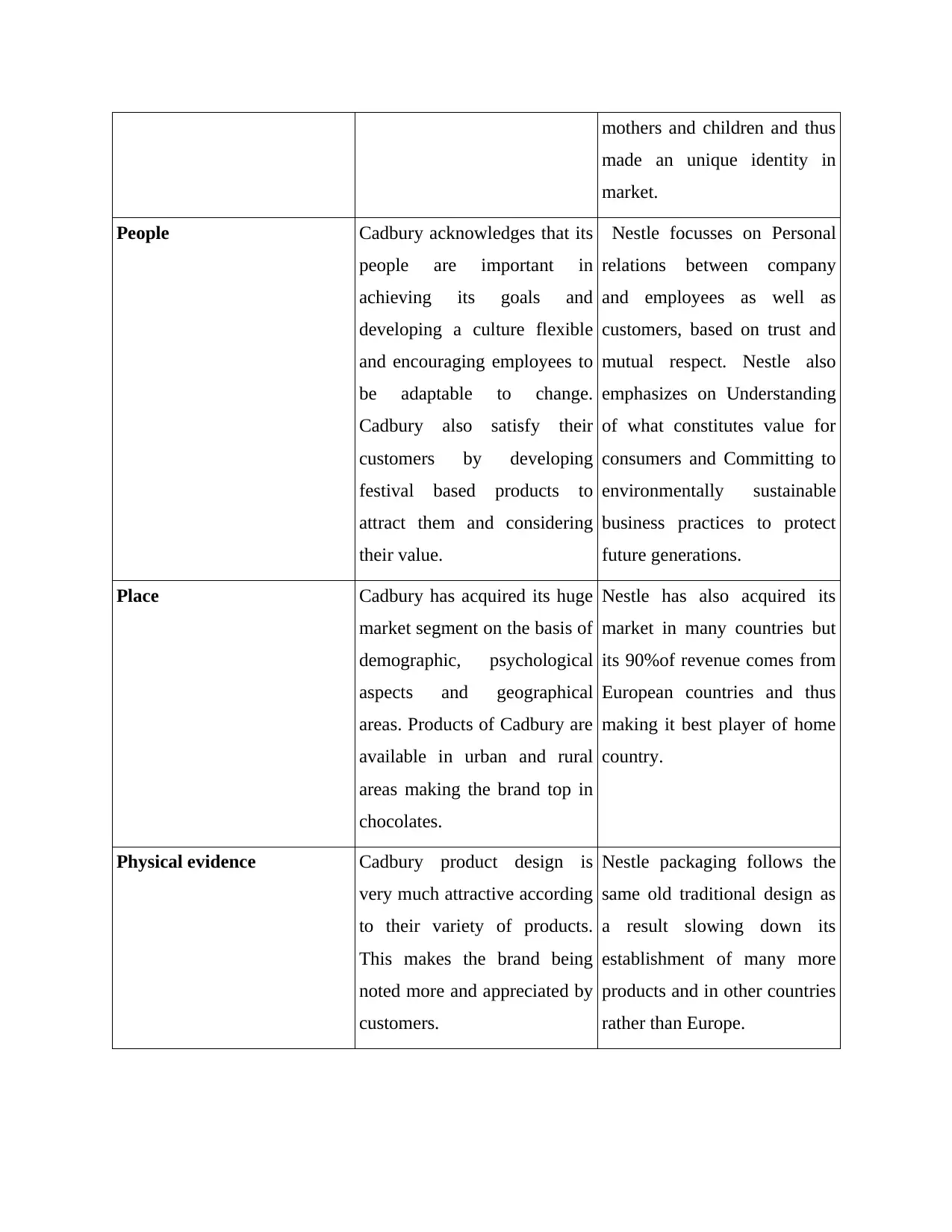
mothers and children and thus
made an unique identity in
market.
People Cadbury acknowledges that its
people are important in
achieving its goals and
developing a culture flexible
and encouraging employees to
be adaptable to change.
Cadbury also satisfy their
customers by developing
festival based products to
attract them and considering
their value.
Nestle focusses on Personal
relations between company
and employees as well as
customers, based on trust and
mutual respect. Nestle also
emphasizes on Understanding
of what constitutes value for
consumers and Committing to
environmentally sustainable
business practices to protect
future generations.
Place Cadbury has acquired its huge
market segment on the basis of
demographic, psychological
aspects and geographical
areas. Products of Cadbury are
available in urban and rural
areas making the brand top in
chocolates.
Nestle has also acquired its
market in many countries but
its 90%of revenue comes from
European countries and thus
making it best player of home
country.
Physical evidence Cadbury product design is
very much attractive according
to their variety of products.
This makes the brand being
noted more and appreciated by
customers.
Nestle packaging follows the
same old traditional design as
a result slowing down its
establishment of many more
products and in other countries
rather than Europe.
made an unique identity in
market.
People Cadbury acknowledges that its
people are important in
achieving its goals and
developing a culture flexible
and encouraging employees to
be adaptable to change.
Cadbury also satisfy their
customers by developing
festival based products to
attract them and considering
their value.
Nestle focusses on Personal
relations between company
and employees as well as
customers, based on trust and
mutual respect. Nestle also
emphasizes on Understanding
of what constitutes value for
consumers and Committing to
environmentally sustainable
business practices to protect
future generations.
Place Cadbury has acquired its huge
market segment on the basis of
demographic, psychological
aspects and geographical
areas. Products of Cadbury are
available in urban and rural
areas making the brand top in
chocolates.
Nestle has also acquired its
market in many countries but
its 90%of revenue comes from
European countries and thus
making it best player of home
country.
Physical evidence Cadbury product design is
very much attractive according
to their variety of products.
This makes the brand being
noted more and appreciated by
customers.
Nestle packaging follows the
same old traditional design as
a result slowing down its
establishment of many more
products and in other countries
rather than Europe.
Paraphrase This Document
Need a fresh take? Get an instant paraphrase of this document with our AI Paraphraser
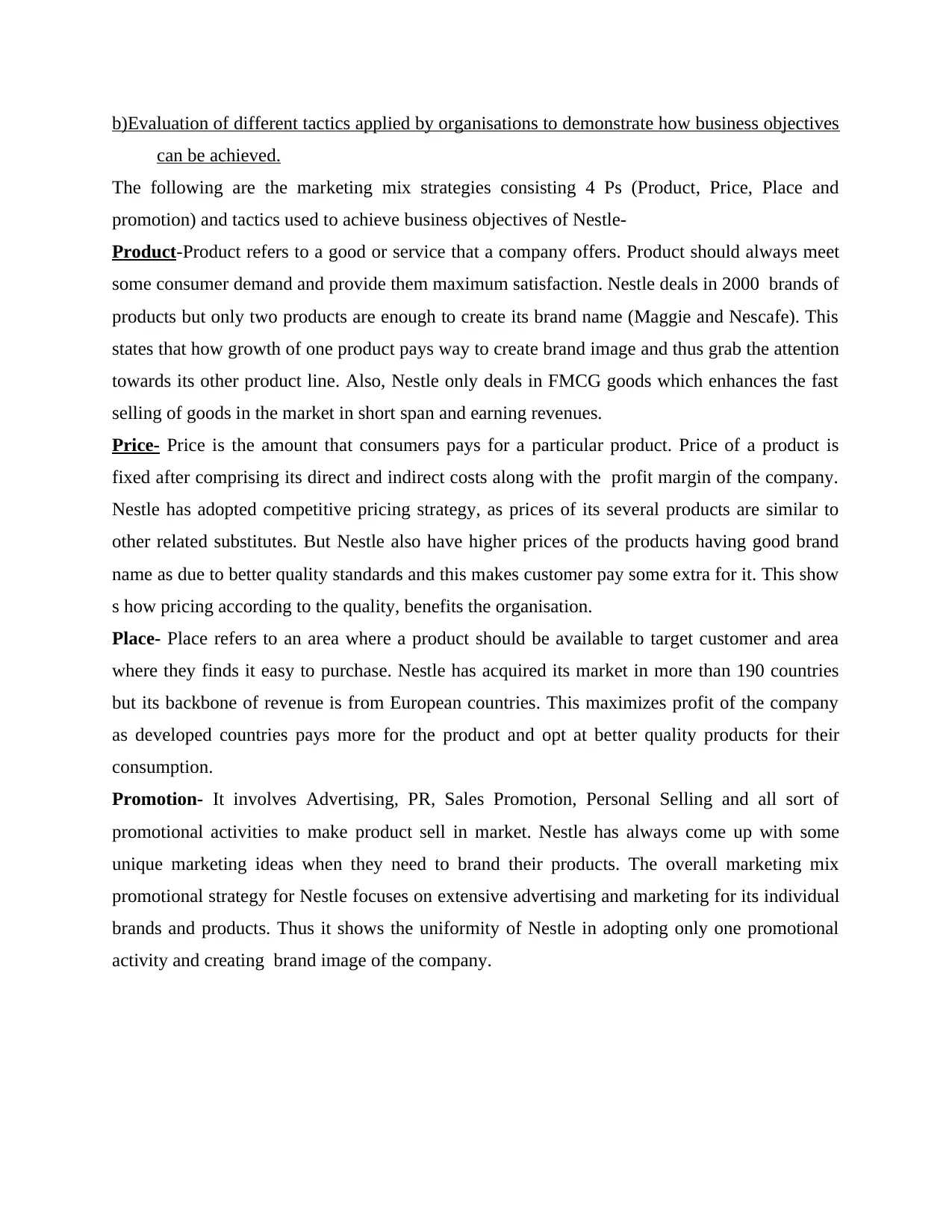
b)Evaluation of different tactics applied by organisations to demonstrate how business objectives
can be achieved.
The following are the marketing mix strategies consisting 4 Ps (Product, Price, Place and
promotion) and tactics used to achieve business objectives of Nestle-
Product-Product refers to a good or service that a company offers. Product should always meet
some consumer demand and provide them maximum satisfaction. Nestle deals in 2000 brands of
products but only two products are enough to create its brand name (Maggie and Nescafe). This
states that how growth of one product pays way to create brand image and thus grab the attention
towards its other product line. Also, Nestle only deals in FMCG goods which enhances the fast
selling of goods in the market in short span and earning revenues.
Price- Price is the amount that consumers pays for a particular product. Price of a product is
fixed after comprising its direct and indirect costs along with the profit margin of the company.
Nestle has adopted competitive pricing strategy, as prices of its several products are similar to
other related substitutes. But Nestle also have higher prices of the products having good brand
name as due to better quality standards and this makes customer pay some extra for it. This show
s how pricing according to the quality, benefits the organisation.
Place- Place refers to an area where a product should be available to target customer and area
where they finds it easy to purchase. Nestle has acquired its market in more than 190 countries
but its backbone of revenue is from European countries. This maximizes profit of the company
as developed countries pays more for the product and opt at better quality products for their
consumption.
Promotion- It involves Advertising, PR, Sales Promotion, Personal Selling and all sort of
promotional activities to make product sell in market. Nestle has always come up with some
unique marketing ideas when they need to brand their products. The overall marketing mix
promotional strategy for Nestle focuses on extensive advertising and marketing for its individual
brands and products. Thus it shows the uniformity of Nestle in adopting only one promotional
activity and creating brand image of the company.
can be achieved.
The following are the marketing mix strategies consisting 4 Ps (Product, Price, Place and
promotion) and tactics used to achieve business objectives of Nestle-
Product-Product refers to a good or service that a company offers. Product should always meet
some consumer demand and provide them maximum satisfaction. Nestle deals in 2000 brands of
products but only two products are enough to create its brand name (Maggie and Nescafe). This
states that how growth of one product pays way to create brand image and thus grab the attention
towards its other product line. Also, Nestle only deals in FMCG goods which enhances the fast
selling of goods in the market in short span and earning revenues.
Price- Price is the amount that consumers pays for a particular product. Price of a product is
fixed after comprising its direct and indirect costs along with the profit margin of the company.
Nestle has adopted competitive pricing strategy, as prices of its several products are similar to
other related substitutes. But Nestle also have higher prices of the products having good brand
name as due to better quality standards and this makes customer pay some extra for it. This show
s how pricing according to the quality, benefits the organisation.
Place- Place refers to an area where a product should be available to target customer and area
where they finds it easy to purchase. Nestle has acquired its market in more than 190 countries
but its backbone of revenue is from European countries. This maximizes profit of the company
as developed countries pays more for the product and opt at better quality products for their
consumption.
Promotion- It involves Advertising, PR, Sales Promotion, Personal Selling and all sort of
promotional activities to make product sell in market. Nestle has always come up with some
unique marketing ideas when they need to brand their products. The overall marketing mix
promotional strategy for Nestle focuses on extensive advertising and marketing for its individual
brands and products. Thus it shows the uniformity of Nestle in adopting only one promotional
activity and creating brand image of the company.
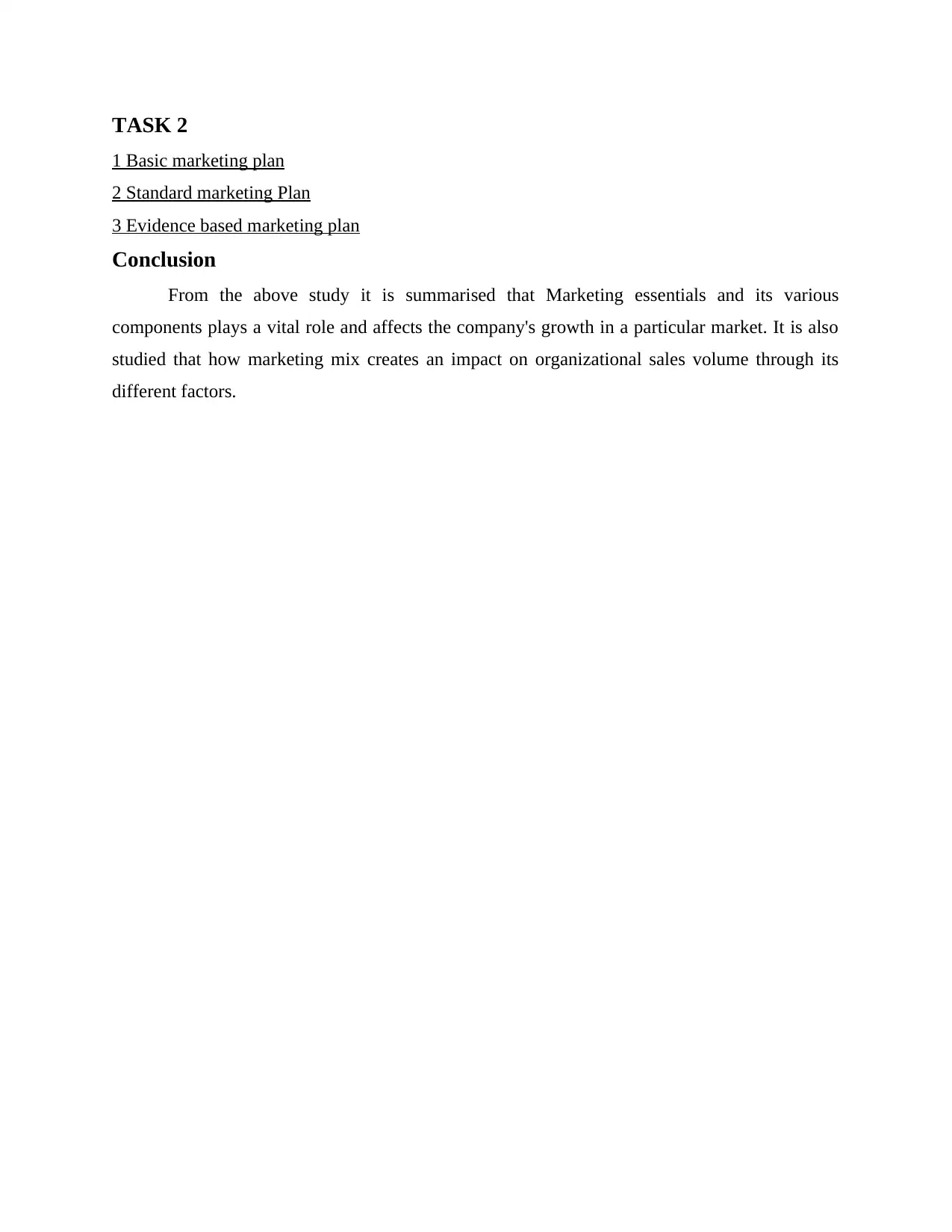
TASK 2
1 Basic marketing plan
2 Standard marketing Plan
3 Evidence based marketing plan
Conclusion
From the above study it is summarised that Marketing essentials and its various
components plays a vital role and affects the company's growth in a particular market. It is also
studied that how marketing mix creates an impact on organizational sales volume through its
different factors.
1 Basic marketing plan
2 Standard marketing Plan
3 Evidence based marketing plan
Conclusion
From the above study it is summarised that Marketing essentials and its various
components plays a vital role and affects the company's growth in a particular market. It is also
studied that how marketing mix creates an impact on organizational sales volume through its
different factors.
⊘ This is a preview!⊘
Do you want full access?
Subscribe today to unlock all pages.
Trusted by 1+ million students worldwide

1 out of 16


Related Documents


Your All-in-One AI-Powered Toolkit for Academic Success.
+13062052269
info@desklib.com
Available 24*7 on WhatsApp / Email
![[object Object]](/_next/static/media/star-bottom.7253800d.svg)
Unlock your academic potential
Copyright © 2020–2026 A2Z Services. All Rights Reserved. Developed and managed by ZUCOL.