Nestlé's Quality Policy: An In-depth Analysis of Scope and Benefits
VerifiedAdded on 2023/06/12
|5
|1392
|95
Essay
AI Summary
This essay provides a comprehensive analysis of Nestlé's quality policy (QP), developed in 2007, focusing on its scope and benefits. It highlights the policy's emphasis on achieving high standards of quality in products and services, supported by leadership commitment and resources. The analysis covers aspects included in the policy such as management support, employee involvement through education and training, and continuous improvement initiatives. It also identifies areas excluded, such as the lack of a clear strategy for involving suppliers in quality improvement and the absence of specific quality measurement standards and procedures. The essay further discusses the policy's impact on safety, compliance, and product quality, aligning with Nestlé's objective of enhancing quality of life. The quality policy aims to understand customer needs and promote employee participation in sustainable quality management processes, encouraging ownership and integration to achieve quality objectives. Desklib offers a range of similar solved assignments and study resources for students.
Running head: Quality policy 1
QUALITY POLICY: SCOPE, AND BENEFITS
Presented by
Student affiliation
Supervisor
17th April 2018
QUALITY POLICY: SCOPE, AND BENEFITS
Presented by
Student affiliation
Supervisor
17th April 2018
Paraphrase This Document
Need a fresh take? Get an instant paraphrase of this document with our AI Paraphraser

Running head: Quality policy 2
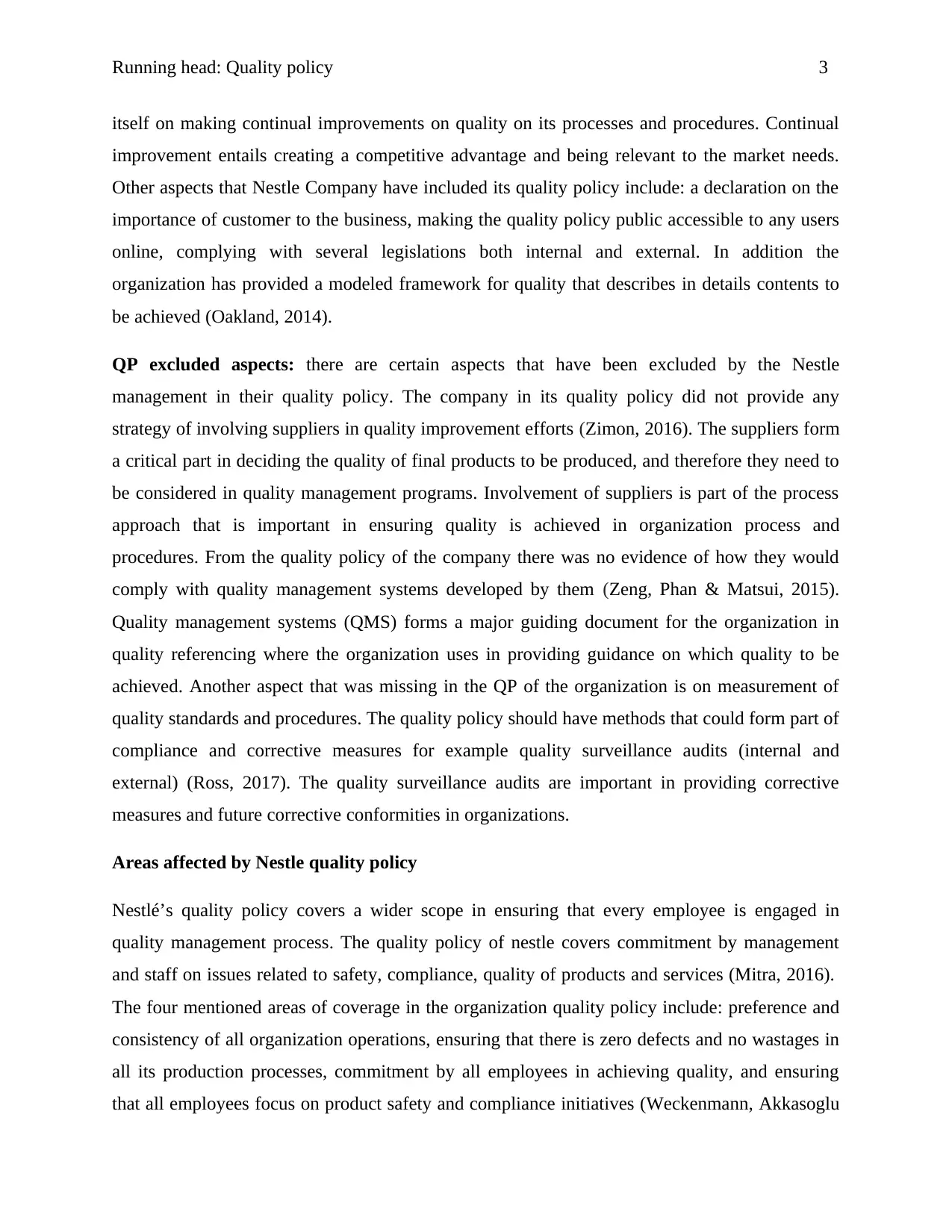
Introduction
The quality policy (QP) is a broad statement drafted by the organization explaining how it would
achieve quality in its operations (Goetsch & Davis, 2014). Nestlé’s quality policy was developed
in March 2007 aimed at achieving high standard of quality for their products and services. The
management of Nestle food industry is committed in providing necessary leadership; resources
and management to ensure quality policy remains relevant to organization needs. The
commitment covers a framework in which the quality policy is reviewed annually and
communicated to relevant stakeholders (Management, 2017). Organization quality policy was
documented to provide guidelines for delivering products and services that are compliant,
preferred and safe to customers. ISO 9000 requires the organization to document its policy on
quality. It is essential for the quality policy to be communicated and known to all staff (Ross,
2017). The target audience for the Nestlé’s quality policy was on the employees. The quality
policy was focusing to ensure that employees are able to own and carry out quality in their work
stations.
Aspects of Nestlé’s quality policy (QP)
There are certain aspects Nestlé’s quality policies that have been excluded and included.
Aspects of quality policies (QP): The four components expected to be included in quality policy
include: management support, customer focus, process approach and continual improvement
(Goetsch & Davis, 2014). The quality policy needs to emphasize on commitment by the top
management and staff to comply with quality requirements. Nestlé’s quality policy there is
commitment to quality by Mark Schneider the chief executive officer this is part of management
support initiative to cultivate quality development. The quality policy requires that the
organization have a strategy to involve everyone in quality improvement process (Oakland,
2014). The Nestle organization quality policy (QP) specifies how promotions and participation
of all employees will be achieved using education, standards, coaching, trainings,
communication and supervision. That shows a roadmap in which the employees will be
empowered to achieve the intended quality outcome (Oakland, 2014).
The quality policy (QP) requires that organizations provide assurance that quality be a
continuous process in the organization (Ross, 2017). Nestlé’s food organization has committed
Introduction
The quality policy (QP) is a broad statement drafted by the organization explaining how it would
achieve quality in its operations (Goetsch & Davis, 2014). Nestlé’s quality policy was developed
in March 2007 aimed at achieving high standard of quality for their products and services. The
management of Nestle food industry is committed in providing necessary leadership; resources
and management to ensure quality policy remains relevant to organization needs. The
commitment covers a framework in which the quality policy is reviewed annually and
communicated to relevant stakeholders (Management, 2017). Organization quality policy was
documented to provide guidelines for delivering products and services that are compliant,
preferred and safe to customers. ISO 9000 requires the organization to document its policy on
quality. It is essential for the quality policy to be communicated and known to all staff (Ross,
2017). The target audience for the Nestlé’s quality policy was on the employees. The quality
policy was focusing to ensure that employees are able to own and carry out quality in their work
stations.
Aspects of Nestlé’s quality policy (QP)
There are certain aspects Nestlé’s quality policies that have been excluded and included.
Aspects of quality policies (QP): The four components expected to be included in quality policy
include: management support, customer focus, process approach and continual improvement
(Goetsch & Davis, 2014). The quality policy needs to emphasize on commitment by the top
management and staff to comply with quality requirements. Nestlé’s quality policy there is
commitment to quality by Mark Schneider the chief executive officer this is part of management
support initiative to cultivate quality development. The quality policy requires that the
organization have a strategy to involve everyone in quality improvement process (Oakland,
2014). The Nestle organization quality policy (QP) specifies how promotions and participation
of all employees will be achieved using education, standards, coaching, trainings,
communication and supervision. That shows a roadmap in which the employees will be
empowered to achieve the intended quality outcome (Oakland, 2014).
The quality policy (QP) requires that organizations provide assurance that quality be a
continuous process in the organization (Ross, 2017). Nestlé’s food organization has committed

Running head: Quality policy 3
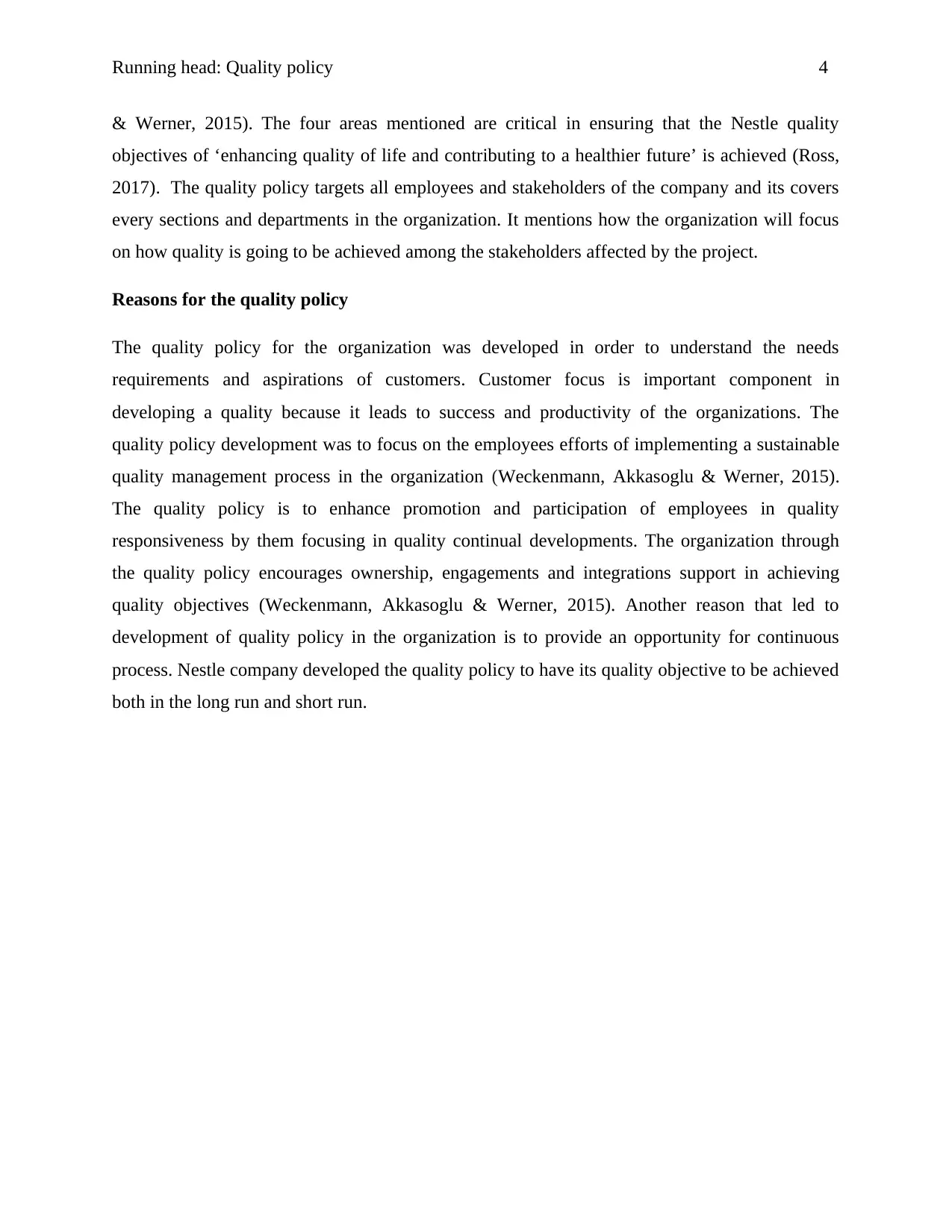
itself on making continual improvements on quality on its processes and procedures. Continual
improvement entails creating a competitive advantage and being relevant to the market needs.
Other aspects that Nestle Company have included its quality policy include: a declaration on the
importance of customer to the business, making the quality policy public accessible to any users
online, complying with several legislations both internal and external. In addition the
organization has provided a modeled framework for quality that describes in details contents to
be achieved (Oakland, 2014).
QP excluded aspects: there are certain aspects that have been excluded by the Nestle
management in their quality policy. The company in its quality policy did not provide any
strategy of involving suppliers in quality improvement efforts (Zimon, 2016). The suppliers form
a critical part in deciding the quality of final products to be produced, and therefore they need to
be considered in quality management programs. Involvement of suppliers is part of the process
approach that is important in ensuring quality is achieved in organization process and
procedures. From the quality policy of the company there was no evidence of how they would
comply with quality management systems developed by them (Zeng, Phan & Matsui, 2015).
Quality management systems (QMS) forms a major guiding document for the organization in
quality referencing where the organization uses in providing guidance on which quality to be
achieved. Another aspect that was missing in the QP of the organization is on measurement of
quality standards and procedures. The quality policy should have methods that could form part of
compliance and corrective measures for example quality surveillance audits (internal and
external) (Ross, 2017). The quality surveillance audits are important in providing corrective
measures and future corrective conformities in organizations.
Areas affected by Nestle quality policy
Nestlé’s quality policy covers a wider scope in ensuring that every employee is engaged in
quality management process. The quality policy of nestle covers commitment by management
and staff on issues related to safety, compliance, quality of products and services (Mitra, 2016).
The four mentioned areas of coverage in the organization quality policy include: preference and
consistency of all organization operations, ensuring that there is zero defects and no wastages in
all its production processes, commitment by all employees in achieving quality, and ensuring
that all employees focus on product safety and compliance initiatives (Weckenmann, Akkasoglu
itself on making continual improvements on quality on its processes and procedures. Continual
improvement entails creating a competitive advantage and being relevant to the market needs.
Other aspects that Nestle Company have included its quality policy include: a declaration on the
importance of customer to the business, making the quality policy public accessible to any users
online, complying with several legislations both internal and external. In addition the
organization has provided a modeled framework for quality that describes in details contents to
be achieved (Oakland, 2014).
QP excluded aspects: there are certain aspects that have been excluded by the Nestle
management in their quality policy. The company in its quality policy did not provide any
strategy of involving suppliers in quality improvement efforts (Zimon, 2016). The suppliers form
a critical part in deciding the quality of final products to be produced, and therefore they need to
be considered in quality management programs. Involvement of suppliers is part of the process
approach that is important in ensuring quality is achieved in organization process and
procedures. From the quality policy of the company there was no evidence of how they would
comply with quality management systems developed by them (Zeng, Phan & Matsui, 2015).
Quality management systems (QMS) forms a major guiding document for the organization in
quality referencing where the organization uses in providing guidance on which quality to be
achieved. Another aspect that was missing in the QP of the organization is on measurement of
quality standards and procedures. The quality policy should have methods that could form part of
compliance and corrective measures for example quality surveillance audits (internal and
external) (Ross, 2017). The quality surveillance audits are important in providing corrective
measures and future corrective conformities in organizations.
Areas affected by Nestle quality policy
Nestlé’s quality policy covers a wider scope in ensuring that every employee is engaged in
quality management process. The quality policy of nestle covers commitment by management
and staff on issues related to safety, compliance, quality of products and services (Mitra, 2016).
The four mentioned areas of coverage in the organization quality policy include: preference and
consistency of all organization operations, ensuring that there is zero defects and no wastages in
all its production processes, commitment by all employees in achieving quality, and ensuring
that all employees focus on product safety and compliance initiatives (Weckenmann, Akkasoglu
⊘ This is a preview!⊘
Do you want full access?
Subscribe today to unlock all pages.

Trusted by 1+ million students worldwide

Running head: Quality policy 4
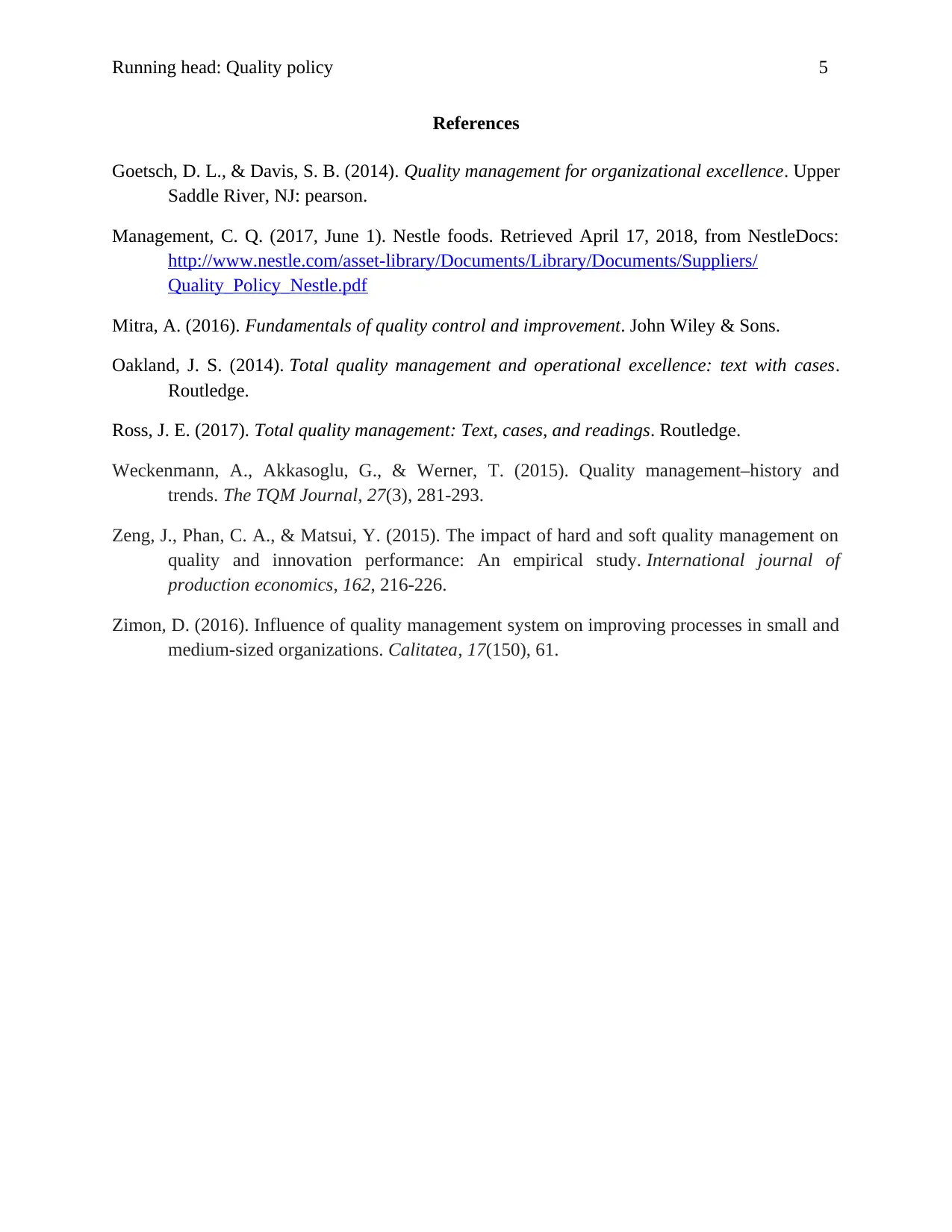
& Werner, 2015). The four areas mentioned are critical in ensuring that the Nestle quality
objectives of ‘enhancing quality of life and contributing to a healthier future’ is achieved (Ross,
2017). The quality policy targets all employees and stakeholders of the company and its covers
every sections and departments in the organization. It mentions how the organization will focus
on how quality is going to be achieved among the stakeholders affected by the project.
Reasons for the quality policy
The quality policy for the organization was developed in order to understand the needs
requirements and aspirations of customers. Customer focus is important component in
developing a quality because it leads to success and productivity of the organizations. The
quality policy development was to focus on the employees efforts of implementing a sustainable
quality management process in the organization (Weckenmann, Akkasoglu & Werner, 2015).
The quality policy is to enhance promotion and participation of employees in quality
responsiveness by them focusing in quality continual developments. The organization through
the quality policy encourages ownership, engagements and integrations support in achieving
quality objectives (Weckenmann, Akkasoglu & Werner, 2015). Another reason that led to
development of quality policy in the organization is to provide an opportunity for continuous
process. Nestle company developed the quality policy to have its quality objective to be achieved
both in the long run and short run.
& Werner, 2015). The four areas mentioned are critical in ensuring that the Nestle quality
objectives of ‘enhancing quality of life and contributing to a healthier future’ is achieved (Ross,
2017). The quality policy targets all employees and stakeholders of the company and its covers
every sections and departments in the organization. It mentions how the organization will focus
on how quality is going to be achieved among the stakeholders affected by the project.
Reasons for the quality policy
The quality policy for the organization was developed in order to understand the needs
requirements and aspirations of customers. Customer focus is important component in
developing a quality because it leads to success and productivity of the organizations. The
quality policy development was to focus on the employees efforts of implementing a sustainable
quality management process in the organization (Weckenmann, Akkasoglu & Werner, 2015).
The quality policy is to enhance promotion and participation of employees in quality
responsiveness by them focusing in quality continual developments. The organization through
the quality policy encourages ownership, engagements and integrations support in achieving
quality objectives (Weckenmann, Akkasoglu & Werner, 2015). Another reason that led to
development of quality policy in the organization is to provide an opportunity for continuous
process. Nestle company developed the quality policy to have its quality objective to be achieved
both in the long run and short run.
Paraphrase This Document
Need a fresh take? Get an instant paraphrase of this document with our AI Paraphraser

Running head: Quality policy 5
References
Goetsch, D. L., & Davis, S. B. (2014). Quality management for organizational excellence. Upper
Saddle River, NJ: pearson.
Management, C. Q. (2017, June 1). Nestle foods. Retrieved April 17, 2018, from NestleDocs:
http://www.nestle.com/asset-library/Documents/Library/Documents/Suppliers/
Quality_Policy_Nestle.pdf
Mitra, A. (2016). Fundamentals of quality control and improvement. John Wiley & Sons.
Oakland, J. S. (2014). Total quality management and operational excellence: text with cases.
Routledge.
Ross, J. E. (2017). Total quality management: Text, cases, and readings. Routledge.
Weckenmann, A., Akkasoglu, G., & Werner, T. (2015). Quality management–history and
trends. The TQM Journal, 27(3), 281-293.
Zeng, J., Phan, C. A., & Matsui, Y. (2015). The impact of hard and soft quality management on
quality and innovation performance: An empirical study. International journal of
production economics, 162, 216-226.
Zimon, D. (2016). Influence of quality management system on improving processes in small and
medium-sized organizations. Calitatea, 17(150), 61.
References
Goetsch, D. L., & Davis, S. B. (2014). Quality management for organizational excellence. Upper
Saddle River, NJ: pearson.
Management, C. Q. (2017, June 1). Nestle foods. Retrieved April 17, 2018, from NestleDocs:
http://www.nestle.com/asset-library/Documents/Library/Documents/Suppliers/
Quality_Policy_Nestle.pdf
Mitra, A. (2016). Fundamentals of quality control and improvement. John Wiley & Sons.
Oakland, J. S. (2014). Total quality management and operational excellence: text with cases.
Routledge.
Ross, J. E. (2017). Total quality management: Text, cases, and readings. Routledge.
Weckenmann, A., Akkasoglu, G., & Werner, T. (2015). Quality management–history and
trends. The TQM Journal, 27(3), 281-293.
Zeng, J., Phan, C. A., & Matsui, Y. (2015). The impact of hard and soft quality management on
quality and innovation performance: An empirical study. International journal of
production economics, 162, 216-226.
Zimon, D. (2016). Influence of quality management system on improving processes in small and
medium-sized organizations. Calitatea, 17(150), 61.
1 out of 5
Related Documents
Your All-in-One AI-Powered Toolkit for Academic Success.
+13062052269
info@desklib.com
Available 24*7 on WhatsApp / Email
Unlock your academic potential
Copyright © 2020–2025 A2Z Services. All Rights Reserved. Developed and managed by ZUCOL.