How Multinational Companies Improve Employee Recruitment and Training
VerifiedAdded on 2020/12/09
|24
|5090
|472
Report
AI Summary
This report examines how multinational companies, specifically Nestle, can improve their recruitment, selection, and training of employees to meet international requirements. The assignment begins with an introduction to globalization and project management, then outlines the aims and objectives of the research, which include understanding the concept of recruitment, selection, and training; determining its importance for Nestle; and identifying improvement methods. A project management plan is presented, covering costs, scope, time, quality, communication, risk, and resources. A work breakdown structure and Gantt chart are included to provide a timeline. The research employs a qualitative research method, using a questionnaire to gather primary data. The report then analyzes the research data using appropriate tools and techniques, presenting findings on the concept of recruitment, selection, and training. Finally, the report offers recommendations for improvement, including suggestions for enhancing Nestle's recruitment, training, and selection methods. The report emphasizes the value of research in achieving stated objectives and improving the researcher's own learning and performance.
MANAGING A
SUCCESSFUL
BUSINESS PROJECT
SUCCESSFUL
BUSINESS PROJECT

Paraphrase This Document
Need a fresh take? Get an instant paraphrase of this document with our AI Paraphraser
Table of Contents
INTRODUCTION...........................................................................................................................1
TASK 1............................................................................................................................................1
P1Project aims and objectives.....................................................................................................1
P2 Project management plan that covers cost, scope, time, quality, communication, risk and
resources......................................................................................................................................2
P3 Work breakdown structure and Gantt chart to provide time-frame.......................................4
TASK 2............................................................................................................................................5
P4 Small scale research by applying qualitative and quantitative research methods..................5
TASK 3............................................................................................................................................7
P5 Analyse research and data using appropriate tools & techniques..........................................7
P6 Communicate appropriate recommendations as a result of research and data analysis.......15
TASK 4..........................................................................................................................................16
P7 Reflect on the value of undertaking research to achieve stated objectives and own learning
& performance..........................................................................................................................16
CONCLUSION..............................................................................................................................17
REFERENCES..............................................................................................................................18
INTRODUCTION...........................................................................................................................1
TASK 1............................................................................................................................................1
P1Project aims and objectives.....................................................................................................1
P2 Project management plan that covers cost, scope, time, quality, communication, risk and
resources......................................................................................................................................2
P3 Work breakdown structure and Gantt chart to provide time-frame.......................................4
TASK 2............................................................................................................................................5
P4 Small scale research by applying qualitative and quantitative research methods..................5
TASK 3............................................................................................................................................7
P5 Analyse research and data using appropriate tools & techniques..........................................7
P6 Communicate appropriate recommendations as a result of research and data analysis.......15
TASK 4..........................................................................................................................................16
P7 Reflect on the value of undertaking research to achieve stated objectives and own learning
& performance..........................................................................................................................16
CONCLUSION..............................................................................................................................17
REFERENCES..............................................................................................................................18

Title: How do multinational companies improve the recruitment, selection and training of their
employees to meet International requirements?
INTRODUCTION
Globalisation is a process in which national and regional cultures, societies & economies
integrate through global network trade. It denotes the connection among different parts of world
that results in expansion of international political and economical activities. Project management
is defined as the practice to initiate, plan, execute, control and close the work of a project team in
an appropriate manner so that specific objectives and targets can be achieved (Cleveland,
Laroche and Hallab, 2013). Managing a project in a successful manner is not an easy task and
require considerations of different aspects such as cost, time, scope of project etc. This
assignment is written in context with Nestle which is a Switzerland based food and drink
company, headquartered in Vaud, Switzerland. This report will cover aims and objectives for
concerned topic along with a project management plan. Beside this, work break-down structure
and Gantt chart is prepared. Research and data analysis is carried out and in respect with that
valid conclusions & recommendations are given that will benefits the company in achieving the
objective of carrying out research.
TASK 1
P1Project aims and objectives
Background of the research
In global context, every organisation wants to sustain a strong position with regional and
international market so that high growth and profitability can be achieved. To attain these
objectives along with capital and advanced technology, capable and skilled human resources are
also required. To meet international needs & requirements in a proper manner, a firm is required
to improves its recruitment, selection and training procedures. This will improve the working
capability of workers to perform better even in complex situations. Nestle is a transnational food
and drink organisation situated in Vaud, Switzerland. In terms of revenue, it is the largest food
company. Products offered by company includes cereals, breakfast, confectionery, Frozen food,
snacks, pet food etc. at present, Nestle is operating at almost every country. Hence, it is very
important for them to recruit and select capable employees which can deliver their best
performance at global level (Coker, 2014).
1
employees to meet International requirements?
INTRODUCTION
Globalisation is a process in which national and regional cultures, societies & economies
integrate through global network trade. It denotes the connection among different parts of world
that results in expansion of international political and economical activities. Project management
is defined as the practice to initiate, plan, execute, control and close the work of a project team in
an appropriate manner so that specific objectives and targets can be achieved (Cleveland,
Laroche and Hallab, 2013). Managing a project in a successful manner is not an easy task and
require considerations of different aspects such as cost, time, scope of project etc. This
assignment is written in context with Nestle which is a Switzerland based food and drink
company, headquartered in Vaud, Switzerland. This report will cover aims and objectives for
concerned topic along with a project management plan. Beside this, work break-down structure
and Gantt chart is prepared. Research and data analysis is carried out and in respect with that
valid conclusions & recommendations are given that will benefits the company in achieving the
objective of carrying out research.
TASK 1
P1Project aims and objectives
Background of the research
In global context, every organisation wants to sustain a strong position with regional and
international market so that high growth and profitability can be achieved. To attain these
objectives along with capital and advanced technology, capable and skilled human resources are
also required. To meet international needs & requirements in a proper manner, a firm is required
to improves its recruitment, selection and training procedures. This will improve the working
capability of workers to perform better even in complex situations. Nestle is a transnational food
and drink organisation situated in Vaud, Switzerland. In terms of revenue, it is the largest food
company. Products offered by company includes cereals, breakfast, confectionery, Frozen food,
snacks, pet food etc. at present, Nestle is operating at almost every country. Hence, it is very
important for them to recruit and select capable employees which can deliver their best
performance at global level (Coker, 2014).
1
⊘ This is a preview!⊘
Do you want full access?
Subscribe today to unlock all pages.

Trusted by 1+ million students worldwide
Purpose of the research
Main purpose for conducting this research is to analyse the manner in which MNC's can improve
their selection, recruitment and training of employees. This will benefits them in increasing the
productivity level of employees so that the organisational goals can be achieved efficiently.
Along with this, it will assists Nestle in meeting all international requirements properly that will
enhance the market shares of company worldwide. Form researcher's point of view, this research
will enhance the personal and professional knowledge that will assists in future researches.
Aim: “To analyse the need of improvement in recruitment, selection and training of
workforce for multinational companies to fulfil international requirements.” A case study on
Nestle.
Objectives:
To understand the concept of recruitment, selection and training
To determine the importance of recruitment, selection and training for Nestle while
operating at international level
To identify the ways by which Nestle can improve recruitment, selection and training
method for workforce.
Questions:
Do you understand the concept of recruitment, selection and training?
What is the importance of recruitment, selection and training for Nestle while operating
at international level?
What are the ways by which Nestle can improve recruitment, selection and training
method for workforce?
P2 Project management plan that covers cost, scope, time, quality, communication, risk and
resources
Project management plan defined as a formal and approved document which is required
to manage execution of a project. It documents the actions which are necessary to define,
integrate, prepare and coordinate different planning activities (Connell, 2013). It will benefits
Nestle in acknowledging the manner in which initiated project is going to be executed, checked
and controlled so that it can be ended in a successful manner. There are some aspects which are
associated with project management plan of Nestle such as cost, time, scope, quality, risk,
resources etc. which are mentioned beneath:
2
Main purpose for conducting this research is to analyse the manner in which MNC's can improve
their selection, recruitment and training of employees. This will benefits them in increasing the
productivity level of employees so that the organisational goals can be achieved efficiently.
Along with this, it will assists Nestle in meeting all international requirements properly that will
enhance the market shares of company worldwide. Form researcher's point of view, this research
will enhance the personal and professional knowledge that will assists in future researches.
Aim: “To analyse the need of improvement in recruitment, selection and training of
workforce for multinational companies to fulfil international requirements.” A case study on
Nestle.
Objectives:
To understand the concept of recruitment, selection and training
To determine the importance of recruitment, selection and training for Nestle while
operating at international level
To identify the ways by which Nestle can improve recruitment, selection and training
method for workforce.
Questions:
Do you understand the concept of recruitment, selection and training?
What is the importance of recruitment, selection and training for Nestle while operating
at international level?
What are the ways by which Nestle can improve recruitment, selection and training
method for workforce?
P2 Project management plan that covers cost, scope, time, quality, communication, risk and
resources
Project management plan defined as a formal and approved document which is required
to manage execution of a project. It documents the actions which are necessary to define,
integrate, prepare and coordinate different planning activities (Connell, 2013). It will benefits
Nestle in acknowledging the manner in which initiated project is going to be executed, checked
and controlled so that it can be ended in a successful manner. There are some aspects which are
associated with project management plan of Nestle such as cost, time, scope, quality, risk,
resources etc. which are mentioned beneath:
2
Paraphrase This Document
Need a fresh take? Get an instant paraphrase of this document with our AI Paraphraser
Cost: It is one of the main aspect while carrying out any research. Cost estimation
benefits a company in acknowledging the capital which is required to further proceed a
project or research. For managing a project in desired manner, it is important that
researcher should not run out of money. All the estimated costs need to be added so that a
proper budget can be prepared which will help Nestle in identifying the amount of money
that must be invested to understand the ways by which recruitment, selection and training
methods can be improved to meet international needs. Cost estimated by the firm to
manage this project is 35000 pounds. Company is required to perform all its activities
under this amount only. This research can be conducted with budget of 200 pounds so
that desired results can be attained (Dutta and Bose, 2015).
Scope: This project is initiated to understand different aspects by which hiring process
and performance of employees can be enhanced. This will benefits the company in
enhancing their brand reputation and revenues at international level. This shows that the
scope of research is wide and will help company in improving the recruitment, select and
training process. From researcher preservative, scope is high as this research will assists
in gaining wide knowledge and information about the ways by which capabilities of
employees can be improved that will help in performing future research.
Time: To carry out research in a proper manner, adequate time is required. If time period
is not sufficient then it will not be possible for Nestle to conduct its project activities in a
proper manner (Fageha and Aibinu, 2013). Team members of project should be given
sufficient time so that all the work can be performed efficiently. Time required by
company to work on this project is 12 weeks. To conduct research in a desired manner 8
weeks are required.
Quality: It is another crucial aspect related with project management. During research,
quality is measured in accordance with the tools and techniques which are taken during
research. If proper research methods will be used then research will be carried out
properly. In case of company, appropriate training and discussions help in performing
project activity desirably.
Communication: Without communication, it is not possible for members of a project to
share important information with one another. Improper communication can results in
failing of project. Project team of Nestle can use different communication methods to
3
benefits a company in acknowledging the capital which is required to further proceed a
project or research. For managing a project in desired manner, it is important that
researcher should not run out of money. All the estimated costs need to be added so that a
proper budget can be prepared which will help Nestle in identifying the amount of money
that must be invested to understand the ways by which recruitment, selection and training
methods can be improved to meet international needs. Cost estimated by the firm to
manage this project is 35000 pounds. Company is required to perform all its activities
under this amount only. This research can be conducted with budget of 200 pounds so
that desired results can be attained (Dutta and Bose, 2015).
Scope: This project is initiated to understand different aspects by which hiring process
and performance of employees can be enhanced. This will benefits the company in
enhancing their brand reputation and revenues at international level. This shows that the
scope of research is wide and will help company in improving the recruitment, select and
training process. From researcher preservative, scope is high as this research will assists
in gaining wide knowledge and information about the ways by which capabilities of
employees can be improved that will help in performing future research.
Time: To carry out research in a proper manner, adequate time is required. If time period
is not sufficient then it will not be possible for Nestle to conduct its project activities in a
proper manner (Fageha and Aibinu, 2013). Team members of project should be given
sufficient time so that all the work can be performed efficiently. Time required by
company to work on this project is 12 weeks. To conduct research in a desired manner 8
weeks are required.
Quality: It is another crucial aspect related with project management. During research,
quality is measured in accordance with the tools and techniques which are taken during
research. If proper research methods will be used then research will be carried out
properly. In case of company, appropriate training and discussions help in performing
project activity desirably.
Communication: Without communication, it is not possible for members of a project to
share important information with one another. Improper communication can results in
failing of project. Project team of Nestle can use different communication methods to
3
interact with one another such as video and voice conferencing, E-mails, printed
documents, telephonic communication etc. While conducting research, researcher can use
SMS, emails, phone calls to interact and communicate information in a desired manner.
Risk: There are different risks that can be faced by researcher at the time of research such
as shortage of funds and lack of appropriate knowledge. From company's perspective
potential risks during working on project can be lack of finances and investment,
mismanagement of time (Fisher, 2011).
Resources: To perform project activities in a desired manner appropriate resources are
required. In case of project started by Nestle, required resources will be capital,
technological advancement, human resources etc. For researcher, required resources will
be internet, money and books, magazines, publication sources. This will helps in
performing research in an efficient manner.
P3 Work breakdown structure and Gantt chart to provide time-frame
Work break-down structure: It is a key project deliverable that divides and organise
the project work into small manageable sections. It defines the scope of a project into small
chunks that can be easily understood by the project members in Nestle so that all the work can be
carried out in an efficiently manner.
4
documents, telephonic communication etc. While conducting research, researcher can use
SMS, emails, phone calls to interact and communicate information in a desired manner.
Risk: There are different risks that can be faced by researcher at the time of research such
as shortage of funds and lack of appropriate knowledge. From company's perspective
potential risks during working on project can be lack of finances and investment,
mismanagement of time (Fisher, 2011).
Resources: To perform project activities in a desired manner appropriate resources are
required. In case of project started by Nestle, required resources will be capital,
technological advancement, human resources etc. For researcher, required resources will
be internet, money and books, magazines, publication sources. This will helps in
performing research in an efficient manner.
P3 Work breakdown structure and Gantt chart to provide time-frame
Work break-down structure: It is a key project deliverable that divides and organise
the project work into small manageable sections. It defines the scope of a project into small
chunks that can be easily understood by the project members in Nestle so that all the work can be
carried out in an efficiently manner.
4
⊘ This is a preview!⊘
Do you want full access?
Subscribe today to unlock all pages.
Trusted by 1+ million students worldwide

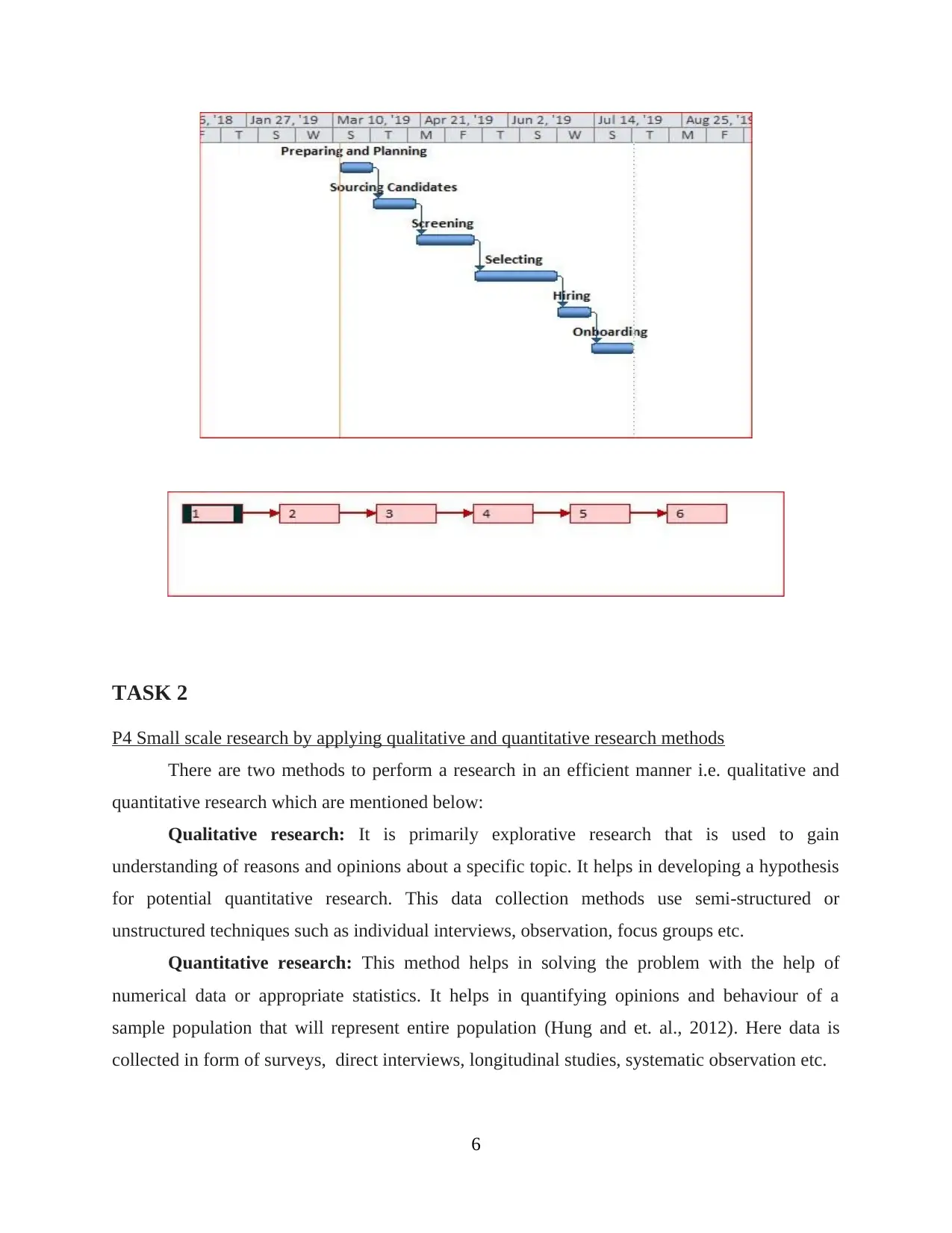
Gantt chart: It is a bar chart that represents project schedule in an organised manner.
This chart graphically depicts all the project activities according to the specified time-frame. It is
the most widely used chart that denotes the start and finish of a project including milestones,
dependencies, resources and tasks. It will appropriately monitors and schedule all the work of
project carried out by Nestle due to which desired outcomes will be received (Hillson, 2017).
5
This chart graphically depicts all the project activities according to the specified time-frame. It is
the most widely used chart that denotes the start and finish of a project including milestones,
dependencies, resources and tasks. It will appropriately monitors and schedule all the work of
project carried out by Nestle due to which desired outcomes will be received (Hillson, 2017).
5
Paraphrase This Document
Need a fresh take? Get an instant paraphrase of this document with our AI Paraphraser
TASK 2
P4 Small scale research by applying qualitative and quantitative research methods
There are two methods to perform a research in an efficient manner i.e. qualitative and
quantitative research which are mentioned below:
Qualitative research: It is primarily explorative research that is used to gain
understanding of reasons and opinions about a specific topic. It helps in developing a hypothesis
for potential quantitative research. This data collection methods use semi-structured or
unstructured techniques such as individual interviews, observation, focus groups etc.
Quantitative research: This method helps in solving the problem with the help of
numerical data or appropriate statistics. It helps in quantifying opinions and behaviour of a
sample population that will represent entire population (Hung and et. al., 2012). Here data is
collected in form of surveys, direct interviews, longitudinal studies, systematic observation etc.
6
P4 Small scale research by applying qualitative and quantitative research methods
There are two methods to perform a research in an efficient manner i.e. qualitative and
quantitative research which are mentioned below:
Qualitative research: It is primarily explorative research that is used to gain
understanding of reasons and opinions about a specific topic. It helps in developing a hypothesis
for potential quantitative research. This data collection methods use semi-structured or
unstructured techniques such as individual interviews, observation, focus groups etc.
Quantitative research: This method helps in solving the problem with the help of
numerical data or appropriate statistics. It helps in quantifying opinions and behaviour of a
sample population that will represent entire population (Hung and et. al., 2012). Here data is
collected in form of surveys, direct interviews, longitudinal studies, systematic observation etc.
6

Primary research method: In this method, fresh and raw data is gathered which is not
used or published in any previous research or findings. It can be performed with the help of
observations, questionnaires, interviews etc.
Secondary research method: This method involves the use of data and information
which is already collected with the help of primary research (Mhamed, 2012). Here researcher
will use information collected through associations, media sources, labour union, government
agencies, internet, books, journals etc.
For this project, researcher has used qualitative research method. Under it, primary
research is used in the form of questionnaire. In this method, some questions will be asked from
specific people and their opinion will be considered as the perspective of entire population.
Questionnaire:
Q1) Do you understand the concept of recruitment, selection and training?
Yes
No
Q2) Do you think improvement in recruitment and selection of employees will benefit a
company in meeting international requirements?
Yes
No
Q3) What are the benefits an organisation can achieve by improving its recruitment,
selection and training process?
Skilled working staff
Improved organisational productivity
Q4) What are the main reasons for Nestle to improve its recruitment, selection and
training process?
Increased profit margins
Enhanced brand reputation
Increased revenues
Q5) What kind of barriers can exist in improvement of recruitment, selection and training
of employees?
Shortage of funds
Uninterested staff
7
used or published in any previous research or findings. It can be performed with the help of
observations, questionnaires, interviews etc.
Secondary research method: This method involves the use of data and information
which is already collected with the help of primary research (Mhamed, 2012). Here researcher
will use information collected through associations, media sources, labour union, government
agencies, internet, books, journals etc.
For this project, researcher has used qualitative research method. Under it, primary
research is used in the form of questionnaire. In this method, some questions will be asked from
specific people and their opinion will be considered as the perspective of entire population.
Questionnaire:
Q1) Do you understand the concept of recruitment, selection and training?
Yes
No
Q2) Do you think improvement in recruitment and selection of employees will benefit a
company in meeting international requirements?
Yes
No
Q3) What are the benefits an organisation can achieve by improving its recruitment,
selection and training process?
Skilled working staff
Improved organisational productivity
Q4) What are the main reasons for Nestle to improve its recruitment, selection and
training process?
Increased profit margins
Enhanced brand reputation
Increased revenues
Q5) What kind of barriers can exist in improvement of recruitment, selection and training
of employees?
Shortage of funds
Uninterested staff
7
⊘ This is a preview!⊘
Do you want full access?
Subscribe today to unlock all pages.
Trusted by 1+ million students worldwide
Lack of understanding
Q6) Do you think training of employees will assists Nestle in meeting different
requirements at global context?
Yes
No
Q7) How barriers can be eliminated so that recruitment, selection and training process of
employees can be improved appropriately?
High investment in training programs
By conducting regular meetings and seminars
Q8) what are the positive impact of improving training processes for employees in Nestle?
Timely work accomplishment
Enhanced working capability of staff
Reduced employee turnover
Q9) Recommend ways by which Nestle can improve its recruiting, training and selection
methods in a effective manner.
TASK 3
P5 Analyse research and data using appropriate tools & techniques
THEME 1: Concept of recruitment, selection and training
Q1) Do you understand the concept of recruitment, selection and training? Frequency
Yes 38
No 12
8
Q6) Do you think training of employees will assists Nestle in meeting different
requirements at global context?
Yes
No
Q7) How barriers can be eliminated so that recruitment, selection and training process of
employees can be improved appropriately?
High investment in training programs
By conducting regular meetings and seminars
Q8) what are the positive impact of improving training processes for employees in Nestle?
Timely work accomplishment
Enhanced working capability of staff
Reduced employee turnover
Q9) Recommend ways by which Nestle can improve its recruiting, training and selection
methods in a effective manner.
TASK 3
P5 Analyse research and data using appropriate tools & techniques
THEME 1: Concept of recruitment, selection and training
Q1) Do you understand the concept of recruitment, selection and training? Frequency
Yes 38
No 12
8
Paraphrase This Document
Need a fresh take? Get an instant paraphrase of this document with our AI Paraphraser
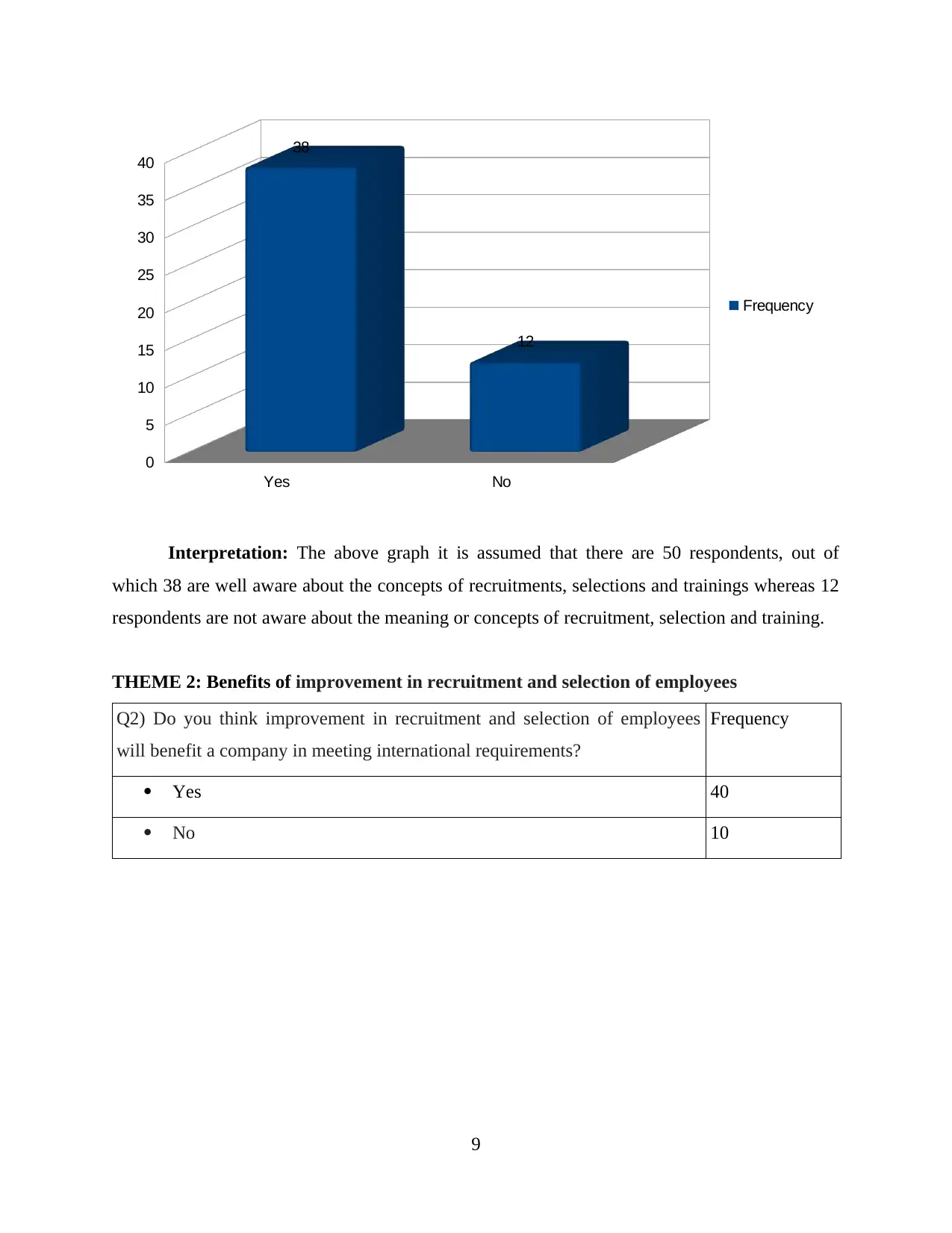
Interpretation: The above graph it is assumed that there are 50 respondents, out of
which 38 are well aware about the concepts of recruitments, selections and trainings whereas 12
respondents are not aware about the meaning or concepts of recruitment, selection and training.
THEME 2: Benefits of improvement in recruitment and selection of employees
Q2) Do you think improvement in recruitment and selection of employees
will benefit a company in meeting international requirements?
Frequency
Yes 40
No 10
9
Yes No
0
5
10
15
20
25
30
35
40
38
12
Frequency
which 38 are well aware about the concepts of recruitments, selections and trainings whereas 12
respondents are not aware about the meaning or concepts of recruitment, selection and training.
THEME 2: Benefits of improvement in recruitment and selection of employees
Q2) Do you think improvement in recruitment and selection of employees
will benefit a company in meeting international requirements?
Frequency
Yes 40
No 10
9
Yes No
0
5
10
15
20
25
30
35
40
38
12
Frequency
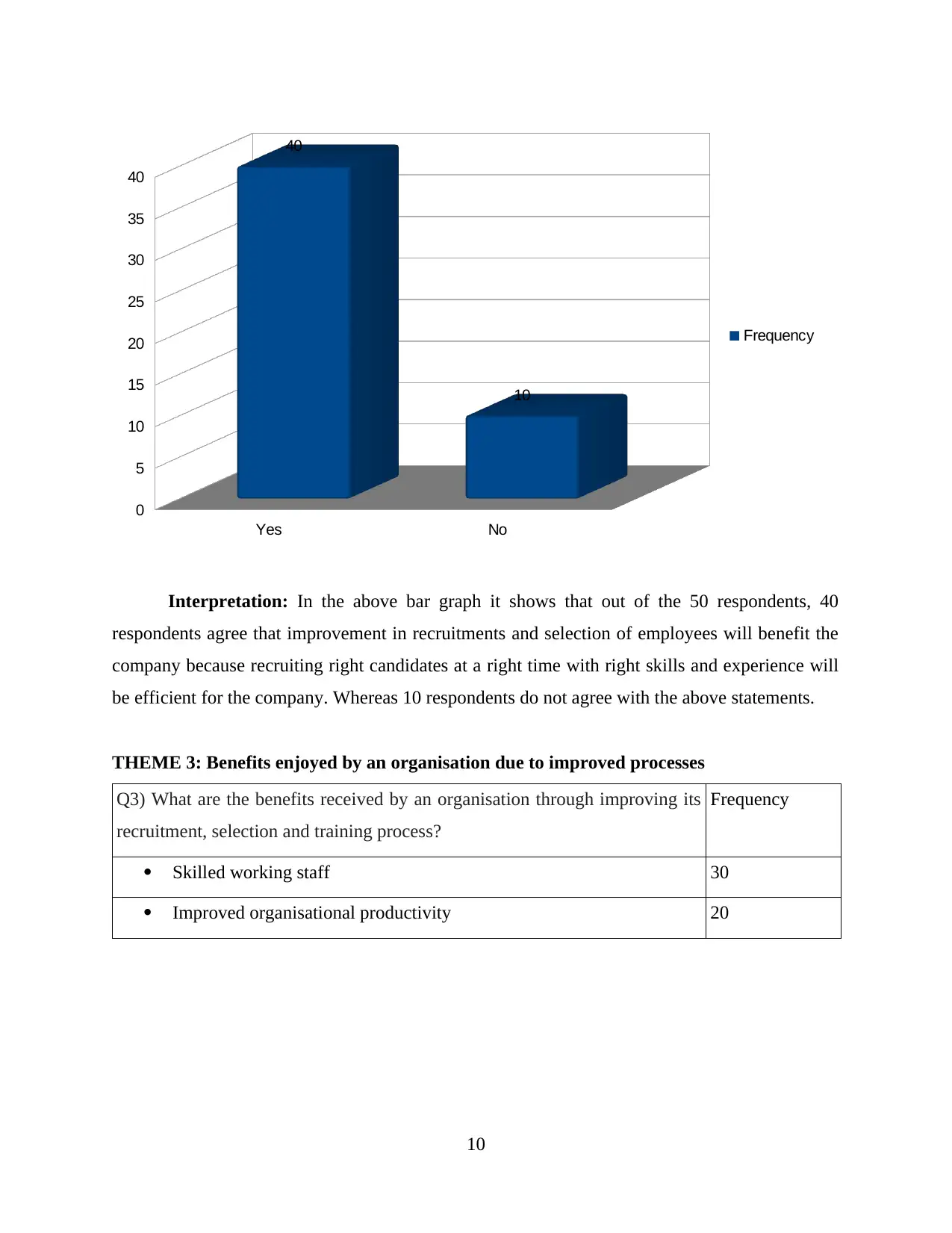
Interpretation: In the above bar graph it shows that out of the 50 respondents, 40
respondents agree that improvement in recruitments and selection of employees will benefit the
company because recruiting right candidates at a right time with right skills and experience will
be efficient for the company. Whereas 10 respondents do not agree with the above statements.
THEME 3: Benefits enjoyed by an organisation due to improved processes
Q3) What are the benefits received by an organisation through improving its
recruitment, selection and training process?
Frequency
Skilled working staff 30
Improved organisational productivity 20
10
Yes No
0
5
10
15
20
25
30
35
40
40
10
Frequency
respondents agree that improvement in recruitments and selection of employees will benefit the
company because recruiting right candidates at a right time with right skills and experience will
be efficient for the company. Whereas 10 respondents do not agree with the above statements.
THEME 3: Benefits enjoyed by an organisation due to improved processes
Q3) What are the benefits received by an organisation through improving its
recruitment, selection and training process?
Frequency
Skilled working staff 30
Improved organisational productivity 20
10
Yes No
0
5
10
15
20
25
30
35
40
40
10
Frequency
⊘ This is a preview!⊘
Do you want full access?
Subscribe today to unlock all pages.
Trusted by 1+ million students worldwide

1 out of 24


Related Documents


Your All-in-One AI-Powered Toolkit for Academic Success.
+13062052269
info@desklib.com
Available 24*7 on WhatsApp / Email
![[object Object]](/_next/static/media/star-bottom.7253800d.svg)
Unlock your academic potential
Copyright © 2020–2026 A2Z Services. All Rights Reserved. Developed and managed by ZUCOL.