Networking Security and Risk Management Analysis for City Group Bank
VerifiedAdded on 2021/06/17
|10
|3587
|29
Report
AI Summary
This report provides a comprehensive analysis of network security and risk management for City Group Bank, a financial institution with multiple branches and a large customer base. It identifies various threats faced by the bank, including mobile banking risks, malware attacks, DOS attacks, phishing, ACH fraud, and skimming, and explores their potential impact on daily operations. The report delves into the networking devices used by the bank, such as routers, switches, firewalls, and WAPs, and discusses their functionalities and vulnerabilities. It also highlights the importance of ensuring a reliable web service through employee education, strong password policies, and secure administrative hosts. Furthermore, the report examines the use of Microsoft Exchange Server for email communication, emphasizing its advantages in terms of security, confidentiality, and integrity, while also addressing common issues like website slowness and login problems. The analysis concludes by discussing the importance of data encryption and other security measures to protect the bank's network from malicious attacks and data breaches.
Running Head: NETWORKING SECURITY
NETWORKING SECURITY
Insert Your Name Here
Insert Your Tutor’s Name Here
Institution Affiliation
Date
NETWORKING SECURITY
Insert Your Name Here
Insert Your Tutor’s Name Here
Institution Affiliation
Date

Paraphrase This Document
Need a fresh take? Get an instant paraphrase of this document with our AI Paraphraser
NETWORKING SECURITY
IS SECURITY AND RISK MANAGEMENT
Introduction
The City Group Bank is one of the busiest banks. The bank was established in the in 2003 and have a
total of 300 employees who are distributed in different branches of the bank. City Group Bank has 15
branches that are distributed in various parts in Australia. The employees include accountants, internal
auditors, financial managers, tellers, loan officers, bookkeepers, clerks, customer service
representatives, deposit-operations specialists, Information and Technology managers, banking sector
president, associate examiners, risk analysts, relationship officers, document delivery drivers, credit
analysts, branch managers, HR manager, receptionist and other employees. Every employee has a task
to accomplish, for the success of the business. The bank has many over 5 million clients. The clients
can acquire the services from any branch. Therefore, the bank has to ensure that the banking system is
up-to-date in every branch. This enhances convenience to all the City Group Bank customers.
Common malwares and threats against the organization systems
With the banking system there is a number of threats that could affect the daily operations in the bank.
The threats include mobile banking risks, social network risks, malware attacks, botnets, DOS attacks,
phishing, ACH Fraud, cloud computing risks, inside attacks, first-party fraud and skimming.
Mobile banking is the latest technology in banking industry, but it is more to the most risks
("Vulnerabilities in network systems", 2018). Mobile banking is on the rise in City Group Bank.
Mobile banking is challenging for the banks, as controls to ensure the bank transactions are protected
do not apply in mobile applications as they do on desktop applications (Beckett, 2015). The main
feature is the storage of user details on the hidden files on the smart phones. Mobile malware such as
Mitmo and Zeus have been identified.
The social networks such as Twitter and Facebook have enabled people to create fake site. People tend
to use such account and end up fooling customers and having some customer share the user bank
details. There is a high risk of internal data leakage via the social media platforms. To mitigate the
problems then City Group Bank has to spell out networking policies to all the employees. The must be
conditions of using the social networks in the course of their jobs. The employees should share the
appropriate information on the social networks (Trydіd, Orekhova, Zelenska & Fialkovska, 2015).
There are various malwares that get to the banking systems. Denial-of-Service is mainly known as
DOS is the most common attack. The DOS is waged by the hacktivist groups such as Izz ad-Din al
Qassam Cyber Fighters. Bank institutions have made improvements of finding ways to mitigate the
IS SECURITY AND RISK MANAGEMENT
Introduction
The City Group Bank is one of the busiest banks. The bank was established in the in 2003 and have a
total of 300 employees who are distributed in different branches of the bank. City Group Bank has 15
branches that are distributed in various parts in Australia. The employees include accountants, internal
auditors, financial managers, tellers, loan officers, bookkeepers, clerks, customer service
representatives, deposit-operations specialists, Information and Technology managers, banking sector
president, associate examiners, risk analysts, relationship officers, document delivery drivers, credit
analysts, branch managers, HR manager, receptionist and other employees. Every employee has a task
to accomplish, for the success of the business. The bank has many over 5 million clients. The clients
can acquire the services from any branch. Therefore, the bank has to ensure that the banking system is
up-to-date in every branch. This enhances convenience to all the City Group Bank customers.
Common malwares and threats against the organization systems
With the banking system there is a number of threats that could affect the daily operations in the bank.
The threats include mobile banking risks, social network risks, malware attacks, botnets, DOS attacks,
phishing, ACH Fraud, cloud computing risks, inside attacks, first-party fraud and skimming.
Mobile banking is the latest technology in banking industry, but it is more to the most risks
("Vulnerabilities in network systems", 2018). Mobile banking is on the rise in City Group Bank.
Mobile banking is challenging for the banks, as controls to ensure the bank transactions are protected
do not apply in mobile applications as they do on desktop applications (Beckett, 2015). The main
feature is the storage of user details on the hidden files on the smart phones. Mobile malware such as
Mitmo and Zeus have been identified.
The social networks such as Twitter and Facebook have enabled people to create fake site. People tend
to use such account and end up fooling customers and having some customer share the user bank
details. There is a high risk of internal data leakage via the social media platforms. To mitigate the
problems then City Group Bank has to spell out networking policies to all the employees. The must be
conditions of using the social networks in the course of their jobs. The employees should share the
appropriate information on the social networks (Trydіd, Orekhova, Zelenska & Fialkovska, 2015).
There are various malwares that get to the banking systems. Denial-of-Service is mainly known as
DOS is the most common attack. The DOS is waged by the hacktivist groups such as Izz ad-Din al
Qassam Cyber Fighters. Bank institutions have made improvements of finding ways to mitigate the
NETWORKING SECURITY
effect of DOS attacks into the bank systems. Most banks have insufficient technical tools to fight DOS
attacks. DOS is one of the major threats in City Group Bank.
Phishing is another issue that has affected the banks. Phishing rate is increasing in the banks. The
Fraudsters tend to design very polished messages that may they send to the customers and the bank
employees. The messages appear to be genuine from the Bank but in reality, the fraudsters tend to use
the message to get confidential messages from the customers. There are various types of phishing. They
include: deceptive phishing, spear phishing, CEO fraud, pharming and drop box phishing. The banks
can try to curb most phishing attacks but not all. The phishing is evolving to adopt new techniques. The
banks can conduct security awareness to reduce phishing.
Another threat the bank is facing is ACH. This is also referred to as corporate account takeovers. The
customers tend to be guilty of the fraud incidents and the losses. This involves the bank attacks with
criminals trying to steal money from the bank. The bank is required to deploy lines of defense such as
desktop hardening, anti-Trojan services and out-of-band authentication.
Skimming is also another threat to the bank industry. The ATM skimming and skimming at the point-
of-sale systems are the common types of skimming. The blitz or flash attacks show that there is more
sophistication among the counterfeit-card operations. Blitz or flash attacks involves simultaneous
withdrawal of funds from multiple ATMs in different areas, and could be scattered all over the world.
Finally, first-party fraud poses security challenges in the bank. The crime involves a customer who
applies for credit and does not intend to repay it later. These applicants use synthetic identification or
give false information about their real identity. This act tends to bring losses in the banks, since there
are many applicants of such character.
Networking Devices
The branches in City Group are connected to a similar system via the Network. The servers are
centralized. All the branches have shared resources. All the devices in City Group bank are connected
to each other via a network. The network is very useful but, has some faults too. The network is prone
to attack. The networking devise that are used in the bank to make a successful connection with all
computer are many and can be vandalized. The networking devices include: routers, gateways, Ethernet
cables, modems, transceivers, firewalls, ISDN adapters, bridges, hubs, switches, CSU/DSU, network
interface cards (NICs), bridges and wireless access points (WAPs). The highlighted devices have roles
to play in the networking system.
The hub has more ports to enable the connection of more computers to the internet. One port is
connected to the data and the other port feed the computers with data. The hub allows less bandwidth.
The switch offers the same functionality as the hub exception for the bandwidth. The switches have a
effect of DOS attacks into the bank systems. Most banks have insufficient technical tools to fight DOS
attacks. DOS is one of the major threats in City Group Bank.
Phishing is another issue that has affected the banks. Phishing rate is increasing in the banks. The
Fraudsters tend to design very polished messages that may they send to the customers and the bank
employees. The messages appear to be genuine from the Bank but in reality, the fraudsters tend to use
the message to get confidential messages from the customers. There are various types of phishing. They
include: deceptive phishing, spear phishing, CEO fraud, pharming and drop box phishing. The banks
can try to curb most phishing attacks but not all. The phishing is evolving to adopt new techniques. The
banks can conduct security awareness to reduce phishing.
Another threat the bank is facing is ACH. This is also referred to as corporate account takeovers. The
customers tend to be guilty of the fraud incidents and the losses. This involves the bank attacks with
criminals trying to steal money from the bank. The bank is required to deploy lines of defense such as
desktop hardening, anti-Trojan services and out-of-band authentication.
Skimming is also another threat to the bank industry. The ATM skimming and skimming at the point-
of-sale systems are the common types of skimming. The blitz or flash attacks show that there is more
sophistication among the counterfeit-card operations. Blitz or flash attacks involves simultaneous
withdrawal of funds from multiple ATMs in different areas, and could be scattered all over the world.
Finally, first-party fraud poses security challenges in the bank. The crime involves a customer who
applies for credit and does not intend to repay it later. These applicants use synthetic identification or
give false information about their real identity. This act tends to bring losses in the banks, since there
are many applicants of such character.
Networking Devices
The branches in City Group are connected to a similar system via the Network. The servers are
centralized. All the branches have shared resources. All the devices in City Group bank are connected
to each other via a network. The network is very useful but, has some faults too. The network is prone
to attack. The networking devise that are used in the bank to make a successful connection with all
computer are many and can be vandalized. The networking devices include: routers, gateways, Ethernet
cables, modems, transceivers, firewalls, ISDN adapters, bridges, hubs, switches, CSU/DSU, network
interface cards (NICs), bridges and wireless access points (WAPs). The highlighted devices have roles
to play in the networking system.
The hub has more ports to enable the connection of more computers to the internet. One port is
connected to the data and the other port feed the computers with data. The hub allows less bandwidth.
The switch offers the same functionality as the hub exception for the bandwidth. The switches have a
⊘ This is a preview!⊘
Do you want full access?
Subscribe today to unlock all pages.

Trusted by 1+ million students worldwide
NETWORKING SECURITY
higher bandwidth there are used in connection to servers. The Ethernet cable (CAT6) are used in the
connection of the networking devices. The Bridges is used to connect networks. The network can be
divided into subnet to reduce traffic. The bridge is used in the reconnection of the subnets. The routers
are used to connect to the internet service providers, often referred to as ISP. The routers determine the
path of the data in the network. There are two types of routers, dedicated router and server-based
routers (IEEE Standard Environmental and Testing Requirements for Communications Networking
Devices Installed in Electric Power Substations - Redline, 2011). The dedicated routers performs with
the hardware devices while, the server-based routers are dedicated to the server system. The gateway is
another useful device in networking. The gateway is used to translate data from one format to another.
The gateway does change the data format but does not change the data. The Channel Service Unit
(CSU) and the Data Service Unit (DSU) are used in he translation of data between the LAN data format
and the WAN data format. Some employees in the branches use Wi-Fi and others use Ethernet cable to
connect to the internet. The modem is used to convert the analog signal into digital signals so that the
data signal can be transmitted via the data cables. The Network Interface Cards (NIC) are used to
connect computers to the network. The wireless Access Points (WAP) are used in the transmitting and
receiving LAN and WAN radio signals. The WAP provide a connection between the WAN and LAN.
The transceivers are used to integrate the network devices such as the Network Interface Cards. Finally,
the firewall is used in controlling access into the banks network. To access the banks network there has
to be authentication required.
The network devices discussed above are subject to destruction and abuse. Some of the problems that
the company faces with the networking devices include: poor quality devices, errors from the devices,
mishandling of the devices. The vulnerability include password sharing, lack of password protection
and employees who set weak password and do not change the password often ("Vulnerabilities in
network systems", 2018). The hackers take advantage of weak passwords and can hack into the bank’s
network. Also, the employees have more jobs to perform than necessary. They might end up messing
up with the system data. Another vulnerability is that the work are not set to lock during the inactive
period or if a user tried to enter the wrong password many time. Most unauthenticated users try to enter
a password a number of times till the system accepts the password (Probst, 2010). The system should
be set to lock after a number of attempts to enter the wrong password.
Another vulnerability is lack of application security. If the banking system lack security then it is
subject to attack. Some application security issues include cross-site scripting, application
misconfiguration, lack of access control, lack of authentication and code injection. With these
higher bandwidth there are used in connection to servers. The Ethernet cable (CAT6) are used in the
connection of the networking devices. The Bridges is used to connect networks. The network can be
divided into subnet to reduce traffic. The bridge is used in the reconnection of the subnets. The routers
are used to connect to the internet service providers, often referred to as ISP. The routers determine the
path of the data in the network. There are two types of routers, dedicated router and server-based
routers (IEEE Standard Environmental and Testing Requirements for Communications Networking
Devices Installed in Electric Power Substations - Redline, 2011). The dedicated routers performs with
the hardware devices while, the server-based routers are dedicated to the server system. The gateway is
another useful device in networking. The gateway is used to translate data from one format to another.
The gateway does change the data format but does not change the data. The Channel Service Unit
(CSU) and the Data Service Unit (DSU) are used in he translation of data between the LAN data format
and the WAN data format. Some employees in the branches use Wi-Fi and others use Ethernet cable to
connect to the internet. The modem is used to convert the analog signal into digital signals so that the
data signal can be transmitted via the data cables. The Network Interface Cards (NIC) are used to
connect computers to the network. The wireless Access Points (WAP) are used in the transmitting and
receiving LAN and WAN radio signals. The WAP provide a connection between the WAN and LAN.
The transceivers are used to integrate the network devices such as the Network Interface Cards. Finally,
the firewall is used in controlling access into the banks network. To access the banks network there has
to be authentication required.
The network devices discussed above are subject to destruction and abuse. Some of the problems that
the company faces with the networking devices include: poor quality devices, errors from the devices,
mishandling of the devices. The vulnerability include password sharing, lack of password protection
and employees who set weak password and do not change the password often ("Vulnerabilities in
network systems", 2018). The hackers take advantage of weak passwords and can hack into the bank’s
network. Also, the employees have more jobs to perform than necessary. They might end up messing
up with the system data. Another vulnerability is that the work are not set to lock during the inactive
period or if a user tried to enter the wrong password many time. Most unauthenticated users try to enter
a password a number of times till the system accepts the password (Probst, 2010). The system should
be set to lock after a number of attempts to enter the wrong password.
Another vulnerability is lack of application security. If the banking system lack security then it is
subject to attack. Some application security issues include cross-site scripting, application
misconfiguration, lack of access control, lack of authentication and code injection. With these
Paraphrase This Document
Need a fresh take? Get an instant paraphrase of this document with our AI Paraphraser
NETWORKING SECURITY
vulnerabilities criminals such as hackers gain access to the network and may do hazardous activities in
the network (Abrahamsson & Oza, 2010).
Network hackers are always try all was to hack companies’ network especially the finance institutions.
Most of these hacker perform the hacking activity during the night hours, to reduce the chances of
awareness of the hacking process by the organization. The areas that are target by the hackers are many.
First a hacker could use social engineering to gain confidential information from the company and
pretend to be an employee in City Bank. The mail servers are also used by the hackers to gain access to
the network. The hackers also find the vulnerabilities in the firewalls that are not updated or configured
properly. The firewall should be configured properly. The hackers also try to filter the routers using
SNMP scanners. If the routers are filtered successfully, then they are turned into bridges and allow
unauthorized users to the network. Finally, the hackers can intercept data being transmitted to the mail
servers. To prevent this the data being transmitted should be encrypted ("Security Risk Management",
2011).
Ensuring a reliable web service
City Group can ensure reliability of the web service by educating the employees on ways of using the
system. The employees should be aware of the importance of using strong password while logging in.
The employees and customers should also be discourage from share the confidential information such
as password and PINs (Michael, 2012). As the bank uses Windows Server 2012, the secure
administrative host are already configured for security purposes. The server offers a chance for the
users to reset the password for the administrative users. The administrative host are desiccated to the
administrative functions only ("Implementing Secure Administrative Hosts", 2018). The emails,
websites do not run on these server for security purposes. Microsoft offers security tools to integrate
into the system. The tools provide configuration baseline security settings. Specific configuration
depend on the architecture of the administrative settings. The security is enhances as the passwords are
not cached by the system (Kowalski, Dymora & Mazurek, 2016).
Confidentiality and Integrity in the system
City Group Bank uses Microsoft Exchange server to provide mails to the staff. There are many
advantages of using Microsoft Exchanger. First, Microsoft Exchanger as future to enhance security.
The mails are confidential and not accessible to unauthorized users. Microsoft Exchanger allows the
employees to use the system to its full potential without worrying of insecurity. Microsoft exchange
offers a monitoring feature that allows the users to detect any issues that may arise in the system
("What Are the Benefits of Using Microsoft Exchange Server?” 2018). The Microsoft Exchange Server
vulnerabilities criminals such as hackers gain access to the network and may do hazardous activities in
the network (Abrahamsson & Oza, 2010).
Network hackers are always try all was to hack companies’ network especially the finance institutions.
Most of these hacker perform the hacking activity during the night hours, to reduce the chances of
awareness of the hacking process by the organization. The areas that are target by the hackers are many.
First a hacker could use social engineering to gain confidential information from the company and
pretend to be an employee in City Bank. The mail servers are also used by the hackers to gain access to
the network. The hackers also find the vulnerabilities in the firewalls that are not updated or configured
properly. The firewall should be configured properly. The hackers also try to filter the routers using
SNMP scanners. If the routers are filtered successfully, then they are turned into bridges and allow
unauthorized users to the network. Finally, the hackers can intercept data being transmitted to the mail
servers. To prevent this the data being transmitted should be encrypted ("Security Risk Management",
2011).
Ensuring a reliable web service
City Group can ensure reliability of the web service by educating the employees on ways of using the
system. The employees should be aware of the importance of using strong password while logging in.
The employees and customers should also be discourage from share the confidential information such
as password and PINs (Michael, 2012). As the bank uses Windows Server 2012, the secure
administrative host are already configured for security purposes. The server offers a chance for the
users to reset the password for the administrative users. The administrative host are desiccated to the
administrative functions only ("Implementing Secure Administrative Hosts", 2018). The emails,
websites do not run on these server for security purposes. Microsoft offers security tools to integrate
into the system. The tools provide configuration baseline security settings. Specific configuration
depend on the architecture of the administrative settings. The security is enhances as the passwords are
not cached by the system (Kowalski, Dymora & Mazurek, 2016).
Confidentiality and Integrity in the system
City Group Bank uses Microsoft Exchange server to provide mails to the staff. There are many
advantages of using Microsoft Exchanger. First, Microsoft Exchanger as future to enhance security.
The mails are confidential and not accessible to unauthorized users. Microsoft Exchanger allows the
employees to use the system to its full potential without worrying of insecurity. Microsoft exchange
offers a monitoring feature that allows the users to detect any issues that may arise in the system
("What Are the Benefits of Using Microsoft Exchange Server?” 2018). The Microsoft Exchange Server
NETWORKING SECURITY
has most of its activities automated, this gives time to the administrator to deal with complex issues.
The advantages of Microsoft Exchanger are so important to the businesses.
Some of the employees report that the organization website is slow. The website server needed to be
restarted for a fast processing of the website content. Other employees complaining that they can login
to the server. Some could have forgotten the passwords while for other the email address could be
blocked by the server. Some email addresses are blocked due to several attempts to try login in the
server. This is a protective measure of the server.
Threats related to web mail and web server
There are many types of malware and threats in City Group. They include: Botnets, Distributed denial-
of-service, hacking, phishing and pharming. To curb the threats the company has installed anti-virus,
installed firewall and ensure good security configuration in all computers and servers.
Approaches to improve availability of web mail and web server
The servers should encrypt the data and all soft wares in the servers should be updated (Bertino, 2012).
To improve the availability of web and mail the bank should ensure that every software is up-to-date.
The server should be automated in mail process to ensure the mail services are secure ("Three ways to
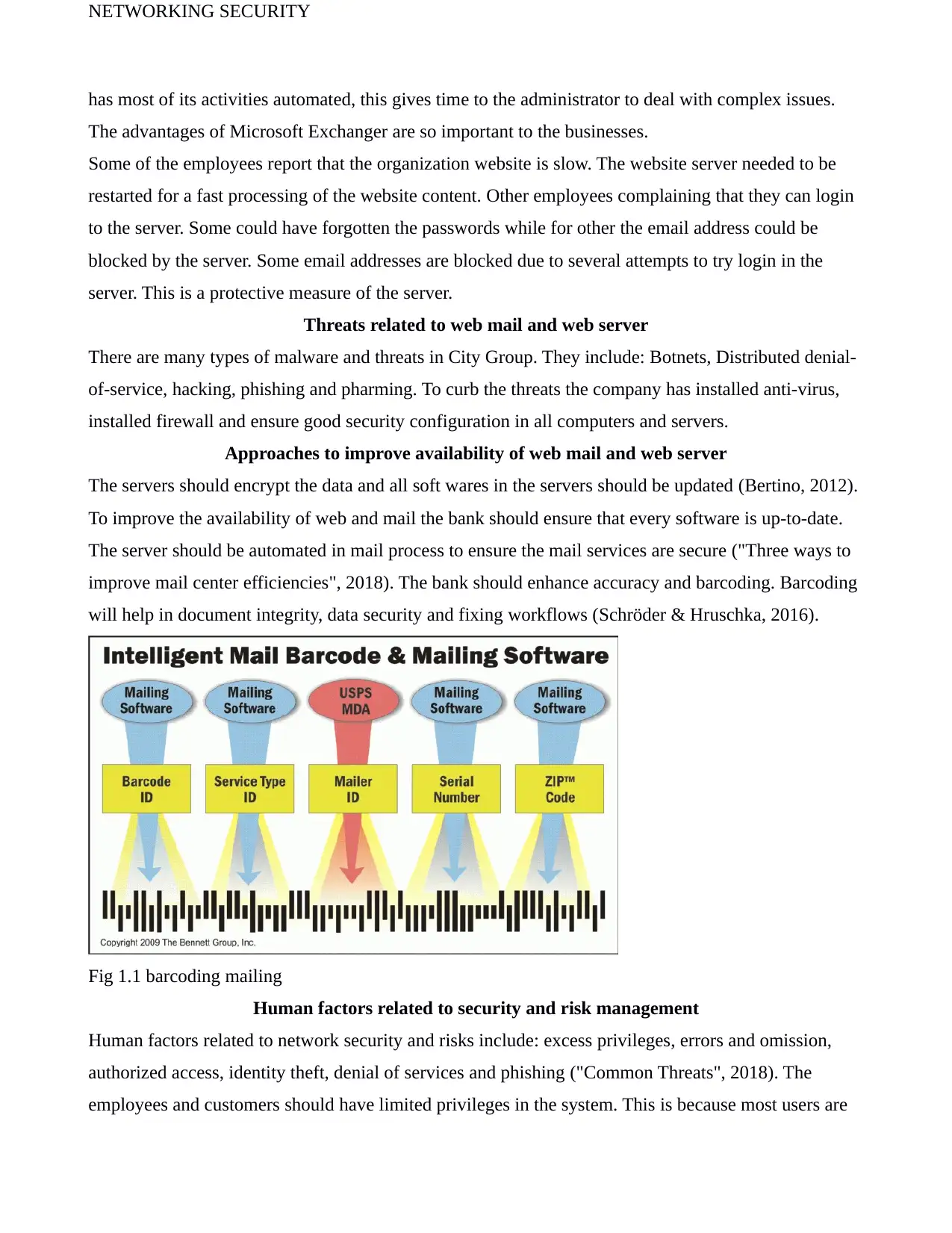
improve mail center efficiencies", 2018). The bank should enhance accuracy and barcoding. Barcoding
will help in document integrity, data security and fixing workflows (Schröder & Hruschka, 2016).
Fig 1.1 barcoding mailing
Human factors related to security and risk management
Human factors related to network security and risks include: excess privileges, errors and omission,
authorized access, identity theft, denial of services and phishing ("Common Threats", 2018). The
employees and customers should have limited privileges in the system. This is because most users are
has most of its activities automated, this gives time to the administrator to deal with complex issues.
The advantages of Microsoft Exchanger are so important to the businesses.
Some of the employees report that the organization website is slow. The website server needed to be
restarted for a fast processing of the website content. Other employees complaining that they can login
to the server. Some could have forgotten the passwords while for other the email address could be
blocked by the server. Some email addresses are blocked due to several attempts to try login in the
server. This is a protective measure of the server.
Threats related to web mail and web server
There are many types of malware and threats in City Group. They include: Botnets, Distributed denial-
of-service, hacking, phishing and pharming. To curb the threats the company has installed anti-virus,
installed firewall and ensure good security configuration in all computers and servers.
Approaches to improve availability of web mail and web server
The servers should encrypt the data and all soft wares in the servers should be updated (Bertino, 2012).
To improve the availability of web and mail the bank should ensure that every software is up-to-date.
The server should be automated in mail process to ensure the mail services are secure ("Three ways to
improve mail center efficiencies", 2018). The bank should enhance accuracy and barcoding. Barcoding
will help in document integrity, data security and fixing workflows (Schröder & Hruschka, 2016).
Fig 1.1 barcoding mailing
Human factors related to security and risk management
Human factors related to network security and risks include: excess privileges, errors and omission,
authorized access, identity theft, denial of services and phishing ("Common Threats", 2018). The
employees and customers should have limited privileges in the system. This is because most users are
⊘ This is a preview!⊘
Do you want full access?
Subscribe today to unlock all pages.
Trusted by 1+ million students worldwide
NETWORKING SECURITY
technology ignorant. The users of the systems should be educated on how to use the system. The
system should detect the errors entered by human.
System logs
The web server has logs for every activity that is done in the system. The logs help to keep track of all
activities in the system ("Intro to Log Management", 2018). The logs help the administrator to solve
some problem. The administrator can tell the causes of some errors in the system by viewing the logs.
There is software that help to analyze the logs and give much understandable information and send
notification of the errors detected. There are various logs in the system. They include: monitoring logs,
production logs, transaction logs and error logs ("What is the System Log (Syslog)? - Definition from
Techopedia", 2018). The events in the systems are recorded in different logs. The latest logs overwrite
the previous logs. The new folders are automatically created for the older logs. The logs are helpful to
the administrators as they can tell the activities happening in the system. To perform a successful
monitoring of the logs a log-based intrusion detection tool is used. GFI Events Manager is one of the
tools a company can use. GFI Events Manager is used in implementing due diligence requirements
added by auditors or the regulatory agencies. GFI Events Manager perform intrusion detection and
reports network security by monitoring the event logs on the servers and the workstations. The GFI
Events Manager gives instant report in case of any intrusion or attack. The administration panel is then
required to solve the problems reported by the system. The GFI Events Manager is installed in the
server and workstations but, the connections are integrated to a one network monitoring system to
register all the systems being monitored.
Network security devices
There are a number of network security devices. The devices include antivirus software, firewalls,
content filtering, web cache, penetration testing device and many more. The network security devices
are categorized in four categories. The categories include: active devices, passive devices, preventive
devices and the unified threat management. The active devices include: firewalls, antivirus and the
content filtering devices. Secondly, the passive device includes intrusion detection devices. Thirdly,
penetration devices include the tools that are used to scan the network for potential problems. Finally,
the unified threat management (UTM) which, provides the general security purpose.
Conclusion
The bank system is prone to many threats. The threats can cause some problems in the banking
transactions. This may lead to loss of customers if their transactions are interfered with. Threats that
can interfere with the banking system can be solved using the approached highlighted above. The
approaches include use of antivirus, intrusion detection devices, Unified Threat Management (UTM),
technology ignorant. The users of the systems should be educated on how to use the system. The
system should detect the errors entered by human.
System logs
The web server has logs for every activity that is done in the system. The logs help to keep track of all
activities in the system ("Intro to Log Management", 2018). The logs help the administrator to solve
some problem. The administrator can tell the causes of some errors in the system by viewing the logs.
There is software that help to analyze the logs and give much understandable information and send
notification of the errors detected. There are various logs in the system. They include: monitoring logs,
production logs, transaction logs and error logs ("What is the System Log (Syslog)? - Definition from
Techopedia", 2018). The events in the systems are recorded in different logs. The latest logs overwrite
the previous logs. The new folders are automatically created for the older logs. The logs are helpful to
the administrators as they can tell the activities happening in the system. To perform a successful
monitoring of the logs a log-based intrusion detection tool is used. GFI Events Manager is one of the
tools a company can use. GFI Events Manager is used in implementing due diligence requirements
added by auditors or the regulatory agencies. GFI Events Manager perform intrusion detection and
reports network security by monitoring the event logs on the servers and the workstations. The GFI
Events Manager gives instant report in case of any intrusion or attack. The administration panel is then
required to solve the problems reported by the system. The GFI Events Manager is installed in the
server and workstations but, the connections are integrated to a one network monitoring system to
register all the systems being monitored.
Network security devices
There are a number of network security devices. The devices include antivirus software, firewalls,
content filtering, web cache, penetration testing device and many more. The network security devices
are categorized in four categories. The categories include: active devices, passive devices, preventive
devices and the unified threat management. The active devices include: firewalls, antivirus and the
content filtering devices. Secondly, the passive device includes intrusion detection devices. Thirdly,
penetration devices include the tools that are used to scan the network for potential problems. Finally,
the unified threat management (UTM) which, provides the general security purpose.
Conclusion
The bank system is prone to many threats. The threats can cause some problems in the banking
transactions. This may lead to loss of customers if their transactions are interfered with. Threats that
can interfere with the banking system can be solved using the approached highlighted above. The
approaches include use of antivirus, intrusion detection devices, Unified Threat Management (UTM),
Paraphrase This Document
Need a fresh take? Get an instant paraphrase of this document with our AI Paraphraser
NETWORKING SECURITY
firewalls and the content filtering devices. Use of the approach the system can be secure of hackers and
other unauthorized personnel.
Recommendation
From a look at the threat that can be faced with the Banking System. Much security measures need to
be taken into action. The bank system needs to secure to ensure confidentiality of the customer
information. The network security device need to be embedded in the bank system. A secure system
will bring out good services to the customers.
References
Three ways to improve mail center efficiencies. (2018). Retrieved from
https://www.pitneybowes.com/us/shipping-and-mailing/case-studies/three-ways-to-improve-mail-
center-efficiencies.html
firewalls and the content filtering devices. Use of the approach the system can be secure of hackers and
other unauthorized personnel.
Recommendation
From a look at the threat that can be faced with the Banking System. Much security measures need to
be taken into action. The bank system needs to secure to ensure confidentiality of the customer
information. The network security device need to be embedded in the bank system. A secure system
will bring out good services to the customers.
References
Three ways to improve mail center efficiencies. (2018). Retrieved from
https://www.pitneybowes.com/us/shipping-and-mailing/case-studies/three-ways-to-improve-mail-
center-efficiencies.html
NETWORKING SECURITY
Vulnerabilities in network systems. (2018). Retrieved from
https://searchsecurity.techtarget.com/tip/Vulnerabilities-in-network-systems
What is the System Log (Syslog)? - Definition from Techopedia. (2018). Retrieved from
https://www.techopedia.com/definition/1858/system-log-syslog
Intro to Log Management. (2018). Retrieved from https://docs.logentries.com/docs/log-management/
Common Threats. (2018). Retrieved from https://www.getcybersafe.gc.ca/cnt/rsks/cmmn-thrts-en.aspx
What Are The Benefits Of Using Microsoft Exchange Server?. (2018). Retrieved from
http://www.streetdirectory.com/travel_guide/124114/microsoft/what_are_the_benefits_of_using_micro
soft_exchange_server.html
Implementing Secure Administrative Hosts. (2018). Retrieved from
https://docs.microsoft.com/en-us/windows-server/identity/ad-ds/plan/security-best-practices/
implementing-secure-administrative-hosts
Vulnerabilities in network systems. (2018). Retrieved from
https://searchsecurity.techtarget.com/tip/Vulnerabilities-in-network-systems
Security Risk Management. (2011). Network Security, 2011(10), 4. doi: 10.1016/s1353-4858(11)70103-
9
Beckett, P. (2015). The business risks of using smartphones. Network Security, 2015(11), 16-17. doi:
10.1016/s1353-4858(15)30101-x
Michael, K. (2012). Security Risk Management: Building an Information Security Risk Management
Program from the Ground Up. Computers & Security, 31(2), 249-250. doi: 10.1016/j.cose.2011.12.011
Trydіd, О., Orekhova, K., Zelenska, M., & Fialkovska, I. (2015). THE EVOLUTION OF THREATS
TO COMPANY’S FINANCIAL SECURITY. Financial And Credit Activity: Problems Of Theory And
Practice, 1(18), 88. doi: 10.18371/fcaptp.v1i18.46127
Vulnerabilities in network systems. (2018). Retrieved from
https://searchsecurity.techtarget.com/tip/Vulnerabilities-in-network-systems
What is the System Log (Syslog)? - Definition from Techopedia. (2018). Retrieved from
https://www.techopedia.com/definition/1858/system-log-syslog
Intro to Log Management. (2018). Retrieved from https://docs.logentries.com/docs/log-management/
Common Threats. (2018). Retrieved from https://www.getcybersafe.gc.ca/cnt/rsks/cmmn-thrts-en.aspx
What Are The Benefits Of Using Microsoft Exchange Server?. (2018). Retrieved from
http://www.streetdirectory.com/travel_guide/124114/microsoft/what_are_the_benefits_of_using_micro
soft_exchange_server.html
Implementing Secure Administrative Hosts. (2018). Retrieved from
https://docs.microsoft.com/en-us/windows-server/identity/ad-ds/plan/security-best-practices/
implementing-secure-administrative-hosts
Vulnerabilities in network systems. (2018). Retrieved from
https://searchsecurity.techtarget.com/tip/Vulnerabilities-in-network-systems
Security Risk Management. (2011). Network Security, 2011(10), 4. doi: 10.1016/s1353-4858(11)70103-
9
Beckett, P. (2015). The business risks of using smartphones. Network Security, 2015(11), 16-17. doi:
10.1016/s1353-4858(15)30101-x
Michael, K. (2012). Security Risk Management: Building an Information Security Risk Management
Program from the Ground Up. Computers & Security, 31(2), 249-250. doi: 10.1016/j.cose.2011.12.011
Trydіd, О., Orekhova, K., Zelenska, M., & Fialkovska, I. (2015). THE EVOLUTION OF THREATS
TO COMPANY’S FINANCIAL SECURITY. Financial And Credit Activity: Problems Of Theory And
Practice, 1(18), 88. doi: 10.18371/fcaptp.v1i18.46127
⊘ This is a preview!⊘
Do you want full access?
Subscribe today to unlock all pages.
Trusted by 1+ million students worldwide
NETWORKING SECURITY
Bertino, E. (2012). Data protection from insider threats. San Rafael, Calif. (1537 Fourth Street, San
Rafael, CA 94901 USA): Morgan & Claypool.
Probst, C. (2010). Insider threats in cyber security. New York: Springer.
Kowalski, D., Dymora, P., & Mazurek, M. (2016). Failover clustering in Microsoft Windows Server
2012. Scientific Journals Of Rzeszów University Of Technology, Series: Electrotechnics, 57-65. doi:
10.7862/re.2016.10
[publisher not identified]. (2011). IEEE Standard Environmental and Testing Requirements for
Communications Networking Devices Installed in Electric Power Substations - Redline. [Place of
publication not identified].
Abrahamsson, P., & Oza, N. (2010). Lean enterprise software and systems. Berlin: Springer.
Schröder, N., & Hruschka, H. (2016). Investigating the effects of mailing variables and endogeneity on
mailing decisions. European Journal Of Operational Research, 250(2), 579-589. doi:
10.1016/j.ejor.2015.09.046
Bertino, E. (2012). Data protection from insider threats. San Rafael, Calif. (1537 Fourth Street, San
Rafael, CA 94901 USA): Morgan & Claypool.
Probst, C. (2010). Insider threats in cyber security. New York: Springer.
Kowalski, D., Dymora, P., & Mazurek, M. (2016). Failover clustering in Microsoft Windows Server
2012. Scientific Journals Of Rzeszów University Of Technology, Series: Electrotechnics, 57-65. doi:
10.7862/re.2016.10
[publisher not identified]. (2011). IEEE Standard Environmental and Testing Requirements for
Communications Networking Devices Installed in Electric Power Substations - Redline. [Place of
publication not identified].
Abrahamsson, P., & Oza, N. (2010). Lean enterprise software and systems. Berlin: Springer.
Schröder, N., & Hruschka, H. (2016). Investigating the effects of mailing variables and endogeneity on
mailing decisions. European Journal Of Operational Research, 250(2), 579-589. doi:
10.1016/j.ejor.2015.09.046

1 out of 10


Related Documents


Your All-in-One AI-Powered Toolkit for Academic Success.
+13062052269
info@desklib.com
Available 24*7 on WhatsApp / Email
![[object Object]](/_next/static/media/star-bottom.7253800d.svg)
Unlock your academic potential
Copyright © 2020–2026 A2Z Services. All Rights Reserved. Developed and managed by ZUCOL.