Networking 1 Assignment: OSI Model, TCP/IP, and Layer Functions

Verified

Added on  2022/08/30

|6
|1133
|23
Homework Assignment
AI Summary
This assignment solution delves into the core concepts of networking, focusing on the OSI and TCP/IP models. It meticulously outlines the seven layers of the OSI model and the four layers of the TCP/IP model, clarifying their respective functions. The solution explains how the layers of the OSI model correlate to those of the TCP/IP model, highlighting the network and user support layers within the TCP/IP suite. Data encapsulation is defined within the context of these models. The responsibilities of the Data Link, Network, and Transport layers are detailed, including the differences between Network and Transport layer delivery, and the need for error detection mechanisms at the Transport layer. The solution also clarifies the distinctions between port, logical, and physical addresses. Furthermore, it lists services provided by the Application layer and discusses the advantages of combining the Session, Presentation, and Application layers of the OSI model into a single layer, offering insights into the benefits such as increased reliability and reduced complexity. The provided references support all the key concepts discussed in the assignment.

Document Page
Networking
tabler-icon-diamond-filled.svg

Paraphrase This Document

Need a fresh take? Get an instant paraphrase of this document with our AI Paraphraser
Document Page
NETWORKING 1
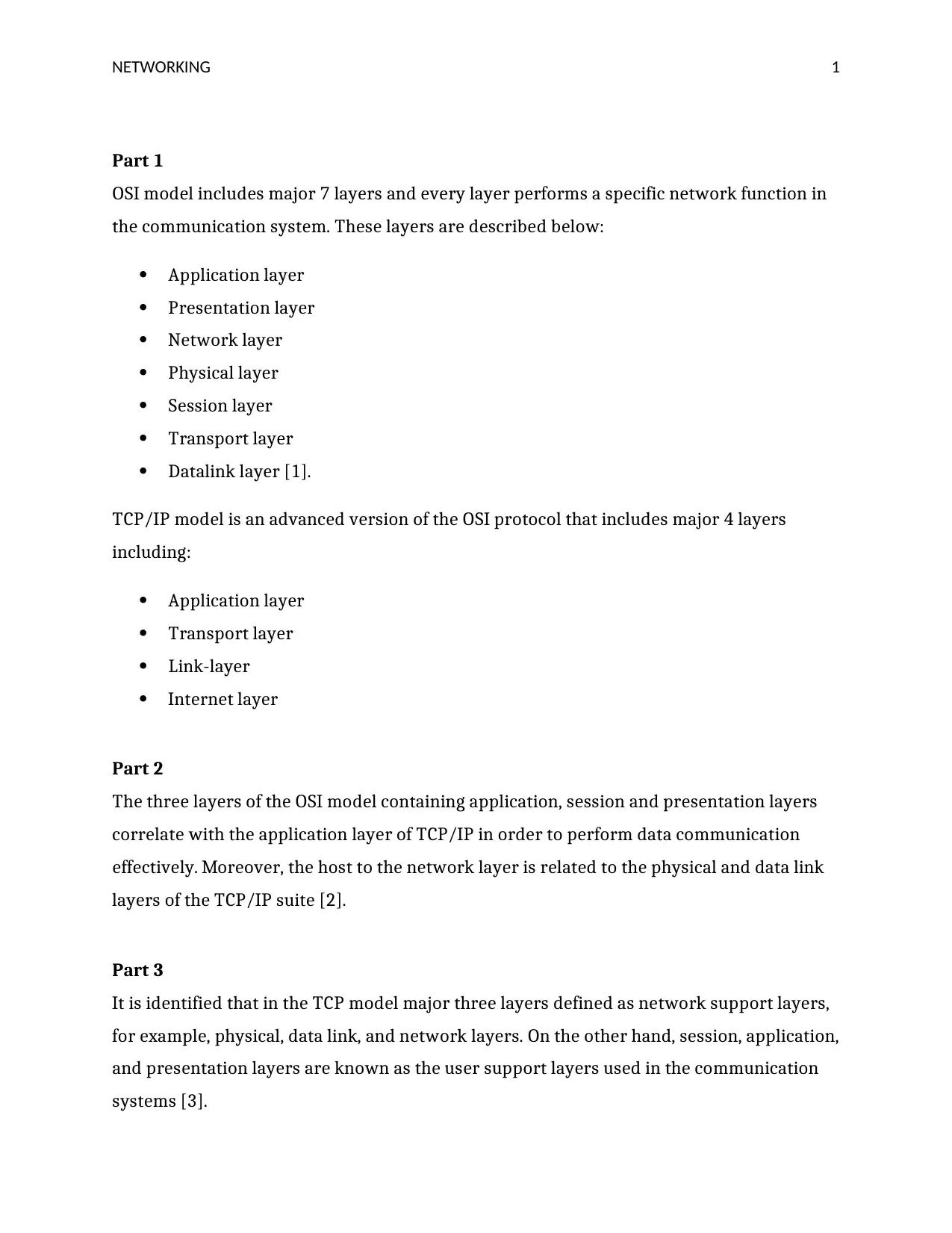
Part 1
OSI model includes major 7 layers and every layer performs a specific network function in
the communication system. These layers are described below:
Application layer
Presentation layer
Network layer
Physical layer
Session layer
Transport layer
Datalink layer [1].
TCP/IP model is an advanced version of the OSI protocol that includes major 4 layers
including:
Application layer
Transport layer
Link-layer
Internet layer
Part 2
The three layers of the OSI model containing application, session and presentation layers
correlate with the application layer of TCP/IP in order to perform data communication
effectively. Moreover, the host to the network layer is related to the physical and data link
layers of the TCP/IP suite [2].
Part 3
It is identified that in the TCP model major three layers defined as network support layers,
for example, physical, data link, and network layers. On the other hand, session, application,
and presentation layers are known as the user support layers used in the communication
systems [3].
Document Page
NETWORKING 2
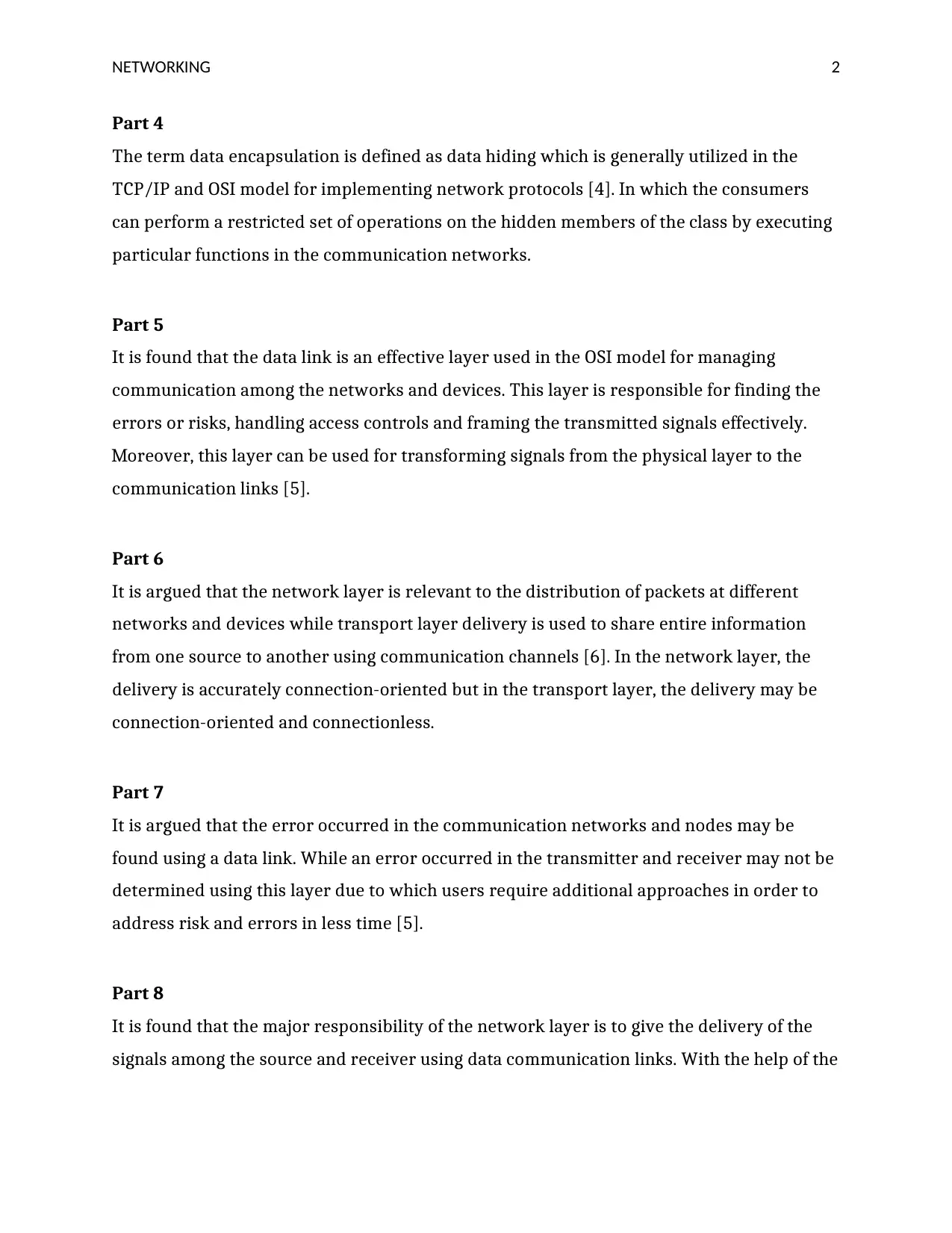
Part 4
The term data encapsulation is defined as data hiding which is generally utilized in the
TCP/IP and OSI model for implementing network protocols [4]. In which the consumers
can perform a restricted set of operations on the hidden members of the class by executing
particular functions in the communication networks.
Part 5
It is found that the data link is an effective layer used in the OSI model for managing
communication among the networks and devices. This layer is responsible for finding the
errors or risks, handling access controls and framing the transmitted signals effectively.
Moreover, this layer can be used for transforming signals from the physical layer to the
communication links [5].
Part 6
It is argued that the network layer is relevant to the distribution of packets at different
networks and devices while transport layer delivery is used to share entire information
from one source to another using communication channels [6]. In the network layer, the
delivery is accurately connection-oriented but in the transport layer, the delivery may be
connection-oriented and connectionless.
Part 7
It is argued that the error occurred in the communication networks and nodes may be
found using a data link. While an error occurred in the transmitter and receiver may not be
determined using this layer due to which users require additional approaches in order to
address risk and errors in less time [5].
Part 8
It is found that the major responsibility of the network layer is to give the delivery of the
signals among the source and receiver using data communication links. With the help of the
Document Page
NETWORKING 3
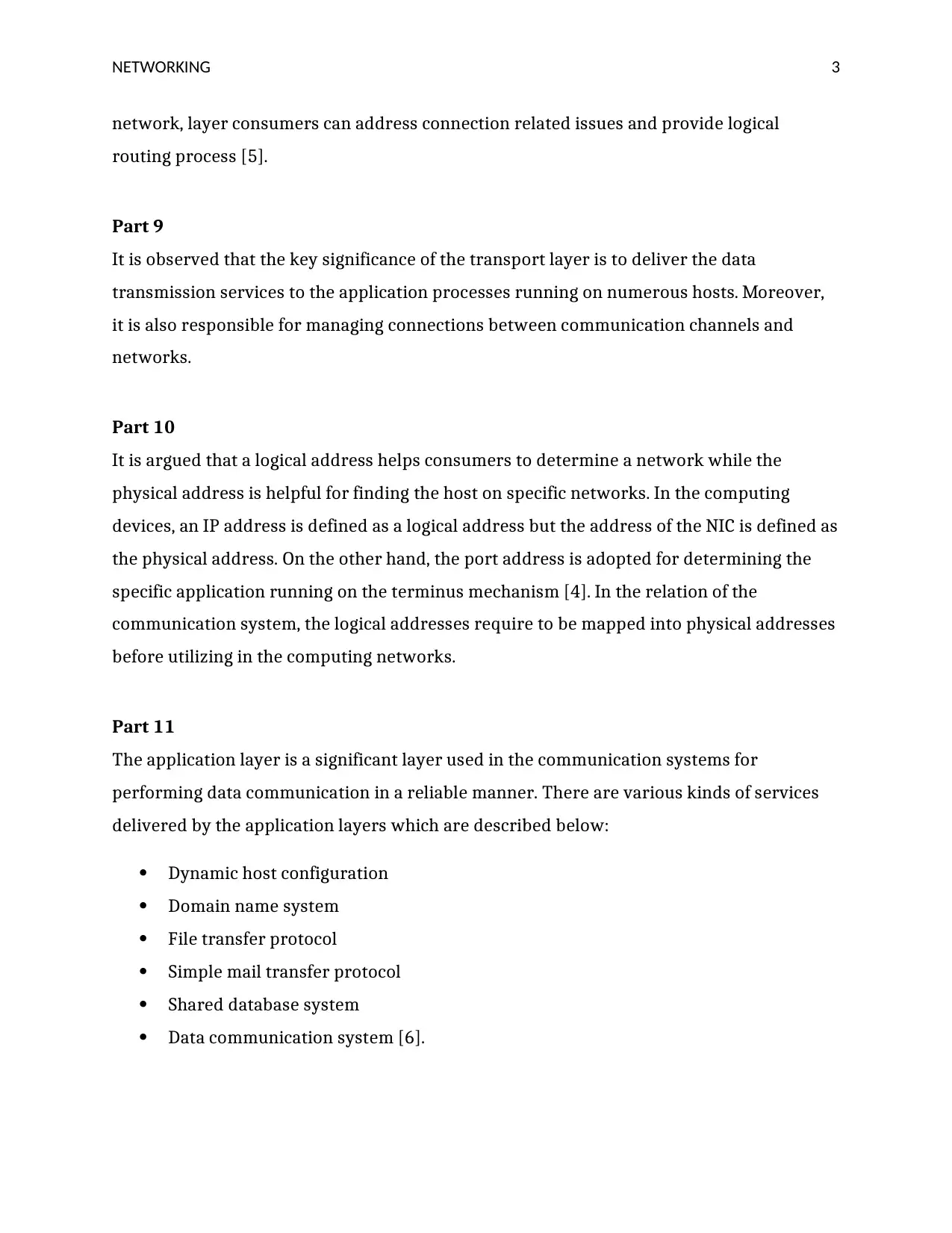
network, layer consumers can address connection related issues and provide logical
routing process [5].
Part 9
It is observed that the key significance of the transport layer is to deliver the data
transmission services to the application processes running on numerous hosts. Moreover,
it is also responsible for managing connections between communication channels and
networks.
Part 10
It is argued that a logical address helps consumers to determine a network while the
physical address is helpful for finding the host on specific networks. In the computing
devices, an IP address is defined as a logical address but the address of the NIC is defined as
the physical address. On the other hand, the port address is adopted for determining the
specific application running on the terminus mechanism [4]. In the relation of the
communication system, the logical addresses require to be mapped into physical addresses
before utilizing in the computing networks.
Part 11
The application layer is a significant layer used in the communication systems for
performing data communication in a reliable manner. There are various kinds of services
delivered by the application layers which are described below:
Dynamic host configuration
Domain name system
File transfer protocol
Simple mail transfer protocol
Shared database system
Data communication system [6].
tabler-icon-diamond-filled.svg

Paraphrase This Document

Need a fresh take? Get an instant paraphrase of this document with our AI Paraphraser
Document Page
NETWORKING 4
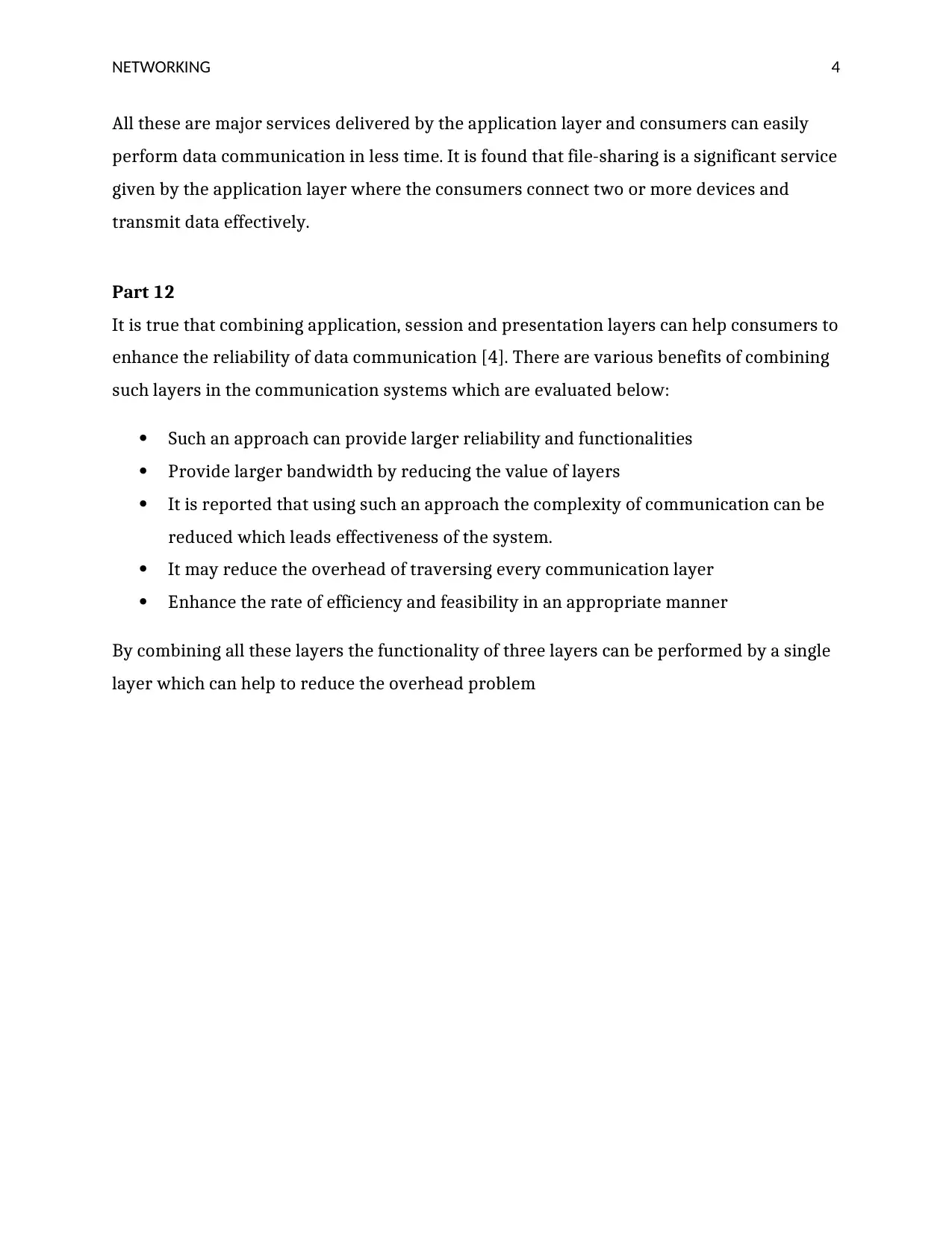
All these are major services delivered by the application layer and consumers can easily
perform data communication in less time. It is found that file-sharing is a significant service
given by the application layer where the consumers connect two or more devices and
transmit data effectively.
Part 12
It is true that combining application, session and presentation layers can help consumers to
enhance the reliability of data communication [4]. There are various benefits of combining
such layers in the communication systems which are evaluated below:
Such an approach can provide larger reliability and functionalities
Provide larger bandwidth by reducing the value of layers
It is reported that using such an approach the complexity of communication can be
reduced which leads effectiveness of the system.
It may reduce the overhead of traversing every communication layer
Enhance the rate of efficiency and feasibility in an appropriate manner
By combining all these layers the functionality of three layers can be performed by a single
layer which can help to reduce the overhead problem
Document Page
NETWORKING 5
References
1. Alotaibi, A. M., Alrashidi, B. F., Naz, S., & Parveen, Z. Security issues in Protocols of TCP/IP
Model at Layers Level. International Journal of Computer Networks and
Communications Security, 2017, 5(5), 96.
2. Howser, G. The OSI Seven Layer Model. In Computer Networks and the Internet. 2020,
12(7), 7-32.
3. Huang, J., & Cai, L. Research on TCP/IP network communication based on Node. js. In AIP
Conference Proceedings. 2018, 1955(1), 040115.
4. Rayes, A., & Salam, S. The Internet in IoT—OSI, TCP/IP, IPv4, IPv6 and Internet Routing.
In the Internet of Things From Hype to Reality. 2017, 12(6), 35-56.
5. Santos, M. G. M., & Marcillo, P. A. A. Security in the data link layer of the OSI model on
LANs wired Cisco. Journal of Science and Research: Revista Ciencia e Investigación.
ISSN 2528-8083, 3(CITT2017). 2018, 12(6), 106-112.
6. Suresh, P. Survey on the seven-layered architecture of the OSI model. International
Journal of research in computer applications and robotics. 2016, 4(8), 1.
chevron_up_icon
1 out of 6
circle_padding
hide_on_mobile
zoom_out_icon
[object Object]