Annotated Bibliography: Neuroscience's Role in Counselling Psychology
VerifiedAdded on 2023/06/09
|9
|2618
|247
Annotated Bibliography
AI Summary
This annotated bibliography examines the integration of neuroscience into counselling psychology, drawing on six articles to explore the benefits and applications of this interdisciplinary approach. The bibliography begins by highlighting how neuroscience provides counsellors with insights into brain function, mental illness, and the effectiveness of various therapies such as cognitive behavioral therapy and person-centered therapy. The articles discuss research methods, including systematic reviews, realist synthesis, and qualitative studies, used to understand the impact of neuroscience on counselling practices. The bibliography emphasizes the importance of neuroscience in understanding mental disorders, informing case conceptualization, and enhancing treatment planning. It also explores specific applications like neuro-education and the use of neuro-feedback. The conclusion emphasizes the value of neuroscience in improving client outcomes, informing teaching, and addressing mental illness by providing a deeper understanding of brain structure and function. The bibliography underscores the potential for neuroscience to enhance the effectiveness of psychotherapy and improve the overall well-being of clients and practitioners.
Annotated Bibliography the
Integration of Neuroscience and
Counselling
Integration of Neuroscience and
Counselling

Paraphrase This Document
Need a fresh take? Get an instant paraphrase of this document with our AI Paraphraser
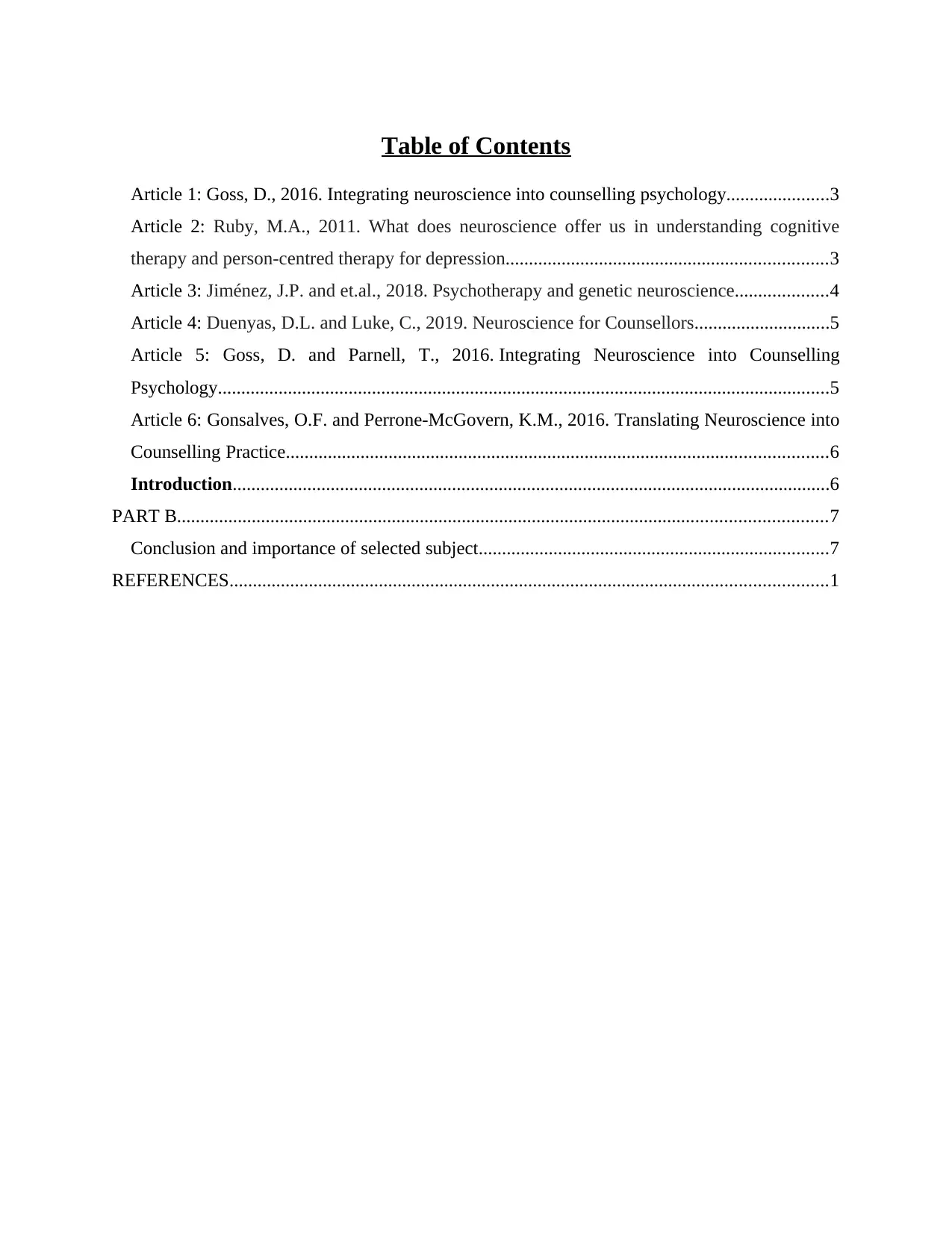
Table of Contents
Article 1: Goss, D., 2016. Integrating neuroscience into counselling psychology......................3
Article 2: Ruby, M.A., 2011. What does neuroscience offer us in understanding cognitive
therapy and person-centred therapy for depression.....................................................................3
Article 3: Jiménez, J.P. and et.al., 2018. Psychotherapy and genetic neuroscience....................4
Article 4: Duenyas, D.L. and Luke, C., 2019. Neuroscience for Counsellors.............................5
Article 5: Goss, D. and Parnell, T., 2016. Integrating Neuroscience into Counselling
Psychology...................................................................................................................................5
Article 6: Gonsalves, O.F. and Perrone-McGovern, K.M., 2016. Translating Neuroscience into
Counselling Practice....................................................................................................................6
Introduction................................................................................................................................6
PART B...........................................................................................................................................7
Conclusion and importance of selected subject...........................................................................7
REFERENCES................................................................................................................................1
Article 1: Goss, D., 2016. Integrating neuroscience into counselling psychology......................3
Article 2: Ruby, M.A., 2011. What does neuroscience offer us in understanding cognitive
therapy and person-centred therapy for depression.....................................................................3
Article 3: Jiménez, J.P. and et.al., 2018. Psychotherapy and genetic neuroscience....................4
Article 4: Duenyas, D.L. and Luke, C., 2019. Neuroscience for Counsellors.............................5
Article 5: Goss, D. and Parnell, T., 2016. Integrating Neuroscience into Counselling
Psychology...................................................................................................................................5
Article 6: Gonsalves, O.F. and Perrone-McGovern, K.M., 2016. Translating Neuroscience into
Counselling Practice....................................................................................................................6
Introduction................................................................................................................................6
PART B...........................................................................................................................................7
Conclusion and importance of selected subject...........................................................................7
REFERENCES................................................................................................................................1
Article 1: Goss, D., 2016. Integrating neuroscience into counselling psychology
Introduction:
Counselling helps out people and families in knowing about the nature of problem that they are
facing along with information that they need to consider for solving problems. This study will
show some effective ways and therapies that counsellors can use. By using neuroscience,
counsellor finds easier in understanding as why client is thinking in an abnormal manner and
accordingly can provide counselling.
Literature
Many studies have shown that by using neuroimaging technique, counsellor or psychotherapies
can know functions of person’s brain as well as subsequent well-being. A total of 21 studies or
publications have carried out and it has shown that neuroscience is helping out counsellor in
improving health of patients with some extent of mental illness and streamline personality
disorder. Cognitive behavioural therapy, psychodynamic, dialectic and interpersonal
psychotherapy affects brain functions of those who are suffering from wide range of
psychological issues.
An increased understanding of neuroscience has improved multidisciplinary team working
environment and counselling psychologists’ communication.
Research methods
Systematic review has done in this article in order to understand inclusion criteria, exclusion
criteria, search process and all about of role of neuroscience in counselling. Counselling
psychology is the main search term that has used. Content that has published in English language
and published within 25 years have selected. Thematic analysis has also been used for knowing
important information relevant to use of neuroscience and its effectiveness in counselling.
Conclusion: It has been concluded that brain network found to be dysfunctional in psychological
disorder and it were normalised after an effective psychotherapeutic intervention as per
neuroscience.
Article 2: Ruby, M.A., 2011. What does neuroscience offer us in understanding cognitive
therapy and person-centred therapy for depression
Introduction: This article is going to discuss role of neuroscience and ways by which
counsellors can understand as well as use person centred and cognitive therapy for depression.
Introduction:
Counselling helps out people and families in knowing about the nature of problem that they are
facing along with information that they need to consider for solving problems. This study will
show some effective ways and therapies that counsellors can use. By using neuroscience,
counsellor finds easier in understanding as why client is thinking in an abnormal manner and
accordingly can provide counselling.
Literature
Many studies have shown that by using neuroimaging technique, counsellor or psychotherapies
can know functions of person’s brain as well as subsequent well-being. A total of 21 studies or
publications have carried out and it has shown that neuroscience is helping out counsellor in
improving health of patients with some extent of mental illness and streamline personality
disorder. Cognitive behavioural therapy, psychodynamic, dialectic and interpersonal
psychotherapy affects brain functions of those who are suffering from wide range of
psychological issues.
An increased understanding of neuroscience has improved multidisciplinary team working
environment and counselling psychologists’ communication.
Research methods
Systematic review has done in this article in order to understand inclusion criteria, exclusion
criteria, search process and all about of role of neuroscience in counselling. Counselling
psychology is the main search term that has used. Content that has published in English language
and published within 25 years have selected. Thematic analysis has also been used for knowing
important information relevant to use of neuroscience and its effectiveness in counselling.
Conclusion: It has been concluded that brain network found to be dysfunctional in psychological
disorder and it were normalised after an effective psychotherapeutic intervention as per
neuroscience.
Article 2: Ruby, M.A., 2011. What does neuroscience offer us in understanding cognitive
therapy and person-centred therapy for depression
Introduction: This article is going to discuss role of neuroscience and ways by which
counsellors can understand as well as use person centred and cognitive therapy for depression.
⊘ This is a preview!⊘
Do you want full access?
Subscribe today to unlock all pages.

Trusted by 1+ million students worldwide
Literature: Number of definitions have used for discussing depression and mental illness for
which people require counselling. Depression is common cold of mental health. This literature
will discuss role of cognitive and psychological cognitive theories in counselling and treating a
person with mental illness. PCT and CT theories can be applied in an effective manner when
counsellor use neuroscience or understand brain’s functions.
Empathy also plays a vital role and it is the main thing that need to be focused by providing
cognitive theory after understanding brain’s functions with neuroscience.
Research methods: In this article, realist synthesis review has done in order to know importance
of neuroscience theory of depression as well as fMRI evidence of effects of person-centred
therapy concept of brain. For more understanding about neuroscience within counselling, meta
ethnography qualitative study has conducted. For more knowing about this topic, positivism and
phenomenological perspectives have used.
Conclusion: It has been concluded that for providing better counselling, counsellors need to
have detailed knowledge of CT, PCT and neuroscience. fMRI studies are important as it can help
out therapists in knowing the best therapy after comparison of therapies for depression.
Article 3: Jiménez, J.P. and et.al., 2018. Psychotherapy and genetic neuroscience
Introduction: This article will show reasons as why psychiatric genetics has led to a move away
from simple diathesis stress models to complex psychopathology models. It shows that for
applying neuroscience in counselling, counsellors need to make a link and association of
psychotherapies with epigenetic changes. It will discuss new intellectual framework for
understanding mental disorders.
Literature: In literature, psychotherapy has been discussed and in this regard, it is found that it
is an interpersonal process that is being followed by counsellors to modify attitude, behaviour
and cognition that cause problems for person.
It can be made more effective than many common medical interventions when neuroscience is
being added. With neuroscience, psychotherapists can understand brain’s functions and ways in
which client behave and accordingly can use their psychotherapies.
Research methods: For understanding pathogenesis of psychopathology, differential
susceptibility models are being used for prevention and treatment of disorder changes. This
model can help out psychotherapists in knowing as whether patient carriers prosocial or n not
which people require counselling. Depression is common cold of mental health. This literature
will discuss role of cognitive and psychological cognitive theories in counselling and treating a
person with mental illness. PCT and CT theories can be applied in an effective manner when
counsellor use neuroscience or understand brain’s functions.
Empathy also plays a vital role and it is the main thing that need to be focused by providing
cognitive theory after understanding brain’s functions with neuroscience.
Research methods: In this article, realist synthesis review has done in order to know importance
of neuroscience theory of depression as well as fMRI evidence of effects of person-centred
therapy concept of brain. For more understanding about neuroscience within counselling, meta
ethnography qualitative study has conducted. For more knowing about this topic, positivism and
phenomenological perspectives have used.
Conclusion: It has been concluded that for providing better counselling, counsellors need to
have detailed knowledge of CT, PCT and neuroscience. fMRI studies are important as it can help
out therapists in knowing the best therapy after comparison of therapies for depression.
Article 3: Jiménez, J.P. and et.al., 2018. Psychotherapy and genetic neuroscience
Introduction: This article will show reasons as why psychiatric genetics has led to a move away
from simple diathesis stress models to complex psychopathology models. It shows that for
applying neuroscience in counselling, counsellors need to make a link and association of
psychotherapies with epigenetic changes. It will discuss new intellectual framework for
understanding mental disorders.
Literature: In literature, psychotherapy has been discussed and in this regard, it is found that it
is an interpersonal process that is being followed by counsellors to modify attitude, behaviour
and cognition that cause problems for person.
It can be made more effective than many common medical interventions when neuroscience is
being added. With neuroscience, psychotherapists can understand brain’s functions and ways in
which client behave and accordingly can use their psychotherapies.
Research methods: For understanding pathogenesis of psychopathology, differential
susceptibility models are being used for prevention and treatment of disorder changes. This
model can help out psychotherapists in knowing as whether patient carriers prosocial or n not
Paraphrase This Document
Need a fresh take? Get an instant paraphrase of this document with our AI Paraphraser
and it responds to treatment that involves social interaction. Qualitative methodology has been
conducted in order to gain text based information regarding genetic neuroscience in counselling.
Conclusion: It has been summarised that for understanding mental illness problems of patient as
well as using gene neuroscience, psychotherapists need to have knowledge regarding
methylation patterns or tissue. Knowledge plays a vital role and biological knowledge is vital for
using neuroscience in counselling.
Article 4: Duenyas, D.L. and Luke, C., 2019. Neuroscience for Counsellors
Introduction: This articles shows reasons as why professional counsellors are focusing on
neuroscience for informing their case conceptualisation as well as treatment planning with
clients. It will then discuss different ways by which counsellors can effectively use neuroscience
in their counselling and psychotherapies for improving relations and health of patients.
Literature: In literature and similar published articles some different ways have shown by
which neuroscience can be applied in counselling such as: use of metaphor based approach,
neuro-education and neuro-feedback. Neuro-education is experiential based intervention.
It shows ways of informing client about brain functions by using neuroscience as it can make
them able in knowing brain from development perspective.
Research methods: For collecting information and conducting this study, peer reviewed journal
publications, videos, apps, magazines and articles have been selected. Cognitive science research
papers have selected in this article. It has helped out counsellors in knowing brain functioning of
students and it made able to tutors in understanding students and developing plan accordingly.
Conclusion: It has been summarised as per this article that neuroscience can be used in
developing and improving teaching graduate course. Neuroscience informed counselling can
treat behavioural and mental health concerns. Counsellor educators need to add neuroscience
informed counselling into their curriculum so that they can improve health.
Article 5: Goss, D. and Parnell, T., 2016. Integrating Neuroscience into Counselling Psychology
Introduction: Development in research techniques has made able to counsellors in using
neuroscience in their psychotherapies. Neuroimaging is one of the emerging technique. This
article will discuss ways in which counselling psychologists can combine the world of
humanistic and phenomenological philosophies. The aim of conducting this research and
selecting article is to know UK based counselling psychologists’ experiences of integrating
neuroscience in psychotherapies.
conducted in order to gain text based information regarding genetic neuroscience in counselling.
Conclusion: It has been summarised that for understanding mental illness problems of patient as
well as using gene neuroscience, psychotherapists need to have knowledge regarding
methylation patterns or tissue. Knowledge plays a vital role and biological knowledge is vital for
using neuroscience in counselling.
Article 4: Duenyas, D.L. and Luke, C., 2019. Neuroscience for Counsellors
Introduction: This articles shows reasons as why professional counsellors are focusing on
neuroscience for informing their case conceptualisation as well as treatment planning with
clients. It will then discuss different ways by which counsellors can effectively use neuroscience
in their counselling and psychotherapies for improving relations and health of patients.
Literature: In literature and similar published articles some different ways have shown by
which neuroscience can be applied in counselling such as: use of metaphor based approach,
neuro-education and neuro-feedback. Neuro-education is experiential based intervention.
It shows ways of informing client about brain functions by using neuroscience as it can make
them able in knowing brain from development perspective.
Research methods: For collecting information and conducting this study, peer reviewed journal
publications, videos, apps, magazines and articles have been selected. Cognitive science research
papers have selected in this article. It has helped out counsellors in knowing brain functioning of
students and it made able to tutors in understanding students and developing plan accordingly.
Conclusion: It has been summarised as per this article that neuroscience can be used in
developing and improving teaching graduate course. Neuroscience informed counselling can
treat behavioural and mental health concerns. Counsellor educators need to add neuroscience
informed counselling into their curriculum so that they can improve health.
Article 5: Goss, D. and Parnell, T., 2016. Integrating Neuroscience into Counselling Psychology
Introduction: Development in research techniques has made able to counsellors in using
neuroscience in their psychotherapies. Neuroimaging is one of the emerging technique. This
article will discuss ways in which counselling psychologists can combine the world of
humanistic and phenomenological philosophies. The aim of conducting this research and
selecting article is to know UK based counselling psychologists’ experiences of integrating
neuroscience in psychotherapies.
Literature: This literature will discuss some benefits that counsellors and clients can take by
integrating neuroscience into counselling psychology. It has discussed importance of using
neuropsychotherapy framework into dynamic interplay between body, mind, society as well as
environment.
Some benefits have shown that counsellor psychotherapists of UK are taking by integrating
neuroscience into their work. Scientist practitioner model is key part of counselling
psychologist’s training. It can help out counsellor graduates in knowing better ways of using
neuroscience and improving health of client.
Research methods: The main research aim for which this article has been selected and
published is: to know ways as how UK based counselling psychologists view neuroscience
integration into counselling psychology. Qualitative interpretivism research has been conducted
with the main aim of using subjective experience and discussion on participants.
Conclusion: It has been summarised from this study and article that advanced technology has
made able to counsellors in using neuroscience in counselling. It has also found that currently
UK counselling psychologists are integrating neuroscience into their work. Communication and
multidisciplinary team working has made them able in increasing performance and health
outcomes as well.
Article 6: Gonsalves, O.F. and Perrone-McGovern, K.M., 2016. Translating Neuroscience into
Counselling Practice
Introduction
During last 2 decades, it is found that neuroscience has evolved and developed in counselling.
The national institute of mental health has also discussed the importance of neuroscience
research into mental health.
Literature
Literature will discuss reasons of using neuroscience as well as giving training to counsellors
about ways of using neuroscience in their work for improving health of client. For this purpose,
there is need to gain knowledge about neuroscience. As per the view of authors it is known that
integrating neuroscience into counselling psychology. It has discussed importance of using
neuropsychotherapy framework into dynamic interplay between body, mind, society as well as
environment.
Some benefits have shown that counsellor psychotherapists of UK are taking by integrating
neuroscience into their work. Scientist practitioner model is key part of counselling
psychologist’s training. It can help out counsellor graduates in knowing better ways of using
neuroscience and improving health of client.
Research methods: The main research aim for which this article has been selected and
published is: to know ways as how UK based counselling psychologists view neuroscience
integration into counselling psychology. Qualitative interpretivism research has been conducted
with the main aim of using subjective experience and discussion on participants.
Conclusion: It has been summarised from this study and article that advanced technology has
made able to counsellors in using neuroscience in counselling. It has also found that currently
UK counselling psychologists are integrating neuroscience into their work. Communication and
multidisciplinary team working has made them able in increasing performance and health
outcomes as well.
Article 6: Gonsalves, O.F. and Perrone-McGovern, K.M., 2016. Translating Neuroscience into
Counselling Practice
Introduction
During last 2 decades, it is found that neuroscience has evolved and developed in counselling.
The national institute of mental health has also discussed the importance of neuroscience
research into mental health.
Literature
Literature will discuss reasons of using neuroscience as well as giving training to counsellors
about ways of using neuroscience in their work for improving health of client. For this purpose,
there is need to gain knowledge about neuroscience. As per the view of authors it is known that
⊘ This is a preview!⊘
Do you want full access?
Subscribe today to unlock all pages.
Trusted by 1+ million students worldwide
basic knowledge of neuroscience can make able to counsellors in understanding as how brain of
people work and why client is facing problem.
Research methods: Qualitative research method has selected in this study with the main aim of
knowing detailed information in textual form as how neuroscience can improve counselling. This
methodology can help out in knowing that with neuroscience, brain plasticity can be maintained
in the aging brain by integrating body via combination of cognitive enrichment.
Conclusion: It has been summarised and known that training and education is vital for making
counsellors able in using neuroscience in their work and improving health of patients. It has then
shown importance to have basic knowledge about neuroscience.
PART B
Conclusion and importance of selected subject
On the basis of above discussed articles and secondary data on neuroscience in
counselling, it can be said that the study of neurosystem and this education can make able to
counsellor in treating mental illness and depression. It has shown different ways by which
counsellors can use neuroscience in counselling such as: neuro-education, neuro-feedback and
metaphor based approach (Javanbakht and Alberini, 2019). These approaches can help out
counsellor educators in knowing better ways of using neuroscience in cognitive behaviour and
other psychotherapies. This study has further shown ways by which neuroscience can make able
to counsellors in improving health of clients. It has shown results of counselling without
neuroscience and counselling with neuroscience and from studies, it has known that counselling
in which neuroscience has been used was better. It makes able to counsellor to address
mechanistic understanding of brain function by framing relevant questions. Psychotherapists find
easier in examining the richness of individual behaviour. It has shown that neuroscience can be
used in teaching field as counsellor educators can use neuroscience and accordingly can
understand as how the brain learns new information. Basic knowledge of neuroscience can make
able to tutors in informing the way of teaching. It can tell them as when children are most likely
to learn new information (Watt, 2018). So, on the basis of this, it can be said that this study and
topic can help out tutors in improving knowledge of students. Psychiatrists can also improve
health of patients and can develop their knowledge about ways in which brain functions.
people work and why client is facing problem.
Research methods: Qualitative research method has selected in this study with the main aim of
knowing detailed information in textual form as how neuroscience can improve counselling. This
methodology can help out in knowing that with neuroscience, brain plasticity can be maintained
in the aging brain by integrating body via combination of cognitive enrichment.
Conclusion: It has been summarised and known that training and education is vital for making
counsellors able in using neuroscience in their work and improving health of patients. It has then
shown importance to have basic knowledge about neuroscience.
PART B
Conclusion and importance of selected subject
On the basis of above discussed articles and secondary data on neuroscience in
counselling, it can be said that the study of neurosystem and this education can make able to
counsellor in treating mental illness and depression. It has shown different ways by which
counsellors can use neuroscience in counselling such as: neuro-education, neuro-feedback and
metaphor based approach (Javanbakht and Alberini, 2019). These approaches can help out
counsellor educators in knowing better ways of using neuroscience in cognitive behaviour and
other psychotherapies. This study has further shown ways by which neuroscience can make able
to counsellors in improving health of clients. It has shown results of counselling without
neuroscience and counselling with neuroscience and from studies, it has known that counselling
in which neuroscience has been used was better. It makes able to counsellor to address
mechanistic understanding of brain function by framing relevant questions. Psychotherapists find
easier in examining the richness of individual behaviour. It has shown that neuroscience can be
used in teaching field as counsellor educators can use neuroscience and accordingly can
understand as how the brain learns new information. Basic knowledge of neuroscience can make
able to tutors in informing the way of teaching. It can tell them as when children are most likely
to learn new information (Watt, 2018). So, on the basis of this, it can be said that this study and
topic can help out tutors in improving knowledge of students. Psychiatrists can also improve
health of patients and can develop their knowledge about ways in which brain functions.
Paraphrase This Document
Need a fresh take? Get an instant paraphrase of this document with our AI Paraphraser
This subject of neuroscience in counselling can be beneficial for both clients and
psychotherapists as they can get improved health outcomes. By reviewing all articles,
practitioners and counsellor graduates can know effective ways of using neuroscience in
cognitive behavioural therapy and other psychotherapies. Neuroscience provides explanation that
counsellors can use for psychoeducation. By using this study and neuroscience, they can help
families of client in understanding about actual problem that client is facing. On the basis of this
understanding, they can use appropriate therapies in treating client as well as improving health in
a timely manner. Other main reason of selecting this topic is to decrease mental illness cases that
are increasing to the great extent. By using neuroscience in counselling, counsellors can better
understand brain, its structure, functions and how all wires of brain are connected to each other
(Gilbert and Kirby, 2019). By knowing this link and connection, counsellor can provide better
and appropriate treatment as well as refer to specialism. It can improve health of client in a
timely manner. It can decrease patients’ hospital stay rate and can improve living standard of
them. So, on the basis of this, it can be said that study on this topic can make beneficial to
people. By using neuroscience and neuro based counselling, counsellors can assist clients like
marguerite in constructing meaning from experience by understanding the role of brain in
experience. Training and education plays a vital role as counsellor graduators need to know
about ways by which they can use cognitive behavioural and other counselling theories with the
help of neuroscience.
psychotherapists as they can get improved health outcomes. By reviewing all articles,
practitioners and counsellor graduates can know effective ways of using neuroscience in
cognitive behavioural therapy and other psychotherapies. Neuroscience provides explanation that
counsellors can use for psychoeducation. By using this study and neuroscience, they can help
families of client in understanding about actual problem that client is facing. On the basis of this
understanding, they can use appropriate therapies in treating client as well as improving health in
a timely manner. Other main reason of selecting this topic is to decrease mental illness cases that
are increasing to the great extent. By using neuroscience in counselling, counsellors can better
understand brain, its structure, functions and how all wires of brain are connected to each other
(Gilbert and Kirby, 2019). By knowing this link and connection, counsellor can provide better
and appropriate treatment as well as refer to specialism. It can improve health of client in a
timely manner. It can decrease patients’ hospital stay rate and can improve living standard of
them. So, on the basis of this, it can be said that study on this topic can make beneficial to
people. By using neuroscience and neuro based counselling, counsellors can assist clients like
marguerite in constructing meaning from experience by understanding the role of brain in
experience. Training and education plays a vital role as counsellor graduators need to know
about ways by which they can use cognitive behavioural and other counselling theories with the
help of neuroscience.
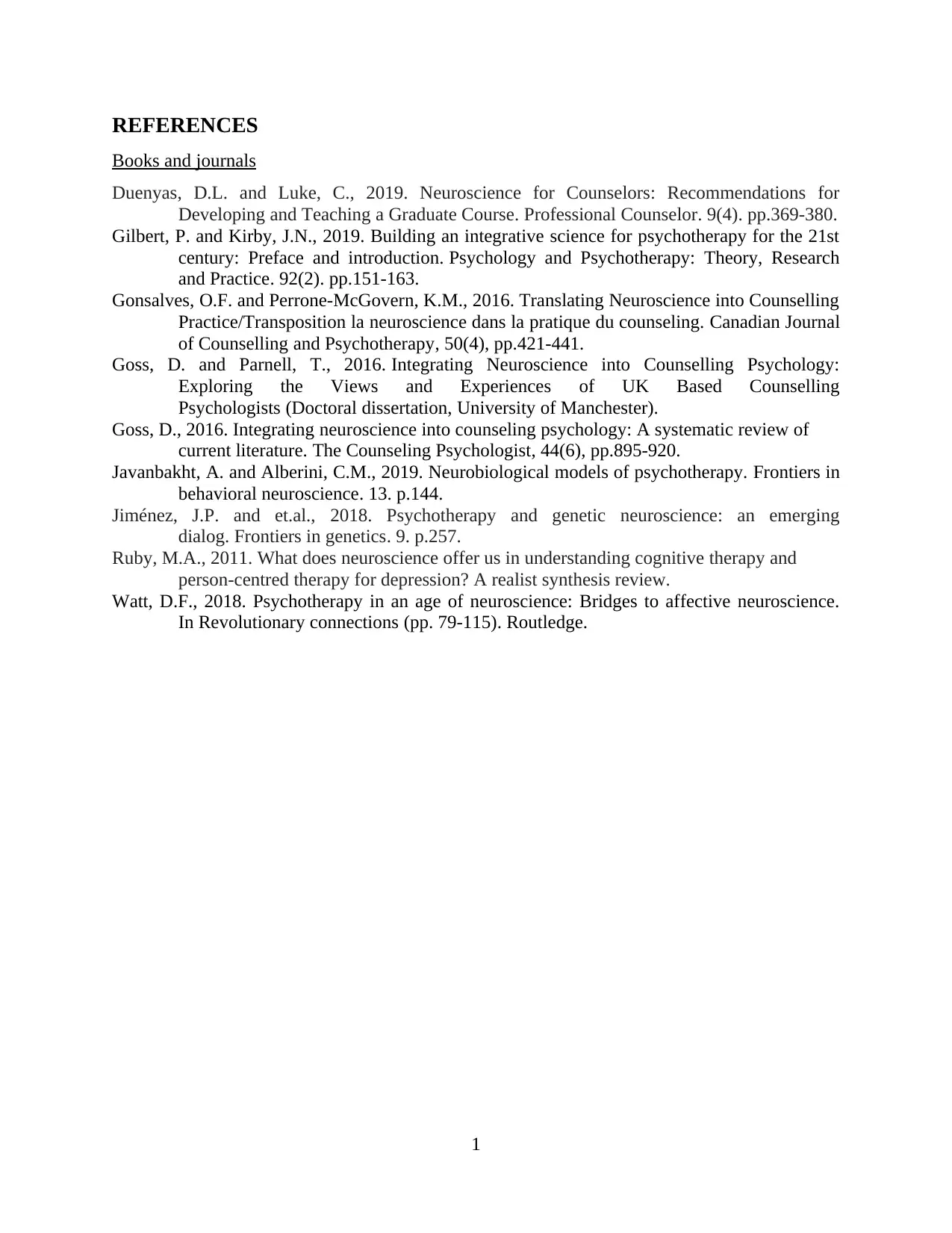
REFERENCES
Books and journals
Duenyas, D.L. and Luke, C., 2019. Neuroscience for Counselors: Recommendations for
Developing and Teaching a Graduate Course. Professional Counselor. 9(4). pp.369-380.
Gilbert, P. and Kirby, J.N., 2019. Building an integrative science for psychotherapy for the 21st
century: Preface and introduction. Psychology and Psychotherapy: Theory, Research
and Practice. 92(2). pp.151-163.
Gonsalves, O.F. and Perrone-McGovern, K.M., 2016. Translating Neuroscience into Counselling
Practice/Transposition la neuroscience dans la pratique du counseling. Canadian Journal
of Counselling and Psychotherapy, 50(4), pp.421-441.
Goss, D. and Parnell, T., 2016. Integrating Neuroscience into Counselling Psychology:
Exploring the Views and Experiences of UK Based Counselling
Psychologists (Doctoral dissertation, University of Manchester).
Goss, D., 2016. Integrating neuroscience into counseling psychology: A systematic review of
current literature. The Counseling Psychologist, 44(6), pp.895-920.
Javanbakht, A. and Alberini, C.M., 2019. Neurobiological models of psychotherapy. Frontiers in
behavioral neuroscience. 13. p.144.
Jiménez, J.P. and et.al., 2018. Psychotherapy and genetic neuroscience: an emerging
dialog. Frontiers in genetics. 9. p.257.
Ruby, M.A., 2011. What does neuroscience offer us in understanding cognitive therapy and
person-centred therapy for depression? A realist synthesis review.
Watt, D.F., 2018. Psychotherapy in an age of neuroscience: Bridges to affective neuroscience.
In Revolutionary connections (pp. 79-115). Routledge.
1
Books and journals
Duenyas, D.L. and Luke, C., 2019. Neuroscience for Counselors: Recommendations for
Developing and Teaching a Graduate Course. Professional Counselor. 9(4). pp.369-380.
Gilbert, P. and Kirby, J.N., 2019. Building an integrative science for psychotherapy for the 21st
century: Preface and introduction. Psychology and Psychotherapy: Theory, Research
and Practice. 92(2). pp.151-163.
Gonsalves, O.F. and Perrone-McGovern, K.M., 2016. Translating Neuroscience into Counselling
Practice/Transposition la neuroscience dans la pratique du counseling. Canadian Journal
of Counselling and Psychotherapy, 50(4), pp.421-441.
Goss, D. and Parnell, T., 2016. Integrating Neuroscience into Counselling Psychology:
Exploring the Views and Experiences of UK Based Counselling
Psychologists (Doctoral dissertation, University of Manchester).
Goss, D., 2016. Integrating neuroscience into counseling psychology: A systematic review of
current literature. The Counseling Psychologist, 44(6), pp.895-920.
Javanbakht, A. and Alberini, C.M., 2019. Neurobiological models of psychotherapy. Frontiers in
behavioral neuroscience. 13. p.144.
Jiménez, J.P. and et.al., 2018. Psychotherapy and genetic neuroscience: an emerging
dialog. Frontiers in genetics. 9. p.257.
Ruby, M.A., 2011. What does neuroscience offer us in understanding cognitive therapy and
person-centred therapy for depression? A realist synthesis review.
Watt, D.F., 2018. Psychotherapy in an age of neuroscience: Bridges to affective neuroscience.
In Revolutionary connections (pp. 79-115). Routledge.
1
⊘ This is a preview!⊘
Do you want full access?
Subscribe today to unlock all pages.
Trusted by 1+ million students worldwide

1 out of 9


Related Documents


Your All-in-One AI-Powered Toolkit for Academic Success.
+13062052269
info@desklib.com
Available 24*7 on WhatsApp / Email
![[object Object]](/_next/static/media/star-bottom.7253800d.svg)
Unlock your academic potential
Copyright © 2020–2026 A2Z Services. All Rights Reserved. Developed and managed by ZUCOL.