Assessment of Neurotoxin Hazards in Occupational Environments Report
VerifiedAdded on 2020/10/04
|11
|3537
|409
Report
AI Summary
This report delves into the complexities of neurotoxin hazards within occupational environments. It begins by defining neurotoxin processes, identifying inputs, outputs, and waste items, and then explores the physicochemical properties of these substances, explaining how they are generated and the mechanisms of exposure. The report emphasizes the risks neurotoxins pose to employee health, detailing both chronic and acute effects. It further outlines methods for monitoring and analyzing neurotoxin hazards, including specific standards, codes of practice, and exposure control measures. The analysis covers the evaluation and implementation of workplace exposure standards, public consultations, and preliminary evaluations to ensure worker safety and health. The report underscores the importance of proactive measures in preventing and managing neurotoxin exposure, highlighting the need for rigorous assessment, monitoring, and adherence to established safety protocols. This report provides a comprehensive overview of neurotoxin management in the workplace.
Occupational hygiene and Chemical Safety

Paraphrase This Document
Need a fresh take? Get an instant paraphrase of this document with our AI Paraphraser
CONTENTS
INTRODUCTION...................................................................................................3
Assessment- 2............................................................................................................3
Discuss about the Neurotoxin process that generate the hazard, including the
identification of inputs, outputs and waste items...................................................3
Determine the physico chemical properties of Neurotoxin, how it can be
generated and the mechanism of exposure in both potential and actual................4
Describe that why Neurotoxin present a risk to employee health and should
include the chronic health affect and acute............................................................5
How Neurotoxin hazard should be monitored and analysed..................................6
Explain the specific standards, code of practices and method applicable in the
exposure..................................................................................................................7
CONCLUSION......................................................................................................10
REFERENCES........................................................................................................12
INTRODUCTION...................................................................................................3
Assessment- 2............................................................................................................3
Discuss about the Neurotoxin process that generate the hazard, including the
identification of inputs, outputs and waste items...................................................3
Determine the physico chemical properties of Neurotoxin, how it can be
generated and the mechanism of exposure in both potential and actual................4
Describe that why Neurotoxin present a risk to employee health and should
include the chronic health affect and acute............................................................5
How Neurotoxin hazard should be monitored and analysed..................................6
Explain the specific standards, code of practices and method applicable in the
exposure..................................................................................................................7
CONCLUSION......................................................................................................10
REFERENCES........................................................................................................12
INTRODUCTION
At workplace, many employees are attracted towards the alcohol drinking products
because it is a part of society and communities but it negatively impact on the body. This
assignment will describe the reason of hazardous agent at workplace and how employee may be
exposed. Furthermore, this report will describe the process of hazard agent and also identify the
physico-chemical properties or their internal mechanism. Why the hazard present a risk to the
employee health which includes both chronic health effects and acute. However, this report will
describe that how could be monitored and analyse in an appropriate manner. It will specify the
proper code of practices, standards and method applicable in the exposure.
ASSESSMENT- 2
Discuss about the Neurotoxin process that generate the hazard, including the identification of
inputs, outputs and waste items
Neurotoxin process refers to the ability and capability of including various type of
adverse chemical that affect in the nervous system. It is to be considered the chemical neurotoxin
where it is capable of including the consistent pattern to change the dysfunction in the chemical
structure of nervous system. It is generally manifested as a continuum symptoms and different
effects. It depends on the nature of chemical and dose. While, the duration of chemical exposure
and their traits of exposed individually (Alston, Millikin and Piispanen, 2018). As neurotoxins
are the compounds which affects the entire mechanism of nervous system. It inhibited the
process can different range from the membrane of depolarization into the inter neuron
communication. It has ability for neuron to perform the intracellular functions and easily pass a
signal to the neighbour. As per survey, it found that there are 50,000 and 1, 00, 000 chemicals
are workplace related the neurotoxic but the majority of chemical have been never tested in
proper manner. It is already available in marketplace.
Although, the neurotoxic chemicals are produced to use for specific ways and exposure
may increase from the different sources such as private homes, industry and drinking pollute
liquids at workplace. It may causes to affect the functionality of nervous tissues (Alston, Millikin
and Piispanen, 2018). For Example- Metal is increasing the toxicity because it contain lead and
mercury which being toxic agents that impact on the overall functionality. Usually, it is found in
At workplace, many employees are attracted towards the alcohol drinking products
because it is a part of society and communities but it negatively impact on the body. This
assignment will describe the reason of hazardous agent at workplace and how employee may be
exposed. Furthermore, this report will describe the process of hazard agent and also identify the
physico-chemical properties or their internal mechanism. Why the hazard present a risk to the
employee health which includes both chronic health effects and acute. However, this report will
describe that how could be monitored and analyse in an appropriate manner. It will specify the
proper code of practices, standards and method applicable in the exposure.
ASSESSMENT- 2
Discuss about the Neurotoxin process that generate the hazard, including the identification of
inputs, outputs and waste items
Neurotoxin process refers to the ability and capability of including various type of
adverse chemical that affect in the nervous system. It is to be considered the chemical neurotoxin
where it is capable of including the consistent pattern to change the dysfunction in the chemical
structure of nervous system. It is generally manifested as a continuum symptoms and different
effects. It depends on the nature of chemical and dose. While, the duration of chemical exposure
and their traits of exposed individually (Alston, Millikin and Piispanen, 2018). As neurotoxins
are the compounds which affects the entire mechanism of nervous system. It inhibited the
process can different range from the membrane of depolarization into the inter neuron
communication. It has ability for neuron to perform the intracellular functions and easily pass a
signal to the neighbour. As per survey, it found that there are 50,000 and 1, 00, 000 chemicals
are workplace related the neurotoxic but the majority of chemical have been never tested in
proper manner. It is already available in marketplace.
Although, the neurotoxic chemicals are produced to use for specific ways and exposure
may increase from the different sources such as private homes, industry and drinking pollute
liquids at workplace. It may causes to affect the functionality of nervous tissues (Alston, Millikin
and Piispanen, 2018). For Example- Metal is increasing the toxicity because it contain lead and
mercury which being toxic agents that impact on the overall functionality. Usually, it is found in
⊘ This is a preview!⊘
Do you want full access?
Subscribe today to unlock all pages.

Trusted by 1+ million students worldwide
their nature at low concentration but in certain working area (Sargent, 2018). It may be used in
large amounts so that it may give to increase the risk in environment for employees. Moreover, it
also considerable in the large amount of metals which found in waste water. In this way, it may
rise the environmental risk for the residential areas. The toxicity in the metal that handle by the
organism which depend on the structure of chemical. On the other hand, pure metal may be taken
by the inhalation and other skin contact of vapour and small particles of lead. It is needed to
monitor the biological action and also released lead in very slowly.
Determine the physico chemical properties of Neurotoxin, how it can be generated and the
mechanism of exposure in both potential and actual
Physico chemical properties is a type of potential chemical alternative that present in the
Neurotoxin chemicals where the inherent hazard of chemical that impact on the biological
conditions. It can be determined by the intrinsic physicochemical properties. It also help for
identifying the materials, composition, size, structure and other morphology. This property can
be used to eliminate from the Neurotoxin chemicals that are likely to exhibit the particular
physical and toxicological hazards. It is important to obtain the data which is relatively fast and
less expensive.
Physicochemical properties are mainly based on the physical properties which related to
the other solvation interaction with different media. It is interested to the chemical alternative
that can use the finding the physical hazards. It also predict the chemical environments, Eco
toxicity and human toxicity etc. This type of property is generated because of change in their
physical as well as chemical state (Mahmoudi and etal., 2018). It is needed for measure the
chemical level through OECD test which guide to know about the level of chemical and
determine the vapour pressure water solubility, melting point, boiling point and PH level. These
are the different criteria to measure the estimation of physicochemical properties.
Initially, it can be used the physicochemical properties to identify the physical hazards, it
is the primary consideration of hazards that impact on the potential chemical substitution. It may
shift to other substances that are considered as non-physical hazards at the level of consumers
where it may greater risk at the time manufacturing. Many employee believes that undesired
physical hazard focus that carry out to the customer realm and most likely limited to the under
pressure, corrosively metals and oxidizing liquids etc.
large amounts so that it may give to increase the risk in environment for employees. Moreover, it
also considerable in the large amount of metals which found in waste water. In this way, it may
rise the environmental risk for the residential areas. The toxicity in the metal that handle by the
organism which depend on the structure of chemical. On the other hand, pure metal may be taken
by the inhalation and other skin contact of vapour and small particles of lead. It is needed to
monitor the biological action and also released lead in very slowly.
Determine the physico chemical properties of Neurotoxin, how it can be generated and the
mechanism of exposure in both potential and actual
Physico chemical properties is a type of potential chemical alternative that present in the
Neurotoxin chemicals where the inherent hazard of chemical that impact on the biological
conditions. It can be determined by the intrinsic physicochemical properties. It also help for
identifying the materials, composition, size, structure and other morphology. This property can
be used to eliminate from the Neurotoxin chemicals that are likely to exhibit the particular
physical and toxicological hazards. It is important to obtain the data which is relatively fast and
less expensive.
Physicochemical properties are mainly based on the physical properties which related to
the other solvation interaction with different media. It is interested to the chemical alternative
that can use the finding the physical hazards. It also predict the chemical environments, Eco
toxicity and human toxicity etc. This type of property is generated because of change in their
physical as well as chemical state (Mahmoudi and etal., 2018). It is needed for measure the
chemical level through OECD test which guide to know about the level of chemical and
determine the vapour pressure water solubility, melting point, boiling point and PH level. These
are the different criteria to measure the estimation of physicochemical properties.
Initially, it can be used the physicochemical properties to identify the physical hazards, it
is the primary consideration of hazards that impact on the potential chemical substitution. It may
shift to other substances that are considered as non-physical hazards at the level of consumers
where it may greater risk at the time manufacturing. Many employee believes that undesired
physical hazard focus that carry out to the customer realm and most likely limited to the under
pressure, corrosively metals and oxidizing liquids etc.
Paraphrase This Document
Need a fresh take? Get an instant paraphrase of this document with our AI Paraphraser
Secondly, it can be used the physicochemical property data is to identify the environment
compartments into which the chemicals partition. It easily predicted the chemical state such as
vapour pressure, melting and boiling point etc. it indicate through the environmental condition
such as water, air, soil and sediment (Bhusnure, Gholve and Giram, 2018). On other hand,
chemicals with high propensity to easily sorb onto the other organic carbon, which moves into
the liquid form. Sometimes, Chemicals may be dissolved in water.
The mechanism of exposure is the most relevant for consideration of chemical alternative
which is directly absorb through the systemic exposure. It vapour pressure of material always
reflect their potential for the liquid and gas phased of exposure to the compound. It is important
to reflect the size of molecules, shape and their structure. Physico chemical properties are
included to control and manage the exposure of risk in human body (Silva, Arezes and Swuste,
2019). Sometimes, it is harmful for people to failure of overall functionality of nervous system.
Describe that why Neurotoxin present a risk to employee health and should include the chronic
health affect and acute
Neurotoxin is a type of poisons chemical substances that harmful for human body. This
type of toxin is directly affects the nervous system of human being. It is required for employee to
protect through the neurotoxin. It is present in different element which are used in our day to day
life. It involves water, metal, drinking products etc. neurotoxic chemical capable of damaging the
central nervous system which are ubiquitous in the working environment. Neurotoxin is the most
common sources of industry chemicals where employee may be exposed to the neurotoxins due
to the occupations. This type of toxic encephalopathy is indicated the brain dysfunction which
caused by the toxic exposure.
Firstly, it is based on the dose response relation in the term of the toxic encephalopathy. It
is the highest level of exposure and different symptoms occurs. Similarly, It the long term
exposure that affect the functionality of human being.
Second, the toxic encephalopathy is generally manifest as symmetrical neurological
syndrome and nonfocal. It causes the weakness as well as loss of sensory of one limb and other
side of body should be suggested as an alternative causes. It is very useful when it evaluating an
employee with the presumed neurotoxic industry. However, It should be tested the function of
compartments into which the chemicals partition. It easily predicted the chemical state such as
vapour pressure, melting and boiling point etc. it indicate through the environmental condition
such as water, air, soil and sediment (Bhusnure, Gholve and Giram, 2018). On other hand,
chemicals with high propensity to easily sorb onto the other organic carbon, which moves into
the liquid form. Sometimes, Chemicals may be dissolved in water.
The mechanism of exposure is the most relevant for consideration of chemical alternative
which is directly absorb through the systemic exposure. It vapour pressure of material always
reflect their potential for the liquid and gas phased of exposure to the compound. It is important
to reflect the size of molecules, shape and their structure. Physico chemical properties are
included to control and manage the exposure of risk in human body (Silva, Arezes and Swuste,
2019). Sometimes, it is harmful for people to failure of overall functionality of nervous system.
Describe that why Neurotoxin present a risk to employee health and should include the chronic
health affect and acute
Neurotoxin is a type of poisons chemical substances that harmful for human body. This
type of toxin is directly affects the nervous system of human being. It is required for employee to
protect through the neurotoxin. It is present in different element which are used in our day to day
life. It involves water, metal, drinking products etc. neurotoxic chemical capable of damaging the
central nervous system which are ubiquitous in the working environment. Neurotoxin is the most
common sources of industry chemicals where employee may be exposed to the neurotoxins due
to the occupations. This type of toxic encephalopathy is indicated the brain dysfunction which
caused by the toxic exposure.
Firstly, it is based on the dose response relation in the term of the toxic encephalopathy. It
is the highest level of exposure and different symptoms occurs. Similarly, It the long term
exposure that affect the functionality of human being.
Second, the toxic encephalopathy is generally manifest as symmetrical neurological
syndrome and nonfocal. It causes the weakness as well as loss of sensory of one limb and other
side of body should be suggested as an alternative causes. It is very useful when it evaluating an
employee with the presumed neurotoxic industry. However, It should be tested the function of
liver, electrolyte, glucose and renal functions etc. this will help for distinguish the toxic
encephalopathy form the metabolic.
After acute exposure, It is the immediate symptoms which are often a consequences of
the physiological effect on the chemical. It is generally maximum exposure and symptoms
occurs. This type of symptoms is eliminating the chemical through the employee body, delayed
the neurological deficits occurs after the exposure of toxic. Nervous system has limited ability
and capability to regenerate the other organs like hematopoietic system.
How Neurotoxin hazard should be monitored and analysed
In the environmental origin, there are lot of exposure to the synthetic and other naturally
occurring chemical toxicants. It also enter in the environments through water and other agent. It
can be prevented by reducing or eliminating the exposure of toxicant (Chebekoue and Krishna,
2019). Testing is factor that help for determine the level of neurotoxicity which prevent the
diseases by identifying the toxic hazards before exposed in humans. Testing of neurotoxicity is
primary prevention approach to easily detect the diseases and dysfunction in person. The
potential hazard is determined through the premarket testing of new chemicals before launching
in global marketplace. Potential neurotoxicity caused by the use of other illicit substances and
contain the consumption of food item. It is naturally occurring toxic is likely, diseases may be
prevented by restricting the use of chemical those who are found the neurotoxic through
engineering control process. It is imposing the use of protective equipment’s and device at the
time of environmental release.
As per survey, it found that there are 1200 to 1600 new harmful substances are
considered in the market through the Australian protection agency. It also analysed that the new
chemical has highest level of exposure that can impact on the functionality of human system.
There are 598 chemicals used in the Substantial quantities by the Australian industry and judged
to be the toxicology significance by Australian government and hygienists industries.
Neurodiagnostic technique is a type of approach that support to analyse and monitor the
hazardous toxic. It deficits to determine the exposure to the toxicants such as memory, problem
solving and disturbances in the intelligence etc. It easily detect the effects in the overall human
body. This technique is described the symptoms which usually occurs. It is clearly noticed by the
employee and other people (Silva, Arezes and Swuste., 2019). It is based on the evaluation by
encephalopathy form the metabolic.
After acute exposure, It is the immediate symptoms which are often a consequences of
the physiological effect on the chemical. It is generally maximum exposure and symptoms
occurs. This type of symptoms is eliminating the chemical through the employee body, delayed
the neurological deficits occurs after the exposure of toxic. Nervous system has limited ability
and capability to regenerate the other organs like hematopoietic system.
How Neurotoxin hazard should be monitored and analysed
In the environmental origin, there are lot of exposure to the synthetic and other naturally
occurring chemical toxicants. It also enter in the environments through water and other agent. It
can be prevented by reducing or eliminating the exposure of toxicant (Chebekoue and Krishna,
2019). Testing is factor that help for determine the level of neurotoxicity which prevent the
diseases by identifying the toxic hazards before exposed in humans. Testing of neurotoxicity is
primary prevention approach to easily detect the diseases and dysfunction in person. The
potential hazard is determined through the premarket testing of new chemicals before launching
in global marketplace. Potential neurotoxicity caused by the use of other illicit substances and
contain the consumption of food item. It is naturally occurring toxic is likely, diseases may be
prevented by restricting the use of chemical those who are found the neurotoxic through
engineering control process. It is imposing the use of protective equipment’s and device at the
time of environmental release.
As per survey, it found that there are 1200 to 1600 new harmful substances are
considered in the market through the Australian protection agency. It also analysed that the new
chemical has highest level of exposure that can impact on the functionality of human system.
There are 598 chemicals used in the Substantial quantities by the Australian industry and judged
to be the toxicology significance by Australian government and hygienists industries.
Neurodiagnostic technique is a type of approach that support to analyse and monitor the
hazardous toxic. It deficits to determine the exposure to the toxicants such as memory, problem
solving and disturbances in the intelligence etc. It easily detect the effects in the overall human
body. This technique is described the symptoms which usually occurs. It is clearly noticed by the
employee and other people (Silva, Arezes and Swuste., 2019). It is based on the evaluation by
⊘ This is a preview!⊘
Do you want full access?
Subscribe today to unlock all pages.
Trusted by 1+ million students worldwide
using standard tests, which follows the specific procedure capable of providing the quantifiable
results and outcomes. This process has analysed and monitor the chemical toxic and other
harmful substances. It is apparent that technique currently applicable in the neurotoxicity
screening program. It also more effective process to target the specific functionality of
vulnerability to neurotoxin.
Explain the specific standards, code of practices and method applicable in the exposure.
At workplace, the exposure standard in west Australia cover approximately 700
chemicals. A workplace exposure standard for the particular chemical set an appropriate legal
concentration limit that must not be exceeded in properly (Silva, Arezes and Swuste, 2019). It is
simply the maximum upper limits that prescribed by the proper rules and regulations. Everyone
has different that some might experience of adverse health issues below the standard exposure.
There are some specific exposure standard to ensure the high quality evidence or supported by
the government.
Public Consultation-
In 2015, public consultation process held to determine the role of standard exposure at workplace
and how it can be maintained or reviewed. It is based on the regulatory standards to manage the
entire frame work of global industries. It is also recommended to change the level of exposure
standards at workplace. It is beneficial with the association in terms of cost with any changes.
Preliminary evaluation-
In 2016, it undertaken the preliminary evaluation of Australia workplace exposure standards for
airborne contaminants. It is provided an idea and indication of standard that may require to
update. The toxicological knowledge and recommendations for the harmful toxic hazardous
chemicals (Hashimoto and et.al., 2018). It is also used the evaluation process to review and
identify the workplace standard exposure. It might be timely, applicable in the Australia
contemporary and also adopt the advanced knowledge of toxicological.
Code of Practices-
results and outcomes. This process has analysed and monitor the chemical toxic and other
harmful substances. It is apparent that technique currently applicable in the neurotoxicity
screening program. It also more effective process to target the specific functionality of
vulnerability to neurotoxin.
Explain the specific standards, code of practices and method applicable in the exposure.
At workplace, the exposure standard in west Australia cover approximately 700
chemicals. A workplace exposure standard for the particular chemical set an appropriate legal
concentration limit that must not be exceeded in properly (Silva, Arezes and Swuste, 2019). It is
simply the maximum upper limits that prescribed by the proper rules and regulations. Everyone
has different that some might experience of adverse health issues below the standard exposure.
There are some specific exposure standard to ensure the high quality evidence or supported by
the government.
Public Consultation-
In 2015, public consultation process held to determine the role of standard exposure at workplace
and how it can be maintained or reviewed. It is based on the regulatory standards to manage the
entire frame work of global industries. It is also recommended to change the level of exposure
standards at workplace. It is beneficial with the association in terms of cost with any changes.
Preliminary evaluation-
In 2016, it undertaken the preliminary evaluation of Australia workplace exposure standards for
airborne contaminants. It is provided an idea and indication of standard that may require to
update. The toxicological knowledge and recommendations for the harmful toxic hazardous
chemicals (Hashimoto and et.al., 2018). It is also used the evaluation process to review and
identify the workplace standard exposure. It might be timely, applicable in the Australia
contemporary and also adopt the advanced knowledge of toxicological.
Code of Practices-
Paraphrase This Document
Need a fresh take? Get an instant paraphrase of this document with our AI Paraphraser
Code of practices is basically prepared documentation which provide by the practical guidance
on how to manage and comply the specific duty under the western Australian occupational health
or safety law.
Control and Safe use of in organic lead at workplace-
This law was conducted by the western Australian government so that many companies are
followed this rules where they can manufacture the products and after testing. The regulation is
described the requirement for workplace in which the hazardous materials like leads. It may
causes the human health. In this way, employee can use the legal obligation to meet the safe
working environment and culture.
Control of workplace Hazardous Substances –
This law was conducted by the western Australian government which requires for organizations
to maintain the business aspects in proper manner. The objective of this legislation for control of
workplace hazardous substances to reduce the risk of adverse health effect because of the
exposure to the hazardous substances at workplace. As per legislation, many industries are
applied the regulation for managing and controlling the hazardous substances in proper manner.
Labelling of workplace Substances-
It is national code of practices for the labelling of workplace substances that provide a flexible
system of the company to use the proper labelling in their products. In this way, importers can
meet the need under the circumstances (Chang and et.al., 2019). As per regulation, it applies a
proper labelling and at the same time, it may produce the label to the workplace requirements.
Occupational Safety and health in call centres-
This legislation is important in Australia because it help for call centres provide the equal right to
their employee. It is required to comply with this regulation of the employee work in call centre.
It applies to the employees and employers. Call centre is a type of workplace where the main
work of employee is providing the customer services by telecommunication and other computer
based. This regulation is helped to address the occupational health and safety regarding the call
centre work.
on how to manage and comply the specific duty under the western Australian occupational health
or safety law.
Control and Safe use of in organic lead at workplace-
This law was conducted by the western Australian government so that many companies are
followed this rules where they can manufacture the products and after testing. The regulation is
described the requirement for workplace in which the hazardous materials like leads. It may
causes the human health. In this way, employee can use the legal obligation to meet the safe
working environment and culture.
Control of workplace Hazardous Substances –
This law was conducted by the western Australian government which requires for organizations
to maintain the business aspects in proper manner. The objective of this legislation for control of
workplace hazardous substances to reduce the risk of adverse health effect because of the
exposure to the hazardous substances at workplace. As per legislation, many industries are
applied the regulation for managing and controlling the hazardous substances in proper manner.
Labelling of workplace Substances-
It is national code of practices for the labelling of workplace substances that provide a flexible
system of the company to use the proper labelling in their products. In this way, importers can
meet the need under the circumstances (Chang and et.al., 2019). As per regulation, it applies a
proper labelling and at the same time, it may produce the label to the workplace requirements.
Occupational Safety and health in call centres-
This legislation is important in Australia because it help for call centres provide the equal right to
their employee. It is required to comply with this regulation of the employee work in call centre.
It applies to the employees and employers. Call centre is a type of workplace where the main
work of employee is providing the customer services by telecommunication and other computer
based. This regulation is helped to address the occupational health and safety regarding the call
centre work.
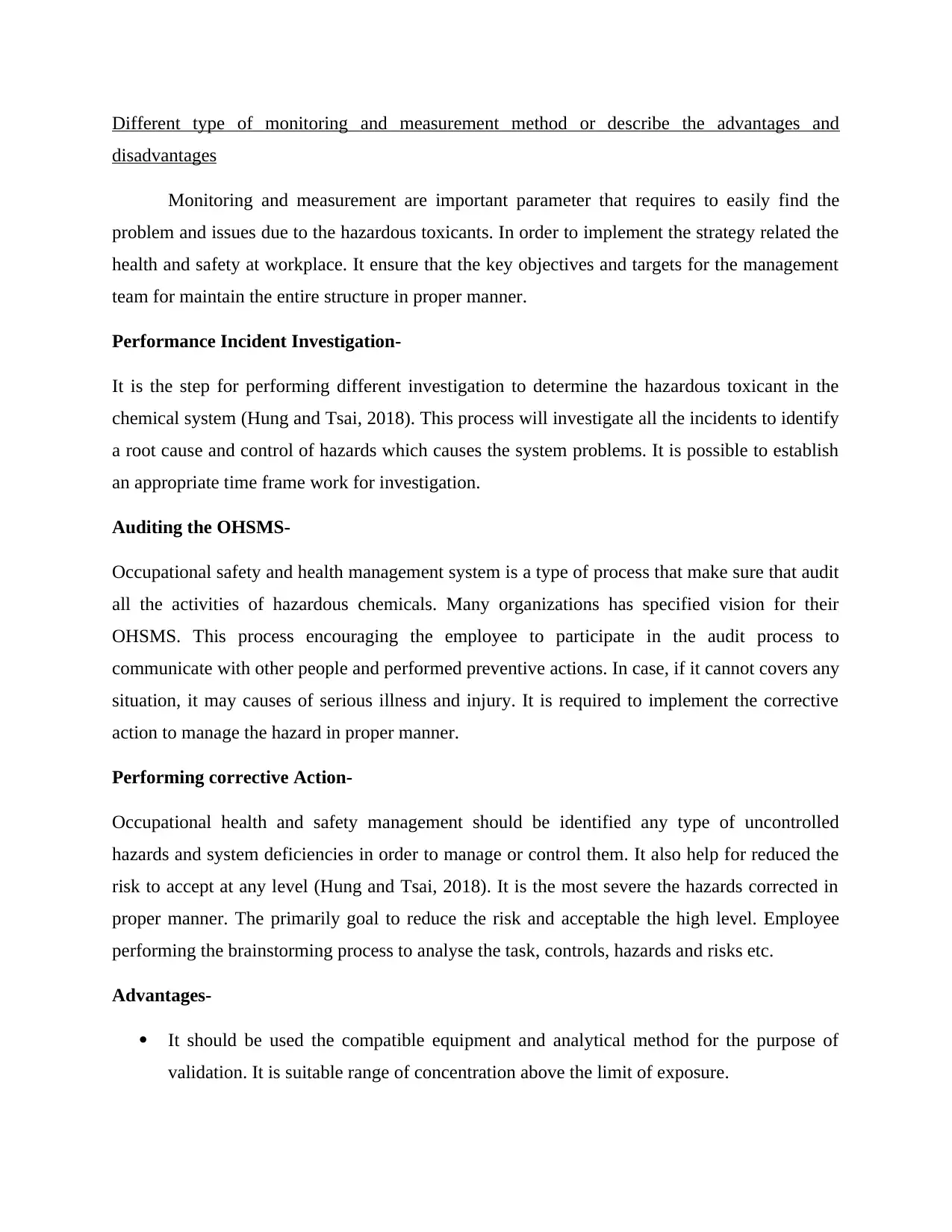
Different type of monitoring and measurement method or describe the advantages and
disadvantages
Monitoring and measurement are important parameter that requires to easily find the
problem and issues due to the hazardous toxicants. In order to implement the strategy related the
health and safety at workplace. It ensure that the key objectives and targets for the management
team for maintain the entire structure in proper manner.
Performance Incident Investigation-
It is the step for performing different investigation to determine the hazardous toxicant in the
chemical system (Hung and Tsai, 2018). This process will investigate all the incidents to identify
a root cause and control of hazards which causes the system problems. It is possible to establish
an appropriate time frame work for investigation.
Auditing the OHSMS-
Occupational safety and health management system is a type of process that make sure that audit
all the activities of hazardous chemicals. Many organizations has specified vision for their
OHSMS. This process encouraging the employee to participate in the audit process to
communicate with other people and performed preventive actions. In case, if it cannot covers any
situation, it may causes of serious illness and injury. It is required to implement the corrective
action to manage the hazard in proper manner.
Performing corrective Action-
Occupational health and safety management should be identified any type of uncontrolled
hazards and system deficiencies in order to manage or control them. It also help for reduced the
risk to accept at any level (Hung and Tsai, 2018). It is the most severe the hazards corrected in
proper manner. The primarily goal to reduce the risk and acceptable the high level. Employee
performing the brainstorming process to analyse the task, controls, hazards and risks etc.
Advantages-
It should be used the compatible equipment and analytical method for the purpose of
validation. It is suitable range of concentration above the limit of exposure.
disadvantages
Monitoring and measurement are important parameter that requires to easily find the
problem and issues due to the hazardous toxicants. In order to implement the strategy related the
health and safety at workplace. It ensure that the key objectives and targets for the management
team for maintain the entire structure in proper manner.
Performance Incident Investigation-
It is the step for performing different investigation to determine the hazardous toxicant in the
chemical system (Hung and Tsai, 2018). This process will investigate all the incidents to identify
a root cause and control of hazards which causes the system problems. It is possible to establish
an appropriate time frame work for investigation.
Auditing the OHSMS-
Occupational safety and health management system is a type of process that make sure that audit
all the activities of hazardous chemicals. Many organizations has specified vision for their
OHSMS. This process encouraging the employee to participate in the audit process to
communicate with other people and performed preventive actions. In case, if it cannot covers any
situation, it may causes of serious illness and injury. It is required to implement the corrective
action to manage the hazard in proper manner.
Performing corrective Action-
Occupational health and safety management should be identified any type of uncontrolled
hazards and system deficiencies in order to manage or control them. It also help for reduced the
risk to accept at any level (Hung and Tsai, 2018). It is the most severe the hazards corrected in
proper manner. The primarily goal to reduce the risk and acceptable the high level. Employee
performing the brainstorming process to analyse the task, controls, hazards and risks etc.
Advantages-
It should be used the compatible equipment and analytical method for the purpose of
validation. It is suitable range of concentration above the limit of exposure.
⊘ This is a preview!⊘
Do you want full access?
Subscribe today to unlock all pages.
Trusted by 1+ million students worldwide

Static Monitoring should be applicable for identifying the distribution of chemical and
maintain the working environment. In case any problem, it easily detect the high
exposure of hazardous chemical.
Personal monitoring should be used evaluating the risk of exposure through the
individual employee.
Measurement technique is mainly used to measure exposure which allow for employee to
work in night shift. The exposure should be compared to the other occupational exposure
limit and their values (Hung and Tsai, 2018). The measurement may be continuous over
the night shift and as long as possible. In this way, it help for employee to calculate the
overall estimation of exposure level.
Disadvantages-
Personal measurement process is based on the employee where how they can implement
the concept for the investigation of hazardous chemicals and toxicants in the functionality
of system.
It is required for employee to provide training to understand the situation and condition
regarding health or safety.
Sometimes, it is very difficult for analysing and identifying the problem as a root of cause
in the illness. (Hung and Tsai, 2018).
It is required for risk adjustment a larger sample needs but it has generated many
outcome for long terms observations. It is difficult to adjust the risk and requires the
different type of model for generation of outcomes.
CONCLUSION
As per discussion, it concluded that Occupational hygiene is a process for performing
different operations such as evaluating, controlling and recognising the health hazards in the
working environment. It is beneficial for employee to provide the safety and security through the
hazardous agent at workplace. This concept determine the practices of hazardous agents,
physical, biological and chemical at workplace.
maintain the working environment. In case any problem, it easily detect the high
exposure of hazardous chemical.
Personal monitoring should be used evaluating the risk of exposure through the
individual employee.
Measurement technique is mainly used to measure exposure which allow for employee to
work in night shift. The exposure should be compared to the other occupational exposure
limit and their values (Hung and Tsai, 2018). The measurement may be continuous over
the night shift and as long as possible. In this way, it help for employee to calculate the
overall estimation of exposure level.
Disadvantages-
Personal measurement process is based on the employee where how they can implement
the concept for the investigation of hazardous chemicals and toxicants in the functionality
of system.
It is required for employee to provide training to understand the situation and condition
regarding health or safety.
Sometimes, it is very difficult for analysing and identifying the problem as a root of cause
in the illness. (Hung and Tsai, 2018).
It is required for risk adjustment a larger sample needs but it has generated many
outcome for long terms observations. It is difficult to adjust the risk and requires the
different type of model for generation of outcomes.
CONCLUSION
As per discussion, it concluded that Occupational hygiene is a process for performing
different operations such as evaluating, controlling and recognising the health hazards in the
working environment. It is beneficial for employee to provide the safety and security through the
hazardous agent at workplace. This concept determine the practices of hazardous agents,
physical, biological and chemical at workplace.
Paraphrase This Document
Need a fresh take? Get an instant paraphrase of this document with our AI Paraphraser
REFERENCES
Books and Journals
Alston, F., Millikin, E.J. and Piispanen, W., 2018. Industrial Hygiene: Improving Worker Health
Through an Operational Risk Approach. CRC Press.
Arezes, P. and et.al., 2018. Occupational Safety and Hygiene VI: Proceedings of the 6th
International Symposium on Occupation Safety and Hygiene (SHO 2018), March 26-
27, 2018, Guimarães, Portugal. CRC Press.
Bhusnure, O.G., Gholve, S.B. and Giram, P.S., 2018. Chemical hazards and safety management
in pharmaceutical industry. Journal of Pharmacy Research. 12(3). pp.357-369.
Chang, P.T., Hung, P.C. and Tsai, S.W., 2018. Occupational exposures of flour dust and airborne
chemicals at bakeries in Taiwan. Journal of occupational and environmental
hygiene. 15(8). pp.580-587.
Chebekoue, S.F. and Krishnan, K., 2019. Derivation of internal dose-based thresholds of
toxicological concern for occupational inhalation exposure to systemically-acting
organic chemical vapors. Journal of occupational and environmental hygiene, (just-
accepted), pp.1-15.
Hashimoto, H. and et.al., 2018. Guidelines for personal exposure monitoring of chemicals: Part
IV. Journal of occupational health. pp.17-0311.
Mahmoudi, D and et.al., 2018. The Occupational health Student’s Awareness towards the
Globally Harmonized System for the Chemical Safety Signs. Safety Promotion and
Injury Prevention. 5(4). pp.219-226.
Sargent, E.V., 2018. 11 Industrial Chemicals. Regulatory Toxicology. p.96.
Silva, F., Arezes, P. and Swuste, P., 2019. Risk management: Controlling occupational exposure
to nanoparticles in construction. In Nanotechnology in Eco-efficient Construction(pp.
755-784). Woodhead Publishing.
Books and Journals
Alston, F., Millikin, E.J. and Piispanen, W., 2018. Industrial Hygiene: Improving Worker Health
Through an Operational Risk Approach. CRC Press.
Arezes, P. and et.al., 2018. Occupational Safety and Hygiene VI: Proceedings of the 6th
International Symposium on Occupation Safety and Hygiene (SHO 2018), March 26-
27, 2018, Guimarães, Portugal. CRC Press.
Bhusnure, O.G., Gholve, S.B. and Giram, P.S., 2018. Chemical hazards and safety management
in pharmaceutical industry. Journal of Pharmacy Research. 12(3). pp.357-369.
Chang, P.T., Hung, P.C. and Tsai, S.W., 2018. Occupational exposures of flour dust and airborne
chemicals at bakeries in Taiwan. Journal of occupational and environmental
hygiene. 15(8). pp.580-587.
Chebekoue, S.F. and Krishnan, K., 2019. Derivation of internal dose-based thresholds of
toxicological concern for occupational inhalation exposure to systemically-acting
organic chemical vapors. Journal of occupational and environmental hygiene, (just-
accepted), pp.1-15.
Hashimoto, H. and et.al., 2018. Guidelines for personal exposure monitoring of chemicals: Part
IV. Journal of occupational health. pp.17-0311.
Mahmoudi, D and et.al., 2018. The Occupational health Student’s Awareness towards the
Globally Harmonized System for the Chemical Safety Signs. Safety Promotion and
Injury Prevention. 5(4). pp.219-226.
Sargent, E.V., 2018. 11 Industrial Chemicals. Regulatory Toxicology. p.96.
Silva, F., Arezes, P. and Swuste, P., 2019. Risk management: Controlling occupational exposure
to nanoparticles in construction. In Nanotechnology in Eco-efficient Construction(pp.
755-784). Woodhead Publishing.

1 out of 11


Your All-in-One AI-Powered Toolkit for Academic Success.
+13062052269
info@desklib.com
Available 24*7 on WhatsApp / Email
![[object Object]](/_next/static/media/star-bottom.7253800d.svg)
Unlock your academic potential
Copyright © 2020–2026 A2Z Services. All Rights Reserved. Developed and managed by ZUCOL.