American History: The New Deal and its Impact on the Economy

Verified

Added on  2022/11/29

|4
|607
|348
Report
AI Summary
This report provides a detailed analysis of the New Deal, enacted by President Franklin D. Roosevelt in response to the Great Depression. It discusses the New Deal's goals, including relief, recovery, and reform, and its impact on the expansion of the Federal Government's role in the economy. The report examines key legislation such as the Civilian Conservation Corps (CCC), the Agricultural Adjustment Administration (AAA), and the Tennessee Valley Authority (TVA), along with financial reforms like the Securities and Exchange Commission (SEC) and the Federal Deposit Insurance Corporation (FDIC). The report concludes that the New Deal was a phenomenal reform in American politics and economy, establishing a model of bold leadership and executive-legislative coordination. It is an analysis of the historical and economic context of the New Deal and its lasting effects on American society and government, including the role of key figures and legislative initiatives.

Document Page
SOCIOLOGY
AMERICAN HISTORY
tabler-icon-diamond-filled.svg

Paraphrase This Document

Need a fresh take? Get an instant paraphrase of this document with our AI Paraphraser
Document Page
AMERICAN HISTORY 1
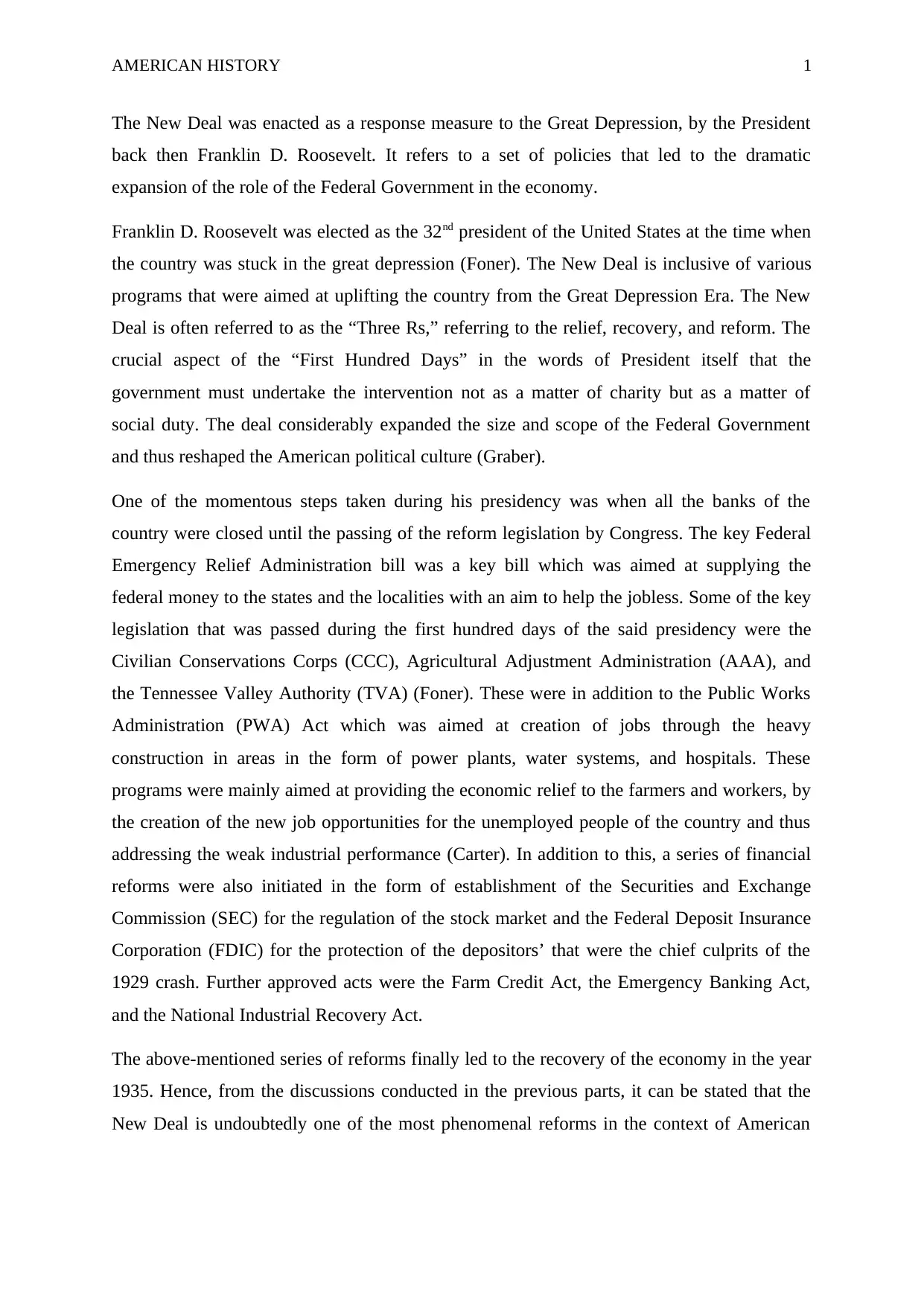
The New Deal was enacted as a response measure to the Great Depression, by the President
back then Franklin D. Roosevelt. It refers to a set of policies that led to the dramatic
expansion of the role of the Federal Government in the economy.
Franklin D. Roosevelt was elected as the 32nd president of the United States at the time when
the country was stuck in the great depression (Foner). The New Deal is inclusive of various
programs that were aimed at uplifting the country from the Great Depression Era. The New
Deal is often referred to as the “Three Rs,” referring to the relief, recovery, and reform. The
crucial aspect of the “First Hundred Days” in the words of President itself that the
government must undertake the intervention not as a matter of charity but as a matter of
social duty. The deal considerably expanded the size and scope of the Federal Government
and thus reshaped the American political culture (Graber).
One of the momentous steps taken during his presidency was when all the banks of the
country were closed until the passing of the reform legislation by Congress. The key Federal
Emergency Relief Administration bill was a key bill which was aimed at supplying the
federal money to the states and the localities with an aim to help the jobless. Some of the key
legislation that was passed during the first hundred days of the said presidency were the
Civilian Conservations Corps (CCC), Agricultural Adjustment Administration (AAA), and
the Tennessee Valley Authority (TVA) (Foner). These were in addition to the Public Works
Administration (PWA) Act which was aimed at creation of jobs through the heavy
construction in areas in the form of power plants, water systems, and hospitals. These
programs were mainly aimed at providing the economic relief to the farmers and workers, by
the creation of the new job opportunities for the unemployed people of the country and thus
addressing the weak industrial performance (Carter). In addition to this, a series of financial
reforms were also initiated in the form of establishment of the Securities and Exchange
Commission (SEC) for the regulation of the stock market and the Federal Deposit Insurance
Corporation (FDIC) for the protection of the depositors’ that were the chief culprits of the
1929 crash. Further approved acts were the Farm Credit Act, the Emergency Banking Act,
and the National Industrial Recovery Act.
The above-mentioned series of reforms finally led to the recovery of the economy in the year
1935. Hence, from the discussions conducted in the previous parts, it can be stated that the
New Deal is undoubtedly one of the most phenomenal reforms in the context of American
Document Page
AMERICAN HISTORY 2
politics and economy. President Franklin D. Roosevelt led to the establishment of the model
of bold leadership and executive-legislative coordination.
Document Page
AMERICAN HISTORY 3
Bibliography
Carter, Zach. "After 84 Years, FDR's First 100 Days Remain A Benchmark".
Huffingtonpost.In, 2017, https://www.huffingtonpost.in/entry/fdr-100-
days_n_58ff825ce4b0c46f0782b0c4. Accessed 28 June 2019.
Foner, Eric. Give Me Liberty!. 5th ed., W W Norton And Company, 2016.
Graber, John. "Revisiting The Old New Deal". Washington Examiner, 2019,
https://www.washingtonexaminer.com/opinion/op-eds/revisiting-the-old-new-deal. Accessed
28 June 2019.
chevron_up_icon
1 out of 4
circle_padding
hide_on_mobile
zoom_out_icon
[object Object]