Comprehensive Assignment on the Nature and Sources of New Zealand Law
VerifiedAdded on 2023/04/24
|17
|3213
|184
Homework Assignment
AI Summary
This assignment delves into the core aspects of New Zealand law, encompassing its nature and sources, legislation, statutory interpretation, and the tort of negligence. Section A explores the relationship between law and society, ethics, the classification of law, the Treaty of Waitangi, and the sovereignty of Parliament and the separation of powers. Section B discusses the process of a bill becoming law, the role of the Select Committee, and the advantages and disadvantages of delegated legislation. Section C focuses on the literal rule of statutory interpretation, its application, the purposive approach, and intrinsic and extrinsic aids. Finally, Section D examines the tort of negligence, clarifying common misconceptions about contributory inattention, employers' accountability for independent contractors, liability for separate damages, and the establishment of negligence claims. This assignment provides a comprehensive overview of the New Zealand legal system, offering insights into its principles and practical applications.


Paraphrase This Document
Need a fresh take? Get an instant paraphrase of this document with our AI Paraphraser

Contents
Section A...............................................................................................................................................4
Section B...............................................................................................................................................7
Section C.............................................................................................................................................11
Section D.............................................................................................................................................13
References:..........................................................................................................................................16
Section A...............................................................................................................................................4
Section B...............................................................................................................................................7
Section C.............................................................................................................................................11
Section D.............................................................................................................................................13
References:..........................................................................................................................................16

⊘ This is a preview!⊘
Do you want full access?
Subscribe today to unlock all pages.

Trusted by 1+ million students worldwide
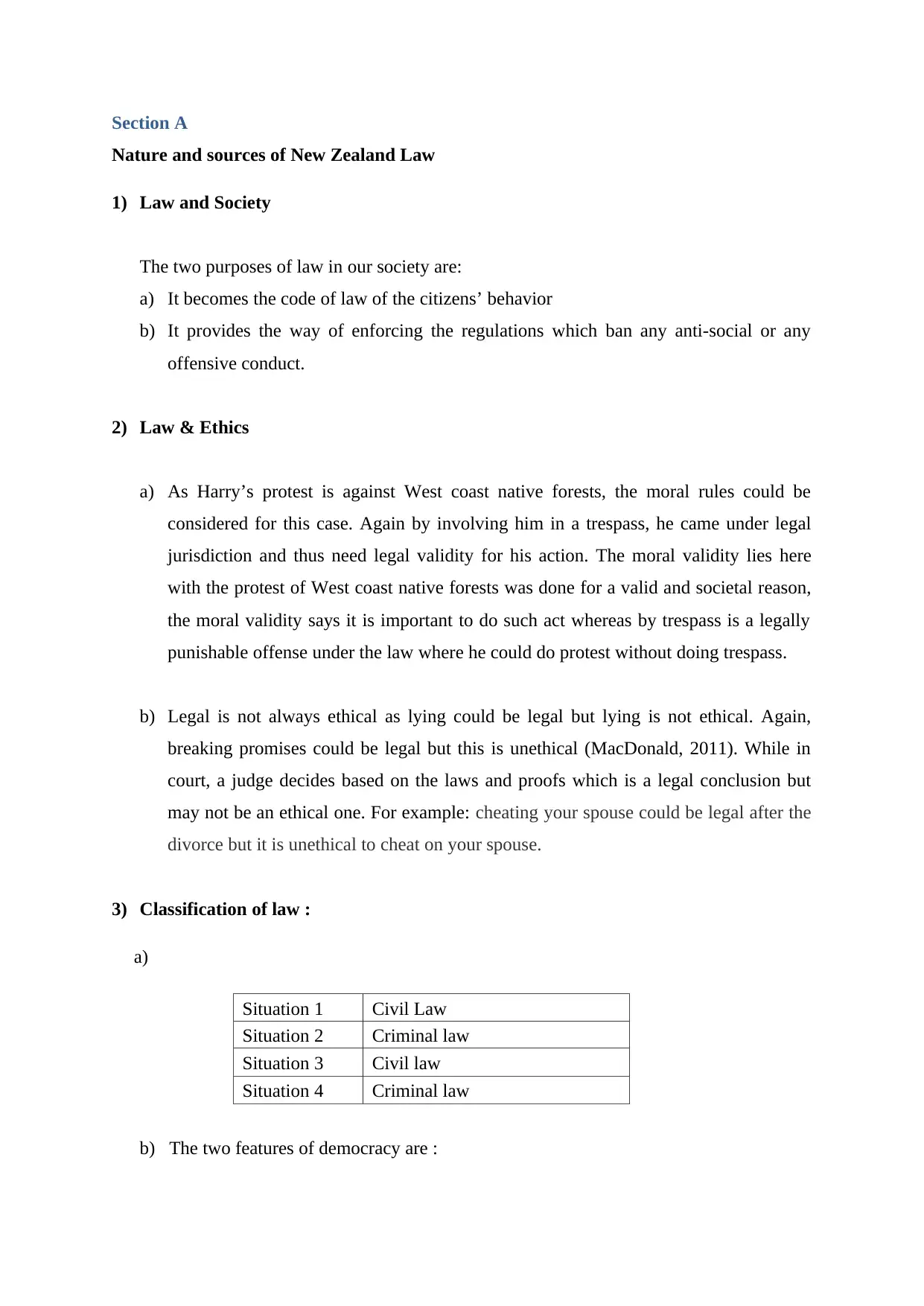
Section A
Nature and sources of New Zealand Law
1) Law and Society
The two purposes of law in our society are:
a) It becomes the code of law of the citizens’ behavior
b) It provides the way of enforcing the regulations which ban any anti-social or any
offensive conduct.
2) Law & Ethics
a) As Harry’s protest is against West coast native forests, the moral rules could be
considered for this case. Again by involving him in a trespass, he came under legal
jurisdiction and thus need legal validity for his action. The moral validity lies here
with the protest of West coast native forests was done for a valid and societal reason,
the moral validity says it is important to do such act whereas by trespass is a legally
punishable offense under the law where he could do protest without doing trespass.
b) Legal is not always ethical as lying could be legal but lying is not ethical. Again,
breaking promises could be legal but this is unethical (MacDonald, 2011). While in
court, a judge decides based on the laws and proofs which is a legal conclusion but
may not be an ethical one. For example: cheating your spouse could be legal after the
divorce but it is unethical to cheat on your spouse.
3) Classification of law :
a)
Situation 1 Civil Law
Situation 2 Criminal law
Situation 3 Civil law
Situation 4 Criminal law
b) The two features of democracy are :
Nature and sources of New Zealand Law
1) Law and Society
The two purposes of law in our society are:
a) It becomes the code of law of the citizens’ behavior
b) It provides the way of enforcing the regulations which ban any anti-social or any
offensive conduct.
2) Law & Ethics
a) As Harry’s protest is against West coast native forests, the moral rules could be
considered for this case. Again by involving him in a trespass, he came under legal
jurisdiction and thus need legal validity for his action. The moral validity lies here
with the protest of West coast native forests was done for a valid and societal reason,
the moral validity says it is important to do such act whereas by trespass is a legally
punishable offense under the law where he could do protest without doing trespass.
b) Legal is not always ethical as lying could be legal but lying is not ethical. Again,
breaking promises could be legal but this is unethical (MacDonald, 2011). While in
court, a judge decides based on the laws and proofs which is a legal conclusion but
may not be an ethical one. For example: cheating your spouse could be legal after the
divorce but it is unethical to cheat on your spouse.
3) Classification of law :
a)
Situation 1 Civil Law
Situation 2 Criminal law
Situation 3 Civil law
Situation 4 Criminal law
b) The two features of democracy are :
Paraphrase This Document
Need a fresh take? Get an instant paraphrase of this document with our AI Paraphraser
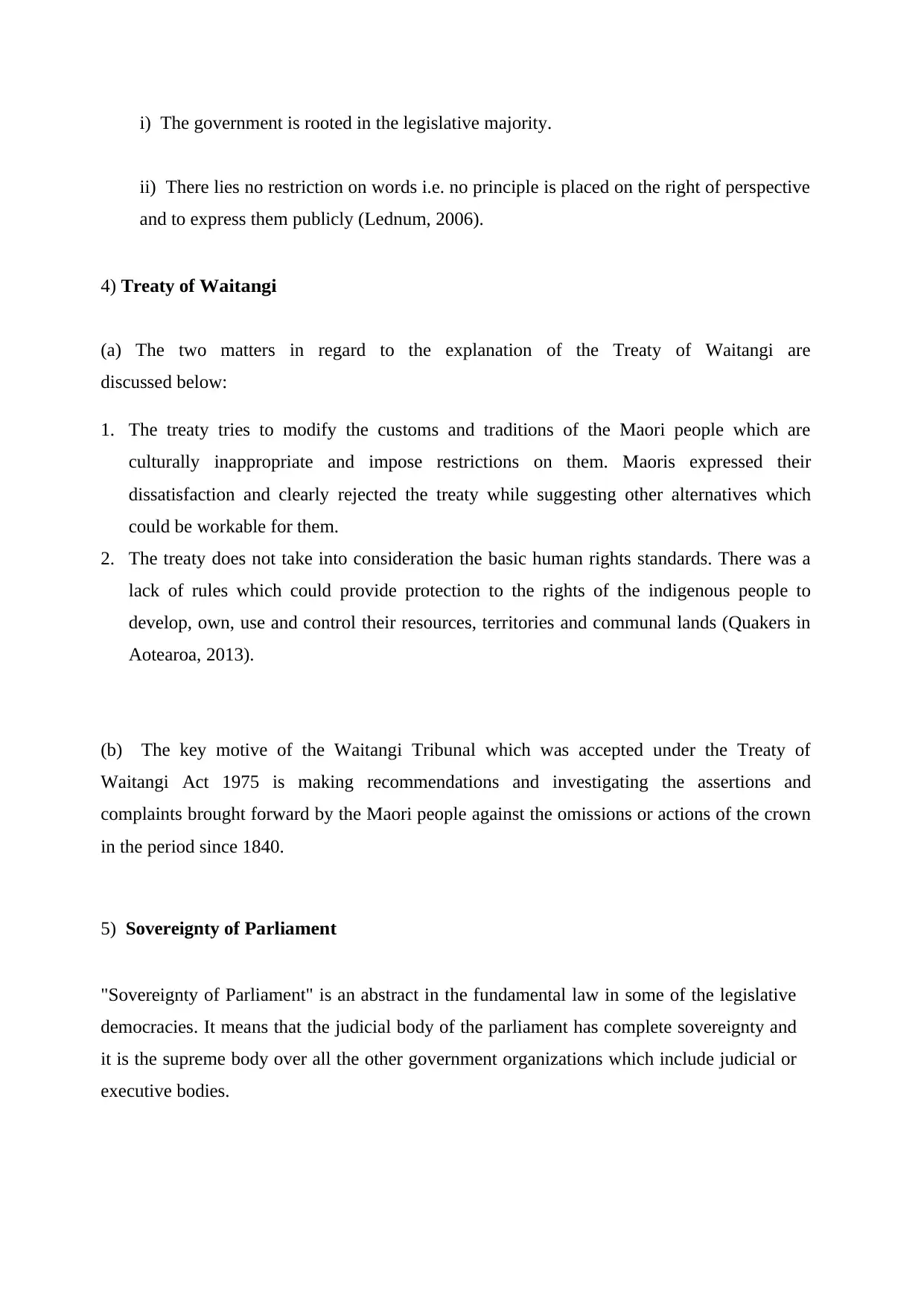
i) The government is rooted in the legislative majority.
ii) There lies no restriction on words i.e. no principle is placed on the right of perspective
and to express them publicly (Lednum, 2006).
4) Treaty of Waitangi
(a) The two matters in regard to the explanation of the Treaty of Waitangi are
discussed below:
1. The treaty tries to modify the customs and traditions of the Maori people which are
culturally inappropriate and impose restrictions on them. Maoris expressed their
dissatisfaction and clearly rejected the treaty while suggesting other alternatives which
could be workable for them.
2. The treaty does not take into consideration the basic human rights standards. There was a
lack of rules which could provide protection to the rights of the indigenous people to
develop, own, use and control their resources, territories and communal lands (Quakers in
Aotearoa, 2013).
(b) The key motive of the Waitangi Tribunal which was accepted under the Treaty of
Waitangi Act 1975 is making recommendations and investigating the assertions and
complaints brought forward by the Maori people against the omissions or actions of the crown
in the period since 1840.
5) Sovereignty of Parliament
"Sovereignty of Parliament" is an abstract in the fundamental law in some of the legislative
democracies. It means that the judicial body of the parliament has complete sovereignty and
it is the supreme body over all the other government organizations which include judicial or
executive bodies.
ii) There lies no restriction on words i.e. no principle is placed on the right of perspective
and to express them publicly (Lednum, 2006).
4) Treaty of Waitangi
(a) The two matters in regard to the explanation of the Treaty of Waitangi are
discussed below:
1. The treaty tries to modify the customs and traditions of the Maori people which are
culturally inappropriate and impose restrictions on them. Maoris expressed their
dissatisfaction and clearly rejected the treaty while suggesting other alternatives which
could be workable for them.
2. The treaty does not take into consideration the basic human rights standards. There was a
lack of rules which could provide protection to the rights of the indigenous people to
develop, own, use and control their resources, territories and communal lands (Quakers in
Aotearoa, 2013).
(b) The key motive of the Waitangi Tribunal which was accepted under the Treaty of
Waitangi Act 1975 is making recommendations and investigating the assertions and
complaints brought forward by the Maori people against the omissions or actions of the crown
in the period since 1840.
5) Sovereignty of Parliament
"Sovereignty of Parliament" is an abstract in the fundamental law in some of the legislative
democracies. It means that the judicial body of the parliament has complete sovereignty and
it is the supreme body over all the other government organizations which include judicial or
executive bodies.
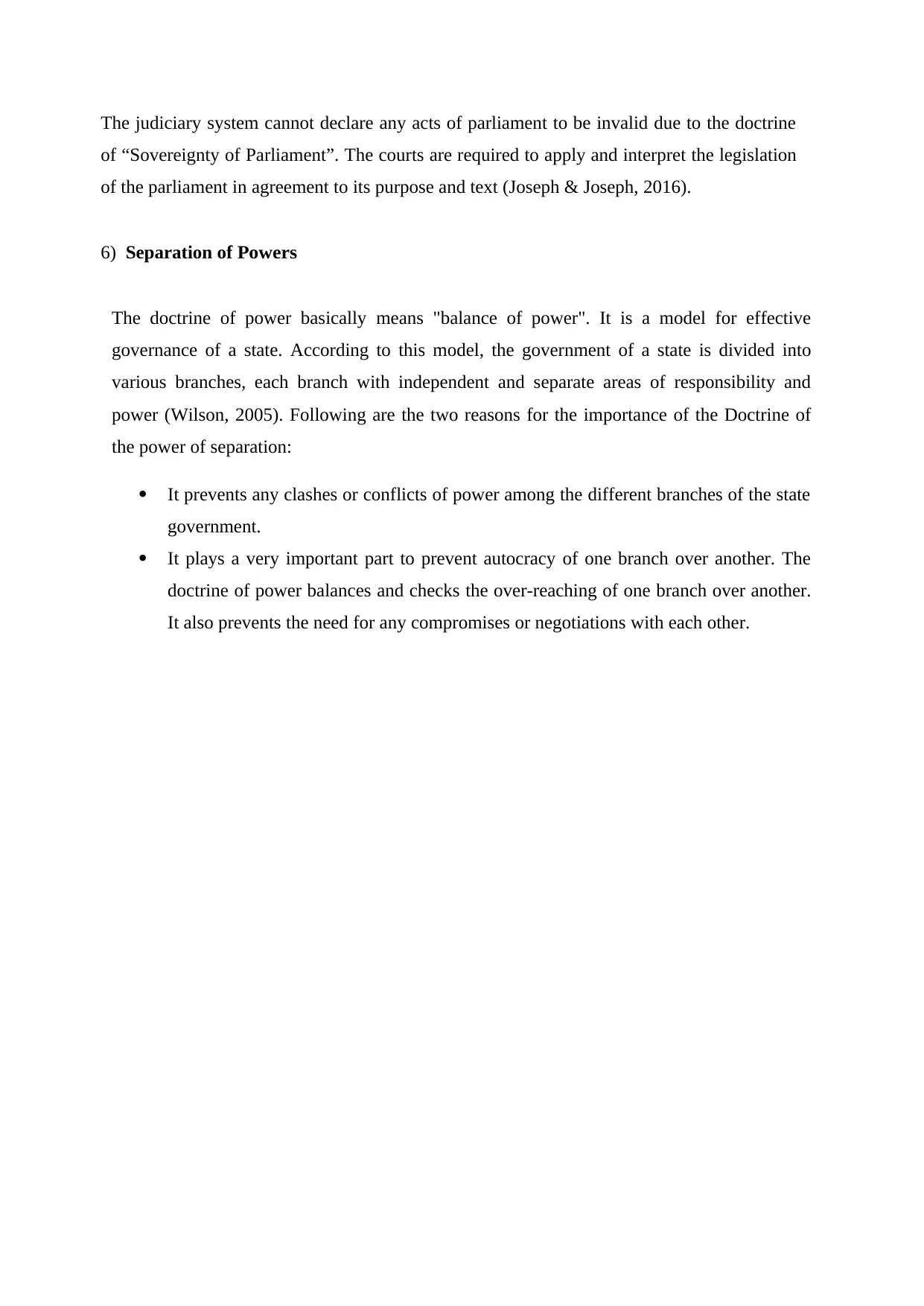
The judiciary system cannot declare any acts of parliament to be invalid due to the doctrine
of “Sovereignty of Parliament”. The courts are required to apply and interpret the legislation
of the parliament in agreement to its purpose and text (Joseph & Joseph, 2016).
6) Separation of Powers
The doctrine of power basically means "balance of power". It is a model for effective
governance of a state. According to this model, the government of a state is divided into
various branches, each branch with independent and separate areas of responsibility and
power (Wilson, 2005). Following are the two reasons for the importance of the Doctrine of
the power of separation:
It prevents any clashes or conflicts of power among the different branches of the state
government.
It plays a very important part to prevent autocracy of one branch over another. The
doctrine of power balances and checks the over-reaching of one branch over another.
It also prevents the need for any compromises or negotiations with each other.
of “Sovereignty of Parliament”. The courts are required to apply and interpret the legislation
of the parliament in agreement to its purpose and text (Joseph & Joseph, 2016).
6) Separation of Powers
The doctrine of power basically means "balance of power". It is a model for effective
governance of a state. According to this model, the government of a state is divided into
various branches, each branch with independent and separate areas of responsibility and
power (Wilson, 2005). Following are the two reasons for the importance of the Doctrine of
the power of separation:
It prevents any clashes or conflicts of power among the different branches of the state
government.
It plays a very important part to prevent autocracy of one branch over another. The
doctrine of power balances and checks the over-reaching of one branch over another.
It also prevents the need for any compromises or negotiations with each other.
⊘ This is a preview!⊘
Do you want full access?
Subscribe today to unlock all pages.
Trusted by 1+ million students worldwide
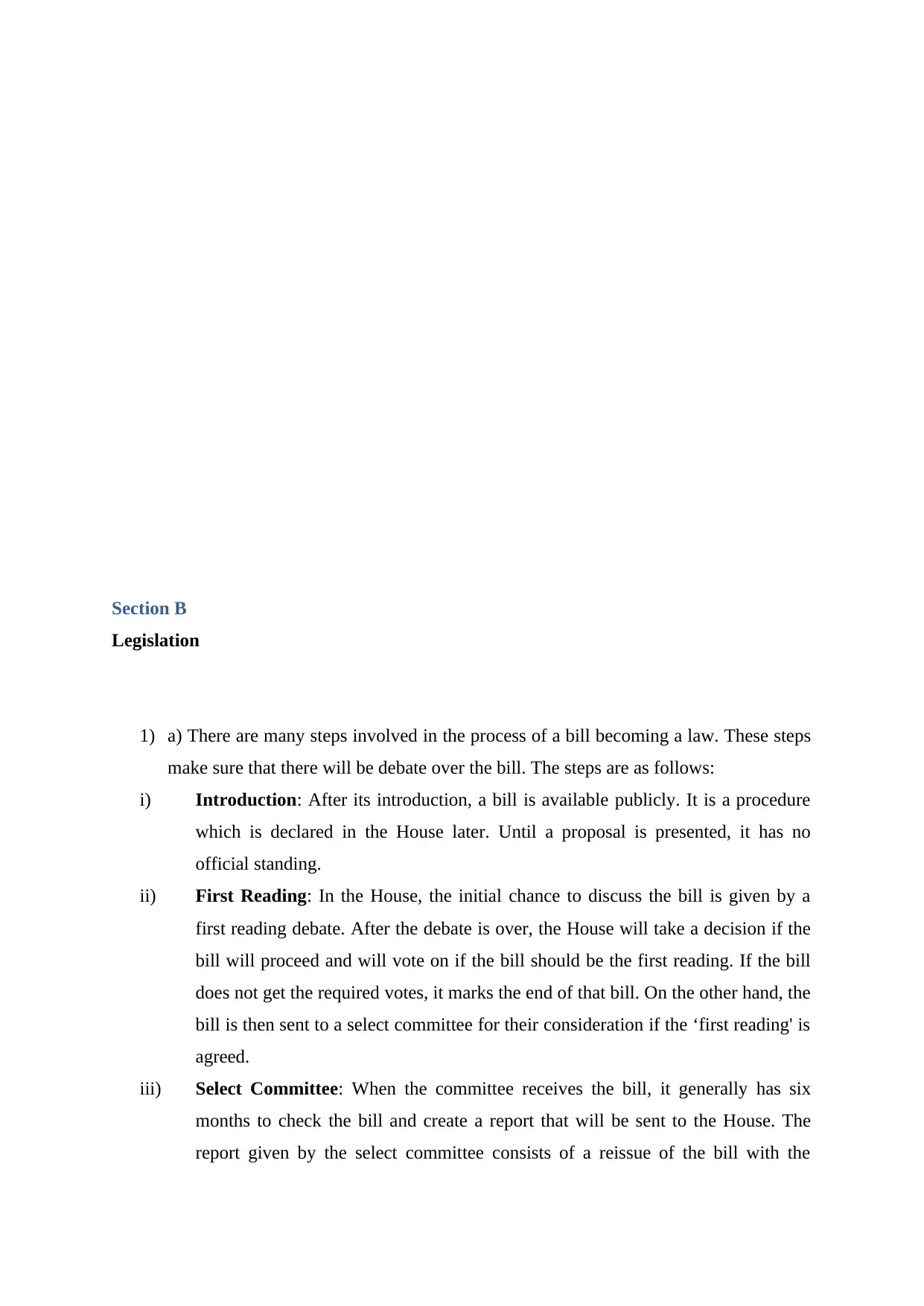
Section B
Legislation
1) a) There are many steps involved in the process of a bill becoming a law. These steps
make sure that there will be debate over the bill. The steps are as follows:
i) Introduction: After its introduction, a bill is available publicly. It is a procedure
which is declared in the House later. Until a proposal is presented, it has no
official standing.
ii) First Reading: In the House, the initial chance to discuss the bill is given by a
first reading debate. After the debate is over, the House will take a decision if the
bill will proceed and will vote on if the bill should be the first reading. If the bill
does not get the required votes, it marks the end of that bill. On the other hand, the
bill is then sent to a select committee for their consideration if the ‘first reading' is
agreed.
iii) Select Committee: When the committee receives the bill, it generally has six
months to check the bill and create a report that will be sent to the House. The
report given by the select committee consists of a reissue of the bill with the
Legislation
1) a) There are many steps involved in the process of a bill becoming a law. These steps
make sure that there will be debate over the bill. The steps are as follows:
i) Introduction: After its introduction, a bill is available publicly. It is a procedure
which is declared in the House later. Until a proposal is presented, it has no
official standing.
ii) First Reading: In the House, the initial chance to discuss the bill is given by a
first reading debate. After the debate is over, the House will take a decision if the
bill will proceed and will vote on if the bill should be the first reading. If the bill
does not get the required votes, it marks the end of that bill. On the other hand, the
bill is then sent to a select committee for their consideration if the ‘first reading' is
agreed.
iii) Select Committee: When the committee receives the bill, it generally has six
months to check the bill and create a report that will be sent to the House. The
report given by the select committee consists of a reissue of the bill with the
Paraphrase This Document
Need a fresh take? Get an instant paraphrase of this document with our AI Paraphraser
necessary changes that are received from the public hearings. These changes are
known as amendments. The committee also explains the changes recommended
and the issues that have been considered (New Zealand Parliament, 2016).
iv) Second Reading: When the House receives the report, the bill can be read again.
The select committee will implement certain adjustments which will be debated in
the House. When the debate is over, the adjustments that are not endorsed by the
members are subject to a single vote. Similarly, the changes that are assisted are
automatically included in the bill. The bill won’t go forward if it does not get the
required votes. The House will discuss the bill if they agree on the second reading.
v) Committee of the whole House: When the committee of the whole House
discusses a bill, any member can participate. When the members agree upon the
final form of the bill, then it is reprinted to show the changes. The bill will then
proceed to the third reading.
vi) Third Reading: The bill gets its final shape under this reading. After the debate is
over, then the final vote is conducted where it is decided if it will get passed or
rejected. If the bill passes, the final step is the Royal assent.
vii) Royal assent: The bill won't be turned into law until it is underwritten by the
Governor-General.
b) The role of the Select Committee is very crucial when a bill needs to pass down
Parliament. After the first reading, the Select Committee gets the bill. To examine and
submit a report on the bill, they normally take around six months. The committee also
holds public hearings to listen to the views through public submission. Then they work on
the issues brought up through these submissions and address them by making necessary
changes. While they submit the report, the changes/amendments and issues considered by
them are highlighted (New Zealand Parliament, 2016).
2. a) One of the advantages of delegated legislation is that it enables flexibility in the
administration by being more adaptable to the changing circumstances. Moreover, it also
saves the time of the parliament. The power has to be delegated to the executive branch in
order to settle the volume and complexity of the legislature.
One drawback of authorized legislation is the apparent lack of publicity and debate that
needs to be related to a form of secondary legislation (Ayres, 2016).
known as amendments. The committee also explains the changes recommended
and the issues that have been considered (New Zealand Parliament, 2016).
iv) Second Reading: When the House receives the report, the bill can be read again.
The select committee will implement certain adjustments which will be debated in
the House. When the debate is over, the adjustments that are not endorsed by the
members are subject to a single vote. Similarly, the changes that are assisted are
automatically included in the bill. The bill won’t go forward if it does not get the
required votes. The House will discuss the bill if they agree on the second reading.
v) Committee of the whole House: When the committee of the whole House
discusses a bill, any member can participate. When the members agree upon the
final form of the bill, then it is reprinted to show the changes. The bill will then
proceed to the third reading.
vi) Third Reading: The bill gets its final shape under this reading. After the debate is
over, then the final vote is conducted where it is decided if it will get passed or
rejected. If the bill passes, the final step is the Royal assent.
vii) Royal assent: The bill won't be turned into law until it is underwritten by the
Governor-General.
b) The role of the Select Committee is very crucial when a bill needs to pass down
Parliament. After the first reading, the Select Committee gets the bill. To examine and
submit a report on the bill, they normally take around six months. The committee also
holds public hearings to listen to the views through public submission. Then they work on
the issues brought up through these submissions and address them by making necessary
changes. While they submit the report, the changes/amendments and issues considered by
them are highlighted (New Zealand Parliament, 2016).
2. a) One of the advantages of delegated legislation is that it enables flexibility in the
administration by being more adaptable to the changing circumstances. Moreover, it also
saves the time of the parliament. The power has to be delegated to the executive branch in
order to settle the volume and complexity of the legislature.
One drawback of authorized legislation is the apparent lack of publicity and debate that
needs to be related to a form of secondary legislation (Ayres, 2016).

b) When a delegated legislation is ultra vires, it becomes void and unenforceable. For
example, a contract cannot be entered into unless it is approved by the board. If the
director enters into the contract without proper approval, the contract will become null
and void as the action of the director is ultra vires (Teacher, Law, 2013).
example, a contract cannot be entered into unless it is approved by the board. If the
director enters into the contract without proper approval, the contract will become null
and void as the action of the director is ultra vires (Teacher, Law, 2013).
⊘ This is a preview!⊘
Do you want full access?
Subscribe today to unlock all pages.
Trusted by 1+ million students worldwide

Paraphrase This Document
Need a fresh take? Get an instant paraphrase of this document with our AI Paraphraser
Section C
Statutory Interpretation
a) The literal rule of Statutory Interpretation says that the meaning of the enactment of
law must be established from its text in order to serve the purpose of the law
(Legislation Design and Advisory committee, 2018). It can be further stated as
The words and the text of the enactment that lead to actual meaning
The interpretation of the meaning or expression of the law as the purpose of
the law is to aid exact interpretation.
The literal rule of Statutory Interpretation primarily concerned with the
fulfillment of the purpose for which the action is made. It deals with
interpreting every provision in the Act consistently with the purpose provision.
b) As stated in literal rule of Statutory Interpretation, Barney is answerable for the
offense under s6 (3) of Computer act. The reasons are mentioned below:
Firstly, according to the computer act s6 (3) which says students are not allowed to
use computers for personal use but it is unclear in the act that whether the student can
use his own laptop for any urgent or personal work but again, as it is not specified he
is liable for the offense as act s2 says computers as any portable or handheld
computing device. Again, the second literal rule of interpretation which deals with the
purpose for which the law is made is to prohibit students to involve them in any
activity that could destruct the students' concentration from his studies and classes and
also restrict them involved in any cybercrime events inside the campus. Thus, Barney
is offensive according to the act and the literal rule of Statutory Interpretation.
c) The purposive approach is the purposive construction, an interpretation or the modern
principle in construction to statutory and constitutional interpretation where common
law courts can interpret an enactment which is a statute or a clause of a constitution
for the fulfillment of the purpose of the law for which it is made.
This approach could provide more flexibility to the court in an ambiguous situation
for the court to make decisions. Though this approach deals with subjective
evaluation, it influences the process of interpretation which would not only consider
Statutory Interpretation
a) The literal rule of Statutory Interpretation says that the meaning of the enactment of
law must be established from its text in order to serve the purpose of the law
(Legislation Design and Advisory committee, 2018). It can be further stated as
The words and the text of the enactment that lead to actual meaning
The interpretation of the meaning or expression of the law as the purpose of
the law is to aid exact interpretation.
The literal rule of Statutory Interpretation primarily concerned with the
fulfillment of the purpose for which the action is made. It deals with
interpreting every provision in the Act consistently with the purpose provision.
b) As stated in literal rule of Statutory Interpretation, Barney is answerable for the
offense under s6 (3) of Computer act. The reasons are mentioned below:
Firstly, according to the computer act s6 (3) which says students are not allowed to
use computers for personal use but it is unclear in the act that whether the student can
use his own laptop for any urgent or personal work but again, as it is not specified he
is liable for the offense as act s2 says computers as any portable or handheld
computing device. Again, the second literal rule of interpretation which deals with the
purpose for which the law is made is to prohibit students to involve them in any
activity that could destruct the students' concentration from his studies and classes and
also restrict them involved in any cybercrime events inside the campus. Thus, Barney
is offensive according to the act and the literal rule of Statutory Interpretation.
c) The purposive approach is the purposive construction, an interpretation or the modern
principle in construction to statutory and constitutional interpretation where common
law courts can interpret an enactment which is a statute or a clause of a constitution
for the fulfillment of the purpose of the law for which it is made.
This approach could provide more flexibility to the court in an ambiguous situation
for the court to make decisions. Though this approach deals with subjective
evaluation, it influences the process of interpretation which would not only consider
the literal rule but would also consider other parameters including the background of
the accused person and reasons for making the offense by aiding the court with
difficult statutory interpretation.
d) By applying a purposive approach, the intrinsic aid in Barney case would be the
definition of the clause that says computer use for a personal reason is prohibited and
for which he is found liable for this act.
The extrinsic aid includes object and reason, in this case, Barney uses his personal
laptop which is the object here and the reason is he unplugged the institution
computer and plugged his laptop to receive and read his boss’s important email.
the accused person and reasons for making the offense by aiding the court with
difficult statutory interpretation.
d) By applying a purposive approach, the intrinsic aid in Barney case would be the
definition of the clause that says computer use for a personal reason is prohibited and
for which he is found liable for this act.
The extrinsic aid includes object and reason, in this case, Barney uses his personal
laptop which is the object here and the reason is he unplugged the institution
computer and plugged his laptop to receive and read his boss’s important email.
⊘ This is a preview!⊘
Do you want full access?
Subscribe today to unlock all pages.
Trusted by 1+ million students worldwide

1 out of 17


Your All-in-One AI-Powered Toolkit for Academic Success.
+13062052269
info@desklib.com
Available 24*7 on WhatsApp / Email
![[object Object]](/_next/static/media/star-bottom.7253800d.svg)
Unlock your academic potential
Copyright © 2020–2026 A2Z Services. All Rights Reserved. Developed and managed by ZUCOL.