Attachment Formation: Newborn Care, Early Bonding, and Parental Roles

Verified

Added on  2022/09/14

|2
|372
|20
Homework Assignment
AI Summary
This assignment delves into the critical topic of newborn attachment, exploring the profound impact of early bonding between mothers and their infants. It emphasizes the significance of immediate postnatal care, highlighting how a secure attachment can positively influence both the baby's well-being and the mother's emotional state. The assignment acknowledges situations where medical interventions may temporarily hinder this process and stresses the importance of individualized care, particularly for first-time mothers. It also references studies that support the role of consistent caregiving in fostering trust and dependence, ultimately leading to a strong mother-infant bond. The assignment underscores the need for nurses to support this process, ensuring that mothers are equipped to meet their babies' needs, thereby promoting healthy development and attachment.
Document Page
Forming an attachment
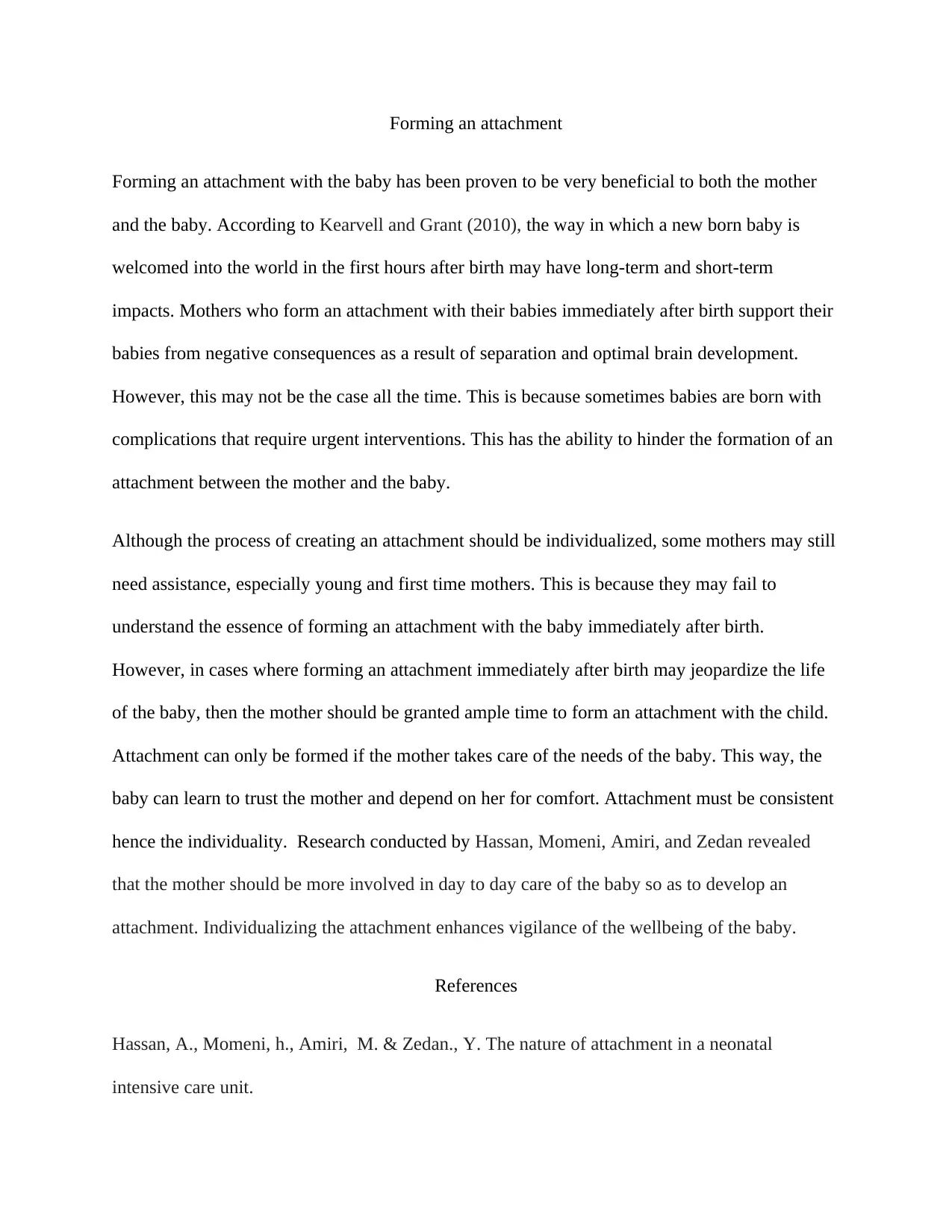
Forming an attachment with the baby has been proven to be very beneficial to both the mother
and the baby. According to Kearvell and Grant (2010), the way in which a new born baby is
welcomed into the world in the first hours after birth may have long-term and short-term
impacts. Mothers who form an attachment with their babies immediately after birth support their
babies from negative consequences as a result of separation and optimal brain development.
However, this may not be the case all the time. This is because sometimes babies are born with
complications that require urgent interventions. This has the ability to hinder the formation of an
attachment between the mother and the baby.
Although the process of creating an attachment should be individualized, some mothers may still
need assistance, especially young and first time mothers. This is because they may fail to
understand the essence of forming an attachment with the baby immediately after birth.
However, in cases where forming an attachment immediately after birth may jeopardize the life
of the baby, then the mother should be granted ample time to form an attachment with the child.
Attachment can only be formed if the mother takes care of the needs of the baby. This way, the
baby can learn to trust the mother and depend on her for comfort. Attachment must be consistent
hence the individuality. Research conducted by Hassan, Momeni, Amiri, and Zedan revealed
that the mother should be more involved in day to day care of the baby so as to develop an
attachment. Individualizing the attachment enhances vigilance of the wellbeing of the baby.
References
Hassan, A., Momeni, h., Amiri, M. & Zedan., Y. The nature of attachment in a neonatal
intensive care unit.
tabler-icon-diamond-filled.svg

Paraphrase This Document

Need a fresh take? Get an instant paraphrase of this document with our AI Paraphraser
Document Page
Kearvell, H., & Grant, J. (2010). Getting connected: How nurses can support mother/infant
attachment in the neonatal intensive care unit. Australian Journal of Advanced Nursing,
The, 27(3), 75.
chevron_up_icon
1 out of 2
circle_padding
hide_on_mobile
zoom_out_icon
[object Object]