INFS 5093 SP2 - Systems Design: A Case Study on Nexus Distribution
VerifiedAdded on 2023/06/11
|20
|6312
|463
Case Study
AI Summary
This assignment presents a comprehensive case study focusing on the systems design for Nexus Distribution, a small film distribution agency. It includes an analysis of their existing information system, the challenges they face with communication and collaboration, and the need for a new app to streamline their business processes. The assignment covers various aspects of systems design, including database management, user interface design, ethical considerations, and risk identification. It also incorporates an ethical analysis, a conceptual development section exploring the impact of systems design tasks, and a learning reflection section. The case study requires the application of systems design principles to address Nexus Distribution's specific needs and improve their overall operational efficiency. The document also has a feedback sheet that lists the assessment criteria.
Business Systems Analysis INFS 5093
SP2 2018 Systems Design Assignment
Introduction
This document extends the instructions on the course website. Read the instructions on the course
website in addition to this document.
This assessment consists of
A case study that requires you to apply your learning from the systems planning module.
An ethical analysis which requires you to apply one of the readings provided on the course
website.
A conceptual development section that requires you to consider how systems planning tasks
impact on a systems development project.
A learning reflection section.
The feedback sheet lists the assessment criteria. Look for it on the assessment’s webpage. Take note
of which sections carry the most marks.
Note that this document’s word count is 3969 without any answers, so
Don’t worry if the final word count seems high.
Also, there are some diagrams in this assessment so don’t worry if the final word count seems
low.
Draw the diagrams by hand, photograph, and insert the photographs in this file. If you prefer, you
can use Word’s drawing tools (or some other drawing or modelling software) but you may find
working with pen and paper is faster, easier to amend, less cumbersome, and more reliable with
respect to layout.
When referring to the exemplars on the course website, read the old assessment specifications
carefully because the assessments differ every study period.
Instructions
In the previous study period, students spent an average of 29 hours on this assessment.
Pace yourself accordingly.
For best results
o Do not attempt to complete the whole assessment in one session.
o Work slowly and carefully.
In addition to the instructions on the course website
Do not overlook the ‘Why?’ questions.
Read the case study carefully.
1
SP2 2018 Systems Design Assignment
Introduction
This document extends the instructions on the course website. Read the instructions on the course
website in addition to this document.
This assessment consists of
A case study that requires you to apply your learning from the systems planning module.
An ethical analysis which requires you to apply one of the readings provided on the course
website.
A conceptual development section that requires you to consider how systems planning tasks
impact on a systems development project.
A learning reflection section.
The feedback sheet lists the assessment criteria. Look for it on the assessment’s webpage. Take note
of which sections carry the most marks.
Note that this document’s word count is 3969 without any answers, so
Don’t worry if the final word count seems high.
Also, there are some diagrams in this assessment so don’t worry if the final word count seems
low.
Draw the diagrams by hand, photograph, and insert the photographs in this file. If you prefer, you
can use Word’s drawing tools (or some other drawing or modelling software) but you may find
working with pen and paper is faster, easier to amend, less cumbersome, and more reliable with
respect to layout.
When referring to the exemplars on the course website, read the old assessment specifications
carefully because the assessments differ every study period.
Instructions
In the previous study period, students spent an average of 29 hours on this assessment.
Pace yourself accordingly.
For best results
o Do not attempt to complete the whole assessment in one session.
o Work slowly and carefully.
In addition to the instructions on the course website
Do not overlook the ‘Why?’ questions.
Read the case study carefully.
1

Paraphrase This Document
Need a fresh take? Get an instant paraphrase of this document with our AI Paraphraser
Keep track of the hours you spend.
Make assumptions where necessary. Scope for assumptions has been deliberately included in this
assessment because it is often necessary to make assumptions openly when dealing with a client
who is under-informed with respect to information systems. Label assumptions clearly. Here’s an
example from a previous study period,
Assumption: As the passengers of Titanic II may be from any nation, we have assumed a
currency converter is required for the ticket-purchasing function.
Case study: Nexus Distribution
From the systems planning assignment
Nexus Distribution is a small film distribution agency that focuses on limited release art-house films.
It has been in business for a decade and has an existing information system for administering its
business processes. Joy Moody started Nexus with her long-time professional contact Deane
Jackson. Joy has a leadership and marketing role and Deane manages operations. Louise Taylor and
Elizabeth Page are spotters who attend film festivals (eg Sundance, Cannes, Sydney, Toronto,
London, etc), identifying films that align with the Nexus Distribution focus, bidding for, and often
signing, those films. This team of four work closely to sign 15-20 films each year, optimising the
distribution of each film so that returns for Nexus and for their clients (the film-makers and the
theatres) are maximised.
The existing information system consists of three databases.
Catalogue
DistributionNetwork
Travel
Louise and Elizabeth do most of their work while travelling and they communicate with Deane via
email, text messaging and phone calls. Louise and Elizabeth attend only the largest film festivals
together; usually they work independently of each other. When they are at a film festival, they work
highly irregular hours and, in addition to the tasks outlined above, their work includes socialising
with, and occasionally entertaining, potential and existing clients. Clients are entertained when the
film they have made is of such high quality that more than one distribution agency is competing for
its distribution rights. In these cases, Elizabeth and Louise take the clients out for dinner or to a bar
in order to build robust working relationships and to create an opportunity for uninterrupted
discussion of why and how the client’s interests are best served by Nexus. Louise and Elizabeth are
consummate networkers; they are confident, good-humoured and charming in all social
circumstances, building relationships with and between people working at all levels of the
international art-house film industry.
However, the communication practices between Nexus staff are not up to date and this has led to
inefficiencies and wastage of Louise and Elizabeth’s talents and efforts. As their time at film festivals
is expensive (flights, accommodation, registration fees, entertainment costs, etc) it is desirable that
their time is not wasted. For example, a new film may be shown at several film festivals
simultaneously; if Elizabeth has already seen it at Toronto and passed on it (or bid for it and signed
it), when Louise is at the Venice film festival, she does not need to waste her time viewing that film
2
Make assumptions where necessary. Scope for assumptions has been deliberately included in this
assessment because it is often necessary to make assumptions openly when dealing with a client
who is under-informed with respect to information systems. Label assumptions clearly. Here’s an
example from a previous study period,
Assumption: As the passengers of Titanic II may be from any nation, we have assumed a
currency converter is required for the ticket-purchasing function.
Case study: Nexus Distribution
From the systems planning assignment
Nexus Distribution is a small film distribution agency that focuses on limited release art-house films.
It has been in business for a decade and has an existing information system for administering its
business processes. Joy Moody started Nexus with her long-time professional contact Deane
Jackson. Joy has a leadership and marketing role and Deane manages operations. Louise Taylor and
Elizabeth Page are spotters who attend film festivals (eg Sundance, Cannes, Sydney, Toronto,
London, etc), identifying films that align with the Nexus Distribution focus, bidding for, and often
signing, those films. This team of four work closely to sign 15-20 films each year, optimising the
distribution of each film so that returns for Nexus and for their clients (the film-makers and the
theatres) are maximised.
The existing information system consists of three databases.
Catalogue
DistributionNetwork
Travel
Louise and Elizabeth do most of their work while travelling and they communicate with Deane via
email, text messaging and phone calls. Louise and Elizabeth attend only the largest film festivals
together; usually they work independently of each other. When they are at a film festival, they work
highly irregular hours and, in addition to the tasks outlined above, their work includes socialising
with, and occasionally entertaining, potential and existing clients. Clients are entertained when the
film they have made is of such high quality that more than one distribution agency is competing for
its distribution rights. In these cases, Elizabeth and Louise take the clients out for dinner or to a bar
in order to build robust working relationships and to create an opportunity for uninterrupted
discussion of why and how the client’s interests are best served by Nexus. Louise and Elizabeth are
consummate networkers; they are confident, good-humoured and charming in all social
circumstances, building relationships with and between people working at all levels of the
international art-house film industry.
However, the communication practices between Nexus staff are not up to date and this has led to
inefficiencies and wastage of Louise and Elizabeth’s talents and efforts. As their time at film festivals
is expensive (flights, accommodation, registration fees, entertainment costs, etc) it is desirable that
their time is not wasted. For example, a new film may be shown at several film festivals
simultaneously; if Elizabeth has already seen it at Toronto and passed on it (or bid for it and signed
it), when Louise is at the Venice film festival, she does not need to waste her time viewing that film
2
and can focus on other films. There are many other instances in which their communication
practices fail to optimise the (mostly asynchronous) day-to-day collaborations between Louise,
Elizabeth and Deane.
While Louise and Elizabeth work on building Nexus’s catalogue, Deane builds its distribution network
(in addition to his significant administrative role). This entails signing various distribution service
providers (both independent and chain) to the Nexus distribution network. A distribution service
provider might be a VOD (Video on Demand) provider, a chain of theatres, an independent theatre,
etc. Deane spends about half of his recruitment effort approaching providers that do not already
screen art-house films. The other half is spent on providers which already adopt an art-house focus.
While it is a key facet of the Nexus business model, building the distribution network does not
consume anywhere near as much effort, money and time as spotting films. Deane estimates that for
every dollar spent on building the distribution network, a hundred are spent on spotting films.
Deane is directly responsible for accounting, travel arrangements and reporting. Also, he is indirectly
responsible for contracts, which he outsources to a legal firm specialising in contracts for this type of
work.
Joy’s role is largely centred on vision and leadership. However, prior to starting Nexus she built a
reputation in film marketing and her practical skills in this area are an essential ingredient in Nexus’s
success. Every time a new film is signed to Nexus, Joy, Deane, Louise, Elizabeth and the film-makers
have a four hour meeting. Occasionally, these meetings are in person, but more often they are held
online. These meetings can be hard to schedule because participants are very busy and in different
time zones.
During these meetings, in order to design the film’s marketing strategy, they leverage Louise or
Elizabeth’s observations of the film, Deane’s knowledge of the Nexus distribution network, Joy’s
marketing expertise and the client’s vision. A marketing strategy includes artistic vision, media,
release windows and release schedule.
Artistic vision is primarily driven by the client and Joy with input from Louise or Elizabeth. It is
actioned by Deane, who reviews the artists who have worked with Nexus in the past, considers the
artistic vision, and prioritises the artists according to how well their unique talent, reliability and
experience match up with the marketing strategy’s artistic vision. After the meeting, Deane
approaches the artists one by one to discuss their availability and to eventually establish a contract.
Media (film, video, television, DVD, VOD, etc) is negotiated between Joy, whose mission is to
optimise returns, and the film-maker, whose mission is exposure. With input from Louise and
Elizabeth, who have viewed more films than anyone else in the meeting and who therefore have the
most comprehensive view of the international market, a binding consensus is reached and
documented.
Joy and Deane, who aim to maximise the size of the audience, are largely responsible for
determining release windows and schedule, however the client’s needs are taken into consideration.
This is achieved by application of market intelligence and expertise. In most cases, a film is screened
in theatres on a schedule that will maximise the audience (eg avoidance of major cultural events,
avoidance of similar films, knowledge of forthcoming films, etc). Also, films are screened in theatres
3
practices fail to optimise the (mostly asynchronous) day-to-day collaborations between Louise,
Elizabeth and Deane.
While Louise and Elizabeth work on building Nexus’s catalogue, Deane builds its distribution network
(in addition to his significant administrative role). This entails signing various distribution service
providers (both independent and chain) to the Nexus distribution network. A distribution service
provider might be a VOD (Video on Demand) provider, a chain of theatres, an independent theatre,
etc. Deane spends about half of his recruitment effort approaching providers that do not already
screen art-house films. The other half is spent on providers which already adopt an art-house focus.
While it is a key facet of the Nexus business model, building the distribution network does not
consume anywhere near as much effort, money and time as spotting films. Deane estimates that for
every dollar spent on building the distribution network, a hundred are spent on spotting films.
Deane is directly responsible for accounting, travel arrangements and reporting. Also, he is indirectly
responsible for contracts, which he outsources to a legal firm specialising in contracts for this type of
work.
Joy’s role is largely centred on vision and leadership. However, prior to starting Nexus she built a
reputation in film marketing and her practical skills in this area are an essential ingredient in Nexus’s
success. Every time a new film is signed to Nexus, Joy, Deane, Louise, Elizabeth and the film-makers
have a four hour meeting. Occasionally, these meetings are in person, but more often they are held
online. These meetings can be hard to schedule because participants are very busy and in different
time zones.
During these meetings, in order to design the film’s marketing strategy, they leverage Louise or
Elizabeth’s observations of the film, Deane’s knowledge of the Nexus distribution network, Joy’s
marketing expertise and the client’s vision. A marketing strategy includes artistic vision, media,
release windows and release schedule.
Artistic vision is primarily driven by the client and Joy with input from Louise or Elizabeth. It is
actioned by Deane, who reviews the artists who have worked with Nexus in the past, considers the
artistic vision, and prioritises the artists according to how well their unique talent, reliability and
experience match up with the marketing strategy’s artistic vision. After the meeting, Deane
approaches the artists one by one to discuss their availability and to eventually establish a contract.
Media (film, video, television, DVD, VOD, etc) is negotiated between Joy, whose mission is to
optimise returns, and the film-maker, whose mission is exposure. With input from Louise and
Elizabeth, who have viewed more films than anyone else in the meeting and who therefore have the
most comprehensive view of the international market, a binding consensus is reached and
documented.
Joy and Deane, who aim to maximise the size of the audience, are largely responsible for
determining release windows and schedule, however the client’s needs are taken into consideration.
This is achieved by application of market intelligence and expertise. In most cases, a film is screened
in theatres on a schedule that will maximise the audience (eg avoidance of major cultural events,
avoidance of similar films, knowledge of forthcoming films, etc). Also, films are screened in theatres
3
⊘ This is a preview!⊘
Do you want full access?
Subscribe today to unlock all pages.

Trusted by 1+ million students worldwide
(primary distribution service providers) prior to being released via secondary distribution service
providers (eg VOD service providers, DVD runs, etc). The duration for which the film is screened in
theatres depends upon various factors (audience, the film’s performance in other markets, the
agreement between Nexus and the film-makers, the agreement between Nexus and the theatres,
etc). For most films, the theatrical release date is preceded by four weeks of postering and trailers,
wherever possible working with the film-makers in order to leverage the social profiles of those who
worked on the film (eg the actors and crew). For highly anticipated films, these four weeks may
extend to six or eight and may require Deane to schedule interviews for the film-makers or actors
with local media.
Although the existing IS meets Nexus’s administrative needs, the ongoing daily communication
problems and the difficulties of scheduling and running online meetings need to be addressed.
Deane thinks Nexus needs its own app so that database updates can be done by anyone at any time
and he has contacted your workplace, IT Foundry, to enquire further. You have been allocated the
task of systems planning for the development of an app for Nexus.
Also, although they are very talented, experienced and respected in their fields, the entire Nexus
team are inexperienced in systems analysis and design. They are confident you will come up with
relevant ideas, they anticipate your suggestions and they expect you to catalyse and drive all
technical aspects of the project. These clients are very much open to suggestion.
From the systems analysis assignment
The preliminary investigation you wrote up for the Nexus project enabled you to develop a basic
understanding of the business context. Your scope lists captured the project’s key elements and
made a positive impression on Joy, Deane, Louise and Elizabeth. They have approved the project’s
progression to system analysis and you have scheduled a meeting with them.
After this meeting, the following requirements are known:
Louise and Elizabeth must be able to enter data into the Catalogue database from their
smartphones
Louise and Elizabeth must be able to query the Catalogue database with their smartphones
o For example, when they are planning their viewing schedule Louise and Elizabeth need
to be able to check whether a film has already been viewed and signed (or passed on)
Dean must be able to enter, access and amend data in the Travel and DistributionNetwork
databases from his smartphone and from his desktop computer
Louise and Elizabeth must be able to view future travel itineraries and hotel bookings on their
smartphones
Louise and Elizabeth must be able to enter, access and amend information on their relationships
with clients or contacts from their smartphones
o For example, a new client or contact’s name; if they are a filmmaker (a director or a
producer), which film and how were they involved with that film; if they’re not a
filmmaker, what their business is and why the relationship is important to Nexus;
whether the client or contact was made by Louise or Elizabeth; when and where the
client or contact was made; their entertainment preferences; etc
o A new database will be needed for this relationship data
4
providers (eg VOD service providers, DVD runs, etc). The duration for which the film is screened in
theatres depends upon various factors (audience, the film’s performance in other markets, the
agreement between Nexus and the film-makers, the agreement between Nexus and the theatres,
etc). For most films, the theatrical release date is preceded by four weeks of postering and trailers,
wherever possible working with the film-makers in order to leverage the social profiles of those who
worked on the film (eg the actors and crew). For highly anticipated films, these four weeks may
extend to six or eight and may require Deane to schedule interviews for the film-makers or actors
with local media.
Although the existing IS meets Nexus’s administrative needs, the ongoing daily communication
problems and the difficulties of scheduling and running online meetings need to be addressed.
Deane thinks Nexus needs its own app so that database updates can be done by anyone at any time
and he has contacted your workplace, IT Foundry, to enquire further. You have been allocated the
task of systems planning for the development of an app for Nexus.
Also, although they are very talented, experienced and respected in their fields, the entire Nexus
team are inexperienced in systems analysis and design. They are confident you will come up with
relevant ideas, they anticipate your suggestions and they expect you to catalyse and drive all
technical aspects of the project. These clients are very much open to suggestion.
From the systems analysis assignment
The preliminary investigation you wrote up for the Nexus project enabled you to develop a basic
understanding of the business context. Your scope lists captured the project’s key elements and
made a positive impression on Joy, Deane, Louise and Elizabeth. They have approved the project’s
progression to system analysis and you have scheduled a meeting with them.
After this meeting, the following requirements are known:
Louise and Elizabeth must be able to enter data into the Catalogue database from their
smartphones
Louise and Elizabeth must be able to query the Catalogue database with their smartphones
o For example, when they are planning their viewing schedule Louise and Elizabeth need
to be able to check whether a film has already been viewed and signed (or passed on)
Dean must be able to enter, access and amend data in the Travel and DistributionNetwork
databases from his smartphone and from his desktop computer
Louise and Elizabeth must be able to view future travel itineraries and hotel bookings on their
smartphones
Louise and Elizabeth must be able to enter, access and amend information on their relationships
with clients or contacts from their smartphones
o For example, a new client or contact’s name; if they are a filmmaker (a director or a
producer), which film and how were they involved with that film; if they’re not a
filmmaker, what their business is and why the relationship is important to Nexus;
whether the client or contact was made by Louise or Elizabeth; when and where the
client or contact was made; their entertainment preferences; etc
o A new database will be needed for this relationship data
4
Paraphrase This Document
Need a fresh take? Get an instant paraphrase of this document with our AI Paraphraser
Joy must be able to view summaries of recent business activity from her smartphone and from
her desktop computer
Joy wants to be able to tailor these summaries on an ad hoc basis
o Examples include recently established client relationships; recently signed films; Louise
or Elizabeth’s notes on the recently signed films; recently planned travel; an annual
overview of the film festivals attended by Louise and Elizabeth; when and where these
festivals are held, etc.
The whole team must be able to schedule and conduct meetings on smartphones (Joy, Deane,
Louise and Elizabeth) and desktop computers (Joy and Deane)
o Scheduling must account for Louise and Elizabeth’s travel itineraries and for whichever
time zone they will be in at the time and date of the meeting
o No one from Nexus will be involved in scheduling – the system will automatically find
the four best dates and times
These dates and times will be sent to the client (their contact details will be in
the new relationship database or, if necessary, the app will alert Deane and he
will look up the contact details in his paper file, enter the details and,
accordingly, the app will update the relationship database)
The client will choose which of the four dates and times is best for them
The app will make the booking, alert all participants, update their calendars and,
on the day, provide an alert 15 minutes before the meeting starts
o It must be possible for a client to call in to these meetings (Skype, phone, any other
method)
o Meetings must be voice recorded for future reference
o A new database will be needed for the meetings data
You make a start on systems analysis. You realise more detailed information will come to light over
time, which may require you to amend your current analysis.
New information
The systems analysis you wrote up for the Nexus project enabled you to develop detailed models of
the Nexus information system. These models addressed the key requirements and made an
extremely positive impression on Joy, Deane, Louise and Elizabeth - so much that Joy and Deane
insisted on taking you out for dinner and you had a great time swapping stories from your respective
industries. They have approved the project’s progression to systems design and you have scheduled
a meeting with them.
Recall: you can make assumptions in this assignment (as noted above). Also, you can use the course
forum if you have any questions.
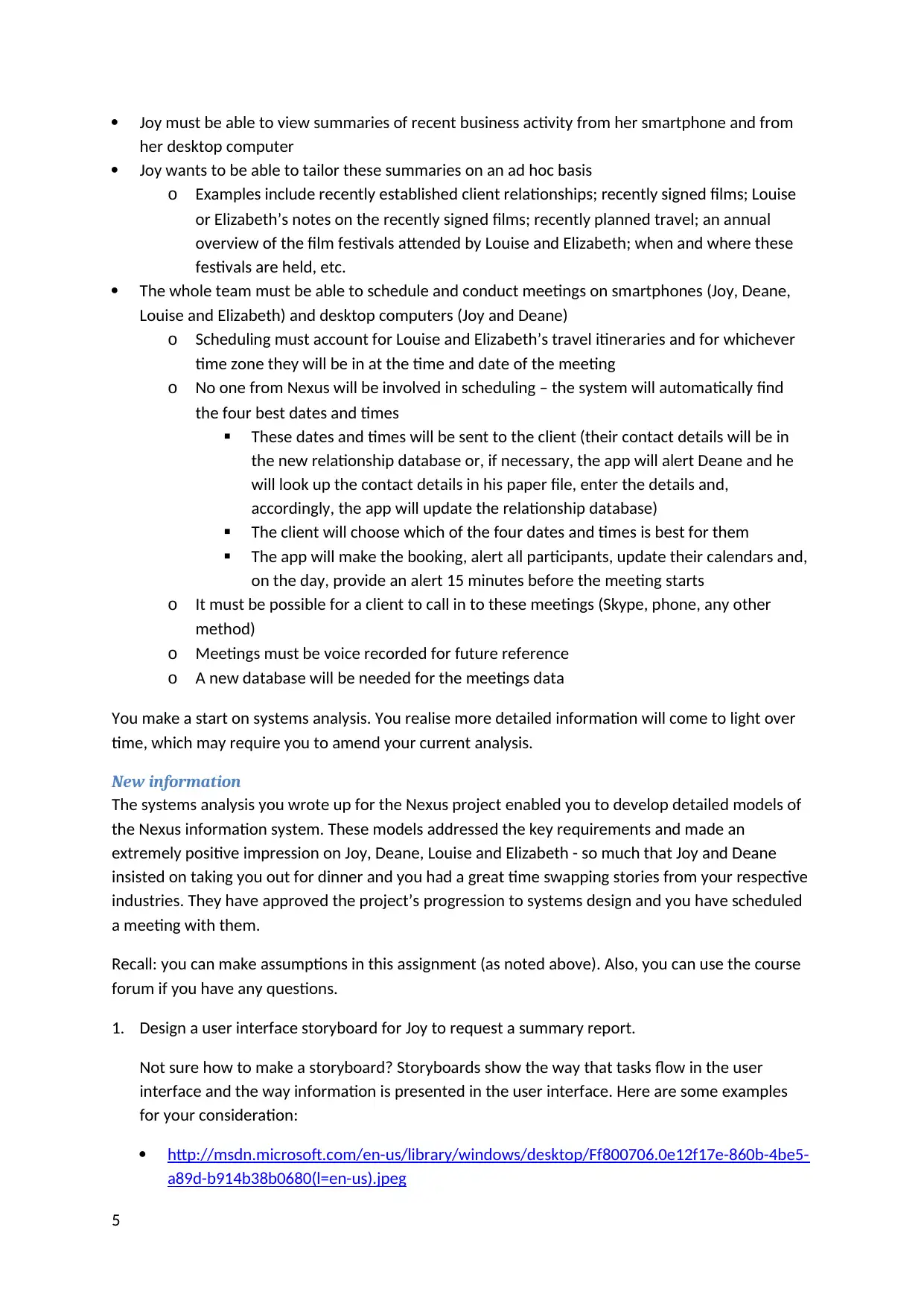
1. Design a user interface storyboard for Joy to request a summary report.
Not sure how to make a storyboard? Storyboards show the way that tasks flow in the user
interface and the way information is presented in the user interface. Here are some examples
for your consideration:
http://msdn.microsoft.com/en-us/library/windows/desktop/Ff800706.0e12f17e-860b-4be5-
a89d-b914b38b0680(l=en-us).jpeg
5
her desktop computer
Joy wants to be able to tailor these summaries on an ad hoc basis
o Examples include recently established client relationships; recently signed films; Louise
or Elizabeth’s notes on the recently signed films; recently planned travel; an annual
overview of the film festivals attended by Louise and Elizabeth; when and where these
festivals are held, etc.
The whole team must be able to schedule and conduct meetings on smartphones (Joy, Deane,
Louise and Elizabeth) and desktop computers (Joy and Deane)
o Scheduling must account for Louise and Elizabeth’s travel itineraries and for whichever
time zone they will be in at the time and date of the meeting
o No one from Nexus will be involved in scheduling – the system will automatically find
the four best dates and times
These dates and times will be sent to the client (their contact details will be in
the new relationship database or, if necessary, the app will alert Deane and he
will look up the contact details in his paper file, enter the details and,
accordingly, the app will update the relationship database)
The client will choose which of the four dates and times is best for them
The app will make the booking, alert all participants, update their calendars and,
on the day, provide an alert 15 minutes before the meeting starts
o It must be possible for a client to call in to these meetings (Skype, phone, any other
method)
o Meetings must be voice recorded for future reference
o A new database will be needed for the meetings data
You make a start on systems analysis. You realise more detailed information will come to light over
time, which may require you to amend your current analysis.
New information
The systems analysis you wrote up for the Nexus project enabled you to develop detailed models of
the Nexus information system. These models addressed the key requirements and made an
extremely positive impression on Joy, Deane, Louise and Elizabeth - so much that Joy and Deane
insisted on taking you out for dinner and you had a great time swapping stories from your respective
industries. They have approved the project’s progression to systems design and you have scheduled
a meeting with them.
Recall: you can make assumptions in this assignment (as noted above). Also, you can use the course
forum if you have any questions.
1. Design a user interface storyboard for Joy to request a summary report.
Not sure how to make a storyboard? Storyboards show the way that tasks flow in the user
interface and the way information is presented in the user interface. Here are some examples
for your consideration:
http://msdn.microsoft.com/en-us/library/windows/desktop/Ff800706.0e12f17e-860b-4be5-
a89d-b914b38b0680(l=en-us).jpeg
5
http://courses.csail.mit.edu/6.831/wiki/images/thumb/a/a8/MOD-Storyboard-4.png/300px-
MOD-Storyboard-4.png
http://www.museumsandtheweb.com/mw2007/papers/vanLoon/vanloon-figure4-
thumbnail.jpg
http://www.stavchansky.net/images/feature_ftsStoryboard.jpg
Put your answer here.
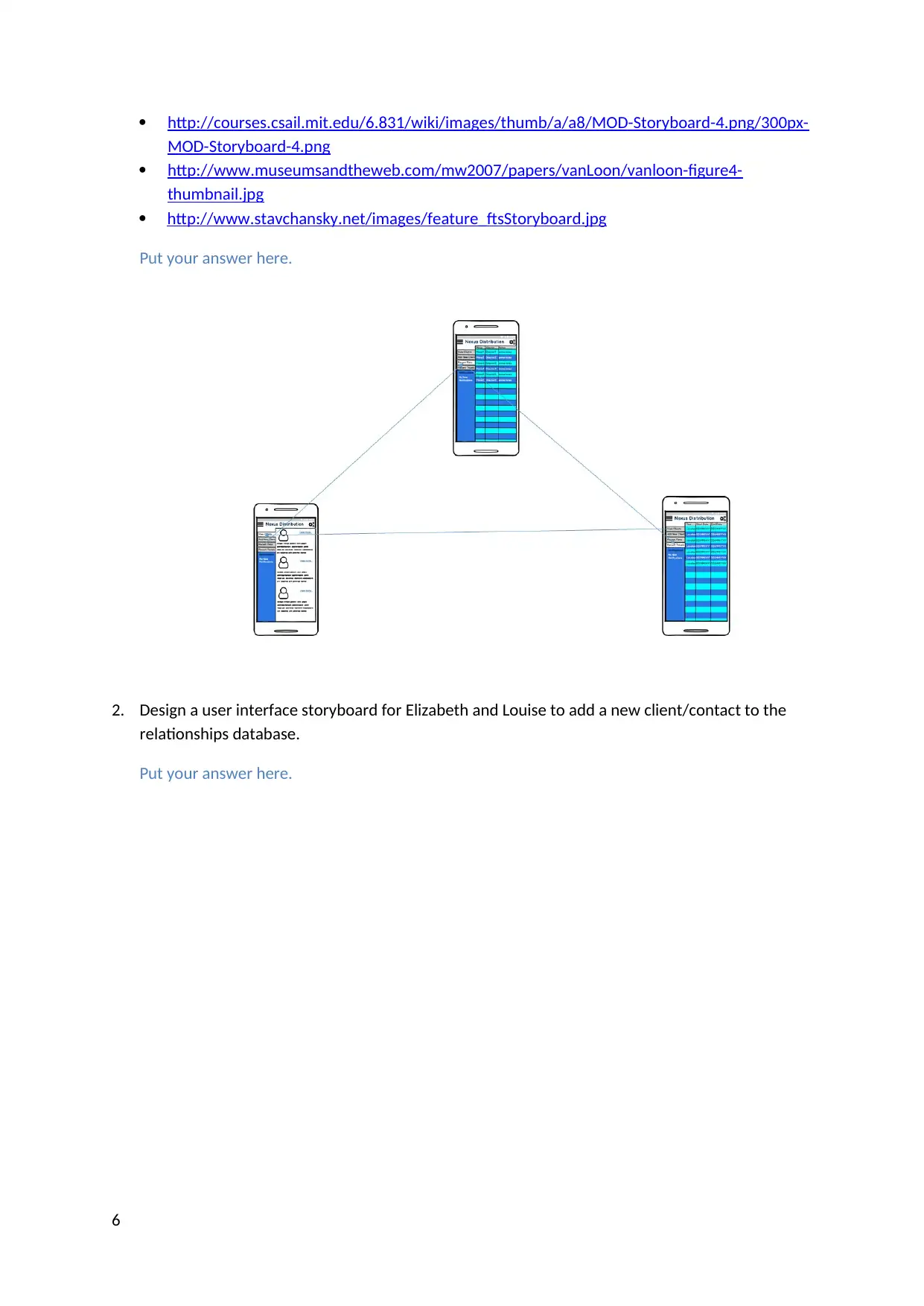
2. Design a user interface storyboard for Elizabeth and Louise to add a new client/contact to the
relationships database.
Put your answer here.
6
MOD-Storyboard-4.png
http://www.museumsandtheweb.com/mw2007/papers/vanLoon/vanloon-figure4-
thumbnail.jpg
http://www.stavchansky.net/images/feature_ftsStoryboard.jpg
Put your answer here.
2. Design a user interface storyboard for Elizabeth and Louise to add a new client/contact to the
relationships database.
Put your answer here.
6
⊘ This is a preview!⊘
Do you want full access?
Subscribe today to unlock all pages.
Trusted by 1+ million students worldwide
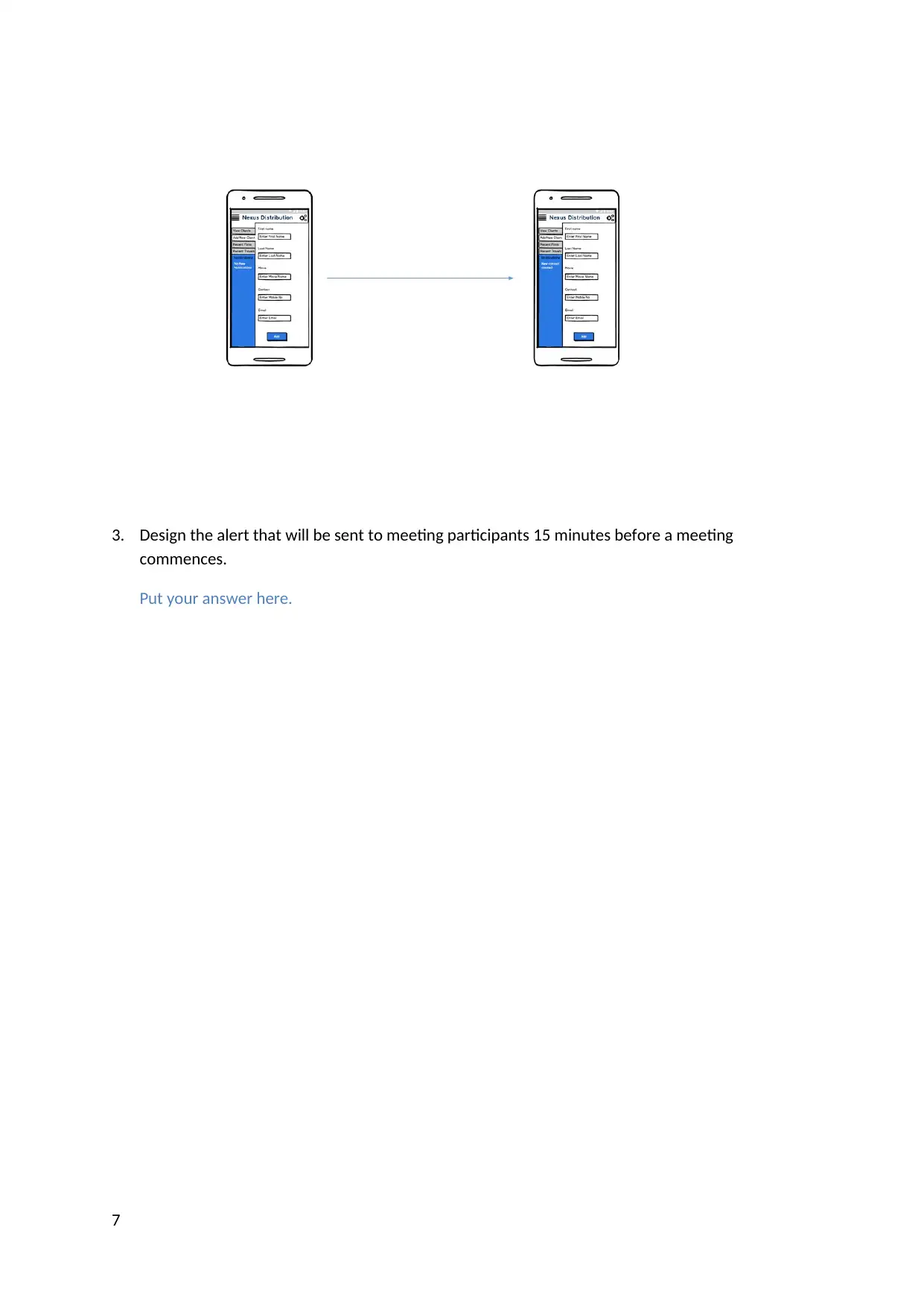
3. Design the alert that will be sent to meeting participants 15 minutes before a meeting
commences.
Put your answer here.
7
commences.
Put your answer here.
7
Paraphrase This Document
Need a fresh take? Get an instant paraphrase of this document with our AI Paraphraser
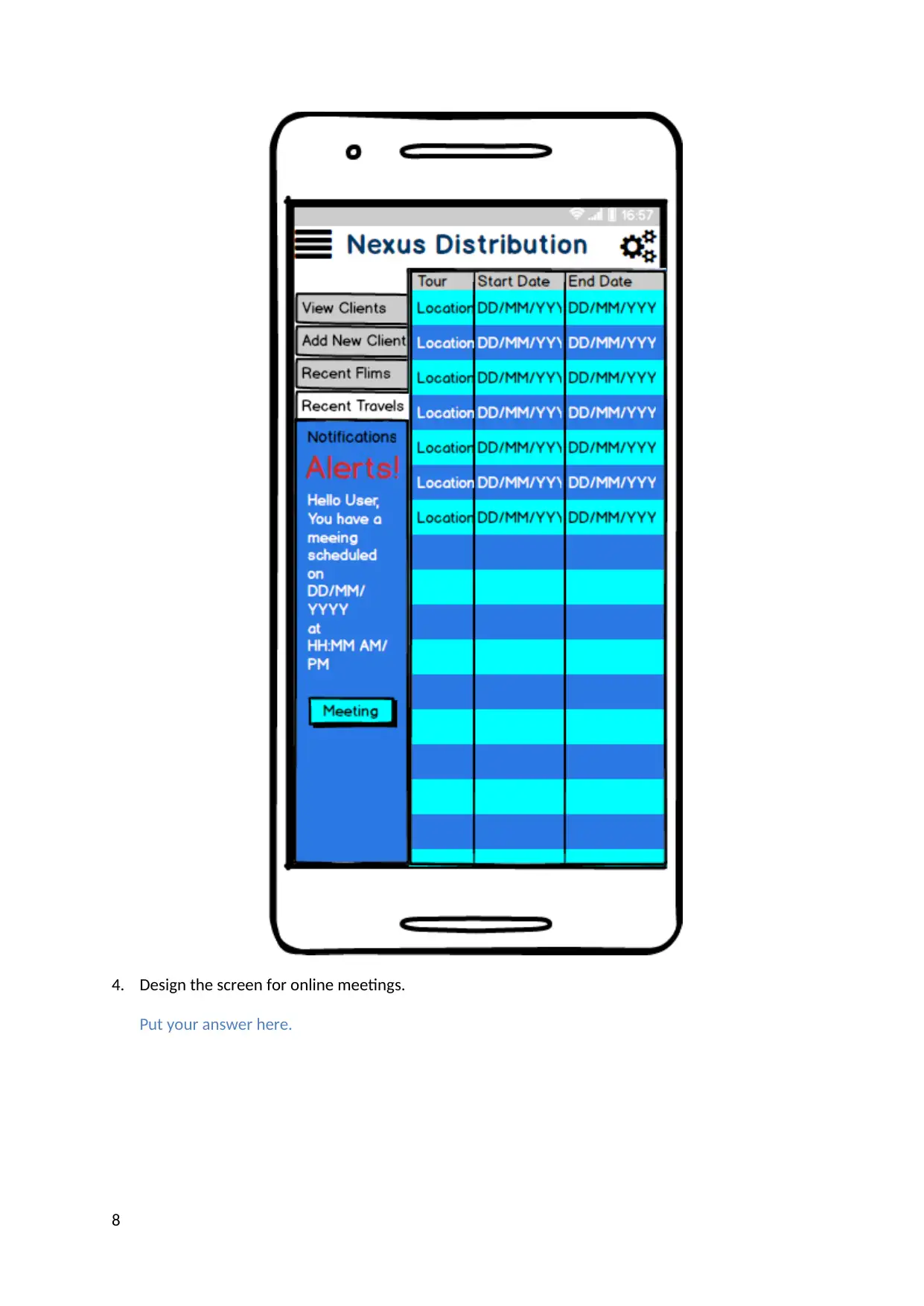
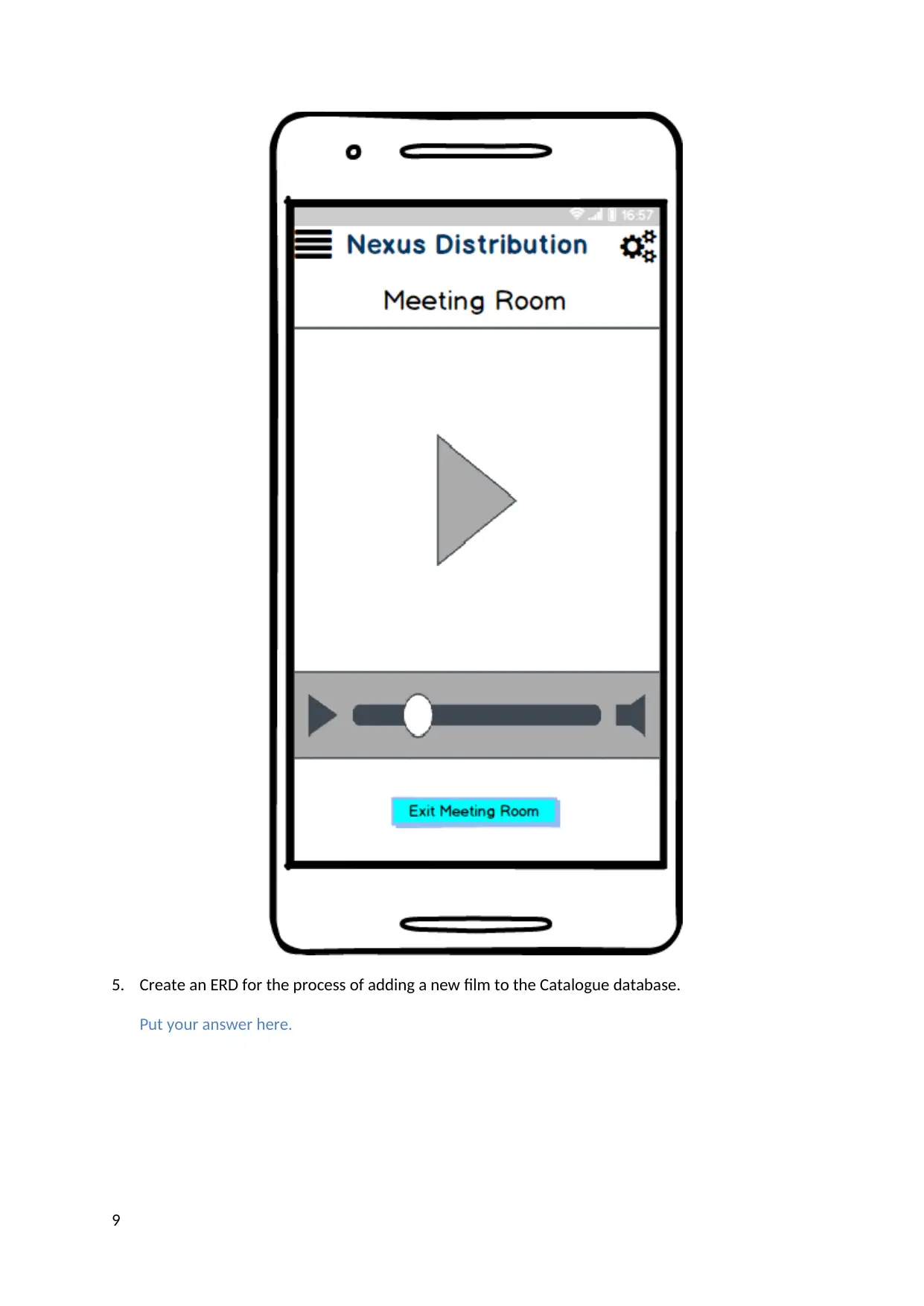
4. Design the screen for online meetings.
Put your answer here.
8
Put your answer here.
8
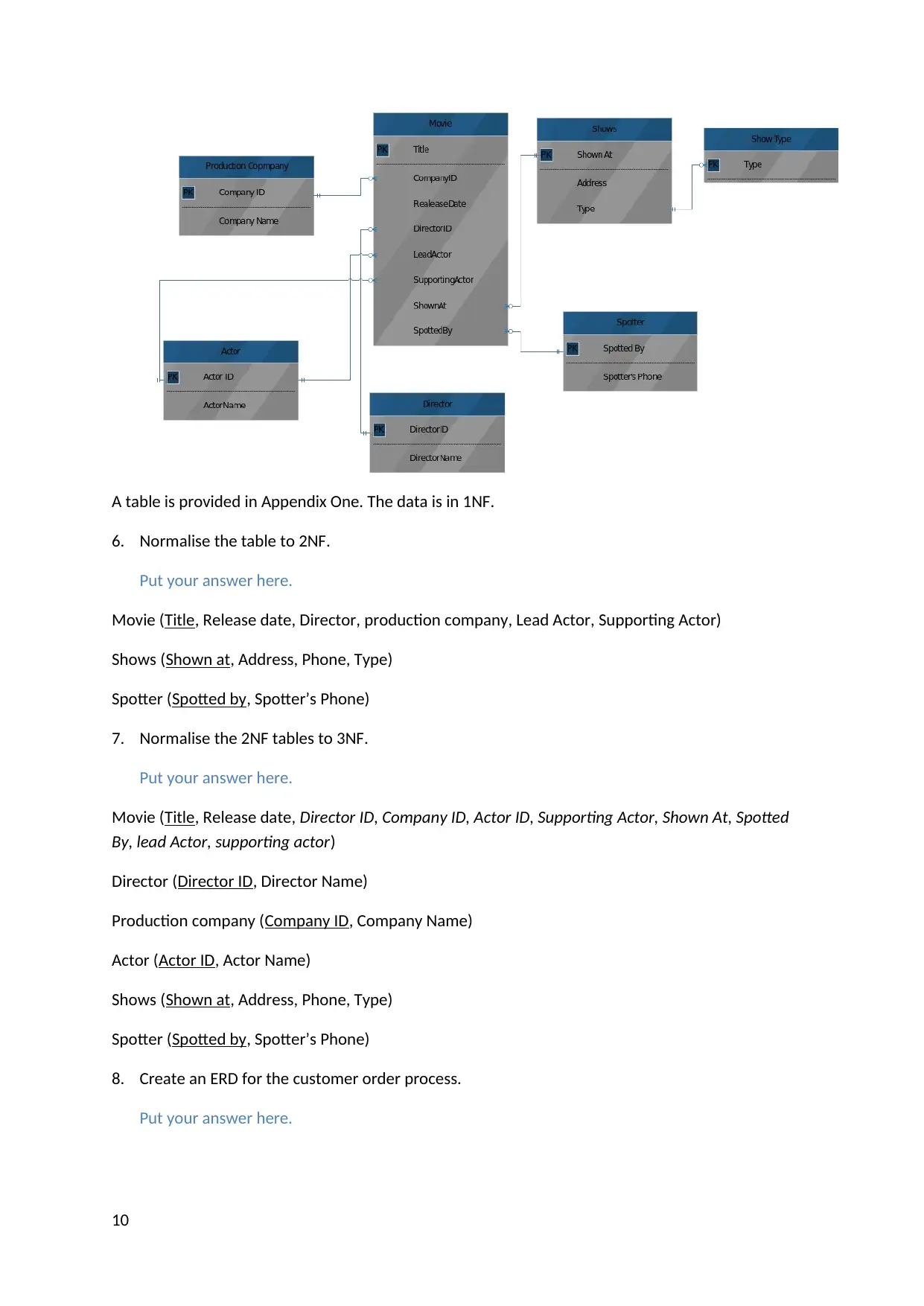
5. Create an ERD for the process of adding a new film to the Catalogue database.
Put your answer here.
9
Put your answer here.
9
⊘ This is a preview!⊘
Do you want full access?
Subscribe today to unlock all pages.
Trusted by 1+ million students worldwide
A table is provided in Appendix One. The data is in 1NF.
6. Normalise the table to 2NF.
Put your answer here.
Movie (Title, Release date, Director, production company, Lead Actor, Supporting Actor)
Shows (Shown at, Address, Phone, Type)
Spotter (Spotted by, Spotter’s Phone)
7. Normalise the 2NF tables to 3NF.
Put your answer here.
Movie (Title, Release date, Director ID, Company ID, Actor ID, Supporting Actor, Shown At, Spotted
By, lead Actor, supporting actor)
Director (Director ID, Director Name)
Production company (Company ID, Company Name)
Actor (Actor ID, Actor Name)
Shows (Shown at, Address, Phone, Type)
Spotter (Spotted by, Spotter’s Phone)
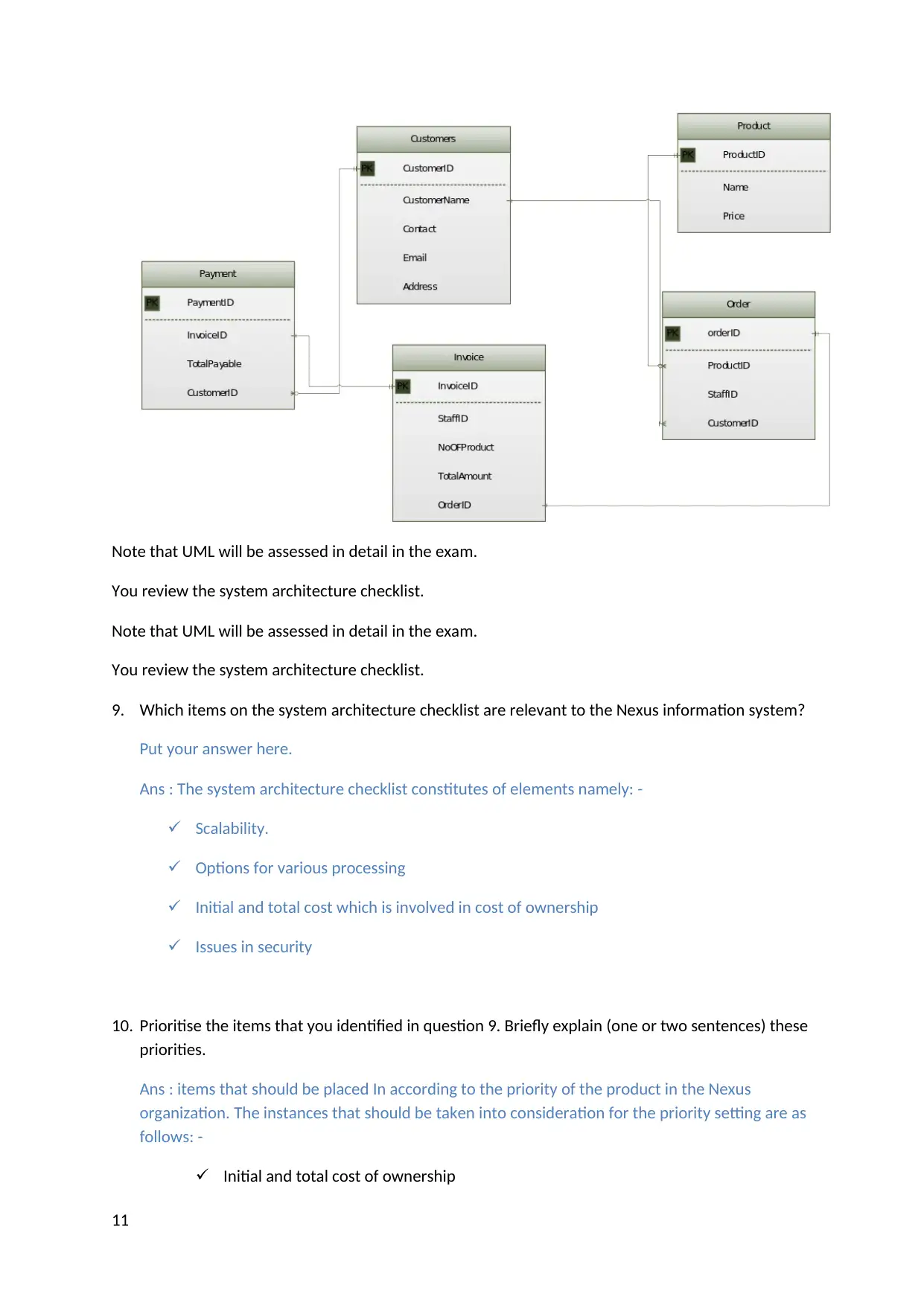
8. Create an ERD for the customer order process.
Put your answer here.
10
6. Normalise the table to 2NF.
Put your answer here.
Movie (Title, Release date, Director, production company, Lead Actor, Supporting Actor)
Shows (Shown at, Address, Phone, Type)
Spotter (Spotted by, Spotter’s Phone)
7. Normalise the 2NF tables to 3NF.
Put your answer here.
Movie (Title, Release date, Director ID, Company ID, Actor ID, Supporting Actor, Shown At, Spotted
By, lead Actor, supporting actor)
Director (Director ID, Director Name)
Production company (Company ID, Company Name)
Actor (Actor ID, Actor Name)
Shows (Shown at, Address, Phone, Type)
Spotter (Spotted by, Spotter’s Phone)
8. Create an ERD for the customer order process.
Put your answer here.
10
Paraphrase This Document
Need a fresh take? Get an instant paraphrase of this document with our AI Paraphraser
Note that UML will be assessed in detail in the exam.
You review the system architecture checklist.
Note that UML will be assessed in detail in the exam.
You review the system architecture checklist.
9. Which items on the system architecture checklist are relevant to the Nexus information system?
Put your answer here.
Ans : The system architecture checklist constitutes of elements namely: -
Scalability.
Options for various processing
Initial and total cost which is involved in cost of ownership
Issues in security
10. Prioritise the items that you identified in question 9. Briefly explain (one or two sentences) these
priorities.
Ans : items that should be placed In according to the priority of the product in the Nexus
organization. The instances that should be taken into consideration for the priority setting are as
follows: -
Initial and total cost of ownership
11
You review the system architecture checklist.
Note that UML will be assessed in detail in the exam.
You review the system architecture checklist.
9. Which items on the system architecture checklist are relevant to the Nexus information system?
Put your answer here.
Ans : The system architecture checklist constitutes of elements namely: -
Scalability.
Options for various processing
Initial and total cost which is involved in cost of ownership
Issues in security
10. Prioritise the items that you identified in question 9. Briefly explain (one or two sentences) these
priorities.
Ans : items that should be placed In according to the priority of the product in the Nexus
organization. The instances that should be taken into consideration for the priority setting are as
follows: -
Initial and total cost of ownership
11
Legacy system interface
Web integration
Security issues.
Tracking of various kinds of security
Scalability
11. Consider cloud computing. Are you going to recommend any cloud computing capabilities for
the Nexus information system? Why?
Ans : Cloud computing is defined as the methodology that is used for the processing of the
different kind of the services that deals with the processing of the information technology.
Cloud computing id recommended for t processing of the Nexus organization as rhe cloud
computing process will come up with large number of advantages like:
It is minimized the cost
Reduction in power and capacity.
Higher number of usability.
Gaining accessibility acts as the major use.
It is useful in disaster recovery.
12. Is a corporate portal an appropriate approach for the Nexus project? Why?
Put your answer here.
Ethical analysis
Reflect on your experiences as a student or in your career. Identify an ethical issue that you
encountered at some time in your past.1
13. Describe the ethical issue. Do not describe how it was resolved.
Ans : the development of different types of codes proves to be the duty of the Nexus technology for
abiding adverse diversity of members of the organization. Ethical issues mainly deals with the issues
related to the diversity of the members that are preceding in the organization. The ethical issues also
deals with the fundamental issues, the issues are also concentrated towards the decision making
issues of the organization. Compliance and governance issues also acts to be the major ethical
issues.
Ethical decision making process from the Reynolds (2015) and the decision making process
from the O’Boyle (2002) is also taking into consideration. These readings are taken into
consideration on the course we site.
1 This ethical issue must come from your real life. Do not describe a theoretical ethical issue. Do not describe
an ethical issue from any courses you have taken.
12
Web integration
Security issues.
Tracking of various kinds of security
Scalability
11. Consider cloud computing. Are you going to recommend any cloud computing capabilities for
the Nexus information system? Why?
Ans : Cloud computing is defined as the methodology that is used for the processing of the
different kind of the services that deals with the processing of the information technology.
Cloud computing id recommended for t processing of the Nexus organization as rhe cloud
computing process will come up with large number of advantages like:
It is minimized the cost
Reduction in power and capacity.
Higher number of usability.
Gaining accessibility acts as the major use.
It is useful in disaster recovery.
12. Is a corporate portal an appropriate approach for the Nexus project? Why?
Put your answer here.
Ethical analysis
Reflect on your experiences as a student or in your career. Identify an ethical issue that you
encountered at some time in your past.1
13. Describe the ethical issue. Do not describe how it was resolved.
Ans : the development of different types of codes proves to be the duty of the Nexus technology for
abiding adverse diversity of members of the organization. Ethical issues mainly deals with the issues
related to the diversity of the members that are preceding in the organization. The ethical issues also
deals with the fundamental issues, the issues are also concentrated towards the decision making
issues of the organization. Compliance and governance issues also acts to be the major ethical
issues.
Ethical decision making process from the Reynolds (2015) and the decision making process
from the O’Boyle (2002) is also taking into consideration. These readings are taken into
consideration on the course we site.
1 This ethical issue must come from your real life. Do not describe a theoretical ethical issue. Do not describe
an ethical issue from any courses you have taken.
12
⊘ This is a preview!⊘
Do you want full access?
Subscribe today to unlock all pages.
Trusted by 1+ million students worldwide

1 out of 20


Related Documents


Your All-in-One AI-Powered Toolkit for Academic Success.
+13062052269
info@desklib.com
Available 24*7 on WhatsApp / Email
![[object Object]](/_next/static/media/star-bottom.7253800d.svg)
Unlock your academic potential
Copyright © 2020–2026 A2Z Services. All Rights Reserved. Developed and managed by ZUCOL.