Critical Management Skills for NGOs: Analysis & Best Practices
VerifiedAdded on 2023/01/09
|20
|4843
|74
Report
AI Summary
This report provides a comprehensive overview of essential management skills for Non-Governmental Organizations (NGOs). It begins by defining NGOs and highlighting their role in society, emphasizing the importance of good governance, leadership, and stakeholder engagement. The report then delves into various critical management areas, including change management, conflict management, communication, cooperation, motivation, and organizational structure. It also addresses leadership qualities specific to the nonprofit sector, project management principles, human resources, volunteer management, fundraising, and operations management. The report further discusses the pros and cons of NGO management at local, national, and international levels and offers general recommendations for improvement. It concludes by emphasizing the need for NGOs to balance their mission-driven goals with effective management practices to ensure sustainability and impact.

1NGO management skills
Running head: NGO MANAGEMENT SKILLS
NGO management skills
Name:
Course:
Running head: NGO MANAGEMENT SKILLS
NGO management skills
Name:
Course:

Paraphrase This Document
Need a fresh take? Get an instant paraphrase of this document with our AI Paraphraser
2NGO management skills
Contents
Introduction......................................................................................................................................3
Description.......................................................................................................................................3
General analysis...............................................................................................................................4
Additional relevant details about the topic......................................................................................4
First: The basic management.......................................................................................................4
1.1 Change management..........................................................................................................4
1.2 Conflict management.........................................................................................................4
1.3 Communication..................................................................................................................5
1.4 Cooperation........................................................................................................................5
1.5 Motivation..........................................................................................................................5
1.6 Organizational structure.....................................................................................................5
Second: leadership.......................................................................................................................6
Third: project management..........................................................................................................6
Fourth: human resources.............................................................................................................7
Fifth: volunteer............................................................................................................................7
Sixth: funds...................................................................................................................................7
Seventh: operations management................................................................................................8
Discussions: Pros and cons of the topic on a local, national and international level......................8
General recommendations...............................................................................................................9
Conclusion.......................................................................................................................................9
References......................................................................................................................................11
Contents
Introduction......................................................................................................................................3
Description.......................................................................................................................................3
General analysis...............................................................................................................................4
Additional relevant details about the topic......................................................................................4
First: The basic management.......................................................................................................4
1.1 Change management..........................................................................................................4
1.2 Conflict management.........................................................................................................4
1.3 Communication..................................................................................................................5
1.4 Cooperation........................................................................................................................5
1.5 Motivation..........................................................................................................................5
1.6 Organizational structure.....................................................................................................5
Second: leadership.......................................................................................................................6
Third: project management..........................................................................................................6
Fourth: human resources.............................................................................................................7
Fifth: volunteer............................................................................................................................7
Sixth: funds...................................................................................................................................7
Seventh: operations management................................................................................................8
Discussions: Pros and cons of the topic on a local, national and international level......................8
General recommendations...............................................................................................................9
Conclusion.......................................................................................................................................9
References......................................................................................................................................11
3NGO management skills
Introduction
NGOs could gain their popularity because of the number of benefits they provide. They
gain increasing support and donations because of their efforts. They to help people in remote
communities. In addition, they help to complement the governmental role of alleviating poverty
(Ahmed, 2014).
According to Vakil1(997), as cited in Graf & Rothlauf (2011), there is no generally
accepted definition of NGOs, despite this, the United Nations defined the NGO to be a nonprofit
organization that involves voluntary citizens’ group it can operate locally, nationally or
internationally. NGOs operate in different services and humanitarian contexts, direct citizens'
attention towards governments, monitor policies and enhance people to participate in the
political issues at the community level. Moreover, they conduct analysis and provide expertise,
use early warning mechanisms and assist in implementing international agreements. Some of the
NGOs are specialized in human rights issues, environment, and health. They focus in their
activities on advocacy and operational efforts of social, political and economic goals.
It is important to investigate two factors; the first is the beneficiary of the NGO. In the
self-benefiting NGO, the members are the beneficiaries, like the labor unions. The other
benefiting NGOs deliver goods and services, like doctors without borders organization. The
second factor of classification is the action type that could be oriented towards providing people's
needs or advocacy (Graf & Rothlauf, 2011).
Good governance enables NGOs to provide legitimacy, leadership, and direction. The
founders of the NGOs are charismatic people in common, who are strongly committed to their
purpose and ideas about serving others. The staff members should share the same ideas of the
founders and commitment to organizational sustainability. Effective leaders of NGOs are able to
Introduction
NGOs could gain their popularity because of the number of benefits they provide. They
gain increasing support and donations because of their efforts. They to help people in remote
communities. In addition, they help to complement the governmental role of alleviating poverty
(Ahmed, 2014).
According to Vakil1(997), as cited in Graf & Rothlauf (2011), there is no generally
accepted definition of NGOs, despite this, the United Nations defined the NGO to be a nonprofit
organization that involves voluntary citizens’ group it can operate locally, nationally or
internationally. NGOs operate in different services and humanitarian contexts, direct citizens'
attention towards governments, monitor policies and enhance people to participate in the
political issues at the community level. Moreover, they conduct analysis and provide expertise,
use early warning mechanisms and assist in implementing international agreements. Some of the
NGOs are specialized in human rights issues, environment, and health. They focus in their
activities on advocacy and operational efforts of social, political and economic goals.
It is important to investigate two factors; the first is the beneficiary of the NGO. In the
self-benefiting NGO, the members are the beneficiaries, like the labor unions. The other
benefiting NGOs deliver goods and services, like doctors without borders organization. The
second factor of classification is the action type that could be oriented towards providing people's
needs or advocacy (Graf & Rothlauf, 2011).
Good governance enables NGOs to provide legitimacy, leadership, and direction. The
founders of the NGOs are charismatic people in common, who are strongly committed to their
purpose and ideas about serving others. The staff members should share the same ideas of the
founders and commitment to organizational sustainability. Effective leaders of NGOs are able to
⊘ This is a preview!⊘
Do you want full access?
Subscribe today to unlock all pages.

Trusted by 1+ million students worldwide
4NGO management skills
use the enthusiasm of the stakeholders. Also, they should involve the stakeholder and community
members and be more focused and consistent to be trusted by others and supported. NGOs have
a political role to play through increasing people's awareness with democracy besides their role
in health, agriculture, relief, industry, education and service supply (Mukanga, 2011)
Description
Kabeer et al. (2012), as cited in Ahmed (2014), argue that NGOs could not be judged to
be more cost-effective than the government institutions. In the developing countries, NGOs are
organizations that can solve social problems, they could take the form of aid to support needy
people. This cooperative role of NGOs should pervade across all NGOs types, but once a
deviation from this role occurs, they are accused of mistrust and to be controlled by the political
and economic powers (Tabsh, 2016).
Nonprofit organizations (NPOs) have witnessed remarkable transformations that made
them become more like the for-profit enterprises since the 1980s. These changes resulted in
diverge attitudes towards the NPOs that are supposed to act according to their main aim of
serving the public (Maier, Meyer, & Steinbereithner, 2014).
The international non-governmental organizations (INGOs) have an ideal mission and
spirit of a strong volunteer. INGOs have grown larger and faster over the years the matter that
increased their financial resources. For example, World Vision International annual budget worth
$2 billion. Also, INGOs have become more complex and the public interest in them has also
increased, which creates a challenging pressure on them. Most people working in INGOs are
driven by their mission more than financial compensation. Accordingly, INGOs should attract
and retain talented people who have a sense of mission (Jayawickrama, 2011).
use the enthusiasm of the stakeholders. Also, they should involve the stakeholder and community
members and be more focused and consistent to be trusted by others and supported. NGOs have
a political role to play through increasing people's awareness with democracy besides their role
in health, agriculture, relief, industry, education and service supply (Mukanga, 2011)
Description
Kabeer et al. (2012), as cited in Ahmed (2014), argue that NGOs could not be judged to
be more cost-effective than the government institutions. In the developing countries, NGOs are
organizations that can solve social problems, they could take the form of aid to support needy
people. This cooperative role of NGOs should pervade across all NGOs types, but once a
deviation from this role occurs, they are accused of mistrust and to be controlled by the political
and economic powers (Tabsh, 2016).
Nonprofit organizations (NPOs) have witnessed remarkable transformations that made
them become more like the for-profit enterprises since the 1980s. These changes resulted in
diverge attitudes towards the NPOs that are supposed to act according to their main aim of
serving the public (Maier, Meyer, & Steinbereithner, 2014).
The international non-governmental organizations (INGOs) have an ideal mission and
spirit of a strong volunteer. INGOs have grown larger and faster over the years the matter that
increased their financial resources. For example, World Vision International annual budget worth
$2 billion. Also, INGOs have become more complex and the public interest in them has also
increased, which creates a challenging pressure on them. Most people working in INGOs are
driven by their mission more than financial compensation. Accordingly, INGOs should attract
and retain talented people who have a sense of mission (Jayawickrama, 2011).
Paraphrase This Document
Need a fresh take? Get an instant paraphrase of this document with our AI Paraphraser
5NGO management skills
General analysis
NGOs do not distribute funds to the owners or the shareholders they use them in fulfilling
the organizational goals. They act independently for achieving the welfare of the society by
providing people with financial support, training programs, food supplies, and advocacy. NGOs
do not seek any financial profit, their main goal is to act for the interest of the public at large.
The large presence of NGOs represents an indicator of the health of the economy measured in
financial terms. The increasing number of NGOs that focus on social services, environment,
education and other needs, NGOs are the center of social health and well-being. Despite this,
NGOs face many challenges represented in the lack of efficient management, lack of resources
and access to information, the need for capacity building, maintenance and increasing (Karanth,
2015).
Managers in large INGOs usually started their career at these organizations among the
staff members, then they learned and got expertise that elected them to take leading positions.
The growth of the NGOs in terms of size, developmental activities and workforce led them to
attract more managers and experts from outside the organization. Also, the high turnover rate
among the staff encourages NGOs to hire external candidates. Larger NGOs could develop
internal systems of training and development to enhance the managerial skills and technical
skills of the staff members. INGOs act for people welfare across countries that required them to
attract staff with new and deep skill sets and more effective managers and leaders
(Jayawickrama, 2011).
General analysis
NGOs do not distribute funds to the owners or the shareholders they use them in fulfilling
the organizational goals. They act independently for achieving the welfare of the society by
providing people with financial support, training programs, food supplies, and advocacy. NGOs
do not seek any financial profit, their main goal is to act for the interest of the public at large.
The large presence of NGOs represents an indicator of the health of the economy measured in
financial terms. The increasing number of NGOs that focus on social services, environment,
education and other needs, NGOs are the center of social health and well-being. Despite this,
NGOs face many challenges represented in the lack of efficient management, lack of resources
and access to information, the need for capacity building, maintenance and increasing (Karanth,
2015).
Managers in large INGOs usually started their career at these organizations among the
staff members, then they learned and got expertise that elected them to take leading positions.
The growth of the NGOs in terms of size, developmental activities and workforce led them to
attract more managers and experts from outside the organization. Also, the high turnover rate
among the staff encourages NGOs to hire external candidates. Larger NGOs could develop
internal systems of training and development to enhance the managerial skills and technical
skills of the staff members. INGOs act for people welfare across countries that required them to
attract staff with new and deep skill sets and more effective managers and leaders
(Jayawickrama, 2011).
6NGO management skills
Additional relevant details about the topic
First: The basic management
Many NGOs aim to achieve their objectives depending on their resources and ideas, but
the forces of the external environment enforce them to adopt concepts belong to the profit
organizations. Also, their rising importance on the national and international scales led them to
engage in stakeholders' management and research on corporate social responsibility (CSR). The
management of the NGOs have switched their policies to become businesses (Schwenger,
Straub, & Borzillo, 2014).
1.1 Change management
The difficulty of managing NGOs represents a big challenge that led them to compete
with each other for private and public donors in fundraising. Change management processes of
NGOs emerge in response to the problems that surround them and take place in negotiations with
stakeholders. NGOs management tend to deviate from their main aim and diversify their sources
of funding and develop projects for generating revenues. The model of knowledge management
enables NGOs to change by a cycle of integrated knowledge management (Rocha, et al., 2015).
1.2 Conflict management
NGOs might have multiple identities that are conflicting and take place among non-
managerial practices from business organizations. The increasing intensity of competition and
resources limitation create conflicts for NGOs in balancing various sources of pressures and
tensions between groups who have different views. New public management (NPM) approach
argues the importance of using more formal control and bureaucratization by using pay-for-
performance plans and standardized business practices. The management focus on achieving
short-term outcomes and project funding could weaken the organization ability to act according
Additional relevant details about the topic
First: The basic management
Many NGOs aim to achieve their objectives depending on their resources and ideas, but
the forces of the external environment enforce them to adopt concepts belong to the profit
organizations. Also, their rising importance on the national and international scales led them to
engage in stakeholders' management and research on corporate social responsibility (CSR). The
management of the NGOs have switched their policies to become businesses (Schwenger,
Straub, & Borzillo, 2014).
1.1 Change management
The difficulty of managing NGOs represents a big challenge that led them to compete
with each other for private and public donors in fundraising. Change management processes of
NGOs emerge in response to the problems that surround them and take place in negotiations with
stakeholders. NGOs management tend to deviate from their main aim and diversify their sources
of funding and develop projects for generating revenues. The model of knowledge management
enables NGOs to change by a cycle of integrated knowledge management (Rocha, et al., 2015).
1.2 Conflict management
NGOs might have multiple identities that are conflicting and take place among non-
managerial practices from business organizations. The increasing intensity of competition and
resources limitation create conflicts for NGOs in balancing various sources of pressures and
tensions between groups who have different views. New public management (NPM) approach
argues the importance of using more formal control and bureaucratization by using pay-for-
performance plans and standardized business practices. The management focus on achieving
short-term outcomes and project funding could weaken the organization ability to act according
⊘ This is a preview!⊘
Do you want full access?
Subscribe today to unlock all pages.
Trusted by 1+ million students worldwide
7NGO management skills
to its values (Chenhall, Hall, & Smith, 2016; Vaceková, 2014). The group belonging to NGO
that rejects the business-like approaches creates a conflicting situation (Maier, Meyer, &
Steinbereithner, 2014).
1.3 Communication
There are three parties involved in the communication process; the expert prescribers are
the public relations professionals announced by the NGO, the communication facilitators who
take the role of going between the public and problem-solving process facilitators is the one who
assists the main coalitions by solving problems of public relations.
Dozier et al. (1995), as cited in Liu (2012), argue that public relations managers are the
more capable to implement public relations programs rather than the technicians. The excellence
theory assumes that the communication manager role consists of a mixture of facilitating
communication, offering expertise and problem solving (Bhati, 2013).
1.4 Cooperation
Collaboration assists in creating economic value to the networked organizations. The
resource-based view assumes that accumulating rare resources, nonsubstitutable and inimitable
enable organizations to achieve a competitive advantage that differentiates it from its competitors
(Graf & Rothlauf, 2011).
Trust is an essential factor of collaboration that represents an essential factor for
partnerships. It opens lines of communication between various organizations through periodic
interactions among organizations. Formalizing collaboration in the form of agreements that
reflect the duties and responsibilities of various parties enhance collaboration (AbouAssi,
Makhlouf, & Whalen, 2016).
to its values (Chenhall, Hall, & Smith, 2016; Vaceková, 2014). The group belonging to NGO
that rejects the business-like approaches creates a conflicting situation (Maier, Meyer, &
Steinbereithner, 2014).
1.3 Communication
There are three parties involved in the communication process; the expert prescribers are
the public relations professionals announced by the NGO, the communication facilitators who
take the role of going between the public and problem-solving process facilitators is the one who
assists the main coalitions by solving problems of public relations.
Dozier et al. (1995), as cited in Liu (2012), argue that public relations managers are the
more capable to implement public relations programs rather than the technicians. The excellence
theory assumes that the communication manager role consists of a mixture of facilitating
communication, offering expertise and problem solving (Bhati, 2013).
1.4 Cooperation
Collaboration assists in creating economic value to the networked organizations. The
resource-based view assumes that accumulating rare resources, nonsubstitutable and inimitable
enable organizations to achieve a competitive advantage that differentiates it from its competitors
(Graf & Rothlauf, 2011).
Trust is an essential factor of collaboration that represents an essential factor for
partnerships. It opens lines of communication between various organizations through periodic
interactions among organizations. Formalizing collaboration in the form of agreements that
reflect the duties and responsibilities of various parties enhance collaboration (AbouAssi,
Makhlouf, & Whalen, 2016).
Paraphrase This Document
Need a fresh take? Get an instant paraphrase of this document with our AI Paraphraser
8NGO management skills
1.5 Motivation
Motivations of the various NGO staff members involve volunteers, who could be
members in the organization or other involved unpaid community members and
Employees that receive wages for doing their work. According to Parry, Kelliher, Mills & Tyson
(2005), as cited in Schmidt (2016), a significant difference exists among people performance in
NGOs compared to employees in other organizations. These differences are result of employees
attitude to work and job satisfaction. Thus management motivation for employees to work is
vital for running the NGO's operations. Also, the board members work without pay in their spare
time. The main aspect is to keep their devotion to the organizational goals and effectively
contribute to the board performance.
1.6 Organizational structure
The executive body of the NGO has full responsibility for the operational business. The
organizational structure is very important, especially in INGOs. There exist a wide variety of
possible organizational structures that differ according to the adopted legal framework within
every country. An umbrella organization networks and units various organizations and creates
distinctive organizational structures. The sister organizations report to the umbrella organization
that represents their legal parent. This organizational structure model maintains the existing
structures and ensures alignment with the strategic goals. Another organizational structure is the
holding organization that includes the various permanent establishment and other sister
organizations. The permanent establishment represents a subsidiary of the sister organizations
who have cooperation agreements with each other. These agreements define their responsibilities
and allow to transfers responsibility from the permanent establishment to the sister organizations
(Thum, 2017).
1.5 Motivation
Motivations of the various NGO staff members involve volunteers, who could be
members in the organization or other involved unpaid community members and
Employees that receive wages for doing their work. According to Parry, Kelliher, Mills & Tyson
(2005), as cited in Schmidt (2016), a significant difference exists among people performance in
NGOs compared to employees in other organizations. These differences are result of employees
attitude to work and job satisfaction. Thus management motivation for employees to work is
vital for running the NGO's operations. Also, the board members work without pay in their spare
time. The main aspect is to keep their devotion to the organizational goals and effectively
contribute to the board performance.
1.6 Organizational structure
The executive body of the NGO has full responsibility for the operational business. The
organizational structure is very important, especially in INGOs. There exist a wide variety of
possible organizational structures that differ according to the adopted legal framework within
every country. An umbrella organization networks and units various organizations and creates
distinctive organizational structures. The sister organizations report to the umbrella organization
that represents their legal parent. This organizational structure model maintains the existing
structures and ensures alignment with the strategic goals. Another organizational structure is the
holding organization that includes the various permanent establishment and other sister
organizations. The permanent establishment represents a subsidiary of the sister organizations
who have cooperation agreements with each other. These agreements define their responsibilities
and allow to transfers responsibility from the permanent establishment to the sister organizations
(Thum, 2017).
9NGO management skills
Second: leadership
Leadership in nonprofits focus on people distinctive skills that enable them to effectively
lead specific subsectors that could be economic, political, environmental, legal or social. Herman
and Heimovics (1990), as cited in Kearns, et al. (2015), created their own approach of leadership
skills. They argue that critical incidents result in an important impact on leadership.
The NGO leader could be considered like the company chief operating officer (CEO), he
is an institutional leader, not a technocratic manager who is concerned with certain managerial
functions of staffing, organizing and coordinating. NGO leaders should demonstrate the
necessity of their initiatives for the development, advocacy, and humanitarian purposes. They are
required to support the legitimacy at different social levels and gain the relevant knowledge
associated with them. According to (Ghere, 2013), NGO leaders are required to reveal NGO
accountability and donor responsibility, covey the sense of the NGO mission through culturally
diverse employees, promote learning and concerning human rights and establish shared
meanings across the NGO network.
Third: project management
Project management does not have a universal definition, but projects share common
characteristics that explain their overall context. According to Roldão (2000), as cited in Esteves
(2013), the project is a set of organization activities designed to fulfill organization objectively
and dissolves after the conclusion. Therefore, projects are characterized by their temporary
nature and accomplishment of their plans. The main project phases consist of planning,
executing and controlling to achieve the predefined goals in a certain time frame according to a
certain budget and quality through technical and human resources mobilization. The explanatory
model of project management in non-profit organizations explains the possible relationships
Second: leadership
Leadership in nonprofits focus on people distinctive skills that enable them to effectively
lead specific subsectors that could be economic, political, environmental, legal or social. Herman
and Heimovics (1990), as cited in Kearns, et al. (2015), created their own approach of leadership
skills. They argue that critical incidents result in an important impact on leadership.
The NGO leader could be considered like the company chief operating officer (CEO), he
is an institutional leader, not a technocratic manager who is concerned with certain managerial
functions of staffing, organizing and coordinating. NGO leaders should demonstrate the
necessity of their initiatives for the development, advocacy, and humanitarian purposes. They are
required to support the legitimacy at different social levels and gain the relevant knowledge
associated with them. According to (Ghere, 2013), NGO leaders are required to reveal NGO
accountability and donor responsibility, covey the sense of the NGO mission through culturally
diverse employees, promote learning and concerning human rights and establish shared
meanings across the NGO network.
Third: project management
Project management does not have a universal definition, but projects share common
characteristics that explain their overall context. According to Roldão (2000), as cited in Esteves
(2013), the project is a set of organization activities designed to fulfill organization objectively
and dissolves after the conclusion. Therefore, projects are characterized by their temporary
nature and accomplishment of their plans. The main project phases consist of planning,
executing and controlling to achieve the predefined goals in a certain time frame according to a
certain budget and quality through technical and human resources mobilization. The explanatory
model of project management in non-profit organizations explains the possible relationships
⊘ This is a preview!⊘
Do you want full access?
Subscribe today to unlock all pages.
Trusted by 1+ million students worldwide
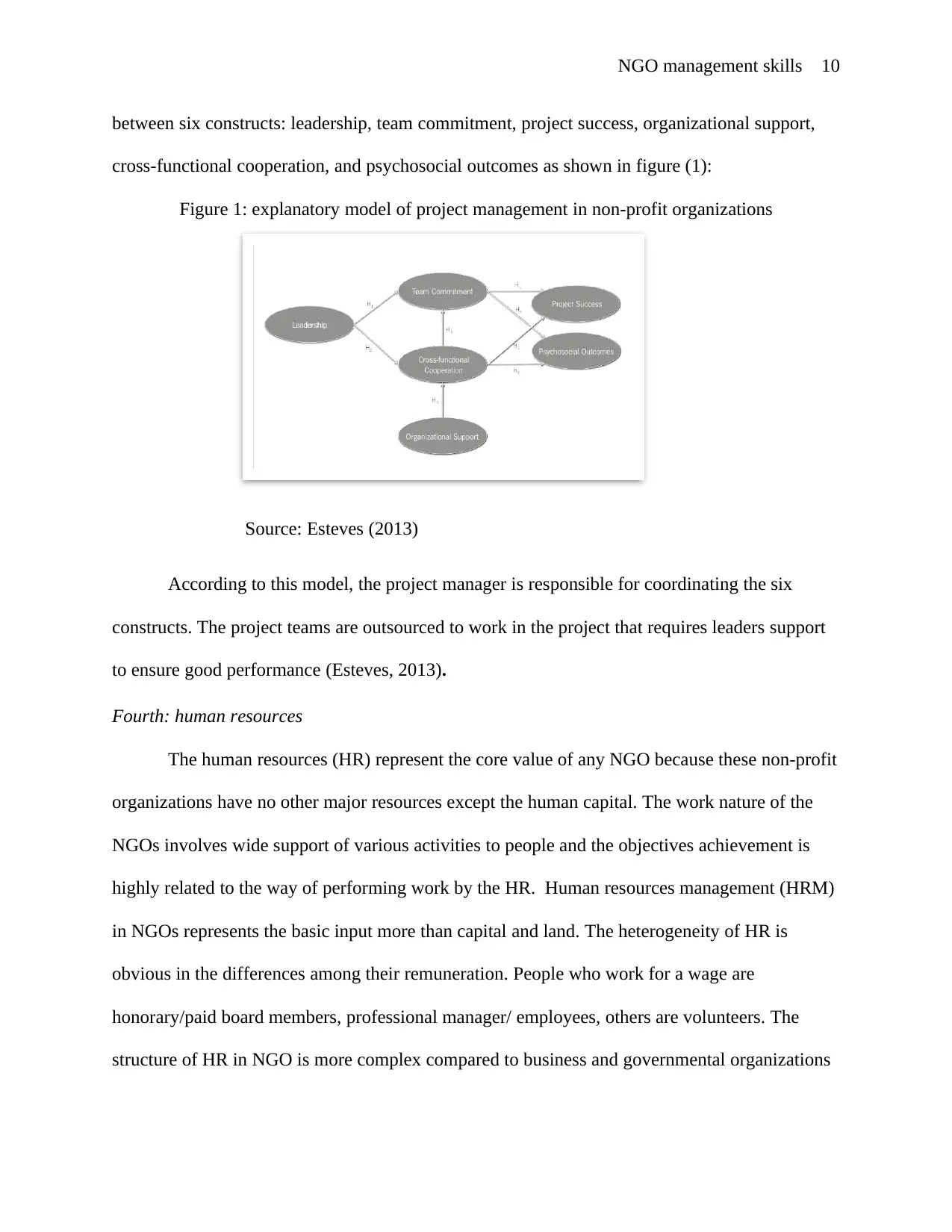
10NGO management skills
between six constructs: leadership, team commitment, project success, organizational support,
cross-functional cooperation, and psychosocial outcomes as shown in figure (1):
Figure 1: explanatory model of project management in non-profit organizations
Source: Esteves (2013)
According to this model, the project manager is responsible for coordinating the six
constructs. The project teams are outsourced to work in the project that requires leaders support
to ensure good performance (Esteves, 2013).
Fourth: human resources
The human resources (HR) represent the core value of any NGO because these non-profit
organizations have no other major resources except the human capital. The work nature of the
NGOs involves wide support of various activities to people and the objectives achievement is
highly related to the way of performing work by the HR. Human resources management (HRM)
in NGOs represents the basic input more than capital and land. The heterogeneity of HR is
obvious in the differences among their remuneration. People who work for a wage are
honorary/paid board members, professional manager/ employees, others are volunteers. The
structure of HR in NGO is more complex compared to business and governmental organizations
between six constructs: leadership, team commitment, project success, organizational support,
cross-functional cooperation, and psychosocial outcomes as shown in figure (1):
Figure 1: explanatory model of project management in non-profit organizations
Source: Esteves (2013)
According to this model, the project manager is responsible for coordinating the six
constructs. The project teams are outsourced to work in the project that requires leaders support
to ensure good performance (Esteves, 2013).
Fourth: human resources
The human resources (HR) represent the core value of any NGO because these non-profit
organizations have no other major resources except the human capital. The work nature of the
NGOs involves wide support of various activities to people and the objectives achievement is
highly related to the way of performing work by the HR. Human resources management (HRM)
in NGOs represents the basic input more than capital and land. The heterogeneity of HR is
obvious in the differences among their remuneration. People who work for a wage are
honorary/paid board members, professional manager/ employees, others are volunteers. The
structure of HR in NGO is more complex compared to business and governmental organizations
Paraphrase This Document
Need a fresh take? Get an instant paraphrase of this document with our AI Paraphraser
11NGO management skills
because the financial criterion is associated with the form of engagement and level of
cooperation with the organization (Schmidt, 2016).
The volunteer paid managers and employees and paid board represent the members'
critical stakeholders of the NGO. Private and organizational donors significantly influence the
personal and managerial levels of NGOs. Many organizations define their goals and objectives
and assign people to achieve them in terms of projects that take place in real life (Rahman &
Sultana, 2012)
Fifth: volunteer
The projects and goals of NGOs around the globe are restricted to a grant-by-grant basis. The
matter that leads NGO management to make critical decisions of reducing the number of staff
members to meet their desired goals. That is why the need for a volunteer group is essential for
them to boost their productivity with their limited funds. volunteers can serve the NGO in a
variety of ways, including creation of a positive image of the organization that enables it to
attract greater outside resources, provide fresh energy to the work environment, maximize the
accountability, link between the community needs and changes and the organization, provide
new networking opportunities and save money for the organization (Abushadi, et. al, 2015)
Volunteering varies by demographic characteristics, including sex, race, ethnicity, and
age. According to Einolf & Yung (2018), Non-Hispanic Whites represent the highest percentage
of volunteering among other volunteers, while the African Americans recorded the most hours of
volunteering. Age has a curve-linear relationship that represents an increasing tendency of
volunteering in the young adulthood and middle age then it declines by getting older. According
to the resource theory, people are more likely to volunteer when they have skills and time to be
because the financial criterion is associated with the form of engagement and level of
cooperation with the organization (Schmidt, 2016).
The volunteer paid managers and employees and paid board represent the members'
critical stakeholders of the NGO. Private and organizational donors significantly influence the
personal and managerial levels of NGOs. Many organizations define their goals and objectives
and assign people to achieve them in terms of projects that take place in real life (Rahman &
Sultana, 2012)
Fifth: volunteer
The projects and goals of NGOs around the globe are restricted to a grant-by-grant basis. The
matter that leads NGO management to make critical decisions of reducing the number of staff
members to meet their desired goals. That is why the need for a volunteer group is essential for
them to boost their productivity with their limited funds. volunteers can serve the NGO in a
variety of ways, including creation of a positive image of the organization that enables it to
attract greater outside resources, provide fresh energy to the work environment, maximize the
accountability, link between the community needs and changes and the organization, provide
new networking opportunities and save money for the organization (Abushadi, et. al, 2015)
Volunteering varies by demographic characteristics, including sex, race, ethnicity, and
age. According to Einolf & Yung (2018), Non-Hispanic Whites represent the highest percentage
of volunteering among other volunteers, while the African Americans recorded the most hours of
volunteering. Age has a curve-linear relationship that represents an increasing tendency of
volunteering in the young adulthood and middle age then it declines by getting older. According
to the resource theory, people are more likely to volunteer when they have skills and time to be
12NGO management skills
allocated to volunteer. People with higher education and better skills are more likely to volunteer
compared to others with low skills (Einolf & Yung, 2018).
Sixth: funds
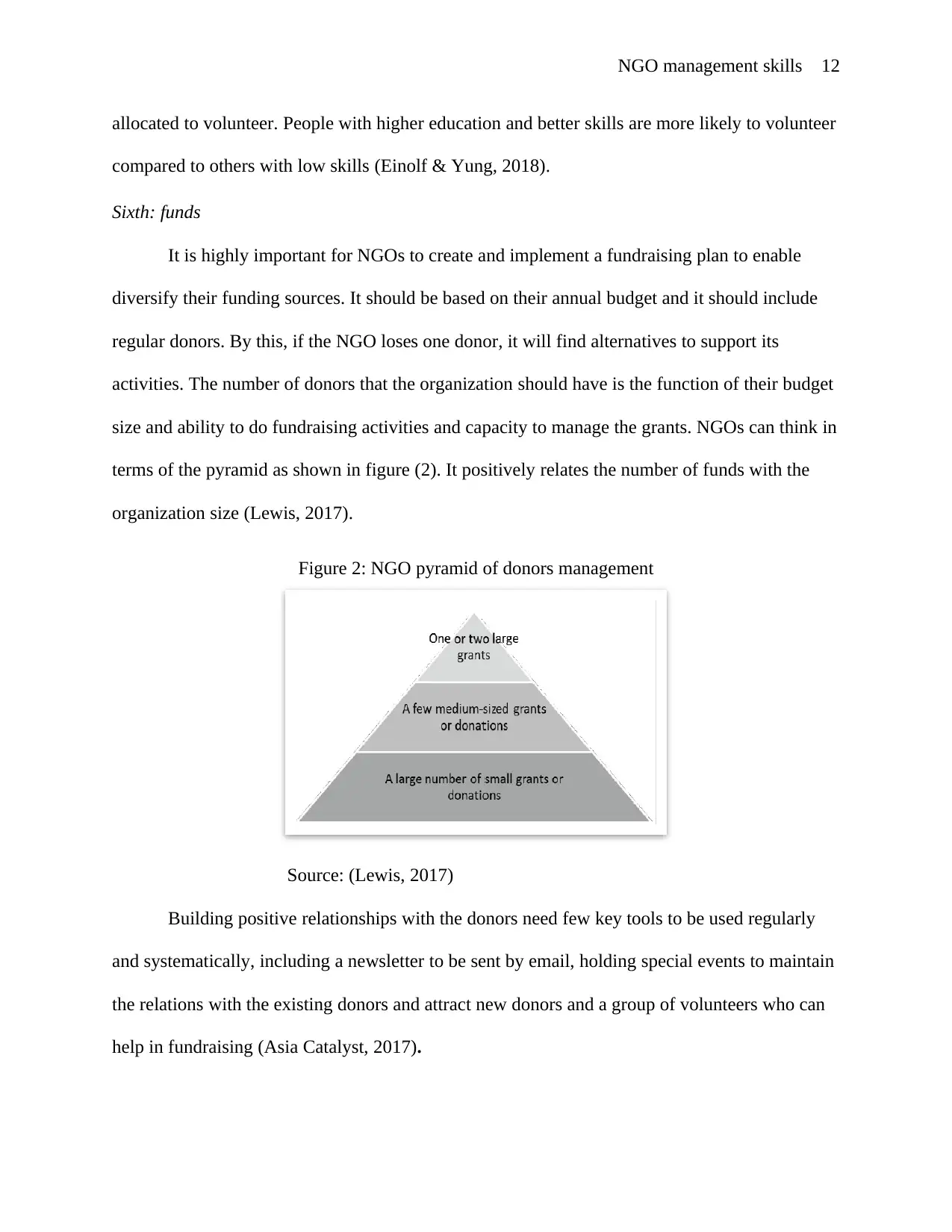
It is highly important for NGOs to create and implement a fundraising plan to enable
diversify their funding sources. It should be based on their annual budget and it should include
regular donors. By this, if the NGO loses one donor, it will find alternatives to support its
activities. The number of donors that the organization should have is the function of their budget
size and ability to do fundraising activities and capacity to manage the grants. NGOs can think in
terms of the pyramid as shown in figure (2). It positively relates the number of funds with the
organization size (Lewis, 2017).
Figure 2: NGO pyramid of donors management
Source: (Lewis, 2017)
Building positive relationships with the donors need few key tools to be used regularly
and systematically, including a newsletter to be sent by email, holding special events to maintain
the relations with the existing donors and attract new donors and a group of volunteers who can
help in fundraising (Asia Catalyst, 2017).
allocated to volunteer. People with higher education and better skills are more likely to volunteer
compared to others with low skills (Einolf & Yung, 2018).
Sixth: funds
It is highly important for NGOs to create and implement a fundraising plan to enable
diversify their funding sources. It should be based on their annual budget and it should include
regular donors. By this, if the NGO loses one donor, it will find alternatives to support its
activities. The number of donors that the organization should have is the function of their budget
size and ability to do fundraising activities and capacity to manage the grants. NGOs can think in
terms of the pyramid as shown in figure (2). It positively relates the number of funds with the
organization size (Lewis, 2017).
Figure 2: NGO pyramid of donors management
Source: (Lewis, 2017)
Building positive relationships with the donors need few key tools to be used regularly
and systematically, including a newsletter to be sent by email, holding special events to maintain
the relations with the existing donors and attract new donors and a group of volunteers who can
help in fundraising (Asia Catalyst, 2017).
⊘ This is a preview!⊘
Do you want full access?
Subscribe today to unlock all pages.
Trusted by 1+ million students worldwide

1 out of 20


Related Documents


Your All-in-One AI-Powered Toolkit for Academic Success.
+13062052269
info@desklib.com
Available 24*7 on WhatsApp / Email
![[object Object]](/_next/static/media/star-bottom.7253800d.svg)
Unlock your academic potential
Copyright © 2020–2026 A2Z Services. All Rights Reserved. Developed and managed by ZUCOL.