People Management Report: NHS Leadership, Training, and Talent
VerifiedAdded on 2020/10/05
|9
|2837
|87
Report
AI Summary
This report provides an in-depth analysis of people management within the National Health Service (NHS), focusing on three key areas: leadership and management, training and development, and talent management. The report begins by exploring leadership theories, contrasting traditional approaches with contemporary collaborative styles, and highlighting the NHS's shift towards distributed leadership. It then examines training and development strategies, including the implementation of strategic training goals and the use of incentives to improve staff performance. Furthermore, the report delves into talent management practices, discussing the importance of attracting, identifying, and developing talent within the NHS. It also addresses both internal and external influences affecting these areas, such as staff shortages, morale, and the need for future-focused training. The report concludes with recommendations for improvement and strategies to address future challenges faced by the NHS. The report is a comprehensive review of the NHS's people management strategies and practices.

INTRODUCTION TO
PEOPLE MANAGEMENT
PEOPLE MANAGEMENT

Paraphrase This Document
Need a fresh take? Get an instant paraphrase of this document with our AI Paraphraser
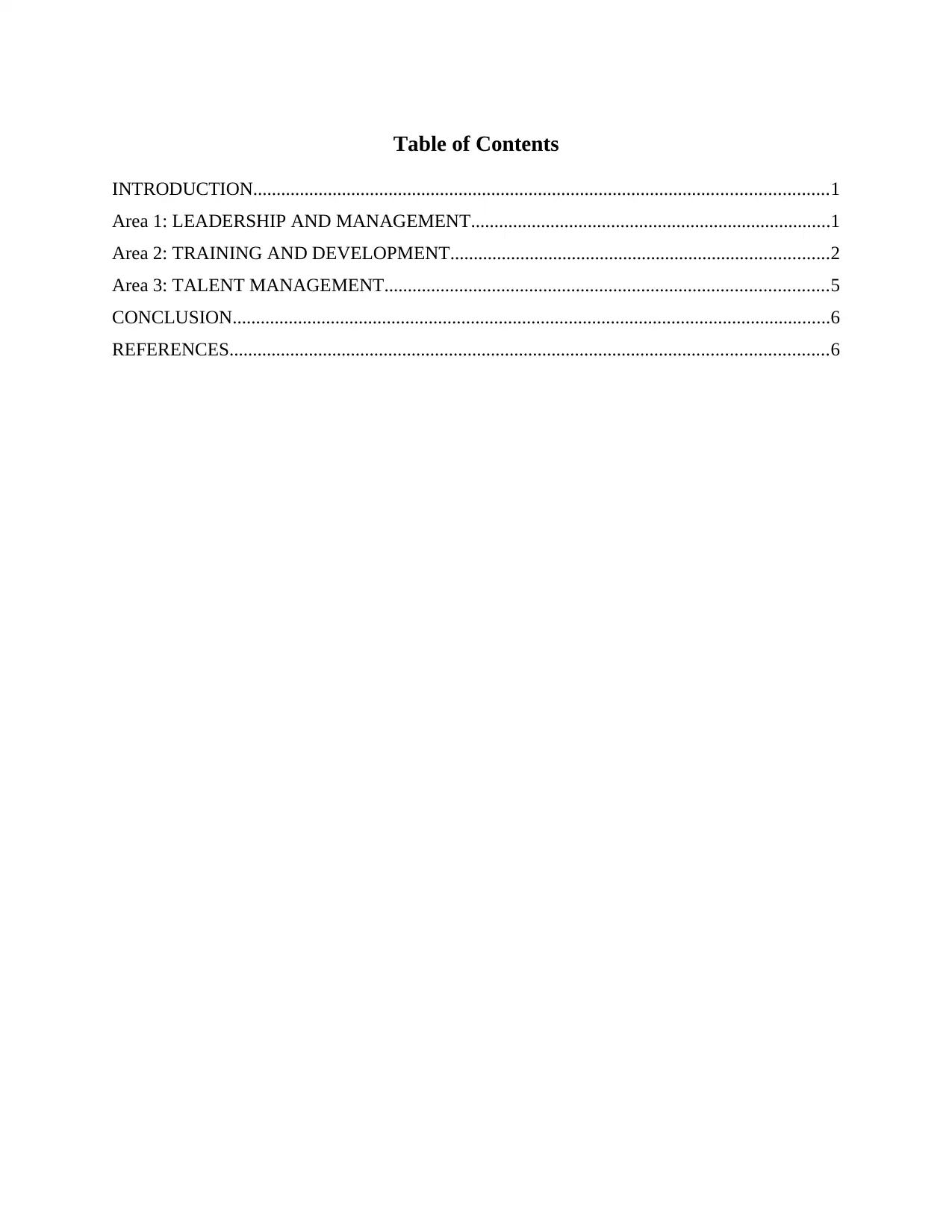
Table of Contents
INTRODUCTION...........................................................................................................................1
Area 1: LEADERSHIP AND MANAGEMENT.............................................................................1
Area 2: TRAINING AND DEVELOPMENT.................................................................................2
Area 3: TALENT MANAGEMENT...............................................................................................5
CONCLUSION................................................................................................................................6
REFERENCES................................................................................................................................6
INTRODUCTION...........................................................................................................................1
Area 1: LEADERSHIP AND MANAGEMENT.............................................................................1
Area 2: TRAINING AND DEVELOPMENT.................................................................................2
Area 3: TALENT MANAGEMENT...............................................................................................5
CONCLUSION................................................................................................................................6
REFERENCES................................................................................................................................6
INTRODUCTION
People or Human Resource Management is an internal organizational discipline that
deals with recruitment, administration, guidance and development of a business' workforce (Al
Ariss, Cascio and Paauwe, 2014). This report focuses on an individual research based portfolio
for given NHS Case Study specifically focusing on three key areas viz. Leadership and
Management, Training and Development, Talent Management. Apart from this, it provides
recommendations how NHS can improve its practices to cope up with future challenges as well
as focus on the internal and external influences affecting the key highlighted areas.
Area 1: LEADERSHIP AND MANAGEMENT
There are many theories that have been propounded in regards to Leadership and
Management. Earlier, traditional leadership approaches such as 'Heroic Leadership' were
engaged in order to demarcate the line of authority between Leaders and their subordinates
(Cappelli and Keller, 2014). Theoretical frameworks such as Trait Model focused more on the
supervisory and control aspect assuming that most leaders were born with a specific set of
leadership traits. Another model called Behavioural Leadership Model emphasized on the
difference in level of authority possessed by an individual in an organization. Lastly, Autocratic
Leadership Model suggested that decision making must be limited to a leader and subordinates
must follow.
However, over the years this demarcation dissolved into a 'collaborative or contemporary
style of leadership' where leaders welcomed their associates to indulge in the process of decision
making and planning of important functional tasks of a business entity (Ehnert and Harry, 2012).
A contemporary or collaborative style of leadership approach argued that an effective
manager/leader must possess cognitive and behavioural capability to identify and respond to
complexness present in the business environment. This leadership style also invests in building
long-term relationships in the workplace and encourages constructive criticism at the same time.
As per the NHS case scenario, the latest King's Fund report implements a shift in the
leadership approach in the healthcare system from traditional heroic approaches to a
collaborative one. They point out the importance of internal transformation of processes led by
front-line staff and service users emphasizing on the need of a more distributed leadership style
to be set in place. This requires adoption of organic methods that favour 'curiosity and invitation'
1
People or Human Resource Management is an internal organizational discipline that
deals with recruitment, administration, guidance and development of a business' workforce (Al
Ariss, Cascio and Paauwe, 2014). This report focuses on an individual research based portfolio
for given NHS Case Study specifically focusing on three key areas viz. Leadership and
Management, Training and Development, Talent Management. Apart from this, it provides
recommendations how NHS can improve its practices to cope up with future challenges as well
as focus on the internal and external influences affecting the key highlighted areas.
Area 1: LEADERSHIP AND MANAGEMENT
There are many theories that have been propounded in regards to Leadership and
Management. Earlier, traditional leadership approaches such as 'Heroic Leadership' were
engaged in order to demarcate the line of authority between Leaders and their subordinates
(Cappelli and Keller, 2014). Theoretical frameworks such as Trait Model focused more on the
supervisory and control aspect assuming that most leaders were born with a specific set of
leadership traits. Another model called Behavioural Leadership Model emphasized on the
difference in level of authority possessed by an individual in an organization. Lastly, Autocratic
Leadership Model suggested that decision making must be limited to a leader and subordinates
must follow.
However, over the years this demarcation dissolved into a 'collaborative or contemporary
style of leadership' where leaders welcomed their associates to indulge in the process of decision
making and planning of important functional tasks of a business entity (Ehnert and Harry, 2012).
A contemporary or collaborative style of leadership approach argued that an effective
manager/leader must possess cognitive and behavioural capability to identify and respond to
complexness present in the business environment. This leadership style also invests in building
long-term relationships in the workplace and encourages constructive criticism at the same time.
As per the NHS case scenario, the latest King's Fund report implements a shift in the
leadership approach in the healthcare system from traditional heroic approaches to a
collaborative one. They point out the importance of internal transformation of processes led by
front-line staff and service users emphasizing on the need of a more distributed leadership style
to be set in place. This requires adoption of organic methods that favour 'curiosity and invitation'
1
⊘ This is a preview!⊘
Do you want full access?
Subscribe today to unlock all pages.

Trusted by 1+ million students worldwide
rather than 'command and control'. One of the methods include Management by Objectives
which includes mechanisms whereby common goals are formulated closely working with
superiors and subordinates. Also, methods such as Pacesetting, Mentoring and Affiliative
Leadership also help in developing harmony, teamwork, innovation,generation of new ideas as
well as maintains a considerable amount of chain of command.
Inculcation of collaborative leadership styles have been supported by national leadership
and management bodies such as NHS Management who have been focusing on the
implementation of 'Developing People, Improving Care' framework. Such models would
improve leadership and capabilities across health and care systems emphasising mainly on
systems working, building skills and feeling of compassion among staff across all organisational
levels. In NHS, Human Resource related initiatives include Faculty of Improvement,
Sustainability and Transformation Plans (STP) footprints through leadership academies,
supporting business to improve talent management and reduce discrimination against staff thus
leading to a joint 'Well-Led' Framework for the organisation as a whole.
Internal influences directly affecting the highlighted area of 'Leadership and
Management' essentially relates to the attempts made by NHS to overcome its staff shortages
specifically in the area of clinical management, board, executive teams and primary care
practitioners. Since the organisation heavily relies on hiring temporary agents, disparity in wages
and responsibilities between permanent and temporary staff also poses a threat to the quality of
services offered by the business. Ultimately, this has also led to the increase in demand for a
strong leader who is also capable of managing broad as well as minute organisational tasks of
NHS. A widespread morale deflation and risk to patient care demands an effective people
manager that can address these issue by inspiring them to work harder under highly stressful
environment. Conversely, there are External Influences too that have affected the highlighted
area of 'Leadership and Management' in a great manner. Such underlying factors include
efficiency of the business as a whole in current scenario, need for improving sustainability for
future, aim to improve leadership, management and governance through trusts such as Care
Quality Commission.
Area 2: TRAINING AND DEVELOPMENT
In a layman's language, training and development refers to the tools and techniques that
help in acquisition of employability skills to both potential as well as existing workforce to
2
which includes mechanisms whereby common goals are formulated closely working with
superiors and subordinates. Also, methods such as Pacesetting, Mentoring and Affiliative
Leadership also help in developing harmony, teamwork, innovation,generation of new ideas as
well as maintains a considerable amount of chain of command.
Inculcation of collaborative leadership styles have been supported by national leadership
and management bodies such as NHS Management who have been focusing on the
implementation of 'Developing People, Improving Care' framework. Such models would
improve leadership and capabilities across health and care systems emphasising mainly on
systems working, building skills and feeling of compassion among staff across all organisational
levels. In NHS, Human Resource related initiatives include Faculty of Improvement,
Sustainability and Transformation Plans (STP) footprints through leadership academies,
supporting business to improve talent management and reduce discrimination against staff thus
leading to a joint 'Well-Led' Framework for the organisation as a whole.
Internal influences directly affecting the highlighted area of 'Leadership and
Management' essentially relates to the attempts made by NHS to overcome its staff shortages
specifically in the area of clinical management, board, executive teams and primary care
practitioners. Since the organisation heavily relies on hiring temporary agents, disparity in wages
and responsibilities between permanent and temporary staff also poses a threat to the quality of
services offered by the business. Ultimately, this has also led to the increase in demand for a
strong leader who is also capable of managing broad as well as minute organisational tasks of
NHS. A widespread morale deflation and risk to patient care demands an effective people
manager that can address these issue by inspiring them to work harder under highly stressful
environment. Conversely, there are External Influences too that have affected the highlighted
area of 'Leadership and Management' in a great manner. Such underlying factors include
efficiency of the business as a whole in current scenario, need for improving sustainability for
future, aim to improve leadership, management and governance through trusts such as Care
Quality Commission.
Area 2: TRAINING AND DEVELOPMENT
In a layman's language, training and development refers to the tools and techniques that
help in acquisition of employability skills to both potential as well as existing workforce to
2
Paraphrase This Document
Need a fresh take? Get an instant paraphrase of this document with our AI Paraphraser
perform their roles and responsibilities in a qualitative manner (James Sunday Kehinde, 2012). It
focuses on development and implementation of training systems in a way that enhances business
performance. The training and development process in NHS calls for implementation of business
strategies that help in measuring and improving training procedures, values and education of all
NHS staff in coming five years and beyond. This model includes identification of business
strategy, setting up of strategic training and development goals in line with such strategies
eventually translating them as specific tasks or activities that contribute in performance
management for the staff through continuous evaluation of actual with budgeted metrics
(Jehanzeb and Bashir, 2013).
NHS Management is the administration and consulting head of NHS that is involved in
providing services to individual nursing homes and companies. It applies a broad approach
provisioning delivery of quality patient care to individuals or residents. This body includes
clinical, estates and facilities, finance, operational, practice, human resources and general
management roles. This body provides a supportive framework to NHS by conducting research
studies to ascertain how workforce management can be managed effectively and how HRM
interventions can help in creating a difference for NHS across all levels. Also, HR functions
support management by ensuring that functional tasks such as overall recruitment
responsibilities, selection and appraisal, training and staff development, engagement as well as
proper knowledge and implementation of employment governance and aide have been done
across all organizational levels effectively (Noe and et.al., 2017). This can be achieved through
employment of resources worth £25 billion into a Staff Improvement Hub.
Apart from this, NHS has successfully implemented a 'Developing People' framework in
collaboration with 12 other nationally acclaimed health and care institutions. This concept
focuses on improving patient care by encouraging staff to employ technologies and technical
know-how to better local healthcare systems as well as amplify pride and joy from their work. In
addition to this, quality incentives have been put into place to encourage continuous
improvements in work-related performance staff. One such is incentive is the Sir Peter Carr
Award that offers £30,000 for a clinician and manager partnership to invest in their professional
evolution thus helping them to achieve a shared improvement objective. Linking incentives and
rewards to performance and valence can help in bringing a positive impact on the staff as well as
NHS itself. The Valence Theory employs psychological tools and techniques mainly focusing on
3
focuses on development and implementation of training systems in a way that enhances business
performance. The training and development process in NHS calls for implementation of business
strategies that help in measuring and improving training procedures, values and education of all
NHS staff in coming five years and beyond. This model includes identification of business
strategy, setting up of strategic training and development goals in line with such strategies
eventually translating them as specific tasks or activities that contribute in performance
management for the staff through continuous evaluation of actual with budgeted metrics
(Jehanzeb and Bashir, 2013).
NHS Management is the administration and consulting head of NHS that is involved in
providing services to individual nursing homes and companies. It applies a broad approach
provisioning delivery of quality patient care to individuals or residents. This body includes
clinical, estates and facilities, finance, operational, practice, human resources and general
management roles. This body provides a supportive framework to NHS by conducting research
studies to ascertain how workforce management can be managed effectively and how HRM
interventions can help in creating a difference for NHS across all levels. Also, HR functions
support management by ensuring that functional tasks such as overall recruitment
responsibilities, selection and appraisal, training and staff development, engagement as well as
proper knowledge and implementation of employment governance and aide have been done
across all organizational levels effectively (Noe and et.al., 2017). This can be achieved through
employment of resources worth £25 billion into a Staff Improvement Hub.
Apart from this, NHS has successfully implemented a 'Developing People' framework in
collaboration with 12 other nationally acclaimed health and care institutions. This concept
focuses on improving patient care by encouraging staff to employ technologies and technical
know-how to better local healthcare systems as well as amplify pride and joy from their work. In
addition to this, quality incentives have been put into place to encourage continuous
improvements in work-related performance staff. One such is incentive is the Sir Peter Carr
Award that offers £30,000 for a clinician and manager partnership to invest in their professional
evolution thus helping them to achieve a shared improvement objective. Linking incentives and
rewards to performance and valence can help in bringing a positive impact on the staff as well as
NHS itself. The Valence Theory employs psychological tools and techniques mainly focusing on
3
the intrinsic attractiveness or averseness towards a particular event, object or circumstance.
Attractiveness brings about Positive Valence whereas Averseness depicts Negative Valence.
Thus, helping in measuring the level of perception, motivation as well as satisfaction
experienced towards a certain task or activity in the workplace. Another initiative known as
'Improvement Hub' has been undertaken by NHS' HR Department to support staff by
encouraging them to come forward and share their experiences, ideas that can be further
collaborated with co-workers thus highlighting resource availability.
Internal influences directly affecting the highlighted domain of 'Training and
Development' relates to the need to overcome staff shortages faced by NHS due to inefficiencies
taking place at the recruitment stage. In addition to this shortcoming, NHS performance is
heavily underpinned due to pervading situations like poor pay, increasing workloads, inflated
targets and highly stressful environment that has resulted in burnout of clinical staff. Training
and Development is also required to reduce dependence on agency and locum staff shifting focus
to the improvement in quality and standard of patient care through a reduction in staffing cost
simultaneously. A widespread morale deflation and risk to patient care demands an effective
people manager that can address these issue by inspiring them to work harder under highly
stressful environment. Conversely, there are external influences too that have affected this area
in a great manner. Externally, the driving factors for the highlighted area of 'Training and
Development' include balancing the gap between existing manpower and future requirements for
highly educated and trained registered nurses. As forecasted by HEE, expected growth in 2020
for registered nurses would create a vacancy for 6,000 extra nurses. A scarcity of practitioners
presents in NHS as compared to European average has forced the organization to train and
develop its current and potential staff to help them in tackling future pressures and ensure their
retention.
Therefore, proper training should be given to the staff as only 52% of the workers
surveyed are satisfied with current opportunities for flexible working. NHS Administration
should also focus on increasing morale of permanent staff by providing them job roles that are
suited to their capabilities with equal wage rates as paid to agency workers, use e-rostering and
effective job planning, support new Advanced Clinical Practice (ACP) nurse roles and tackle
pressures on doctors in training by conducting seminars or workshops for them.
4
Attractiveness brings about Positive Valence whereas Averseness depicts Negative Valence.
Thus, helping in measuring the level of perception, motivation as well as satisfaction
experienced towards a certain task or activity in the workplace. Another initiative known as
'Improvement Hub' has been undertaken by NHS' HR Department to support staff by
encouraging them to come forward and share their experiences, ideas that can be further
collaborated with co-workers thus highlighting resource availability.
Internal influences directly affecting the highlighted domain of 'Training and
Development' relates to the need to overcome staff shortages faced by NHS due to inefficiencies
taking place at the recruitment stage. In addition to this shortcoming, NHS performance is
heavily underpinned due to pervading situations like poor pay, increasing workloads, inflated
targets and highly stressful environment that has resulted in burnout of clinical staff. Training
and Development is also required to reduce dependence on agency and locum staff shifting focus
to the improvement in quality and standard of patient care through a reduction in staffing cost
simultaneously. A widespread morale deflation and risk to patient care demands an effective
people manager that can address these issue by inspiring them to work harder under highly
stressful environment. Conversely, there are external influences too that have affected this area
in a great manner. Externally, the driving factors for the highlighted area of 'Training and
Development' include balancing the gap between existing manpower and future requirements for
highly educated and trained registered nurses. As forecasted by HEE, expected growth in 2020
for registered nurses would create a vacancy for 6,000 extra nurses. A scarcity of practitioners
presents in NHS as compared to European average has forced the organization to train and
develop its current and potential staff to help them in tackling future pressures and ensure their
retention.
Therefore, proper training should be given to the staff as only 52% of the workers
surveyed are satisfied with current opportunities for flexible working. NHS Administration
should also focus on increasing morale of permanent staff by providing them job roles that are
suited to their capabilities with equal wage rates as paid to agency workers, use e-rostering and
effective job planning, support new Advanced Clinical Practice (ACP) nurse roles and tackle
pressures on doctors in training by conducting seminars or workshops for them.
4
⊘ This is a preview!⊘
Do you want full access?
Subscribe today to unlock all pages.
Trusted by 1+ million students worldwide
Area 3: TALENT MANAGEMENT
The concept of Talent Management differs from organization to organization based on
the goals, objectives and business drivers of the business (Sparrow and et.al., 2015). Essentially,
it refers to the sequential process of attracting, identifying, creating, engaging, holding and
deploying of individuals that an organisation perceives of value to them either due to the skill-set
they possess which are in tune with the roles and responsibilities required to be filled by the
organisation or in view of their high future capabilities. Hence, it is important for the manager to
acquire proper talent for their organization to aid its future success.
Talent Management model has undergone a lot of changes over the years based on the
evolution of business and their driving factors. Commonly, this model includes planning,
attracting, discovering, talent acquisition or recruitment, learning and development, performance
management, career pathways and succession planning. The planning stage includes
understanding business needs and strategies, evaluating prior initiatives, workforce and talent
performance based on current business scenario and future goals. This provides the recruiter
ample information to create workforce plan that ensures business goals and talent needs are in
line. This workforce plan enables proper allocation of resources thus helping in forecasting
future needs (Vaccaro and et.al., 2012). NHS has been experiencing staff shortages at an
increasing rate. Hence it has committed to discovering and developing talent by adopting 'Ward
to Board' approach that encourages staff from across all levels or wards of the organisation to
work qualitatively by providing them the opportunity to be a part of decision making
functionaries.
The roles and priorities of NHS as well as its supporting bodies have been designed in
such a way that the talent development engages in inducing technical competency among NHS'
workforce truly aligning them to lead services in accordance with belief, values, visions and
missions prevalent in the organisation. Since talent development creates an internal pool of talent
it is important for this domain to be highly customized in nature. NHS' Leading Sustainability
and Transformation Plans and Accountable Care Systems have ensured that staff and trade
unions are paid appropriately in a way that encourages flexible working and 'de-risking' service
change. This would help the staff to support team-based working and create internal efficacies
for the organisation. However, external influences such as government regulations, industry
trends should also be taken into consideration. Continuous innovations occurring in health and
5
The concept of Talent Management differs from organization to organization based on
the goals, objectives and business drivers of the business (Sparrow and et.al., 2015). Essentially,
it refers to the sequential process of attracting, identifying, creating, engaging, holding and
deploying of individuals that an organisation perceives of value to them either due to the skill-set
they possess which are in tune with the roles and responsibilities required to be filled by the
organisation or in view of their high future capabilities. Hence, it is important for the manager to
acquire proper talent for their organization to aid its future success.
Talent Management model has undergone a lot of changes over the years based on the
evolution of business and their driving factors. Commonly, this model includes planning,
attracting, discovering, talent acquisition or recruitment, learning and development, performance
management, career pathways and succession planning. The planning stage includes
understanding business needs and strategies, evaluating prior initiatives, workforce and talent
performance based on current business scenario and future goals. This provides the recruiter
ample information to create workforce plan that ensures business goals and talent needs are in
line. This workforce plan enables proper allocation of resources thus helping in forecasting
future needs (Vaccaro and et.al., 2012). NHS has been experiencing staff shortages at an
increasing rate. Hence it has committed to discovering and developing talent by adopting 'Ward
to Board' approach that encourages staff from across all levels or wards of the organisation to
work qualitatively by providing them the opportunity to be a part of decision making
functionaries.
The roles and priorities of NHS as well as its supporting bodies have been designed in
such a way that the talent development engages in inducing technical competency among NHS'
workforce truly aligning them to lead services in accordance with belief, values, visions and
missions prevalent in the organisation. Since talent development creates an internal pool of talent
it is important for this domain to be highly customized in nature. NHS' Leading Sustainability
and Transformation Plans and Accountable Care Systems have ensured that staff and trade
unions are paid appropriately in a way that encourages flexible working and 'de-risking' service
change. This would help the staff to support team-based working and create internal efficacies
for the organisation. However, external influences such as government regulations, industry
trends should also be taken into consideration. Continuous innovations occurring in health and
5
Paraphrase This Document
Need a fresh take? Get an instant paraphrase of this document with our AI Paraphraser
care industry must be adopted by the organization by developing a succession planning system in
the organization to reduce attrition rates as well as increase staff retention in NHS.
This is required because of the growing need for medical practitioners that are highly
trained and knowledgeable in the field of healthcare systems especially in General Management,
Accident & Emergency and Mental Health which are expected to grow substantially in the
future. Apart from this, talent management is also important in NHS to look after the needs of
the rapid technological advancements in the overall industry that may create gap between the
quality of service delivered and required, if ignored.
CONCLUSION
From the above discussions carried out in the research based portfolio of NHS, three
critical areas have been analysed where the organisation has been facing challenges due to
increased staff shortages. These domains mainly discuss the key theoretical models, their role in
contributing to support management and how internal as well as external influences have
affected these domains to increase the adversity of challenges faced by NHS. It can be concluded
that in order to address these problems NHS needs to improve its leadership approach by
adopting more open and welcoming leadership style such as launching an evidence based culture
and leadership programme such as Care Quality Commission which would help in assessing
leadership, management and governance. The organisation also needs to enhance its training and
development domain by adopting a more collaborative approach that would focus on patient
safety, strengthen the workforce taking pressure off of current staff and create efficiency. Lastly,
the organisation must look after its Talent Management aspect by creating local partnerships
between various care providers that help in funding and sustainability of future success of NHS.
REFERENCES
Al Ariss, A., Cascio, W. F. and Paauwe, J., 2014. Talent management: Current theories and
future research directions. Journal of World Business. 49(2). pp.173-179.
Cappelli, P. and Keller, J. R., 2014. Talent management: Conceptual approaches and practical
challenges. Annu. Rev. Organ. Psychol. Organ. Behav.. 1(1). pp.305-331.
Ehnert, I. and Harry, W., 2012. Recent developments and future prospects on sustainable human
resource management: Introduction to the special issue. management revue. pp.221-238.
James Sunday Kehinde PhD, A. C. A., 2012. Talent management: Effect on organizational
performance. Journal of Management Research. 4(2). p.178.
Jehanzeb, K. and Bashir, N. A., 2013. Training and development program and its benefits to
employee and organization: A conceptual study. European Journal of business and
management. 5(2).
6
the organization to reduce attrition rates as well as increase staff retention in NHS.
This is required because of the growing need for medical practitioners that are highly
trained and knowledgeable in the field of healthcare systems especially in General Management,
Accident & Emergency and Mental Health which are expected to grow substantially in the
future. Apart from this, talent management is also important in NHS to look after the needs of
the rapid technological advancements in the overall industry that may create gap between the
quality of service delivered and required, if ignored.
CONCLUSION
From the above discussions carried out in the research based portfolio of NHS, three
critical areas have been analysed where the organisation has been facing challenges due to
increased staff shortages. These domains mainly discuss the key theoretical models, their role in
contributing to support management and how internal as well as external influences have
affected these domains to increase the adversity of challenges faced by NHS. It can be concluded
that in order to address these problems NHS needs to improve its leadership approach by
adopting more open and welcoming leadership style such as launching an evidence based culture
and leadership programme such as Care Quality Commission which would help in assessing
leadership, management and governance. The organisation also needs to enhance its training and
development domain by adopting a more collaborative approach that would focus on patient
safety, strengthen the workforce taking pressure off of current staff and create efficiency. Lastly,
the organisation must look after its Talent Management aspect by creating local partnerships
between various care providers that help in funding and sustainability of future success of NHS.
REFERENCES
Al Ariss, A., Cascio, W. F. and Paauwe, J., 2014. Talent management: Current theories and
future research directions. Journal of World Business. 49(2). pp.173-179.
Cappelli, P. and Keller, J. R., 2014. Talent management: Conceptual approaches and practical
challenges. Annu. Rev. Organ. Psychol. Organ. Behav.. 1(1). pp.305-331.
Ehnert, I. and Harry, W., 2012. Recent developments and future prospects on sustainable human
resource management: Introduction to the special issue. management revue. pp.221-238.
James Sunday Kehinde PhD, A. C. A., 2012. Talent management: Effect on organizational
performance. Journal of Management Research. 4(2). p.178.
Jehanzeb, K. and Bashir, N. A., 2013. Training and development program and its benefits to
employee and organization: A conceptual study. European Journal of business and
management. 5(2).
6

Noe, R. A. and et.al., 2017. Human resource management: Gaining a competitive advantage.
New York, NY: McGraw-Hill Education.
Sparrow, P. and et.al., 2015. Strategic talent management. In Do We Need HR?. (pp. 177-212).
Palgrave Macmillan, London.
Vaccaro, I. G., and et.al., 2012. Management innovation and leadership: The moderating role of
organizational size. Journal of management studies. 49(1). pp.28-51.
7
New York, NY: McGraw-Hill Education.
Sparrow, P. and et.al., 2015. Strategic talent management. In Do We Need HR?. (pp. 177-212).
Palgrave Macmillan, London.
Vaccaro, I. G., and et.al., 2012. Management innovation and leadership: The moderating role of
organizational size. Journal of management studies. 49(1). pp.28-51.
7
⊘ This is a preview!⊘
Do you want full access?
Subscribe today to unlock all pages.
Trusted by 1+ million students worldwide

1 out of 9


Related Documents


Your All-in-One AI-Powered Toolkit for Academic Success.
+13062052269
info@desklib.com
Available 24*7 on WhatsApp / Email
![[object Object]](/_next/static/media/star-bottom.7253800d.svg)
Unlock your academic potential
Copyright © 2020–2026 A2Z Services. All Rights Reserved. Developed and managed by ZUCOL.