MOD006887 - International Operations Management: NHS Report
VerifiedAdded on 2023/06/18
|14
|3830
|82
Report
AI Summary
This report provides a consultancy-based analysis of operational challenges within the Mid and South Barsetshire NHS Foundation Trust (MSBFT). It identifies three key problems: supply chain crises (particularly regarding PPE), resource management issues, and delays in patient attending time. For each problem, the report provides an analysis of the causes, an evaluation of the consequences, and a discussion of potential solutions. The report emphasizes the impact of the COVID-19 pandemic on exacerbating these issues. Recommendations focus on improving supply chain resilience through diversification and data-driven demand forecasting, enhancing resource management using Lean methodologies, and reducing patient wait times through process optimization. The report highlights the need for better strategic and operational capabilities within the NHS to ensure effective healthcare delivery during both normal and crisis situations. Desklib offers a wealth of resources, including past papers and solved assignments, to support students in their academic endeavors.
International Operations Management:
operations consultancy report
SID: Type your SID here
Word count:
(Excluding text in abstracts; data; tables; figures;
diagrams; in-text citations; footnotes/endnotes
used for reference purposes and kept within
reasonable limits; references; appendices. Per
ARU Assessment Regulations 13, 2020, §6.83).
Type word count here
Academic honesty: [By submitting this assignment, I declare that] I
understand that the piece of work submitted will be
considered as the final and complete version of my
assignment of which I am otherwise the sole author. I
understand both the meaning and consequences of
plagiarism and that my work has been appropriately
attributed unless otherwise stated. I have not knowingly
allowed another to copy my work.
Assignment deadline: Type deadline here
Assignment:
Module:
Module leader:
Lecturer:
Semester/Trimester:
Academic year:
SID: Type SID here 1 of
Module: MOD006887
operations consultancy report
SID: Type your SID here
Word count:
(Excluding text in abstracts; data; tables; figures;
diagrams; in-text citations; footnotes/endnotes
used for reference purposes and kept within
reasonable limits; references; appendices. Per
ARU Assessment Regulations 13, 2020, §6.83).
Type word count here
Academic honesty: [By submitting this assignment, I declare that] I
understand that the piece of work submitted will be
considered as the final and complete version of my
assignment of which I am otherwise the sole author. I
understand both the meaning and consequences of
plagiarism and that my work has been appropriately
attributed unless otherwise stated. I have not knowingly
allowed another to copy my work.
Assignment deadline: Type deadline here
Assignment:
Module:
Module leader:
Lecturer:
Semester/Trimester:
Academic year:
SID: Type SID here 1 of
Module: MOD006887

Paraphrase This Document
Need a fresh take? Get an instant paraphrase of this document with our AI Paraphraser
Executive summary
The commercialization of the NHS brought with it a slew of issues, including a failing to
provide personal protective equipment (PPE), a lack of pandemic preparedness, and
restricting rather than expanding the food production. This resulted in the loss of lives as well
as profits. According to the analysis, the NHS will need to use a variety of operational
methodologies and supply management approaches to ensure a seamless supply chain. To
estimate demands and stockpile appropriately, the NHS must use massive data automated
reasoning. Furthermore, the firm must diversity its supplier to guarantee that it can maintain
an appropriate supply of commodities during moments of emergency.
SID: Type SID here 2 of
Module: MOD006887
The commercialization of the NHS brought with it a slew of issues, including a failing to
provide personal protective equipment (PPE), a lack of pandemic preparedness, and
restricting rather than expanding the food production. This resulted in the loss of lives as well
as profits. According to the analysis, the NHS will need to use a variety of operational
methodologies and supply management approaches to ensure a seamless supply chain. To
estimate demands and stockpile appropriately, the NHS must use massive data automated
reasoning. Furthermore, the firm must diversity its supplier to guarantee that it can maintain
an appropriate supply of commodities during moments of emergency.
SID: Type SID here 2 of
Module: MOD006887
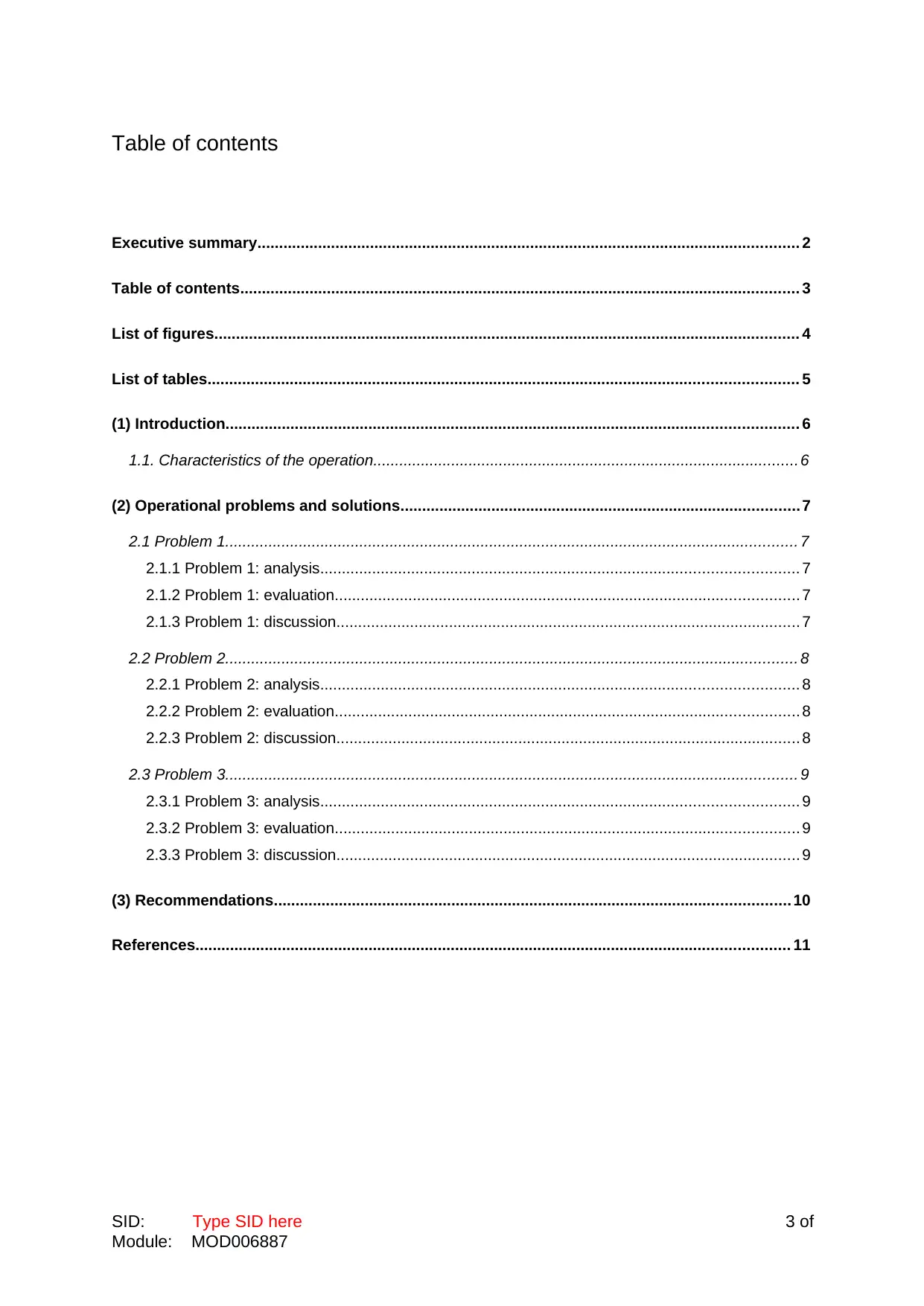
Table of contents
Executive summary............................................................................................................................. 2
Table of contents................................................................................................................................. 3
List of figures....................................................................................................................................... 4
List of tables........................................................................................................................................ 5
(1) Introduction.................................................................................................................................... 6
1.1. Characteristics of the operation.................................................................................................. 6
(2) Operational problems and solutions............................................................................................ 7
2.1 Problem 1.................................................................................................................................... 7
2.1.1 Problem 1: analysis.............................................................................................................. 7
2.1.2 Problem 1: evaluation........................................................................................................... 7
2.1.3 Problem 1: discussion........................................................................................................... 7
2.2 Problem 2.................................................................................................................................... 8
2.2.1 Problem 2: analysis.............................................................................................................. 8
2.2.2 Problem 2: evaluation........................................................................................................... 8
2.2.3 Problem 2: discussion........................................................................................................... 8
2.3 Problem 3.................................................................................................................................... 9
2.3.1 Problem 3: analysis.............................................................................................................. 9
2.3.2 Problem 3: evaluation........................................................................................................... 9
2.3.3 Problem 3: discussion........................................................................................................... 9
(3) Recommendations....................................................................................................................... 10
References......................................................................................................................................... 11
SID: Type SID here 3 of
Module: MOD006887
Executive summary............................................................................................................................. 2
Table of contents................................................................................................................................. 3
List of figures....................................................................................................................................... 4
List of tables........................................................................................................................................ 5
(1) Introduction.................................................................................................................................... 6
1.1. Characteristics of the operation.................................................................................................. 6
(2) Operational problems and solutions............................................................................................ 7
2.1 Problem 1.................................................................................................................................... 7
2.1.1 Problem 1: analysis.............................................................................................................. 7
2.1.2 Problem 1: evaluation........................................................................................................... 7
2.1.3 Problem 1: discussion........................................................................................................... 7
2.2 Problem 2.................................................................................................................................... 8
2.2.1 Problem 2: analysis.............................................................................................................. 8
2.2.2 Problem 2: evaluation........................................................................................................... 8
2.2.3 Problem 2: discussion........................................................................................................... 8
2.3 Problem 3.................................................................................................................................... 9
2.3.1 Problem 3: analysis.............................................................................................................. 9
2.3.2 Problem 3: evaluation........................................................................................................... 9
2.3.3 Problem 3: discussion........................................................................................................... 9
(3) Recommendations....................................................................................................................... 10
References......................................................................................................................................... 11
SID: Type SID here 3 of
Module: MOD006887
⊘ This is a preview!⊘
Do you want full access?
Subscribe today to unlock all pages.

Trusted by 1+ million students worldwide
(1) Introduction
1.1.Characteristics of the operation
According to research, the introduction of the corona virus pandemic has resulted in the loss
of a large number of UK health and care professionals, but there are still gaps in supply
chain, process, and operations. It is thought to be affecting a number of professions, such as
health care professionals, and also the assistance offered by medical employees and care
workers who have a range of work functions. According to the research, coronavirus has
harmed and caused to the mortality of health and care professionals in the United Kingdom.
The report indicated that 129 people were murdered while working in health and care on
May 14th, 2020.
SID: Type SID here 4 of
Module: MOD006887
1.1.Characteristics of the operation
According to research, the introduction of the corona virus pandemic has resulted in the loss
of a large number of UK health and care professionals, but there are still gaps in supply
chain, process, and operations. It is thought to be affecting a number of professions, such as
health care professionals, and also the assistance offered by medical employees and care
workers who have a range of work functions. According to the research, coronavirus has
harmed and caused to the mortality of health and care professionals in the United Kingdom.
The report indicated that 129 people were murdered while working in health and care on
May 14th, 2020.
SID: Type SID here 4 of
Module: MOD006887
Paraphrase This Document
Need a fresh take? Get an instant paraphrase of this document with our AI Paraphraser
(2)Operational problems and solutions
2.1 Problem 1
Supply Crisis
2.1.1Problem 1: analysis
According to a response to the increasing number by the national association, trusts are
facing "inevitable" price increases on items purchased via NHS Supply Chain owing to
continuous global trade dislocation. Even during NHS's continuing wintertime emergency,
hospitals are experiencing severe shortages of key hospital devices including respirators,
medication pumps, and oxygen tanks, according to the Independent. As the amount of
persons that need treatment has increased, several institutions have ran out of mattresses,
pillows, and carts for clients to stay on as they wait for admittance. NHS England has said
that the system is experiencing its most severe pressure but since 1990s. To meet crucial
supply demands, logistics management must constantly assess their strategic and
operational capabilities. Considering continuous supply limitations of protective gear (PPE)
and other emergency aid when healthcare providers restart prepandemic levels of
procedures, it's unclear if the supply chain will be able to satisfy commitments. The ability to
provide a stable, long-term supply of necessary PPE will continue to be a difficulty in the
foreseeable future. To fulfil demand more efficiently during a crisis, lengthier significant
improvements to the activities and management of healthcare distribution networks will be
required across various domains.
2.1.2Problem 1: evaluation
Hacked documents indicate that the clinic's managing director, Andrea Young, recently sent
a warning to workers about a distinct lack of surgical masks, which assist prevent the
transmission of illnesses like the flu. She emphasised, "Always only give facemasks to
patients as a precautionary protection." Since "we are getting critically low on inventory
levels," employees should not allow consumers to seek a walking aid home without them
once they are released. "The previous two weeks have been insane," a medical nurse
stated. There is frequently a wait list for a pneumatically bed on weekend. Clients' cushions
are being taken from beneath their heads by doctors who take them up to the wards since
we don't have any pillows to send them back. Cushions are worth their weight in gold.
Hospitals should be equipped to handle the growing pressure of winter, according to the
Ministry of Health and Social Care. "As part of its rigorous and strong winter preparations,
which was backed by an additional £437 million in government money, the NHS should have
SID: Type SID here 5 of
Module: MOD006887
2.1 Problem 1
Supply Crisis
2.1.1Problem 1: analysis
According to a response to the increasing number by the national association, trusts are
facing "inevitable" price increases on items purchased via NHS Supply Chain owing to
continuous global trade dislocation. Even during NHS's continuing wintertime emergency,
hospitals are experiencing severe shortages of key hospital devices including respirators,
medication pumps, and oxygen tanks, according to the Independent. As the amount of
persons that need treatment has increased, several institutions have ran out of mattresses,
pillows, and carts for clients to stay on as they wait for admittance. NHS England has said
that the system is experiencing its most severe pressure but since 1990s. To meet crucial
supply demands, logistics management must constantly assess their strategic and
operational capabilities. Considering continuous supply limitations of protective gear (PPE)
and other emergency aid when healthcare providers restart prepandemic levels of
procedures, it's unclear if the supply chain will be able to satisfy commitments. The ability to
provide a stable, long-term supply of necessary PPE will continue to be a difficulty in the
foreseeable future. To fulfil demand more efficiently during a crisis, lengthier significant
improvements to the activities and management of healthcare distribution networks will be
required across various domains.
2.1.2Problem 1: evaluation
Hacked documents indicate that the clinic's managing director, Andrea Young, recently sent
a warning to workers about a distinct lack of surgical masks, which assist prevent the
transmission of illnesses like the flu. She emphasised, "Always only give facemasks to
patients as a precautionary protection." Since "we are getting critically low on inventory
levels," employees should not allow consumers to seek a walking aid home without them
once they are released. "The previous two weeks have been insane," a medical nurse
stated. There is frequently a wait list for a pneumatically bed on weekend. Clients' cushions
are being taken from beneath their heads by doctors who take them up to the wards since
we don't have any pillows to send them back. Cushions are worth their weight in gold.
Hospitals should be equipped to handle the growing pressure of winter, according to the
Ministry of Health and Social Care. "As part of its rigorous and strong winter preparations,
which was backed by an additional £437 million in government money, the NHS should have
SID: Type SID here 5 of
Module: MOD006887
adequate supply to manage with times of intense need," a spokeswoman said. Whether
there are limitations, national NHS groups are prepared to engage with hospital to obtain
medical a continuous supply."
2.1.3Problem 1: discussion
Professor Anthony Marsh, the chief operating officer of the West Midlands Ambulance
Service, had his remuneration rise by £50,000 to £235,000 in the fiscal year that ended in
March. Although not receiving any contributes prior to the epidemic, he earned a reward of
between £15,000 and £20,000. The system fulfilled NHS expectations from 2020 to 2021,
but ever since, conditions have slipped, with critical call long waits three times greater than
the October security objective. In that year, five executives at South Central Emergency
Services received bonuses totalling up to £60,000, whereas the chief executive of North
East Ambulance Crew earned more than £15,000. Yesterday, opponents criticised the
bonus reveal, branding it a "insult" to consumers and claiming that the government's difficult
wealth should not be used to "fill the feathers of the top brass."
2.2 Problem 2
Resource management Issue
2.2.1Problem 2: analysis
Health and social care workers (HSCWs) have taken a significant load throughout the
COVID-19 crisis and have been directly affected by its repercussions in the fight to contain
the virus. As a result, ensuring their psychological well-being remains a top focus. In during
COVID-19 crisis, this fast evaluation was conducted to see whether there were any known
risk factors for bad mental health consequences amongst HSCWs. The goal of operations
management is to increase processes using systematic methodologies including such Lean.
Lean emphasises operational productivity by minimizing non-value-adding procedures in
order to improve operations for people who use and rely on them.
The first major issue is a lack of enough power to cope with the increasing patient load. The
demand for intensive care (ICU) beds, ventilation systems, and manpower in many regions
greatly reached the threshold capacities. As during height of the crisis, the number of ICU
people diagnosed at New York City Health + Hospitals (NYC H+H) was more than 3 times
the state's ICU capacity. 3
The requirement for genuine development of patient care systems is a second
problem. Because of the infection's extremely infectious nature and magnitude, doctors,
SID: Type SID here 6 of
Module: MOD006887
there are limitations, national NHS groups are prepared to engage with hospital to obtain
medical a continuous supply."
2.1.3Problem 1: discussion
Professor Anthony Marsh, the chief operating officer of the West Midlands Ambulance
Service, had his remuneration rise by £50,000 to £235,000 in the fiscal year that ended in
March. Although not receiving any contributes prior to the epidemic, he earned a reward of
between £15,000 and £20,000. The system fulfilled NHS expectations from 2020 to 2021,
but ever since, conditions have slipped, with critical call long waits three times greater than
the October security objective. In that year, five executives at South Central Emergency
Services received bonuses totalling up to £60,000, whereas the chief executive of North
East Ambulance Crew earned more than £15,000. Yesterday, opponents criticised the
bonus reveal, branding it a "insult" to consumers and claiming that the government's difficult
wealth should not be used to "fill the feathers of the top brass."
2.2 Problem 2
Resource management Issue
2.2.1Problem 2: analysis
Health and social care workers (HSCWs) have taken a significant load throughout the
COVID-19 crisis and have been directly affected by its repercussions in the fight to contain
the virus. As a result, ensuring their psychological well-being remains a top focus. In during
COVID-19 crisis, this fast evaluation was conducted to see whether there were any known
risk factors for bad mental health consequences amongst HSCWs. The goal of operations
management is to increase processes using systematic methodologies including such Lean.
Lean emphasises operational productivity by minimizing non-value-adding procedures in
order to improve operations for people who use and rely on them.
The first major issue is a lack of enough power to cope with the increasing patient load. The
demand for intensive care (ICU) beds, ventilation systems, and manpower in many regions
greatly reached the threshold capacities. As during height of the crisis, the number of ICU
people diagnosed at New York City Health + Hospitals (NYC H+H) was more than 3 times
the state's ICU capacity. 3
The requirement for genuine development of patient care systems is a second
problem. Because of the infection's extremely infectious nature and magnitude, doctors,
SID: Type SID here 6 of
Module: MOD006887
⊘ This is a preview!⊘
Do you want full access?
Subscribe today to unlock all pages.
Trusted by 1+ million students worldwide
pharmacists, and other professionals must choose the best care model and design with
white. Safeguarding the physical and emotional wellbeing of frontline workers is a related
issue. Clinics and hospitals must ensure that their employees have enough personal
protective equipment (PPE). In relation to the threat of getting the disease, frontline workers
must deal with a great deal of emotional stress, which some may consider unbearable.4
There have been stories of staff members committing suicide.
2.2.2Problem 2: evaluation
Six sigma, critical path method, business processing methods, process monitoring, and Lean
are among the operations management methodologies that have been used in medicine.
The term "lean" has gained a lot of traction. In the English NHS, NHS England and
Innovation (NHSE&I), the federal supervisor of provider trusts, has embarked in an initiative
to incorporate Lean in a number of trusts. The William Mason Foundation originally provided
assistance to five trusts (VMI). Virginia Mason Medical Institute (VMI) is the consultant
branch of Virginia Mason Medical Center, a healthcare institution situated in the United
States that has a worldwide recognition for using Lean to enhance quality and safety. 5–11
An internal NHSE&I consultancy team has provided assistance to another seven trusts. To
enhance the program's effect and return on capital, the information products must be broadly
shared within the NHS. The NHSE&I's cooperation with VMI is being evaluated by Warwick
Business School (WBS), which is recording information outputs14, and innovation education
is one at-scale technique for sharing learning broadly (TEL). The poor quality of PPE kits
issued to NHS employees poses a serious threat to the country's finances and the UK's
ability to recover quickly from the epidemic. The rationale for this is because when clinical
staff are not immune to the pandemic, the risk of the pandemic propagating further doubles.
The PPE kits supplied to medical staff throughout the UK are classified as medium
substance that cannot be used for a longer length of time can provide additional safety
against with the viral infection. This is because a lack of PPE has harmed the morale of
healthcare workers and other customer - facing troops in the struggle against with the
coronavirus disorder, as even more than 22000 hospital workers in 56 countries have been
infected with COVID-19. In this sense, several of them have agreed to it in various nations.
2.2.3Problem 2: discussion
Health care companies have taken the essential decision to launch or cut personnel or to
transfer many people to working remotely, particularly health professionals working with tele-
monitoring, in terms of managing capacities, financial loss, and service innovation. It's
SID: Type SID here 7 of
Module: MOD006887
white. Safeguarding the physical and emotional wellbeing of frontline workers is a related
issue. Clinics and hospitals must ensure that their employees have enough personal
protective equipment (PPE). In relation to the threat of getting the disease, frontline workers
must deal with a great deal of emotional stress, which some may consider unbearable.4
There have been stories of staff members committing suicide.
2.2.2Problem 2: evaluation
Six sigma, critical path method, business processing methods, process monitoring, and Lean
are among the operations management methodologies that have been used in medicine.
The term "lean" has gained a lot of traction. In the English NHS, NHS England and
Innovation (NHSE&I), the federal supervisor of provider trusts, has embarked in an initiative
to incorporate Lean in a number of trusts. The William Mason Foundation originally provided
assistance to five trusts (VMI). Virginia Mason Medical Institute (VMI) is the consultant
branch of Virginia Mason Medical Center, a healthcare institution situated in the United
States that has a worldwide recognition for using Lean to enhance quality and safety. 5–11
An internal NHSE&I consultancy team has provided assistance to another seven trusts. To
enhance the program's effect and return on capital, the information products must be broadly
shared within the NHS. The NHSE&I's cooperation with VMI is being evaluated by Warwick
Business School (WBS), which is recording information outputs14, and innovation education
is one at-scale technique for sharing learning broadly (TEL). The poor quality of PPE kits
issued to NHS employees poses a serious threat to the country's finances and the UK's
ability to recover quickly from the epidemic. The rationale for this is because when clinical
staff are not immune to the pandemic, the risk of the pandemic propagating further doubles.
The PPE kits supplied to medical staff throughout the UK are classified as medium
substance that cannot be used for a longer length of time can provide additional safety
against with the viral infection. This is because a lack of PPE has harmed the morale of
healthcare workers and other customer - facing troops in the struggle against with the
coronavirus disorder, as even more than 22000 hospital workers in 56 countries have been
infected with COVID-19. In this sense, several of them have agreed to it in various nations.
2.2.3Problem 2: discussion
Health care companies have taken the essential decision to launch or cut personnel or to
transfer many people to working remotely, particularly health professionals working with tele-
monitoring, in terms of managing capacities, financial loss, and service innovation. It's
SID: Type SID here 7 of
Module: MOD006887
Paraphrase This Document
Need a fresh take? Get an instant paraphrase of this document with our AI Paraphraser
challenging to downsize and retrain employees in times of stability, but it's considerably
harder whenever adjustments must be made quickly.
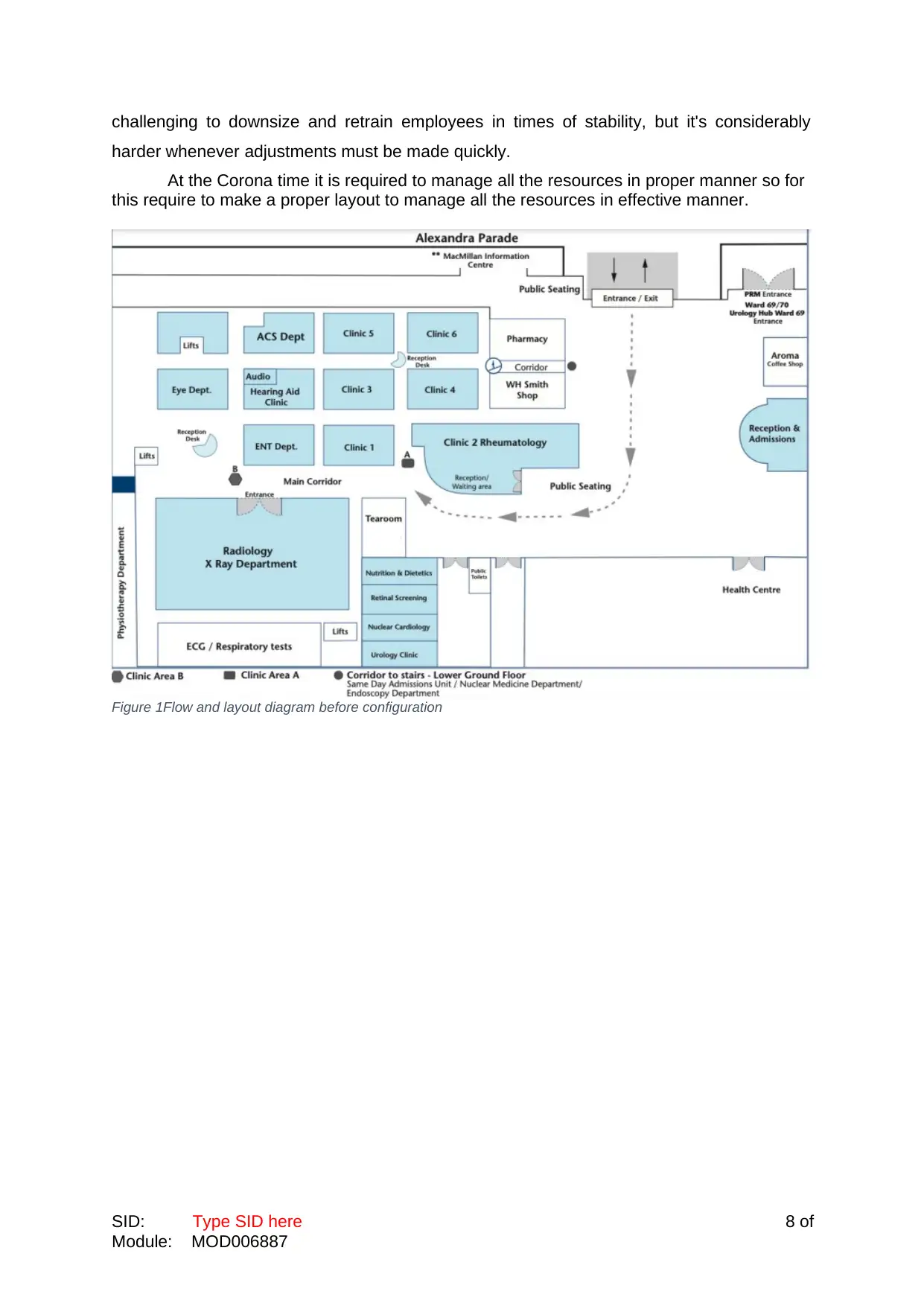
At the Corona time it is required to manage all the resources in proper manner so for
this require to make a proper layout to manage all the resources in effective manner.
Figure 1Flow and layout diagram before configuration
SID: Type SID here 8 of
Module: MOD006887
harder whenever adjustments must be made quickly.
At the Corona time it is required to manage all the resources in proper manner so for
this require to make a proper layout to manage all the resources in effective manner.
Figure 1Flow and layout diagram before configuration
SID: Type SID here 8 of
Module: MOD006887
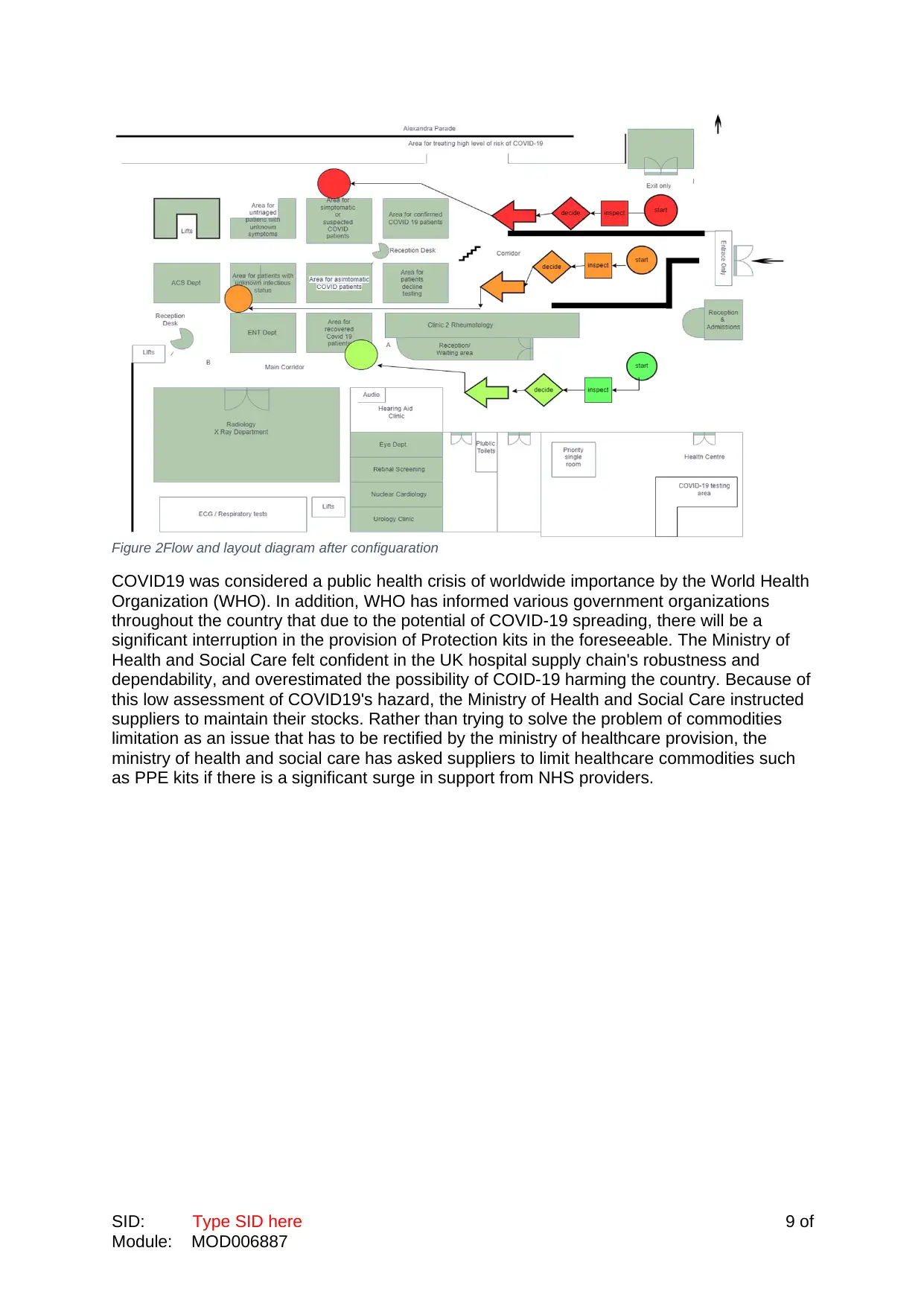
Figure 2Flow and layout diagram after configuaration
COVID19 was considered a public health crisis of worldwide importance by the World Health
Organization (WHO). In addition, WHO has informed various government organizations
throughout the country that due to the potential of COVID-19 spreading, there will be a
significant interruption in the provision of Protection kits in the foreseeable. The Ministry of
Health and Social Care felt confident in the UK hospital supply chain's robustness and
dependability, and overestimated the possibility of COID-19 harming the country. Because of
this low assessment of COVID19's hazard, the Ministry of Health and Social Care instructed
suppliers to maintain their stocks. Rather than trying to solve the problem of commodities
limitation as an issue that has to be rectified by the ministry of healthcare provision, the
ministry of health and social care has asked suppliers to limit healthcare commodities such
as PPE kits if there is a significant surge in support from NHS providers.
SID: Type SID here 9 of
Module: MOD006887
COVID19 was considered a public health crisis of worldwide importance by the World Health
Organization (WHO). In addition, WHO has informed various government organizations
throughout the country that due to the potential of COVID-19 spreading, there will be a
significant interruption in the provision of Protection kits in the foreseeable. The Ministry of
Health and Social Care felt confident in the UK hospital supply chain's robustness and
dependability, and overestimated the possibility of COID-19 harming the country. Because of
this low assessment of COVID19's hazard, the Ministry of Health and Social Care instructed
suppliers to maintain their stocks. Rather than trying to solve the problem of commodities
limitation as an issue that has to be rectified by the ministry of healthcare provision, the
ministry of health and social care has asked suppliers to limit healthcare commodities such
as PPE kits if there is a significant surge in support from NHS providers.
SID: Type SID here 9 of
Module: MOD006887
⊘ This is a preview!⊘
Do you want full access?
Subscribe today to unlock all pages.
Trusted by 1+ million students worldwide
2.3 Problem 3
Delay in Patient attending time
2.3.1Problem 3: analysis
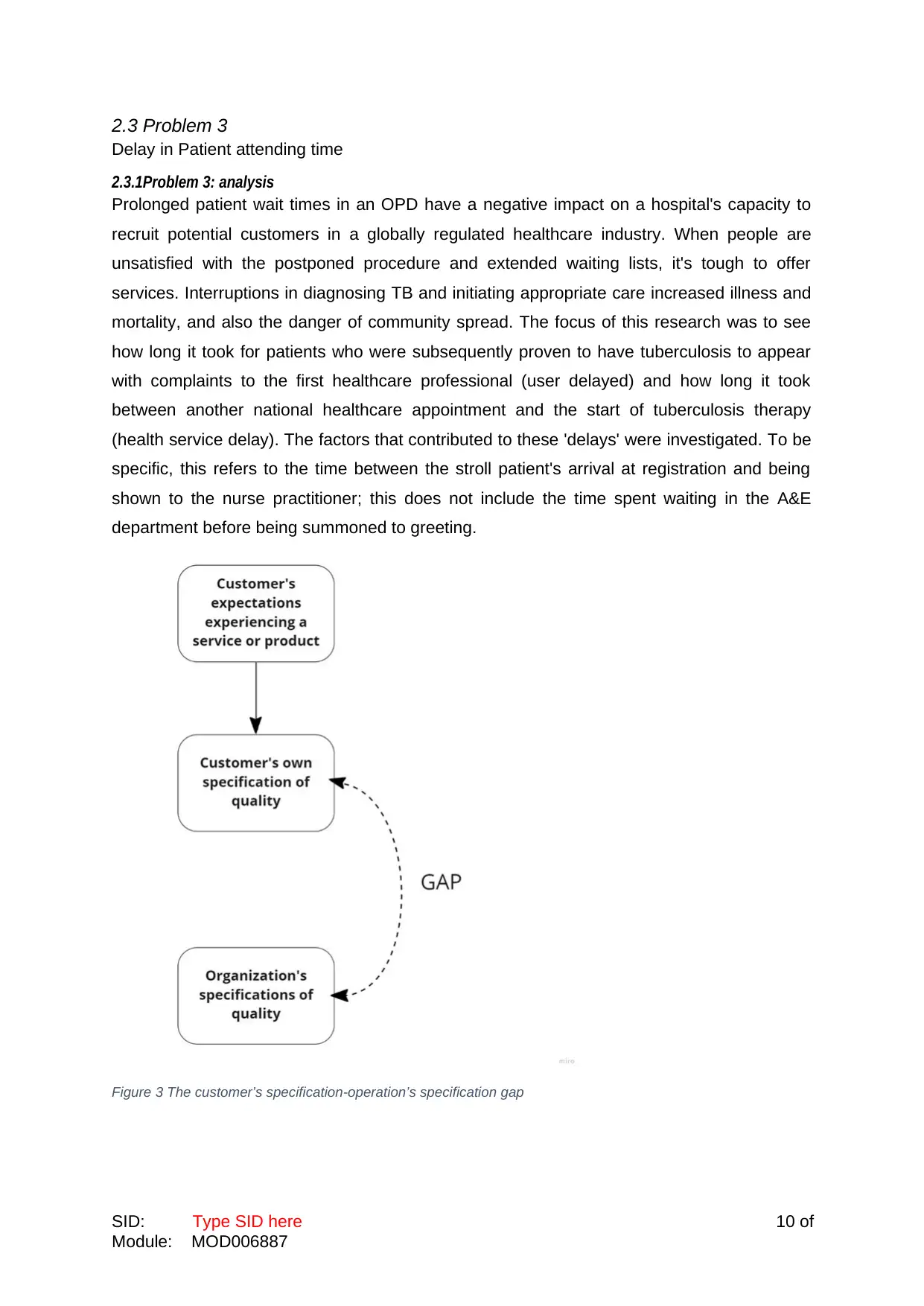
Prolonged patient wait times in an OPD have a negative impact on a hospital's capacity to
recruit potential customers in a globally regulated healthcare industry. When people are
unsatisfied with the postponed procedure and extended waiting lists, it's tough to offer
services. Interruptions in diagnosing TB and initiating appropriate care increased illness and
mortality, and also the danger of community spread. The focus of this research was to see
how long it took for patients who were subsequently proven to have tuberculosis to appear
with complaints to the first healthcare professional (user delayed) and how long it took
between another national healthcare appointment and the start of tuberculosis therapy
(health service delay). The factors that contributed to these 'delays' were investigated. To be
specific, this refers to the time between the stroll patient's arrival at registration and being
shown to the nurse practitioner; this does not include the time spent waiting in the A&E
department before being summoned to greeting.
Figure 3 The customer’s specification-operation’s specification gap
SID: Type SID here 10 of
Module: MOD006887
Delay in Patient attending time
2.3.1Problem 3: analysis
Prolonged patient wait times in an OPD have a negative impact on a hospital's capacity to
recruit potential customers in a globally regulated healthcare industry. When people are
unsatisfied with the postponed procedure and extended waiting lists, it's tough to offer
services. Interruptions in diagnosing TB and initiating appropriate care increased illness and
mortality, and also the danger of community spread. The focus of this research was to see
how long it took for patients who were subsequently proven to have tuberculosis to appear
with complaints to the first healthcare professional (user delayed) and how long it took
between another national healthcare appointment and the start of tuberculosis therapy
(health service delay). The factors that contributed to these 'delays' were investigated. To be
specific, this refers to the time between the stroll patient's arrival at registration and being
shown to the nurse practitioner; this does not include the time spent waiting in the A&E
department before being summoned to greeting.
Figure 3 The customer’s specification-operation’s specification gap
SID: Type SID here 10 of
Module: MOD006887
Paraphrase This Document
Need a fresh take? Get an instant paraphrase of this document with our AI Paraphraser
2.3.2Problem 3: evaluation
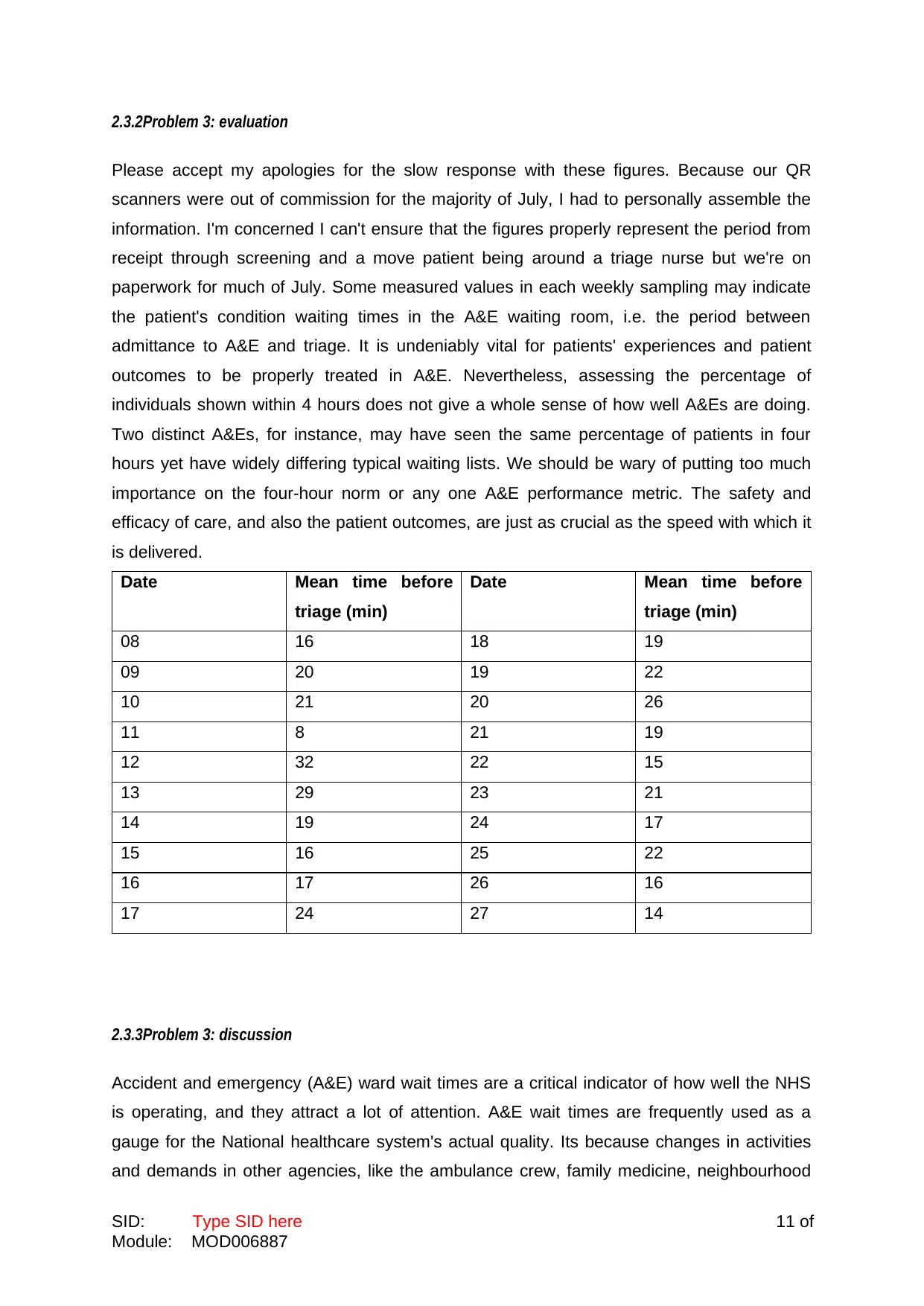
Please accept my apologies for the slow response with these figures. Because our QR
scanners were out of commission for the majority of July, I had to personally assemble the
information. I'm concerned I can't ensure that the figures properly represent the period from
receipt through screening and a move patient being around a triage nurse but we're on
paperwork for much of July. Some measured values in each weekly sampling may indicate
the patient's condition waiting times in the A&E waiting room, i.e. the period between
admittance to A&E and triage. It is undeniably vital for patients' experiences and patient
outcomes to be properly treated in A&E. Nevertheless, assessing the percentage of
individuals shown within 4 hours does not give a whole sense of how well A&Es are doing.
Two distinct A&Es, for instance, may have seen the same percentage of patients in four
hours yet have widely differing typical waiting lists. We should be wary of putting too much
importance on the four-hour norm or any one A&E performance metric. The safety and
efficacy of care, and also the patient outcomes, are just as crucial as the speed with which it
is delivered.
Date Mean time before
triage (min)
Date Mean time before
triage (min)
08 16 18 19
09 20 19 22
10 21 20 26
11 8 21 19
12 32 22 15
13 29 23 21
14 19 24 17
15 16 25 22
16 17 26 16
17 24 27 14
2.3.3Problem 3: discussion
Accident and emergency (A&E) ward wait times are a critical indicator of how well the NHS
is operating, and they attract a lot of attention. A&E wait times are frequently used as a
gauge for the National healthcare system's actual quality. Its because changes in activities
and demands in other agencies, like the ambulance crew, family medicine, neighbourhood
SID: Type SID here 11 of
Module: MOD006887
Please accept my apologies for the slow response with these figures. Because our QR
scanners were out of commission for the majority of July, I had to personally assemble the
information. I'm concerned I can't ensure that the figures properly represent the period from
receipt through screening and a move patient being around a triage nurse but we're on
paperwork for much of July. Some measured values in each weekly sampling may indicate
the patient's condition waiting times in the A&E waiting room, i.e. the period between
admittance to A&E and triage. It is undeniably vital for patients' experiences and patient
outcomes to be properly treated in A&E. Nevertheless, assessing the percentage of
individuals shown within 4 hours does not give a whole sense of how well A&Es are doing.
Two distinct A&Es, for instance, may have seen the same percentage of patients in four
hours yet have widely differing typical waiting lists. We should be wary of putting too much
importance on the four-hour norm or any one A&E performance metric. The safety and
efficacy of care, and also the patient outcomes, are just as crucial as the speed with which it
is delivered.
Date Mean time before
triage (min)
Date Mean time before
triage (min)
08 16 18 19
09 20 19 22
10 21 20 26
11 8 21 19
12 32 22 15
13 29 23 21
14 19 24 17
15 16 25 22
16 17 26 16
17 24 27 14
2.3.3Problem 3: discussion
Accident and emergency (A&E) ward wait times are a critical indicator of how well the NHS
is operating, and they attract a lot of attention. A&E wait times are frequently used as a
gauge for the National healthcare system's actual quality. Its because changes in activities
and demands in other agencies, like the ambulance crew, family medicine, neighbourhood
SID: Type SID here 11 of
Module: MOD006887
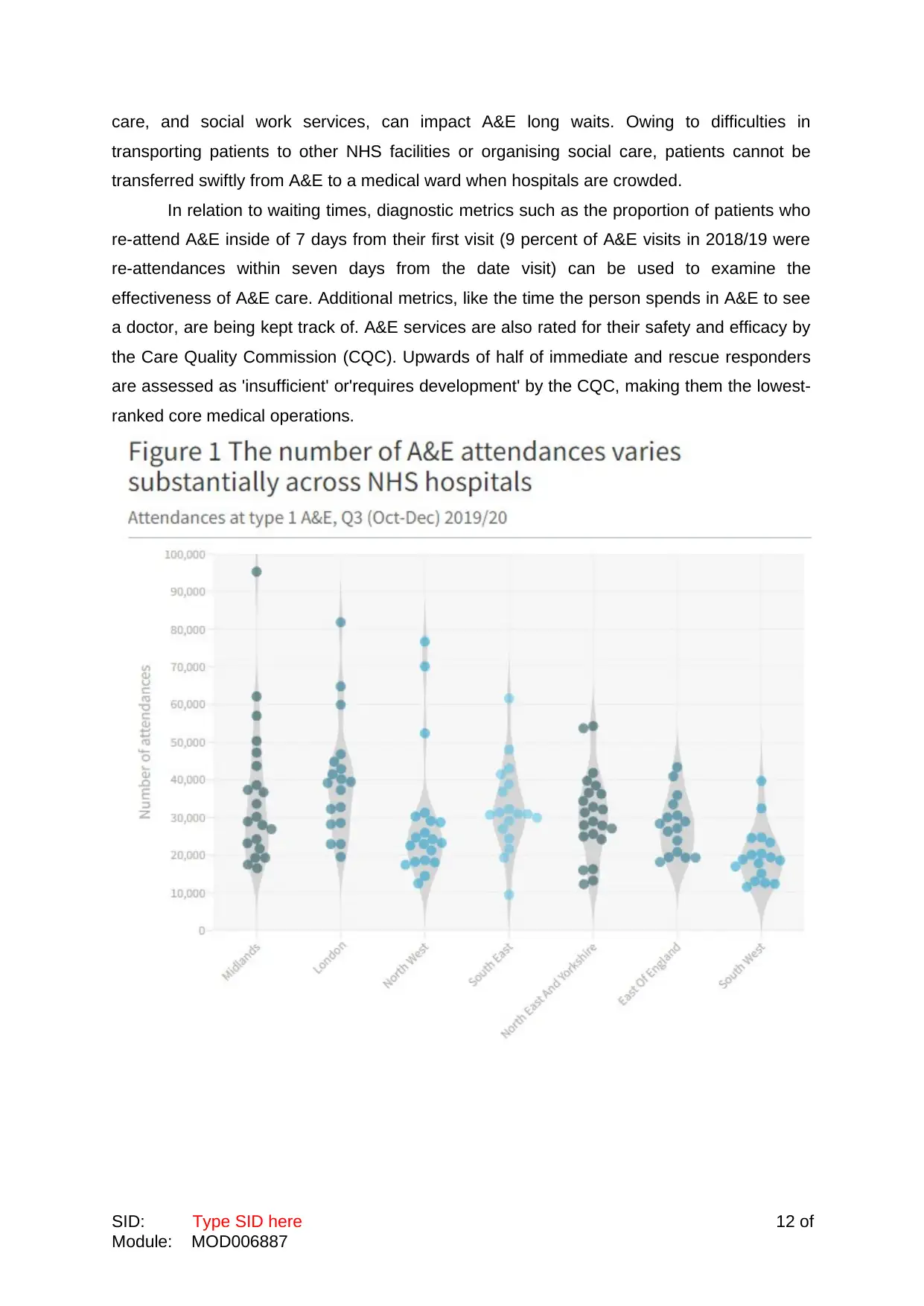
care, and social work services, can impact A&E long waits. Owing to difficulties in
transporting patients to other NHS facilities or organising social care, patients cannot be
transferred swiftly from A&E to a medical ward when hospitals are crowded.
In relation to waiting times, diagnostic metrics such as the proportion of patients who
re-attend A&E inside of 7 days from their first visit (9 percent of A&E visits in 2018/19 were
re-attendances within seven days from the date visit) can be used to examine the
effectiveness of A&E care. Additional metrics, like the time the person spends in A&E to see
a doctor, are being kept track of. A&E services are also rated for their safety and efficacy by
the Care Quality Commission (CQC). Upwards of half of immediate and rescue responders
are assessed as 'insufficient' or'requires development' by the CQC, making them the lowest-
ranked core medical operations.
SID: Type SID here 12 of
Module: MOD006887
transporting patients to other NHS facilities or organising social care, patients cannot be
transferred swiftly from A&E to a medical ward when hospitals are crowded.
In relation to waiting times, diagnostic metrics such as the proportion of patients who
re-attend A&E inside of 7 days from their first visit (9 percent of A&E visits in 2018/19 were
re-attendances within seven days from the date visit) can be used to examine the
effectiveness of A&E care. Additional metrics, like the time the person spends in A&E to see
a doctor, are being kept track of. A&E services are also rated for their safety and efficacy by
the Care Quality Commission (CQC). Upwards of half of immediate and rescue responders
are assessed as 'insufficient' or'requires development' by the CQC, making them the lowest-
ranked core medical operations.
SID: Type SID here 12 of
Module: MOD006887
⊘ This is a preview!⊘
Do you want full access?
Subscribe today to unlock all pages.
Trusted by 1+ million students worldwide

1 out of 14


Related Documents


Your All-in-One AI-Powered Toolkit for Academic Success.
+13062052269
info@desklib.com
Available 24*7 on WhatsApp / Email
![[object Object]](/_next/static/media/star-bottom.7253800d.svg)
Unlock your academic potential
Copyright © 2020–2026 A2Z Services. All Rights Reserved. Developed and managed by ZUCOL.