Improving Quality in NHS: Models, Roles, and Strategies Report
VerifiedAdded on 2022/12/15
|11
|2579
|90
Report
AI Summary
This report provides a detailed overview of quality management within the National Health Service (NHS). It begins by defining the role of quality assurance, emphasizing its importance in preventing errors and ensuring high standards of care. The report then explores two key models for quality improvement: the Lean model, which focuses on efficiency and waste reduction, and the Six Sigma model, which aims to minimize defects and variations. The role of the Quality Care Commission in maintaining quality standards is discussed, along with the importance of benchmarks in healthcare. Furthermore, the report examines various methods for gathering patient feedback, identifies key stakeholders in quality improvement, and outlines strategies to enhance service user safety. The conclusion summarizes the key findings, highlighting the significance of quality management in achieving excellence in healthcare and ensuring patient satisfaction.
Management
Of Quality
Table of Contents
Of Quality
Table of Contents

Paraphrase This Document
Need a fresh take? Get an instant paraphrase of this document with our AI Paraphraser
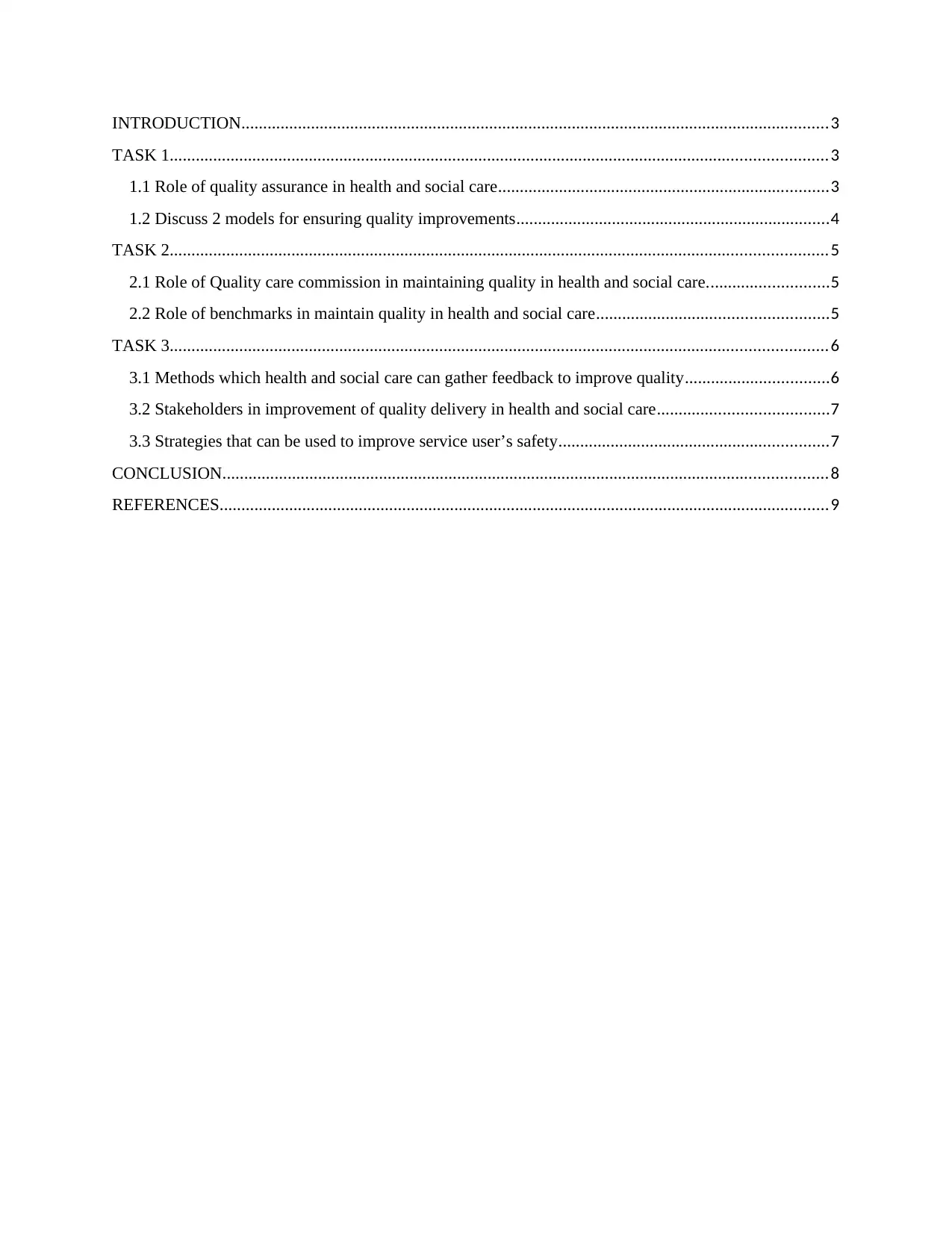
INTRODUCTION.......................................................................................................................................3
TASK 1.......................................................................................................................................................3
1.1 Role of quality assurance in health and social care............................................................................3
1.2 Discuss 2 models for ensuring quality improvements........................................................................4
TASK 2.......................................................................................................................................................5
2.1 Role of Quality care commission in maintaining quality in health and social care............................5
2.2 Role of benchmarks in maintain quality in health and social care.....................................................5
TASK 3.......................................................................................................................................................6
3.1 Methods which health and social care can gather feedback to improve quality.................................6
3.2 Stakeholders in improvement of quality delivery in health and social care.......................................7
3.3 Strategies that can be used to improve service user’s safety..............................................................7
CONCLUSION...........................................................................................................................................8
REFERENCES............................................................................................................................................9
TASK 1.......................................................................................................................................................3
1.1 Role of quality assurance in health and social care............................................................................3
1.2 Discuss 2 models for ensuring quality improvements........................................................................4
TASK 2.......................................................................................................................................................5
2.1 Role of Quality care commission in maintaining quality in health and social care............................5
2.2 Role of benchmarks in maintain quality in health and social care.....................................................5
TASK 3.......................................................................................................................................................6
3.1 Methods which health and social care can gather feedback to improve quality.................................6
3.2 Stakeholders in improvement of quality delivery in health and social care.......................................7
3.3 Strategies that can be used to improve service user’s safety..............................................................7
CONCLUSION...........................................................................................................................................8
REFERENCES............................................................................................................................................9
INTRODUCTION
The term management of quality determines that different activities and tasks are to be
performed in a business enterprise and focus on long term goals (Aggarwal, Aeran and Rathee,
2019). These tasks must be accomplished for determination of some policy, implementing
quality planning and quality improvements are should be considered. For this assessment,
selected organization is NHS (national health service) is a publicly health fund service in UK. In
this report, various tasks are covered such as role of quality assurance, different models are
ensuring improvement in quality, role of quality care commission, role of benchmarks in
maintain quality and healthcare, methods, stakeholders to improvement in quality of health care
and some strategies which is used to improve service user safety.
TASK 1
1.1 Role of quality assurance in health and social care
The term quality assurance is preventing their mistakes for manufactured their products
and avoid various problems when they delivering their services to customers. It is a procedures
which systematically monitor and evaluate different aspects of service or facility that provided
by customers. In health and social care, some regulators are sure that quality is inspecting in
registered service against some regulations and standards are should be provided. Key roles of
quality assurance which determine in health and social care with context to NHS are as described
below:
Quality assurance ensures that there is a final product that would be observes by firm
standards of quality (Bhatia and Awasthi, 2018). These detail oriented professionals are should
be liable for development and implementation their inspection activities for detection and
delivery of customers satisfactory outcomes.
To interpret, maintain and build their firm quality assurance standards.
Carefully maintain complaint processing through records and tracking system to be
maintained which include cause and corrective actions.
The term management of quality determines that different activities and tasks are to be
performed in a business enterprise and focus on long term goals (Aggarwal, Aeran and Rathee,
2019). These tasks must be accomplished for determination of some policy, implementing
quality planning and quality improvements are should be considered. For this assessment,
selected organization is NHS (national health service) is a publicly health fund service in UK. In
this report, various tasks are covered such as role of quality assurance, different models are
ensuring improvement in quality, role of quality care commission, role of benchmarks in
maintain quality and healthcare, methods, stakeholders to improvement in quality of health care
and some strategies which is used to improve service user safety.
TASK 1
1.1 Role of quality assurance in health and social care
The term quality assurance is preventing their mistakes for manufactured their products
and avoid various problems when they delivering their services to customers. It is a procedures
which systematically monitor and evaluate different aspects of service or facility that provided
by customers. In health and social care, some regulators are sure that quality is inspecting in
registered service against some regulations and standards are should be provided. Key roles of
quality assurance which determine in health and social care with context to NHS are as described
below:
Quality assurance ensures that there is a final product that would be observes by firm
standards of quality (Bhatia and Awasthi, 2018). These detail oriented professionals are should
be liable for development and implementation their inspection activities for detection and
delivery of customers satisfactory outcomes.
To interpret, maintain and build their firm quality assurance standards.
Carefully maintain complaint processing through records and tracking system to be
maintained which include cause and corrective actions.
⊘ This is a preview!⊘
Do you want full access?
Subscribe today to unlock all pages.

Trusted by 1+ million students worldwide
For documentation of quality standards assurance activities with internal and external
reporting audits system.
To development of new standards for their productions and designing improvements as
needed and create a testing tools for protocols across all service lines.
To identify their training need and taking corrective action to ensure that there is a firm
wide fulfillment.
Pursue their new technology for students to new solutions and various skills and
experiences are identified.
1.2 Discuss 2 models for ensuring quality improvements
Quality improvements are a formal approach which consist that there is an analysis of
performance and efforts to improve performances (Dahlgaard-Park, Reyes and Chen, 2018). It
is a continuous action which leads to measurable improvement in health care services and
identify many health care patients groups. Models of quality improvements are lean model and
six sigma model which are described below:
Lean model: It is an approach that improve efficiency and drives waste in work
procedures that all works are adds to a value. This model defined that value which customer
wants and helps to how the flow of values that created a customer and ensure that there is a
competency of procedure by making it cost effective and efficiency of time. Lean which is
sometimes is referred as Toyota production system is a tool which is used for business purpose to
streamline their production activities. The main purpose is that to cutting out unnecessary
equipments which is creation of delivery of product or service that creates a value added. The
lean model is also provide what are internal and external customer wants satisfaction which is
provide value, time, cost and efforts of customers which is considered. In health care purpose,
lean thinking involved a clear understanding which review including each and every step are to
be involved, eliminate those unnecessary steps and redesigns their procedures.
Six sigma: It is a method that improvement in decrease their variation and defects and
waste through improving their quality standards and efficiency in all business processes
(Epifanov, Obshivalкin and Lukonkina, 2018). This six sigma consist of percentage those defect
free products which would be created as a 99.666% something for all activities of production and
it is designed for manufacturing in health care industry which could be reliability on the process
reporting audits system.
To development of new standards for their productions and designing improvements as
needed and create a testing tools for protocols across all service lines.
To identify their training need and taking corrective action to ensure that there is a firm
wide fulfillment.
Pursue their new technology for students to new solutions and various skills and
experiences are identified.
1.2 Discuss 2 models for ensuring quality improvements
Quality improvements are a formal approach which consist that there is an analysis of
performance and efforts to improve performances (Dahlgaard-Park, Reyes and Chen, 2018). It
is a continuous action which leads to measurable improvement in health care services and
identify many health care patients groups. Models of quality improvements are lean model and
six sigma model which are described below:
Lean model: It is an approach that improve efficiency and drives waste in work
procedures that all works are adds to a value. This model defined that value which customer
wants and helps to how the flow of values that created a customer and ensure that there is a
competency of procedure by making it cost effective and efficiency of time. Lean which is
sometimes is referred as Toyota production system is a tool which is used for business purpose to
streamline their production activities. The main purpose is that to cutting out unnecessary
equipments which is creation of delivery of product or service that creates a value added. The
lean model is also provide what are internal and external customer wants satisfaction which is
provide value, time, cost and efforts of customers which is considered. In health care purpose,
lean thinking involved a clear understanding which review including each and every step are to
be involved, eliminate those unnecessary steps and redesigns their procedures.
Six sigma: It is a method that improvement in decrease their variation and defects and
waste through improving their quality standards and efficiency in all business processes
(Epifanov, Obshivalкin and Lukonkina, 2018). This six sigma consist of percentage those defect
free products which would be created as a 99.666% something for all activities of production and
it is designed for manufacturing in health care industry which could be reliability on the process
Paraphrase This Document
Need a fresh take? Get an instant paraphrase of this document with our AI Paraphraser
of delivering their health care services. It seeks to improve their quality by identifying and
removing that access that causes defects and sets of quality management which creates a special
infrastructure of people in an organization.
TASK 2
2.1 Role of Quality care commission in maintaining quality in health and social care.
This term Quality care commission is an independent regulatory for health and various
social care services (Ladewski and Al-Bayati, 2019). It should be monitor and inspecting such
items which are named as all hospitals like NHS and private hospitals, dentist, community health
services and some agencies which provide care to people in their own homes. It should include
some standards that they do not expect involved in are and support and told that each and every
stage of treatment. They should be cared for staff with right skills to do their jobs properly
manner.
The role of Quality care commission is an vital role for maintain their quality standards
and best practice across a wide spectrum of health care establishments which included hospital,
clinic and care for homes. To make sure that there is a health and social care services which
provide an effective and compassionate about high quality care that should be encourage
improving their services.
Duty of Candour: These organizations aims to ensure that there is a provider which is to
be honest with some people when something going is to be wrong with their treatment and care
for homes. It should expect open and honest services with all peoples and be in timely manner
when certain safeties have happened.
Fit and proper person requirements: When service provider is maintain a perfect
health body and it must be appoint or have in place for practice anyone who is not in a good
character and does not have an qualifications, skills and experience.
2.2 Role of benchmarks in maintain quality in health and social care
Benchmarking is a comparison and procedures of health care services that firms are
against some social service against national health care organization (Leiber, 2018). It provides
removing that access that causes defects and sets of quality management which creates a special
infrastructure of people in an organization.
TASK 2
2.1 Role of Quality care commission in maintaining quality in health and social care.
This term Quality care commission is an independent regulatory for health and various
social care services (Ladewski and Al-Bayati, 2019). It should be monitor and inspecting such
items which are named as all hospitals like NHS and private hospitals, dentist, community health
services and some agencies which provide care to people in their own homes. It should include
some standards that they do not expect involved in are and support and told that each and every
stage of treatment. They should be cared for staff with right skills to do their jobs properly
manner.
The role of Quality care commission is an vital role for maintain their quality standards
and best practice across a wide spectrum of health care establishments which included hospital,
clinic and care for homes. To make sure that there is a health and social care services which
provide an effective and compassionate about high quality care that should be encourage
improving their services.
Duty of Candour: These organizations aims to ensure that there is a provider which is to
be honest with some people when something going is to be wrong with their treatment and care
for homes. It should expect open and honest services with all peoples and be in timely manner
when certain safeties have happened.
Fit and proper person requirements: When service provider is maintain a perfect
health body and it must be appoint or have in place for practice anyone who is not in a good
character and does not have an qualifications, skills and experience.
2.2 Role of benchmarks in maintain quality in health and social care
Benchmarking is a comparison and procedures of health care services that firms are
against some social service against national health care organization (Leiber, 2018). It provides
some leaders which help them to understand how firm can compare with related firms. It is a
process for comparison between performances of some features to separate and often which is
used to intend that would be enable to improve its performance of firm. The main goals of
benchmarking are to improve efficiency, quality of care, safety purpose and satisfaction of
patient. This type of process which involves looking at standards, best practices and evidence
based should be identifying potential areas of improvement. Some organization in benchmarking
industry focus on patients, quality comparing and operational based benchmarking. It is a
procedure with establishing high standard excellence by comparing health care services with best
practices from other institutions.
The main goal of benchmarking in healthcare is to improve efficiency, quality of care and
satisfaction of patients. Employee in an organizations are involves such type of individuals goal
or accomplishing in area and goal of organization when new practices are developed or involved
in management they must find a way to measure their progress to determine whether it is new
benchmark is achieve or not. Role of benchmarks is a practice of performance with external
standard and it is most important thing is that facilitators should used to motivate their
engagement in improvement work and helps them to understand their performance in
comparison to other organization.
TASK 3
3.1 Methods which health and social care can gather feedback to improve quality
Health care organizations collect feedback from patient’s feedback in many ways of
variety such as surveys, audit and comments (Ligarski, 2018). Patients experience in hospitals is
one of main pillars in quality of health care problems and providing feedback on some
experience of the patients to encouraging health care team need to be addresses to identify some
problem. Various methods to gather feedback to improve their quality of social health care
which are described below:
Surveys: Patient experience through surveys is a best method to improve their quality of
health care problem to gather feedback it helps to want to know about how much experience a
large number of people. Questions should be developed and they have to answer some those
questions in a suitable manner. Surveys can be carried out post, telephones, online and
process for comparison between performances of some features to separate and often which is
used to intend that would be enable to improve its performance of firm. The main goals of
benchmarking are to improve efficiency, quality of care, safety purpose and satisfaction of
patient. This type of process which involves looking at standards, best practices and evidence
based should be identifying potential areas of improvement. Some organization in benchmarking
industry focus on patients, quality comparing and operational based benchmarking. It is a
procedure with establishing high standard excellence by comparing health care services with best
practices from other institutions.
The main goal of benchmarking in healthcare is to improve efficiency, quality of care and
satisfaction of patients. Employee in an organizations are involves such type of individuals goal
or accomplishing in area and goal of organization when new practices are developed or involved
in management they must find a way to measure their progress to determine whether it is new
benchmark is achieve or not. Role of benchmarks is a practice of performance with external
standard and it is most important thing is that facilitators should used to motivate their
engagement in improvement work and helps them to understand their performance in
comparison to other organization.
TASK 3
3.1 Methods which health and social care can gather feedback to improve quality
Health care organizations collect feedback from patient’s feedback in many ways of
variety such as surveys, audit and comments (Ligarski, 2018). Patients experience in hospitals is
one of main pillars in quality of health care problems and providing feedback on some
experience of the patients to encouraging health care team need to be addresses to identify some
problem. Various methods to gather feedback to improve their quality of social health care
which are described below:
Surveys: Patient experience through surveys is a best method to improve their quality of
health care problem to gather feedback it helps to want to know about how much experience a
large number of people. Questions should be developed and they have to answer some those
questions in a suitable manner. Surveys can be carried out post, telephones, online and
⊘ This is a preview!⊘
Do you want full access?
Subscribe today to unlock all pages.
Trusted by 1+ million students worldwide
electronically though hand held devices. For NHS, health care organizations are carried out those
surveys to asking some patients whether it feels good or not. National surveys are so valuable
because they have to allow comparing such results against their performance of similar
organization.
Focus groups: To gather some small groups of people and explore their views together
in detail that should be provides an opportunity to listen and range of many opinions and
experiences (Mizuno, 2020).
3.2 Stakeholders in improvement of quality delivery in health and social care
There are various stakeholders who need to be improve and delivering their quality health
and social care services (Mukhopadhyay, 2020). There has been recently been distribute their
infectious diseases and large number of clients many of people are susceptible to infection and
their negative impact of health and population in London. Key stakeholders that should be
contributing in improvement in quality and management are as follows:
Service users: For health care firms, service users would be like residents of some clients
and top management health care services are maintaining their services according to their target
groups. To consider their quality improvement there should be manage their resources on timely
basis for patients, their workers and key stakeholders.
Government: Most of organizations are operate their business in health care purpose
that would be require support of some government agencies and nay functional authority to
maintain their effectiveness of people in health care purpose. From above analysis, it is
considered that government has a vital role in health care to improvement a monitoring their
service quality and meets its objectives for use of resources.
3.3 Strategies that can be used to improve service user’s safety
The most effective strategies are absolutely increasing in care a treatment which includes
clinician audit feedback, support systems and chronic disease management programmes. Key
strategies which are used to improve service user’s safety are as follows:
Allow patients access to EHR data: To facilitate access to health information is an
effective method for preventing their medical record and researchers find out their clinician to
surveys to asking some patients whether it feels good or not. National surveys are so valuable
because they have to allow comparing such results against their performance of similar
organization.
Focus groups: To gather some small groups of people and explore their views together
in detail that should be provides an opportunity to listen and range of many opinions and
experiences (Mizuno, 2020).
3.2 Stakeholders in improvement of quality delivery in health and social care
There are various stakeholders who need to be improve and delivering their quality health
and social care services (Mukhopadhyay, 2020). There has been recently been distribute their
infectious diseases and large number of clients many of people are susceptible to infection and
their negative impact of health and population in London. Key stakeholders that should be
contributing in improvement in quality and management are as follows:
Service users: For health care firms, service users would be like residents of some clients
and top management health care services are maintaining their services according to their target
groups. To consider their quality improvement there should be manage their resources on timely
basis for patients, their workers and key stakeholders.
Government: Most of organizations are operate their business in health care purpose
that would be require support of some government agencies and nay functional authority to
maintain their effectiveness of people in health care purpose. From above analysis, it is
considered that government has a vital role in health care to improvement a monitoring their
service quality and meets its objectives for use of resources.
3.3 Strategies that can be used to improve service user’s safety
The most effective strategies are absolutely increasing in care a treatment which includes
clinician audit feedback, support systems and chronic disease management programmes. Key
strategies which are used to improve service user’s safety are as follows:
Allow patients access to EHR data: To facilitate access to health information is an
effective method for preventing their medical record and researchers find out their clinician to
Paraphrase This Document
Need a fresh take? Get an instant paraphrase of this document with our AI Paraphraser
help to improve their patent safety (Zimon and Zimon, 2019). Some researcher find their data
related to health and social care people who are good for improving their quality services and
helping people.
Create a safe patient experience: To building a safe patient experience is more than a
simply makes happy and ensuring that there s a patient safety that does not experience harmful
which is equally important to patient experience. This experience which is safe and quality to
improvement in health care and social care and what patient thinks that it is efficient or not.
CONCLUSION
From the above information, it has been concluded that management of quality is a task
that oversees all tasks and activities for maintain a desired level of excellence. It is essential that
creates a superior quality of products or services which are not only meet its objectives but also
satisfaction of customers also. In this report, several topics are to be covered such as role of
quality assurance, models of quality improvement such as six sigma and lean models, role of
quality care commission, role of benchmarks to maintain quality in health care and social care,
methods to patient feedback, stakeholders to improvement that delivery in health care and
strategies which are to be used to improve service users safety.
related to health and social care people who are good for improving their quality services and
helping people.
Create a safe patient experience: To building a safe patient experience is more than a
simply makes happy and ensuring that there s a patient safety that does not experience harmful
which is equally important to patient experience. This experience which is safe and quality to
improvement in health care and social care and what patient thinks that it is efficient or not.
CONCLUSION
From the above information, it has been concluded that management of quality is a task
that oversees all tasks and activities for maintain a desired level of excellence. It is essential that
creates a superior quality of products or services which are not only meet its objectives but also
satisfaction of customers also. In this report, several topics are to be covered such as role of
quality assurance, models of quality improvement such as six sigma and lean models, role of
quality care commission, role of benchmarks to maintain quality in health care and social care,
methods to patient feedback, stakeholders to improvement that delivery in health care and
strategies which are to be used to improve service users safety.
REFERENCES
Books and Journals
Aggarwal, A., Aeran, H. and Rathee, M., 2019. Quality management in healthcare: The pivotal
desideratum. Journal of oral biology and craniofacial research. 9(2). pp.180-182.
Bhatia, M. S. and Awasthi, A., 2018. Assessing relationship between quality management
systems and business performance and its mediators: SEM approach. International
Journal of Quality & Reliability Management.
Dahlgaard-Park, S. M., Reyes, L. and Chen, C. K., 2018. The evolution and convergence of total
quality management and management theories. Total Quality Management & Business
Excellence. 29(9-10). pp.1108-1128.
Epifanov, V., Obshivalкin, M. and Lukonkina, K., 2018. Management of quality and security
level of transportation in the system of regular passenger motor transport. Transportation
research procedia. 36. pp.141-148.
Ladewski, B. J. and Al-Bayati, A. J., 2019. Quality and safety management practices: The theory
of quality management approach. Journal of safety research. 69. pp.193-200.
Leiber, T., 2018. Impact evaluation of quality management in higher education: a contribution to
sustainable quality development in knowledge societies. European Journal of Higher
Education. 8(3). pp.235-248.
Ligarski, M. J., 2018. Methodology of problem analysis in the quality management system with
the use of systems approach. Management Systems in Production Engineering.
Mizuno, S., 2020. Management for quality improvement: the 7 new QC tools. CRC Press.
Mukhopadhyay, M., 2020. Total quality management in education. SAGE Publications Pvt.
Limited.
Zimon, D. and Zimon, G., 2019. The impact of implementation of standardized quality
management systems on management of liabilities in group purchasing
organizations. Quality Innovation Prosperity. 23(1). pp.60-73.
Books and Journals
Aggarwal, A., Aeran, H. and Rathee, M., 2019. Quality management in healthcare: The pivotal
desideratum. Journal of oral biology and craniofacial research. 9(2). pp.180-182.
Bhatia, M. S. and Awasthi, A., 2018. Assessing relationship between quality management
systems and business performance and its mediators: SEM approach. International
Journal of Quality & Reliability Management.
Dahlgaard-Park, S. M., Reyes, L. and Chen, C. K., 2018. The evolution and convergence of total
quality management and management theories. Total Quality Management & Business
Excellence. 29(9-10). pp.1108-1128.
Epifanov, V., Obshivalкin, M. and Lukonkina, K., 2018. Management of quality and security
level of transportation in the system of regular passenger motor transport. Transportation
research procedia. 36. pp.141-148.
Ladewski, B. J. and Al-Bayati, A. J., 2019. Quality and safety management practices: The theory
of quality management approach. Journal of safety research. 69. pp.193-200.
Leiber, T., 2018. Impact evaluation of quality management in higher education: a contribution to
sustainable quality development in knowledge societies. European Journal of Higher
Education. 8(3). pp.235-248.
Ligarski, M. J., 2018. Methodology of problem analysis in the quality management system with
the use of systems approach. Management Systems in Production Engineering.
Mizuno, S., 2020. Management for quality improvement: the 7 new QC tools. CRC Press.
Mukhopadhyay, M., 2020. Total quality management in education. SAGE Publications Pvt.
Limited.
Zimon, D. and Zimon, G., 2019. The impact of implementation of standardized quality
management systems on management of liabilities in group purchasing
organizations. Quality Innovation Prosperity. 23(1). pp.60-73.
⊘ This is a preview!⊘
Do you want full access?
Subscribe today to unlock all pages.
Trusted by 1+ million students worldwide

Paraphrase This Document
Need a fresh take? Get an instant paraphrase of this document with our AI Paraphraser


1 out of 11


Related Documents


Your All-in-One AI-Powered Toolkit for Academic Success.
+13062052269
info@desklib.com
Available 24*7 on WhatsApp / Email
![[object Object]](/_next/static/media/star-bottom.7253800d.svg)
Unlock your academic potential
Copyright © 2020–2026 A2Z Services. All Rights Reserved. Developed and managed by ZUCOL.