System Failure Analysis: A Case Study of the National Health Service

Verified

Added on  2024/05/21

|1
|334
|427
Case Study
AI Summary
This case study analyzes the failure of the system at the National Health Service (NHS), a publicly funded healthcare system, focusing on a project to create unified electronic health records for all citizens of England. The project, intended to handle 40,000 GPs and 300 British hospitals, resulted in significant financial losses and information loss. Reasons for the failure include the project's large size, an ill-fated central core, the replacement of existing HER systems, and a lack of stakeholder involvement. The case study highlights the importance of centralized services, proper IT system implementation, and adherence to interoperability constraints for successful healthcare system projects.
Document Page
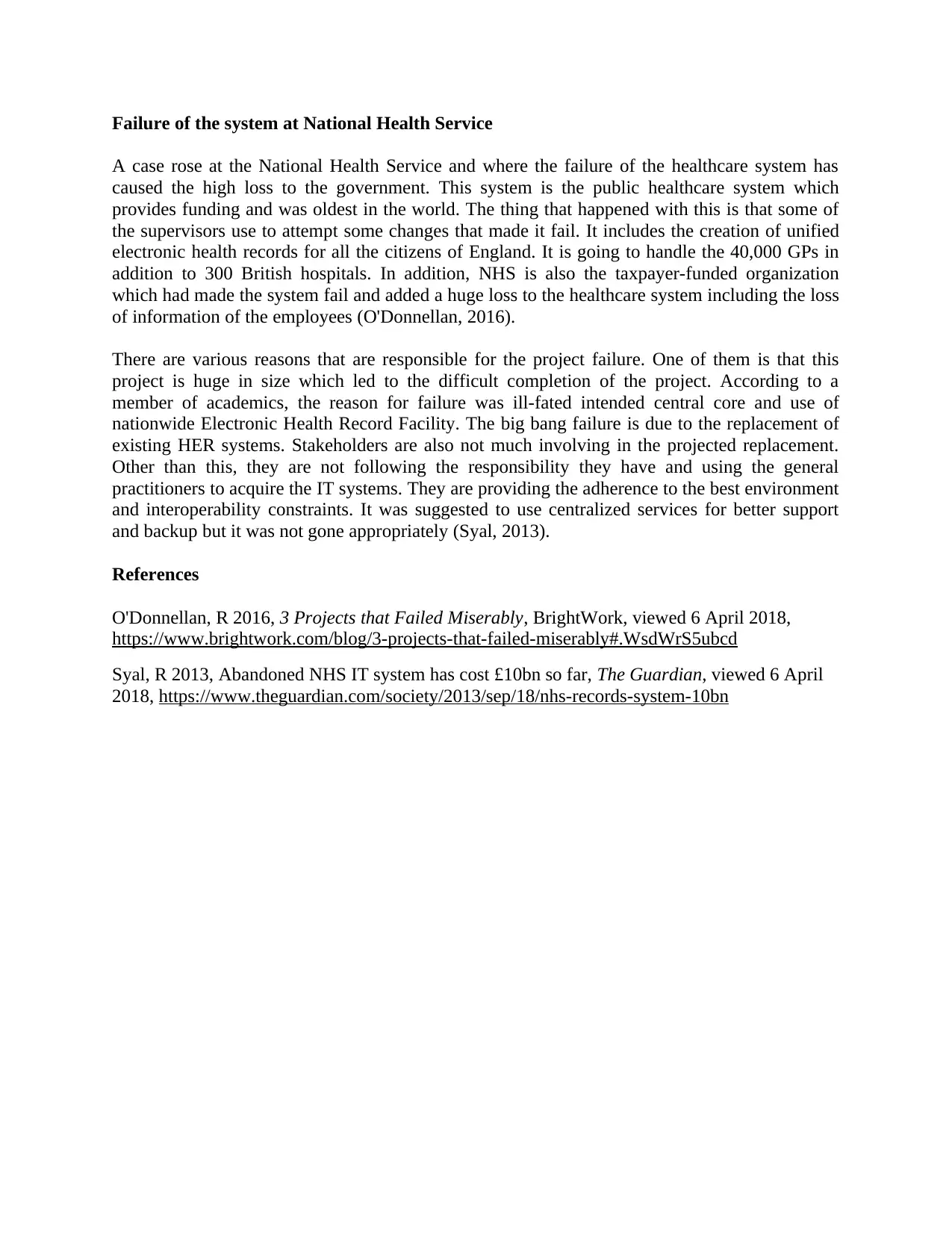
Failure of the system at National Health Service
A case rose at the National Health Service and where the failure of the healthcare system has
caused the high loss to the government. This system is the public healthcare system which
provides funding and was oldest in the world. The thing that happened with this is that some of
the supervisors use to attempt some changes that made it fail. It includes the creation of unified
electronic health records for all the citizens of England. It is going to handle the 40,000 GPs in
addition to 300 British hospitals. In addition, NHS is also the taxpayer-funded organization
which had made the system fail and added a huge loss to the healthcare system including the loss
of information of the employees (O'Donnellan, 2016).
There are various reasons that are responsible for the project failure. One of them is that this
project is huge in size which led to the difficult completion of the project. According to a
member of academics, the reason for failure was ill-fated intended central core and use of
nationwide Electronic Health Record Facility. The big bang failure is due to the replacement of
existing HER systems. Stakeholders are also not much involving in the projected replacement.
Other than this, they are not following the responsibility they have and using the general
practitioners to acquire the IT systems. They are providing the adherence to the best environment
and interoperability constraints. It was suggested to use centralized services for better support
and backup but it was not gone appropriately (Syal, 2013).
References
O'Donnellan, R 2016, 3 Projects that Failed Miserably, BrightWork, viewed 6 April 2018,
https://www.brightwork.com/blog/3-projects-that-failed-miserably#.WsdWrS5ubcd
Syal, R 2013, Abandoned NHS IT system has cost £10bn so far, The Guardian, viewed 6 April
2018, https://www.theguardian.com/society/2013/sep/18/nhs-records-system-10bn
tabler-icon-diamond-filled.svg

Paraphrase This Document

Need a fresh take? Get an instant paraphrase of this document with our AI Paraphraser
[object Object]