Analysis of the Oil Industry in Nigeria: A Comprehensive Report
VerifiedAdded on 2021/05/30
|14
|4275
|22
Report
AI Summary
This report provides a comprehensive overview of the oil industry in Nigeria, highlighting its significant role in the nation's economy and development. It delves into various challenges such as corruption, mechanical breakdowns, militant activities, and OPEC regulations that hinder the industry's progress. The report also examines the environmental impacts of greenhouse emissions and fluctuating global oil prices. Despite these challenges, the report identifies opportunities for sustainable processing and refining operations, emphasizing the need for a clear legal framework, restructuring of funding, and advancements in energy generation. The analysis covers the industry's striving for economic development, and the improvement of the industry through articulating a key petroleum strategy and legal agenda as a tool for national growth. The report also includes an analysis of energy generation and processing, environmental impact of greenhouse emissions, and the influence of global economy and fluctuating prices. The report concludes by emphasizing the importance of transforming the oil and gas sector to achieve sustainable growth and economic development in Nigeria.
Oil Industry In Nigeria 1
OIL INDUSTRY IN NIGERIA
Student's Name
Course
Professor's Name
Institution
Location of Institution
Date
OIL INDUSTRY IN NIGERIA
Student's Name
Course
Professor's Name
Institution
Location of Institution
Date

Paraphrase This Document
Need a fresh take? Get an instant paraphrase of this document with our AI Paraphraser
Oil Industry In Nigeria 2
Introduction
The biggest industry in Nigeria is the petroleum industry. It plays an important
function to the maintenance of the nation and economic development activities. Only a small
amount accruable gain is used in Nigeria. Most of the amounts are used away where a lot of
materials are made and hence creating employment chances for the residents of other nations.
This is because of low native content which is a condition where a lot of works are given to
foreign companies since the native firms have inadequate skills, manpower, and low
completion and lack technical knowledge.
Nigeria has the second largest proven oil reserves in Africa, after those of Libya. The
oil fields are located in the south, specifically in the Niger delta and offshore in the Gulf of
Guinea. Current exploration activities are mostly focused in the deep and ultra-deep offshore,
with some activities in the Chad basin, located in the northeast of the country. Nigeria has
been a member of OPEC since 1971. Most of the oil is exported to North America and
Western Europe.
Challenges of oil and gas refineries
Corruption and incompetence
Corruption is not new in the gas and oil company in Lagos. The most challenging is
the one that happened in the time of general Babangida, where there was a loss of 12, 2
billion dollars which have been known during the period of gulf war crises and has never
been counted up to date (Wilson ,2014, pp.69-81). This occurrence is just but one out of
many that occurred in Nigeria. It should be noted that Nigeria could have earned about 340
million dollars in more than its 40 years of oil discovery. Nigeria contains 4 oil refineries that
are running under capacity. Corruption is the huge problem that Nigeria faces that affect oil
improvement from the scratch. It is very difficult to obtain the correct figure of how much
money has been stolen on Nigeria oil sector. If the corruption is eliminated then the nation
will have improved economic development.
According to Wilson (2014,pp.69-81), The shell which dominated at the mid 90's
when it was told to repair at a given price it was deemed by the tender committee and it
resulted to the work given to a less qualified industry which was unable to reach the
maximum production for a given time.
Mechanical breakdowns, militants, vandalism and fire
In Delta state, a pipeline fire in the year 2005 broke and led to the death of more than
sixty people. The incidence was followed by an attack where armed men in speedboat
Introduction
The biggest industry in Nigeria is the petroleum industry. It plays an important
function to the maintenance of the nation and economic development activities. Only a small
amount accruable gain is used in Nigeria. Most of the amounts are used away where a lot of
materials are made and hence creating employment chances for the residents of other nations.
This is because of low native content which is a condition where a lot of works are given to
foreign companies since the native firms have inadequate skills, manpower, and low
completion and lack technical knowledge.
Nigeria has the second largest proven oil reserves in Africa, after those of Libya. The
oil fields are located in the south, specifically in the Niger delta and offshore in the Gulf of
Guinea. Current exploration activities are mostly focused in the deep and ultra-deep offshore,
with some activities in the Chad basin, located in the northeast of the country. Nigeria has
been a member of OPEC since 1971. Most of the oil is exported to North America and
Western Europe.
Challenges of oil and gas refineries
Corruption and incompetence
Corruption is not new in the gas and oil company in Lagos. The most challenging is
the one that happened in the time of general Babangida, where there was a loss of 12, 2
billion dollars which have been known during the period of gulf war crises and has never
been counted up to date (Wilson ,2014, pp.69-81). This occurrence is just but one out of
many that occurred in Nigeria. It should be noted that Nigeria could have earned about 340
million dollars in more than its 40 years of oil discovery. Nigeria contains 4 oil refineries that
are running under capacity. Corruption is the huge problem that Nigeria faces that affect oil
improvement from the scratch. It is very difficult to obtain the correct figure of how much
money has been stolen on Nigeria oil sector. If the corruption is eliminated then the nation
will have improved economic development.
According to Wilson (2014,pp.69-81), The shell which dominated at the mid 90's
when it was told to repair at a given price it was deemed by the tender committee and it
resulted to the work given to a less qualified industry which was unable to reach the
maximum production for a given time.
Mechanical breakdowns, militants, vandalism and fire
In Delta state, a pipeline fire in the year 2005 broke and led to the death of more than
sixty people. The incidence was followed by an attack where armed men in speedboat
Oil Industry In Nigeria 3
boomed up opobo channel pipeline. In 2006 there was pipeline attack brought by brass cleek
fields toward the resulted to shutting up of oil production due to lack of security.
Nigeria has embarked on the kidnapping of the workers in oil refineries that has led to the
loss of 16 billion dollars that they get from the export of oil (Wilson, 2014.pp69- 81). In 2006
there was kidnapping situation in the same region where about nine workers were kidnapped.
After where the pipeline operated by Royal Dutch shell was brown up.
There was a close-up of two port which are Port Harcourt refinery for two months
because of technical issues. The militia organizations and Niger rebel group have attacked the
oil infrastructure leading to declining in its domestic refining potential. Also as they search
for compensations or political power they lead to attacks. Many foreign workers and their
households have completely abandoned the Niger Delta due to progressive attacks. In 2006
four overseas workers of Royal Dutch shell were snatched and held for 19 days before they
were realized on humanitarian ground. This led to Nigeria withdrawing licences that were
issued to external and homeland firms to start oil refinery since the companies did not begin
up any particular work after the five years.
Pipeline vandalism has been a great challenge which is attributed by the militants who
are sponsored by the corrupt government officials. For instance the operation at Warri and
Kaduna in the year 2010 did not go through due pipeline damage. Fire and breakdowns are
common in all industries but in Nigeria the main cause of the problem is poor control
measures and untrained staff.
OPEC regulation
This arises from the argument that the body that regulates Oil Company has not
favoured Nigeria as well in order for it to maximize its making. This body was formed in
1960 by Venezuela, Saudi Arabia Iraq, and Iran together with other five nations including
Qatar Indonesia, Algeria which joined before Nigeria, Libya and United Arab emirate. OPEC
control manufacture of its team has not helped Nigeria to increase its output.
Nigeria production remains in OPEC has prevented its refineries since budget of scale
stand. Nigeria is not increasing its manufacture due to the quota levied by OPEC. There are
questions why production of oil is very low. The reason behind that is due to OPEC cartels
have created an obstacle to effective slow trade with other nations and the economic growth
of Nigeria from its oil trade.
boomed up opobo channel pipeline. In 2006 there was pipeline attack brought by brass cleek
fields toward the resulted to shutting up of oil production due to lack of security.
Nigeria has embarked on the kidnapping of the workers in oil refineries that has led to the
loss of 16 billion dollars that they get from the export of oil (Wilson, 2014.pp69- 81). In 2006
there was kidnapping situation in the same region where about nine workers were kidnapped.
After where the pipeline operated by Royal Dutch shell was brown up.
There was a close-up of two port which are Port Harcourt refinery for two months
because of technical issues. The militia organizations and Niger rebel group have attacked the
oil infrastructure leading to declining in its domestic refining potential. Also as they search
for compensations or political power they lead to attacks. Many foreign workers and their
households have completely abandoned the Niger Delta due to progressive attacks. In 2006
four overseas workers of Royal Dutch shell were snatched and held for 19 days before they
were realized on humanitarian ground. This led to Nigeria withdrawing licences that were
issued to external and homeland firms to start oil refinery since the companies did not begin
up any particular work after the five years.
Pipeline vandalism has been a great challenge which is attributed by the militants who
are sponsored by the corrupt government officials. For instance the operation at Warri and
Kaduna in the year 2010 did not go through due pipeline damage. Fire and breakdowns are
common in all industries but in Nigeria the main cause of the problem is poor control
measures and untrained staff.
OPEC regulation
This arises from the argument that the body that regulates Oil Company has not
favoured Nigeria as well in order for it to maximize its making. This body was formed in
1960 by Venezuela, Saudi Arabia Iraq, and Iran together with other five nations including
Qatar Indonesia, Algeria which joined before Nigeria, Libya and United Arab emirate. OPEC
control manufacture of its team has not helped Nigeria to increase its output.
Nigeria production remains in OPEC has prevented its refineries since budget of scale
stand. Nigeria is not increasing its manufacture due to the quota levied by OPEC. There are
questions why production of oil is very low. The reason behind that is due to OPEC cartels
have created an obstacle to effective slow trade with other nations and the economic growth
of Nigeria from its oil trade.
⊘ This is a preview!⊘
Do you want full access?
Subscribe today to unlock all pages.

Trusted by 1+ million students worldwide
Oil Industry In Nigeria 4
Inadequate finance and insufficient technical proficiency
The sector of finance in Nigeria has been going through the transformation so as the banking
system can become competitive. The banking systems lack adequate finance to fund a large
project in the country.
Poor infrastructure
Organisational problems which include poor transport systems, poor communication
network, inadequate power source. Poor infrastructure leads to delay of industrial
development. Proper infrastructure gives rise to proper industrial company which in turn
increases the market of oil. Poor infrastructure is the major problems in Nigeria From one
region of the country to the other, and this makes Nigeria poor since the products cannot be
transported.
Poor investment environment
Beside the inefficient infrastructure, the investment climate is poor, the housing is
unaffordable, poor health facilities and insecurity due to crimes. This problem hinders the
foreign straight investment.
Political instability
It is efficient for industrial development, and since Nigeria is a young democratic
country there have been regular attacks on aliens and their interest in Niger Delta. This
political instability has led to decrease in the development of oil industry.
Other problems include:
Lack of a motivating government agenda.
Lack of effective tools.
Inadequate education standards
Poor licensing programs
Opportunities
Though there have been problems, a group of persons realized that Nigeria has many
strengths which comprise of access to a lot of oil and gas reserves, a finely grown oil
industry, a power sector that is privately placed for effectiveness and a capable local sector.
Moreover, many countries guidelines, like gas cost are on spot to move the important projects
in front, For instance, the gas cost ranges from $2 to $2.50, which is an encouraging cost for
both power production and petrochemicals. As a result, the puts more effort so as to monetize
its abundant gas source. Also, the countries development is starting to improve and draws
overseas trade in the oil and gas sector and also power production. The imports are now over
Inadequate finance and insufficient technical proficiency
The sector of finance in Nigeria has been going through the transformation so as the banking
system can become competitive. The banking systems lack adequate finance to fund a large
project in the country.
Poor infrastructure
Organisational problems which include poor transport systems, poor communication
network, inadequate power source. Poor infrastructure leads to delay of industrial
development. Proper infrastructure gives rise to proper industrial company which in turn
increases the market of oil. Poor infrastructure is the major problems in Nigeria From one
region of the country to the other, and this makes Nigeria poor since the products cannot be
transported.
Poor investment environment
Beside the inefficient infrastructure, the investment climate is poor, the housing is
unaffordable, poor health facilities and insecurity due to crimes. This problem hinders the
foreign straight investment.
Political instability
It is efficient for industrial development, and since Nigeria is a young democratic
country there have been regular attacks on aliens and their interest in Niger Delta. This
political instability has led to decrease in the development of oil industry.
Other problems include:
Lack of a motivating government agenda.
Lack of effective tools.
Inadequate education standards
Poor licensing programs
Opportunities
Though there have been problems, a group of persons realized that Nigeria has many
strengths which comprise of access to a lot of oil and gas reserves, a finely grown oil
industry, a power sector that is privately placed for effectiveness and a capable local sector.
Moreover, many countries guidelines, like gas cost are on spot to move the important projects
in front, For instance, the gas cost ranges from $2 to $2.50, which is an encouraging cost for
both power production and petrochemicals. As a result, the puts more effort so as to monetize
its abundant gas source. Also, the countries development is starting to improve and draws
overseas trade in the oil and gas sector and also power production. The imports are now over
Paraphrase This Document
Need a fresh take? Get an instant paraphrase of this document with our AI Paraphraser
Oil Industry In Nigeria 5
80% which create a huge latent for the native refining and hence there is a chance for
possible uptake by their neighbouring nations.
How the industry is striving to achieve sustainable processing and refining operation
Since oil industry in Nigeria is one of the largest source of income then it is being
driven from being a ‘cash cow' to be a path for economic development and countries growth
failure to change the oil and gas sector will lead to squandered chances hence affecting the
visions for making maintainable growth. . The following are the ways of improving the
industry.
Articulating a key petroleum strategy and legal agenda as a tool for national growth
way
So as to invite investment to the oil industry, rules and regulation as well as the
strategy governing the firm should be clear, inclusive, transparent, accommodating and
realistic. The legal agenda that is approachable to Nigeria environment will handle the
following:
Local consumption
Local participation
Petroleum proceeds as seed capital
Administering of an assertive land
Nigeria has the most sloppy land control system. The lands are large and endowment
of law for abandonment and withdrawal are not comprehended. The present system and
planned oil industry bill contains requirements which need a mandatory abandonment of half
the land after a period of ten years, or surrendering the leased areas or withdrawal for good .if
the aim is for better native contribution and general improvement of the industry, then the
nation should apply drop by abandoning the unproductive lands and give them to the
interested persons.
Restructuring funding of oil processes
The petroleum industry in Nigeria is run by the nation through the joint ventures. The
recent plan is to provide funds to the industry (Achikeand Onoja, 2014). This is by ensuring
that IJVs becomes self-funded so as to fund the oil company since it is owned by the
government through JV,
Other way includes:
The building of all infrastructure that is needed to conduct petroleum processes.
80% which create a huge latent for the native refining and hence there is a chance for
possible uptake by their neighbouring nations.
How the industry is striving to achieve sustainable processing and refining operation
Since oil industry in Nigeria is one of the largest source of income then it is being
driven from being a ‘cash cow' to be a path for economic development and countries growth
failure to change the oil and gas sector will lead to squandered chances hence affecting the
visions for making maintainable growth. . The following are the ways of improving the
industry.
Articulating a key petroleum strategy and legal agenda as a tool for national growth
way
So as to invite investment to the oil industry, rules and regulation as well as the
strategy governing the firm should be clear, inclusive, transparent, accommodating and
realistic. The legal agenda that is approachable to Nigeria environment will handle the
following:
Local consumption
Local participation
Petroleum proceeds as seed capital
Administering of an assertive land
Nigeria has the most sloppy land control system. The lands are large and endowment
of law for abandonment and withdrawal are not comprehended. The present system and
planned oil industry bill contains requirements which need a mandatory abandonment of half
the land after a period of ten years, or surrendering the leased areas or withdrawal for good .if
the aim is for better native contribution and general improvement of the industry, then the
nation should apply drop by abandoning the unproductive lands and give them to the
interested persons.
Restructuring funding of oil processes
The petroleum industry in Nigeria is run by the nation through the joint ventures. The
recent plan is to provide funds to the industry (Achikeand Onoja, 2014). This is by ensuring
that IJVs becomes self-funded so as to fund the oil company since it is owned by the
government through JV,
Other way includes:
The building of all infrastructure that is needed to conduct petroleum processes.
Oil Industry In Nigeria 6
Creating surplus crude bill oil technology growth fund and the Niger development
company.
Energy generation and processing
Based on Adhekpukoli,E. (2018, pp 1-6) Energy generation in Nigeria remains a
crucial thing for less expensive electricity. From the data given by EIA it displays that there
is improved energy generation over the years. Though Nigeria is lagging behind in the energy
generation as compared to other countries like Brazil, South Africa etc. it is noted that there
has been an increase especially in 2015 compared to another year. The investment of the
energy produced has increased prior to the financial problems since it rose from 295$ to828$.
Though there are barriers which hinders the efficiency of energy generation which
include policy problems, regulatory barriers, inadequate instructional framework, lack of
information, and lack of manufacturing local base, inadequate finance and inadequate
capacity. The most significant environmental effects of energy generation are: the change in
climate because of emitting greenhouse gases, leads to health problems due to pollution of
the air, gasses and particles. And problems brought about by waste kept and occurrence of
accidents.
An image showing the generation of energy and processing (Onakoya et al., 2013).
Energy production in Nigeria is got via decentralized and centralized systems. The
centralized organization is linked to the countries grid for transmitting and distributing to
customers whereas decentralized is alone and not linked with countries grid.
Creating surplus crude bill oil technology growth fund and the Niger development
company.
Energy generation and processing
Based on Adhekpukoli,E. (2018, pp 1-6) Energy generation in Nigeria remains a
crucial thing for less expensive electricity. From the data given by EIA it displays that there
is improved energy generation over the years. Though Nigeria is lagging behind in the energy
generation as compared to other countries like Brazil, South Africa etc. it is noted that there
has been an increase especially in 2015 compared to another year. The investment of the
energy produced has increased prior to the financial problems since it rose from 295$ to828$.
Though there are barriers which hinders the efficiency of energy generation which
include policy problems, regulatory barriers, inadequate instructional framework, lack of
information, and lack of manufacturing local base, inadequate finance and inadequate
capacity. The most significant environmental effects of energy generation are: the change in
climate because of emitting greenhouse gases, leads to health problems due to pollution of
the air, gasses and particles. And problems brought about by waste kept and occurrence of
accidents.
An image showing the generation of energy and processing (Onakoya et al., 2013).
Energy production in Nigeria is got via decentralized and centralized systems. The
centralized organization is linked to the countries grid for transmitting and distributing to
customers whereas decentralized is alone and not linked with countries grid.
⊘ This is a preview!⊘
Do you want full access?
Subscribe today to unlock all pages.
Trusted by 1+ million students worldwide
Oil Industry In Nigeria 7
Environmental impact of greenhouse emission
Based on Ajugwo (2013.pp 6-8) the global largest threat is change in climatic
condition and how the resources are being depleted. It's thought that Africa has great issues in
environmental degradation due to experienced climatic changes compared to the best part of
the world. Greenhouse emission e.g. sulphur dioxide, carbon dioxide are some of greenhouse
Effect gases (Achike and Onoja, 2014). Fossil fuels and the products from chemical industry,
agriculture as well as other technological methods that can affect the environment destroying
both flora and fauna life.
Gas flaring has been the main cause of pollution which results to GHG production
and loss of money.CNG fuel produces less greenhouse gases which lead to improved
environment compared to diesel and gasoline cars. Since carbon dioxide production from
greenhouses lead to less social and industrial development, low energy need and
unproductive economy and thus should be reduced so as to significantly achieve the
country’s economy. And also the use of CNG fuel. The air that is emitted from the
greenhouses leads to land change, deforestation and also leads to displacements (Ajugwo,
2013).
Global economy and fluctuating prices
The international oil prices is unpredictable and very unstable. There is a relationship
between the oil prices and the economy of Nigeria (Abdalla 2013). There is a significant
positive change coming from the oil cost to the final exports. Since the oil prices have been
low, for Nigeria to achieve high oil prices it should increase the amount of oil exports which
will in turn raise the entire exports. In the year 2015 the crude oil price was lower compared
to the year 2014. In the year 2016 it had a negative impact on the economic growth. The
economic development of Nigeria depends on the cost of oil. The cost of the oil have a
crucial impact on the actual domestic goods money supply and also lead to unemployment.
Table illustrating the Nigerians economy (Abdalla, 2013, pp.10-20).
Environmental impact of greenhouse emission
Based on Ajugwo (2013.pp 6-8) the global largest threat is change in climatic
condition and how the resources are being depleted. It's thought that Africa has great issues in
environmental degradation due to experienced climatic changes compared to the best part of
the world. Greenhouse emission e.g. sulphur dioxide, carbon dioxide are some of greenhouse
Effect gases (Achike and Onoja, 2014). Fossil fuels and the products from chemical industry,
agriculture as well as other technological methods that can affect the environment destroying
both flora and fauna life.
Gas flaring has been the main cause of pollution which results to GHG production
and loss of money.CNG fuel produces less greenhouse gases which lead to improved
environment compared to diesel and gasoline cars. Since carbon dioxide production from
greenhouses lead to less social and industrial development, low energy need and
unproductive economy and thus should be reduced so as to significantly achieve the
country’s economy. And also the use of CNG fuel. The air that is emitted from the
greenhouses leads to land change, deforestation and also leads to displacements (Ajugwo,
2013).
Global economy and fluctuating prices
The international oil prices is unpredictable and very unstable. There is a relationship
between the oil prices and the economy of Nigeria (Abdalla 2013). There is a significant
positive change coming from the oil cost to the final exports. Since the oil prices have been
low, for Nigeria to achieve high oil prices it should increase the amount of oil exports which
will in turn raise the entire exports. In the year 2015 the crude oil price was lower compared
to the year 2014. In the year 2016 it had a negative impact on the economic growth. The
economic development of Nigeria depends on the cost of oil. The cost of the oil have a
crucial impact on the actual domestic goods money supply and also lead to unemployment.
Table illustrating the Nigerians economy (Abdalla, 2013, pp.10-20).
Paraphrase This Document
Need a fresh take? Get an instant paraphrase of this document with our AI Paraphraser
Oil Industry In Nigeria 8
year 2012 2013 2014 2015 2016
GDP, current
prices
461 515 581.9 597.8 661.4
GDP
nominal
growth
11.68 _ - _ _
GDP per
capita
current cost
2835 3082 3416 3677 _
actual GDP
growth
4.3 5.4 6.2 5.6 6.5
.
Renewable energy to replace fossil fuels
According to Oyewo et al, (2017.pp14-16) The largest problem that faces Nigeria is
the energy segment, Nigeria is an oil-rich nation and the energy consumption comes from
non-renewable energy for example coal, the natural gas most important. Nigeria has an
access to renewable sources of energy and also a master blueprint for the renewable energy.
Changing from non-renewable to renewable sources of energy has brought great impact to
the rural lives, reduction of pollution, climate change modification and also has led to energy
modification. Renewable energy cannot contend with fossil fuel in terms of price value. The
gaps are becoming smaller and smaller in major increment in the energy competency.
There is need for investing capital but prices has always gone to greater extent in the
last down five years the developing chances for the renewable energy in Nigeria is clear as
pave for the technologies such as increased solar power which are coming ad competitors in
oil production. Renewable energy potential increases the capacity of energy in Nigeria
(Alabi, 2006).
Nigeria has the greater number of renewable resources and the government support is
also high. The potential for Nigeria going to use of renewable sources of energy is very high.
This renewable sources of energy include;
Solar energy, wind energy, and hydroelectric power. Wind energy uses the air current in
incorporated turbines to generate electricity. Hydroelectric power in Nigeria is approximated
to be over 36,000GWh which consists of about eight thousand MW of large electric power.
year 2012 2013 2014 2015 2016
GDP, current
prices
461 515 581.9 597.8 661.4
GDP
nominal
growth
11.68 _ - _ _
GDP per
capita
current cost
2835 3082 3416 3677 _
actual GDP
growth
4.3 5.4 6.2 5.6 6.5
.
Renewable energy to replace fossil fuels
According to Oyewo et al, (2017.pp14-16) The largest problem that faces Nigeria is
the energy segment, Nigeria is an oil-rich nation and the energy consumption comes from
non-renewable energy for example coal, the natural gas most important. Nigeria has an
access to renewable sources of energy and also a master blueprint for the renewable energy.
Changing from non-renewable to renewable sources of energy has brought great impact to
the rural lives, reduction of pollution, climate change modification and also has led to energy
modification. Renewable energy cannot contend with fossil fuel in terms of price value. The
gaps are becoming smaller and smaller in major increment in the energy competency.
There is need for investing capital but prices has always gone to greater extent in the
last down five years the developing chances for the renewable energy in Nigeria is clear as
pave for the technologies such as increased solar power which are coming ad competitors in
oil production. Renewable energy potential increases the capacity of energy in Nigeria
(Alabi, 2006).
Nigeria has the greater number of renewable resources and the government support is
also high. The potential for Nigeria going to use of renewable sources of energy is very high.
This renewable sources of energy include;
Solar energy, wind energy, and hydroelectric power. Wind energy uses the air current in
incorporated turbines to generate electricity. Hydroelectric power in Nigeria is approximated
to be over 36,000GWh which consists of about eight thousand MW of large electric power.
Oil Industry In Nigeria 9
Solar energy is the energy that is harnessed from the sun and the heat that's harvested directly
from the sun via voltaic cells.
Use of petrochemicals
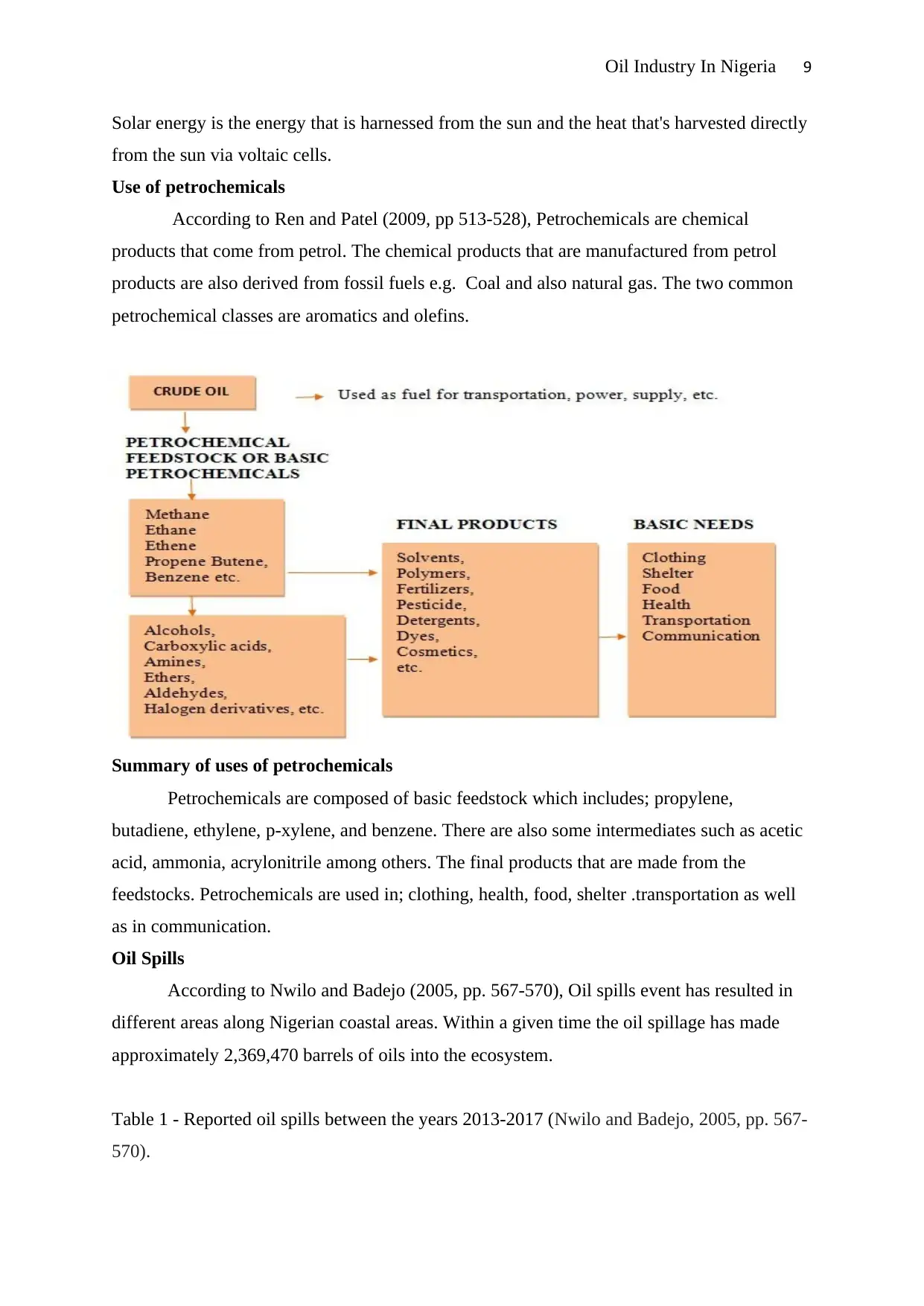
According to Ren and Patel (2009, pp 513-528), Petrochemicals are chemical
products that come from petrol. The chemical products that are manufactured from petrol
products are also derived from fossil fuels e.g. Coal and also natural gas. The two common
petrochemical classes are aromatics and olefins.
Summary of uses of petrochemicals
Petrochemicals are composed of basic feedstock which includes; propylene,
butadiene, ethylene, p-xylene, and benzene. There are also some intermediates such as acetic
acid, ammonia, acrylonitrile among others. The final products that are made from the
feedstocks. Petrochemicals are used in; clothing, health, food, shelter .transportation as well
as in communication.
Oil Spills
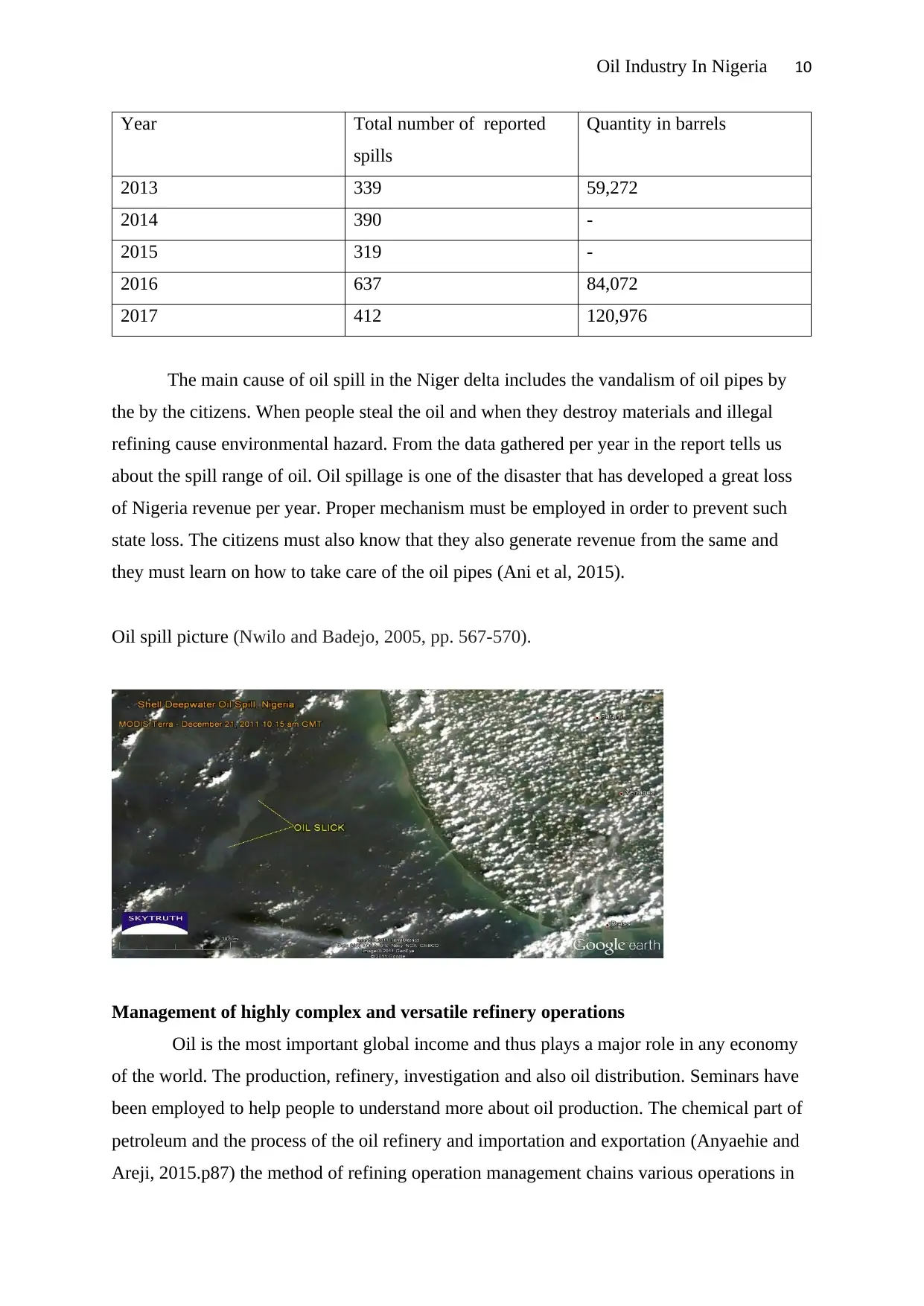
According to Nwilo and Badejo (2005, pp. 567-570), Oil spills event has resulted in
different areas along Nigerian coastal areas. Within a given time the oil spillage has made
approximately 2,369,470 barrels of oils into the ecosystem.
Table 1 - Reported oil spills between the years 2013-2017 (Nwilo and Badejo, 2005, pp. 567-
570).
Solar energy is the energy that is harnessed from the sun and the heat that's harvested directly
from the sun via voltaic cells.
Use of petrochemicals
According to Ren and Patel (2009, pp 513-528), Petrochemicals are chemical
products that come from petrol. The chemical products that are manufactured from petrol
products are also derived from fossil fuels e.g. Coal and also natural gas. The two common
petrochemical classes are aromatics and olefins.
Summary of uses of petrochemicals
Petrochemicals are composed of basic feedstock which includes; propylene,
butadiene, ethylene, p-xylene, and benzene. There are also some intermediates such as acetic
acid, ammonia, acrylonitrile among others. The final products that are made from the
feedstocks. Petrochemicals are used in; clothing, health, food, shelter .transportation as well
as in communication.
Oil Spills
According to Nwilo and Badejo (2005, pp. 567-570), Oil spills event has resulted in
different areas along Nigerian coastal areas. Within a given time the oil spillage has made
approximately 2,369,470 barrels of oils into the ecosystem.
Table 1 - Reported oil spills between the years 2013-2017 (Nwilo and Badejo, 2005, pp. 567-
570).
⊘ This is a preview!⊘
Do you want full access?
Subscribe today to unlock all pages.
Trusted by 1+ million students worldwide
Oil Industry In Nigeria 10
Year Total number of reported
spills
Quantity in barrels
2013 339 59,272
2014 390 -
2015 319 -
2016 637 84,072
2017 412 120,976
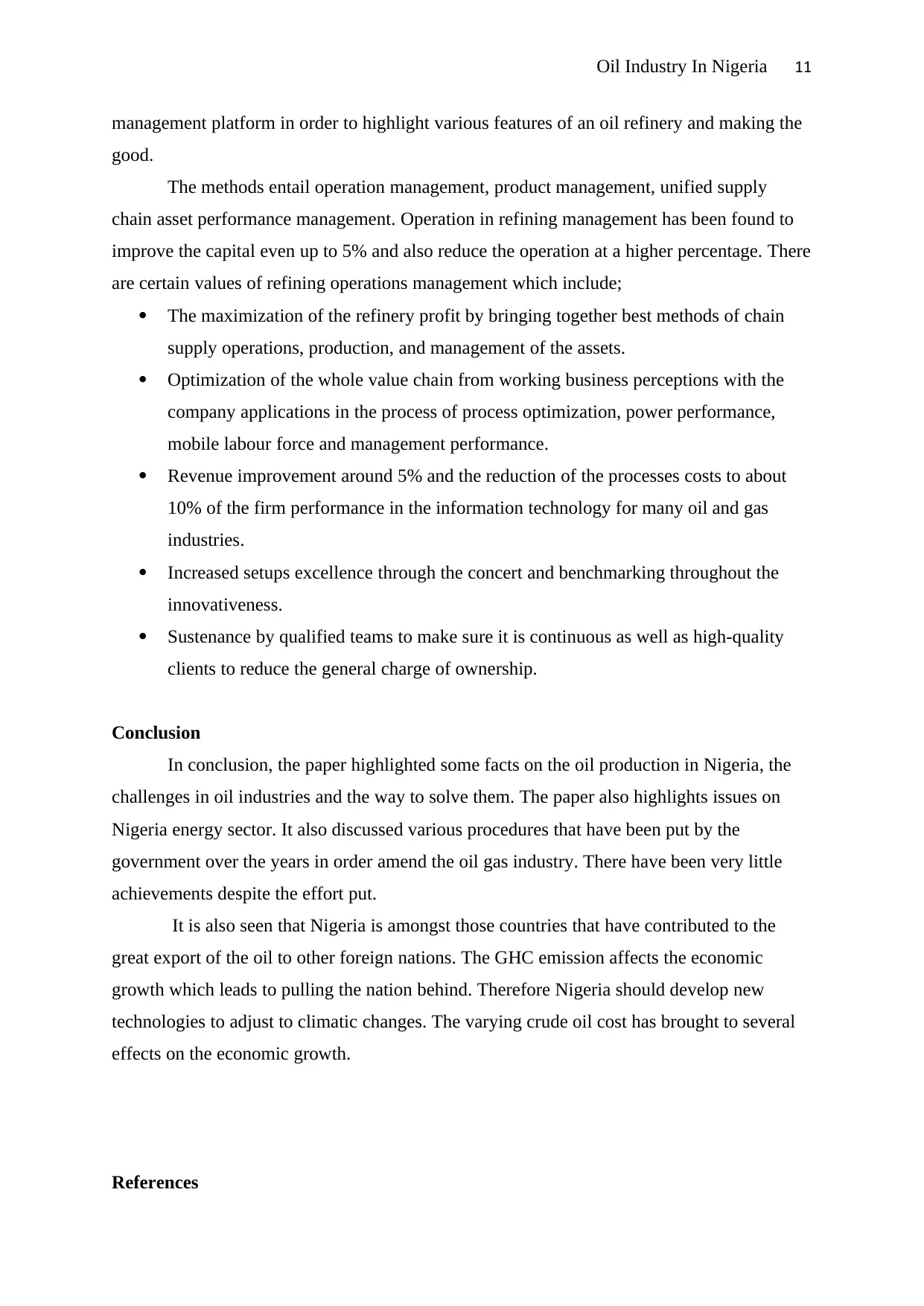
The main cause of oil spill in the Niger delta includes the vandalism of oil pipes by
the by the citizens. When people steal the oil and when they destroy materials and illegal
refining cause environmental hazard. From the data gathered per year in the report tells us
about the spill range of oil. Oil spillage is one of the disaster that has developed a great loss
of Nigeria revenue per year. Proper mechanism must be employed in order to prevent such
state loss. The citizens must also know that they also generate revenue from the same and
they must learn on how to take care of the oil pipes (Ani et al, 2015).
Oil spill picture (Nwilo and Badejo, 2005, pp. 567-570).
Management of highly complex and versatile refinery operations
Oil is the most important global income and thus plays a major role in any economy
of the world. The production, refinery, investigation and also oil distribution. Seminars have
been employed to help people to understand more about oil production. The chemical part of
petroleum and the process of the oil refinery and importation and exportation (Anyaehie and
Areji, 2015.p87) the method of refining operation management chains various operations in
Year Total number of reported
spills
Quantity in barrels
2013 339 59,272
2014 390 -
2015 319 -
2016 637 84,072
2017 412 120,976
The main cause of oil spill in the Niger delta includes the vandalism of oil pipes by
the by the citizens. When people steal the oil and when they destroy materials and illegal
refining cause environmental hazard. From the data gathered per year in the report tells us
about the spill range of oil. Oil spillage is one of the disaster that has developed a great loss
of Nigeria revenue per year. Proper mechanism must be employed in order to prevent such
state loss. The citizens must also know that they also generate revenue from the same and
they must learn on how to take care of the oil pipes (Ani et al, 2015).
Oil spill picture (Nwilo and Badejo, 2005, pp. 567-570).
Management of highly complex and versatile refinery operations
Oil is the most important global income and thus plays a major role in any economy
of the world. The production, refinery, investigation and also oil distribution. Seminars have
been employed to help people to understand more about oil production. The chemical part of
petroleum and the process of the oil refinery and importation and exportation (Anyaehie and
Areji, 2015.p87) the method of refining operation management chains various operations in
Paraphrase This Document
Need a fresh take? Get an instant paraphrase of this document with our AI Paraphraser
Oil Industry In Nigeria 11
management platform in order to highlight various features of an oil refinery and making the
good.
The methods entail operation management, product management, unified supply
chain asset performance management. Operation in refining management has been found to
improve the capital even up to 5% and also reduce the operation at a higher percentage. There
are certain values of refining operations management which include;
The maximization of the refinery profit by bringing together best methods of chain
supply operations, production, and management of the assets.
Optimization of the whole value chain from working business perceptions with the
company applications in the process of process optimization, power performance,
mobile labour force and management performance.
Revenue improvement around 5% and the reduction of the processes costs to about
10% of the firm performance in the information technology for many oil and gas
industries.
Increased setups excellence through the concert and benchmarking throughout the
innovativeness.
Sustenance by qualified teams to make sure it is continuous as well as high-quality
clients to reduce the general charge of ownership.
Conclusion
In conclusion, the paper highlighted some facts on the oil production in Nigeria, the
challenges in oil industries and the way to solve them. The paper also highlights issues on
Nigeria energy sector. It also discussed various procedures that have been put by the
government over the years in order amend the oil gas industry. There have been very little
achievements despite the effort put.
It is also seen that Nigeria is amongst those countries that have contributed to the
great export of the oil to other foreign nations. The GHC emission affects the economic
growth which leads to pulling the nation behind. Therefore Nigeria should develop new
technologies to adjust to climatic changes. The varying crude oil cost has brought to several
effects on the economic growth.
References
management platform in order to highlight various features of an oil refinery and making the
good.
The methods entail operation management, product management, unified supply
chain asset performance management. Operation in refining management has been found to
improve the capital even up to 5% and also reduce the operation at a higher percentage. There
are certain values of refining operations management which include;
The maximization of the refinery profit by bringing together best methods of chain
supply operations, production, and management of the assets.
Optimization of the whole value chain from working business perceptions with the
company applications in the process of process optimization, power performance,
mobile labour force and management performance.
Revenue improvement around 5% and the reduction of the processes costs to about
10% of the firm performance in the information technology for many oil and gas
industries.
Increased setups excellence through the concert and benchmarking throughout the
innovativeness.
Sustenance by qualified teams to make sure it is continuous as well as high-quality
clients to reduce the general charge of ownership.
Conclusion
In conclusion, the paper highlighted some facts on the oil production in Nigeria, the
challenges in oil industries and the way to solve them. The paper also highlights issues on
Nigeria energy sector. It also discussed various procedures that have been put by the
government over the years in order amend the oil gas industry. There have been very little
achievements despite the effort put.
It is also seen that Nigeria is amongst those countries that have contributed to the
great export of the oil to other foreign nations. The GHC emission affects the economic
growth which leads to pulling the nation behind. Therefore Nigeria should develop new
technologies to adjust to climatic changes. The varying crude oil cost has brought to several
effects on the economic growth.
References
Oil Industry In Nigeria 12
Abdalla, S.Z.S., 2013. Modelling the impact of oil price fluctuations on the stock returns in
an emerging market: The case of Saudi Arabia. interdisciplinary Journal of
Research in Business, 2(10), pp.10-20.
Achike, A.I. and Onoja, A.O., 2014. Greenhouse Gas Emission Determinants in Nigeria:
Implications for Trade, Climate Change Mitigation and Adaptation Policies.
Adhekpukoli, E., 2018. The democratization of electricity in Nigeria. The Electricity
Journal, 31(2), pp.1-6.
Ajugwo, A.O., 2013. Negative effects of gas flaring: The Nigerian experience. Journal of
Environment Pollution and Human Health, 1(1), pp.6-8.
Alabi, M.O.A., 2006. Law Making in Pre colonial Yoruba land. The Yoruba in Transition,
edited by Toyin Falola and Ann Genova, available at www. unilorin. edu.
ng/publications/Law Making in Pre-Colonial Yorubaland. pdf.
Alley, I., Asekomeh, A., Mobolaji, H. and Adeniran, Y.A., 2014. Oil price shocks and
Nigerian economic growth. European Scientific Journal, ESJ, 10(19).
Ani, A.O., Chikaire, J.U., Ogueri, E.I. and Orusha, J.O., 2015. Effects of Oil Spillage
(Pollution) on Agricultural Production in Delta Central Agricultural Zone of Delta
State Nigeria. International Journal of Environmental Sciences, 4(2), pp.75-80.
Anyaehie, M.C. and Areji, A.C., 2015. Economic diversification for sustainable development
in Nigeria. Open journal of political science, 5(02), p.87.
Atakpu, L., 2007. Resource-based conflicts: challenges of oil extraction in Nigeria.
In European Conference hosted by the German EU Council Presidency (March 29
and 30), Berlin, Germany.
Edeh, H.C., Iloka, E.C. and Nnamani, A.U., Impact of Oil Price Volatility on Investment and
Human Capital Development in Nigeria.
Gaonkar, N. and Vaidya, R.G., PHYSICAL PROPERTIES OF BIODIESEL: DENSITY
AND VISCOSITY. RENEWABLE ENERGY SYSTEMS, p.163.
Lin, B., Wesseh Jr, P.K. and Appiah, M.O., 2014. Oil price fluctuation, volatility spillover
and the Ghanaian equity market: Implication for portfolio management and hedging
effectiveness. Energy Economics, 42, pp.172-182.
Okoro, O.I. and Chikuni, E., 2017. Power sector reforms in Nigeria: opportunities and
challenges. Journal of Energy in Southern Africa, 18(3), pp.52-57.
Ogboru, I., Rivi, M.T. and Idisi, P., 2017. The Impact of Changes in Crude Oil Prices on
Economic Growth in Nigeria: 1986–2015.
Abdalla, S.Z.S., 2013. Modelling the impact of oil price fluctuations on the stock returns in
an emerging market: The case of Saudi Arabia. interdisciplinary Journal of
Research in Business, 2(10), pp.10-20.
Achike, A.I. and Onoja, A.O., 2014. Greenhouse Gas Emission Determinants in Nigeria:
Implications for Trade, Climate Change Mitigation and Adaptation Policies.
Adhekpukoli, E., 2018. The democratization of electricity in Nigeria. The Electricity
Journal, 31(2), pp.1-6.
Ajugwo, A.O., 2013. Negative effects of gas flaring: The Nigerian experience. Journal of
Environment Pollution and Human Health, 1(1), pp.6-8.
Alabi, M.O.A., 2006. Law Making in Pre colonial Yoruba land. The Yoruba in Transition,
edited by Toyin Falola and Ann Genova, available at www. unilorin. edu.
ng/publications/Law Making in Pre-Colonial Yorubaland. pdf.
Alley, I., Asekomeh, A., Mobolaji, H. and Adeniran, Y.A., 2014. Oil price shocks and
Nigerian economic growth. European Scientific Journal, ESJ, 10(19).
Ani, A.O., Chikaire, J.U., Ogueri, E.I. and Orusha, J.O., 2015. Effects of Oil Spillage
(Pollution) on Agricultural Production in Delta Central Agricultural Zone of Delta
State Nigeria. International Journal of Environmental Sciences, 4(2), pp.75-80.
Anyaehie, M.C. and Areji, A.C., 2015. Economic diversification for sustainable development
in Nigeria. Open journal of political science, 5(02), p.87.
Atakpu, L., 2007. Resource-based conflicts: challenges of oil extraction in Nigeria.
In European Conference hosted by the German EU Council Presidency (March 29
and 30), Berlin, Germany.
Edeh, H.C., Iloka, E.C. and Nnamani, A.U., Impact of Oil Price Volatility on Investment and
Human Capital Development in Nigeria.
Gaonkar, N. and Vaidya, R.G., PHYSICAL PROPERTIES OF BIODIESEL: DENSITY
AND VISCOSITY. RENEWABLE ENERGY SYSTEMS, p.163.
Lin, B., Wesseh Jr, P.K. and Appiah, M.O., 2014. Oil price fluctuation, volatility spillover
and the Ghanaian equity market: Implication for portfolio management and hedging
effectiveness. Energy Economics, 42, pp.172-182.
Okoro, O.I. and Chikuni, E., 2017. Power sector reforms in Nigeria: opportunities and
challenges. Journal of Energy in Southern Africa, 18(3), pp.52-57.
Ogboru, I., Rivi, M.T. and Idisi, P., 2017. The Impact of Changes in Crude Oil Prices on
Economic Growth in Nigeria: 1986–2015.
⊘ This is a preview!⊘
Do you want full access?
Subscribe today to unlock all pages.
Trusted by 1+ million students worldwide

1 out of 14


Your All-in-One AI-Powered Toolkit for Academic Success.
+13062052269
info@desklib.com
Available 24*7 on WhatsApp / Email
![[object Object]](/_next/static/media/star-bottom.7253800d.svg)
Unlock your academic potential
Copyright © 2020–2026 A2Z Services. All Rights Reserved. Developed and managed by ZUCOL.