Evaluating Nike's Ethical Decisions: A CSR Perspective on Conduct
VerifiedAdded on 2023/06/12
|14
|4050
|495
Essay
AI Summary
This essay examines Nike's recent ethical issues as published in a news article, focusing on corporate social responsibility (CSR). It summarizes the arguments made in the article, which highlights workplace misconduct and the resignation of Nike executives. The essay evaluates whether Nike's ethical decisions were appropriate, comparing them with ethical cases from Coca-Cola and Walmart. The student provides an ethical decision-making process aligned with their opinion, emphasizing the need for comprehensive action beyond simply firing executives to address the underlying culture of misconduct. The analysis includes identifying affected parties, potential consequences, and relevant ethical principles, concluding that a more holistic approach is necessary for lasting change. Desklib provides access to similar essays and resources for students.
Corporate Social Responsibility 1
Corporate Social Responsibility
by
Course:
Tutor:
University:
Department:
Date:
Corporate Social Responsibility
by
Course:
Tutor:
University:
Department:
Date:

Paraphrase This Document
Need a fresh take? Get an instant paraphrase of this document with our AI Paraphraser
Corporate Social Responsibility 2
Abstract
The objective of this essay is to respond to specific ethical questions by examining recently
published ethical issues of Nike Company in the news media. This paper provides an
introductory outline of the areas addressed in the entire essay. A summary outline of the
media article is presented concerning the arguments made in it. Then corporate social
responsibility is discussed in detail as the primary ethical issue highlighted in the article. The
essay then provides the student's opinion whether the moral decision by Nike was the most
appropriate one or not. Additionally, examples of other ethical cases namely Coca-Cola and
Walmart Company are provided to support the opinion. The essay offers an ethical decision-
making process according to the student in line with the opinion given. Lastly, a conclusion is
made about the achievements of the initial objectives of the essay
Abstract
The objective of this essay is to respond to specific ethical questions by examining recently
published ethical issues of Nike Company in the news media. This paper provides an
introductory outline of the areas addressed in the entire essay. A summary outline of the
media article is presented concerning the arguments made in it. Then corporate social
responsibility is discussed in detail as the primary ethical issue highlighted in the article. The
essay then provides the student's opinion whether the moral decision by Nike was the most
appropriate one or not. Additionally, examples of other ethical cases namely Coca-Cola and
Walmart Company are provided to support the opinion. The essay offers an ethical decision-
making process according to the student in line with the opinion given. Lastly, a conclusion is
made about the achievements of the initial objectives of the essay
Corporate Social Responsibility 3
Introduction
Various individuals or groups have always resisted violation of the code of ethics at the
workplace, but ethical misconduct at the workplace is still evident in most organizations. This
essay considers the latest published ethical issues of Nike Company in the Raked media
article. The piece begins by providing an outline and summary of the ethical issues in the
article; then a discussion is made on the key ethical concerns namely corporate social
responsibility. The writer’s opinion on whether the company has taken the most appropriate
decisions or not is provided alongside examples of moral cases in other companies. Lastly,
the student submits his ethical decision-making process in line with his opinions.
Article Summary
Ethics can be defined as the right principles by which individuals behave themselves
personally informally and professionally. “The perceived conflict between the traditional
corporate objective of profit maximization and the overall desire for increased social welfare”
(Schwartz, 2017). The article “did Nike’s Frat Boy Culture” lead to the departures of two
executives”? by Lieber (2018) published in Racked examines the recent resignation of Nike
executives on accusations of engaging in actions that were demeaning to female employees.
The article names the Brand president of Nike Trevor Edwards and Nike vice president
Jayme Martin as the individuals who were fired for protecting male staffs who harassed and
bullied women and people from foreign nations.
The article points out that the announcement was made through a memo of the company CEO
Mark Parker. The CEO consents that the organization's internal HR system was under review.
However, the article points out that cases of workplace misconduct are not new in Nike
Company, and several cases of former employee complaints are taken from Glassdoor in
which most employees refer Nike to “frat boy culture.” A former employee also refers Nike
Introduction
Various individuals or groups have always resisted violation of the code of ethics at the
workplace, but ethical misconduct at the workplace is still evident in most organizations. This
essay considers the latest published ethical issues of Nike Company in the Raked media
article. The piece begins by providing an outline and summary of the ethical issues in the
article; then a discussion is made on the key ethical concerns namely corporate social
responsibility. The writer’s opinion on whether the company has taken the most appropriate
decisions or not is provided alongside examples of moral cases in other companies. Lastly,
the student submits his ethical decision-making process in line with his opinions.
Article Summary
Ethics can be defined as the right principles by which individuals behave themselves
personally informally and professionally. “The perceived conflict between the traditional
corporate objective of profit maximization and the overall desire for increased social welfare”
(Schwartz, 2017). The article “did Nike’s Frat Boy Culture” lead to the departures of two
executives”? by Lieber (2018) published in Racked examines the recent resignation of Nike
executives on accusations of engaging in actions that were demeaning to female employees.
The article names the Brand president of Nike Trevor Edwards and Nike vice president
Jayme Martin as the individuals who were fired for protecting male staffs who harassed and
bullied women and people from foreign nations.
The article points out that the announcement was made through a memo of the company CEO
Mark Parker. The CEO consents that the organization's internal HR system was under review.
However, the article points out that cases of workplace misconduct are not new in Nike
Company, and several cases of former employee complaints are taken from Glassdoor in
which most employees refer Nike to “frat boy culture.” A former employee also refers Nike
⊘ This is a preview!⊘
Do you want full access?
Subscribe today to unlock all pages.

Trusted by 1+ million students worldwide
Corporate Social Responsibility 4
to an insolent, ageist, chauvinist, entitled, spoilt and selfish executive management”. The
article also notes that Nike has all-time low employee satisfaction because of its bureaucratic
overwork of 80 hours per week and inadequate compensation. The company is also accused
of favouritism in promotions and workplace operations. Such workplace misconduct is a
direct violation of labor laws on gender equality, employee right to safe working conditions
and reasonable pay.
Corporate Social Responsibility
The article points out several areas of key ethical issues about Nike Company. The article
points out that Nike has poor working conditions that are not up to the standard of WHO. For
instance, employees are forced to work for 70-80 hours per week. This shows that Nike has
no responsibility for the well-being of its employees. Nike has historically been accused of
taking advantage of underdeveloped countries to establish subsidiaries and take advantage of
the cheap labor force (Boje and Khan, 2009). The organization is also accused of segregation
by color (Lund-Thomsen and Coe, 2013). One of the former employees is quoted in the
article blaming Nike Company for favoring the white or British employees more than others.
The company is accused of making it difficult or impossible for employees to advance career-
wise if not included in their social circle. This state of things is fostered and encouraged by
the executive, and as a result, it is reflected amongst the employees.
The article primarily reports of demeaning actions of the Nike management on women and
individuals from foreign countries. Two senior executives resigned from the company on
allegations of sexual harassment and protecting junior staff who were involved in behavior
that was belittling to female employees and even bullied them alongside team from foreign
countries. The management behavior suctioned the misconduct of the employees against their
to an insolent, ageist, chauvinist, entitled, spoilt and selfish executive management”. The
article also notes that Nike has all-time low employee satisfaction because of its bureaucratic
overwork of 80 hours per week and inadequate compensation. The company is also accused
of favouritism in promotions and workplace operations. Such workplace misconduct is a
direct violation of labor laws on gender equality, employee right to safe working conditions
and reasonable pay.
Corporate Social Responsibility
The article points out several areas of key ethical issues about Nike Company. The article
points out that Nike has poor working conditions that are not up to the standard of WHO. For
instance, employees are forced to work for 70-80 hours per week. This shows that Nike has
no responsibility for the well-being of its employees. Nike has historically been accused of
taking advantage of underdeveloped countries to establish subsidiaries and take advantage of
the cheap labor force (Boje and Khan, 2009). The organization is also accused of segregation
by color (Lund-Thomsen and Coe, 2013). One of the former employees is quoted in the
article blaming Nike Company for favoring the white or British employees more than others.
The company is accused of making it difficult or impossible for employees to advance career-
wise if not included in their social circle. This state of things is fostered and encouraged by
the executive, and as a result, it is reflected amongst the employees.
The article primarily reports of demeaning actions of the Nike management on women and
individuals from foreign countries. Two senior executives resigned from the company on
allegations of sexual harassment and protecting junior staff who were involved in behavior
that was belittling to female employees and even bullied them alongside team from foreign
countries. The management behavior suctioned the misconduct of the employees against their
Paraphrase This Document
Need a fresh take? Get an instant paraphrase of this document with our AI Paraphraser
Corporate Social Responsibility 5
colleagues and made the workplace conditions unbearable to the segregated class. Sexual
harassment is reported to be rampant even at the headquarters of Nike in Beaverton, Oregon.
The complainants give first-hand information because they were former employees in the
organization. They accuse the company management of the “frat boy culture.” One of the
current female directors says that she was told several times to attend the meeting but should
never make any contribution but to keep silent. Additionally, the Complainant accuses the
company of having males dominate their leadership position. This is evidenced by the
campaign by Nike to promote women to appear gender balanced. Another employee accuses
the management of Nike for supporting only the male leaders. The administration excuses
their action by citing specific instances in which a female leader reactive emotionally.
My Opinion on whether the most appropriate ethical decision has been made
The Nike Company have not made the most appropriate moral decision to deal with the
issues in its workplace misconduct. This is because ethical misconduct in Nike Company has
been exposed in history in almost all its subsidiaries in different countries (Herrnstadt, 2013).
Meaning that it is a culture that has been fostered and developed, and just firing two
executives who have been found guilty of workplace misconduct will not deal with the
menace from the cause, if it will only stop at that. The organization claims in other forums to
have clearly outlined guidelines on workplace ethics, but the complaints from the employees
show that the management is not implementing these codes of ethics. This can also be
attributed to the fact the management does not only apply them, but they are the one leading
to the misconduct.
Therefore, I am of the opinion that the decision to fire the two executives for wrongdoing is
not the most appropriate ethical decision if it will only stop at that. This is because it is
already an established culture and therefore to deal with it appropriately, the company should
colleagues and made the workplace conditions unbearable to the segregated class. Sexual
harassment is reported to be rampant even at the headquarters of Nike in Beaverton, Oregon.
The complainants give first-hand information because they were former employees in the
organization. They accuse the company management of the “frat boy culture.” One of the
current female directors says that she was told several times to attend the meeting but should
never make any contribution but to keep silent. Additionally, the Complainant accuses the
company of having males dominate their leadership position. This is evidenced by the
campaign by Nike to promote women to appear gender balanced. Another employee accuses
the management of Nike for supporting only the male leaders. The administration excuses
their action by citing specific instances in which a female leader reactive emotionally.
My Opinion on whether the most appropriate ethical decision has been made
The Nike Company have not made the most appropriate moral decision to deal with the
issues in its workplace misconduct. This is because ethical misconduct in Nike Company has
been exposed in history in almost all its subsidiaries in different countries (Herrnstadt, 2013).
Meaning that it is a culture that has been fostered and developed, and just firing two
executives who have been found guilty of workplace misconduct will not deal with the
menace from the cause, if it will only stop at that. The organization claims in other forums to
have clearly outlined guidelines on workplace ethics, but the complaints from the employees
show that the management is not implementing these codes of ethics. This can also be
attributed to the fact the management does not only apply them, but they are the one leading
to the misconduct.
Therefore, I am of the opinion that the decision to fire the two executives for wrongdoing is
not the most appropriate ethical decision if it will only stop at that. This is because it is
already an established culture and therefore to deal with it appropriately, the company should
Corporate Social Responsibility 6
besides of firing the accused executives, should streamline its leadership to the lower level of
line managers and employees and fish out those that promote the menace. This will be more
effective if an independent joint investigative committee is established to investigate the
matter in each company and then present a report with recommendations to the directors.
Additionally, the new management should promptly act on any reported allegations of
workplace misconduct after identifying the direct and indirect perpetrators. To facilitate this,
the new administration should ensure that the reporting process is effective and safe for the
employees who may fear to report due to intimidation.
Coca-Cola Company Ethical Conflicts
A fitting example is Coca-Cola Company and its allegations on CRS policy in India (Gill,
2009). Coca-Cola Company in India had faced water conflict with the government in 2003.
It was accused of causing the water shortage in the community in India due to its
manufacturing operations. This led to several legal sanctions that saw the company lose its
sales in India. However, the response by the 2008 Coca-Cola vice president of environment
Jeff Seabright was remarkable. Jeff first acknowledged that the company had not adequately
addressed the conflict and that the local community was justified (Calvano, 2008).
The company went ahead and developed goodwill with the government and locals by
partnering in projects for water conservation such as the Coca-Cola India Foundation (Mitra,
2012). This has achieved a full balance between groundwater used in beverage production
and that used by the community. The several legal sanctions imposed on Coca-Cola
Company in India are justified because this led them to re-examine their relationship with the
community and the decline in sales, and acted appropriately.
Walmart Ethical Conflicts
besides of firing the accused executives, should streamline its leadership to the lower level of
line managers and employees and fish out those that promote the menace. This will be more
effective if an independent joint investigative committee is established to investigate the
matter in each company and then present a report with recommendations to the directors.
Additionally, the new management should promptly act on any reported allegations of
workplace misconduct after identifying the direct and indirect perpetrators. To facilitate this,
the new administration should ensure that the reporting process is effective and safe for the
employees who may fear to report due to intimidation.
Coca-Cola Company Ethical Conflicts
A fitting example is Coca-Cola Company and its allegations on CRS policy in India (Gill,
2009). Coca-Cola Company in India had faced water conflict with the government in 2003.
It was accused of causing the water shortage in the community in India due to its
manufacturing operations. This led to several legal sanctions that saw the company lose its
sales in India. However, the response by the 2008 Coca-Cola vice president of environment
Jeff Seabright was remarkable. Jeff first acknowledged that the company had not adequately
addressed the conflict and that the local community was justified (Calvano, 2008).
The company went ahead and developed goodwill with the government and locals by
partnering in projects for water conservation such as the Coca-Cola India Foundation (Mitra,
2012). This has achieved a full balance between groundwater used in beverage production
and that used by the community. The several legal sanctions imposed on Coca-Cola
Company in India are justified because this led them to re-examine their relationship with the
community and the decline in sales, and acted appropriately.
Walmart Ethical Conflicts
⊘ This is a preview!⊘
Do you want full access?
Subscribe today to unlock all pages.
Trusted by 1+ million students worldwide
Corporate Social Responsibility 7
Another example of ethical cases is Walmart. The company has had multiple conflicts with
its CSR policies in different countries with its establishments, but it still stands as one of the
international employers. Walmart has been accused majorly of child labor and poor work
conditions. However, the organization worked towards tolerating zero tolerance policy for
underage staff by undertaking some steps (Torres et al., 2012). The 2005 report on ethical
sourcing shows that Walmart had terminated business with 141 factories which were accused
of underage labor violations (Lund‐Thomsen et al., 2012). The organization also encouraged
transparency and accountability through its Global Responsibility Report. The sanctions
imposed by Walmart were justifiable because it demonstrated its commitment to safe work
conditions.
Ethical Decision-Making Process
An ethical decision-making process will take seven stages. The first step is to gather facts
regarding the ethical misconduct. At this stage the individuals involved are identified, the
situation, the time, how, and why it took place. Step two is to define the ethical issues.
According to Ruedy and Schweitzer (2010) defining moral matters will ensure that specific
ethical issues are focused and dealt with one at a time. In the case of Nike, allegations such as
sexual harassment, segregation, etc. should be dealt with one by one. Step three is to identify
the affected parties. Identify the primary or direct and secondary or indirect parties involved
in the case.
Step four is to ascertain the consequences by brainstorming on the potential positive and
negative results for the affected people by the decision. Thiel et al. (2012) suggest that the
leadership should consider both the short and long-term consequences and whether the
decision will offer a long-term solution or not. The decision by Nike Company to fire the two
executives is a short-term decision because the ethical issue is already a culture in the
Another example of ethical cases is Walmart. The company has had multiple conflicts with
its CSR policies in different countries with its establishments, but it still stands as one of the
international employers. Walmart has been accused majorly of child labor and poor work
conditions. However, the organization worked towards tolerating zero tolerance policy for
underage staff by undertaking some steps (Torres et al., 2012). The 2005 report on ethical
sourcing shows that Walmart had terminated business with 141 factories which were accused
of underage labor violations (Lund‐Thomsen et al., 2012). The organization also encouraged
transparency and accountability through its Global Responsibility Report. The sanctions
imposed by Walmart were justifiable because it demonstrated its commitment to safe work
conditions.
Ethical Decision-Making Process
An ethical decision-making process will take seven stages. The first step is to gather facts
regarding the ethical misconduct. At this stage the individuals involved are identified, the
situation, the time, how, and why it took place. Step two is to define the ethical issues.
According to Ruedy and Schweitzer (2010) defining moral matters will ensure that specific
ethical issues are focused and dealt with one at a time. In the case of Nike, allegations such as
sexual harassment, segregation, etc. should be dealt with one by one. Step three is to identify
the affected parties. Identify the primary or direct and secondary or indirect parties involved
in the case.
Step four is to ascertain the consequences by brainstorming on the potential positive and
negative results for the affected people by the decision. Thiel et al. (2012) suggest that the
leadership should consider both the short and long-term consequences and whether the
decision will offer a long-term solution or not. The decision by Nike Company to fire the two
executives is a short-term decision because the ethical issue is already a culture in the
Paraphrase This Document
Need a fresh take? Get an instant paraphrase of this document with our AI Paraphraser
Corporate Social Responsibility 8
company. The fifth step is to identify the appropriate principles, rights and justice issues that
are associated with the decision. The rights of the affected and well as accused are to be
considered here. Nonetheless, fairness for all is key.
Step six is consideration of individual character and integrity. The CEO of Nike should think
what will be the perception of the community regarding his integrity while making the
decision and should also consider a disclosure rule in case of the social media interviews him.
Step seven is thinking of the potential actions. The actions against the accused should be done
in the interest of the primary parties involved in the issue (Ferrell and Fraedrich, 2015; Detert
et al., 2008). The decision here should not only stop at the executives but should also extend
to the supervisors that foster and encourage unethical behaviors.
Conclusion
Nike has recently and historically been accused of workplace misconduct. The key ethical
concerns outlined in the news article by Chavier Lieber include corporate social
responsibility. The decision announced by the company’s CEO of firing the brand director
and vice president is not the most appropriate decision if it will only stop at that. Workplace
misconduct in Nike is a culture that has been fostered in almost all its subsidiaries and
therefore must be dealt with entirely by dealing with everyone involved. Examples of Coca-
Cola and Walmart companies on how they have dealt with ethical misconduct is worth
imitating. The ethical decision-making process should be comprehensive and should consider
the long-term and short-term effect on the organization as a whole.
company. The fifth step is to identify the appropriate principles, rights and justice issues that
are associated with the decision. The rights of the affected and well as accused are to be
considered here. Nonetheless, fairness for all is key.
Step six is consideration of individual character and integrity. The CEO of Nike should think
what will be the perception of the community regarding his integrity while making the
decision and should also consider a disclosure rule in case of the social media interviews him.
Step seven is thinking of the potential actions. The actions against the accused should be done
in the interest of the primary parties involved in the issue (Ferrell and Fraedrich, 2015; Detert
et al., 2008). The decision here should not only stop at the executives but should also extend
to the supervisors that foster and encourage unethical behaviors.
Conclusion
Nike has recently and historically been accused of workplace misconduct. The key ethical
concerns outlined in the news article by Chavier Lieber include corporate social
responsibility. The decision announced by the company’s CEO of firing the brand director
and vice president is not the most appropriate decision if it will only stop at that. Workplace
misconduct in Nike is a culture that has been fostered in almost all its subsidiaries and
therefore must be dealt with entirely by dealing with everyone involved. Examples of Coca-
Cola and Walmart companies on how they have dealt with ethical misconduct is worth
imitating. The ethical decision-making process should be comprehensive and should consider
the long-term and short-term effect on the organization as a whole.
Corporate Social Responsibility 9
References
Boje, D.M. and Khan, F.R., 2009. Story-branding by empire entrepreneurs: Nike, child
labour, and Pakistan’s soccer ball industry. Journal of Small Business &
Entrepreneurship, 22(1), pp.9-24.
Calvano, L., 2008. Multinational corporations and local communities: A critical analysis of
conflict. Journal of Business Ethics, 82(4), pp.793-805.
Detert, J.R., Treviño, L.K. and Sweitzer, V.L., 2008. Moral disengagement in ethical decision
making: a study of antecedents and outcomes. Journal of Applied Psychology, 93(2), p.374.
Ferrell, O.C. and Fraedrich, J., 2015. Business ethics: Ethical decision making & cases.
Nelson Education.
Gill, L., 2009. The limits of solidarity: Labor and transnational organizing against Coca‐
Cola. American Ethnologist, 36(4), pp.667-680.
Herrnstadt, O.E., 2013. Corporate social responsibility, international framework agreements
and changing corporate behavior in the global workplace. Am. U. Labor & Emp. LF, 3, p.i.
Lieber C., 2018. Did Nike’s ‘Frat Boy Culture’ Lead to the Departures of Two Executives?
Racked. 16 March [online]. Retrieved from:
https://www.racked.com/2018/3/16/17129110/nike-trevor-edwards-workplace-misconduct
[Accessed on 22 May 2018].
Lund-Thomsen, P. and Coe, N.M., 2013. Corporate social responsibility and labour agency:
the case of Nike in Pakistan. Journal of Economic Geography, 15(2), pp.275-296.
References
Boje, D.M. and Khan, F.R., 2009. Story-branding by empire entrepreneurs: Nike, child
labour, and Pakistan’s soccer ball industry. Journal of Small Business &
Entrepreneurship, 22(1), pp.9-24.
Calvano, L., 2008. Multinational corporations and local communities: A critical analysis of
conflict. Journal of Business Ethics, 82(4), pp.793-805.
Detert, J.R., Treviño, L.K. and Sweitzer, V.L., 2008. Moral disengagement in ethical decision
making: a study of antecedents and outcomes. Journal of Applied Psychology, 93(2), p.374.
Ferrell, O.C. and Fraedrich, J., 2015. Business ethics: Ethical decision making & cases.
Nelson Education.
Gill, L., 2009. The limits of solidarity: Labor and transnational organizing against Coca‐
Cola. American Ethnologist, 36(4), pp.667-680.
Herrnstadt, O.E., 2013. Corporate social responsibility, international framework agreements
and changing corporate behavior in the global workplace. Am. U. Labor & Emp. LF, 3, p.i.
Lieber C., 2018. Did Nike’s ‘Frat Boy Culture’ Lead to the Departures of Two Executives?
Racked. 16 March [online]. Retrieved from:
https://www.racked.com/2018/3/16/17129110/nike-trevor-edwards-workplace-misconduct
[Accessed on 22 May 2018].
Lund-Thomsen, P. and Coe, N.M., 2013. Corporate social responsibility and labour agency:
the case of Nike in Pakistan. Journal of Economic Geography, 15(2), pp.275-296.
⊘ This is a preview!⊘
Do you want full access?
Subscribe today to unlock all pages.
Trusted by 1+ million students worldwide
Corporate Social Responsibility 10
Lund‐Thomsen, P., Nadvi, K., Chan, A., Khara, N. and Xue, H., 2012. Labour in global value
chains: Work conditions in football manufacturing in China, India and
Pakistan. Development and Change, 43(6), pp.1211-1237.
Mitra, R., 2012. “My country’s future”: A culture-centered interrogation of corporate social
responsibility in India. Journal of Business Ethics, 106(2), pp.131-147.
Ruedy, N.E. and Schweitzer, M.E., 2010. In the moment: The effect of mindfulness on
ethical decision making. Journal of Business Ethics, 95(1), pp.73-87.
Schwartz, M.S., 2017. Corporate social responsibility. Routledge.
Thiel, C.E., Bagdasarov, Z., Harkrider, L., Johnson, J.F. and Mumford, M.D., 2012. Leader
ethical decision-making in organizations: Strategies for sensemaking. Journal of Business
Ethics, 107(1), pp.49-64.
Torres, C.A.C., Garcia-French, M., Hordijk, R. and Nguyen, K., 2012. Four Case Studies on
Corporate Social Responsibility: Do Conflict Affect a Company's Corporate Social
Responsibility Policy. Utrecht L. Rev., 8, p.51.
Lund‐Thomsen, P., Nadvi, K., Chan, A., Khara, N. and Xue, H., 2012. Labour in global value
chains: Work conditions in football manufacturing in China, India and
Pakistan. Development and Change, 43(6), pp.1211-1237.
Mitra, R., 2012. “My country’s future”: A culture-centered interrogation of corporate social
responsibility in India. Journal of Business Ethics, 106(2), pp.131-147.
Ruedy, N.E. and Schweitzer, M.E., 2010. In the moment: The effect of mindfulness on
ethical decision making. Journal of Business Ethics, 95(1), pp.73-87.
Schwartz, M.S., 2017. Corporate social responsibility. Routledge.
Thiel, C.E., Bagdasarov, Z., Harkrider, L., Johnson, J.F. and Mumford, M.D., 2012. Leader
ethical decision-making in organizations: Strategies for sensemaking. Journal of Business
Ethics, 107(1), pp.49-64.
Torres, C.A.C., Garcia-French, M., Hordijk, R. and Nguyen, K., 2012. Four Case Studies on
Corporate Social Responsibility: Do Conflict Affect a Company's Corporate Social
Responsibility Policy. Utrecht L. Rev., 8, p.51.
Paraphrase This Document
Need a fresh take? Get an instant paraphrase of this document with our AI Paraphraser
Corporate Social Responsibility 11
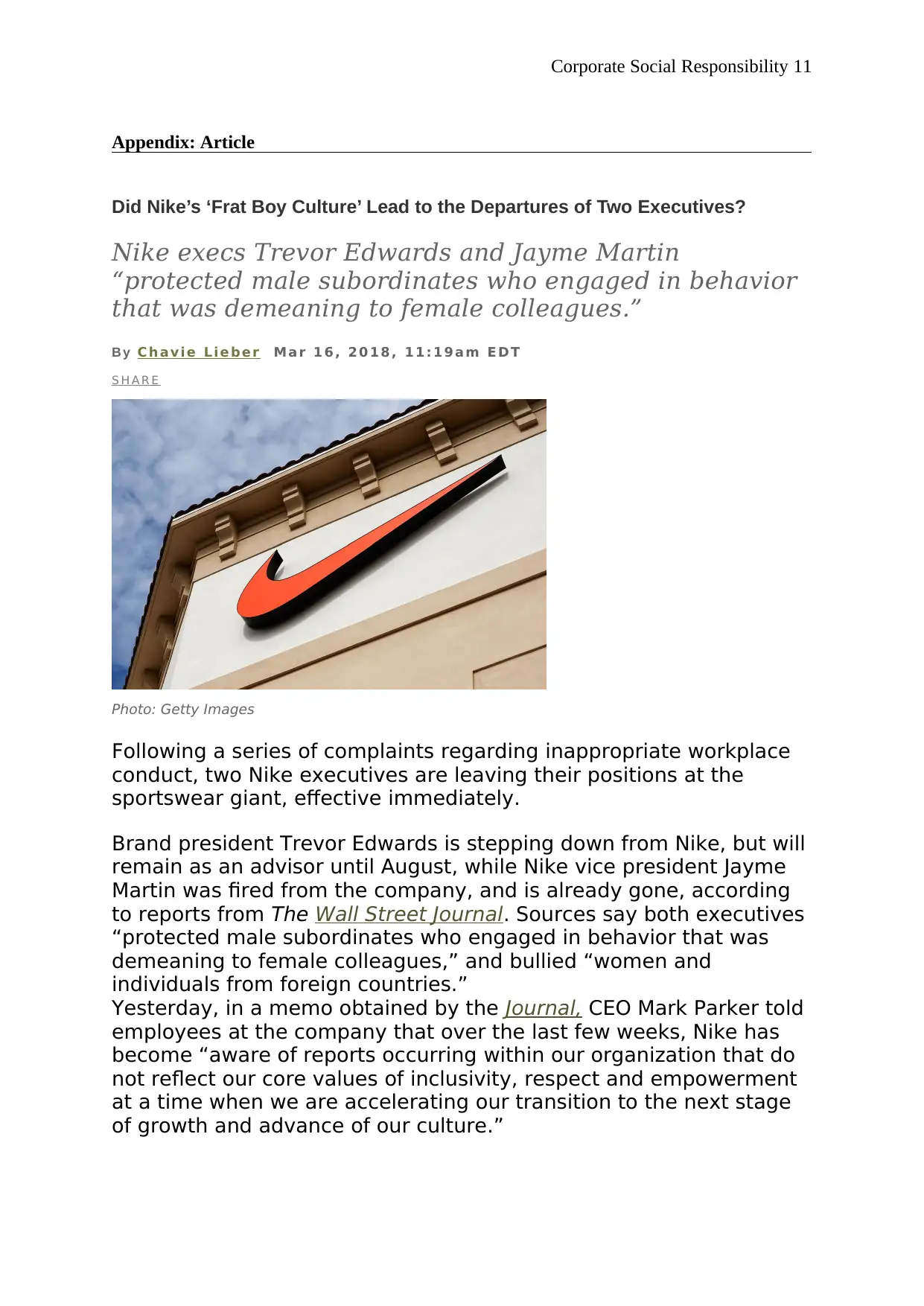
Appendix: Article
Did Nike’s ‘Frat Boy Culture’ Lead to the Departures of Two Executives?
Nike execs Trevor Edwards and Jayme Martin
“protected male subordinates who engaged in behavior
that was demeaning to female colleagues.”
B y C h a v i e L i e b e r M a r 1 6 , 2 0 1 8 , 1 1 : 1 9 a m E D T
S H A R E
Photo: Getty Images
Following a series of complaints regarding inappropriate workplace
conduct, two Nike executives are leaving their positions at the
sportswear giant, effective immediately.
Brand president Trevor Edwards is stepping down from Nike, but will
remain as an advisor until August, while Nike vice president Jayme
Martin was fired from the company, and is already gone, according
to reports from The Wall Street Journal. Sources say both executives
“protected male subordinates who engaged in behavior that was
demeaning to female colleagues,” and bullied “women and
individuals from foreign countries.”
Yesterday, in a memo obtained by the Journal, CEO Mark Parker told
employees at the company that over the last few weeks, Nike has
become “aware of reports occurring within our organization that do
not reflect our core values of inclusivity, respect and empowerment
at a time when we are accelerating our transition to the next stage
of growth and advance of our culture.”
Appendix: Article
Did Nike’s ‘Frat Boy Culture’ Lead to the Departures of Two Executives?
Nike execs Trevor Edwards and Jayme Martin
“protected male subordinates who engaged in behavior
that was demeaning to female colleagues.”
B y C h a v i e L i e b e r M a r 1 6 , 2 0 1 8 , 1 1 : 1 9 a m E D T
S H A R E
Photo: Getty Images
Following a series of complaints regarding inappropriate workplace
conduct, two Nike executives are leaving their positions at the
sportswear giant, effective immediately.
Brand president Trevor Edwards is stepping down from Nike, but will
remain as an advisor until August, while Nike vice president Jayme
Martin was fired from the company, and is already gone, according
to reports from The Wall Street Journal. Sources say both executives
“protected male subordinates who engaged in behavior that was
demeaning to female colleagues,” and bullied “women and
individuals from foreign countries.”
Yesterday, in a memo obtained by the Journal, CEO Mark Parker told
employees at the company that over the last few weeks, Nike has
become “aware of reports occurring within our organization that do
not reflect our core values of inclusivity, respect and empowerment
at a time when we are accelerating our transition to the next stage
of growth and advance of our culture.”
Corporate Social Responsibility 12
Parker also told employees that Nike was currently reviewing the
company’s internal HR system, noting that “this has been a very
difficult time,” according to the Journal.
An employee since 1992, Edwards was reportedly being considered
to take over as CEO when Parker retires. Yesterday the company
released a statement that Edwards will now retire from Nike in
August, although sources tell ESPN that there was “no outward talk
that the 55-year-old Edwards was ready to retire.” Martin, who
reported to Edwards, has been with Nike since 1997, and most
recently ran Nike’s business divisions of training, basketball, and its
women’s business, according to the Journal. These departures have
created a shuffle within the company: Parker is now staying on as
CEO beyond 2020, and former Nike Geographies & Sales president
Elliott Hill is assuming responsibilities as president of consumer and
marketplace.
In his memo, Parker wrote that the situation at Nike “disturbs and
saddens me.” He did not specify what exactly the complaints at Nike
were about, or whether they involved Edwards or Martin personally.
(Nike did not immediately respond to Racked for comment.)
The news of workplace misconduct isn’t all too surprising, though.
Nike’s headquarters in Beaverton, Oregon, has plenty of complaints
on Glassdoor, with several employees calling Nike a company with
“frat boy culture.”
“Boys club, with frat- boy type bad behavior that is ignored by
mgmt,” one Glassdoor user wrote.
“I have been told multiple times to ‘sit and keep my mouth shut’
during a meeting (Female typically in all male meetings),” another
Glassdoor review reads, written by a Nike Beaverton employee who
holds a director position. The employee also says Nike has a “lack of
promotion of female leaders: Often excuse given is that a specific
female acts too aggressive and therefore is passed over for
promotion (this is when a male counter-part can say the exact same
thing but been seen as a strong leader). I see this occur on a weekly
basis.”
One current employee, who’s worked at Nike for eight years, wrote
on Glassdoor two months ago that Nike has “disrespectful, ageist,
sexist, entitled, pampered and selfish upper management.”
“TimesUp on the odious frat-boy culture, dudes,” the Nike employee
writes. “Many women I talk to are super sick of the boys club
Parker also told employees that Nike was currently reviewing the
company’s internal HR system, noting that “this has been a very
difficult time,” according to the Journal.
An employee since 1992, Edwards was reportedly being considered
to take over as CEO when Parker retires. Yesterday the company
released a statement that Edwards will now retire from Nike in
August, although sources tell ESPN that there was “no outward talk
that the 55-year-old Edwards was ready to retire.” Martin, who
reported to Edwards, has been with Nike since 1997, and most
recently ran Nike’s business divisions of training, basketball, and its
women’s business, according to the Journal. These departures have
created a shuffle within the company: Parker is now staying on as
CEO beyond 2020, and former Nike Geographies & Sales president
Elliott Hill is assuming responsibilities as president of consumer and
marketplace.
In his memo, Parker wrote that the situation at Nike “disturbs and
saddens me.” He did not specify what exactly the complaints at Nike
were about, or whether they involved Edwards or Martin personally.
(Nike did not immediately respond to Racked for comment.)
The news of workplace misconduct isn’t all too surprising, though.
Nike’s headquarters in Beaverton, Oregon, has plenty of complaints
on Glassdoor, with several employees calling Nike a company with
“frat boy culture.”
“Boys club, with frat- boy type bad behavior that is ignored by
mgmt,” one Glassdoor user wrote.
“I have been told multiple times to ‘sit and keep my mouth shut’
during a meeting (Female typically in all male meetings),” another
Glassdoor review reads, written by a Nike Beaverton employee who
holds a director position. The employee also says Nike has a “lack of
promotion of female leaders: Often excuse given is that a specific
female acts too aggressive and therefore is passed over for
promotion (this is when a male counter-part can say the exact same
thing but been seen as a strong leader). I see this occur on a weekly
basis.”
One current employee, who’s worked at Nike for eight years, wrote
on Glassdoor two months ago that Nike has “disrespectful, ageist,
sexist, entitled, pampered and selfish upper management.”
“TimesUp on the odious frat-boy culture, dudes,” the Nike employee
writes. “Many women I talk to are super sick of the boys club
⊘ This is a preview!⊘
Do you want full access?
Subscribe today to unlock all pages.
Trusted by 1+ million students worldwide

1 out of 14


Related Documents


Your All-in-One AI-Powered Toolkit for Academic Success.
+13062052269
info@desklib.com
Available 24*7 on WhatsApp / Email
![[object Object]](/_next/static/media/star-bottom.7253800d.svg)
Unlock your academic potential
Copyright © 2020–2026 A2Z Services. All Rights Reserved. Developed and managed by ZUCOL.