Ethical Dilemmas in Advertising: A Case Study of Nike's Balaclava
VerifiedAdded on 2021/02/21
|14
|4232
|311
Report
AI Summary
This report examines the ethical concerns arising from Nike's advertising campaigns, specifically focusing on the controversy surrounding the Balaclava product. The analysis explores the ethical implications of the advertisements, which were perceived by some as promoting a terrorist look. The report identifies key stakeholders, including investors, employees, suppliers, and customers, and assesses the impact of the advertising on each group. It also delves into relevant ethical theories, such as utilitarianism and Kantianism, to evaluate the ethical dimensions of Nike's marketing decisions. Furthermore, the report discusses the qualities of ethical leadership and how organizations can foster an ethical environment. The study recommends strategies for Nike to improve its marketing practices, enhance stakeholder relations, and maintain a positive brand image by emphasizing ethical considerations in advertising and decision-making.
Table of Contents
INTRODUCTION...........................................................................................................................3
PART 1............................................................................................................................................3
a) Explanation of ethical concern and identification of key stakeholder...............................3
b) Ethical Theories.................................................................................................................6
PART 2............................................................................................................................................8
INTRODUCTION...........................................................................................................................3
PART 1............................................................................................................................................3
a) Explanation of ethical concern and identification of key stakeholder...............................3
b) Ethical Theories.................................................................................................................6
PART 2............................................................................................................................................8

Paraphrase This Document
Need a fresh take? Get an instant paraphrase of this document with our AI Paraphraser
Qualities for ethical leadership and creation of ethical organisation.....................................8
CONCLUSION..............................................................................................................................10
REFERENCES..............................................................................................................................11
CONCLUSION..............................................................................................................................10
REFERENCES..............................................................................................................................11
INTRODUCTION
Business ethics are considered as the appropriate business practices and policies
associated with some of core subjects that is discrimination, corporate social responsibility,
corporate governance etc. These ethics also guides managers and other business associated
people that can check and analyse what is right or wrong at the time of taking decision
effectively (Weiss, 2014). In order to sustain longer at workplace business organisations are
focuses on complying all legal as well as ethical procedures in order to avoid any of the
uncertain situation. By following all of the associated norms they can easily enhance their
sustainability at market place. The current project is based on case of Nike that is associated with
its advertising case. The company has faced various controversies related to their promotional
advertisement which have been perceived by viewers in wrong manner. Viewers has thought that
this advertisement promotes terrorist looks more instead of actual promotion of particular
product of Nike. The report will explore various edges of ethics which are linked with the case of
company. It will also define that what makes an individual as a ethical manager or leader.
Further, it will include assessment of some qualities which can be taken as the mode of
recognition for ethical leader.
PART 1-a
a) Explanation of ethical concern and identification of key stakeholder
The current study is associated to Nike, a popular sports brand which offers sports
equipment as well as clothing products to its customers. The company has introduced one its best
product named as Balaclava in July. The product became centre of attraction across the society,
but this popularity was not associated with quality of product, but it was related to its marketing.
It has been analysed the marketing team of this company has represented this product as a
military kind of outfit, but which will cover maximum upper portion of individual (Hibbert and
Cunliffe, 2015). According to the company this advertisement will influence interest of
customers as it is presented in the military look but, many of the people has perceived this
advertisement in wrong manner. They had taken it as the advertisement which supports or
promotes terrorist activity as the overall look reflects like the attire of gangster. This perception
of people has placed this product into the situation of criticism. The overall scenario has
developed negative image of Nike in front of its customers as they are taking company as the one
Business ethics are considered as the appropriate business practices and policies
associated with some of core subjects that is discrimination, corporate social responsibility,
corporate governance etc. These ethics also guides managers and other business associated
people that can check and analyse what is right or wrong at the time of taking decision
effectively (Weiss, 2014). In order to sustain longer at workplace business organisations are
focuses on complying all legal as well as ethical procedures in order to avoid any of the
uncertain situation. By following all of the associated norms they can easily enhance their
sustainability at market place. The current project is based on case of Nike that is associated with
its advertising case. The company has faced various controversies related to their promotional
advertisement which have been perceived by viewers in wrong manner. Viewers has thought that
this advertisement promotes terrorist looks more instead of actual promotion of particular
product of Nike. The report will explore various edges of ethics which are linked with the case of
company. It will also define that what makes an individual as a ethical manager or leader.
Further, it will include assessment of some qualities which can be taken as the mode of
recognition for ethical leader.
PART 1-a
a) Explanation of ethical concern and identification of key stakeholder
The current study is associated to Nike, a popular sports brand which offers sports
equipment as well as clothing products to its customers. The company has introduced one its best
product named as Balaclava in July. The product became centre of attraction across the society,
but this popularity was not associated with quality of product, but it was related to its marketing.
It has been analysed the marketing team of this company has represented this product as a
military kind of outfit, but which will cover maximum upper portion of individual (Hibbert and
Cunliffe, 2015). According to the company this advertisement will influence interest of
customers as it is presented in the military look but, many of the people has perceived this
advertisement in wrong manner. They had taken it as the advertisement which supports or
promotes terrorist activity as the overall look reflects like the attire of gangster. This perception
of people has placed this product into the situation of criticism. The overall scenario has
developed negative image of Nike in front of its customers as they are taking company as the one
⊘ This is a preview!⊘
Do you want full access?
Subscribe today to unlock all pages.

Trusted by 1+ million students worldwide
does not perform their activities under the parameters of ethics. The scene became sensitive in
society and also placed a big question mark on the marketing department of Nike as they have
completely ignored or neglected this consequence which have not only affected its sales
performance but had also affected its brand image (Ismaeel and Blaim, 2012). In order to protect
themselves the company has also placed many claims such as they developed this product for
protecting individuals from the cold in winter season. But, for gaining customers positive
influence, the company has said that they will ensure that marketing team will further emphasize
on pursuing ethical norms and consider society at the time of promoting product among
customer. Here, it is essential for marketing department to focus on choosing right intention
about the product so that they present same intention and values of product in front of customers
at the time of presenting it to them in advertisements. Thus, it can be said that it is important for
Nike to concentrate on using ethical and societal aspect at the finalising any advertisement for
the company. This will help them out in developing positive image of the company in front of
customers as slowly they will accept Nike again. As a result, it will contribute in the
enhancement of organisations sales performance effectively.
Stakeholders concepts
With reference to the Nike, Key stakeholder for this company are investors, employees,
suppliers and customers. In terms with investors, they got affected as they were expecting
profits but after the controversial case there were high amount of losses that has been faced by
investors while some investors also got bankrupt. While if it is seen in terms of employees,
advertisement case impact employees in terms of having incentives and additional hikes. While
some employees lost their jobs due to increase in loss percentage that has been faced by
company. In addition with this, Customers get affected as their expectations from company
decreases. This affect suppliers the most as black lash from advertisement made them face high
amount of loss. They all get affected due to placed influence over the power utilisation as well as
decision making of the Nike at extent level. As per current situation, it has been analysed that
Nike requires support of its stakeholder in overcoming criticism faced for the Balaclava. It can
be said that support of stakeholders will help company in gaining its positive image back among
society. In this regard, for enhancing sustainability of stakeholders with Nike top management
team of the company is required to follow stakeholder theory which will aware them about
retaining stakeholders and guide them about effective execution of their operational activities
society and also placed a big question mark on the marketing department of Nike as they have
completely ignored or neglected this consequence which have not only affected its sales
performance but had also affected its brand image (Ismaeel and Blaim, 2012). In order to protect
themselves the company has also placed many claims such as they developed this product for
protecting individuals from the cold in winter season. But, for gaining customers positive
influence, the company has said that they will ensure that marketing team will further emphasize
on pursuing ethical norms and consider society at the time of promoting product among
customer. Here, it is essential for marketing department to focus on choosing right intention
about the product so that they present same intention and values of product in front of customers
at the time of presenting it to them in advertisements. Thus, it can be said that it is important for
Nike to concentrate on using ethical and societal aspect at the finalising any advertisement for
the company. This will help them out in developing positive image of the company in front of
customers as slowly they will accept Nike again. As a result, it will contribute in the
enhancement of organisations sales performance effectively.
Stakeholders concepts
With reference to the Nike, Key stakeholder for this company are investors, employees,
suppliers and customers. In terms with investors, they got affected as they were expecting
profits but after the controversial case there were high amount of losses that has been faced by
investors while some investors also got bankrupt. While if it is seen in terms of employees,
advertisement case impact employees in terms of having incentives and additional hikes. While
some employees lost their jobs due to increase in loss percentage that has been faced by
company. In addition with this, Customers get affected as their expectations from company
decreases. This affect suppliers the most as black lash from advertisement made them face high
amount of loss. They all get affected due to placed influence over the power utilisation as well as
decision making of the Nike at extent level. As per current situation, it has been analysed that
Nike requires support of its stakeholder in overcoming criticism faced for the Balaclava. It can
be said that support of stakeholders will help company in gaining its positive image back among
society. In this regard, for enhancing sustainability of stakeholders with Nike top management
team of the company is required to follow stakeholder theory which will aware them about
retaining stakeholders and guide them about effective execution of their operational activities
Paraphrase This Document
Need a fresh take? Get an instant paraphrase of this document with our AI Paraphraser
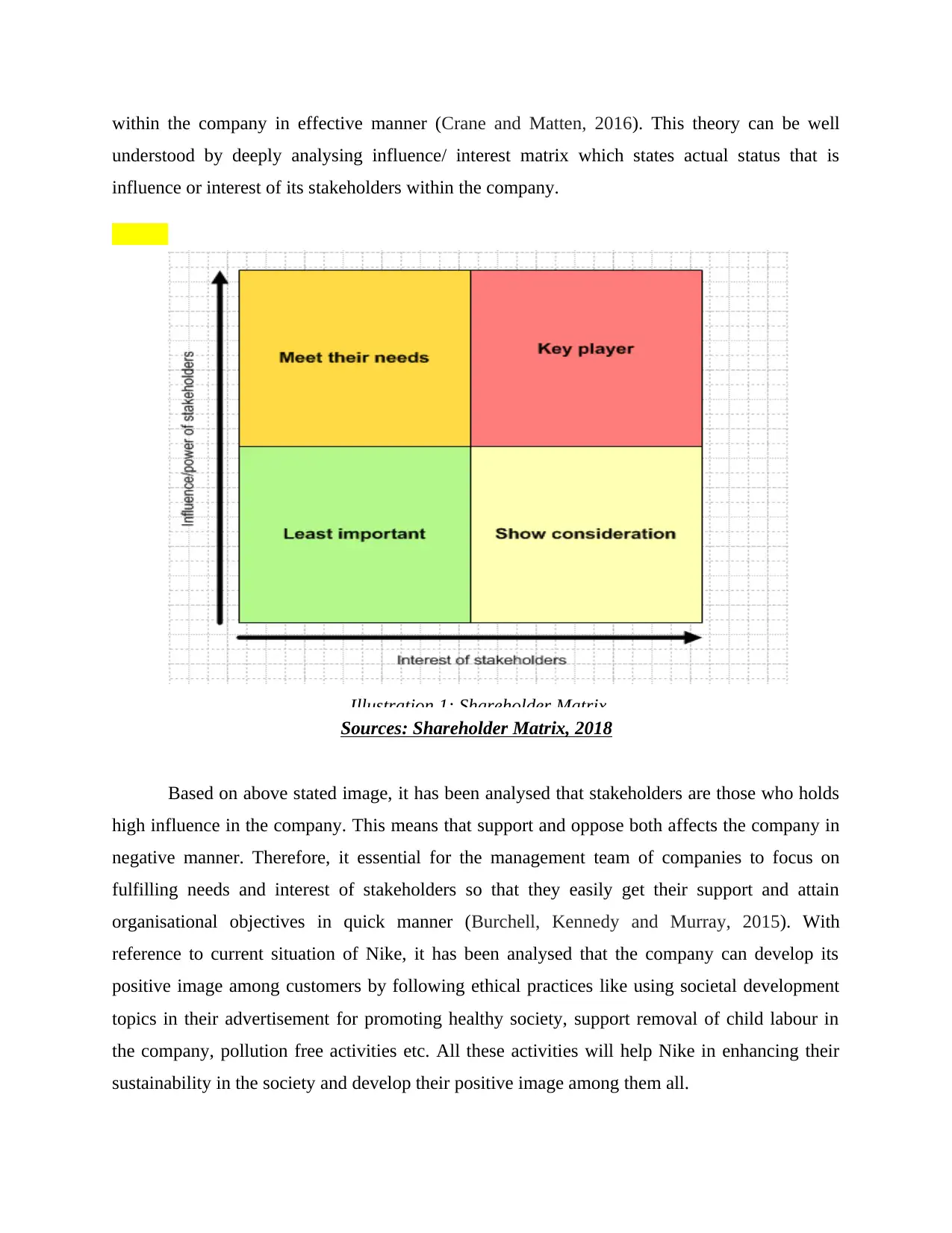
within the company in effective manner (Crane and Matten, 2016). This theory can be well
understood by deeply analysing influence/ interest matrix which states actual status that is
influence or interest of its stakeholders within the company.
Illustration 1: Shareholder Matrix
Sources: Shareholder Matrix, 2018
Based on above stated image, it has been analysed that stakeholders are those who holds
high influence in the company. This means that support and oppose both affects the company in
negative manner. Therefore, it essential for the management team of companies to focus on
fulfilling needs and interest of stakeholders so that they easily get their support and attain
organisational objectives in quick manner (Burchell, Kennedy and Murray, 2015). With
reference to current situation of Nike, it has been analysed that the company can develop its
positive image among customers by following ethical practices like using societal development
topics in their advertisement for promoting healthy society, support removal of child labour in
the company, pollution free activities etc. All these activities will help Nike in enhancing their
sustainability in the society and develop their positive image among them all.
understood by deeply analysing influence/ interest matrix which states actual status that is
influence or interest of its stakeholders within the company.
Illustration 1: Shareholder Matrix
Sources: Shareholder Matrix, 2018
Based on above stated image, it has been analysed that stakeholders are those who holds
high influence in the company. This means that support and oppose both affects the company in
negative manner. Therefore, it essential for the management team of companies to focus on
fulfilling needs and interest of stakeholders so that they easily get their support and attain
organisational objectives in quick manner (Burchell, Kennedy and Murray, 2015). With
reference to current situation of Nike, it has been analysed that the company can develop its
positive image among customers by following ethical practices like using societal development
topics in their advertisement for promoting healthy society, support removal of child labour in
the company, pollution free activities etc. All these activities will help Nike in enhancing their
sustainability in the society and develop their positive image among them all.
Recommendation:
company are investors, employees, suppliers and customers. In terms with customers, the
company is required to develop new marketing strategies which are planned in such a manner
that will influence interest of customers and attracts them to make purchase from this company
(Forray and Leigh, 2012). While if it is seen with employees, it is important for Nike to
formulate best effective relationship with employees as to fulfil their needs. In addition with this,
company is required to frame strategies that will assist them to conduct trade with suppliers in
best effective manner. Along with this, Nike in order to gain loyalty from customers is required
to make promotions in fair manner as to regain high amount of customer attentions. Based on
overall analysis, it is recommended to Nike that they must develop effective structure of
community who will be responsible for taking right decisions in these kinds of situation related
to unethical practice. Along with this, the structure will also be responsible for taking effective
course of action within the situation. This will improve sales performance of the company and
help them executing their operational activities effectively at marketplace.
1-b) Ethical Theories
Ethical theories are the base or support for the decision-making process in the
organisation. These theories provide assistance to the individual so that they can select right
process, policy and techniques according to the situation. It has been analysed that there are
numerous of theories which are used by individuals for converting organisational situation in
their favour. In context to the given situation of Nike Case Study, it has been analysed that the
company is facing criticism related to its newly launched product named as Balaclava in July.
Balaclava is a face covering kind of mask that is further covering neck as well as upper chest
portion. It has been observed that advertisement of this product has presented terrorist look
which have placed negative impact over the youth. Along with this, it has also been seen that
youngster have acquired this look and the society has opposed this product as they believe that
this fashion sense has increased influence of young people towards gang inspired look which was
ethically not accepted by them (Hoejmose, Brammer and Millington, 2013). Also, the overall
criticism goes viral over social media which have resulted in the decline of sales performance of
Nike as the company was facing issues related to its ethical values.
Business ethics are considered as the philosophy that is associated with the norms and
principle of company that what is right and what is wrong for the company. Business ethics
company are investors, employees, suppliers and customers. In terms with customers, the
company is required to develop new marketing strategies which are planned in such a manner
that will influence interest of customers and attracts them to make purchase from this company
(Forray and Leigh, 2012). While if it is seen with employees, it is important for Nike to
formulate best effective relationship with employees as to fulfil their needs. In addition with this,
company is required to frame strategies that will assist them to conduct trade with suppliers in
best effective manner. Along with this, Nike in order to gain loyalty from customers is required
to make promotions in fair manner as to regain high amount of customer attentions. Based on
overall analysis, it is recommended to Nike that they must develop effective structure of
community who will be responsible for taking right decisions in these kinds of situation related
to unethical practice. Along with this, the structure will also be responsible for taking effective
course of action within the situation. This will improve sales performance of the company and
help them executing their operational activities effectively at marketplace.
1-b) Ethical Theories
Ethical theories are the base or support for the decision-making process in the
organisation. These theories provide assistance to the individual so that they can select right
process, policy and techniques according to the situation. It has been analysed that there are
numerous of theories which are used by individuals for converting organisational situation in
their favour. In context to the given situation of Nike Case Study, it has been analysed that the
company is facing criticism related to its newly launched product named as Balaclava in July.
Balaclava is a face covering kind of mask that is further covering neck as well as upper chest
portion. It has been observed that advertisement of this product has presented terrorist look
which have placed negative impact over the youth. Along with this, it has also been seen that
youngster have acquired this look and the society has opposed this product as they believe that
this fashion sense has increased influence of young people towards gang inspired look which was
ethically not accepted by them (Hoejmose, Brammer and Millington, 2013). Also, the overall
criticism goes viral over social media which have resulted in the decline of sales performance of
Nike as the company was facing issues related to its ethical values.
Business ethics are considered as the philosophy that is associated with the norms and
principle of company that what is right and what is wrong for the company. Business ethics
⊘ This is a preview!⊘
Do you want full access?
Subscribe today to unlock all pages.
Trusted by 1+ million students worldwide
represents character of company associated with rules, ethical values, fairness, rights, obligation
and benefit to society. In order to understand the same case scenario in effective manner two
ethical theories are described as below:
Utilitarianism
This approach of ethical theory emphasises on separating right activities from the wrong
one with the support of outcomes. It simply states that in terms of morale the best action is
considered as the one which creates maximum level of happiness among individuals (Godemann
and Moon, 2014). Further, it has been seen that it is not only associated with the single action,
but it involves overall collaborative actions that which influences happiness for future
consequences. In relation to Nike, it has been analysed that the newly launched product
Balaclava was not good for all as the product was giving gangster look to the one who wore it.
This means anyone who is planning to conduct any robbery or terrorist attack can easily execute
their plan by using this product as it will hide their upper portion completely (Voegtlin, Patzer
and Scherer, 2012). This has raised non satisfaction level of customer because they believe that it
ignores safety of individuals. As per this theory, it can be said Balaclava product of Nike was not
feasible for all. Thus, society has not accepted it due to its unethical influence over the security
of individuals.
Kantianism
It is an important theory which is based upon the ethical principle it help that time when
talking decision related to business environment as well as individual. Further its Kant theory is
also useful to provide training related to repents and equalisation in autonomous life. The basic
principle of this theory is that people are the end and not the source for creating the end of
process or product (Solitander and Herlin, 2012). The main purpose of this is to provide the
rights of peoples and generates a process for personalization of rights with resolution of
conflicts. It play an important role.
It has been analysed that Nike is facing issue related to its new launch product that is
Balaclava. The advertisement of this product was not developed in the ethical manner which
have placed negative influence over the society and developed insecurity among them as they
can face any robbery or terrorist attack because these people can wear this product of Nike and
execute their plan. According to this theory, this advertisement of Nike was unethical as it was
not providing respect to societal security.
and benefit to society. In order to understand the same case scenario in effective manner two
ethical theories are described as below:
Utilitarianism
This approach of ethical theory emphasises on separating right activities from the wrong
one with the support of outcomes. It simply states that in terms of morale the best action is
considered as the one which creates maximum level of happiness among individuals (Godemann
and Moon, 2014). Further, it has been seen that it is not only associated with the single action,
but it involves overall collaborative actions that which influences happiness for future
consequences. In relation to Nike, it has been analysed that the newly launched product
Balaclava was not good for all as the product was giving gangster look to the one who wore it.
This means anyone who is planning to conduct any robbery or terrorist attack can easily execute
their plan by using this product as it will hide their upper portion completely (Voegtlin, Patzer
and Scherer, 2012). This has raised non satisfaction level of customer because they believe that it
ignores safety of individuals. As per this theory, it can be said Balaclava product of Nike was not
feasible for all. Thus, society has not accepted it due to its unethical influence over the security
of individuals.
Kantianism
It is an important theory which is based upon the ethical principle it help that time when
talking decision related to business environment as well as individual. Further its Kant theory is
also useful to provide training related to repents and equalisation in autonomous life. The basic
principle of this theory is that people are the end and not the source for creating the end of
process or product (Solitander and Herlin, 2012). The main purpose of this is to provide the
rights of peoples and generates a process for personalization of rights with resolution of
conflicts. It play an important role.
It has been analysed that Nike is facing issue related to its new launch product that is
Balaclava. The advertisement of this product was not developed in the ethical manner which
have placed negative influence over the society and developed insecurity among them as they
can face any robbery or terrorist attack because these people can wear this product of Nike and
execute their plan. According to this theory, this advertisement of Nike was unethical as it was
not providing respect to societal security.
Paraphrase This Document
Need a fresh take? Get an instant paraphrase of this document with our AI Paraphraser
Based on both the theories, it has been identified that even though Nike has developed an
effective product by analysing winter time. But, at the same time, the society has misinterpreted
the product by perceiving its marketing activity in negative manner (Doh and Quigley, 2014).
The overall situation has realised marketing team of Nike as well as the company that they are
required to emphasize on the marketing activities before introducing its product at marketplace.
This will allow them in improving the situation at the right time without waiting for the scenario
that converts it into worse situation.
PART 2
Qualities for ethical leadership and creation of ethical organisation
There are numerous of reasons at workplace which influences interest of company to
indulge into unethical business practices at the time of implementing business activities at
workplace. This situation normally generates at workplace because of many reasons such as high
pressure from shareholders side, non-effective supervision of superiors, high influence over
achievement of goals and objective of company within less period of time and financial losses
(Quarshie, Salmi and Leuschner, 2016). Every business enterprise has its own code of conduct
which includes processes, cultures, values and methods of that company. All of them are
required to abided by all employees as well as superior teams in order to keep their company
away from various unethical issues and do not harm surrounding environment or society.
Leader is the one who leads or direct overall workforce in same directions so that
business objectives can be attained by them in ethical manner. This is normally done effectively
by engaging them into a ethical and morally right practices (Weiss, 2014). As being a good
leader, it is essential for me to possess some basic but effective qualities as well as characteristics
that will contribute in becoming good and effective leader. In this regard, some of the common
qualities as well as behavioural attributes which are required to be owned by me are described as
below:
Gratitude: Gratitude refers to positive behaviour of leader which states that leader values
efforts of employees which are placed by them in their work and shows thanks towards them. It
is also mandatory for me to show gratitude towards employees also appreciate their performance
in order to motivate them towards the work. This will show that I should remain down to earth at
effective product by analysing winter time. But, at the same time, the society has misinterpreted
the product by perceiving its marketing activity in negative manner (Doh and Quigley, 2014).
The overall situation has realised marketing team of Nike as well as the company that they are
required to emphasize on the marketing activities before introducing its product at marketplace.
This will allow them in improving the situation at the right time without waiting for the scenario
that converts it into worse situation.
PART 2
Qualities for ethical leadership and creation of ethical organisation
There are numerous of reasons at workplace which influences interest of company to
indulge into unethical business practices at the time of implementing business activities at
workplace. This situation normally generates at workplace because of many reasons such as high
pressure from shareholders side, non-effective supervision of superiors, high influence over
achievement of goals and objective of company within less period of time and financial losses
(Quarshie, Salmi and Leuschner, 2016). Every business enterprise has its own code of conduct
which includes processes, cultures, values and methods of that company. All of them are
required to abided by all employees as well as superior teams in order to keep their company
away from various unethical issues and do not harm surrounding environment or society.
Leader is the one who leads or direct overall workforce in same directions so that
business objectives can be attained by them in ethical manner. This is normally done effectively
by engaging them into a ethical and morally right practices (Weiss, 2014). As being a good
leader, it is essential for me to possess some basic but effective qualities as well as characteristics
that will contribute in becoming good and effective leader. In this regard, some of the common
qualities as well as behavioural attributes which are required to be owned by me are described as
below:
Gratitude: Gratitude refers to positive behaviour of leader which states that leader values
efforts of employees which are placed by them in their work and shows thanks towards them. It
is also mandatory for me to show gratitude towards employees also appreciate their performance
in order to motivate them towards the work. This will show that I should remain down to earth at
the time of talking to employees so that they can feel related to the company and will also
contribute in developing positive behaviour of employees towards the company. This will lead to
increase in employee’s commitment towards the company which enhances productivity of
employees. As a result, it will also become main reason of success for the company as they will
develop positive relationship among employer and employee.
Humility: Humility is considered as the quality of human being as humble (Dierksmeier,
2011). It states that leaders should represent positive behaviour towards the employees and
influence them to work perform well for attaining success. Thus, it is essential for me to focus to
remain modest at workplace in order to develop familiar relationship with employees which will
result in creation of positive and healthy environment at workplace. As a result, it leads to high
business success of company that contributes in attainment of organisational goals and
objectives.
Justice: The behaviour of employees which is has to be governing by leaders in effective
manner (Hibbert and Cunliffe, 2015). More over conflicts affect the working environment of
company and for creating healthy working place leaders should adopt ethical leadership. Hence
for handling different circumstances of organisations I encouraged innovative cultures in my
company which aid to work in justice and fair and hardworking attitude among employees. As a
leader it is necessary to act in honest and promote healthy relationship among employers and
worker. For effective justice which aid to retain employees for longer durations. Even through
this company will increase profitability and productivity in effective manner.
Mercy and Compassion: Compassion which aid to create forgiveness and mercy and
perform well in organisation. The leaders which need to function smoothly in effective manner
so that forgiveness and leniency can be created among employees and employers. In any
company if workers found guilty of their mistake then leaders should have mercy on them and
give less punishment it how professional environment is created in the organisation. Hence when
decisions are taken by leaders, they should consider feelings of employees so that no one gets
hurt at work place. More than anything, a path which affect positive impact on employees so that
it can help to achieve targets of company.
Magnanimity: Employees is every business enterprise performs effectively when they
take leaders as their guide (Ismaeel and Blaim, 2012). Here, it is essential for me to work in such
a manner in front of my subordinates so that they will also work in a same manner that
contribute in developing positive behaviour of employees towards the company. This will lead to
increase in employee’s commitment towards the company which enhances productivity of
employees. As a result, it will also become main reason of success for the company as they will
develop positive relationship among employer and employee.
Humility: Humility is considered as the quality of human being as humble (Dierksmeier,
2011). It states that leaders should represent positive behaviour towards the employees and
influence them to work perform well for attaining success. Thus, it is essential for me to focus to
remain modest at workplace in order to develop familiar relationship with employees which will
result in creation of positive and healthy environment at workplace. As a result, it leads to high
business success of company that contributes in attainment of organisational goals and
objectives.
Justice: The behaviour of employees which is has to be governing by leaders in effective
manner (Hibbert and Cunliffe, 2015). More over conflicts affect the working environment of
company and for creating healthy working place leaders should adopt ethical leadership. Hence
for handling different circumstances of organisations I encouraged innovative cultures in my
company which aid to work in justice and fair and hardworking attitude among employees. As a
leader it is necessary to act in honest and promote healthy relationship among employers and
worker. For effective justice which aid to retain employees for longer durations. Even through
this company will increase profitability and productivity in effective manner.
Mercy and Compassion: Compassion which aid to create forgiveness and mercy and
perform well in organisation. The leaders which need to function smoothly in effective manner
so that forgiveness and leniency can be created among employees and employers. In any
company if workers found guilty of their mistake then leaders should have mercy on them and
give less punishment it how professional environment is created in the organisation. Hence when
decisions are taken by leaders, they should consider feelings of employees so that no one gets
hurt at work place. More than anything, a path which affect positive impact on employees so that
it can help to achieve targets of company.
Magnanimity: Employees is every business enterprise performs effectively when they
take leaders as their guide (Ismaeel and Blaim, 2012). Here, it is essential for me to work in such
a manner in front of my subordinates so that they will also work in a same manner that
⊘ This is a preview!⊘
Do you want full access?
Subscribe today to unlock all pages.
Trusted by 1+ million students worldwide
responsible and accountable towards their work as well as performance. I should also
strategically align vision of organisation so that organisational goals can be attained within the
predetermined time frame as the employees are responsible and accountable towards completion
of task.
Integrity and Resilience: Every leader is required to execute their business
responsibility with ethical values so that statutory requirements could be fulfilled (Crane and
Matten, 2016). For this, it is essential me to adhere all laws while performing organisational
work. They are also required to be performed in ethical manner. By observing my own work
with legally adhered and ethically valuable, my subordinates will also get motivated and perform
their work in the same manner. As a result, all organisational goals will be attained effectively
with by compliance of ethical values and associated norms.
On the basis of above described various qualities of ethical values, it can be said that it is
essential for me to engage employees into the ethical practices at workplace so that effective
organisational culture can be developed, and staff of company complies with every ethical as
well as legal norm in effective manner. Along with this, positive working environment helps
employees in sharing their issues with the leaders or other superiors at the same moment so that
solution regarding the same can be found. As a result, this would make it easier for employees to
attain organisational goals and objectives in quick manner with the support of ethical practices.
CONCLUSION
Based on above-mentioned report, it has been analysed that business manager and leaders
are required to take ethical decisions at workplace so that value of their decision can be enhanced
for longer period of time. In addition with this, as per according to my own work experience as a
leader compliance and integrity acts as a one of the most supporting tool in order to conduct
leadership ethical management in best effective manner. As with the help of this employees can
be guided towards more directional output in an ethical manner. Furthermore, it has been
identified that if company do not follow all ethical practices then there are probable chances that
company might face issues related decline in corporate image of company as well as low
customers loyalty. Also, usage of utilitarian theory of ethics has helped in understanding that at
which level company can easily comply all ethical as well as moral values within the company
premises at the time of implementing business activities. Along with this, various essential
qualities of a leader and managers are identified with their relation with ethical values. In
strategically align vision of organisation so that organisational goals can be attained within the
predetermined time frame as the employees are responsible and accountable towards completion
of task.
Integrity and Resilience: Every leader is required to execute their business
responsibility with ethical values so that statutory requirements could be fulfilled (Crane and
Matten, 2016). For this, it is essential me to adhere all laws while performing organisational
work. They are also required to be performed in ethical manner. By observing my own work
with legally adhered and ethically valuable, my subordinates will also get motivated and perform
their work in the same manner. As a result, all organisational goals will be attained effectively
with by compliance of ethical values and associated norms.
On the basis of above described various qualities of ethical values, it can be said that it is
essential for me to engage employees into the ethical practices at workplace so that effective
organisational culture can be developed, and staff of company complies with every ethical as
well as legal norm in effective manner. Along with this, positive working environment helps
employees in sharing their issues with the leaders or other superiors at the same moment so that
solution regarding the same can be found. As a result, this would make it easier for employees to
attain organisational goals and objectives in quick manner with the support of ethical practices.
CONCLUSION
Based on above-mentioned report, it has been analysed that business manager and leaders
are required to take ethical decisions at workplace so that value of their decision can be enhanced
for longer period of time. In addition with this, as per according to my own work experience as a
leader compliance and integrity acts as a one of the most supporting tool in order to conduct
leadership ethical management in best effective manner. As with the help of this employees can
be guided towards more directional output in an ethical manner. Furthermore, it has been
identified that if company do not follow all ethical practices then there are probable chances that
company might face issues related decline in corporate image of company as well as low
customers loyalty. Also, usage of utilitarian theory of ethics has helped in understanding that at
which level company can easily comply all ethical as well as moral values within the company
premises at the time of implementing business activities. Along with this, various essential
qualities of a leader and managers are identified with their relation with ethical values. In
Paraphrase This Document
Need a fresh take? Get an instant paraphrase of this document with our AI Paraphraser
addition to this, requirement of leadership at the time of developing ethical practices at
workplace has been analysed.
workplace has been analysed.
REFERENCES
Books and Journals
Part 1-a
Weiss, J. W., 2014. Business ethics: A stakeholder and issues management approach. Berrett-
Koehler Publishers.
Hibbert, P. and Cunliffe, A., 2015. Responsible management: Engaging moral reflexive practice
through threshold concepts. Journal of business ethics. 127(1). pp.177-188.
Ismaeel, M. and Blaim, K., 2012. Toward applied Islamic business ethics: responsible halal
business. Journal of Management Development. 31(10). pp.1090-1100.
Crane, A. and Matten, D., 2016. Business ethics: Managing corporate citizenship and
sustainability in the age of globalization. Oxford University Press.
Part1-b
Burchell, J., Kennedy, S. and Murray, A., 2015. Responsible management education in UK
business schools: Critically examining the role of the United Nations Principles for
Responsible Management Education as a driver for change. Management Learning. 46(4).
pp.479-497.
Forray, J. M. and Leigh, J. S., 2012. A primer on the principles of responsible management
education: Intellectual roots and waves of change. Journal of Management Education. 36(3).
pp.295-309.
Hoejmose, S., Brammer, S. and Millington, A., 2013. An empirical examination of the
relationship between business strategy and socially responsible supply chain management.
International Journal of Operations & Production Management. 33(5). pp.589-621.
Godemann, J., Haertle, J., Herzig, C. and Moon, J., 2014. United Nations supported principles
for responsible management education: purpose, progress and prospects. Journal of Cleaner
Production. 62. pp.16-23.
Part 2
Voegtlin, C., Patzer, M. and Scherer, A. G., 2012. Responsible leadership in global business: A
new approach to leadership and its multi-level outcomes. Journal of Business Ethics. 105(1).
pp.1-16.
Solitander, N., Fougere, M., Sobczak, A. and Herlin, H., 2012. We are the champions:
Organizational learning and change for responsible management education. Journal of
Management Education. 36(3). pp.337-363.
Doh, J. P. and Quigley, N. R., 2014. Responsible leadership and stakeholder management:
Influence pathways and organizational outcomes. Academy of Management Perspectives.
28(3). pp.255-274.
Quarshie, A. M., Salmi, A. and Leuschner, R., 2016. Sustainability and corporate social
responsibility in supply chains: The state of research in supply chain management and
business ethics journals. Journal of Purchasing and Supply Management. 22(2). pp.82-97.
Weiss, J. W., 2014. Business ethics: A and issues management approach. Berrett-Koehler
Publishers.
Books and Journals
Part 1-a
Weiss, J. W., 2014. Business ethics: A stakeholder and issues management approach. Berrett-
Koehler Publishers.
Hibbert, P. and Cunliffe, A., 2015. Responsible management: Engaging moral reflexive practice
through threshold concepts. Journal of business ethics. 127(1). pp.177-188.
Ismaeel, M. and Blaim, K., 2012. Toward applied Islamic business ethics: responsible halal
business. Journal of Management Development. 31(10). pp.1090-1100.
Crane, A. and Matten, D., 2016. Business ethics: Managing corporate citizenship and
sustainability in the age of globalization. Oxford University Press.
Part1-b
Burchell, J., Kennedy, S. and Murray, A., 2015. Responsible management education in UK
business schools: Critically examining the role of the United Nations Principles for
Responsible Management Education as a driver for change. Management Learning. 46(4).
pp.479-497.
Forray, J. M. and Leigh, J. S., 2012. A primer on the principles of responsible management
education: Intellectual roots and waves of change. Journal of Management Education. 36(3).
pp.295-309.
Hoejmose, S., Brammer, S. and Millington, A., 2013. An empirical examination of the
relationship between business strategy and socially responsible supply chain management.
International Journal of Operations & Production Management. 33(5). pp.589-621.
Godemann, J., Haertle, J., Herzig, C. and Moon, J., 2014. United Nations supported principles
for responsible management education: purpose, progress and prospects. Journal of Cleaner
Production. 62. pp.16-23.
Part 2
Voegtlin, C., Patzer, M. and Scherer, A. G., 2012. Responsible leadership in global business: A
new approach to leadership and its multi-level outcomes. Journal of Business Ethics. 105(1).
pp.1-16.
Solitander, N., Fougere, M., Sobczak, A. and Herlin, H., 2012. We are the champions:
Organizational learning and change for responsible management education. Journal of
Management Education. 36(3). pp.337-363.
Doh, J. P. and Quigley, N. R., 2014. Responsible leadership and stakeholder management:
Influence pathways and organizational outcomes. Academy of Management Perspectives.
28(3). pp.255-274.
Quarshie, A. M., Salmi, A. and Leuschner, R., 2016. Sustainability and corporate social
responsibility in supply chains: The state of research in supply chain management and
business ethics journals. Journal of Purchasing and Supply Management. 22(2). pp.82-97.
Weiss, J. W., 2014. Business ethics: A and issues management approach. Berrett-Koehler
Publishers.
⊘ This is a preview!⊘
Do you want full access?
Subscribe today to unlock all pages.
Trusted by 1+ million students worldwide

1 out of 14


Related Documents


Your All-in-One AI-Powered Toolkit for Academic Success.
+13062052269
info@desklib.com
Available 24*7 on WhatsApp / Email
![[object Object]](/_next/static/media/star-bottom.7253800d.svg)
Unlock your academic potential
Copyright © 2020–2026 A2Z Services. All Rights Reserved. Developed and managed by ZUCOL.