Marketing Case Study: Analysis of Nike Force Zoom Trout 6 Product
VerifiedAdded on 2022/11/03
|23
|6014
|362
Case Study
AI Summary
This case study provides a comprehensive analysis of the Nike Force Zoom Trout 6, a recent product launch by Nike. It begins with an introduction to the product, its integration within Nike's brand portfolio, and an overview of its market scope and size. The study delves into Nike's expansion plans, benefits of the product, and the application of the 4Ps of marketing (Product, Place, Promotion, and Pricing). It explores the product's features, connection to the Mike Trout signature line, and its design elements. The case study also examines Nike's marketing strategies, including endorsements and promotional campaigns, and concludes with potential questions and answers derived from the analysis. The study includes appendices with relevant data on Nike's revenue, brand portfolio, and market position. The case study offers a detailed examination of the product's features, market position, and marketing strategies, providing valuable insights into Nike's approach to product development and market penetration.
Running head: CASE STUDY: NIKE FORCE ZOOM TROUT 6
CASE STUDY: NIKE FORCE ZOOM TROUT 6
Name of Student
Name of the University
Author Note
CASE STUDY: NIKE FORCE ZOOM TROUT 6
Name of Student
Name of the University
Author Note

Paraphrase This Document
Need a fresh take? Get an instant paraphrase of this document with our AI Paraphraser
1CASE STUDY: NIKE FORCE ZOOM TROUT 6
Executive Summary
The primary motive of this case study is to provide a detailed analysis of the new product
launched by Nike, the Nike Force Zoom Trout 6. The paper initiates with the introduction of
the product followed by its association with the brand portfolio. The next important aspect
mentioned is the scope and market size of the model in the global market. The discussion
proceeds with Nike’s expansion plans and other benefits of the product is described further.
The marketing principles (the 4Ps) of Nike that are applied for the marketing of this
particular model are explained after the above discussion. The overall discussion ends with
three possible questions and answers that can be derived from the case study. Finally, the
case study is concluded in a closing paragraph followed by the reference list and the
appendix.
Executive Summary
The primary motive of this case study is to provide a detailed analysis of the new product
launched by Nike, the Nike Force Zoom Trout 6. The paper initiates with the introduction of
the product followed by its association with the brand portfolio. The next important aspect
mentioned is the scope and market size of the model in the global market. The discussion
proceeds with Nike’s expansion plans and other benefits of the product is described further.
The marketing principles (the 4Ps) of Nike that are applied for the marketing of this
particular model are explained after the above discussion. The overall discussion ends with
three possible questions and answers that can be derived from the case study. Finally, the
case study is concluded in a closing paragraph followed by the reference list and the
appendix.
2CASE STUDY: NIKE FORCE ZOOM TROUT 6
Table of Contents
Introduction................................................................................................................................3
Discussion..................................................................................................................................4
About the product...................................................................................................................4
Connection with Nike’s existing portfolio.............................................................................5
Scope and Market Size...........................................................................................................6
Nike’s Plan for Expansion.....................................................................................................7
Benefits and Upsides of the Product......................................................................................8
Marketing Principles (The 4Ps).............................................................................................9
Product.......................................................................................................................10
Place or Distribution..................................................................................................10
Promotional Strategies...............................................................................................11
Pricing Strategies.......................................................................................................12
Case Study Questions:..........................................................................................................13
Conclusion................................................................................................................................15
References................................................................................................................................17
Appendix..................................................................................................................................20
Appendix 1: Nike Revenue Breakdown...............................................................................20
Appendix 2: Nike Brand Port Folio.....................................................................................21
Appendix 3: Nike’s Market Position....................................................................................21
Table of Contents
Introduction................................................................................................................................3
Discussion..................................................................................................................................4
About the product...................................................................................................................4
Connection with Nike’s existing portfolio.............................................................................5
Scope and Market Size...........................................................................................................6
Nike’s Plan for Expansion.....................................................................................................7
Benefits and Upsides of the Product......................................................................................8
Marketing Principles (The 4Ps).............................................................................................9
Product.......................................................................................................................10
Place or Distribution..................................................................................................10
Promotional Strategies...............................................................................................11
Pricing Strategies.......................................................................................................12
Case Study Questions:..........................................................................................................13
Conclusion................................................................................................................................15
References................................................................................................................................17
Appendix..................................................................................................................................20
Appendix 1: Nike Revenue Breakdown...............................................................................20
Appendix 2: Nike Brand Port Folio.....................................................................................21
Appendix 3: Nike’s Market Position....................................................................................21
⊘ This is a preview!⊘
Do you want full access?
Subscribe today to unlock all pages.

Trusted by 1+ million students worldwide

3CASE STUDY: NIKE FORCE ZOOM TROUT 6
Paraphrase This Document
Need a fresh take? Get an instant paraphrase of this document with our AI Paraphraser
4CASE STUDY: NIKE FORCE ZOOM TROUT 6
Introduction
Nike, the venerable American MNC, is the largest manufacturer of sports equipment
earning a colossal average revenue of US$ 24.1 billion annually (www.nike.com/in/, 2019).
Founded as Blue Ribbon Sports, by Phil Knight and Bill Bowerman, the corporation
officially claimed the brand name Nike on 30 May 1971. Phil knight started out with his firm
with the aim of overthrowing the German monopoly in the markets of America (Subotnick,
2017). Without getting involved in the manufacturing process, the owners had the idea of
importing sports goods thereby establishing the strong foothold of the corporation. Nike
Corporation heavily involves in design, price regulation, marketing expansions and so on and
endorses eminent athletes with the ideology of finding the athlete within oneself thereby
drawing on a wide range of consumers (Harmeling et al., 2017). With its largest market in
USA, Nike’s top class promotional schemes and unique artistic advertisements, has left its
mark in countries belonging to distinct economic backgrounds.
With its headquarters in Beaverton, Oregon, Nike engages over 44,000 associates
globally, the organization markets a varied range of sports products (Brenner, Schlegelmilch
& Ambos, 2013). The Nike Force Zoom Trout 6, one of the most recent innovations of Nike,
is the chosen subject of this case study. The case study deals with the facets of the product,
how it is incorporated within the structure of the corporation. The paper is further enriched
with the scope, market size and a relevant social issue that the brand supports. The study is
concluded with certain recommendations and questionnaires that suffices to create a better
case study. An appendix with required data is also incorporated at the end of the case study.
The paper is furthered by introducing the product.
Introduction
Nike, the venerable American MNC, is the largest manufacturer of sports equipment
earning a colossal average revenue of US$ 24.1 billion annually (www.nike.com/in/, 2019).
Founded as Blue Ribbon Sports, by Phil Knight and Bill Bowerman, the corporation
officially claimed the brand name Nike on 30 May 1971. Phil knight started out with his firm
with the aim of overthrowing the German monopoly in the markets of America (Subotnick,
2017). Without getting involved in the manufacturing process, the owners had the idea of
importing sports goods thereby establishing the strong foothold of the corporation. Nike
Corporation heavily involves in design, price regulation, marketing expansions and so on and
endorses eminent athletes with the ideology of finding the athlete within oneself thereby
drawing on a wide range of consumers (Harmeling et al., 2017). With its largest market in
USA, Nike’s top class promotional schemes and unique artistic advertisements, has left its
mark in countries belonging to distinct economic backgrounds.
With its headquarters in Beaverton, Oregon, Nike engages over 44,000 associates
globally, the organization markets a varied range of sports products (Brenner, Schlegelmilch
& Ambos, 2013). The Nike Force Zoom Trout 6, one of the most recent innovations of Nike,
is the chosen subject of this case study. The case study deals with the facets of the product,
how it is incorporated within the structure of the corporation. The paper is further enriched
with the scope, market size and a relevant social issue that the brand supports. The study is
concluded with certain recommendations and questionnaires that suffices to create a better
case study. An appendix with required data is also incorporated at the end of the case study.
The paper is furthered by introducing the product.
5CASE STUDY: NIKE FORCE ZOOM TROUT 6
Discussion
About the product
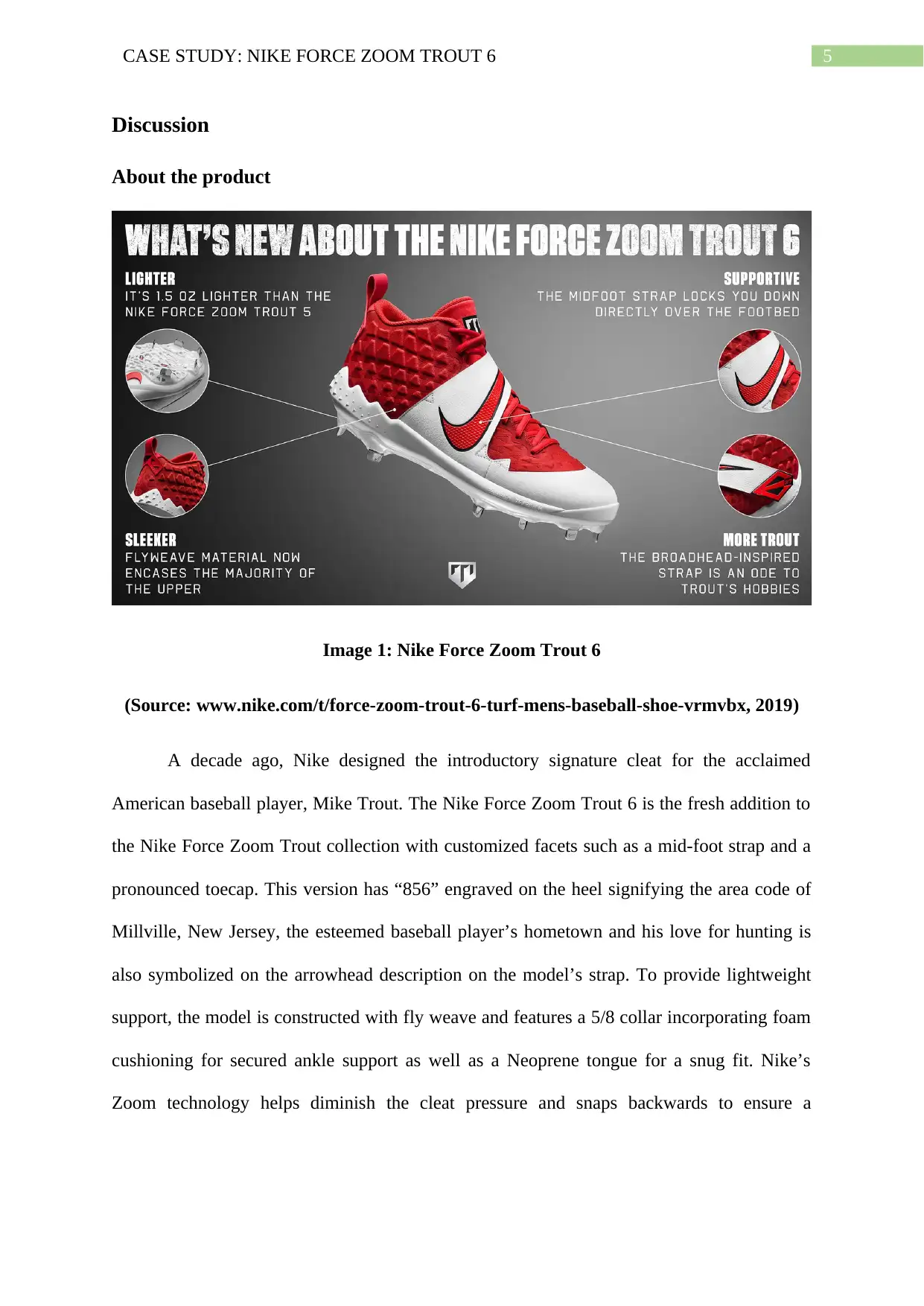
Image 1: Nike Force Zoom Trout 6
(Source: www.nike.com/t/force-zoom-trout-6-turf-mens-baseball-shoe-vrmvbx, 2019)
A decade ago, Nike designed the introductory signature cleat for the acclaimed
American baseball player, Mike Trout. The Nike Force Zoom Trout 6 is the fresh addition to
the Nike Force Zoom Trout collection with customized facets such as a mid-foot strap and a
pronounced toecap. This version has “856” engraved on the heel signifying the area code of
Millville, New Jersey, the esteemed baseball player’s hometown and his love for hunting is
also symbolized on the arrowhead description on the model’s strap. To provide lightweight
support, the model is constructed with fly weave and features a 5/8 collar incorporating foam
cushioning for secured ankle support as well as a Neoprene tongue for a snug fit. Nike’s
Zoom technology helps diminish the cleat pressure and snaps backwards to ensure a
Discussion
About the product
Image 1: Nike Force Zoom Trout 6
(Source: www.nike.com/t/force-zoom-trout-6-turf-mens-baseball-shoe-vrmvbx, 2019)
A decade ago, Nike designed the introductory signature cleat for the acclaimed
American baseball player, Mike Trout. The Nike Force Zoom Trout 6 is the fresh addition to
the Nike Force Zoom Trout collection with customized facets such as a mid-foot strap and a
pronounced toecap. This version has “856” engraved on the heel signifying the area code of
Millville, New Jersey, the esteemed baseball player’s hometown and his love for hunting is
also symbolized on the arrowhead description on the model’s strap. To provide lightweight
support, the model is constructed with fly weave and features a 5/8 collar incorporating foam
cushioning for secured ankle support as well as a Neoprene tongue for a snug fit. Nike’s
Zoom technology helps diminish the cleat pressure and snaps backwards to ensure a
⊘ This is a preview!⊘
Do you want full access?
Subscribe today to unlock all pages.
Trusted by 1+ million students worldwide
6CASE STUDY: NIKE FORCE ZOOM TROUT 6
responsive feel (www.nike.com/t/force-zoom-trout-6-turf-mens-baseball-shoe-vrmvbx,
2019).
The signature model is designed using the data from Mike Trout’s foot map and
imparts flexibility and stability with angular spikes for optimal traction. The model is
specifically designed for ace baseball players as well as aspiring amateurs, and is
systematized in providing ample comfort and durability. Accompanied with Nike’s brand
recognition the model comes in variable sizes and are appropriate for people of all genders
and ages. The price range varies in various countries in accordance to the economic state and
affairs of the country and is thus widely available through Nike outlets, online websites and
such other supermarkets. As always, Nike delivers its best through this model
(www.nike.com/t/force-zoom-trout-6-turf-mens-baseball-shoe-vrmvbx, 2019).
Connection with Nike’s existing portfolio
Nike being a globally acclaimed brand, manufactures merchandise ranges from shoes
for running, training, and such other athletic purposes (Mustamil, Chung & Ariff, 2014). The
company’s products are renowned for distinctly integrating its consumer demands. For
consistent profitability and growth, Nike diversifies its brand portfolio (refer appendix 2).
Wherein the new Nike Force Zoom Trout 6 gains a special acclaim (Voss & Mohan, 2016). It
incorporates upgraded facets from previous models such as the mid-foot strap is a
sophisticated version of the one used in the Nike Baseball Huarache cleats. Similarly, the
pronounced toecap is derived from the Nike Air Max Diamond Elite, which was also
incorporated in the Nike Force Zoom Trout 4. The purpose behind the creation of this edition
also resembles Nike’s distinguished trait of pertaining to the wishes of the celebrity, in cases
of signature collections. Mike Trout conveyed to Nike that his intention was to create a
design that kids shall be inspired to use, which is incorporated within the Nike Force Zoom
Trout 6, in the specialized cleats of the model. The product caters primarily to further the
responsive feel (www.nike.com/t/force-zoom-trout-6-turf-mens-baseball-shoe-vrmvbx,
2019).
The signature model is designed using the data from Mike Trout’s foot map and
imparts flexibility and stability with angular spikes for optimal traction. The model is
specifically designed for ace baseball players as well as aspiring amateurs, and is
systematized in providing ample comfort and durability. Accompanied with Nike’s brand
recognition the model comes in variable sizes and are appropriate for people of all genders
and ages. The price range varies in various countries in accordance to the economic state and
affairs of the country and is thus widely available through Nike outlets, online websites and
such other supermarkets. As always, Nike delivers its best through this model
(www.nike.com/t/force-zoom-trout-6-turf-mens-baseball-shoe-vrmvbx, 2019).
Connection with Nike’s existing portfolio
Nike being a globally acclaimed brand, manufactures merchandise ranges from shoes
for running, training, and such other athletic purposes (Mustamil, Chung & Ariff, 2014). The
company’s products are renowned for distinctly integrating its consumer demands. For
consistent profitability and growth, Nike diversifies its brand portfolio (refer appendix 2).
Wherein the new Nike Force Zoom Trout 6 gains a special acclaim (Voss & Mohan, 2016). It
incorporates upgraded facets from previous models such as the mid-foot strap is a
sophisticated version of the one used in the Nike Baseball Huarache cleats. Similarly, the
pronounced toecap is derived from the Nike Air Max Diamond Elite, which was also
incorporated in the Nike Force Zoom Trout 4. The purpose behind the creation of this edition
also resembles Nike’s distinguished trait of pertaining to the wishes of the celebrity, in cases
of signature collections. Mike Trout conveyed to Nike that his intention was to create a
design that kids shall be inspired to use, which is incorporated within the Nike Force Zoom
Trout 6, in the specialized cleats of the model. The product caters primarily to further the
Paraphrase This Document
Need a fresh take? Get an instant paraphrase of this document with our AI Paraphraser
7CASE STUDY: NIKE FORCE ZOOM TROUT 6
young fan base of Mike Trout. (Parker & Van Alstyne, 2017) Instilled with the brand values,
ideas and innovations, the Nike Force Zoom Trout 6 is a furthering of Nike’s aim of
delivering high quality sports gear for the aspiring sportsperson.
Scope and Market Size
Nike engages various market strategies for the widening of the market scope and size
of the corporation (Mahdi et al., 2015).The new Nike Force Zoom Trout 6, an upgrade from
the previous model, sports attractive and useful new attributes that are lucrative for the ace
baseball players. Since the product is ideal for players belonging to the game of baseball, the
model is widely acclaimed in countries like the USA, Canada, Japan and such others thereby
creating a broad base for marketing the product. The availability of the model on online
avenues and every other Nike websites and outlets suffices the needs of consumers in varied
countries. Mike Trout being the figure behind this signature collection also contributes to the
model’s fame and demand. Trout’s main concern or rather wish was to aspire the younger
generation to be confident with their sports gear, which is furthered by Nike.
Nike’s position in the market is commendable and generate the brand’s respectability
and huge consumer loyalty (refer appendix 3). The varied products sold by Nike ranges from
sports gear to shoes to apparel and other accessories designed for athletic and fitness purposes
for people of every age and gender (refer appendix 1). Nike sports a wide scope with its
products being promoted and used by celebrities of various fields. Along with Jordan and
Nike brands, Nike has wholly possessed subsidiary brands that includes Cole Haan (luxury
handbags, coats, shoes and accessories), Umbro (UK based soccer brand), Converse (lifestyle
and athletic footwear and apparel) and Nike Golf and so on. Nike indulges in famous
collaborations with renowned brands, for instance the Supreme x Nike Dunk Low Pro SB
(2002), Nike-Lab ACG 07 KMTR, Atmos, and such others defines Nike’s demand and regard
in the world market (www.nike.com/in/, 2019). Nike’s market expanse is widely established
young fan base of Mike Trout. (Parker & Van Alstyne, 2017) Instilled with the brand values,
ideas and innovations, the Nike Force Zoom Trout 6 is a furthering of Nike’s aim of
delivering high quality sports gear for the aspiring sportsperson.
Scope and Market Size
Nike engages various market strategies for the widening of the market scope and size
of the corporation (Mahdi et al., 2015).The new Nike Force Zoom Trout 6, an upgrade from
the previous model, sports attractive and useful new attributes that are lucrative for the ace
baseball players. Since the product is ideal for players belonging to the game of baseball, the
model is widely acclaimed in countries like the USA, Canada, Japan and such others thereby
creating a broad base for marketing the product. The availability of the model on online
avenues and every other Nike websites and outlets suffices the needs of consumers in varied
countries. Mike Trout being the figure behind this signature collection also contributes to the
model’s fame and demand. Trout’s main concern or rather wish was to aspire the younger
generation to be confident with their sports gear, which is furthered by Nike.
Nike’s position in the market is commendable and generate the brand’s respectability
and huge consumer loyalty (refer appendix 3). The varied products sold by Nike ranges from
sports gear to shoes to apparel and other accessories designed for athletic and fitness purposes
for people of every age and gender (refer appendix 1). Nike sports a wide scope with its
products being promoted and used by celebrities of various fields. Along with Jordan and
Nike brands, Nike has wholly possessed subsidiary brands that includes Cole Haan (luxury
handbags, coats, shoes and accessories), Umbro (UK based soccer brand), Converse (lifestyle
and athletic footwear and apparel) and Nike Golf and so on. Nike indulges in famous
collaborations with renowned brands, for instance the Supreme x Nike Dunk Low Pro SB
(2002), Nike-Lab ACG 07 KMTR, Atmos, and such others defines Nike’s demand and regard
in the world market (www.nike.com/in/, 2019). Nike’s market expanse is widely established
8CASE STUDY: NIKE FORCE ZOOM TROUT 6
by the huge amount of recognized endorsements with highly influential people, for instance,
Drake, Kanye West, Michael Jordan, Tiger Woods, Rafael Nadal, Rory Mcllory, LeBron
James, Roger Federer, and Cristiano Ronaldo and such others (McKelvey & Masteralexis,
2013).
Endorsements of these types help increase the brand portfolio, generate competitive
precedence in the market and propagate the publicity of the brand globally (Bergkvist,
Hjalmarson & Mägi, 2016). Apart from significantly contributing to Nike’s brand equity,
these policies enhance the reputation of the brand as well as honors the esteemed athletes.
Nike’s marketing strategies include breaking stereotypes in order to promote the brand as
well as spread humane messages to the world. The recent “Dream Crazier” ad under the “Just
Do It” campaign celebrates female athletes across history who are known for breaking
barriers. The all-female cast of the ad includes Serena Williams, Sarah Reinertsen as well as
Paralympian Caster Semenya and Tatyana McFadden, and celebrates their struggles leading
to their success. All these facets contribute to the enhancement of the market position of
Nike, expanding its consumer base.
Nike’s Plan for Expansion
Nike is a brand that has its outlets in almost every other country of the world. With its
expansion in over 160 countries, Nike progresses with the intention of bringing innovation
and inspiration for athletes around the world. The corporation utilizes psychographic
segmentation in order to present before its target consumers products that are more lucrative
in nature (Haider et al., 2019). With high brand equity, strong portfolio and varied
distribution channels, Nike has emerged in all markets related to sports gear with high
recognition and demand. Nike strategizes the demands of the customers and thereby
generates data for the expansion plans. In order to expand around the world successfully and
keeping in mind the profitability of the organization, Nike often invests in third world
by the huge amount of recognized endorsements with highly influential people, for instance,
Drake, Kanye West, Michael Jordan, Tiger Woods, Rafael Nadal, Rory Mcllory, LeBron
James, Roger Federer, and Cristiano Ronaldo and such others (McKelvey & Masteralexis,
2013).
Endorsements of these types help increase the brand portfolio, generate competitive
precedence in the market and propagate the publicity of the brand globally (Bergkvist,
Hjalmarson & Mägi, 2016). Apart from significantly contributing to Nike’s brand equity,
these policies enhance the reputation of the brand as well as honors the esteemed athletes.
Nike’s marketing strategies include breaking stereotypes in order to promote the brand as
well as spread humane messages to the world. The recent “Dream Crazier” ad under the “Just
Do It” campaign celebrates female athletes across history who are known for breaking
barriers. The all-female cast of the ad includes Serena Williams, Sarah Reinertsen as well as
Paralympian Caster Semenya and Tatyana McFadden, and celebrates their struggles leading
to their success. All these facets contribute to the enhancement of the market position of
Nike, expanding its consumer base.
Nike’s Plan for Expansion
Nike is a brand that has its outlets in almost every other country of the world. With its
expansion in over 160 countries, Nike progresses with the intention of bringing innovation
and inspiration for athletes around the world. The corporation utilizes psychographic
segmentation in order to present before its target consumers products that are more lucrative
in nature (Haider et al., 2019). With high brand equity, strong portfolio and varied
distribution channels, Nike has emerged in all markets related to sports gear with high
recognition and demand. Nike strategizes the demands of the customers and thereby
generates data for the expansion plans. In order to expand around the world successfully and
keeping in mind the profitability of the organization, Nike often invests in third world
⊘ This is a preview!⊘
Do you want full access?
Subscribe today to unlock all pages.
Trusted by 1+ million students worldwide
9CASE STUDY: NIKE FORCE ZOOM TROUT 6
countries. The reason behind such a strategy is the fact that labor cost in third world countries
are low as compared to the developed countries. The expansion in third world countries prove
to be beneficial for both the country as well as the corporation as the country gains
investments which revitalizes the economy of that concerned country, and it is beneficial for
the corporation as it attain higher yield at reduced rates of the factors used for productions of
its merchandise.
Along with its ongoing market operations, Nike is also planning further expansion in
Indonesia. Asian markets tend to have high demands for various MNC products due to the
high population rates in various Asian countries (Jomo, 2019). Being the biggest economy of
Southeast Asia, Indonesia is one the emanating market economies of the world. Nike’s
presence in Indonesia is limited, as viewed by the corporation, and thus the organization is
planning a further market penetration strategy to increase their output from the Indonesian
market. Nike’s expansion in Indonesia accompanies a huge investment along with securing
increased employment opportunities for the natives of the country (Hayat, 2014). Nike shall
also retrieve from Indonesia a range of labor at a lower cost than the labor cost of developed
countries. These attributes helps the growing economy of the country as foreign investments
provide funds for the development of the Indonesian infrastructure and employment structure.
This in turn also helps improve the gross domestic product and the per capita income of the
economy of Indonesia. Therefore, this intention of Nike is to penetrate further into the
economy of Indonesia benefits both the corporation and the country incorporating minor
adjustment factors.
Benefits and Upsides of the Product
Nike secures a major segment of the international market in the sale of several objects
related to sports. With a varied brand portfolio, Nike manufactures a wide range of products
including apparels, sports gear, accessories and ultimate comfort and efficient shoes for
countries. The reason behind such a strategy is the fact that labor cost in third world countries
are low as compared to the developed countries. The expansion in third world countries prove
to be beneficial for both the country as well as the corporation as the country gains
investments which revitalizes the economy of that concerned country, and it is beneficial for
the corporation as it attain higher yield at reduced rates of the factors used for productions of
its merchandise.
Along with its ongoing market operations, Nike is also planning further expansion in
Indonesia. Asian markets tend to have high demands for various MNC products due to the
high population rates in various Asian countries (Jomo, 2019). Being the biggest economy of
Southeast Asia, Indonesia is one the emanating market economies of the world. Nike’s
presence in Indonesia is limited, as viewed by the corporation, and thus the organization is
planning a further market penetration strategy to increase their output from the Indonesian
market. Nike’s expansion in Indonesia accompanies a huge investment along with securing
increased employment opportunities for the natives of the country (Hayat, 2014). Nike shall
also retrieve from Indonesia a range of labor at a lower cost than the labor cost of developed
countries. These attributes helps the growing economy of the country as foreign investments
provide funds for the development of the Indonesian infrastructure and employment structure.
This in turn also helps improve the gross domestic product and the per capita income of the
economy of Indonesia. Therefore, this intention of Nike is to penetrate further into the
economy of Indonesia benefits both the corporation and the country incorporating minor
adjustment factors.
Benefits and Upsides of the Product
Nike secures a major segment of the international market in the sale of several objects
related to sports. With a varied brand portfolio, Nike manufactures a wide range of products
including apparels, sports gear, accessories and ultimate comfort and efficient shoes for
Paraphrase This Document
Need a fresh take? Get an instant paraphrase of this document with our AI Paraphraser
10CASE STUDY: NIKE FORCE ZOOM TROUT 6
various athletic and fitness purposes. An ace in manufacturing various sports gears, Nike is
especially known for its genius in creation of shoes that are one of their kinds, truly unique.
Nike shoes are used and designed for several purposes namely running, basketball, cricket,
baseball, tennis and such other sports, however, the demand of the merchandise sold by Nike
does not only remain limited to athletes but also to people interested in the field of sports or
in fitness. The corporation bags the best attributes for each of its products, and it is due to the
high end products that Nike delivers, the brand’s consumer loyalty is high and secure. The
Nike Force Zoom Trout 6 promises supreme comfort due to the specialized and custom-made
sole of the model. The product boasts a lighter weight than its previous model and has
angular spikes, which provide the player with accurate grip. The flair is ideal for baseball
players and attracts consumers more because of its eye-catching design and stylized base and
structure of the model. In regards to the product’s durability, it can be ensured that the long-
standing reputation of the brand shall suffice.
Marketing Principles (The 4Ps)
Image 2: The 4Ps of Marketing
The 4Ps of
Marketing
Product
Pricing
Place
Promotion
various athletic and fitness purposes. An ace in manufacturing various sports gears, Nike is
especially known for its genius in creation of shoes that are one of their kinds, truly unique.
Nike shoes are used and designed for several purposes namely running, basketball, cricket,
baseball, tennis and such other sports, however, the demand of the merchandise sold by Nike
does not only remain limited to athletes but also to people interested in the field of sports or
in fitness. The corporation bags the best attributes for each of its products, and it is due to the
high end products that Nike delivers, the brand’s consumer loyalty is high and secure. The
Nike Force Zoom Trout 6 promises supreme comfort due to the specialized and custom-made
sole of the model. The product boasts a lighter weight than its previous model and has
angular spikes, which provide the player with accurate grip. The flair is ideal for baseball
players and attracts consumers more because of its eye-catching design and stylized base and
structure of the model. In regards to the product’s durability, it can be ensured that the long-
standing reputation of the brand shall suffice.
Marketing Principles (The 4Ps)
Image 2: The 4Ps of Marketing
The 4Ps of
Marketing
Product
Pricing
Place
Promotion
11CASE STUDY: NIKE FORCE ZOOM TROUT 6
Neil Borden publicized the idea of the 4Ps of marketing; the concept helps companies
to identify the physical barriers that prevents the spread of the product adoption in other
countries (Talpau, 2014). The 4Ps constitutes of the analyses of the Product, the Place of
distribution, the Promotional strategies and finally the Pricing strategies regarding the model
chosen. These facets determine the yield and growth of the model through which the
company can develop its motives and market plans. The marketing mix provided below
analyzes the 4Ps for the Nike Corporation to let the company compete efficiently and
robustly with such other companies that produce products of the similar sort (Brohi, 2016).
Product
This particular facet of market mix concerns about the product and states how the
product will influence the outputs of the corporation as well as how it can generate consumer
base (Khan, 2014). Nike Inc.’s development is largely based on the success of its research
teams that helps the company to invent and develop accordingly. Nike is a major producer of
shoes specifically; however, it has expanded to produce apparels and other sports gears to
attain higher gains. Applying its generic strategies and other intensive development schemes,
the corporation integrates advanced technologies in its products in order to cater to the high
standards of customer satisfaction and product efficiency. Nike has a vast range of shoe
selling catalogue incorporating shoes for tennis, cricket, baseball, and such other sports as
well as for running purposes under its brand names like Hurley, Air Jordan, Converse and so
on. The product chosen for this case study also is a shoe, the Nike Force Zoom Trout 6, that
features fly weave technique enhancing the lightweight of the model. The product also
incorporates specialized cleats to improve the traction of the wearer on soft surfaces. The
model is designed with softer soles that enhances comfort and reduces pressure on the
purchaser’s heels. Nike Force Zoom Trout 6 is well built and addresses sufficiently to the
targeted consumers.
Neil Borden publicized the idea of the 4Ps of marketing; the concept helps companies
to identify the physical barriers that prevents the spread of the product adoption in other
countries (Talpau, 2014). The 4Ps constitutes of the analyses of the Product, the Place of
distribution, the Promotional strategies and finally the Pricing strategies regarding the model
chosen. These facets determine the yield and growth of the model through which the
company can develop its motives and market plans. The marketing mix provided below
analyzes the 4Ps for the Nike Corporation to let the company compete efficiently and
robustly with such other companies that produce products of the similar sort (Brohi, 2016).
Product
This particular facet of market mix concerns about the product and states how the
product will influence the outputs of the corporation as well as how it can generate consumer
base (Khan, 2014). Nike Inc.’s development is largely based on the success of its research
teams that helps the company to invent and develop accordingly. Nike is a major producer of
shoes specifically; however, it has expanded to produce apparels and other sports gears to
attain higher gains. Applying its generic strategies and other intensive development schemes,
the corporation integrates advanced technologies in its products in order to cater to the high
standards of customer satisfaction and product efficiency. Nike has a vast range of shoe
selling catalogue incorporating shoes for tennis, cricket, baseball, and such other sports as
well as for running purposes under its brand names like Hurley, Air Jordan, Converse and so
on. The product chosen for this case study also is a shoe, the Nike Force Zoom Trout 6, that
features fly weave technique enhancing the lightweight of the model. The product also
incorporates specialized cleats to improve the traction of the wearer on soft surfaces. The
model is designed with softer soles that enhances comfort and reduces pressure on the
purchaser’s heels. Nike Force Zoom Trout 6 is well built and addresses sufficiently to the
targeted consumers.
⊘ This is a preview!⊘
Do you want full access?
Subscribe today to unlock all pages.
Trusted by 1+ million students worldwide

1 out of 23


Related Documents


Your All-in-One AI-Powered Toolkit for Academic Success.
+13062052269
info@desklib.com
Available 24*7 on WhatsApp / Email
![[object Object]](/_next/static/media/star-bottom.7253800d.svg)
Unlock your academic potential
Copyright © 2020–2026 A2Z Services. All Rights Reserved. Developed and managed by ZUCOL.