Nike's Management Decisions and Control: Performance Analysis
VerifiedAdded on 2023/06/13
|9
|2339
|313
Report
AI Summary
This report provides an organizational analysis of Nike, focusing on its objectives, strategies, organizational structure, and activities. It defines performance for Nike by considering factors such as quantity and quality of work, efficiency, and market share. The report justifies this definition by linking it to Nike's profitability goals and innovative strategies. It also includes a reflective section detailing the use of Grammarly and peer feedback to improve written communication. The analysis covers Nike's approach to sustainability, supply chain management, and product innovation, highlighting the company's commitment to performance standards and shareholder value.
RUNNING HEAD: Management decisions and control 0
Nike
Management decisions and control
Nike
Management decisions and control

Paraphrase This Document
Need a fresh take? Get an instant paraphrase of this document with our AI Paraphraser
Management decisions and control 1
Contents
Executive summary....................................................................................................................1
Introduction................................................................................................................................1
Organizational Analysis.............................................................................................................1
Objective.................................................................................................................................1
Strategy...................................................................................................................................1
Organizational Structure.........................................................................................................2
Activities.................................................................................................................................2
Defining performance................................................................................................................3
Justification of the definition of performance............................................................................4
Reflective...................................................................................................................................4
Supporting evidence...................................................................................................................5
References..................................................................................................................................6
Contents
Executive summary....................................................................................................................1
Introduction................................................................................................................................1
Organizational Analysis.............................................................................................................1
Objective.................................................................................................................................1
Strategy...................................................................................................................................1
Organizational Structure.........................................................................................................2
Activities.................................................................................................................................2
Defining performance................................................................................................................3
Justification of the definition of performance............................................................................4
Reflective...................................................................................................................................4
Supporting evidence...................................................................................................................5
References..................................................................................................................................6
Management decisions and control 2
Executive summary
Nike creates products and services for today’s athlete. It is the mission of company to bring
inspiration and innovation to every athlete. This report includes introduction and
organizational analysis of Nike. The organizational analysis further includes objective,
strategy, organizational structure and activities. The definition of performance is also
discussed. Finally the definition of performance is justified by referring to the organizational
analysis.
Introduction
Nike is an American multinational corporation which manufacture and sell footwear, apparel
and equipment. Nike is the world’s largest supplier of athletic shoemaker; was found in 1962
by Bill Bowerman and Phil Knight. In this report we will discuss about the management
accounting system of the world’s largest athletic shoemaker company named as Nike.
Accounting information systems and organisations are directly related to each other.
Management of accounting system means to provide the information which helps managers
to take good decisions and make good business strategies. It helps in developing reports for
internal use by managers for making good decisions. In this report we will also discuss about
the organizational analysis and performance strategies for success of the organisation. We
will analyze the institutional and organisation influences on management accounting systems
of Nike along with the professional perception regarding operations of management
accounting systems.
Organizational Analysis
Objective
Nike is for-profit organisation; its first objective is to make profit for their shareholders. Nike
is world’s largest manufacturing of athletic footwear, apparel and sports clothes; the company
has stated that their aim is to bring inspiration and innovation to every athlete in the world.
The organisation has various objectives and aims, which involves nobility of the universal
operation in field of designing the product and they aim to manufacture exclusive products.
Nike also aims to save environment like by using less water and by reducing waste from the
material they use.
Executive summary
Nike creates products and services for today’s athlete. It is the mission of company to bring
inspiration and innovation to every athlete. This report includes introduction and
organizational analysis of Nike. The organizational analysis further includes objective,
strategy, organizational structure and activities. The definition of performance is also
discussed. Finally the definition of performance is justified by referring to the organizational
analysis.
Introduction
Nike is an American multinational corporation which manufacture and sell footwear, apparel
and equipment. Nike is the world’s largest supplier of athletic shoemaker; was found in 1962
by Bill Bowerman and Phil Knight. In this report we will discuss about the management
accounting system of the world’s largest athletic shoemaker company named as Nike.
Accounting information systems and organisations are directly related to each other.
Management of accounting system means to provide the information which helps managers
to take good decisions and make good business strategies. It helps in developing reports for
internal use by managers for making good decisions. In this report we will also discuss about
the organizational analysis and performance strategies for success of the organisation. We
will analyze the institutional and organisation influences on management accounting systems
of Nike along with the professional perception regarding operations of management
accounting systems.
Organizational Analysis
Objective
Nike is for-profit organisation; its first objective is to make profit for their shareholders. Nike
is world’s largest manufacturing of athletic footwear, apparel and sports clothes; the company
has stated that their aim is to bring inspiration and innovation to every athlete in the world.
The organisation has various objectives and aims, which involves nobility of the universal
operation in field of designing the product and they aim to manufacture exclusive products.
Nike also aims to save environment like by using less water and by reducing waste from the
material they use.
⊘ This is a preview!⊘
Do you want full access?
Subscribe today to unlock all pages.

Trusted by 1+ million students worldwide
Management decisions and control 3
Strategy
Nike adapted innovative strategies for the benefit of the company. The brand and logo have
been established through huge marketing investment. The company adapted the strategy of
selling the emotional benefits of their product by utilizing emotional branding. Nike focuses
on the quality of the product and manufacture products with the objective of helping athletes
to perform better (Bouck, 2017). The company always try to stay ahead in terms of
technology and marketing. Nike minimizes production costs to maximize profitability; this
strategy helped the company in regaining competitiveness. The company adapts promotion
strategies through sponsorship agreements with celebrities and professional athletes. Nike
manages the operating costs of shareholders in proportion to growth rates to increase the
returns of shareholders. The company made strategy to deliver premium products growing in
geographic region with the motive of achieving growth (Burgelman, 2017). The company
concentrate on digital marketing.
Organizational Structure
The organizational structure of Nike is very similar to divisional structure. Divisional
structure includes products and projects which are grouped internally. Nike split their
divisions to each sport such as for soccer, golf, and basketball. Divisional structure is
beneficial as it helps the organisation to perform effectively and efficiently. Nike’s business
demands designing and developing its products for customers. Organisation structure is
expensive in terms of accounting and finance components for each sport (Fullerton, Kennedy
& Widener, 2014). The company uses management accounting systems for the relevant cost
analysis. Nike believes that their business becomes more valuable to the organisation than it
costs. Nike focuses on the specifications of the product for different sports. Nike aspires to
stay contentious in all regions where company has its business, which spreads across the
world.
Activities
Integrating sustainability with supply chain management:
The company’s approach to supply chain management has elaborated changes at both
company level and with it’s suppliers. The company has changed it’s organizational
activities to better integrate with suppliers (Distelhorst, Hainmueller & Locke, 2016). Nike
uses matrix organizational structure in which managers’ report to various departments. The
company develops activities and plans which provides details of multidisciplinary
Strategy
Nike adapted innovative strategies for the benefit of the company. The brand and logo have
been established through huge marketing investment. The company adapted the strategy of
selling the emotional benefits of their product by utilizing emotional branding. Nike focuses
on the quality of the product and manufacture products with the objective of helping athletes
to perform better (Bouck, 2017). The company always try to stay ahead in terms of
technology and marketing. Nike minimizes production costs to maximize profitability; this
strategy helped the company in regaining competitiveness. The company adapts promotion
strategies through sponsorship agreements with celebrities and professional athletes. Nike
manages the operating costs of shareholders in proportion to growth rates to increase the
returns of shareholders. The company made strategy to deliver premium products growing in
geographic region with the motive of achieving growth (Burgelman, 2017). The company
concentrate on digital marketing.
Organizational Structure
The organizational structure of Nike is very similar to divisional structure. Divisional
structure includes products and projects which are grouped internally. Nike split their
divisions to each sport such as for soccer, golf, and basketball. Divisional structure is
beneficial as it helps the organisation to perform effectively and efficiently. Nike’s business
demands designing and developing its products for customers. Organisation structure is
expensive in terms of accounting and finance components for each sport (Fullerton, Kennedy
& Widener, 2014). The company uses management accounting systems for the relevant cost
analysis. Nike believes that their business becomes more valuable to the organisation than it
costs. Nike focuses on the specifications of the product for different sports. Nike aspires to
stay contentious in all regions where company has its business, which spreads across the
world.
Activities
Integrating sustainability with supply chain management:
The company’s approach to supply chain management has elaborated changes at both
company level and with it’s suppliers. The company has changed it’s organizational
activities to better integrate with suppliers (Distelhorst, Hainmueller & Locke, 2016). Nike
uses matrix organizational structure in which managers’ report to various departments. The
company develops activities and plans which provides details of multidisciplinary
Paraphrase This Document
Need a fresh take? Get an instant paraphrase of this document with our AI Paraphraser
Management decisions and control 4
responsibilities. The internal scorecards are also used by the company to report activities
towards achieving goals.
Penalties and Incentives”: The manufacturing Index
Nike implemented Manufacturing Index model in 2011 which promotes the importance of
sustainable manufacturing practices. It provides framework for measuring performance
across supply chain, brand and products. It is used to monitor measure and reward suppliers
on the basis of their performance. Quality, delivery and sustainable performance are the
measures to monitor employees (Epstein, 2014). The sustainability dimension of
manufacturing index includes environmental, social, health and safety issues. The employees
can be penalised for non-compliance of their code of conduct.
Innovation in product and process design:
Nike has concentrated on collaborative product and process design innovations to focus on
environmental sustainability. The company has targeted innovations which can prevent
environmental issues and create value for customers. After successfully completing product
design innovations in 2010, the company further made shirts from recycled plastic bottles.
The Flynit technology has been used by the company to deliver light weight shoes for
runners. Now the company is focused on one of the biggest challenges that are sustainability
of product, who makes it and how it is made (Wijethilake, Munir & Appuhami, 2017).
Defining performance
Nike is world’s largest athletic footwear and apparel company. Management accounting has
been used for the decision making and performance control. The factors given below justify
the performance of company:
Quantity of work: Nike sells products in 170 countries and is the largest supplier of shoes and
apparels. The company is traded on the New York Stock Exchange. Nike has approximately
74,000 employees and operates 1000 retail stores worldwide. Nike generated revenue over 32
billion in 2016 (The Statistics Portal, 2017).
Quality of work: Nike has redesigned supply chain of company to compliance with standard
and code of conduct. The company also transforms manufacturing at every level to improve
quality of work. It focuses on green and equitable workplace for the productive and profitable
business model (Amran, Lee & Devi, 2014).
Use of efficiency:
responsibilities. The internal scorecards are also used by the company to report activities
towards achieving goals.
Penalties and Incentives”: The manufacturing Index
Nike implemented Manufacturing Index model in 2011 which promotes the importance of
sustainable manufacturing practices. It provides framework for measuring performance
across supply chain, brand and products. It is used to monitor measure and reward suppliers
on the basis of their performance. Quality, delivery and sustainable performance are the
measures to monitor employees (Epstein, 2014). The sustainability dimension of
manufacturing index includes environmental, social, health and safety issues. The employees
can be penalised for non-compliance of their code of conduct.
Innovation in product and process design:
Nike has concentrated on collaborative product and process design innovations to focus on
environmental sustainability. The company has targeted innovations which can prevent
environmental issues and create value for customers. After successfully completing product
design innovations in 2010, the company further made shirts from recycled plastic bottles.
The Flynit technology has been used by the company to deliver light weight shoes for
runners. Now the company is focused on one of the biggest challenges that are sustainability
of product, who makes it and how it is made (Wijethilake, Munir & Appuhami, 2017).
Defining performance
Nike is world’s largest athletic footwear and apparel company. Management accounting has
been used for the decision making and performance control. The factors given below justify
the performance of company:
Quantity of work: Nike sells products in 170 countries and is the largest supplier of shoes and
apparels. The company is traded on the New York Stock Exchange. Nike has approximately
74,000 employees and operates 1000 retail stores worldwide. Nike generated revenue over 32
billion in 2016 (The Statistics Portal, 2017).
Quality of work: Nike has redesigned supply chain of company to compliance with standard
and code of conduct. The company also transforms manufacturing at every level to improve
quality of work. It focuses on green and equitable workplace for the productive and profitable
business model (Amran, Lee & Devi, 2014).
Use of efficiency:
Management decisions and control 5
Nike examines efficiency by comparing performance with other competitors. It uses
standards such as return on investment, earnings per share, sales growth and net profit.
Market share:
Nike serves millions of consumers with thousands of products. The market share of Nike is
continuously increasing. In 2017 the global revenue of company amounted to 34.35 billion
dollars (The Statistics Portal, 2017).
The company relies on research committees, trainers, coaches, podiatrists, athlete advisory
boards and other experts for the consultation, reviewing designs, material and ideas for
product improvement. The talent and ethnic culture of company defines performance of
company and helps in achieving success.
Justification of the definition of performance
Performance is a mean of getting better performance from the employees and company by
managing performance within the agreed framework of planned activities and standards. The
performance can be achieved in short term and long term and increases the profitability of
company. It is an understanding about what is to be achieved and how it is to be achieved.
According to Brumbrach, performance is an approach to manage and develop people so that
profitability of company can be increased. This definition is appropriate for Nike. It is the
objective of the company to make profits for it’s shareholders (Agu, Nweze & Enekwe,
2016). The innovative strategies adopted by company focuses on minimising production cost
to maximise profitability. The designing and development of products by company helps to
meet demand of customers. The activities such as integrating sustainability, penalties and
incentives and innovations in product and process design are carried on to performance
standards.
Reflective
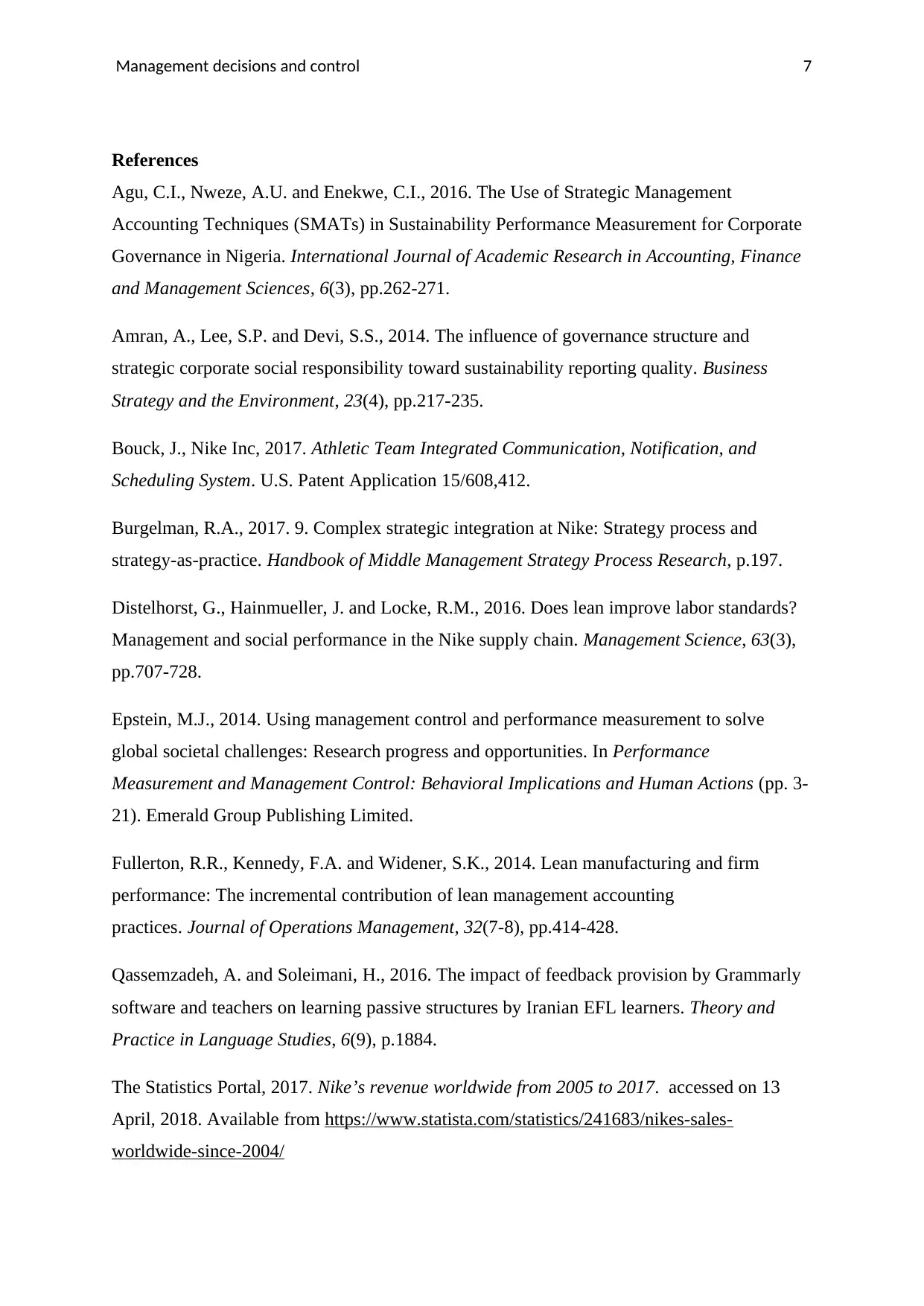
I use grammarly writing analytical tool to improve my written communication in this report.
It is quick and easy to use. A grammar checker helped to check my grammar. I use
grammarly by running documents on Microsoft word. I checked my written communication
on grammarly by creating account on Grammarly.com. For creating account I navigated to
http://www.grammarly.com and complete the registration process. Soon after completing the
registration process, I created an account. After logging in I copy the text on the window of
Nike examines efficiency by comparing performance with other competitors. It uses
standards such as return on investment, earnings per share, sales growth and net profit.
Market share:
Nike serves millions of consumers with thousands of products. The market share of Nike is
continuously increasing. In 2017 the global revenue of company amounted to 34.35 billion
dollars (The Statistics Portal, 2017).
The company relies on research committees, trainers, coaches, podiatrists, athlete advisory
boards and other experts for the consultation, reviewing designs, material and ideas for
product improvement. The talent and ethnic culture of company defines performance of
company and helps in achieving success.
Justification of the definition of performance
Performance is a mean of getting better performance from the employees and company by
managing performance within the agreed framework of planned activities and standards. The
performance can be achieved in short term and long term and increases the profitability of
company. It is an understanding about what is to be achieved and how it is to be achieved.
According to Brumbrach, performance is an approach to manage and develop people so that
profitability of company can be increased. This definition is appropriate for Nike. It is the
objective of the company to make profits for it’s shareholders (Agu, Nweze & Enekwe,
2016). The innovative strategies adopted by company focuses on minimising production cost
to maximise profitability. The designing and development of products by company helps to
meet demand of customers. The activities such as integrating sustainability, penalties and
incentives and innovations in product and process design are carried on to performance
standards.
Reflective
I use grammarly writing analytical tool to improve my written communication in this report.
It is quick and easy to use. A grammar checker helped to check my grammar. I use
grammarly by running documents on Microsoft word. I checked my written communication
on grammarly by creating account on Grammarly.com. For creating account I navigated to
http://www.grammarly.com and complete the registration process. Soon after completing the
registration process, I created an account. After logging in I copy the text on the window of
⊘ This is a preview!⊘
Do you want full access?
Subscribe today to unlock all pages.
Trusted by 1+ million students worldwide
Management decisions and control 6
grammarly.com and click the start review button. It helped me to review writing and checked
against grammar rules. Grammarly helped to check my potential improvements for writing
(Qassemzadeh & Soleimani, 2016). The tool also provides suggestion for the improvement
and changes required to make writing more grammatically correct. Grammarly benefited me
by checking writing against grammar rules. It provided correct structured sentences to
improve writing. It helps in vocabulary improvement and unlimited reviews for writing.
Grammarly also avoided plagiarism by checking my work against published content. It
provides the instant report and how it can be improved. It also helped to learn rules of
grammar and ensured improved writing.
Peer feedback assisted me to produce a substantial amount of writing. The feedback was used
to redraft report. The response of readers helped to strengthen my writing and provided
opportunity to learn from them. The peer feedback was given to me in the form of
corrections, suggestions and ideas to make improvement. It facilitated in building and
increasing confidence in writing. It is surely going to help me in preparing for future. It
allowed interacting with peers as it helps in learning material more effectively. The feedback
reduced my writing anxiety and improved quality of learning (Van Popta, et. al. 2017). It was
supportive in awaking grammar mistakes. It increased my motivation and confidence in
learning.
Supporting evidence
grammarly.com and click the start review button. It helped me to review writing and checked
against grammar rules. Grammarly helped to check my potential improvements for writing
(Qassemzadeh & Soleimani, 2016). The tool also provides suggestion for the improvement
and changes required to make writing more grammatically correct. Grammarly benefited me
by checking writing against grammar rules. It provided correct structured sentences to
improve writing. It helps in vocabulary improvement and unlimited reviews for writing.
Grammarly also avoided plagiarism by checking my work against published content. It
provides the instant report and how it can be improved. It also helped to learn rules of
grammar and ensured improved writing.
Peer feedback assisted me to produce a substantial amount of writing. The feedback was used
to redraft report. The response of readers helped to strengthen my writing and provided
opportunity to learn from them. The peer feedback was given to me in the form of
corrections, suggestions and ideas to make improvement. It facilitated in building and
increasing confidence in writing. It is surely going to help me in preparing for future. It
allowed interacting with peers as it helps in learning material more effectively. The feedback
reduced my writing anxiety and improved quality of learning (Van Popta, et. al. 2017). It was
supportive in awaking grammar mistakes. It increased my motivation and confidence in
learning.
Supporting evidence
Paraphrase This Document
Need a fresh take? Get an instant paraphrase of this document with our AI Paraphraser
Management decisions and control 7
References
Agu, C.I., Nweze, A.U. and Enekwe, C.I., 2016. The Use of Strategic Management
Accounting Techniques (SMATs) in Sustainability Performance Measurement for Corporate
Governance in Nigeria. International Journal of Academic Research in Accounting, Finance
and Management Sciences, 6(3), pp.262-271.
Amran, A., Lee, S.P. and Devi, S.S., 2014. The influence of governance structure and
strategic corporate social responsibility toward sustainability reporting quality. Business
Strategy and the Environment, 23(4), pp.217-235.
Bouck, J., Nike Inc, 2017. Athletic Team Integrated Communication, Notification, and
Scheduling System. U.S. Patent Application 15/608,412.
Burgelman, R.A., 2017. 9. Complex strategic integration at Nike: Strategy process and
strategy-as-practice. Handbook of Middle Management Strategy Process Research, p.197.
Distelhorst, G., Hainmueller, J. and Locke, R.M., 2016. Does lean improve labor standards?
Management and social performance in the Nike supply chain. Management Science, 63(3),
pp.707-728.
Epstein, M.J., 2014. Using management control and performance measurement to solve
global societal challenges: Research progress and opportunities. In Performance
Measurement and Management Control: Behavioral Implications and Human Actions (pp. 3-
21). Emerald Group Publishing Limited.
Fullerton, R.R., Kennedy, F.A. and Widener, S.K., 2014. Lean manufacturing and firm
performance: The incremental contribution of lean management accounting
practices. Journal of Operations Management, 32(7-8), pp.414-428.
Qassemzadeh, A. and Soleimani, H., 2016. The impact of feedback provision by Grammarly
software and teachers on learning passive structures by Iranian EFL learners. Theory and
Practice in Language Studies, 6(9), p.1884.
The Statistics Portal, 2017. Nike’s revenue worldwide from 2005 to 2017. accessed on 13
April, 2018. Available from https://www.statista.com/statistics/241683/nikes-sales-
worldwide-since-2004/
References
Agu, C.I., Nweze, A.U. and Enekwe, C.I., 2016. The Use of Strategic Management
Accounting Techniques (SMATs) in Sustainability Performance Measurement for Corporate
Governance in Nigeria. International Journal of Academic Research in Accounting, Finance
and Management Sciences, 6(3), pp.262-271.
Amran, A., Lee, S.P. and Devi, S.S., 2014. The influence of governance structure and
strategic corporate social responsibility toward sustainability reporting quality. Business
Strategy and the Environment, 23(4), pp.217-235.
Bouck, J., Nike Inc, 2017. Athletic Team Integrated Communication, Notification, and
Scheduling System. U.S. Patent Application 15/608,412.
Burgelman, R.A., 2017. 9. Complex strategic integration at Nike: Strategy process and
strategy-as-practice. Handbook of Middle Management Strategy Process Research, p.197.
Distelhorst, G., Hainmueller, J. and Locke, R.M., 2016. Does lean improve labor standards?
Management and social performance in the Nike supply chain. Management Science, 63(3),
pp.707-728.
Epstein, M.J., 2014. Using management control and performance measurement to solve
global societal challenges: Research progress and opportunities. In Performance
Measurement and Management Control: Behavioral Implications and Human Actions (pp. 3-
21). Emerald Group Publishing Limited.
Fullerton, R.R., Kennedy, F.A. and Widener, S.K., 2014. Lean manufacturing and firm
performance: The incremental contribution of lean management accounting
practices. Journal of Operations Management, 32(7-8), pp.414-428.
Qassemzadeh, A. and Soleimani, H., 2016. The impact of feedback provision by Grammarly
software and teachers on learning passive structures by Iranian EFL learners. Theory and
Practice in Language Studies, 6(9), p.1884.
The Statistics Portal, 2017. Nike’s revenue worldwide from 2005 to 2017. accessed on 13
April, 2018. Available from https://www.statista.com/statistics/241683/nikes-sales-
worldwide-since-2004/
Management decisions and control 8
The Statistics Portal, 2017. Number of employees of Nike worldwide from 2009 to 2017*.
Accessed on 13 April, 2018. available from
https://www.statista.com/statistics/243199/number-of-employees-of-nike-worldwide/
Van Popta, E., Kral, M., Camp, G., Martens, R.L. and Simons, P.R.J., 2017. Exploring the
value of peer feedback in online learning for the provider. Educational Research Review, 20,
pp.24-34.
Wijethilake, C., Munir, R. and Appuhami, R., 2017. Strategic responses to institutional
pressures for sustainability: The role of management control systems. Accounting, Auditing &
Accountability Journal, 30(8), pp.1677-1710.
The Statistics Portal, 2017. Number of employees of Nike worldwide from 2009 to 2017*.
Accessed on 13 April, 2018. available from
https://www.statista.com/statistics/243199/number-of-employees-of-nike-worldwide/
Van Popta, E., Kral, M., Camp, G., Martens, R.L. and Simons, P.R.J., 2017. Exploring the
value of peer feedback in online learning for the provider. Educational Research Review, 20,
pp.24-34.
Wijethilake, C., Munir, R. and Appuhami, R., 2017. Strategic responses to institutional
pressures for sustainability: The role of management control systems. Accounting, Auditing &
Accountability Journal, 30(8), pp.1677-1710.
⊘ This is a preview!⊘
Do you want full access?
Subscribe today to unlock all pages.
Trusted by 1+ million students worldwide

1 out of 9


Related Documents


Your All-in-One AI-Powered Toolkit for Academic Success.
+13062052269
info@desklib.com
Available 24*7 on WhatsApp / Email
![[object Object]](/_next/static/media/star-bottom.7253800d.svg)
Unlock your academic potential
Copyright © 2020–2026 A2Z Services. All Rights Reserved. Developed and managed by ZUCOL.