Marketing Issues: Analysis of Nokia's Strategic Failures

Verified

Added on  2019/09/30

|5
|937
|178
Report
AI Summary
This report provides a comprehensive analysis of Nokia's marketing issues, exploring the factors that contributed to its decline in the mobile phone industry. It identifies key problems such as a flawed value proposition, inconsistent messaging, lack of support for middle management, failure to meet customer needs, and reluctance to collaborate with other companies. The report presents findings on these issues and provides marketing insights, including the potential benefits of focusing on rural areas, leveraging R&D, and fostering better management support. A research hypothesis is proposed, suggesting that increased promotional activities in rural areas can improve marketing strategy, and the importance of R&D in company sustainability is highlighted. The report concludes by discussing the additional data needed to test the hypothesis and improve marketing strategies.

Document Page
ASSIGNMENT
tabler-icon-diamond-filled.svg

Paraphrase This Document

Need a fresh take? Get an instant paraphrase of this document with our AI Paraphraser
Document Page
1
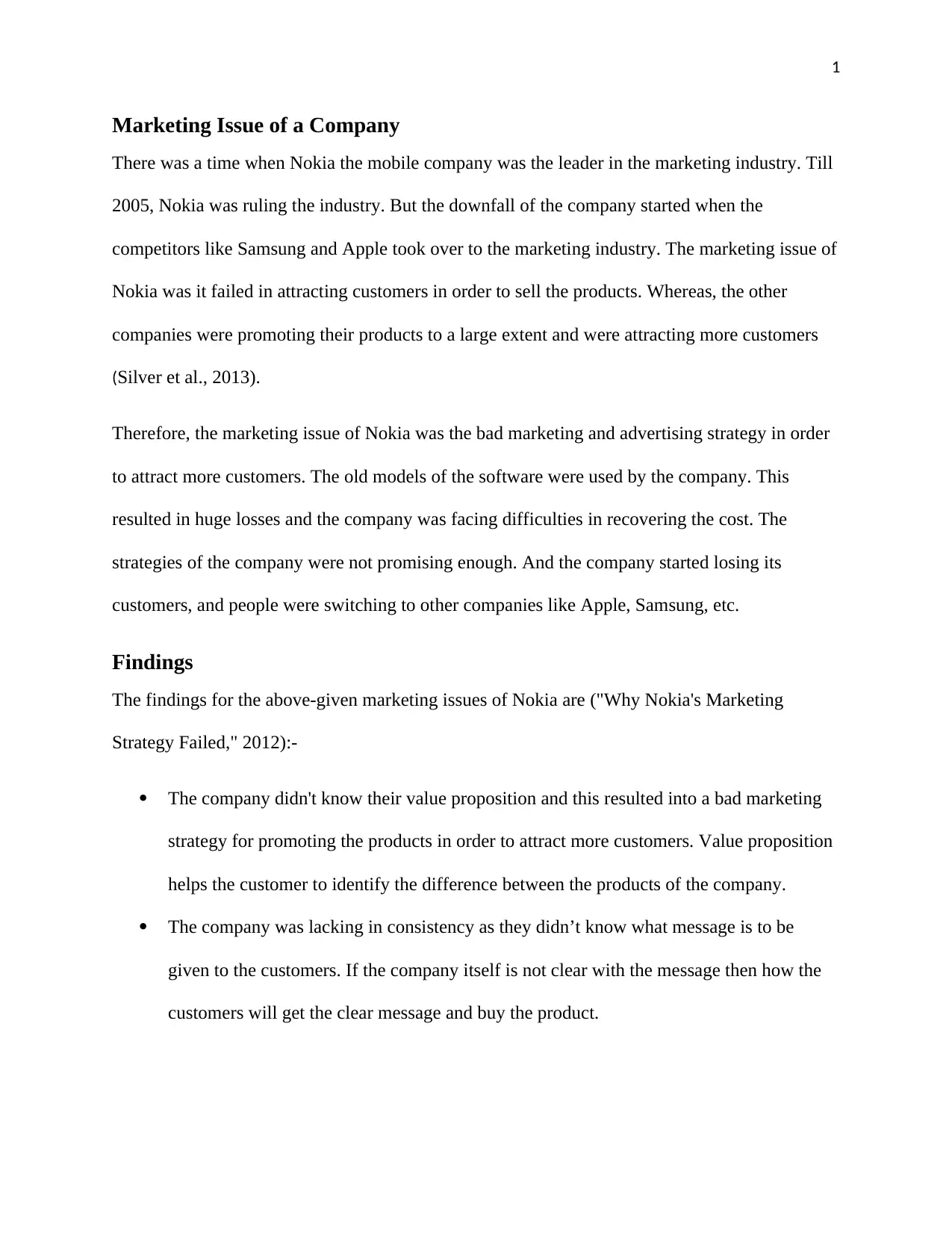
Marketing Issue of a Company
There was a time when Nokia the mobile company was the leader in the marketing industry. Till
2005, Nokia was ruling the industry. But the downfall of the company started when the
competitors like Samsung and Apple took over to the marketing industry. The marketing issue of
Nokia was it failed in attracting customers in order to sell the products. Whereas, the other
companies were promoting their products to a large extent and were attracting more customers
(Silver et al., 2013).
Therefore, the marketing issue of Nokia was the bad marketing and advertising strategy in order
to attract more customers. The old models of the software were used by the company. This
resulted in huge losses and the company was facing difficulties in recovering the cost. The
strategies of the company were not promising enough. And the company started losing its
customers, and people were switching to other companies like Apple, Samsung, etc.
Findings
The findings for the above-given marketing issues of Nokia are ("Why Nokia's Marketing
Strategy Failed," 2012):-
The company didn't know their value proposition and this resulted into a bad marketing
strategy for promoting the products in order to attract more customers. Value proposition
helps the customer to identify the difference between the products of the company.
The company was lacking in consistency as they didn’t know what message is to be
given to the customers. If the company itself is not clear with the message then how the
customers will get the clear message and buy the product.
Document Page
2
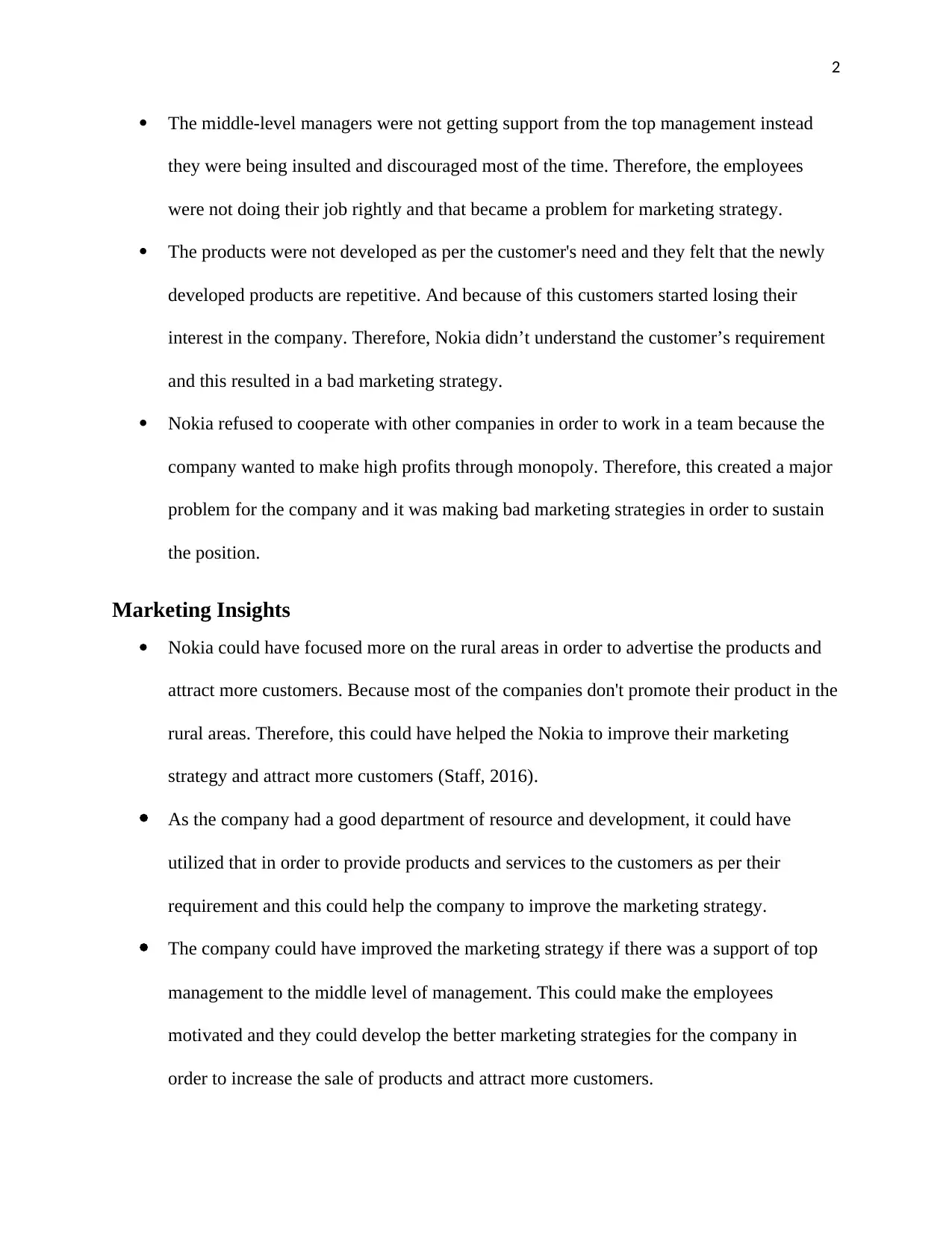
The middle-level managers were not getting support from the top management instead
they were being insulted and discouraged most of the time. Therefore, the employees
were not doing their job rightly and that became a problem for marketing strategy.
The products were not developed as per the customer's need and they felt that the newly
developed products are repetitive. And because of this customers started losing their
interest in the company. Therefore, Nokia didn’t understand the customer’s requirement
and this resulted in a bad marketing strategy.
Nokia refused to cooperate with other companies in order to work in a team because the
company wanted to make high profits through monopoly. Therefore, this created a major
problem for the company and it was making bad marketing strategies in order to sustain
the position.
Marketing Insights
Nokia could have focused more on the rural areas in order to advertise the products and
attract more customers. Because most of the companies don't promote their product in the
rural areas. Therefore, this could have helped the Nokia to improve their marketing
strategy and attract more customers (Staff, 2016).
As the company had a good department of resource and development, it could have
utilized that in order to provide products and services to the customers as per their
requirement and this could help the company to improve the marketing strategy.
The company could have improved the marketing strategy if there was a support of top
management to the middle level of management. This could make the employees
motivated and they could develop the better marketing strategies for the company in
order to increase the sale of products and attract more customers.
Document Page
3
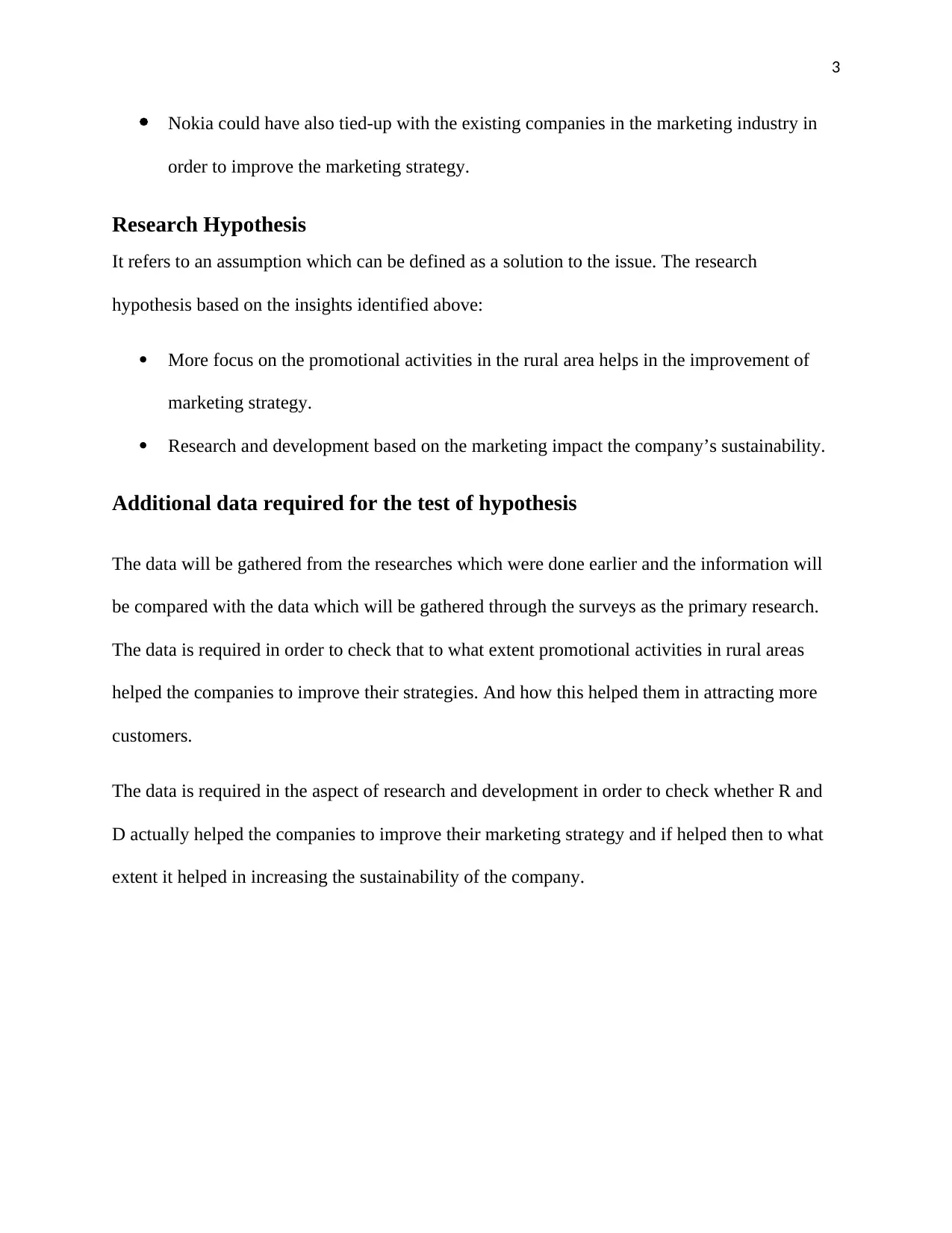
Nokia could have also tied-up with the existing companies in the marketing industry in
order to improve the marketing strategy.
Research Hypothesis
It refers to an assumption which can be defined as a solution to the issue. The research
hypothesis based on the insights identified above:
More focus on the promotional activities in the rural area helps in the improvement of
marketing strategy.
Research and development based on the marketing impact the company’s sustainability.
Additional data required for the test of hypothesis
The data will be gathered from the researches which were done earlier and the information will
be compared with the data which will be gathered through the surveys as the primary research.
The data is required in order to check that to what extent promotional activities in rural areas
helped the companies to improve their strategies. And how this helped them in attracting more
customers.
The data is required in the aspect of research and development in order to check whether R and
D actually helped the companies to improve their marketing strategy and if helped then to what
extent it helped in increasing the sustainability of the company.
tabler-icon-diamond-filled.svg

Paraphrase This Document

Need a fresh take? Get an instant paraphrase of this document with our AI Paraphraser
Document Page
4
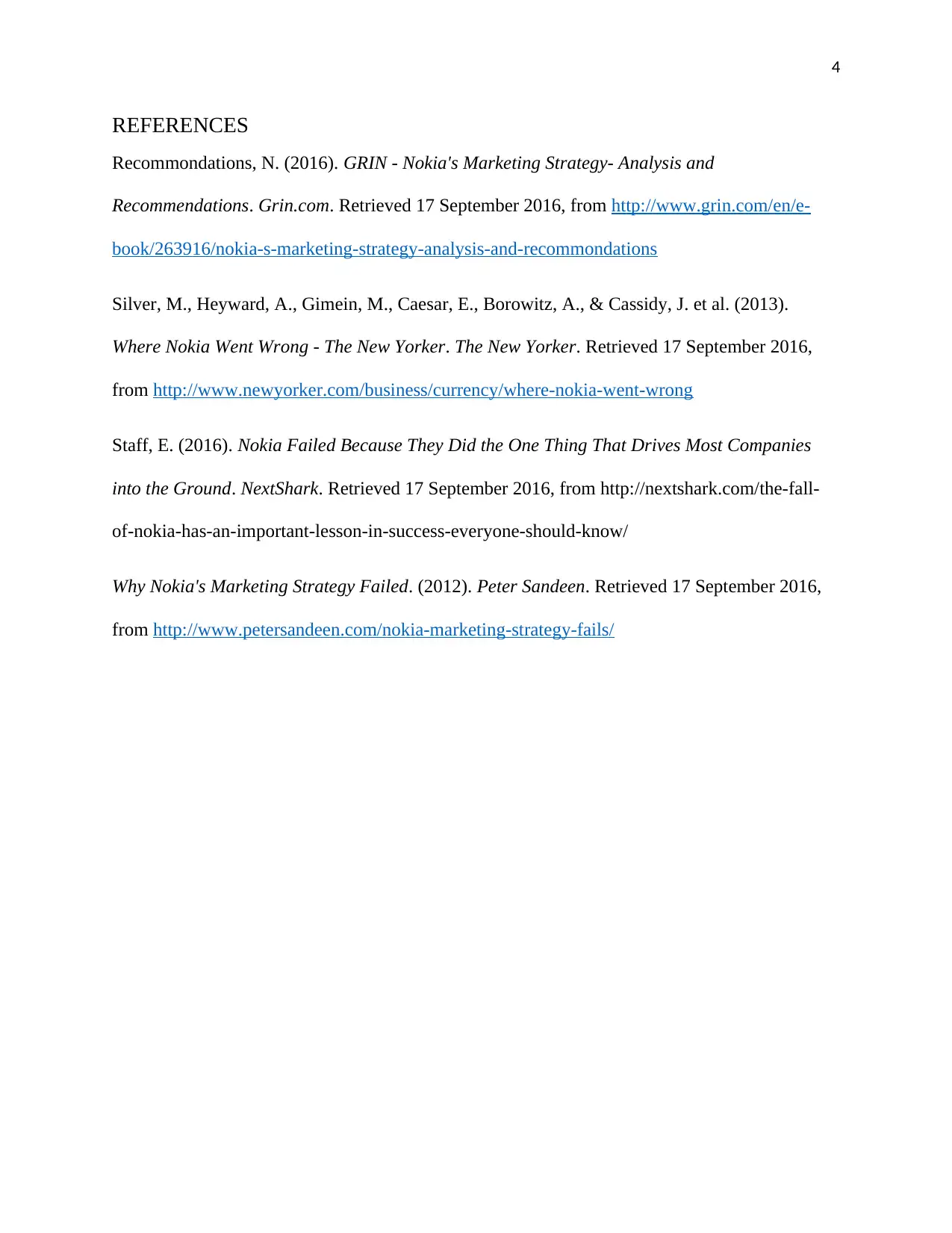
REFERENCES
Recommondations, N. (2016). GRIN - Nokia's Marketing Strategy- Analysis and
Recommendations. Grin.com. Retrieved 17 September 2016, from http://www.grin.com/en/e-
book/263916/nokia-s-marketing-strategy-analysis-and-recommondations
Silver, M., Heyward, A., Gimein, M., Caesar, E., Borowitz, A., & Cassidy, J. et al. (2013).
Where Nokia Went Wrong - The New Yorker. The New Yorker. Retrieved 17 September 2016,
from http://www.newyorker.com/business/currency/where-nokia-went-wrong
Staff, E. (2016). Nokia Failed Because They Did the One Thing That Drives Most Companies
into the Ground. NextShark. Retrieved 17 September 2016, from http://nextshark.com/the-fall-
of-nokia-has-an-important-lesson-in-success-everyone-should-know/
Why Nokia's Marketing Strategy Failed. (2012). Peter Sandeen. Retrieved 17 September 2016,
from http://www.petersandeen.com/nokia-marketing-strategy-fails/
chevron_up_icon
1 out of 5
circle_padding
hide_on_mobile
zoom_out_icon
[object Object]