Business Strategy and Consumer Behavior: Nokia vs Samsung Analysis
VerifiedAdded on 2021/02/20
|7
|1104
|406
Report
AI Summary
This report offers a comprehensive comparison of Nokia and Samsung's business strategies and consumer behavior. It begins by contrasting their visions, missions, and strategic approaches, highlighting the distinct interrelationships between the two companies. The report then identifies key stakeholders for both companies, examining how each manages and engages with them. A SWOT analysis is provided specifically for Nokia, evaluating its strengths, weaknesses, opportunities, and threats. Furthermore, the report explores Porter's Generic Strategy adapted by Nokia and details Nokia's growth strategies, including research and development initiatives and key priority areas. The analysis draws upon multiple sources to provide a well-rounded and insightful view of the two companies' strategic positions and market behaviors.

Paraphrase This Document
Need a fresh take? Get an instant paraphrase of this document with our AI Paraphraser

Business Strategy &
Consumer Behavior
Consumer Behavior

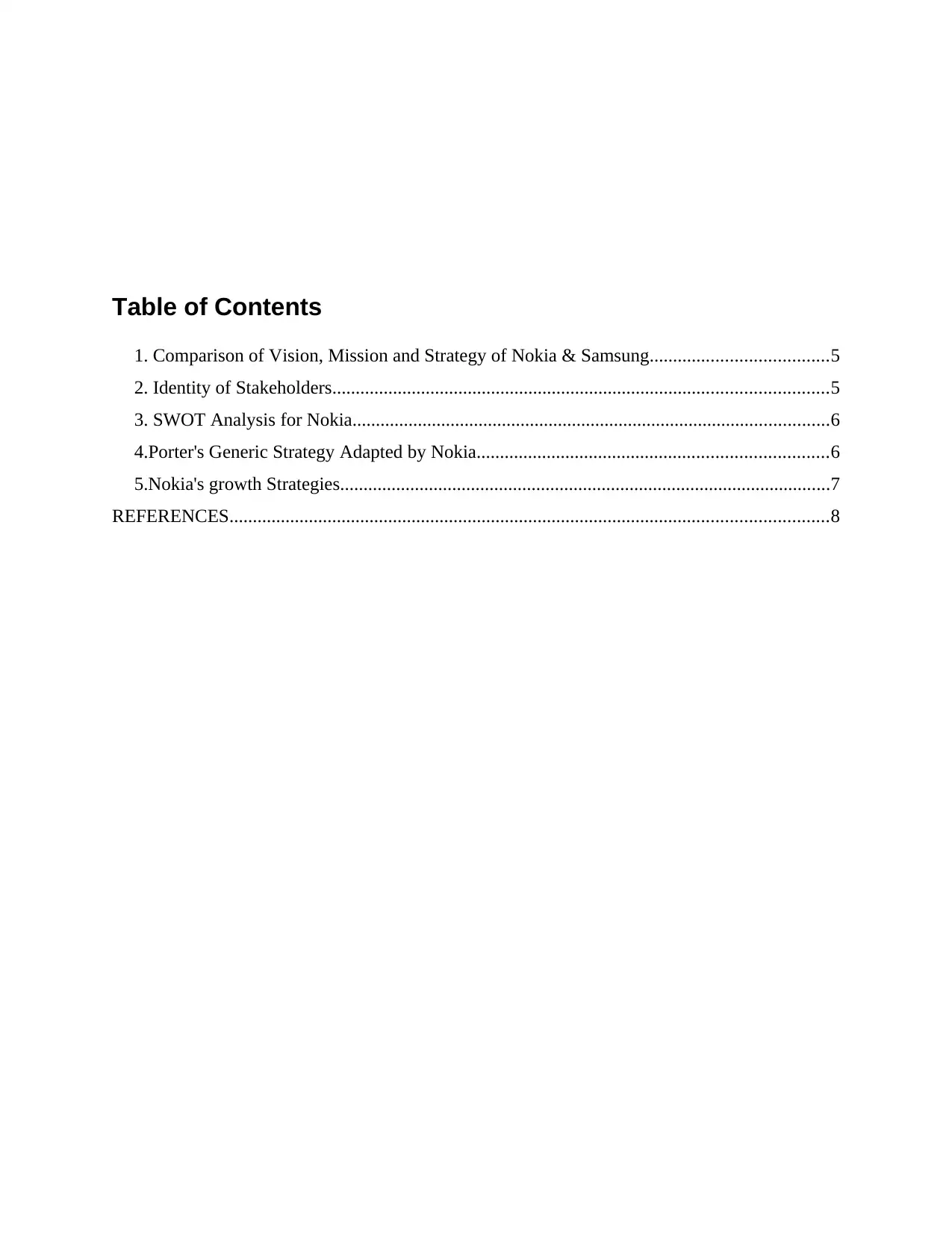
Table of Contents
1. Comparison of Vision, Mission and Strategy of Nokia & Samsung......................................5
2. Identity of Stakeholders..........................................................................................................5
3. SWOT Analysis for Nokia......................................................................................................6
4.Porter's Generic Strategy Adapted by Nokia...........................................................................6
5.Nokia's growth Strategies.........................................................................................................7
REFERENCES................................................................................................................................8
1. Comparison of Vision, Mission and Strategy of Nokia & Samsung......................................5
2. Identity of Stakeholders..........................................................................................................5
3. SWOT Analysis for Nokia......................................................................................................6
4.Porter's Generic Strategy Adapted by Nokia...........................................................................6
5.Nokia's growth Strategies.........................................................................................................7
REFERENCES................................................................................................................................8
⊘ This is a preview!⊘
Do you want full access?
Subscribe today to unlock all pages.

Trusted by 1+ million students worldwide

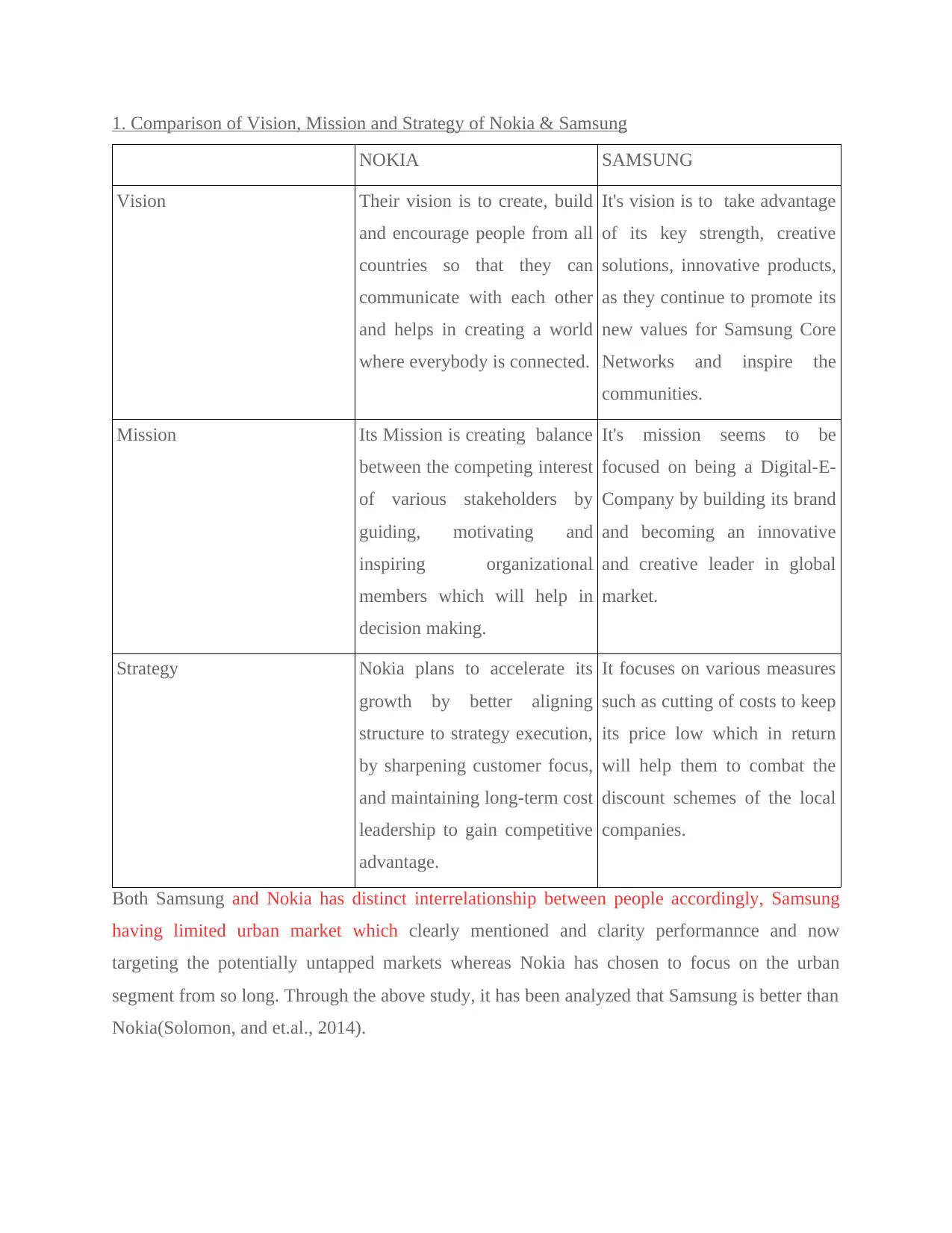
1. Comparison of Vision, Mission and Strategy of Nokia & Samsung
NOKIA SAMSUNG
Vision Their vision is to create, build
and encourage people from all
countries so that they can
communicate with each other
and helps in creating a world
where everybody is connected.
It's vision is to take advantage
of its key strength, creative
solutions, innovative products,
as they continue to promote its
new values for Samsung Core
Networks and inspire the
communities.
Mission Its Mission is creating balance
between the competing interest
of various stakeholders by
guiding, motivating and
inspiring organizational
members which will help in
decision making.
It's mission seems to be
focused on being a Digital-E-
Company by building its brand
and becoming an innovative
and creative leader in global
market.
Strategy Nokia plans to accelerate its
growth by better aligning
structure to strategy execution,
by sharpening customer focus,
and maintaining long-term cost
leadership to gain competitive
advantage.
It focuses on various measures
such as cutting of costs to keep
its price low which in return
will help them to combat the
discount schemes of the local
companies.
Both Samsung and Nokia has distinct interrelationship between people accordingly, Samsung
having limited urban market which clearly mentioned and clarity performannce and now
targeting the potentially untapped markets whereas Nokia has chosen to focus on the urban
segment from so long. Through the above study, it has been analyzed that Samsung is better than
Nokia(Solomon, and et.al., 2014).
NOKIA SAMSUNG
Vision Their vision is to create, build
and encourage people from all
countries so that they can
communicate with each other
and helps in creating a world
where everybody is connected.
It's vision is to take advantage
of its key strength, creative
solutions, innovative products,
as they continue to promote its
new values for Samsung Core
Networks and inspire the
communities.
Mission Its Mission is creating balance
between the competing interest
of various stakeholders by
guiding, motivating and
inspiring organizational
members which will help in
decision making.
It's mission seems to be
focused on being a Digital-E-
Company by building its brand
and becoming an innovative
and creative leader in global
market.
Strategy Nokia plans to accelerate its
growth by better aligning
structure to strategy execution,
by sharpening customer focus,
and maintaining long-term cost
leadership to gain competitive
advantage.
It focuses on various measures
such as cutting of costs to keep
its price low which in return
will help them to combat the
discount schemes of the local
companies.
Both Samsung and Nokia has distinct interrelationship between people accordingly, Samsung
having limited urban market which clearly mentioned and clarity performannce and now
targeting the potentially untapped markets whereas Nokia has chosen to focus on the urban
segment from so long. Through the above study, it has been analyzed that Samsung is better than
Nokia(Solomon, and et.al., 2014).
Paraphrase This Document
Need a fresh take? Get an instant paraphrase of this document with our AI Paraphraser

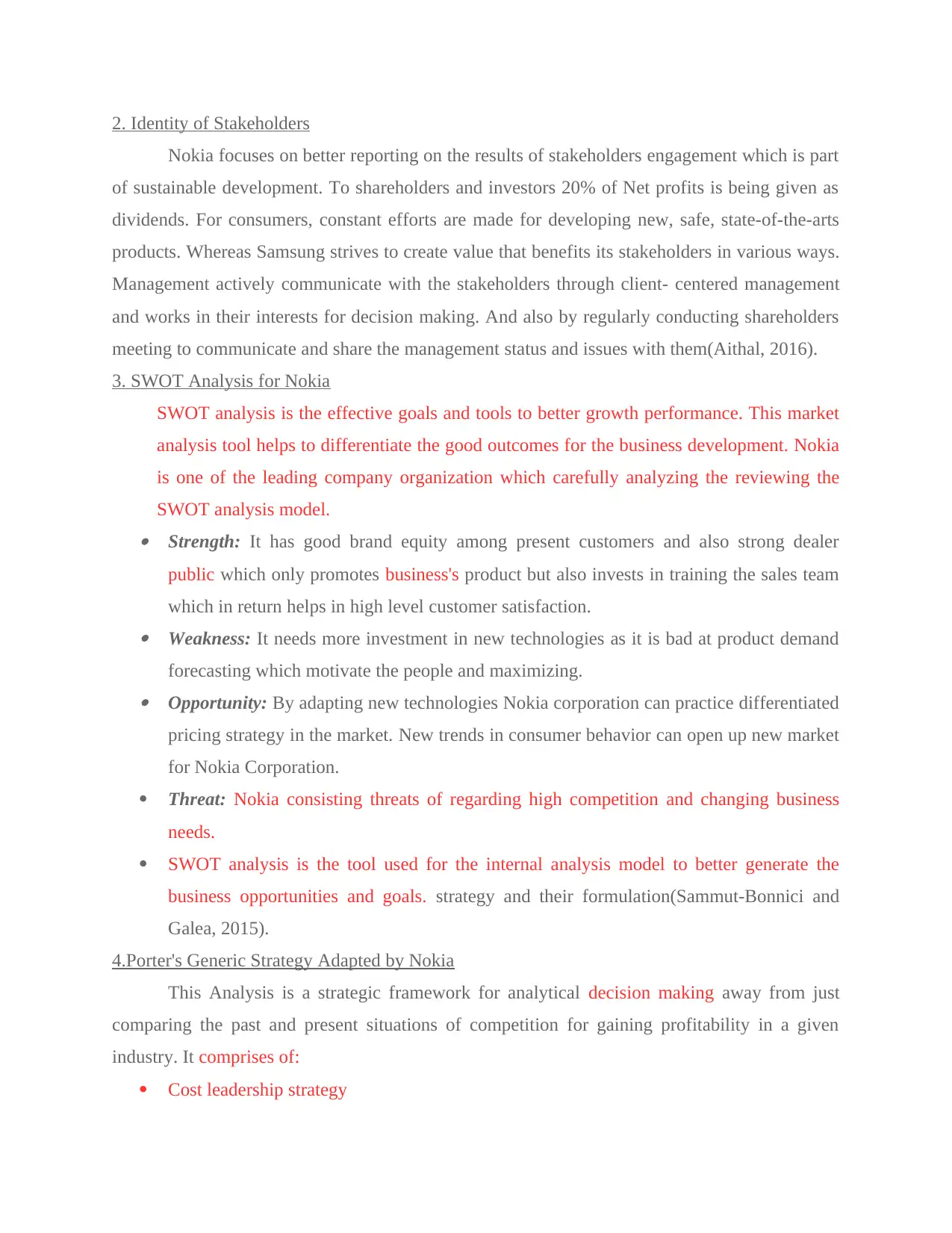
2. Identity of Stakeholders
Nokia focuses on better reporting on the results of stakeholders engagement which is part
of sustainable development. To shareholders and investors 20% of Net profits is being given as
dividends. For consumers, constant efforts are made for developing new, safe, state-of-the-arts
products. Whereas Samsung strives to create value that benefits its stakeholders in various ways.
Management actively communicate with the stakeholders through client- centered management
and works in their interests for decision making. And also by regularly conducting shareholders
meeting to communicate and share the management status and issues with them(Aithal, 2016).
3. SWOT Analysis for Nokia
SWOT analysis is the effective goals and tools to better growth performance. This market
analysis tool helps to differentiate the good outcomes for the business development. Nokia
is one of the leading company organization which carefully analyzing the reviewing the
SWOT analysis model. Strength: It has good brand equity among present customers and also strong dealer
public which only promotes business's product but also invests in training the sales team
which in return helps in high level customer satisfaction. Weakness: It needs more investment in new technologies as it is bad at product demand
forecasting which motivate the people and maximizing. Opportunity: By adapting new technologies Nokia corporation can practice differentiated
pricing strategy in the market. New trends in consumer behavior can open up new market
for Nokia Corporation.
Threat: Nokia consisting threats of regarding high competition and changing business
needs.
SWOT analysis is the tool used for the internal analysis model to better generate the
business opportunities and goals. strategy and their formulation(Sammut‐Bonnici and
Galea, 2015).
4.Porter's Generic Strategy Adapted by Nokia
This Analysis is a strategic framework for analytical decision making away from just
comparing the past and present situations of competition for gaining profitability in a given
industry. It comprises of:
Cost leadership strategy
Nokia focuses on better reporting on the results of stakeholders engagement which is part
of sustainable development. To shareholders and investors 20% of Net profits is being given as
dividends. For consumers, constant efforts are made for developing new, safe, state-of-the-arts
products. Whereas Samsung strives to create value that benefits its stakeholders in various ways.
Management actively communicate with the stakeholders through client- centered management
and works in their interests for decision making. And also by regularly conducting shareholders
meeting to communicate and share the management status and issues with them(Aithal, 2016).
3. SWOT Analysis for Nokia
SWOT analysis is the effective goals and tools to better growth performance. This market
analysis tool helps to differentiate the good outcomes for the business development. Nokia
is one of the leading company organization which carefully analyzing the reviewing the
SWOT analysis model. Strength: It has good brand equity among present customers and also strong dealer
public which only promotes business's product but also invests in training the sales team
which in return helps in high level customer satisfaction. Weakness: It needs more investment in new technologies as it is bad at product demand
forecasting which motivate the people and maximizing. Opportunity: By adapting new technologies Nokia corporation can practice differentiated
pricing strategy in the market. New trends in consumer behavior can open up new market
for Nokia Corporation.
Threat: Nokia consisting threats of regarding high competition and changing business
needs.
SWOT analysis is the tool used for the internal analysis model to better generate the
business opportunities and goals. strategy and their formulation(Sammut‐Bonnici and
Galea, 2015).
4.Porter's Generic Strategy Adapted by Nokia
This Analysis is a strategic framework for analytical decision making away from just
comparing the past and present situations of competition for gaining profitability in a given
industry. It comprises of:
Cost leadership strategy

Differentiation strategy
Focus strategy(low cost)
Focus strategy(differentiation)
By analyzing all the strategies the company can reach the stage where through proper planning
and adopting the right strategy according to its operations can lead it to gain competitive
advantage in the targeted market. It also provides the best services and strategies together
understand the opportunities and task. By innovation of new products and satisfying the
customer of Nokia generates the better organization performance objectives (Pappas, 2016).
5.Nokia's growth Strategies
Through Research & Development it has been concluded that Nokia's strategic intent is
to built distinctive competency in product innovation, rapid response, and global brand
management which requires continuous growth of mobile phones and telecommunications
network. The exposure of digital technology helped in creating a constant communication
standard. It's strategies focuses on four key priority areas:
Being the leading provider of communication services with high quality performance.
Securing Market share through high sales, customer satisfaction and high performance.
Building a software business which will separate it from its competitors.
Creation of business and licensing opportunities in Nokia's targeted market(Biancamaria,
Lettenmaier and Pavelsky. 2016.).
Focus strategy(low cost)
Focus strategy(differentiation)
By analyzing all the strategies the company can reach the stage where through proper planning
and adopting the right strategy according to its operations can lead it to gain competitive
advantage in the targeted market. It also provides the best services and strategies together
understand the opportunities and task. By innovation of new products and satisfying the
customer of Nokia generates the better organization performance objectives (Pappas, 2016).
5.Nokia's growth Strategies
Through Research & Development it has been concluded that Nokia's strategic intent is
to built distinctive competency in product innovation, rapid response, and global brand
management which requires continuous growth of mobile phones and telecommunications
network. The exposure of digital technology helped in creating a constant communication
standard. It's strategies focuses on four key priority areas:
Being the leading provider of communication services with high quality performance.
Securing Market share through high sales, customer satisfaction and high performance.
Building a software business which will separate it from its competitors.
Creation of business and licensing opportunities in Nokia's targeted market(Biancamaria,
Lettenmaier and Pavelsky. 2016.).
⊘ This is a preview!⊘
Do you want full access?
Subscribe today to unlock all pages.

Trusted by 1+ million students worldwide

REFERENCES
Books and Journals
Aithal, P.S., 2016. Creating innovators through setting up organizational vision, mission and core
values: a strategic model in higher education. International Journal of Management, IT
and Engineering. 6(1). pp.310-324.
Biancamaria, S., Lettenmaier, D.P. and Pavelsky, T.M., 2016. The SWOT mission and its
capabilities for land hydrology. In Remote Sensing and Water Resources. (pp. 117-
147). Springer, Cham.
Pappas, N., 2016. Marketing strategies, perceived risks, and consumer trust in online buying
behaviour. Journal of Retailing and Consumer Services. 29. pp.92-103.
Sammut‐Bonnici, T. and Galea, D., 2015. SWOT analysis. Wiley Encyclopedia of Management.
pp.1-8.
Solomon, M.R. and et.al., 2014. Consumer behavior: Buying, having, and being. (Vol. 10).
Toronto, Canada: Pearson.
Books and Journals
Aithal, P.S., 2016. Creating innovators through setting up organizational vision, mission and core
values: a strategic model in higher education. International Journal of Management, IT
and Engineering. 6(1). pp.310-324.
Biancamaria, S., Lettenmaier, D.P. and Pavelsky, T.M., 2016. The SWOT mission and its
capabilities for land hydrology. In Remote Sensing and Water Resources. (pp. 117-
147). Springer, Cham.
Pappas, N., 2016. Marketing strategies, perceived risks, and consumer trust in online buying
behaviour. Journal of Retailing and Consumer Services. 29. pp.92-103.
Sammut‐Bonnici, T. and Galea, D., 2015. SWOT analysis. Wiley Encyclopedia of Management.
pp.1-8.
Solomon, M.R. and et.al., 2014. Consumer behavior: Buying, having, and being. (Vol. 10).
Toronto, Canada: Pearson.
1 out of 7
Related Documents
Your All-in-One AI-Powered Toolkit for Academic Success.
+13062052269
info@desklib.com
Available 24*7 on WhatsApp / Email
Unlock your academic potential
Copyright © 2020–2025 A2Z Services. All Rights Reserved. Developed and managed by ZUCOL.