Critical Appraisal: Non-Research Evidence in Healthcare Setting

Verified

Added on  2022/08/19

|6
|1359
|14
Report
AI Summary
This report offers a comprehensive critique of a non-research-based evidence article, specifically a meta-analysis by Snyder (2019) examining lesbian women's healthcare experiences. The analysis delves into the ethical review, noting the absence of explicit ethical approval but acknowledging the nature of the secondary, qualitative research. The report dissects the study's findings, highlighting the key themes related to positive and negative healthcare encounters, such as the provider's attitude, the women's disclosure of sexuality, and partner acknowledgment. It also addresses limitations, particularly the reliance on qualitative data (interviews) and the lack of generalizability due to the sample's demographic makeup. The discussion connects the findings to societal stigma and healthcare discrimination, with implications for practice, including the need for healthcare provider training and the availability of resources. The report concludes by emphasizing the importance of addressing limitations and socially disadvantaged populations to enhance the study's internal validity.

Document Page
Running head: CRITIQUE OF NON-RESEARCH EVIDENCE
CRITIQUE OF NON-RESEARCH EVIDENCE
Name of the Student:
Name of the University:
Author note:
tabler-icon-diamond-filled.svg

Paraphrase This Document

Need a fresh take? Get an instant paraphrase of this document with our AI Paraphraser
Document Page
1CRITIQUE OF NON-RESEARCH EVIDENCE
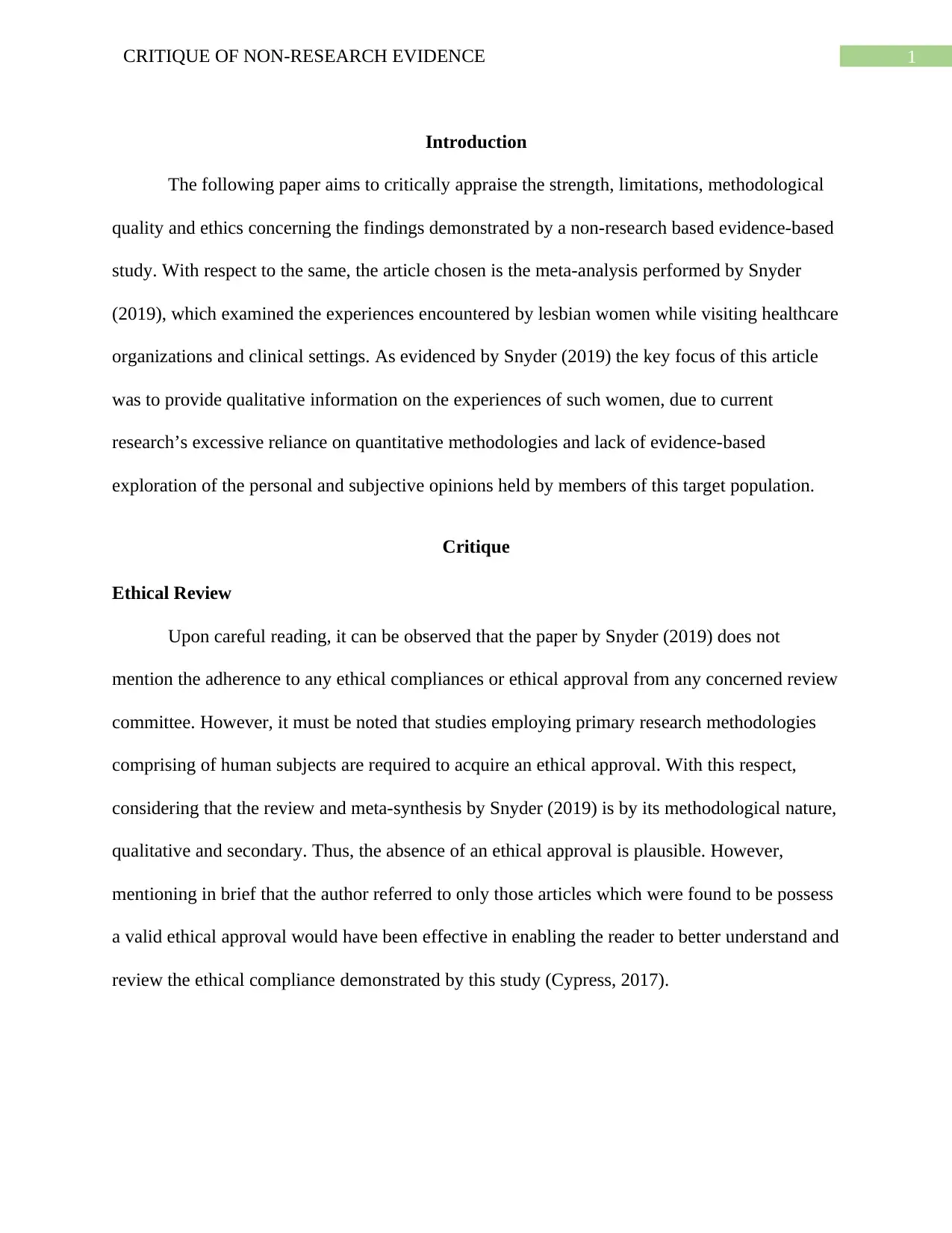
Introduction
The following paper aims to critically appraise the strength, limitations, methodological
quality and ethics concerning the findings demonstrated by a non-research based evidence-based
study. With respect to the same, the article chosen is the meta-analysis performed by Snyder
(2019), which examined the experiences encountered by lesbian women while visiting healthcare
organizations and clinical settings. As evidenced by Snyder (2019) the key focus of this article
was to provide qualitative information on the experiences of such women, due to current
research’s excessive reliance on quantitative methodologies and lack of evidence-based
exploration of the personal and subjective opinions held by members of this target population.
Critique
Ethical Review
Upon careful reading, it can be observed that the paper by Snyder (2019) does not
mention the adherence to any ethical compliances or ethical approval from any concerned review
committee. However, it must be noted that studies employing primary research methodologies
comprising of human subjects are required to acquire an ethical approval. With this respect,
considering that the review and meta-synthesis by Snyder (2019) is by its methodological nature,
qualitative and secondary. Thus, the absence of an ethical approval is plausible. However,
mentioning in brief that the author referred to only those articles which were found to be possess
a valid ethical approval would have been effective in enabling the reader to better understand and
review the ethical compliance demonstrated by this study (Cypress, 2017).
Document Page
2CRITIQUE OF NON-RESEARCH EVIDENCE
Analysis of Findings
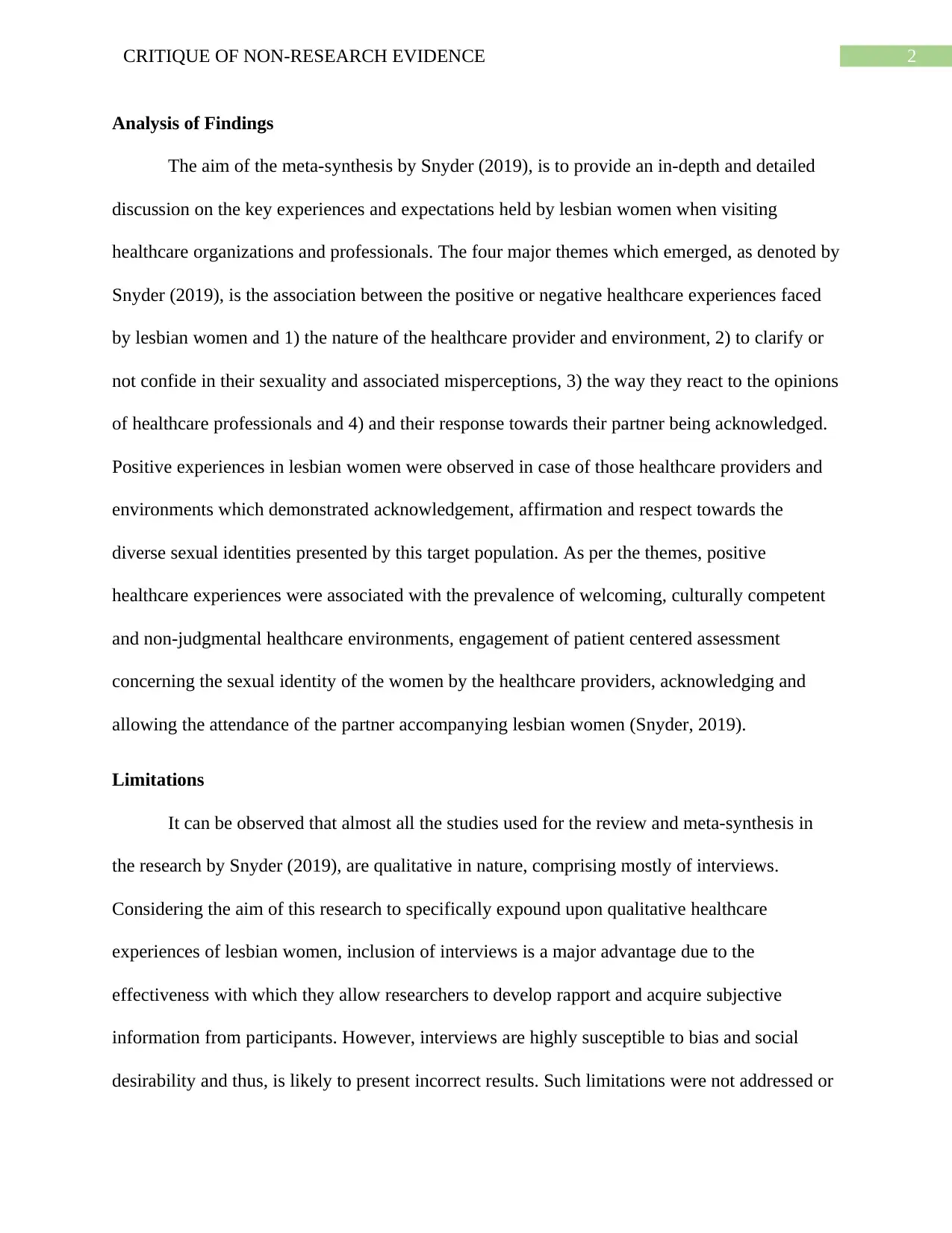
The aim of the meta-synthesis by Snyder (2019), is to provide an in-depth and detailed
discussion on the key experiences and expectations held by lesbian women when visiting
healthcare organizations and professionals. The four major themes which emerged, as denoted by
Snyder (2019), is the association between the positive or negative healthcare experiences faced
by lesbian women and 1) the nature of the healthcare provider and environment, 2) to clarify or
not confide in their sexuality and associated misperceptions, 3) the way they react to the opinions
of healthcare professionals and 4) and their response towards their partner being acknowledged.
Positive experiences in lesbian women were observed in case of those healthcare providers and
environments which demonstrated acknowledgement, affirmation and respect towards the
diverse sexual identities presented by this target population. As per the themes, positive
healthcare experiences were associated with the prevalence of welcoming, culturally competent
and non-judgmental healthcare environments, engagement of patient centered assessment
concerning the sexual identity of the women by the healthcare providers, acknowledging and
allowing the attendance of the partner accompanying lesbian women (Snyder, 2019).
Limitations
It can be observed that almost all the studies used for the review and meta-synthesis in
the research by Snyder (2019), are qualitative in nature, comprising mostly of interviews.
Considering the aim of this research to specifically expound upon qualitative healthcare
experiences of lesbian women, inclusion of interviews is a major advantage due to the
effectiveness with which they allow researchers to develop rapport and acquire subjective
information from participants. However, interviews are highly susceptible to bias and social
desirability and thus, is likely to present incorrect results. Such limitations were not addressed or
Document Page
3CRITIQUE OF NON-RESEARCH EVIDENCE
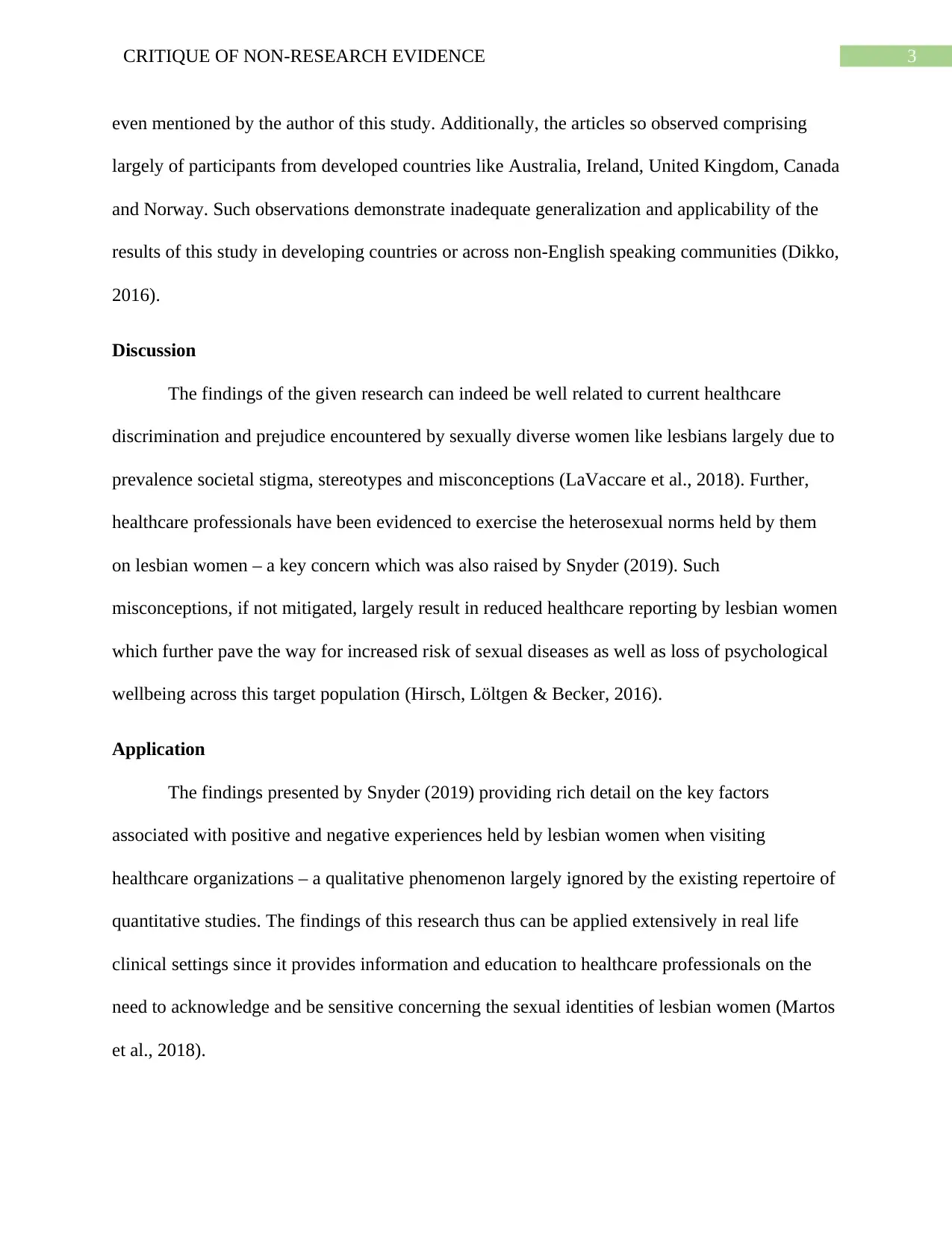
even mentioned by the author of this study. Additionally, the articles so observed comprising
largely of participants from developed countries like Australia, Ireland, United Kingdom, Canada
and Norway. Such observations demonstrate inadequate generalization and applicability of the
results of this study in developing countries or across non-English speaking communities (Dikko,
2016).
Discussion
The findings of the given research can indeed be well related to current healthcare
discrimination and prejudice encountered by sexually diverse women like lesbians largely due to
prevalence societal stigma, stereotypes and misconceptions (LaVaccare et al., 2018). Further,
healthcare professionals have been evidenced to exercise the heterosexual norms held by them
on lesbian women – a key concern which was also raised by Snyder (2019). Such
misconceptions, if not mitigated, largely result in reduced healthcare reporting by lesbian women
which further pave the way for increased risk of sexual diseases as well as loss of psychological
wellbeing across this target population (Hirsch, Löltgen & Becker, 2016).
Application
The findings presented by Snyder (2019) providing rich detail on the key factors
associated with positive and negative experiences held by lesbian women when visiting
healthcare organizations – a qualitative phenomenon largely ignored by the existing repertoire of
quantitative studies. The findings of this research thus can be applied extensively in real life
clinical settings since it provides information and education to healthcare professionals on the
need to acknowledge and be sensitive concerning the sexual identities of lesbian women (Martos
et al., 2018).
tabler-icon-diamond-filled.svg

Paraphrase This Document

Need a fresh take? Get an instant paraphrase of this document with our AI Paraphraser
Document Page
4CRITIQUE OF NON-RESEARCH EVIDENCE
Future Implications
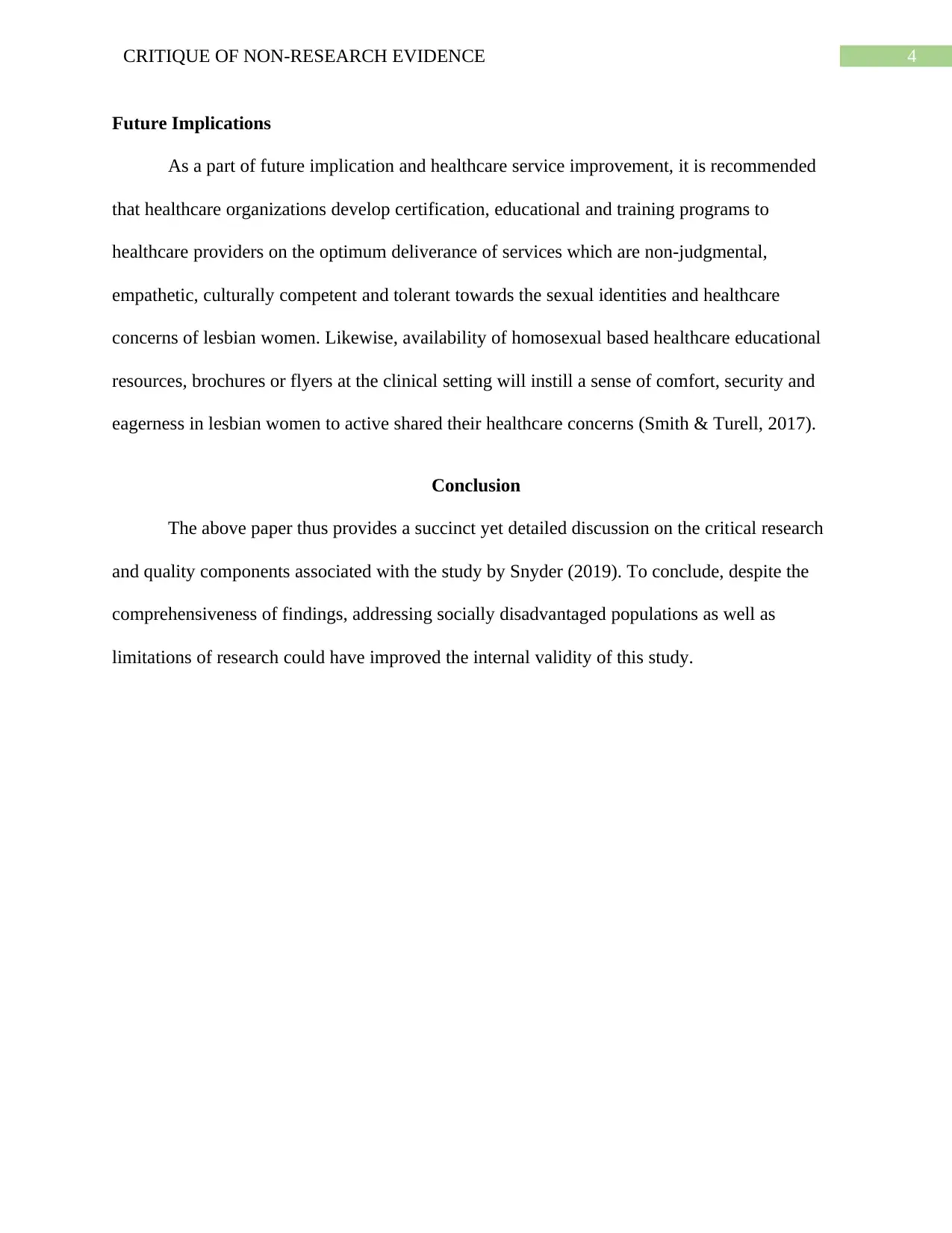
As a part of future implication and healthcare service improvement, it is recommended
that healthcare organizations develop certification, educational and training programs to
healthcare providers on the optimum deliverance of services which are non-judgmental,
empathetic, culturally competent and tolerant towards the sexual identities and healthcare
concerns of lesbian women. Likewise, availability of homosexual based healthcare educational
resources, brochures or flyers at the clinical setting will instill a sense of comfort, security and
eagerness in lesbian women to active shared their healthcare concerns (Smith & Turell, 2017).
Conclusion
The above paper thus provides a succinct yet detailed discussion on the critical research
and quality components associated with the study by Snyder (2019). To conclude, despite the
comprehensiveness of findings, addressing socially disadvantaged populations as well as
limitations of research could have improved the internal validity of this study.
Document Page
5CRITIQUE OF NON-RESEARCH EVIDENCE
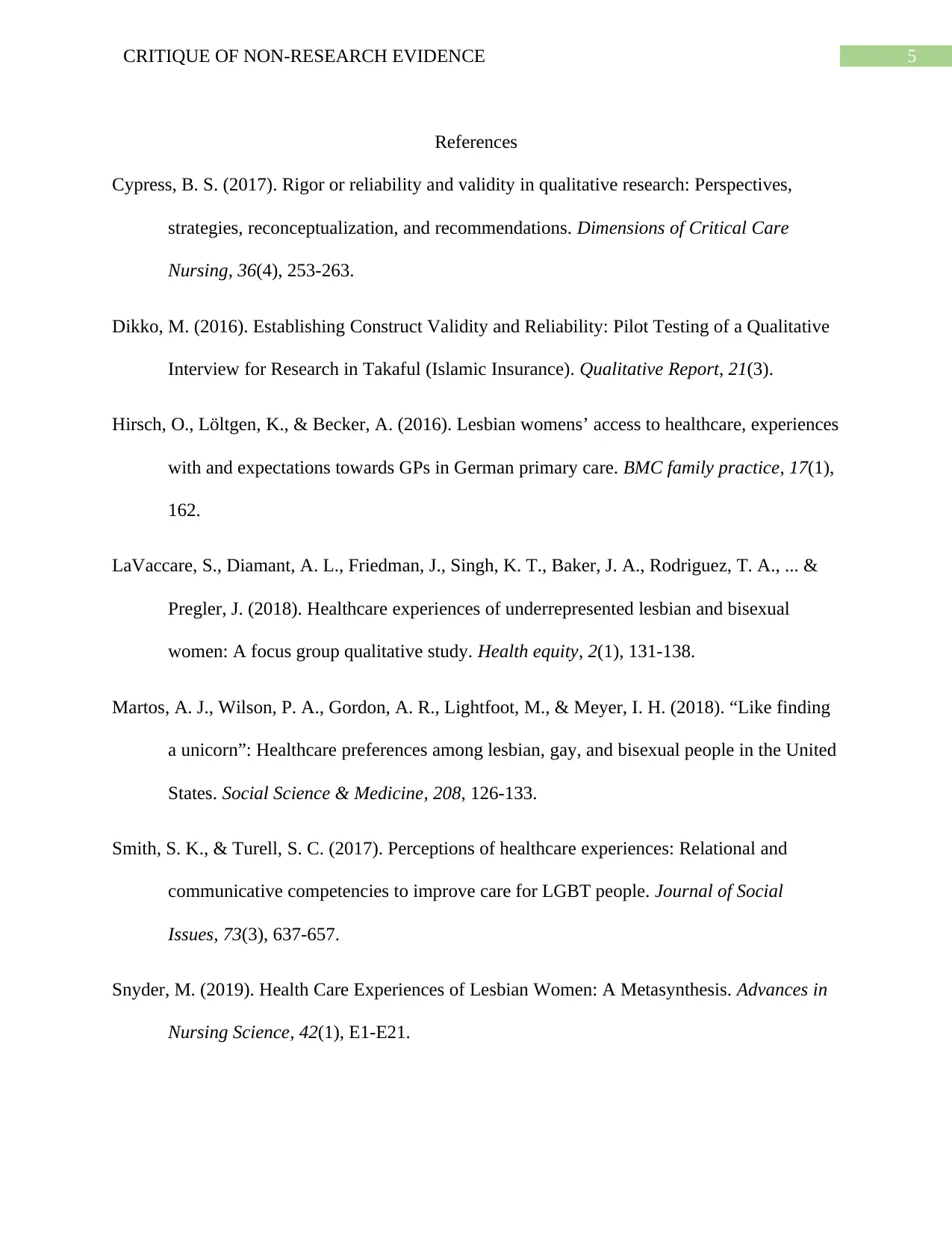
References
Cypress, B. S. (2017). Rigor or reliability and validity in qualitative research: Perspectives,
strategies, reconceptualization, and recommendations. Dimensions of Critical Care
Nursing, 36(4), 253-263.
Dikko, M. (2016). Establishing Construct Validity and Reliability: Pilot Testing of a Qualitative
Interview for Research in Takaful (Islamic Insurance). Qualitative Report, 21(3).
Hirsch, O., Löltgen, K., & Becker, A. (2016). Lesbian womens’ access to healthcare, experiences
with and expectations towards GPs in German primary care. BMC family practice, 17(1),
162.
LaVaccare, S., Diamant, A. L., Friedman, J., Singh, K. T., Baker, J. A., Rodriguez, T. A., ... &
Pregler, J. (2018). Healthcare experiences of underrepresented lesbian and bisexual
women: A focus group qualitative study. Health equity, 2(1), 131-138.
Martos, A. J., Wilson, P. A., Gordon, A. R., Lightfoot, M., & Meyer, I. H. (2018). “Like finding
a unicorn”: Healthcare preferences among lesbian, gay, and bisexual people in the United
States. Social Science & Medicine, 208, 126-133.
Smith, S. K., & Turell, S. C. (2017). Perceptions of healthcare experiences: Relational and
communicative competencies to improve care for LGBT people. Journal of Social
Issues, 73(3), 637-657.
Snyder, M. (2019). Health Care Experiences of Lesbian Women: A Metasynthesis. Advances in
Nursing Science, 42(1), E1-E21.
chevron_up_icon
1 out of 6
circle_padding
hide_on_mobile
zoom_out_icon
[object Object]