A Qualitative Study on Non-Severe Nocturnal Hypoglycemic Events
VerifiedAdded on 2022/09/02
|13
|2927
|15
Report
AI Summary
This report provides a qualitative analysis of non-severe nocturnal hypoglycemic events (NSNHEs) and their impact on patient well-being and functioning. It discusses the aim, background, and methodology of the study, including semi-structured interviews conducted in multiple countries. The research explores the social impacts of NSNHEs, such as sleep disruption and the need for support, and highlights the importance of understanding patient experiences to improve diabetes management. The report also acknowledges limitations, including language barriers and the need for further research to address patient dissatisfaction with current NSNHE management strategies. The study concludes that NSNHEs have significant effects on productivity and lost work time, emphasizing the need for future nursing practices to better analyze and understand these events.
Running head: QUALITATIVE REPORT
NON-SEVERE NOCTURNAL HYPOGLYCEMIC EVENTS
Name of the Student
Name of the University
Author note
NON-SEVERE NOCTURNAL HYPOGLYCEMIC EVENTS
Name of the Student
Name of the University
Author note

Paraphrase This Document
Need a fresh take? Get an instant paraphrase of this document with our AI Paraphraser
1QUALITATIVE REPORT
Executive summary
This report discusses about improved analysis of the NSNHEs as patients actually suffers from
the process in their everyday life, and the ways they wedged operative as well as well-being. It
discusses about the aim, background as well the methodology used. The reported explains about
different ways the data was collected and gives a clear analysis of the data. It also explains about
the limitation and provides a reflective analysis of the investigation.
Executive summary
This report discusses about improved analysis of the NSNHEs as patients actually suffers from
the process in their everyday life, and the ways they wedged operative as well as well-being. It
discusses about the aim, background as well the methodology used. The reported explains about
different ways the data was collected and gives a clear analysis of the data. It also explains about
the limitation and provides a reflective analysis of the investigation.
2QUALITATIVE REPORT
Table of Contents
Introduction......................................................................................................................................3
Background......................................................................................................................................3
Aim..................................................................................................................................................4
Methodology....................................................................................................................................4
Methods...........................................................................................................................................5
Ethics...............................................................................................................................................6
Result...............................................................................................................................................6
Discussion........................................................................................................................................7
Conclusion.......................................................................................................................................7
Limitations.......................................................................................................................................8
Reflection.........................................................................................................................................8
References......................................................................................................................................10
CASP TOOL..................................................................................................................................12
Table of Contents
Introduction......................................................................................................................................3
Background......................................................................................................................................3
Aim..................................................................................................................................................4
Methodology....................................................................................................................................4
Methods...........................................................................................................................................5
Ethics...............................................................................................................................................6
Result...............................................................................................................................................6
Discussion........................................................................................................................................7
Conclusion.......................................................................................................................................7
Limitations.......................................................................................................................................8
Reflection.........................................................................................................................................8
References......................................................................................................................................10
CASP TOOL..................................................................................................................................12
⊘ This is a preview!⊘
Do you want full access?
Subscribe today to unlock all pages.

Trusted by 1+ million students worldwide
3QUALITATIVE REPORT
Introduction
NSNHE (Non-severe nocturnal hypoglycemic events) are events that are hypoglycemic,
which occur during sleep nevertheless do not necessitate any medical aid from another person. In
this paper the study was conducted to have a better understanding of the NSNHEs as patients
essentially develop knowledge from their daily life, and ways they reduced operational and
comfort. Hypoglycemia is a recurrent difficulty of anti-diabetic medicine (Brod et al., 2013).
Hence, it would be helpful for nurses as the patient can perform some work of their own
preference and they need not to be present nearby when the patient in sleeping (Wang, Ioacara &
DeHennis, 2015). It is very important for nurses to understand that the NSNHEs because patient
undergoes this experience on regular basis and nurses must know the ways this have wedged the
well-being and functioning.
The report is structured to discuss about the chosen paper, the main objective of the
research, the methodology used, the way the study was conducted, various ethical consideration,
data obtained, conclusion and limitation of the research. Even the paper would reflect about the
experience learner developed while conducting the study.
Background
NSNHEs are hypoglycemic actions happening in the course of sleep however do not
necessitate medical aid from nurse. The patient manages remedial deed upon wakening, though
they can recruit someone for assisting (Desjardins et al., 2014). The previous study has shown
that 6,756 adults suffering from diabetes that comprises both Type 1 or Type 2 diabetics, the
sample of about 16.6% was reported having one NSNHE in the last study. Clear identification of
the problem or limitation were done that states that NSNHE is limited (Brod et al., 2013). The
Introduction
NSNHE (Non-severe nocturnal hypoglycemic events) are events that are hypoglycemic,
which occur during sleep nevertheless do not necessitate any medical aid from another person. In
this paper the study was conducted to have a better understanding of the NSNHEs as patients
essentially develop knowledge from their daily life, and ways they reduced operational and
comfort. Hypoglycemia is a recurrent difficulty of anti-diabetic medicine (Brod et al., 2013).
Hence, it would be helpful for nurses as the patient can perform some work of their own
preference and they need not to be present nearby when the patient in sleeping (Wang, Ioacara &
DeHennis, 2015). It is very important for nurses to understand that the NSNHEs because patient
undergoes this experience on regular basis and nurses must know the ways this have wedged the
well-being and functioning.
The report is structured to discuss about the chosen paper, the main objective of the
research, the methodology used, the way the study was conducted, various ethical consideration,
data obtained, conclusion and limitation of the research. Even the paper would reflect about the
experience learner developed while conducting the study.
Background
NSNHEs are hypoglycemic actions happening in the course of sleep however do not
necessitate medical aid from nurse. The patient manages remedial deed upon wakening, though
they can recruit someone for assisting (Desjardins et al., 2014). The previous study has shown
that 6,756 adults suffering from diabetes that comprises both Type 1 or Type 2 diabetics, the
sample of about 16.6% was reported having one NSNHE in the last study. Clear identification of
the problem or limitation were done that states that NSNHE is limited (Brod et al., 2013). The
Paraphrase This Document
Need a fresh take? Get an instant paraphrase of this document with our AI Paraphraser
4QUALITATIVE REPORT
study exposed that that the most of research, which was performed has concentrated
hypoglycemic events while sleeping or was induced by laboratory. The conclusion drawn from
the gap investigation are not common to the patient suffering with diabetes as well as their
consequences and impacts. Hence. It was concluded that the gap resulted due to imperfect
control of glucose resulting in high NSNHE frequency (Buckingham et al., 2015). It is assumed
that the influences on non-severe hypoglycemic proceedings normally accomplishes that non-
severe hypoglycemia is linked with considerable negative financial significances for both
patients and nurses, that results from lost efficiency and missing of the worktime. The research
mainly focusses on the functioning of the patient along with well-being signifying psychological
state of mind and patient’s view point.
Aim
The main aim of the research was to investigate non-severe nocturnal hypoglycemic
events occurring and its impact as well as experience on the well-being and functioning of the
patient. The main goal of the research was properly fulfilled through qualitative research
proceeding.
As per CASP tool, the statement for aims of research is mentioned clearly.
Methodology
The methodology used for this study was qualitative design. A qualitative research design
is apprehensive with founding solutions to the question focussing on how and why for the chosen
objective. Qualitative research is a subjective form of research and the outputs are collected in a
written format as opposite to statistical (Brod et al., 2013). The qualitative research was
study exposed that that the most of research, which was performed has concentrated
hypoglycemic events while sleeping or was induced by laboratory. The conclusion drawn from
the gap investigation are not common to the patient suffering with diabetes as well as their
consequences and impacts. Hence. It was concluded that the gap resulted due to imperfect
control of glucose resulting in high NSNHE frequency (Buckingham et al., 2015). It is assumed
that the influences on non-severe hypoglycemic proceedings normally accomplishes that non-
severe hypoglycemia is linked with considerable negative financial significances for both
patients and nurses, that results from lost efficiency and missing of the worktime. The research
mainly focusses on the functioning of the patient along with well-being signifying psychological
state of mind and patient’s view point.
Aim
The main aim of the research was to investigate non-severe nocturnal hypoglycemic
events occurring and its impact as well as experience on the well-being and functioning of the
patient. The main goal of the research was properly fulfilled through qualitative research
proceeding.
As per CASP tool, the statement for aims of research is mentioned clearly.
Methodology
The methodology used for this study was qualitative design. A qualitative research design
is apprehensive with founding solutions to the question focussing on how and why for the chosen
objective. Qualitative research is a subjective form of research and the outputs are collected in a
written format as opposite to statistical (Brod et al., 2013). The qualitative research was
5QUALITATIVE REPORT
appropriate to fulfil the aim of the paper was to qualitatively portray and designate the
involvement of NSNHEs in addition to their influences on patient working and safety.
Methods
To conduct the research focus group was semi structured and interviewed in countries
such as UK, US, France and Germany. Data was gathered for the patient experiencing of
NSNHEs. Interviews were conducted for the focus group as it helps in the identification of the
wide range of perspectives and experiences by providing a forum for both covenant and
divergence among the participants facilitating awareness into the inconsistency of understanding
and the assortment of disconfirming suggestion (Campbell et al., 2015). The selection of the
participants was done through professional market research administrations that apprentice focus
groups in their associates’ conveniences for respective countries. The market research
administrations communicated individuals registered in their registered databases in addition to
prequalified on telephone with the use of a screening script. Interview ranged for 8 to 11
participants for every focus group. Consent form was signed by the participant before conducting
the research. The questionnaire was given to the participants and were asked to fill in out. All the
participant was above 18 years of age and have the ability to speak the native language of the
country and was diagnosed with Type I and II diabetes. Participants using insulin pump were
excluded from this study (Brod et al., 2013). The method was suitable in achieving aim as the
data obtained from consequent focus group interviews augmented the investigation with their
added explanations of established subjects (Harris et al., 2014).
As per CASP tool, yes the qualitative methodology was perfect along with proper
research design. Yes, the research design was structured clearly for easy understanding. No, the
data collection was not totally justifiable as it was specific to a particular age group. Yes, the
appropriate to fulfil the aim of the paper was to qualitatively portray and designate the
involvement of NSNHEs in addition to their influences on patient working and safety.
Methods
To conduct the research focus group was semi structured and interviewed in countries
such as UK, US, France and Germany. Data was gathered for the patient experiencing of
NSNHEs. Interviews were conducted for the focus group as it helps in the identification of the
wide range of perspectives and experiences by providing a forum for both covenant and
divergence among the participants facilitating awareness into the inconsistency of understanding
and the assortment of disconfirming suggestion (Campbell et al., 2015). The selection of the
participants was done through professional market research administrations that apprentice focus
groups in their associates’ conveniences for respective countries. The market research
administrations communicated individuals registered in their registered databases in addition to
prequalified on telephone with the use of a screening script. Interview ranged for 8 to 11
participants for every focus group. Consent form was signed by the participant before conducting
the research. The questionnaire was given to the participants and were asked to fill in out. All the
participant was above 18 years of age and have the ability to speak the native language of the
country and was diagnosed with Type I and II diabetes. Participants using insulin pump were
excluded from this study (Brod et al., 2013). The method was suitable in achieving aim as the
data obtained from consequent focus group interviews augmented the investigation with their
added explanations of established subjects (Harris et al., 2014).
As per CASP tool, yes the qualitative methodology was perfect along with proper
research design. Yes, the research design was structured clearly for easy understanding. No, the
data collection was not totally justifiable as it was specific to a particular age group. Yes, the
⊘ This is a preview!⊘
Do you want full access?
Subscribe today to unlock all pages.
Trusted by 1+ million students worldwide
6QUALITATIVE REPORT
collection of data was well addressed. Yes, the relation between participant and researchers were
considered clearly.
Ethics
The ethics are clearly maintained in the investigation. Such as signing of consent form,
participant above 18 years of age and even insulin pump patient was not considered. Hence, all
these states that patient’s safety and ethical rules were maintained (Wilson et al., 2015). Even the
privacy of the participants was taken under considered and fulfilled according to the given
guideline. All the transcript data were maintained among two author there was no disclosure of
the names and privacy. Maintaining privacy and safety for the participants are important along
with volunteer participation. There was no forceful participation in the study (DeSalvo et al.,
2014).
As per CASP tool, Yes, the ethical issues were taken under consideration. Yes, the data
collection method was significantly rigorous.
Result
The main finding from the paper that the social impacts such as awakening others up in
NSNHE besides disrupting their sleep, solicited sustenance and support in the course of the
occurrence, and the involvement of concentrated social communication following day by
retreating or abandoning events (Morales & Schneider, 2014). Yes, the data was clearly
obtained, participants views were clearly noted and discussed. All the finding was mentioned in
detailed and the finding explained that NSNHE effects over the individual performing it.
Nine focus group from four countries chosen, with a total of 78 participants. Average
diabetes duration of sample was 12years. Half of the sample can control diabetes for 51.3% and
collection of data was well addressed. Yes, the relation between participant and researchers were
considered clearly.
Ethics
The ethics are clearly maintained in the investigation. Such as signing of consent form,
participant above 18 years of age and even insulin pump patient was not considered. Hence, all
these states that patient’s safety and ethical rules were maintained (Wilson et al., 2015). Even the
privacy of the participants was taken under considered and fulfilled according to the given
guideline. All the transcript data were maintained among two author there was no disclosure of
the names and privacy. Maintaining privacy and safety for the participants are important along
with volunteer participation. There was no forceful participation in the study (DeSalvo et al.,
2014).
As per CASP tool, Yes, the ethical issues were taken under consideration. Yes, the data
collection method was significantly rigorous.
Result
The main finding from the paper that the social impacts such as awakening others up in
NSNHE besides disrupting their sleep, solicited sustenance and support in the course of the
occurrence, and the involvement of concentrated social communication following day by
retreating or abandoning events (Morales & Schneider, 2014). Yes, the data was clearly
obtained, participants views were clearly noted and discussed. All the finding was mentioned in
detailed and the finding explained that NSNHE effects over the individual performing it.
Nine focus group from four countries chosen, with a total of 78 participants. Average
diabetes duration of sample was 12years. Half of the sample can control diabetes for 51.3% and
Paraphrase This Document
Need a fresh take? Get an instant paraphrase of this document with our AI Paraphraser
7QUALITATIVE REPORT
43.6% of people were considered diabetic. Mainly the age of people ranged from 1 to 44 years.
Type I was found to be 4.4 NSNHEs/ month and type II was 3.8 NSNHEs/month. Average for
them were 4.0 months. Three quarters of participants was white 57 to 73.1 %. However, for this
investigation about 62.8% of people worked fulltime.
According to CASP tool, Yes, there was clear statement of finding. The research
conducted is highly valuable as it would help in understanding patient experience and the impact
of NSHNE over those patient, which would make the further research easy.
Discussion
Yes, the study was in relation to credibility, significance as well as compared with the
given result. Yes, the discussion helped me to understand the research finding data. It helped in
clear exploration of the patient’s health with healthcare provider. This research unequivocally
explores NSNHEs might modify diabetes administration policies overall in addition caused new
endorsements for the applied in addition to daily organization of hypoglycemia. This
investigation made clear NSNHE is common issue and patient discuses with physicians to get
solution to their problems that led to an explanation about the directing diabetes management
(Brod et al., 2013).
Conclusion
It can be concluded from the investigation that NSNHEs also have not insignificant effort
influences of condensed production in addition to misplaced time of work for both the person
suffering from diabetes as well as for the people of their bed partners. Hence, it helps in
understanding the facts that influences of non-severe hypoglycemia that was distinguished that
efficiency loss was uppermost for NSNHEs (Fulcher et al., 2014). In future nursing practice this
43.6% of people were considered diabetic. Mainly the age of people ranged from 1 to 44 years.
Type I was found to be 4.4 NSNHEs/ month and type II was 3.8 NSNHEs/month. Average for
them were 4.0 months. Three quarters of participants was white 57 to 73.1 %. However, for this
investigation about 62.8% of people worked fulltime.
According to CASP tool, Yes, there was clear statement of finding. The research
conducted is highly valuable as it would help in understanding patient experience and the impact
of NSHNE over those patient, which would make the further research easy.
Discussion
Yes, the study was in relation to credibility, significance as well as compared with the
given result. Yes, the discussion helped me to understand the research finding data. It helped in
clear exploration of the patient’s health with healthcare provider. This research unequivocally
explores NSNHEs might modify diabetes administration policies overall in addition caused new
endorsements for the applied in addition to daily organization of hypoglycemia. This
investigation made clear NSNHE is common issue and patient discuses with physicians to get
solution to their problems that led to an explanation about the directing diabetes management
(Brod et al., 2013).
Conclusion
It can be concluded from the investigation that NSNHEs also have not insignificant effort
influences of condensed production in addition to misplaced time of work for both the person
suffering from diabetes as well as for the people of their bed partners. Hence, it helps in
understanding the facts that influences of non-severe hypoglycemia that was distinguished that
efficiency loss was uppermost for NSNHEs (Fulcher et al., 2014). In future nursing practice this
8QUALITATIVE REPORT
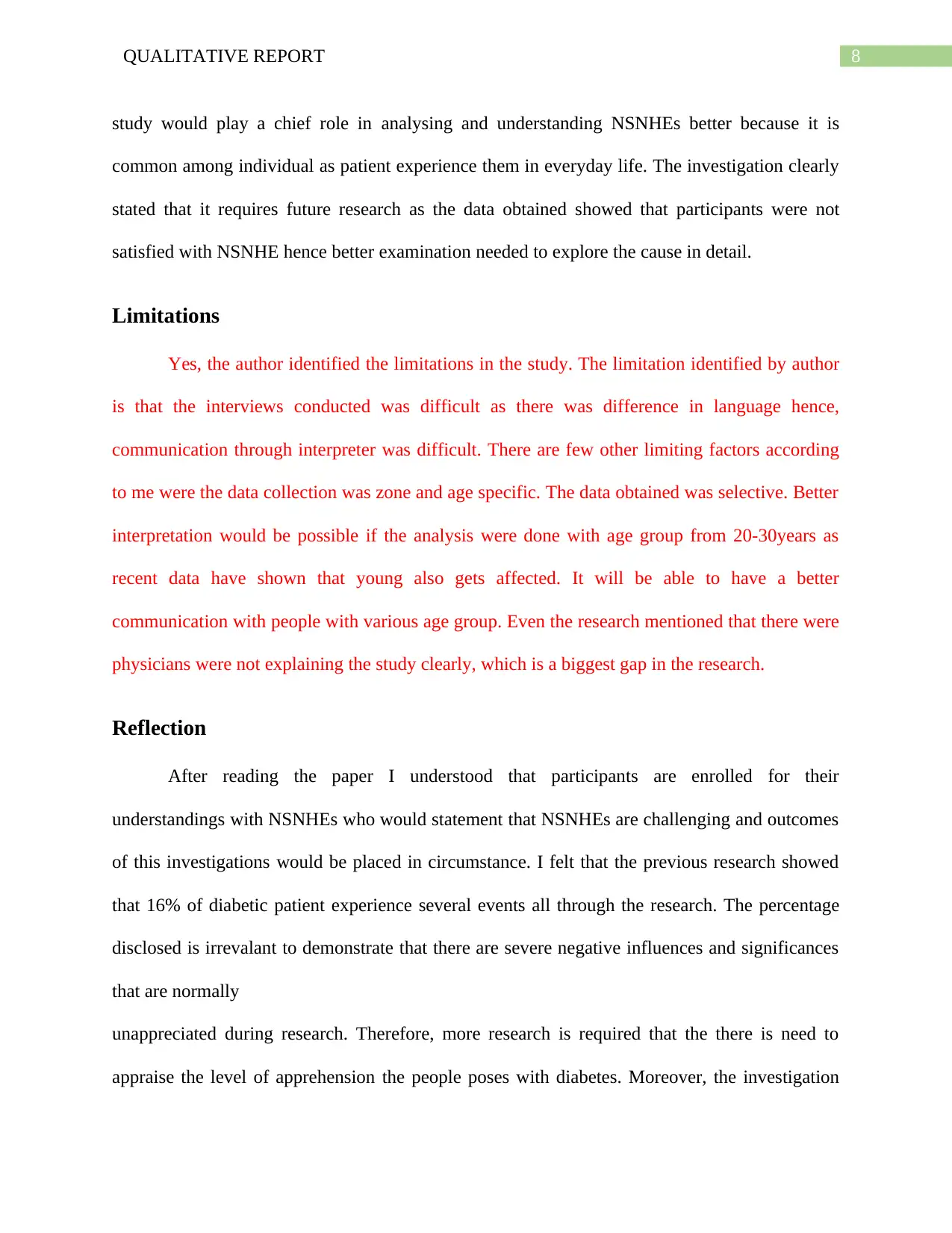
study would play a chief role in analysing and understanding NSNHEs better because it is
common among individual as patient experience them in everyday life. The investigation clearly
stated that it requires future research as the data obtained showed that participants were not
satisfied with NSNHE hence better examination needed to explore the cause in detail.
Limitations
Yes, the author identified the limitations in the study. The limitation identified by author
is that the interviews conducted was difficult as there was difference in language hence,
communication through interpreter was difficult. There are few other limiting factors according
to me were the data collection was zone and age specific. The data obtained was selective. Better
interpretation would be possible if the analysis were done with age group from 20-30years as
recent data have shown that young also gets affected. It will be able to have a better
communication with people with various age group. Even the research mentioned that there were
physicians were not explaining the study clearly, which is a biggest gap in the research.
Reflection
After reading the paper I understood that participants are enrolled for their
understandings with NSNHEs who would statement that NSNHEs are challenging and outcomes
of this investigations would be placed in circumstance. I felt that the previous research showed
that 16% of diabetic patient experience several events all through the research. The percentage
disclosed is irrevalant to demonstrate that there are severe negative influences and significances
that are normally
unappreciated during research. Therefore, more research is required that the there is need to
appraise the level of apprehension the people poses with diabetes. Moreover, the investigation
study would play a chief role in analysing and understanding NSNHEs better because it is
common among individual as patient experience them in everyday life. The investigation clearly
stated that it requires future research as the data obtained showed that participants were not
satisfied with NSNHE hence better examination needed to explore the cause in detail.
Limitations
Yes, the author identified the limitations in the study. The limitation identified by author
is that the interviews conducted was difficult as there was difference in language hence,
communication through interpreter was difficult. There are few other limiting factors according
to me were the data collection was zone and age specific. The data obtained was selective. Better
interpretation would be possible if the analysis were done with age group from 20-30years as
recent data have shown that young also gets affected. It will be able to have a better
communication with people with various age group. Even the research mentioned that there were
physicians were not explaining the study clearly, which is a biggest gap in the research.
Reflection
After reading the paper I understood that participants are enrolled for their
understandings with NSNHEs who would statement that NSNHEs are challenging and outcomes
of this investigations would be placed in circumstance. I felt that the previous research showed
that 16% of diabetic patient experience several events all through the research. The percentage
disclosed is irrevalant to demonstrate that there are severe negative influences and significances
that are normally
unappreciated during research. Therefore, more research is required that the there is need to
appraise the level of apprehension the people poses with diabetes. Moreover, the investigation
⊘ This is a preview!⊘
Do you want full access?
Subscribe today to unlock all pages.
Trusted by 1+ million students worldwide
9QUALITATIVE REPORT
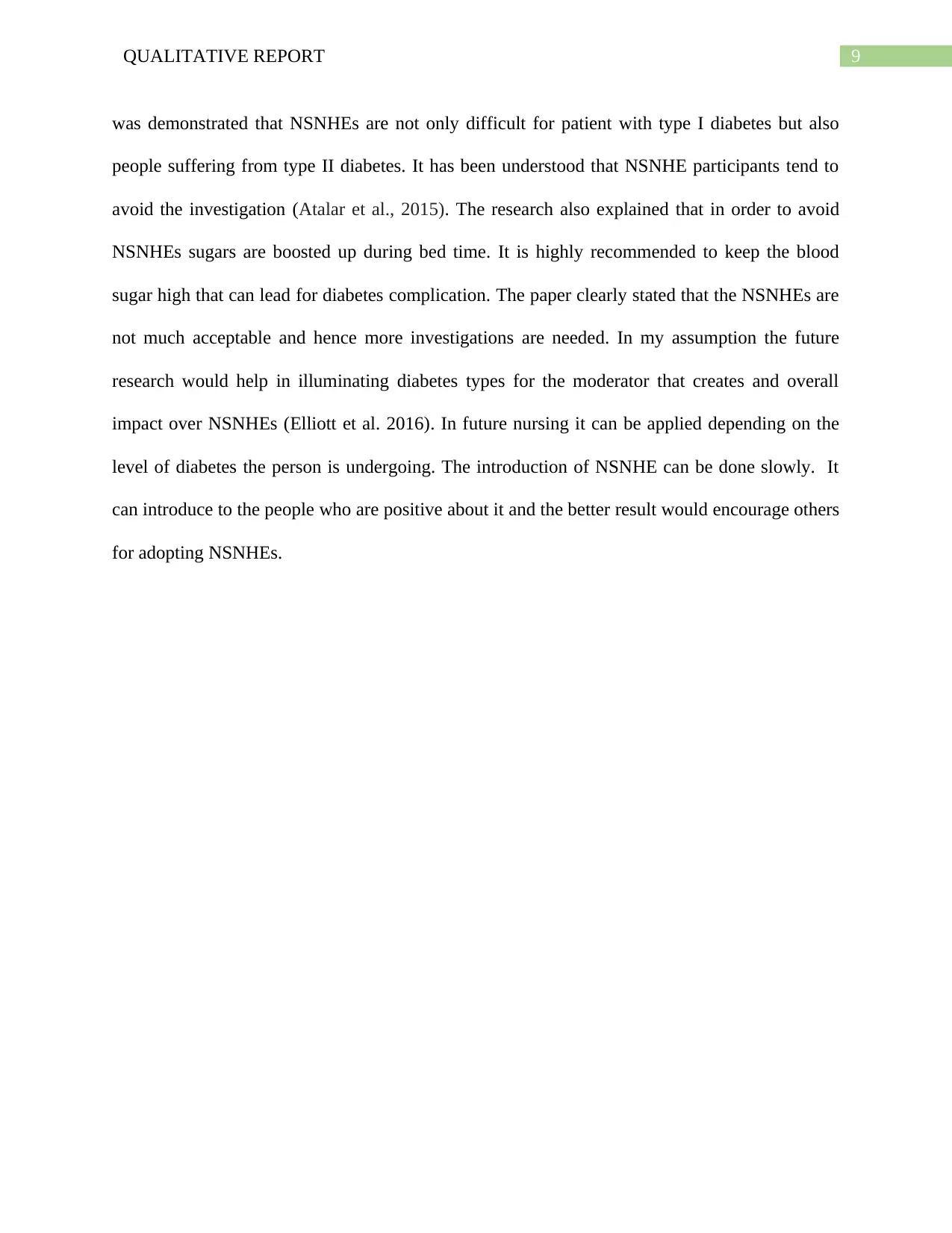
was demonstrated that NSNHEs are not only difficult for patient with type I diabetes but also
people suffering from type II diabetes. It has been understood that NSNHE participants tend to
avoid the investigation (Atalar et al., 2015). The research also explained that in order to avoid
NSNHEs sugars are boosted up during bed time. It is highly recommended to keep the blood
sugar high that can lead for diabetes complication. The paper clearly stated that the NSNHEs are
not much acceptable and hence more investigations are needed. In my assumption the future
research would help in illuminating diabetes types for the moderator that creates and overall
impact over NSNHEs (Elliott et al. 2016). In future nursing it can be applied depending on the
level of diabetes the person is undergoing. The introduction of NSNHE can be done slowly. It
can introduce to the people who are positive about it and the better result would encourage others
for adopting NSNHEs.
was demonstrated that NSNHEs are not only difficult for patient with type I diabetes but also
people suffering from type II diabetes. It has been understood that NSNHE participants tend to
avoid the investigation (Atalar et al., 2015). The research also explained that in order to avoid
NSNHEs sugars are boosted up during bed time. It is highly recommended to keep the blood
sugar high that can lead for diabetes complication. The paper clearly stated that the NSNHEs are
not much acceptable and hence more investigations are needed. In my assumption the future
research would help in illuminating diabetes types for the moderator that creates and overall
impact over NSNHEs (Elliott et al. 2016). In future nursing it can be applied depending on the
level of diabetes the person is undergoing. The introduction of NSNHE can be done slowly. It
can introduce to the people who are positive about it and the better result would encourage others
for adopting NSNHEs.
Paraphrase This Document
Need a fresh take? Get an instant paraphrase of this document with our AI Paraphraser
10QUALITATIVE REPORT
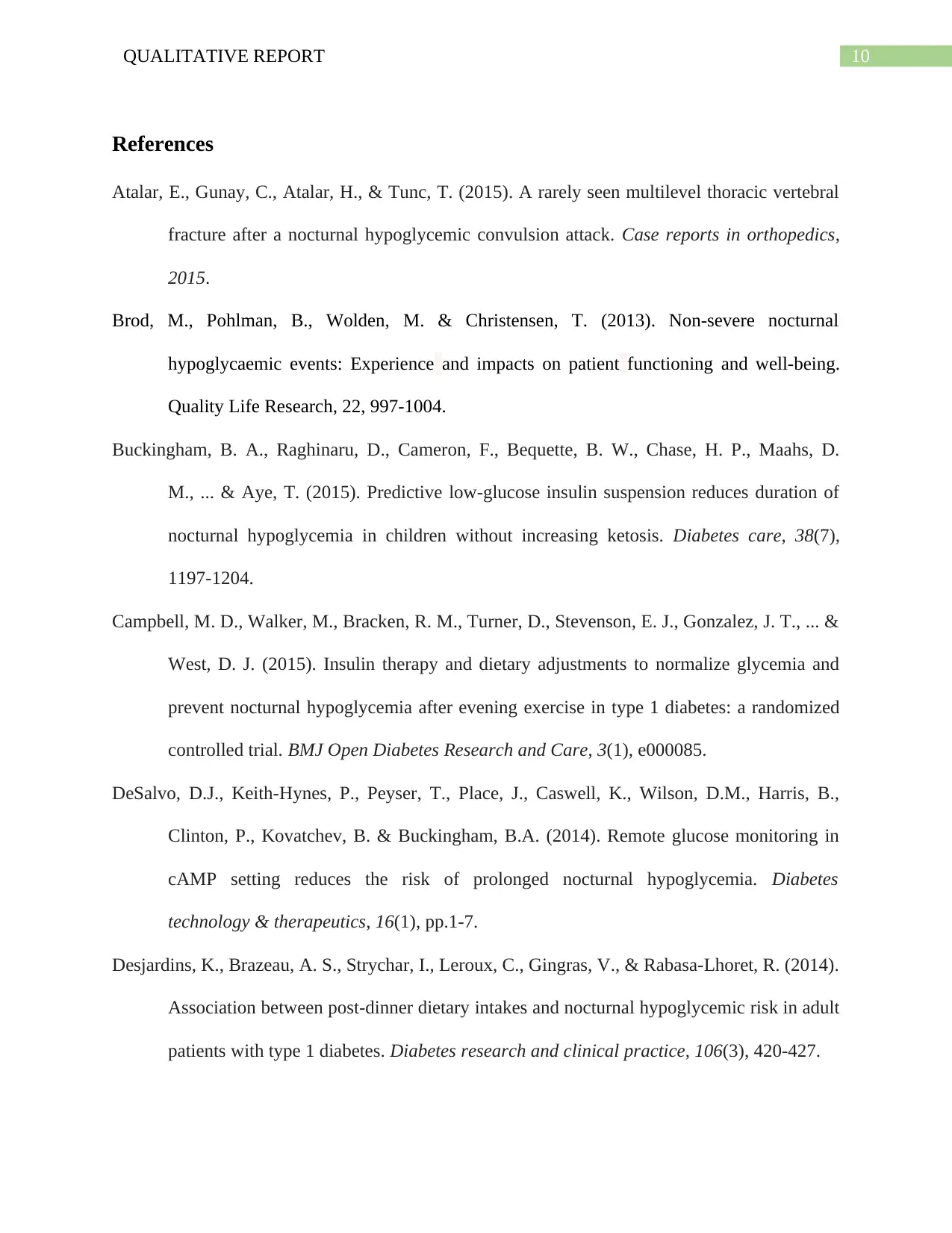
References
Atalar, E., Gunay, C., Atalar, H., & Tunc, T. (2015). A rarely seen multilevel thoracic vertebral
fracture after a nocturnal hypoglycemic convulsion attack. Case reports in orthopedics,
2015.
Brod, M., Pohlman, B., Wolden, M. & Christensen, T. (2013). Non-severe nocturnal
hypoglycaemic events: Experience and impacts on patient functioning and well-being.
Quality Life Research, 22, 997-1004.
Buckingham, B. A., Raghinaru, D., Cameron, F., Bequette, B. W., Chase, H. P., Maahs, D.
M., ... & Aye, T. (2015). Predictive low-glucose insulin suspension reduces duration of
nocturnal hypoglycemia in children without increasing ketosis. Diabetes care, 38(7),
1197-1204.
Campbell, M. D., Walker, M., Bracken, R. M., Turner, D., Stevenson, E. J., Gonzalez, J. T., ... &
West, D. J. (2015). Insulin therapy and dietary adjustments to normalize glycemia and
prevent nocturnal hypoglycemia after evening exercise in type 1 diabetes: a randomized
controlled trial. BMJ Open Diabetes Research and Care, 3(1), e000085.
DeSalvo, D.J., Keith-Hynes, P., Peyser, T., Place, J., Caswell, K., Wilson, D.M., Harris, B.,
Clinton, P., Kovatchev, B. & Buckingham, B.A. (2014). Remote glucose monitoring in
cAMP setting reduces the risk of prolonged nocturnal hypoglycemia. Diabetes
technology & therapeutics, 16(1), pp.1-7.
Desjardins, K., Brazeau, A. S., Strychar, I., Leroux, C., Gingras, V., & Rabasa-Lhoret, R. (2014).
Association between post-dinner dietary intakes and nocturnal hypoglycemic risk in adult
patients with type 1 diabetes. Diabetes research and clinical practice, 106(3), 420-427.
References
Atalar, E., Gunay, C., Atalar, H., & Tunc, T. (2015). A rarely seen multilevel thoracic vertebral
fracture after a nocturnal hypoglycemic convulsion attack. Case reports in orthopedics,
2015.
Brod, M., Pohlman, B., Wolden, M. & Christensen, T. (2013). Non-severe nocturnal
hypoglycaemic events: Experience and impacts on patient functioning and well-being.
Quality Life Research, 22, 997-1004.
Buckingham, B. A., Raghinaru, D., Cameron, F., Bequette, B. W., Chase, H. P., Maahs, D.
M., ... & Aye, T. (2015). Predictive low-glucose insulin suspension reduces duration of
nocturnal hypoglycemia in children without increasing ketosis. Diabetes care, 38(7),
1197-1204.
Campbell, M. D., Walker, M., Bracken, R. M., Turner, D., Stevenson, E. J., Gonzalez, J. T., ... &
West, D. J. (2015). Insulin therapy and dietary adjustments to normalize glycemia and
prevent nocturnal hypoglycemia after evening exercise in type 1 diabetes: a randomized
controlled trial. BMJ Open Diabetes Research and Care, 3(1), e000085.
DeSalvo, D.J., Keith-Hynes, P., Peyser, T., Place, J., Caswell, K., Wilson, D.M., Harris, B.,
Clinton, P., Kovatchev, B. & Buckingham, B.A. (2014). Remote glucose monitoring in
cAMP setting reduces the risk of prolonged nocturnal hypoglycemia. Diabetes
technology & therapeutics, 16(1), pp.1-7.
Desjardins, K., Brazeau, A. S., Strychar, I., Leroux, C., Gingras, V., & Rabasa-Lhoret, R. (2014).
Association between post-dinner dietary intakes and nocturnal hypoglycemic risk in adult
patients with type 1 diabetes. Diabetes research and clinical practice, 106(3), 420-427.
11QUALITATIVE REPORT
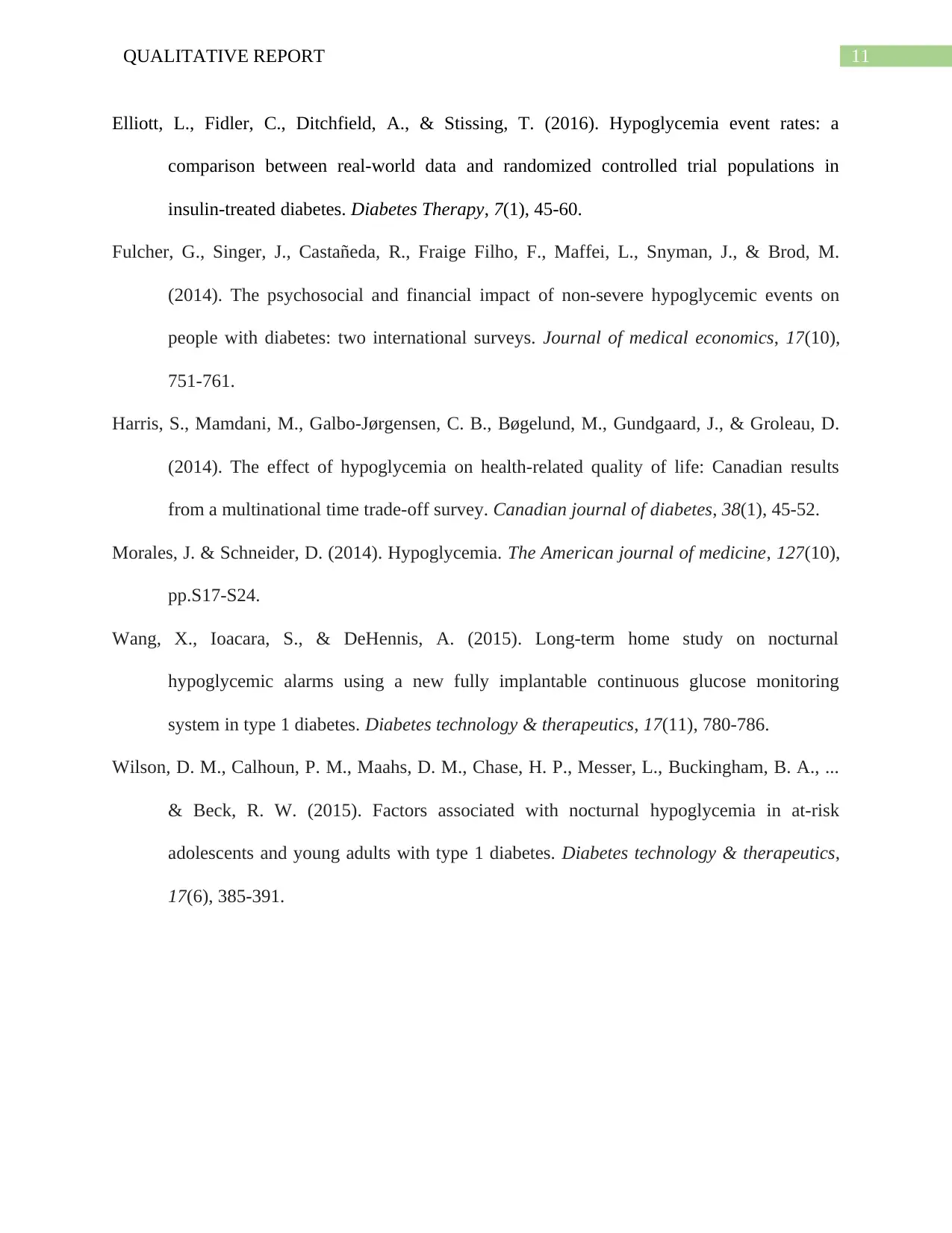
Elliott, L., Fidler, C., Ditchfield, A., & Stissing, T. (2016). Hypoglycemia event rates: a
comparison between real-world data and randomized controlled trial populations in
insulin-treated diabetes. Diabetes Therapy, 7(1), 45-60.
Fulcher, G., Singer, J., Castañeda, R., Fraige Filho, F., Maffei, L., Snyman, J., & Brod, M.
(2014). The psychosocial and financial impact of non-severe hypoglycemic events on
people with diabetes: two international surveys. Journal of medical economics, 17(10),
751-761.
Harris, S., Mamdani, M., Galbo-Jørgensen, C. B., Bøgelund, M., Gundgaard, J., & Groleau, D.
(2014). The effect of hypoglycemia on health-related quality of life: Canadian results
from a multinational time trade-off survey. Canadian journal of diabetes, 38(1), 45-52.
Morales, J. & Schneider, D. (2014). Hypoglycemia. The American journal of medicine, 127(10),
pp.S17-S24.
Wang, X., Ioacara, S., & DeHennis, A. (2015). Long-term home study on nocturnal
hypoglycemic alarms using a new fully implantable continuous glucose monitoring
system in type 1 diabetes. Diabetes technology & therapeutics, 17(11), 780-786.
Wilson, D. M., Calhoun, P. M., Maahs, D. M., Chase, H. P., Messer, L., Buckingham, B. A., ...
& Beck, R. W. (2015). Factors associated with nocturnal hypoglycemia in at-risk
adolescents and young adults with type 1 diabetes. Diabetes technology & therapeutics,
17(6), 385-391.
Elliott, L., Fidler, C., Ditchfield, A., & Stissing, T. (2016). Hypoglycemia event rates: a
comparison between real-world data and randomized controlled trial populations in
insulin-treated diabetes. Diabetes Therapy, 7(1), 45-60.
Fulcher, G., Singer, J., Castañeda, R., Fraige Filho, F., Maffei, L., Snyman, J., & Brod, M.
(2014). The psychosocial and financial impact of non-severe hypoglycemic events on
people with diabetes: two international surveys. Journal of medical economics, 17(10),
751-761.
Harris, S., Mamdani, M., Galbo-Jørgensen, C. B., Bøgelund, M., Gundgaard, J., & Groleau, D.
(2014). The effect of hypoglycemia on health-related quality of life: Canadian results
from a multinational time trade-off survey. Canadian journal of diabetes, 38(1), 45-52.
Morales, J. & Schneider, D. (2014). Hypoglycemia. The American journal of medicine, 127(10),
pp.S17-S24.
Wang, X., Ioacara, S., & DeHennis, A. (2015). Long-term home study on nocturnal
hypoglycemic alarms using a new fully implantable continuous glucose monitoring
system in type 1 diabetes. Diabetes technology & therapeutics, 17(11), 780-786.
Wilson, D. M., Calhoun, P. M., Maahs, D. M., Chase, H. P., Messer, L., Buckingham, B. A., ...
& Beck, R. W. (2015). Factors associated with nocturnal hypoglycemia in at-risk
adolescents and young adults with type 1 diabetes. Diabetes technology & therapeutics,
17(6), 385-391.
⊘ This is a preview!⊘
Do you want full access?
Subscribe today to unlock all pages.
Trusted by 1+ million students worldwide

1 out of 13


Related Documents


Your All-in-One AI-Powered Toolkit for Academic Success.
+13062052269
info@desklib.com
Available 24*7 on WhatsApp / Email
![[object Object]](/_next/static/media/star-bottom.7253800d.svg)
Unlock your academic potential
Copyright © 2020–2026 A2Z Services. All Rights Reserved. Developed and managed by ZUCOL.