North Vancouver Tourism: Social Capital Strategy Report
VerifiedAdded on 2023/01/20
|9
|3030
|23
Report
AI Summary
This report, a strategy meeting plan for North Vancouver, focuses on building bonding and bridging social capital to enhance tourism competitiveness and sustainability. It examines internal stakeholders like government departments and tourism organizations, emphasizing strategies to foster trust, reciprocity, and cooperation. The report conducts a SWOT analysis, highlighting strengths such as rich heritage and outdoor activities, opportunities like a well-known reputation, weaknesses like inconvenient public transit, and threats like intense competition. It then delves into the importance of trust, reciprocity, and cooperation in bonding social capital, recommending effective marketing communication, stakeholder involvement, and a diverse approach to represent the community. Regarding bridging social capital, the report suggests leveraging consultants to connect tourism members with the local government and ensuring all stakeholders are considered for reciprocity and cooperation. The conclusion underscores the critical role of social capital in tourism strategy implementation and evaluation, recommending strategies to strengthen trust, reciprocity, and cooperation within North Vancouver's tourism planning process.
Introduction
This document is a report - Strategy Meeting Plan for North Vancouver. It mainly talks
about the content of bonding capital and bridging social capital in terms of internal
stakeholders such as government departments and tourism organizations. The purpose of
this plan is to provide strategies regarding how to build trust, achieve reciprocity and make
cooperation among tourism members and the government representatives to enhance
destination competitiveness and sustainability in tourism in North Vancouver.
The North Shore is more than just an amazing backdrop for one of the world’s most scenic
cities. It is tied with life, wild and urban. It provides visitors with the chance to spend the
morning skiing or boarding, and the afternoon to enjoy golf. In addition, it is the best
destination for water lovers; just head down from anywhere and people are able to hit the
ocean (City of North Vancouver, n.d.). With the natural benefits and humanity, tourism is
one of the most influential industries in North Vancouver.
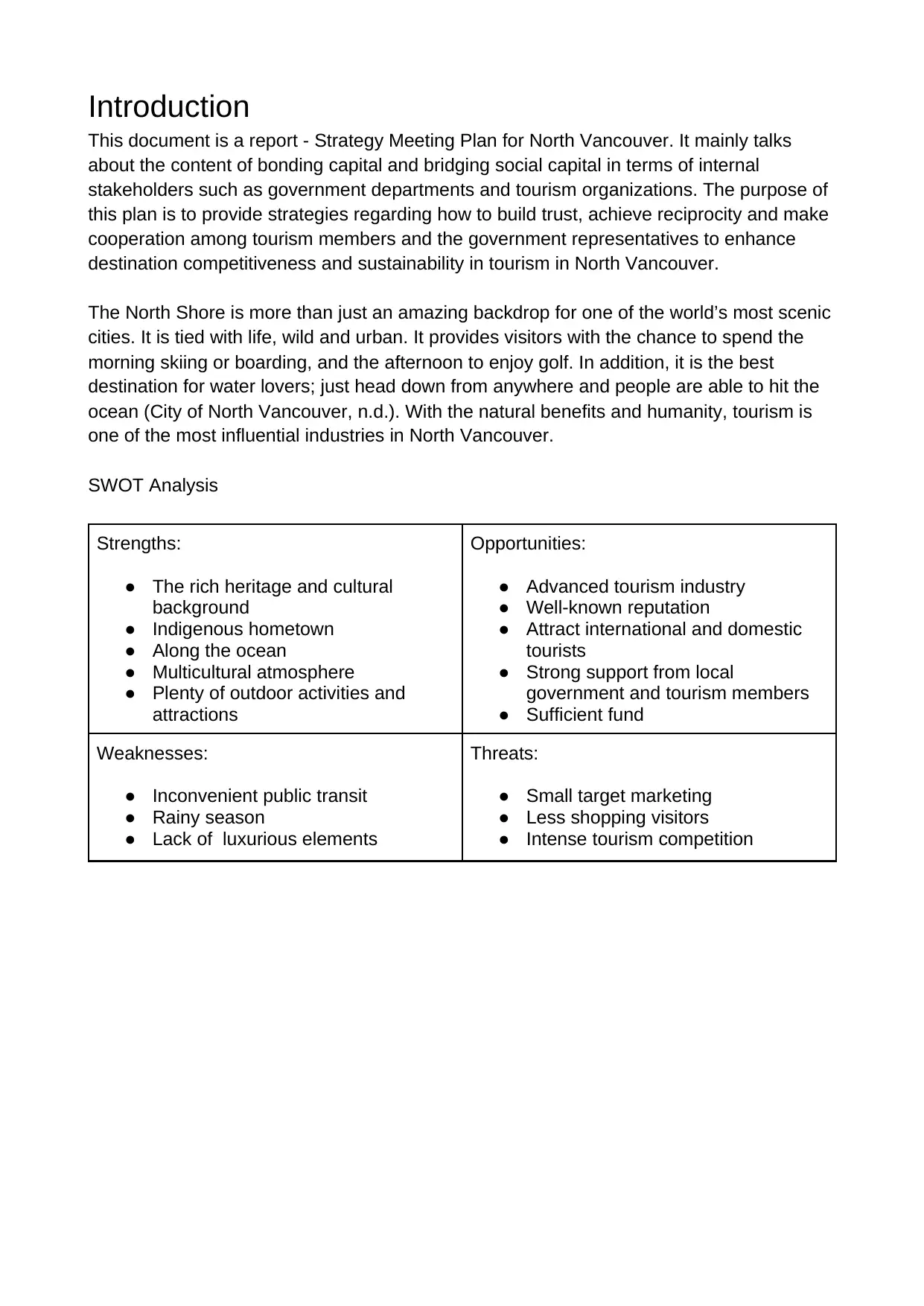
SWOT Analysis
Strengths:
● The rich heritage and cultural
background
● Indigenous hometown
● Along the ocean
● Multicultural atmosphere
● Plenty of outdoor activities and
attractions
Opportunities:
● Advanced tourism industry
● Well-known reputation
● Attract international and domestic
tourists
● Strong support from local
government and tourism members
● Sufficient fund
Weaknesses:
● Inconvenient public transit
● Rainy season
● Lack of luxurious elements
Threats:
● Small target marketing
● Less shopping visitors
● Intense tourism competition
This document is a report - Strategy Meeting Plan for North Vancouver. It mainly talks
about the content of bonding capital and bridging social capital in terms of internal
stakeholders such as government departments and tourism organizations. The purpose of
this plan is to provide strategies regarding how to build trust, achieve reciprocity and make
cooperation among tourism members and the government representatives to enhance
destination competitiveness and sustainability in tourism in North Vancouver.
The North Shore is more than just an amazing backdrop for one of the world’s most scenic
cities. It is tied with life, wild and urban. It provides visitors with the chance to spend the
morning skiing or boarding, and the afternoon to enjoy golf. In addition, it is the best
destination for water lovers; just head down from anywhere and people are able to hit the
ocean (City of North Vancouver, n.d.). With the natural benefits and humanity, tourism is
one of the most influential industries in North Vancouver.
SWOT Analysis
Strengths:
● The rich heritage and cultural
background
● Indigenous hometown
● Along the ocean
● Multicultural atmosphere
● Plenty of outdoor activities and
attractions
Opportunities:
● Advanced tourism industry
● Well-known reputation
● Attract international and domestic
tourists
● Strong support from local
government and tourism members
● Sufficient fund
Weaknesses:
● Inconvenient public transit
● Rainy season
● Lack of luxurious elements
Threats:
● Small target marketing
● Less shopping visitors
● Intense tourism competition

Paraphrase This Document
Need a fresh take? Get an instant paraphrase of this document with our AI Paraphraser
Bonding Social Capital
Trust
According to Soulard et al. (2018), the presence of trust among stakeholders appears to
be the starting point of bonding social capital. When stakeholders are or feel included in
the planning process and community-based participation, it facilitates the trust between
different stakeholders. In contrast, there is a significant decrease in trust when
stakeholders are not given any opportunities to express their opinions.
The marketing employees are responsible to span the boundary of the organization and
interact with external stakeholders (Ennz, 2010). Therefore, for the City of North
Vancouver to sufficiently utilize social capital within tourism, the initial step is to build
trusting relationships with stakeholders. To achieve this, at the most basic level, the City of
North Vancouver should perform effective marketing communication to the stakeholders
about the programs, services, and resources they provide, allowing the stakeholders to
have access to adequate information such as what services are available, how to obtain
additional information or follow up, and the reason why the plan is necessary. In addition,
the City of North Vancouver should get stakeholders involved in the planning process,
since stakeholders seek a channel to voice their opinions, especially when they are and
will be directly impacted by the changes. Another advantage of this is that they can feel
empowered (Soulard et al. 2018).
To be specific, the City of North Vancouver should perform a public consultation for their
opinions before the start of the project. This can be taken in various forms, such as
surveys, interviews, and council meetings. The City of North Vancouver can encourage
stakeholders to participate in decision-making to make them feel empowered, resulting in
an increase in trust. Other essential stakeholder information includes the plans for
continuous improvements, expansions, new technologies and projected future demand
(Ennz, 2010). The development of trust relationships can help defuse a potentially serious
conflict as well (Soulard et al. 2018).
Reciprocity
When bonding social capital, reciprocity helps make sure that there is a sense of
fairness involved. For effective reciprocity, the community must know that diverse people
from the community are represented in their tourism industry (Soulard et al., 2018). The
City of North Vancouver currently addresses reciprocity while bonding social capital, but
there are more approaches that the city could use. Vancouver’s North Shore (n.d.) lists its
diversity programs online, including the arts, museums, and Indigenous peoples. The
mention of Indigenous peoples is a strong step for reciprocity in bonding social capital.
However, other groups of people from the community are not mentioned in their approach.
The current approach for tourism in the City of North Vancouver is to focus on “a brand
identity that can promote wilderness and urban experiences alike” (Loki Creative, n.d.).
This approach will note the perception of reciprocity from bonding. To better address this
part of social capital, the City of North Vancouver should better represent the wide
Trust
According to Soulard et al. (2018), the presence of trust among stakeholders appears to
be the starting point of bonding social capital. When stakeholders are or feel included in
the planning process and community-based participation, it facilitates the trust between
different stakeholders. In contrast, there is a significant decrease in trust when
stakeholders are not given any opportunities to express their opinions.
The marketing employees are responsible to span the boundary of the organization and
interact with external stakeholders (Ennz, 2010). Therefore, for the City of North
Vancouver to sufficiently utilize social capital within tourism, the initial step is to build
trusting relationships with stakeholders. To achieve this, at the most basic level, the City of
North Vancouver should perform effective marketing communication to the stakeholders
about the programs, services, and resources they provide, allowing the stakeholders to
have access to adequate information such as what services are available, how to obtain
additional information or follow up, and the reason why the plan is necessary. In addition,
the City of North Vancouver should get stakeholders involved in the planning process,
since stakeholders seek a channel to voice their opinions, especially when they are and
will be directly impacted by the changes. Another advantage of this is that they can feel
empowered (Soulard et al. 2018).
To be specific, the City of North Vancouver should perform a public consultation for their
opinions before the start of the project. This can be taken in various forms, such as
surveys, interviews, and council meetings. The City of North Vancouver can encourage
stakeholders to participate in decision-making to make them feel empowered, resulting in
an increase in trust. Other essential stakeholder information includes the plans for
continuous improvements, expansions, new technologies and projected future demand
(Ennz, 2010). The development of trust relationships can help defuse a potentially serious
conflict as well (Soulard et al. 2018).
Reciprocity
When bonding social capital, reciprocity helps make sure that there is a sense of
fairness involved. For effective reciprocity, the community must know that diverse people
from the community are represented in their tourism industry (Soulard et al., 2018). The
City of North Vancouver currently addresses reciprocity while bonding social capital, but
there are more approaches that the city could use. Vancouver’s North Shore (n.d.) lists its
diversity programs online, including the arts, museums, and Indigenous peoples. The
mention of Indigenous peoples is a strong step for reciprocity in bonding social capital.
However, other groups of people from the community are not mentioned in their approach.
The current approach for tourism in the City of North Vancouver is to focus on “a brand
identity that can promote wilderness and urban experiences alike” (Loki Creative, n.d.).
This approach will note the perception of reciprocity from bonding. To better address this
part of social capital, the City of North Vancouver should better represent the wide
diversity of people who live in the area. If they are not represented, then the sense of
reciprocity in the community cannot be achieved. The tourism industry in the City of North
Vancouver would then be more effective in its approach. This approach would also help
the ethics of the City of North Vancouver's tourism. Ethics are an important part of creating
trust with the local community. However, the organization must build and be responsible
for its code of conduct, not the individual people in the organization (Enz, 2010). Having a
more diverse approach to tourism then helps the City of North Vancouver represent the
ethics of all its citizens.
Cooperation
The next aspect that should be considered when bonding social capital in a region
is cooperation. According to Soulard et al. (2018), cooperation happens when the region
works together or with other regions to help improve its tourism in bonding social capital.
The cooperation in the City of North Vancouver is currently very strong. The City of North
Vancouver (n.d.) has put other organizations in charge of its local tourism. First, the North
Shore Tourism Association plans activities throughout the community and helps create an
identity for the region (Vancouver’s North Shore, n.d.). Specific parts of the community
also have their own approaches to tourism. For example, Lower Lonsdale Business
Improvement Association (n.d.) represents the Lower Lonsdale area and the shops in that
area. These organizations also work together with Loki Creative to help create a larger
identity for North Vancouver (Loki Creative, n.d.). These organizations then represent that
the City of North Vancouver has a strong strategy to encourage cooperation in the
community. While the City of North Vancouver’s approach to cooperation in bonding social
capital is strong, some improvements could still be made. The government is not
represented in the local tourism industry, and there do not appear to be any community
organizers who add to the local cooperation. Any organization includes various
stakeholders, such as local communities, competitors, unions, and activists, but the only
groups represented in the City of North Vancouver’s tourism industry are companies (Enz,
2010). One recommendation would then be to encourage the local government to act as a
connection between these other groups. This approach would create a stronger feeling of
cooperation in the City of North Vancouver. Another recommendation would be to include
community outreach in the tourism industry.
Bridging Social Capital
Bridging social capital consists of social components that link one network with other
networks, organizations, and government departments (Soulard et al., 2018). For example,
the same informal groups invite the state tourism director to decide what resources could
be used to improve the group’s marketing effectiveness.
Trust plays a pivotal role in collaborating with different interest groups, industry members
and governmental entities. It helps build connections between different stakeholders and
push conversation regarding important issues which affect the different groups.
reciprocity in the community cannot be achieved. The tourism industry in the City of North
Vancouver would then be more effective in its approach. This approach would also help
the ethics of the City of North Vancouver's tourism. Ethics are an important part of creating
trust with the local community. However, the organization must build and be responsible
for its code of conduct, not the individual people in the organization (Enz, 2010). Having a
more diverse approach to tourism then helps the City of North Vancouver represent the
ethics of all its citizens.
Cooperation
The next aspect that should be considered when bonding social capital in a region
is cooperation. According to Soulard et al. (2018), cooperation happens when the region
works together or with other regions to help improve its tourism in bonding social capital.
The cooperation in the City of North Vancouver is currently very strong. The City of North
Vancouver (n.d.) has put other organizations in charge of its local tourism. First, the North
Shore Tourism Association plans activities throughout the community and helps create an
identity for the region (Vancouver’s North Shore, n.d.). Specific parts of the community
also have their own approaches to tourism. For example, Lower Lonsdale Business
Improvement Association (n.d.) represents the Lower Lonsdale area and the shops in that
area. These organizations also work together with Loki Creative to help create a larger
identity for North Vancouver (Loki Creative, n.d.). These organizations then represent that
the City of North Vancouver has a strong strategy to encourage cooperation in the
community. While the City of North Vancouver’s approach to cooperation in bonding social
capital is strong, some improvements could still be made. The government is not
represented in the local tourism industry, and there do not appear to be any community
organizers who add to the local cooperation. Any organization includes various
stakeholders, such as local communities, competitors, unions, and activists, but the only
groups represented in the City of North Vancouver’s tourism industry are companies (Enz,
2010). One recommendation would then be to encourage the local government to act as a
connection between these other groups. This approach would create a stronger feeling of
cooperation in the City of North Vancouver. Another recommendation would be to include
community outreach in the tourism industry.
Bridging Social Capital
Bridging social capital consists of social components that link one network with other
networks, organizations, and government departments (Soulard et al., 2018). For example,
the same informal groups invite the state tourism director to decide what resources could
be used to improve the group’s marketing effectiveness.
Trust plays a pivotal role in collaborating with different interest groups, industry members
and governmental entities. It helps build connections between different stakeholders and
push conversation regarding important issues which affect the different groups.
⊘ This is a preview!⊘
Do you want full access?
Subscribe today to unlock all pages.

Trusted by 1+ million students worldwide
Consultants are a key element in bridging capital to associate tourism industry members
with government representatives. Small Planet Consulting INC. (SPC) is a tourism
consulting company, providing suggestions on tourism development, management and
marketing to governments, development agencies, NGOs, communities and indigenous
governments and groups in North Vancouver (go2HR, n.d.). SPC has rich experience in
specialty tourism in terms of indigenous, nature, culture, community-based, horticultural
and agricultural tourism. It is recommended that SPC could be used as a bridge to connect
tourism members in North Vancouver with the local government to discuss sustainability
and effectiveness.
By implementing experienced consulting bridges, the trust could be naturally built between
tourism operators and the government departments; thus, the stakeholders’ motivation is
more likely to be ensured, the relevance of the objectives could be achieved, and the
obstacles with the plan could be decreased. As a result, a consensus of opinion could be
achieved.
Reciprocity
Reciprocity is the feeling of stakeholders about the linkage and connection with region and
industry segment (Soulard et al., 2018). When stakeholders feel they are excluded from
the proposed plan, reciprocity decreases (Soulard et al., 2018). Specifically, the
stakeholders living in the rural area believe that the benefits and efforts of the region and
state are focusing on the rural area, while the stakeholders living in the coastal area
indicate that the people in rural areas are self-centred (Soulard et al., 2018). This
deteriorates the stakeholder’s relation between rural and coastal and as well as the rural
stakeholders’ feeling of exclusion.
The exclusion is the main problem within the reciprocity. It is common that the large
tourism company applies a new regional strategy, but the small tourism company has not
known what the strategy is (Soulard et al., 2018). The lack of linking and connecting for the
small tourism business with the plan creator causes resentment and division among
regions (Soulard et al., 2018). In the meanwhile, some tourism businesses only focus on
survival rather than seeing the business as a whole to benefit the overall region (Soulard
et al., 2018). The exclusion makes some regions fall behind in terms of development
since they are not able to participate in the plan. Hence, it is critical for the city of North
Vancouver to make sure every stakeholder is considered while providing an opportunity for
them to convey opinions and to participate in a plan. Meetings and briefings can be
conducted for mayors and different tourism businesses to share ideas and perspectives
relating to building a new plan and strategy. Also, the future strategy and plan should not
only be promoting the business, but also the region and the state so that people and
stakeholders can feel connected.
In addition, in order to achieve reciprocity, the city of North Vancouver should apply the
perspective of stakeholder view in terms of the process of strategy management. The
with government representatives. Small Planet Consulting INC. (SPC) is a tourism
consulting company, providing suggestions on tourism development, management and
marketing to governments, development agencies, NGOs, communities and indigenous
governments and groups in North Vancouver (go2HR, n.d.). SPC has rich experience in
specialty tourism in terms of indigenous, nature, culture, community-based, horticultural
and agricultural tourism. It is recommended that SPC could be used as a bridge to connect
tourism members in North Vancouver with the local government to discuss sustainability
and effectiveness.
By implementing experienced consulting bridges, the trust could be naturally built between
tourism operators and the government departments; thus, the stakeholders’ motivation is
more likely to be ensured, the relevance of the objectives could be achieved, and the
obstacles with the plan could be decreased. As a result, a consensus of opinion could be
achieved.
Reciprocity
Reciprocity is the feeling of stakeholders about the linkage and connection with region and
industry segment (Soulard et al., 2018). When stakeholders feel they are excluded from
the proposed plan, reciprocity decreases (Soulard et al., 2018). Specifically, the
stakeholders living in the rural area believe that the benefits and efforts of the region and
state are focusing on the rural area, while the stakeholders living in the coastal area
indicate that the people in rural areas are self-centred (Soulard et al., 2018). This
deteriorates the stakeholder’s relation between rural and coastal and as well as the rural
stakeholders’ feeling of exclusion.
The exclusion is the main problem within the reciprocity. It is common that the large
tourism company applies a new regional strategy, but the small tourism company has not
known what the strategy is (Soulard et al., 2018). The lack of linking and connecting for the
small tourism business with the plan creator causes resentment and division among
regions (Soulard et al., 2018). In the meanwhile, some tourism businesses only focus on
survival rather than seeing the business as a whole to benefit the overall region (Soulard
et al., 2018). The exclusion makes some regions fall behind in terms of development
since they are not able to participate in the plan. Hence, it is critical for the city of North
Vancouver to make sure every stakeholder is considered while providing an opportunity for
them to convey opinions and to participate in a plan. Meetings and briefings can be
conducted for mayors and different tourism businesses to share ideas and perspectives
relating to building a new plan and strategy. Also, the future strategy and plan should not
only be promoting the business, but also the region and the state so that people and
stakeholders can feel connected.
In addition, in order to achieve reciprocity, the city of North Vancouver should apply the
perspective of stakeholder view in terms of the process of strategy management. The
Paraphrase This Document
Need a fresh take? Get an instant paraphrase of this document with our AI Paraphraser
stakeholder view is about the stakeholder’s relationship management, although the
stakeholder can come from the external. Having good relationships with stakeholders can
be beneficial from not only the aspect of connecting with other different external resources
more conveniently as stakeholder links to different places and avenues, but also achieving
reciprocity among stakeholders since all stakeholders can be included in a relationship
(Enz, 2010).
Cooperation
Cooperation is an important source of bridging social capital (Soulard et al., 2018). The
city of North Vancouver should make the communities reach out and collaborate more with
other regions and government entities. To be specific, the stakeholders of North
Vancouver needs, and encourage the stakeholders, to branch out, extend their social
network, and make more partnership with a larger scale while the city of North Vancouver
should also protect and embrace the stakeholders with different background and from a
different industry (Soulard et al., 2018). The well-performed cooperation helps overcome
the legislation that threatened to remove the funding (Soulard et al., 2018).
However, the city of North Vancouver should balance different entities. Cooperation
always needs integration. Any plan and strategy implemented by any entity or business
needs approval and support from other sectors and the government. In this, it is
indispensable for the city of North Vancouver to help make the integration among different
entities and agencies and reduce the conflict when proposing new plans, otherwise, it
causes problems to threaten the cooperation (Soulard et al., 2018).
Conclusion
In conclusion, the bridging and bonding social capital play important roles in the
development, implementation, and evaluation of tourism destinations strategic plans. The
more successful the social capital is, the stronger stakeholder support is (Soulard et al.,
2018). To better understand the social capital within tourism, this report has highlighted
several strategies that the City of North Vancouver should implement in their tourism
planning process, so as to increase the three key components of bridging and bonding
social capital, including trust, reciprocity, and cooperation.
In terms of bonding social capital, to build trust among stakeholders, the City of North
Vancouver should empower stakeholders by giving them the opportunity to voice their
opinions. Further, since reciprocity involves a sense of fairness, it is suggested that the
organization should establish a more diverse approach to tourism. This also helps
reinforce organization’s the code of ethics. And to increase cooperation within bonding
social capital, The City of North Vancouver should encourage local governments to act as
a connection between different stakeholders, enabling them to collaborate towards the
goals.
stakeholder can come from the external. Having good relationships with stakeholders can
be beneficial from not only the aspect of connecting with other different external resources
more conveniently as stakeholder links to different places and avenues, but also achieving
reciprocity among stakeholders since all stakeholders can be included in a relationship
(Enz, 2010).
Cooperation
Cooperation is an important source of bridging social capital (Soulard et al., 2018). The
city of North Vancouver should make the communities reach out and collaborate more with
other regions and government entities. To be specific, the stakeholders of North
Vancouver needs, and encourage the stakeholders, to branch out, extend their social
network, and make more partnership with a larger scale while the city of North Vancouver
should also protect and embrace the stakeholders with different background and from a
different industry (Soulard et al., 2018). The well-performed cooperation helps overcome
the legislation that threatened to remove the funding (Soulard et al., 2018).
However, the city of North Vancouver should balance different entities. Cooperation
always needs integration. Any plan and strategy implemented by any entity or business
needs approval and support from other sectors and the government. In this, it is
indispensable for the city of North Vancouver to help make the integration among different
entities and agencies and reduce the conflict when proposing new plans, otherwise, it
causes problems to threaten the cooperation (Soulard et al., 2018).
Conclusion
In conclusion, the bridging and bonding social capital play important roles in the
development, implementation, and evaluation of tourism destinations strategic plans. The
more successful the social capital is, the stronger stakeholder support is (Soulard et al.,
2018). To better understand the social capital within tourism, this report has highlighted
several strategies that the City of North Vancouver should implement in their tourism
planning process, so as to increase the three key components of bridging and bonding
social capital, including trust, reciprocity, and cooperation.
In terms of bonding social capital, to build trust among stakeholders, the City of North
Vancouver should empower stakeholders by giving them the opportunity to voice their
opinions. Further, since reciprocity involves a sense of fairness, it is suggested that the
organization should establish a more diverse approach to tourism. This also helps
reinforce organization’s the code of ethics. And to increase cooperation within bonding
social capital, The City of North Vancouver should encourage local governments to act as
a connection between different stakeholders, enabling them to collaborate towards the
goals.
For bridging social capital, the government can use tourism consulting companies, such as
Small Planet Consulting INC to build connections with other tourism members in North
Vancouver to develop trust with different stakeholders. In addition, lower levels of
reciprocity appear when stakeholders feel excluded from the planning, causing resentment
and division among regions. The City of North Vancouver should strive to connect and
include all stakeholders, applying their perspectives in terms of the process of strategy
management. Last but not least, the City of North Vancouver should expand their network,
resulting in wider, more efficient, integrated cooperation and partnerships.
Small Planet Consulting INC to build connections with other tourism members in North
Vancouver to develop trust with different stakeholders. In addition, lower levels of
reciprocity appear when stakeholders feel excluded from the planning, causing resentment
and division among regions. The City of North Vancouver should strive to connect and
include all stakeholders, applying their perspectives in terms of the process of strategy
management. Last but not least, the City of North Vancouver should expand their network,
resulting in wider, more efficient, integrated cooperation and partnerships.
⊘ This is a preview!⊘
Do you want full access?
Subscribe today to unlock all pages.
Trusted by 1+ million students worldwide
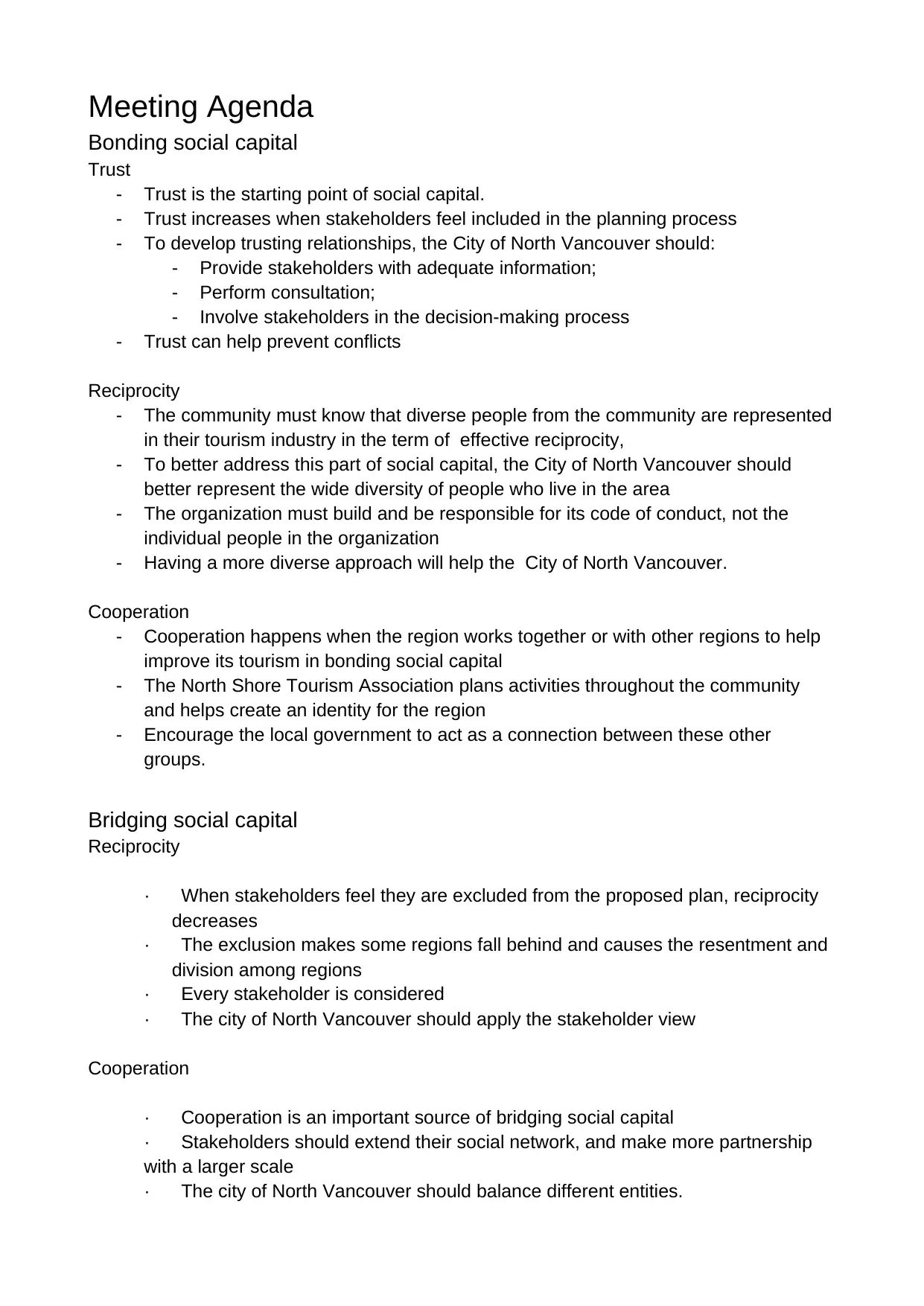
Meeting Agenda
Bonding social capital
Trust
- Trust is the starting point of social capital.
- Trust increases when stakeholders feel included in the planning process
- To develop trusting relationships, the City of North Vancouver should:
- Provide stakeholders with adequate information;
- Perform consultation;
- Involve stakeholders in the decision-making process
- Trust can help prevent conflicts
Reciprocity
- The community must know that diverse people from the community are represented
in their tourism industry in the term of effective reciprocity,
- To better address this part of social capital, the City of North Vancouver should
better represent the wide diversity of people who live in the area
- The organization must build and be responsible for its code of conduct, not the
individual people in the organization
- Having a more diverse approach will help the City of North Vancouver.
Cooperation
- Cooperation happens when the region works together or with other regions to help
improve its tourism in bonding social capital
- The North Shore Tourism Association plans activities throughout the community
and helps create an identity for the region
- Encourage the local government to act as a connection between these other
groups.
Bridging social capital
Reciprocity
· When stakeholders feel they are excluded from the proposed plan, reciprocity
decreases
· The exclusion makes some regions fall behind and causes the resentment and
division among regions
· Every stakeholder is considered
· The city of North Vancouver should apply the stakeholder view
Cooperation
· Cooperation is an important source of bridging social capital
· Stakeholders should extend their social network, and make more partnership
with a larger scale
· The city of North Vancouver should balance different entities.
Bonding social capital
Trust
- Trust is the starting point of social capital.
- Trust increases when stakeholders feel included in the planning process
- To develop trusting relationships, the City of North Vancouver should:
- Provide stakeholders with adequate information;
- Perform consultation;
- Involve stakeholders in the decision-making process
- Trust can help prevent conflicts
Reciprocity
- The community must know that diverse people from the community are represented
in their tourism industry in the term of effective reciprocity,
- To better address this part of social capital, the City of North Vancouver should
better represent the wide diversity of people who live in the area
- The organization must build and be responsible for its code of conduct, not the
individual people in the organization
- Having a more diverse approach will help the City of North Vancouver.
Cooperation
- Cooperation happens when the region works together or with other regions to help
improve its tourism in bonding social capital
- The North Shore Tourism Association plans activities throughout the community
and helps create an identity for the region
- Encourage the local government to act as a connection between these other
groups.
Bridging social capital
Reciprocity
· When stakeholders feel they are excluded from the proposed plan, reciprocity
decreases
· The exclusion makes some regions fall behind and causes the resentment and
division among regions
· Every stakeholder is considered
· The city of North Vancouver should apply the stakeholder view
Cooperation
· Cooperation is an important source of bridging social capital
· Stakeholders should extend their social network, and make more partnership
with a larger scale
· The city of North Vancouver should balance different entities.
Paraphrase This Document
Need a fresh take? Get an instant paraphrase of this document with our AI Paraphraser
Trust
· Trust is a pivotal factor in building relationships between tourism members and
the government representatives
· Consultants could be used as a bridge between tourism members and the
government departments due to its specialty
· SPC has an excellent reputation among tourism consulting companies in North
Vancouver; it could be considered to implement
· Trust is a pivotal factor in building relationships between tourism members and
the government representatives
· Consultants could be used as a bridge between tourism members and the
government departments due to its specialty
· SPC has an excellent reputation among tourism consulting companies in North
Vancouver; it could be considered to implement
References
City of North Vancouver. (n.d.). Tourism. Retrieved from https://www.cnv.org/parks-
recreation-and-culture/tourism.
Soulard, J., Knollenberg, W., Boley, B. B., Perdue, R. R., & McGehee, N. G. (2018). Social
capital and destination strategic planning. Tourism Management, 69, 189–200.
https://doi.org/10.1016/j.tourman.2018.06.011
Enz, C. A. (2010). Hospitality Strategic Management: Concepts and Cases: Vol. 2nd ed.
Loki Creative. (n.d.). Portfolio: Vancouver’s North Shore. Retrieved from
https://www.weareloki.com/portfolio/vancouvers-north-shore/.
Lower Lonsdale Business Improvement Association. (n.d.). Home. Retrieved from
https://theshipyardsdistrict.ca/.
John Wiley & Sons, Inc. [US].
Go2HR. (n.d.). Small planet consulting INC. Company directory. Retrieved from
https://www.go2hr.ca/companies/small-planet-consulting-inc
City of North Vancouver. (n.d.). Tourism. Retrieved from https://www.cnv.org/Parks-
Recreation-and-Culture/Tourism
Vancouver’s North Shore. (n.d.). Home. Retrieved from
https://www.vancouversnorthshore.com/.
City of North Vancouver. (n.d.). Tourism. Retrieved from https://www.cnv.org/parks-
recreation-and-culture/tourism.
Soulard, J., Knollenberg, W., Boley, B. B., Perdue, R. R., & McGehee, N. G. (2018). Social
capital and destination strategic planning. Tourism Management, 69, 189–200.
https://doi.org/10.1016/j.tourman.2018.06.011
Enz, C. A. (2010). Hospitality Strategic Management: Concepts and Cases: Vol. 2nd ed.
Loki Creative. (n.d.). Portfolio: Vancouver’s North Shore. Retrieved from
https://www.weareloki.com/portfolio/vancouvers-north-shore/.
Lower Lonsdale Business Improvement Association. (n.d.). Home. Retrieved from
https://theshipyardsdistrict.ca/.
John Wiley & Sons, Inc. [US].
Go2HR. (n.d.). Small planet consulting INC. Company directory. Retrieved from
https://www.go2hr.ca/companies/small-planet-consulting-inc
City of North Vancouver. (n.d.). Tourism. Retrieved from https://www.cnv.org/Parks-
Recreation-and-Culture/Tourism
Vancouver’s North Shore. (n.d.). Home. Retrieved from
https://www.vancouversnorthshore.com/.
⊘ This is a preview!⊘
Do you want full access?
Subscribe today to unlock all pages.
Trusted by 1+ million students worldwide

1 out of 9


Your All-in-One AI-Powered Toolkit for Academic Success.
+13062052269
info@desklib.com
Available 24*7 on WhatsApp / Email
![[object Object]](/_next/static/media/star-bottom.7253800d.svg)
Unlock your academic potential
Copyright © 2020–2026 A2Z Services. All Rights Reserved. Developed and managed by ZUCOL.